BP Plans To Turn Teesside Into First Green Hydrogen Hub
The title of this post, is the same as that of this article in The Times.
This is the first paragraph.
BP plans to build Britain’s biggest “green hydrogen” facility on Teesside to produce the clean fuel for use in new hydrogen-powered lorries and other transport.
Note.
The plans appear to be ambitious starting with a £100 million investment to build a 60 MW electrolyser by 2025, which would rise to as much as 500 MW by 2030.
The electrolyser will be paired with an upwards of a billion pound one gigawatt facility called H2Teesside, that will produce blue hydrogen.
I think there could be more to this than meets the eye.
Using The Carbon Dioxide Rather than Storing It!
I followed the carbon dioxide pipe from the CF fertiliser plant on Teesside using Google maps after seeing a film about it on the BBC. It goes to the Quorn factory and a massive greenhouse. I do wonder, if BP is talking to other companies, who also have a need for large quantities of good quality carbon dioxide.
One could be an Australian company, called Mineral Carbonation International, who have developed a process to convert carbon dioxide into building products like blocks and plasterboard. MCI won a prize at COP26, so could BP be looking at integrating one of these plants into their complex on Teesside?
The Electrolysers
Will BP be purchasing their electrolysers for green hydrogen from ITM Power in Sheffield?
This press release from ITM Power is entitled 12MW Electrolyser Sale.
The customer is not named, but could this be a starter kit for BP?
Alstom’s Hydrogen Aventras
In Alstom And Eversholt Rail Sign An Agreement For The UK’s First Ever Brand-New Hydrogen Train Fleet, I came to this conclusion.
This modern hydrogen train from Alstom is what is needed.
I also felt there could be three similar trains; electric, battery-electric and hydrogen, which would help operators hedge their bets on what type of traction to use.
Teesside must be one of the more likelier places where the Hydrogen Aventras will be carrying passengers.
I wrote about this possibility in Alstom Hydrogen Aventras And Teesside.
A deal between BP and Alstom would surely be in the interest of both companies.
- Alstom would get a local hydrogen supply.
- BP would get a first sale.
- BP would get excellent publicity and a local demonstration of the possibilities of hydrogen.
It might even be possible to supply the hydrogen by pipeline.
Whitelee Green Hydrogen Facility To Power Public Transport
The title of this post, is the same as that of this article on the BBC.
Some points from the article.
- It will be the country’s largest electrolyser. Is that Scotland or the UK?
- The facility is being built by Scottish Power, ITM Power and BOC.
- Friends of the Earth think it’s wrong and the electricity should be used immediately.
In ScottishPower’s Green Hydrogen Project Looks To Build UK’s Largest Electrolyser, the title says that the Whitelee project will be the UK’s largest electrolyser.
Hydrogen-Powered Ambulance Drives Into Glasgow Ahead Of London Trial
The title of this post, is the same as that of this article on New Atlas.
This is the first paragraph.
Back in February, ULEMCo and industry partners announced plans to design an electric rapid response ambulance for the UK’s NHS Trust that would run on batteries and hydrogen fuel cells. Now, the working prototype has driven into Glasgow to give global leaders attending the UN’s COP26 climate summit a closer look at the technology.
Surely, this is a good application of hydrogen power.
Could they be used in the scenario I proposed in Big London Hospital Was Close To Running Out Of Oxygen?
Hospitals would have an electrolyser, which would produce the following.
- High grade oxygen for the hospital.
- Hydrogen to power the vehicles and especially the ambulances.
Note.
- There would be no oxygen delivery problems.
- The excess hydrogen could be stored to use as an emergency power supply.
- Would it improve the air quality by the hospital?
I have checked with the world’s premier electrolyser company; ITM Power of Sheffield and my idea is feasible.
JCB Signs Green Hydrogen Deal Worth Billions
The title of this post, is the same as that of this article on the BBC.
This is the first two paragraphs.
Construction equipment maker JCB has signed a deal to buy billions of pounds of green hydrogen, defined as hydrogen produced using renewable energy.
The deal means JCB will take 10% of the green hydrogen made by the Australian firm Fortescue Future Industries (FFI).
JCB are certainly going into hydrogen in a big way.
- They have demonstrated hydrogen-powered construction equipment.
- They have developed technology, so that internal combustion engines can run on hydrogen.
- Lord Bamford’s son; Jo bought Wrightbus and company supplied London’s hydrogen buses.
- Ryze, which is mentioned in the article was founded by Jo Bamford.
- JCB have made a strategic investment in electrolyser company; ITM Power.
I can see JCB making more investments in hydrogen.
In terms of green hydrogen production from renewable energy, I can see three areas providing substantial amounts of green hydrogen.
- Australia from solar and electrolysers. Australia has space and sun.
- Africa from solar and electrolysers. Africa has space and sun.
- Waters around the UK from wind and electrolysers.
As ITM Power have the world’s largest electrolyser factory in Sheffield and have recently raised money to build a second one, they could be the big winner in green hydrogen production.
But I can see JCB making hydrogen-powered equipment all over the world and supplying the hydrogen to run it.l
It should also be born in mind, that JCB know how to dominate a market.
ITM Power Raises £250 million
The title of this post, is the same as that of this media release from ITM Power.
There is a also a sub-title.
Manufacturing Expanded To 5GW Per Annum By 2024
ITM Power are certainly going large.
Given the number of plans for electrolysers published around the world, a 5GW annual production is by no means over ambitious.
Linde Commits To Green Hydrogen For Trucks And Becomes H2Accelerate Member
The title of this post, is the same as that of this article on Hydrogen Fuel News.
- Linde have already installed more than two hundred hydrogen filling stations around the world.
- Now, it appears they intend to install a lot more.
Could this give a big stimulus to more hydrogen trucks, buses and other road vehicles?
It should probably be noted that Linde are a shareholder in ITM Power and have ordered several large electrolysers from the Sheffield company.
Shell Starts Up Europe’s Largest PEM Green Hydrogen Electrolyser
The title of this post, is the same as that of this press release from Refhyne.
These are the first three paragraphs.
Europe’s largest PEM hydrogen electrolyser*, today began operations at Shell’s Energy and Chemicals Park Rheinland, producing green hydrogen.
As part of the Refhyne European consortium and with European Commission funding through the Fuel Cells and Hydrogen Joint Undertaking (FCH JU), the fully operational plant is the first to use this technology at such a large scale in a refinery.
Plans are under way to expand capacity of the electrolyser from 10 megawatts to 100 megawatts at the Rheinland site, near Cologne, where Shell also intends to produce sustainable aviation fuel (SAF) using renewable power and biomass in the future. A plant for liquefied renewable natural gas (bio-LNG) is also in development.
It certainly seems a comprehensive green development.
- It will be based on a massive 100 MW electrolyser.
- I estimate that the electrolyser will produce just under 45 tonnes of hydrogen per day.
As ITM Power is part of the Refhyne consortium, the electrolyser is being built in their factory in Sheffield.
This paragraph quotes Shell’s Downstream Director, Huibert Vigeveno .
“Shell wants to become a leading supplier of green hydrogen for industrial and transport customers in Germany,” he added. “We will be involved in the whole process — from power generation, using offshore wind, to hydrogen production and distribution across sectors. We want to be the partner of choice for our customers as we help them decarbonise.”
Shell certainly have green ambitions.
The Story Of ITM Power
The title of this post, is the same as that of this article on H2 View.
The article confirms, that they have the funds to build a second Gigafactory for electrolysers and it would take eighteen months to build.
My view is that after the Anglo-Australian trade deal, that it could be built in Australia, as that country will need a lot of electrolysers to fulfil their hydrogen ambitions.
Hydrogen And The Anglo-Australian Trade Deal
This article on the BBC is entitled UK And Australia In First Post-Brexit Trade Deal.
I can see one very profitable result of this trade deal.
The world has a large and growing need for green hydrogen produced by renewable energy.
Australia is embracing the hydrogen economy and I have posted about Australia hydrogen developments several times.
This post is entitled H2U Eyre Peninsula Gateway Hydrogen Project Begins Largest Green Ammonia Plant and it describes how Australia will convert renewable electricity into liquid green ammonia for export to Japan.
Australia has a lot of sun and can create a lot of green hydrogen and ammonia for South East Asia.
Electrolysers need to be used to convert solar and wind electricity into hydrogen, which would be exported in tankers either as liquid hydrogen or liquid ammonia.
The largest hydrogen electrolyser factory in the world, is owned by ITM Power and is located in Sheffield/Rotherham. It has a capacity to build 1 GW of electrolysers in a year.
Looking at the electrolyser market, I can see the company needing another similar-sized factory.
Australia’s Solar Power Potential
This section in the Wikipedia entry for Solar Power In Australia is called Potential.
These are some points from the section.
- Typically, in the winter months, a square metre of much of Australia receives 4 kWh of insolation per day.
- Some areas in the North receive fifty percent more.
- Australia has the potential to install 179 GW of solar power on roofs across the nation.
Australia used to curse the sun because of all the cancer it brought. Now it could make them the world’s hydrogen powerhouse!
At present ninety percent of Australia’s solar panels are made in China.
But that may not be for ever, if what I wrote in Solar To Hydrogen Efficiency Record Broken By Australian National University Researchers, turns out to lead to an alternative technology to create hydrogen.
An Anglo-Australian Hydrogen Alliance
What better possible place to build a second electrolyser factory is there, than in Australia?
- The Australian economy can use a lot of hydrogen for transport.
- Australia is embracing hydrogen technology.
- Australia is well-placed to export electrolysers to their friends in South East Asia.
- Australia has the sun to produce massive amounts of green hydrogen.
If the UK and Australia developed hydrogen together, it would be good for both countries.
- Australia can develop massive levels of renewable electricity from solar.
- The UK can develop massive levels of renewable electricity from wind and possibly other sources.
- Both countries are researching the ways to create and use hydrogen.
- Both countries could produce hydrogen for nearby economies needing large amounts of hydrogen.
- Many UK and Australian companies operate in both countries.
But above all, we haven’t had a major fall-out with Australia since the Bodyline Tour in 1932-1933.
Do BP And The Germans Have A Cunning Plan For European Energy Domination?
The headline of this post may be slightly tongue in cheek, but I believe that a plan is being hatched.
Preamble
I’ll start with a preamble, where I’ll outline some of the factors behind what may be happening.
Decarbonisation
It is generally accepted by most people that there is a need to decarbonise everything we do.
And large oil companies like Shell, BP and others are starting to move in the same direction.
Hydrogen
Using hydrogen instead of fossil fuels is becoming one of the major routes to decarbonisation.
Hydrogen can be used for the following.
- Provide power for cars, buses, trucks, trains, locomotives and ships.
- Hydrogen can be used in steelmaking instead of coking coal.
- As a chemical feedstock to make ammonia, fertiliser and a large range of petrochemicals.
- I believe that hydrogen could be a viable fuel to power aircraft over thousands of miles.
Hydrogen will become the most common zero-carbon fuel.
Hydrogen And Natural Gas
In many applications hydrogen can replace natural gas, so for large users of natural gas, hydrogen offers a route to decarbonisation.
But hydrogen can also be mixed up to a level of around twenty percent in natural gas for partial decarbonisation of applications like space heating. Most industrial uses, boilers and appliances can be made to work very successfully with this mixture.
I grew up in the 1950s with coal gas, which according to Wikipedia had this composition.
- hydrogen 50%
- methane 35%
- carbon monoxide 10%
- ethylene 5%
- When we changed over in the 1970s, all my appliances were converted.
This is the UK government description of natural gas.
It contains primarily methane, along with small amounts of ethane, butane, pentane, and propane. Natural gas does not contain carbon monoxide. The by-products of burning natural gas are primarily carbon dioxide and water vapour. Natural gas is colourless, tasteless and odourless.
As with the conversion from coal-gas to natural gas, conversion from Natural gas to a hydrogen/natural gas mixture and eventually to hydrogen, will be a relatively painless process.
Note that carbon monoxide is a nasty poison and is not contained in either natural gas or hydrogen.
Green Hydrogen And Electrolysis Of Water
Green hydrogen is hydrogen produced exclusively from renewable energy sources.
Typically green hydrogen is produced by electrolysis of water using electricity produced by hydro, solar, tidal or wind.
The largest factory building electrolysers is owned by ITM Power.
- It is located in Rotherham.
- The factory has the capacity to build 1 GW of electrolysers in a year.
- Typical electrolysers have a capacity of several MW.
Ryze Hydrogen are building an electrolyser at Herne Bay, that will consume 23 MW of solar and wind power and produce ten tonnes of hydrogen per day.
Blue Hydrogen
‘Blue hydrogen is produced through a production process where carbon dioxide is also produced then subsequently captured via carbon capture and storage. In many cases the carbon dioxide is stored in depleted gas fields, of which we have plenty in the North Sea. Over the last few years, research has been ongoing into using the carbon dioxide. Applications in horticulture and agriculture, carbon structures and sustainable aviation fuel are being developed.
Shell have also developed the Shell Blue Hydrogen Process, where the carbon is extracted from methane as carbon dioxide and then stored or used.
CO2 In Greenhouse Horticulture
This paper from The Netherlands is called CO2 In Greenhouse Horticulture.
Read it and you might believe me, when I say, we’ll eat a lot of carbon in the form of tomatoes, salads and soft fruit. We’ll also buy flowers grown in a carbon-dioxide rich atmosphere.
Hydrogen As An Energy Transfer Medium
Every kilogram of natural gas when it burns releases energy, as it does in your boiler or gas hob. So it transfers energy in the form of gas from the gas well or storage tank to your house.
Electricity can also be transferred from the power station to your house using wires instead of pipes.
Hydrogen is being put forward as a means of transferring energy over hundreds of miles.
- Electricity is converted to hydrogen, probably using an electrolyser, which would be powered by zero-carbon electricity.
- The hydrogen is transferred using a steel pipe.
- At the destination, the hydrogen is either distributed to end-users, stored or used in a gas-fired power station, that has been modified to run on hydrogen, to generate electricity.
It sounds inefficient, but it has advantages.
- Long underwater cables have energy losses.
- Electrical connections use a lot of expensive copper.
- Re-use of existing gas pipes is possible.
- Oil and gas companies like BP and their contractors have been laying gas pipes on land and under water for decades.
If hydrogen has a problem as an energy transfer medium, it is that it us difficult to liquify, as this statement from Air Liquide illustrates.
Hydrogen turns into a liquid when it is cooled to a temperature below -252,87 °C. At -252.87°C and 1.013 bar, liquid hydrogen has a density of close to 71 kg/m3. At this pressure, 5 kg of hydrogen can be stored in a 75-liter tank.
To transport, larger quantities of hydrogen by ship, it is probably better to convert the hydrogen into ammonia, which is much easier to handle.
The Germans and others are experimenting with using liquid ammonia to power large ships.
Hydrogen As An Energy Storage Medium
The UK has a comprehensive National Transmission System for natural gas with large amounts of different types of storage.
This section of the Wikipedia entry is entitled Natural Gas Storage and lists ten large storage facilities in salt caverns and depleted onshore gas fields. In addition, several depleted offshore gas fields have been proposed for the storage of natural gas. Rough was used successfully for some years.
I can certainly see a network of hydrogen storage sites being developed both onshore and offshore around the UK.
Iceland
With its large amount of hydro-electric and geothermal energy, Iceland can generate much more electricity, than it needs and has been looking to export it.
The UK is probably the only country close enough to be connected to Iceland to buy some of the country’s surplus electricity.
There has been a proposal called Icelink, that would build an electrical interconnector with a capacity of around a GW between Iceland at the UK.
But the project seems to have stalled since I first heard about it on my trip to Iceland in 2014.
Could the engineering problems just be too difficult?
The Waters Around The Northern Parts Of Great Britain
Look at a map of the UK and particularly Great Britain and there is a massive area of water, which is not short of wind.
Between Norway, Denmark, Germany, The Netherlands, the East Coast of England, the Northern Coasts of Scotland and Iceland, there are only a few islands.
- Faroes
- Orkney
- Shetlands
To be complete we probably must include hundreds of oil and gas rigs and platforms and the Dogger Bank.
- Oil and gas companies probably know most there is to know about these waters.
- Gas pipelines connect the production platforms to terminals at Sullom Voe and along the East Coast from St. Fergus near Aberdeen to Bacton in Norfolk.
- Many of the oil and gas fields are coming to the end of their working lives.
I believe that all this infrastructure could be repurposed to support the offshore wind industry.
The Dutch Are Invading The Dogger Bank
The Dogger Bank sits in the middle of the North Sea.
- It is roughly equidistant from Norway, Denmark, the Netherlands and the UK.
- The Western part is in UK territorial waters.
- The Eastern part is mainly in Dutch territorial waters.
On the UK part, the Dogger Bank Wind Farm is being developed.
- The turbines will be between 78 and 180 miles from the shore.
- It could have a capacity of up to 5 GW.
- It would be connected to East Yorkshire or Teesside.
On their side of the Dogger Bank, the Dutch are proposing the North Sea Wind Power Hub.
- It is a collaboration between the Dutch, Germans, and Danes.
- There have been reports, that up to 110 GW of turbines could be installed.
- It will be connected to the Dogger Bank Wind Farm, as well as The Netherlands.
It is also planned that the connections to the Dogger Bank will create another interconnector between the UK and the Continent.
The Shetland Islands
The Shetland Islands are the only natural islands with a large oil and gas infrastructure in the waters to the North of Great Britain.
They have a large gas and oil terminal at Sullom Voe.
- Oil is transported to the terminal by pipelines and tanker.
- Oil is exported by tanker.
- Gas is imported from oil and gas fields to the West of the islands through the West of Shetland Pipeline.
- The gas-fired Sullom Voe power station provide about 80 MW of power to the islands.
This document on the APSE web site is entitled Future Hydrogen Production In Shetland.
It describes how the Shetland Islands can decarbonise and reposition themselves in the energy industry to be a major producer of hydrogen.
It gives these two facts about carbon emissions in the Shetlands Islands and Scotland.
- Annual per capita CO2 emissions in the Shetland Islands are 17 tonnes.
- In Scotland they are just 5.3 tonnes.
By comparison, the UK average is 5.55 and Qatar is 37.29.
Currently, the annual local market for road, marine and domestic fuel calculated
at around £50 million.
These are the objectives of the Shetland’s plan for future hydrogen production.
- Supply 32TWh of low carbon hydrogen annually, 12% of the expected UK total requirement, by 2050
- Provide more than 3GW of wind generated electrical power to Shetland, the UK grid, generating green hydrogen and electrification of the offshore oil and gas sector
- Enable all West of Shetland hydrocarbon assets to be net zero by 2030 and abate 8Mt/year CO2 by 2050
- Generate £5bn in annual revenue by 2050 and contribute significantly to the UK Exchequer.
They also envisage removing the topsides of platforms, during decommissioning of mature East of Shetland
oil fields and repurposing them for hydrogen production using offshore wind.
That is certainly a powerful set of ambitions.
This diagram from the report shows the flow of electricity and hydrogen around the islands, terminals and platforms.
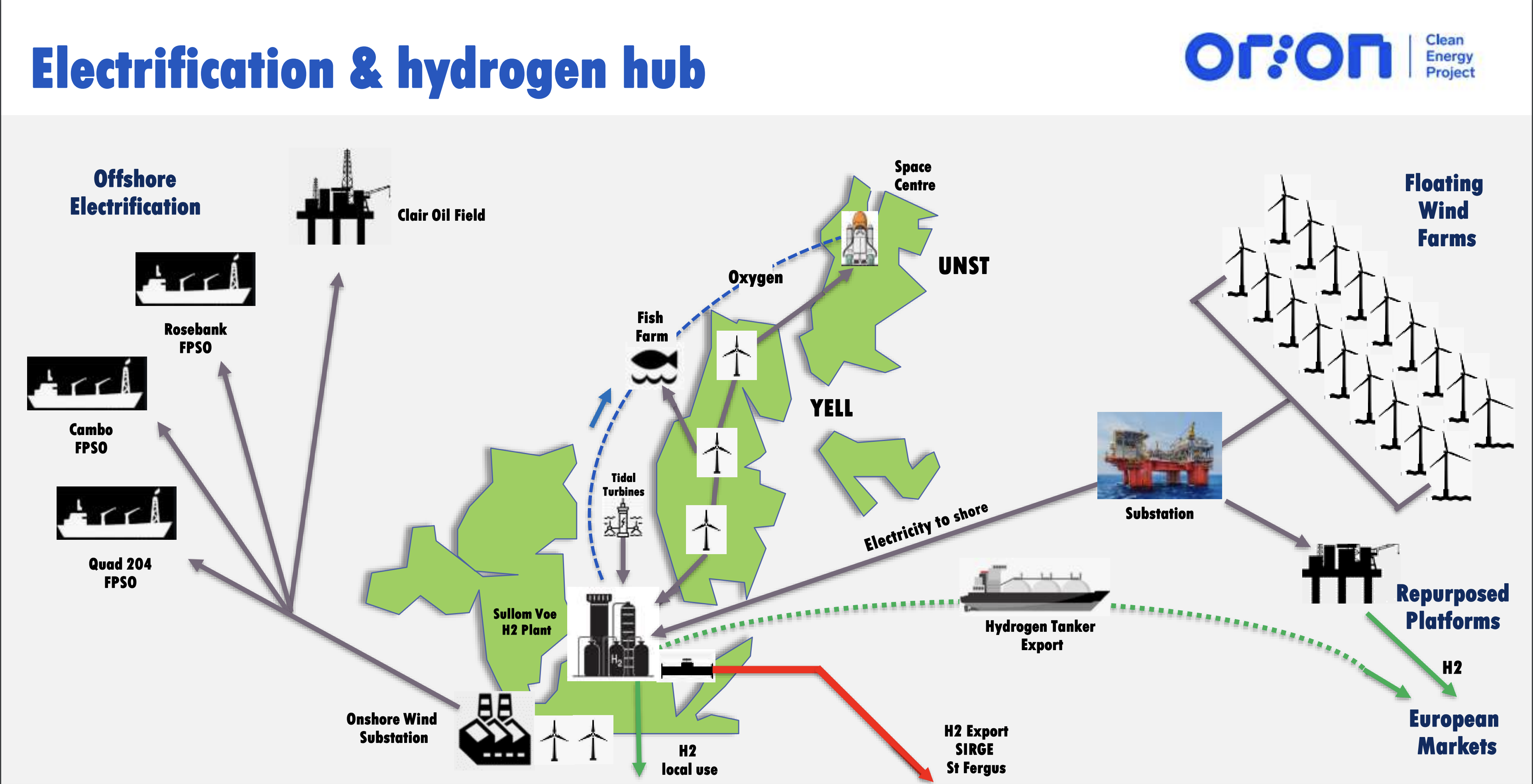
Note these points about what the Shetlanders call the Orion Project.
- Offshore installations are electrified.
- There are wind turbines on the islands
- Hydrogen is provided for local energy uses like transport and shipping.
- Oxygen is provided for the fish farms and a future space centre.
- There is tidal power between the islands.
- There are armadas of floating wind turbines to the East of the islands.
- Repurposed oil platforms are used to generate hydrogen.
- Hydrogen can be exported by pipeline to St. Fergus near Aberdeen, which is a distance of about 200 miles.
- Hydrogen can be exported by pipeline to Rotterdam, which is a distance of about 600 miles.
- Hydrogen can be exported by tanker to Rotterdam and other parts of Europe.
It looks a very comprehensive plan!
The German Problem
Germany has an energy problem.
- It is a large energy user.
- It has the largest production of steel in Europe.
- It prematurely shut some nuclear power stations.
- About a quarter of electricity in Germany comes from coal. In the UK it’s just 1.2 %.
- It is very reliant on Russian natural gas.
- The country also has a strong Green Party.
- Germany needs a lot more energy to replace coal and the remaining nuclear.
- It also needs a lot of hydrogen to decarbonise the steel and other industries.
Over the last few months, I’ve written these articles.
- Sale To Linde Of World’s Largest PEM Electrolyser
- Uniper To Make Wilhelmshaven German Hub For Green Hydrogen; Green Ammonia Import Terminal
- WindH2 Hydrogen Project Commissioned In Germany
- Morocco Could Produce Up To 4% Of World’s Green Hydrogen By 2030
- Get H2 Partners Propose Green Hydrogen Pipeline In Europe
- Alstom Hydrogen Trains Complete Trials
Germany seems to have these main objectives.
- Increase their supply of energy.
- Ensure a plentiful supply of hydrogen.
They appear to be going about them with a degree of enthusiasm.
BP’s Ambition To Be Net Zero By 2050
This press release from BP is entitled BP Sets Ambition For Net Zero By 2050, Fundamentally Changing Organisation To Deliver.
This is the introductory paragraph.
BP today set a new ambition to become a net zero company by 2050 or sooner, and to help the world get to net zero. The ambition is supported by ten aims
The ten aims are divided into two groups.
Five Aims To Get BP To Net Zero
These are.
- Net zero across BP’s operations on an absolute basis by 2050 or sooner.
- Net zero on carbon in BP’s oil and gas production on an absolute basis by 2050 or sooner.
- 50% cut in the carbon intensity of products BP sells by 2050 or sooner.
- Install methane measurement at all BP’s major oil and gas processing sites by 2023 and reduce methane intensity of operations by 50%.
- Increase the proportion of investment into non-oil and gas businesses over time.
I would assume that by gas, they mean natural gas.
Five Aims To Help The World Get To Net Zero
These are.
- More active advocacy for policies that support net zero, including carbon pricing.
- Further incentivise BP’s workforce to deliver aims and mobilise them to advocate for net zero.
- Set new expectations for relationships with trade associations.
- Aim to be recognised as a leader for transparency of reporting, including supporting the recommendations of the TCFD.
- Launch a new team to help countries, cities and large companies decarbonise.
This all does sound like a very sensible policy.
BP’s Partnership With EnBW
BP seemed to have formed a partnership with EnBW to develop offshore wind farms in the UK
Their first investment is described in this press release from BP, which is entitled BP Advances Offshore Wind Growth Strategy; Enters World-Class UK Sector With 3GW Of Advantaged Leases In Irish Sea.
This is the first five paragraphs.
bp and partner EnBW selected as preferred bidder for two highly-advantaged 60-year leases in UK’s first offshore wind leasing round in a decade.
Advantaged leases due to distance from shore, lower grid cost, synergies from scale, and faster cycle time.
Projects expected to meet bp’s 8-10% returns aim, delivering attractive and stable returns and integrating with trading, mobility, and other opportunities.
Annual payments expected for four years before final investment decisions and assets planned to be operational in seven years.
In the past six months bp has entered offshore wind in the UK – the world’s largest market – and the US – the world’s fastest-growing market.
Note.
- EnBW are Energie Baden-Wuerttemberg AG, who, according to Wikipedia, are the third largest utilities company in Germany.
- It also appears, that EnBW have developed wind farms.
BP have issued this infographic with the press release.
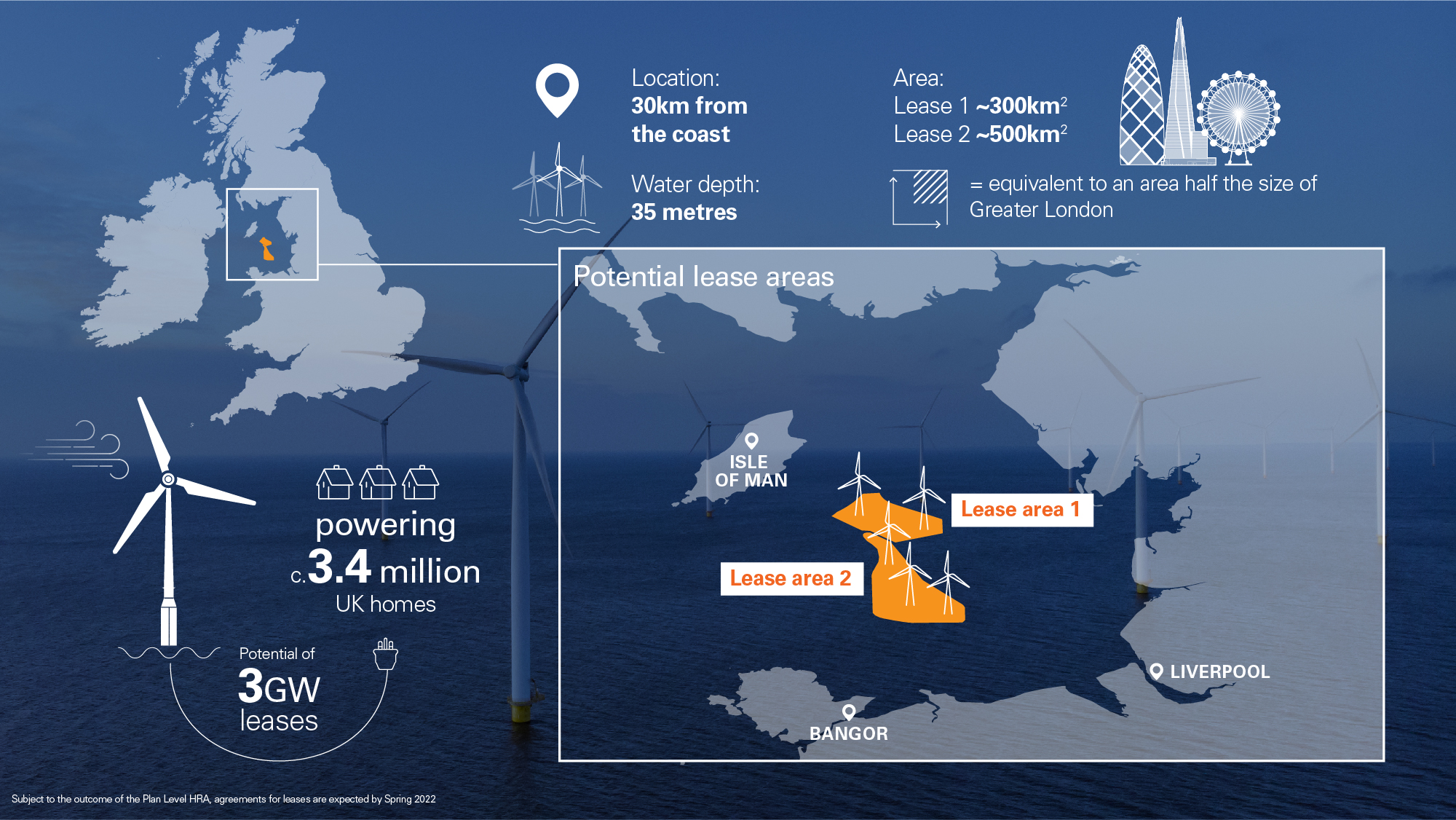
Note.
- The lease areas don’t appear to be far from the Morecambe Bay gas field.
- The Morecambe Bay gas field is coming to the end of its life.
- The Morecambe Bay gas field is connected to the Rampside gas terminal at Barrow-in-Furness.
- At peak production 15 % of the UK’s natural gas came from Morecambe Bay.
I just wonder, if there is a cunning plan.
Could the platforms be repurposed to act as electrical hubs for the wind turbines?
- 3GW of electricity would produce 55 tonnes of hydrogen per day.
- The hydrogen would be exported to the Rampside gas terminal using the existing pipelines.
- There may be savings to be made, as HVDC links are expensive.
- BP either has the engineering to convert the platforms or they know someone who does.
- Would the industrial complex at Barrow-in-Furnace and the nearby Sellafield complex have a use for all that hydrogen?
- Or would the hydrogen be used to fuel Lancashire’s buses and trucks on the M6.
It certainly looks to me, that it could be a possibility, to bring the energy ashore as hydrogen.
BP Seeking Second Wind Off Scotland
The title of this section, is the same as that of this article in The Times.
These are the first two paragraphs.
BP is preparing to bid for the rights to build wind farms off Scotland as it signals no let-up in expansion after a £900 million splurge on leases in the Irish Sea.
The London-based oil giant caused waves in February by offering record prices to enter the UK offshore wind market through a Crown Estate auction of seabed leases off England and Wales.
As I said earlier.
- The Shetland Islands are developing themselves as a giant hydrogen factory.
- There are pipelines connecting platforms to the Sullom Voe Terminal.
- There are plans to convert some of the redundant platforms into hydrogen production platforms.
- The islands will be developing ways to export the hydrogen to the South and Europe.
BP also operates the Schiehallion oil and gas field to the West of the Shetlands, which is connected to the Sullom Voe Terminal by the West of Shetland pipeline.
Could BP and EnBW be coming to the party?
They certainly won’t be arriving empty-handed.
Does BP Have Access To Storage Technology?
I ask this question because both the Morecambe Bay and Shetland leases could be built with co-located depleted gas fields and offshore electrolysers.
So could hydrogen gas be stored in the gas fields?
I think it could be a possibility and would mean that hydrogen would always be available.
Could Iceland Be Connected To Schiehallion Via A Gas Pipeline?
I estimate that Iceland and Schiehallion would be about six hundred miles.
This wouldn’t be the longest undersea gas pipeline in the world as these two are longer.
- Langeled – 725 miles
- Nord Stream – 759 miles
The Langeled pipeline cost £1.7 billion.
Conclusion
I think there’s more to the link-up between BP and EnBW.
I am fairly certain, that BP are thinking about converting some redundant gas platforms into hubs for wind turbines, which use the electricity to create hydrogen, which is then exported to the shore using existing gas pipelines and onshore terminals.
Could it be said, that BP will be recycling oil and gas platforms?
I feel that the answer is yes! Or at least maybe!
The answer my friend is blowing in the wind!
 The Anonymous Widower