FEV And Daimler Buses Create Hydrogen Coach Demonstrator
The title of this post is the same as that of this article on Automotive World.
This is the sub-heading.
Daimler Buses and engineering firm FEV have developed a hydrogen fuel cell-powered Setra coach, marking the first hydrogen demonstrator vehicle in the coach segment for the Daimler Truck subsidiary. The H₂ Coach technology demonstrator, which was handed over to Daimler Buses in summer 2025 following approximately two years of development and approval by German technical inspection authority TÜV, offers a range of at least 800 kilometres per tank filling and is intended for testing purposes.
The article also has a picture, which shows.
- A typical modern coach design with three axles.
- Setra H2 Coach branding.
- A Slogan of “Travelling Towards a Sustainable Future”
It looks very similar to images of Wrightbus’s three-axle Contour design. But that would mean, they could fit similar infrastructure.
But when I asked Google AI, when the Wrightbus three-axle hydrogen coach would enter passenger service, I received this answer.
Wrightbus’s three-axle hydrogen fuel cell electric coach is planned for launch in 2026. The company, which is developing the vehicle in Ballymena, Northern Ireland, has confirmed the project is aimed at decarbonising long-distance travel, with a projected range of up to 1,000 km.
It would appear that Wrightbus are ahead on range and timescale.
Could Doncaster Sheffield Airport Become A Hydrogen Airport?
I asked Google AI, what is the current status of Doncaster Sheffield Airport and received this reply.
Doncaster Sheffield Airport (DSA) is currently in a state of active, public-funded redevelopment after closing in late 2022 due to financial issues, with plans to reopen for passenger flights by late 2027 or 2028, following significant funding (around £160m) secured by the South Yorkshire Mayoral Combined Authority (SYMCA) for the City of Doncaster Council to take over operations and rebuild commercial viability, with freight and general aviation potentially returning sooner.
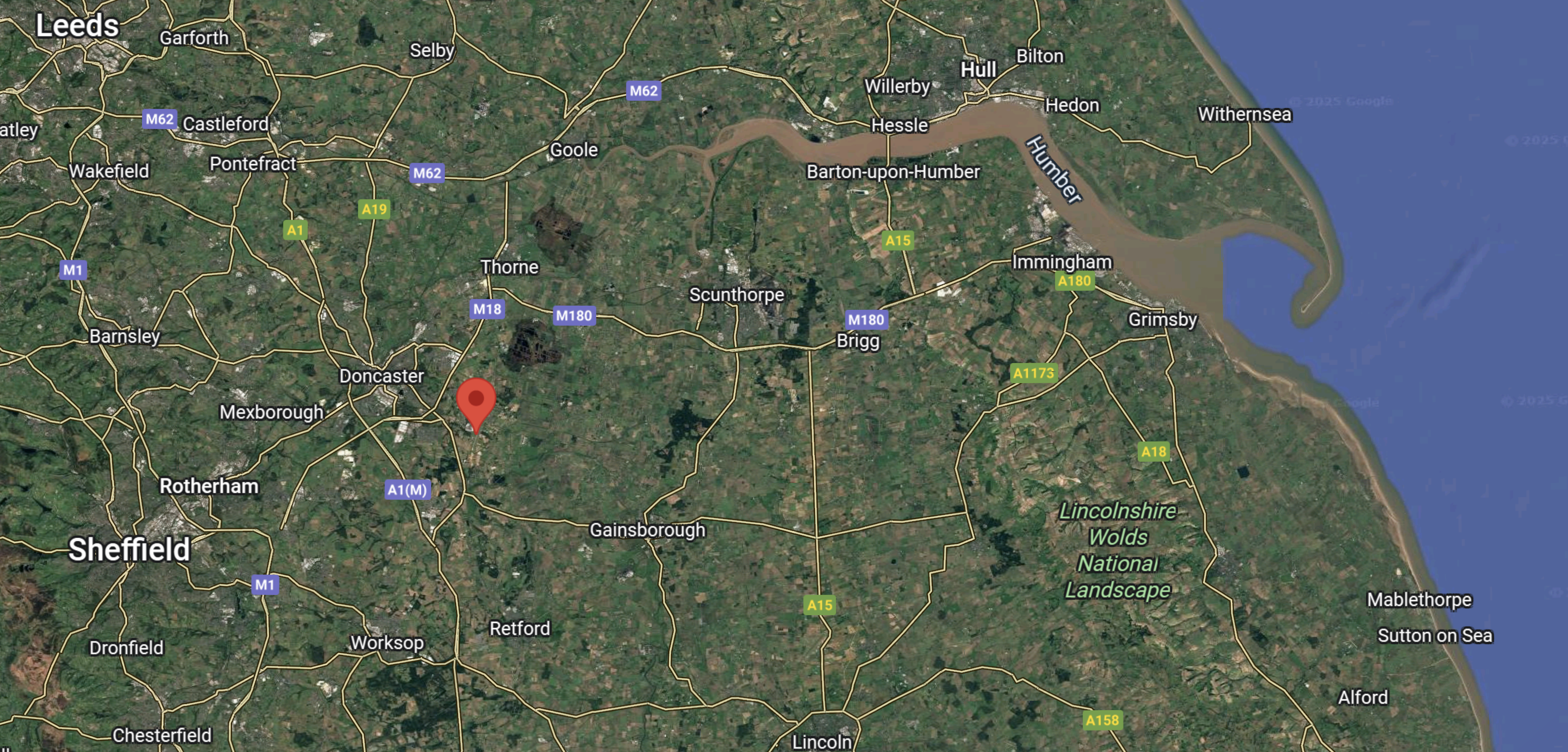
This Google Map shows the location of the airport.
Note.
- The distinctive mouth of the River Humber can be picked out towards the North-East corner of the map.
- Hull and Grimsby sit in the mouth of the Humber.
- The red arrow indicates Doncaster Sheffield Airport.
- Leeds is in the North-West corner of the map.
- The towns and city of Doncaster, Rotherham and Sheffield can be picked out to the West of the airport.
This second Google Map shows a close-up of the airport.

On my visit to NASA in the 1980s, where an Artemis system was used to project manage the turnround of the Space Shuttle, I was asked questions by one of NASA’s support people about RAF Finningley. Nothing too technical, but things like what is Doncaster like.
When I asked why, they said there’s a high chance that a Space Shuttle could land at RAF Finningley, as it has one of the best runways for a very heavy aircraft in Europe.
Looking at the runway, it is a long and wide runway that was built for heavy RAF nuclear bombers like Valiants, Victors and Vulcans.
I believe that we will eventually see hydrogen- and/or nuclear-powered airliners flying very long routes across the globe, just as a nuclear-powered example, attempted to do in the first episode of the TV series Thunderbirds, which was called Trapped in the Sky and has this Wikipedia entry.
Just as the Space Shuttle did, these airliners and their air-cargo siblings will need a large runway.
Doncaster Sheffield Airport already has such a runway.
These hydrogen- and nuclear-powered aircraft will make Airbus A 380s look small and will need runways like the one at Finningley.
But I don’t think we’ll ever see nuclear-powered aircraft in the near future, so the aircraft will likely be hydrogen.
Other things in favour of making Doncaster Sheffield Airport, an airport for long range hydrogen aircraft include.
- The airport is close to the massive hydrogen production and storage facilities being developed on Humberside at Aldbrough and Rough.
- The airport could be connected to the Sheffield Supertram.
- The airport could be connected to the trains at Doncaster station, which has 173 express trains per day to all over the country.
- The airport would fit well with my thoughts on hydrogen-powered coaches, that I wrote about inFirstGroup Adds Leeds-based J&B Travel To Growing Coach Portfolio
- The airport might even be able to accept the next generation of supersonic aircraft.
- The airport could certainly accept the largest hydrogen-powered cargo aircraft.
- The Airport isn’t far from Doncaster iPort railfreight terminal.
Did I read too much science fiction?
I have some further thoughts.
Do Electric Aircraft Have A Future?
I asked Google AI this question and received this answer.
Yes, electric aircraft absolutely have a future, especially for short-haul, regional, and urban air mobility (UAM), promising quieter, zero-emission flights, but battery limitations mean long-haul flights will rely more on hydrogen-electric or Sustainable Aviation Fuels (SAF) for the foreseeable future. Expect to see battery-electric planes for shorter trips by the late 2020s, while hybrid or hydrogen solutions tackle longer distances, with a significant shift towards alternative propulsion by 2050.
That doesn’t seem very promising, so I asked Google AI what range can be elected from electric aircraft by 2035 and received this answer.
By 2035, fully electric aircraft ranges are expected to be around 200-400 km (125-250 miles) for small commuter planes, while hybrid-electric models could reach 800-1,000 km (500-620 miles), focusing on short-haul routes due to battery limitations; larger, long-range electric flight remains decades away, with hydrogen propulsion targeting 1,000-2,000 km ranges for that timeframe.
Note.
- I doubt that many prospective passengers would want to use small commuter planes for up to 250 miles from Doncaster Sheffield airport with hundreds of express trains per day going all over the UK mainland from Doncaster station.
- But Belfast City (212 miles), Dublin (215 miles) and Ostend (227 miles), Ronaldsway on the Isle of Man (154 miles) and Rotterdam(251 miles) and Schipol 340 miles) may be another matter, as there is water to cross.
It looks like it will be after 2035 before zero-carbon aircraft will be travelling further than 620 miles.
My bets would be on these aircraft being hydrogen hybrid aircraft.
What Will The Range Of Hydrogen-Powered Aircraft In 2040?
I asked Google AI this question and received this answer.
By 2040, hydrogen-powered commercial aircraft are projected to have a range that covers short- to medium-haul flights, likely up to 7,000 kilometers (approximately 3,780 nautical miles), with some models potentially achieving longer ranges as technology and infrastructure mature.
The range of these aircraft will vary depending on the specific technology used (hydrogen fuel cells versus hydrogen combustion in modified gas turbines) and aircraft size.
It looks like we’ll be getting there.
This Wikipedia entry is a list of large aircraft and there are some very large aircraft, like the Antonov An-225, which was destroyed in the Ukraine War.
A future long-range hydrogen-powered airline must be able to match the range of current aircraft that will need to be replaced.
I asked Google AI what airliner has the longest range and received this reply.
The longest-range airliner in service is the Airbus A350-900ULR (Ultra Long Range), specifically configured for airlines like Singapore Airlines to fly extremely long distances, reaching around 9,700 nautical miles (18,000 km) for routes like Singapore to New York. While the A350-900ULR holds records for current operations, the upcoming Boeing 777-8X aims to compete, and the Boeing 777-200LR was previously known for its exceptional range.
I believe that based on the technology of current successful aircraft, that an aircraft could be built, that would be able to have the required range and payload to be economic, with the first version probably being a high-capacity cargo version.
What Would An Ultra Long Range Hydrogen-Powered Airliner Look Like?
Whatever the aircraft looks like it will need to be powered. Rolls-Royce, appear to be destining a future turbofan for aircraft called the Ultrafan, which has this Wikipedia entry.
I asked Google AI, if Rolls-Royce will produce an Ultrafan for hydrogen and received this answer.
Rolls-Royce is actively developing the UltraFan architecture to be compatible with hydrogen fuel in the future, but the current UltraFan demonstrator runs on Sustainable Aviation Fuel (SAF). The company has a research program dedicated to developing hydrogen-powered engines for future aircraft, aiming for entry into service in the mid-2030s.
I asked Google AI, if Rolls-Royce have had major difficulties converting engines to hydrogen and received this answer.
Rolls-Royce has not encountered insurmountable difficulties but faces significant engineering and logistical challenges in converting engines to run on hydrogen. The company has made substantial progress in testing both stationary and aero engines using pure hydrogen, confirming its technical feasibility.
Given the company’s success in developing engines in the past, like the R Type, Merlin, RB 211, Pegasus, Trent, mtu 4000 and others, I suspect there’s a high chance of a successful hydrogen-powered Ultrafan.
If you look at a history of large passenger and cargo aircraft over the last sixty years, there has been a lot of the following.
- Conversion of one type of aircraft to a totally different type.
- Fitting new engines to a particular type.
- Fitting new avionics to a particular type.
Examples include.
- Fitting new CFM-56 engines to DC-8s.
- The first two Nimrods were converted from unsold Comet 4Cs.
- Converting Victor bombers to RAF tanker aircraft.
- Converting BA Tristars to RAF tanker aircraft.
- Converting DC-8s to cargo aircraft.
- Airbus converted five Airbus A 300-600 into Belugas, which have this Wikipedia entry.
- Airbus converted six Airbus A 330-200F into BelugaXLs, which have this Wikipedia entry.
- Converting two Boeing-747s to carry Space Shuttles ; one from American Airlines and one from Japan Airlines, which have this Wikipedia entry.
Note.
- Most of these examples have been successful.
- The last three examples have been very successful.
- Most of these applications do not have a human cargo.
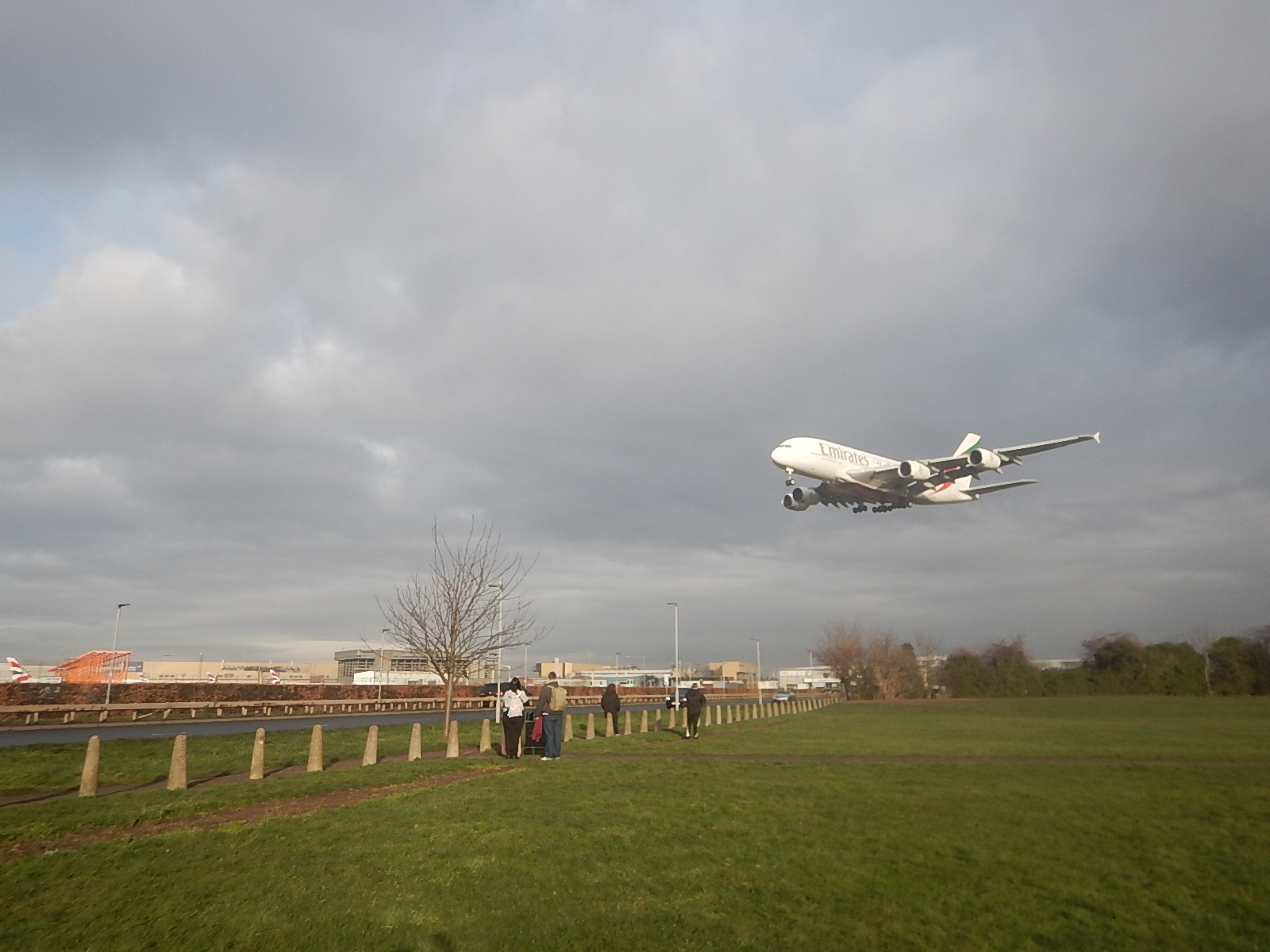
This picture shows an Emirates Air Lines’s Airbus A 380 on finals at Heathrow.
Note.
- The aircraft was landing on Runway 27 L.
- The four engines and the vertical oval cross-section of the fuselage are clearly visible.
- The Wikipedia entry for the Airbus A 380 shows two floors across the fuselage; the upper floor with eight seats in 2-4-2 and the lower floor with ten seats in 3-4-3, and a pair of LD3 cargo containers in the basement.
I’d be interested to know, how much hydrogen could be put in the basement and how far it could take the plane with a full load of passengers!
This link to the Wikipedia entry, shows the cross section in detail.
Note
I wouldn’t be surprised that the first application of large hydrogen aircraft will be for cargo and it could be an Airbus Beluga or perhaps an Airbus A 380 freighter?
FirstGroup Adds Leeds-based J&B Travel To Growing Coach Portfolio
The title of this post, is the same as that of this article on Route One.
These two paragraphs add more detail.
J&B Travel of Leeds is the latest coach business to be acquired by FirstGroup.
The operator, which has been established for more than 40 years, has a fleet of 15 vehicles, with work including home-to-school, private hire and FlixBus contracts.
But in some ways, the most significant thing not mentioned is that FirstGroup have now acquired seven coach firms.
- AndersonTravel in London
- EnsignBus in London
- J & B Travel in Leeds
- Matthews Coaches in County Monaghan, Ireland
- Tetley’s Coaches in Leeds
- York Pullman in Harrogate, Hull, Leeds and York
Note.
- MatthewsCoaches are about halfway between Dublin and Belfast.
- Three of the English acquisitions are in Yorkshire and two are in London.
- Leeds isn’t far off being halfway between London and Central Scotland.
This looks like the first part of a master plan.
- Leeds and County Monaghan could be ideal refuelling points for zero-carbon coaches.
- Ferrybridge, just South of Leeds is getting a hydrogen-fired power station.
- Ferrybridge is a big site with a motorway service station on the M1.
- Wrightbus are building an electrolyser at Ballymena, which is 81 miles from Matthews Coaches.
- Wrightbus have said that Dublin and Cork would be an ideal route for a hydrogen coach.
- Wrightbus have said that Heathrow and Gatwick would be an ideal route for a hydrogen coach.
This plan could be built-on with routes to various cities and attractions.
I have some further sorts and questions.
Could The First Obvious Routes Be Run By Hydrogen Coaches?
From what Wrightbus have indicated, I would rate the obvious routes as.
- Dublin and Belfast – 103 miles or 206 miles round trip
- Dublin and Cork – 107 miles or 340 miles round trip
- Leeds and Glasgow – 224 miles or 448 miles round trip
- Leeds and Edinburgh – 222 miles or 444 miles round trip
- Leeds and London – 197 miles or 396 miles round trip
- Heathrow and Gatwick – 40 miles or 80 miles round trip
Note.
The longest route is 714.5 km.
It would appear that, if the hydrogen-powered coach had a range of 1,000 km. all routes would be possible.
How Far Would A Hydrogen Coach Get On A Tankful From London?
A thousand kilometres is 621.4 miles.
These are the distances from Scottish cities to London.
- Aberdeen – 537 miles
- Dundee – 472 miles
- Dunfermline – 430 miles
- Edinburgh – 410 miles
- Glasgow – 404 miles
- Inverness – 561 miles
- John O ‘Groats – 678 miles
- Perth – 451 miles
- Stirling – 418 miles
I’ve added John O’Groats for completeness, but all cities would be reached.
How Far Would A Hydrogen Coach Get On A Tankful Going West From London?
These are the distances from Western towns and cities to London.
- Aberystwyth – 236 miles
- Fishguard – 255 miles
- Holyhead – 289 miles
- Lands End – 310 miles
- Penzance – 307 miles
I’ve added Lands End for completeness, but all towns and cities would be reached.
John O’Groats And Lands End In A Hydrogen Coach
I asked Google AI how far the journey was and received this answer.
The distance from Land’s End to John o’ Groats varies by transport: about 837-874 miles (1347-1407 km) by road, roughly 600 miles (970 km) as the crow flies, and around 1,200 miles (1900 km) for an off-road walking route, with cyclists typically taking 10-14 days and walkers 2-3 months.
So it looks, like there will be a need for a refuel, but that would give 2,000 kilometres, which is more than the 1,347-1,407 kilometres needed.
Ferrybridge Could Be An Ideal Refuelling Point
I suspect, even in fifty years you could name the places in the UK, where you will be certain of refuelling any hydrogen vehicle on the fingers of one hand.
The list would include.
- Ferrybridge in Yorkshire, where SSE are building a hydrogen-fired power station.
- Felixstowe Docks in Suffolk, where there will be a need to fuel hydrogen trucks.
- Keadby in Lincolnshire, where SSE are building a hydrogen-fired power station.
- Kintore in Aberdeenshire, where an electrolyser is being built.
- Runcorn in Cheshire, where there was an electrolyser in 1968, when I worked there.
This web site lists all the UK hydrogen projects.
This Google Map shows the location of the Ferrybridge hydrogen-powered power station site in relation to Barnsley, Doncaster, Leeds and other towns and cities of Yorkshire.

Note.
- The red arrow indicates the former coal-fired power station site.
- Leeds is in the North-West corner of the map.
- Barnsley and Stocksbridge are in the South-West corner of the map.
- The city of Sheffield is to the South-West of Stocksbridge.
- Doncaster is in the South-East corner of the map.
Last September I wrote Visiting The Consultation For Ferrybridge Next Generation Power Station At Knottingley.
In that post, I wrote about supplying both the power station and the motorway services with hydrogen and felt that it could use one of two methods.
- A pipeline from the hydrogen storage in East Yorkshire.
- Some form of train from a hydrogen production site.
Recently, Network Rail have been conducting tests on the movement of hydrogen by train, which I wrote about in Network Rail’s Test Track Take Centre Stage As Hydrogen Is Delivered By Rail For The First Time.
The Ferrybridge Site Has most things needed.
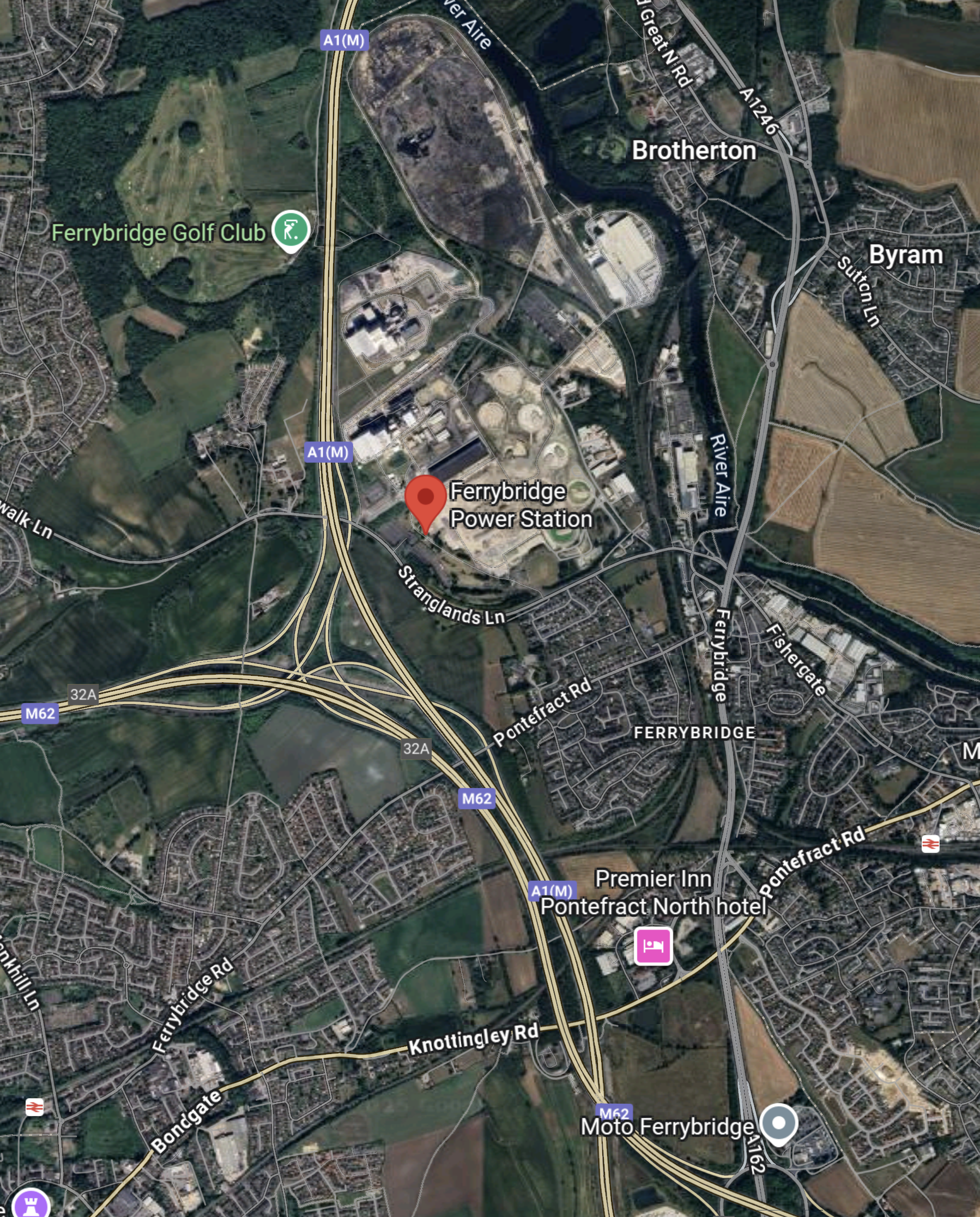
This map shows the site.
Note.
- The impressive motorway junction, where the North-South M1 crosses the East-West M62.
- Liverpool and Manchester are to the West.
- Leeds, Newcastle and Scotland is to the North.
- Hull is to the East.
- London is to the South.
- There is a Moto Services.
- There is a Premier Inn.
There is even two railway stations on the map.
This reply from Google AI gives the details of the distance between Ferrybridge and the South-West.
The driving distance from Ferrybridge, Yorkshire, to Land’s End is roughly 470 to 500 miles, taking about 8-9 hours, primarily via motorways like the M1, M5, and A30, though exact times and routes vary by real-time traffic and specific starting/ending points.
I am absolutely certain, that if you have a vehicle like a hydrogen coach and you want to go anywhere between A to B on the UK mainland, then if there is hydrogen-refuelling at Ferrybridge, you will be able too do the journey with a refuel at Ferrybridge.
Is Formula One Likely To Go To Hydrogen Fuel?
Formula One has a long term aim of decarbonising or at least going net-zero.
I’ve never been to an electric-car race, but it must be more boring to many to have motor-racing without the smells and the noise.
I asked Google AI, the question in the title of this post and received this answer.
Formula One is unlikely to switch to hydrogen fuel in the immediate future, as its current strategy is focused on using 100% sustainable “e-fuels” from the 2026 season. However, F1 leadership has stated that hydrogen is a potential long-term solution for the 2030s and beyond.
This article on the BBC is entitled Formula 1 boss Ross Brawn Says Hydrogen Could Be Future Fuel.
But I do believe, that the trucks, vans and transporters that accompany Formula One will be decarbonised earlier and hydrogen could play a major part, due to its proven longer range.
Hydrogen coaches are being developed and could be launches next year and are likely to have a 1,000 km. range, so expect to see some of these vehicles in the fleet of vehicles following Formula One.
What Happened To The Toyota Hydrogen-Powered HiLux?
I wrote about this vehicle in Toyota Unveils Prototype Hydrogen Fuel Cell Hilux, but I’ve not heard any more.
So I asked Google AI, the question in the title of this post and received this reply.
The Toyota hydrogen-powered Hilux is currently in the demonstration and evaluation phase and has not been officially confirmed for mass production. Ten prototypes were built in the UK and are undergoing testing, with some being used for customer and media demonstrations at events like the Paris Olympics. Toyota is using this project to gather data, refine its hydrogen technology, and prepare for a future European market that could see the vehicle go on sale around 2028.
A simple Google search produced this YouTube video and this article in the Toyota UK magazine.
I don’t want to drive one, as that would be illegal, but I have just added riding in one of these beasts to my bucket list.
Toyota Have Gone To The Advanced Propulsion Centre For Their Latest Project
In Toyota Leads Multi-Million-Pound Micromobility Research Project, I write about another project, where Toyota have approached the Advanced Propulsion Centre for funding and technical help. So the Advanced Propulsion Centre must be doing something right, to attract another project from Toyota.
In CoacH2 – The Next Generation Coach, I write about how the Advanced Propulsion Centre are helping to develop the powertrain for Wrightbus’s upcoming hydrogen-powered coach.
It certainly looks like the Advanced Propulsion Centre are in the middle of the net-zero transport revolution.
Eurostar Orders First Double-Decker Trains
The title of this post, is the same as that of this article on the BBC.
This is the sub-heading.
Eurostar has revealed plans to run double-decker trains through the Channel Tunnel for the first time.
These three paragraphs add more details.
The cross-channel rail operator has confirmed it will order up to 50 trains from manufacturer Alstom, eventually increasing the size of its fleet by nearly a third.
The expansion plans would include investing heavily in a crucial London depot, it said.
But questions remain over whether the facility has enough space for both Eurostar and potential rival operators to use it.
This my solution to the problem outlined in the last paragraph.
Note, that I wrote the software that planned the building of the Channel Tunnel and the rail links to London and was also friends with the project manager of the 1960s attempt to build a Channel Tunnel.
We need more terminal platforms and depot space in the UK to handle Eurostar’s extra trains and the other companies who want to run to London.
We should split services into two groups.
Group 1 would terminate as now in an updated St. Pancras with more passenger handling capacity, which could probably be built over the tracks at the Northern end of the station. Trains would still be stabled at Temple Mills.
Group 2 would terminate at Ebbsfleet International, which would have extra platforms, a new depot, masses of car parking and a coach terminal.
Some trains from both groups could also stop at Ashford International.
To access Ebbsfleet from Central London and also create a Heathrow link to the Channel Tunnel, the Lizzie Line would be extended to Northfleet, where there is space to handle up to eight trains per hour in new platforms built in two disused sidings.
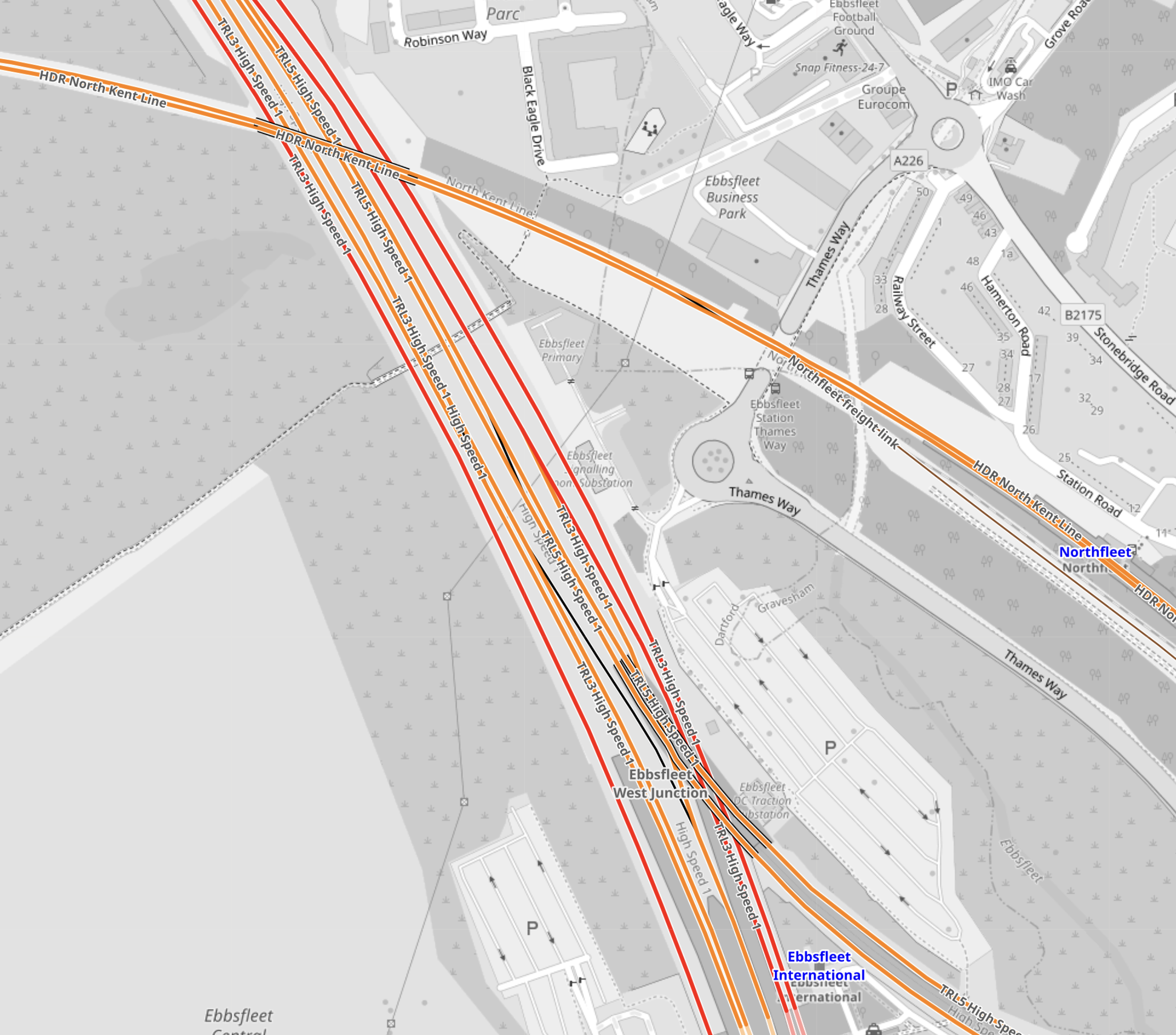
This OpenRailwayMap shows the location of Northfleet and Ebbsfleet stations.
Note.
- Ebbsfleet International station at the bottom of the map.
- The red tracks are High Speed One.
- The orange tracks are third-rail electrified lines.
- The orange tracks going across the map is the North Kent Line.
- Northfleet station is at the right edge of the map on the North Kent Line.
- Northfleet and Ebbsfleet stations are less than a kilometer apart.
- Ebbsfleet has a lot of car parking spaces.
I believe a spectacular cable-car or other link would connect Northfleet and Ebbsfleet stations.
These are some other thoughts.
Ebbsfleet International Station Has Good Motorway Access
This Google Map shows the location of Ebbsfleet International station in relation to the motorways.
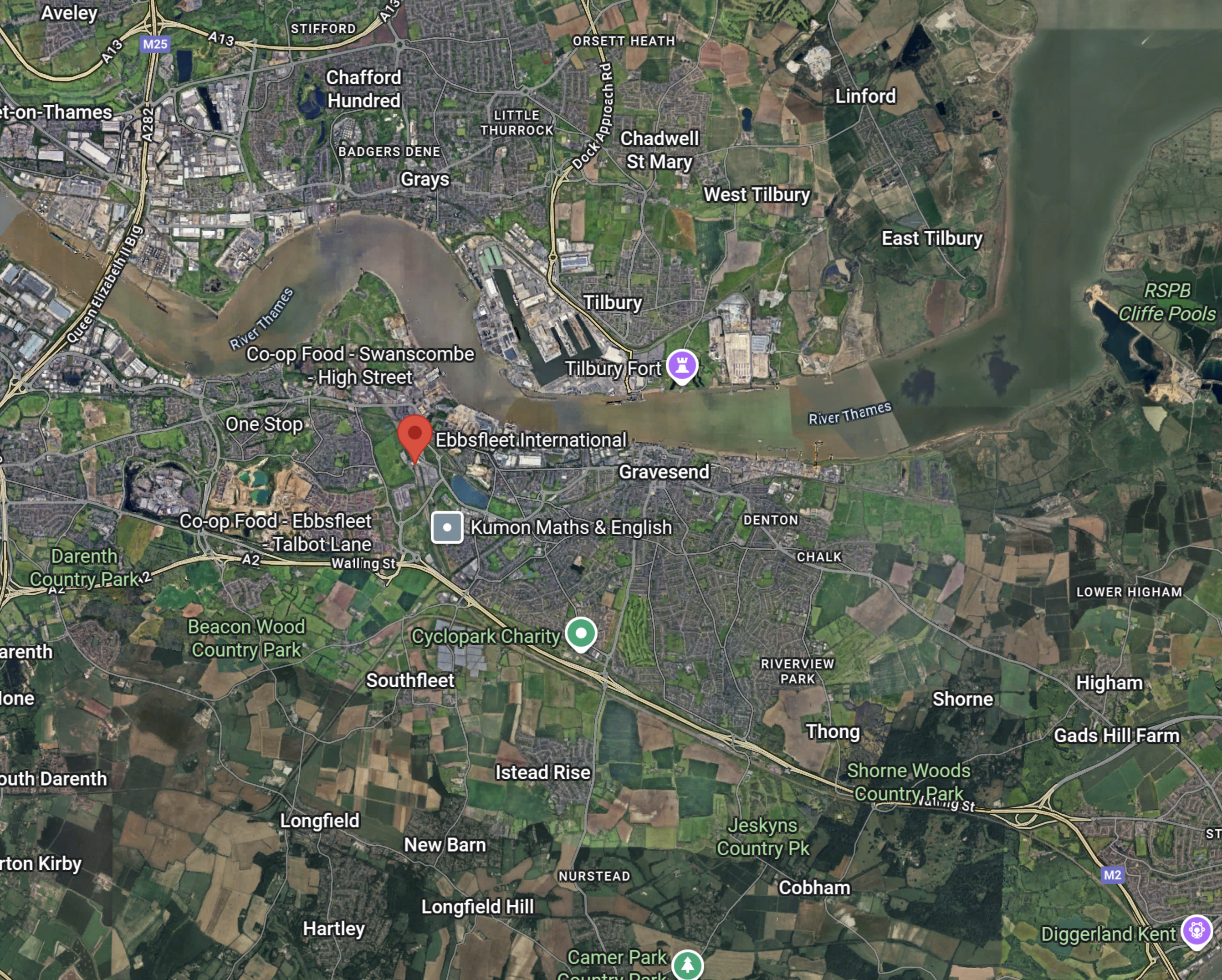
Note.
- The A2/M2 road runs across the bottom half of the map.
- The red arrow marks the position of Ebbsfleet International station.
- The Dartford Crossing is a few miles West of the station.
In my last few years, as an Ipswich season ticket holder, I regularly had a lift to Ebbsfleet International from a friend and the route to the station from the M25 and the A2/M2 wasn’t bad.
But it will be getting better.
This map from the Government’s consultation on the Lower Thames Crossing, shows the road layout in a few years.
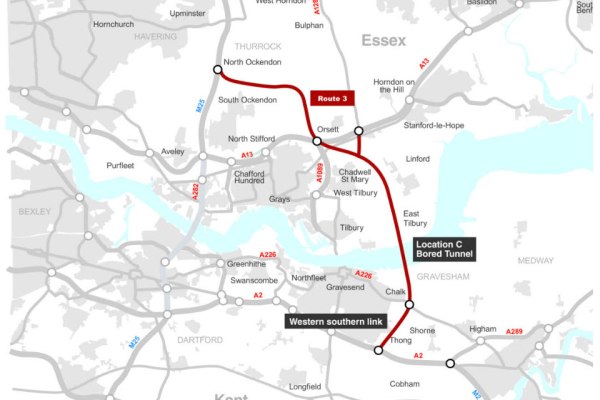
Note.
- The Lower Thames Crossing is shown in red.
- Ebbsfleet International station is about a mile South of Northfleet
- The new crossing will connect to the A2, a few miles East of the link road to the station.
Travellers from much of the East of and Middle England could use the new crossing to get to Ebbsfleet International station.
These are current times from Google.
- Birmingham – 2 hours and 41 minutes
- Cambridge – 1 hour and 17 minutes
- Edinburgh – 7 hours and 44 minutes
- Fishguard – 5 hours and 29 minutes
- Glasgow – 7 hours and 6 minutes
- Holyhead – 5 hours and 29 minutes
- Hull – 4 hours and 1 minute
- Ipswich – 1 hour and 29 minutes
- Leeds – 3 hours and 55 minutes
- Liverpool – 4 hours and 40 minutes
- Manchester – 4 hours and 28 minutes
- Milton Keynes – 1 hour and 37 minutes
- Newcastle 5 hours and 25 minutes
- Norwich – 2 hours 23 minutes
- Nottingham – 2 hours and 55 minutes
- Peterborough – 1 hour and 54 minutes
- Sheffield – 3 hours and 35 minutes
- Stoke-on-Trent – 3 hours and 25 minutes
- York – 4 hours and 16 minutes
Note.
- I would suspect that the opening of the Lower Thames Crossing will knock 10-15 minutes off these times.
- Edinburgh, Glasgow, Hull, Leeds, Newcastle, Nottingham, Peterborough, Sheffield and York would probably be quicker to Europe with a change to Continental train services at St. Pancras, rather than Ebbsfleet International.
- With improvements to rail services, more of these journeys will be quicker by train.
- High Speed Two should connect Birmingham, Liverpool, Manchester and Stoke-on-Trent to London, by the mid 2030s.
But there are some, who always feel their car is safer in a car park!
Ebbsfleet International Station Has A Large Amount Of Car Parking
This map shows the car parks at Ebbsfleet International station.
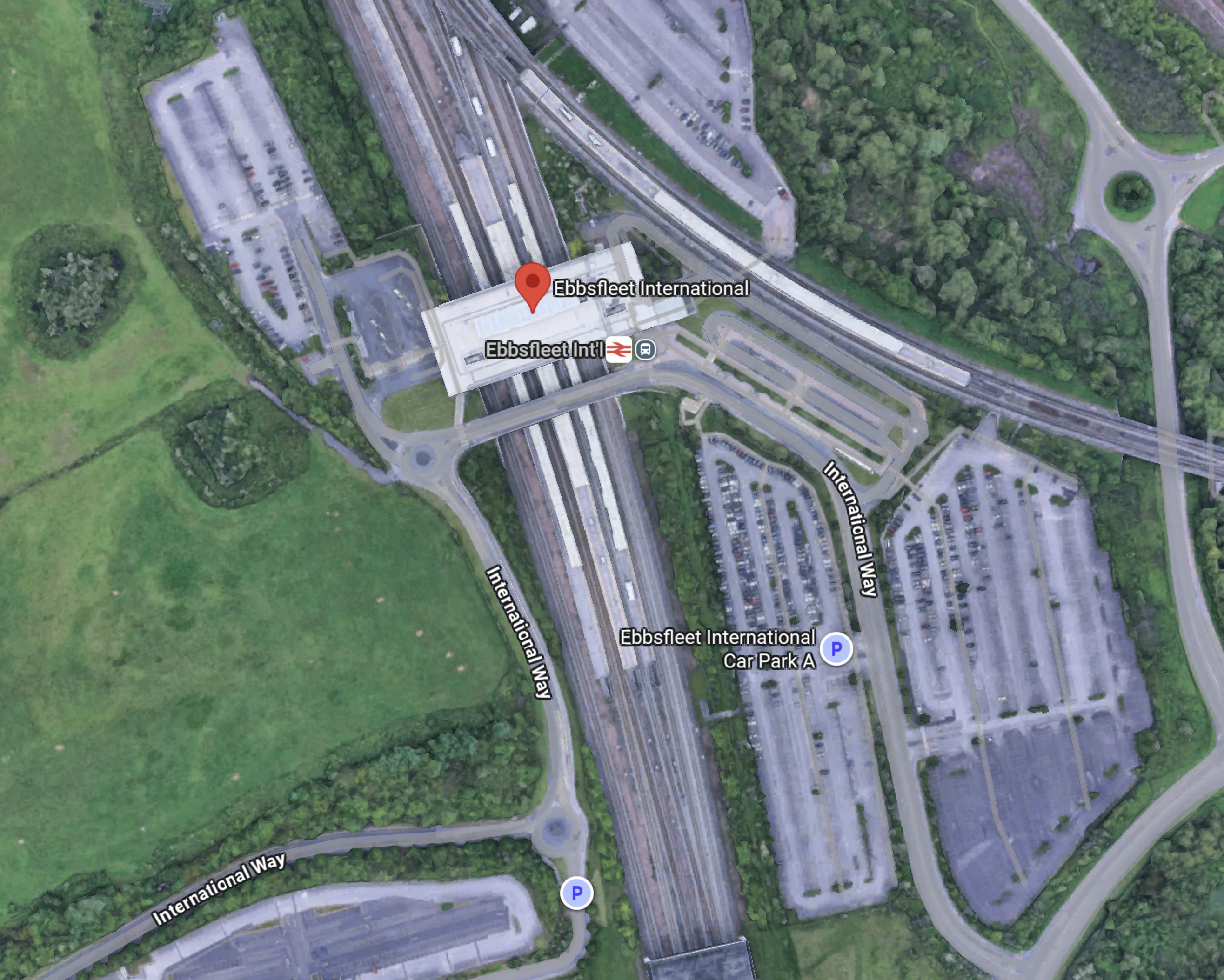
Note.
- Some of the parking areas are marked with a P.
- It is easy to pick-up and drop passengers.
- The car parks could be double-decked to add more spaces if needed.
- According to the Ebbsfleet International web site, the station currently has 5225 parking spaces, 68 accessible car parking spaces.
For those that have a lot of luggage or a large family, taking the car to Ebbsfleet International may be the best option.
Ebbsfleet International Station Should Have A Coach Station
Consider.
- In the next few years, hydrogen-powered coaches with a thousand kilometre range will come to dominate the long distance coach market.
- Mercedes and Wrightbus are know to be developing long-distance hydrogen-powered coaches.
- Hydrogen-powered coaches will be able to reach all of England and Wales and a large part of Scotland from Ebbsfleet International.
- Ebbsfleet International is closely connected to the UK motorway network.
- Continental coaches using the Channel Tunnel, could use Ebbsfleet as a coach interchange with the UK.
- Ebbsfleet International could also handle customs services for Continental coach services, which would take the pressure off the Channel Tunnel and the ferries.
- Ebbsfleet International could also have a coach link to Gatwick Airport.
These and other reasons make me feel, that a coach terminal at Ebbsfleet International is essential.
A Green Connection Between The Two Halves Of The European Union For the Gretas Of This World
Consider.
- There is no zero-carbon route between the island of Ireland and Continental Europe.
- Eurostar is all-electric between London and Continental Europe, but only serves a limited number of destinations.
- Low- or zero-carbon ferries are being designed, that run on hydrogen.
- Trains between London and the Irish ferries are diesel-powered.
- The simplest solution would surely be to run hydrogen-powered coaches between Ebbsfleet International and Fishguard and/or Holyhead. Both journeys would take three and a half hours.
Hydrogen-powered coaches are under development by Wrightbus.
I also asked Google AI if anybody is planning zero-carbon ferries between the UK and ireland and received this answer.
Yes, there are plans for zero-carbon ferries between the UK and Ireland, with a specific “Green Corridor” feasibility study underway for the Holyhead to Dublin route, and a separate, separate commuter service project planned between Belfast and Bangor. The Belfast Maritime Consortium is developing the zero-carbon commuter service, and a separate “Green Corridor” feasibility study is assessing potential low-carbon pathways between Holyhead and Dublin
I believe the green connection is feasible, provided the following happens.
- Ebbsfleet International is reopened and developed as a station for Continental Europe.
- The zero-carbon ferries are developed.
- The busmasters from Ballymena deliver the ultimate hydrogen-powered coach.
- Hydrogen and other fuels are made available, where they is needed.
This could do wonders for the economy of the island of Ireland.
Out of curiosity, I did ask Google AI, what is the longest coach route in the UK and received this answer.
The longest scheduled coach journey in the UK is the Scottish Citylink route from Glasgow to Uig on the Isle of Skye (route 915 or 916), which is about 230 miles and takes around 7 hours and 50 minutes. Historically, there have been much longer international bus routes, such as the Penn Overland tour from London to Ceylon, but these were not regular, scheduled services.
So my proposal at five hours and 29 minutes is only a short hop.
I also believe that with good project management that the additional infrastructure could be built by 2030, with little or no disruption to existing services.
Visiting The Consultation For Ferrybridge Next Generation Power Station At Knottingley
Yesterday, I visited the first meeting for the consultation on Ferrybridge Next Generation Power Station, which was held in the old town hall at Knottingley.
This Google Map shows the power station in relation to Knottingley.
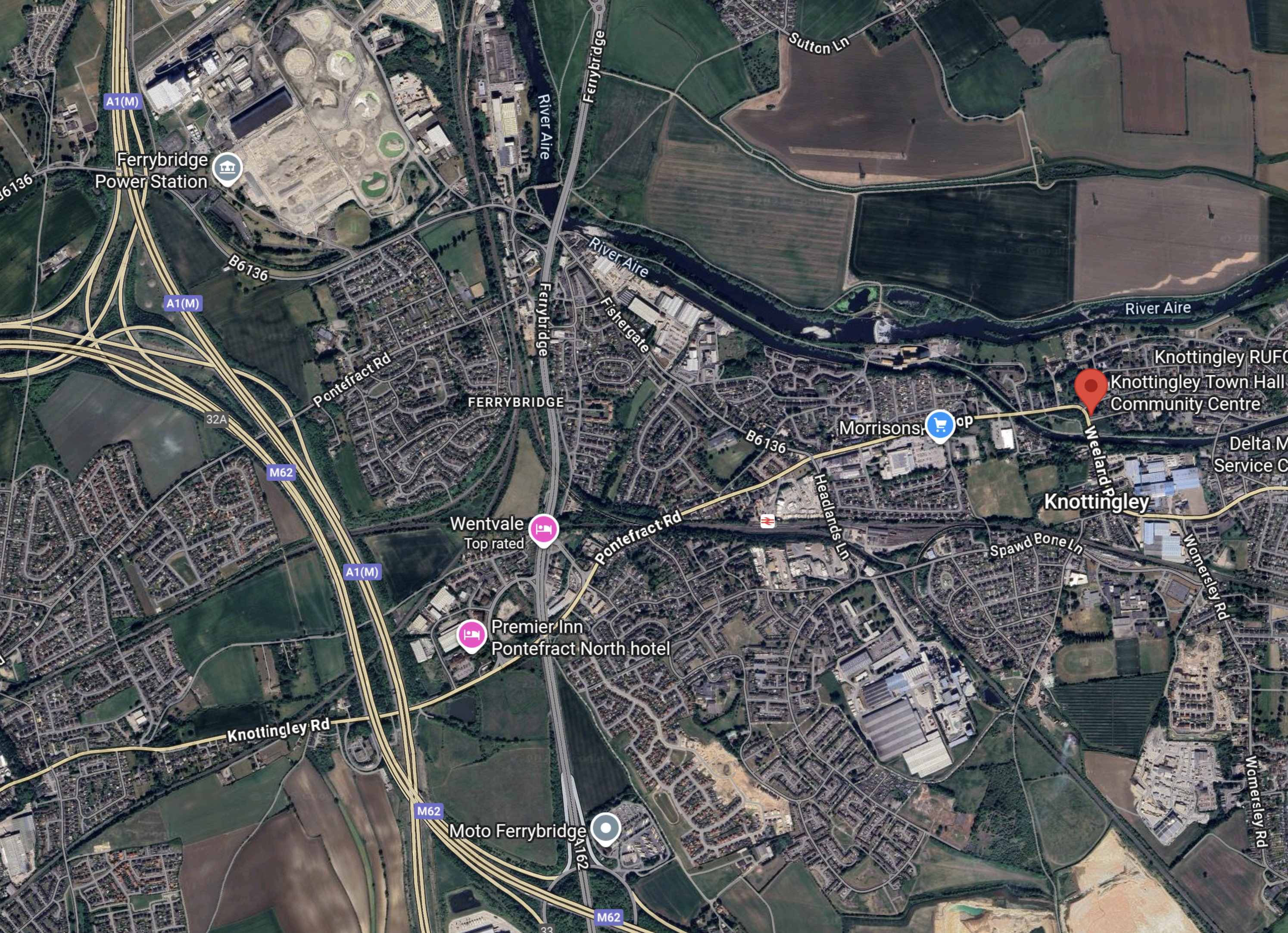
Note.
- The meeting was held in the Knottingley Town Tall Community Centre, which is marked by the red arrow.
- I had arrived by train from Wakefield at Knottingley station and I was lucky enough to be able to get a taxi to the Town Hall.
- Knottingley station is marked on the map about a twenty-minute walk to the West of the Town Hall.
- The Ferrybridge power station site is in the North-West corner of the map and appears to be bordered by the B6136 road.
- The A1 (M) and the M 62 motorways run North-South past the power station site.
- The A (M) motorway continues North-South to Newcastle and Scotland, and London respectively.
- The M62 motorway continues West-East to Liverpool and Manchester, and Hull respectively.
- The well-appointed Moto Ferrybridge services is accessible from both motorways.
This OpenRailwayMap shows the rail lines in the area.
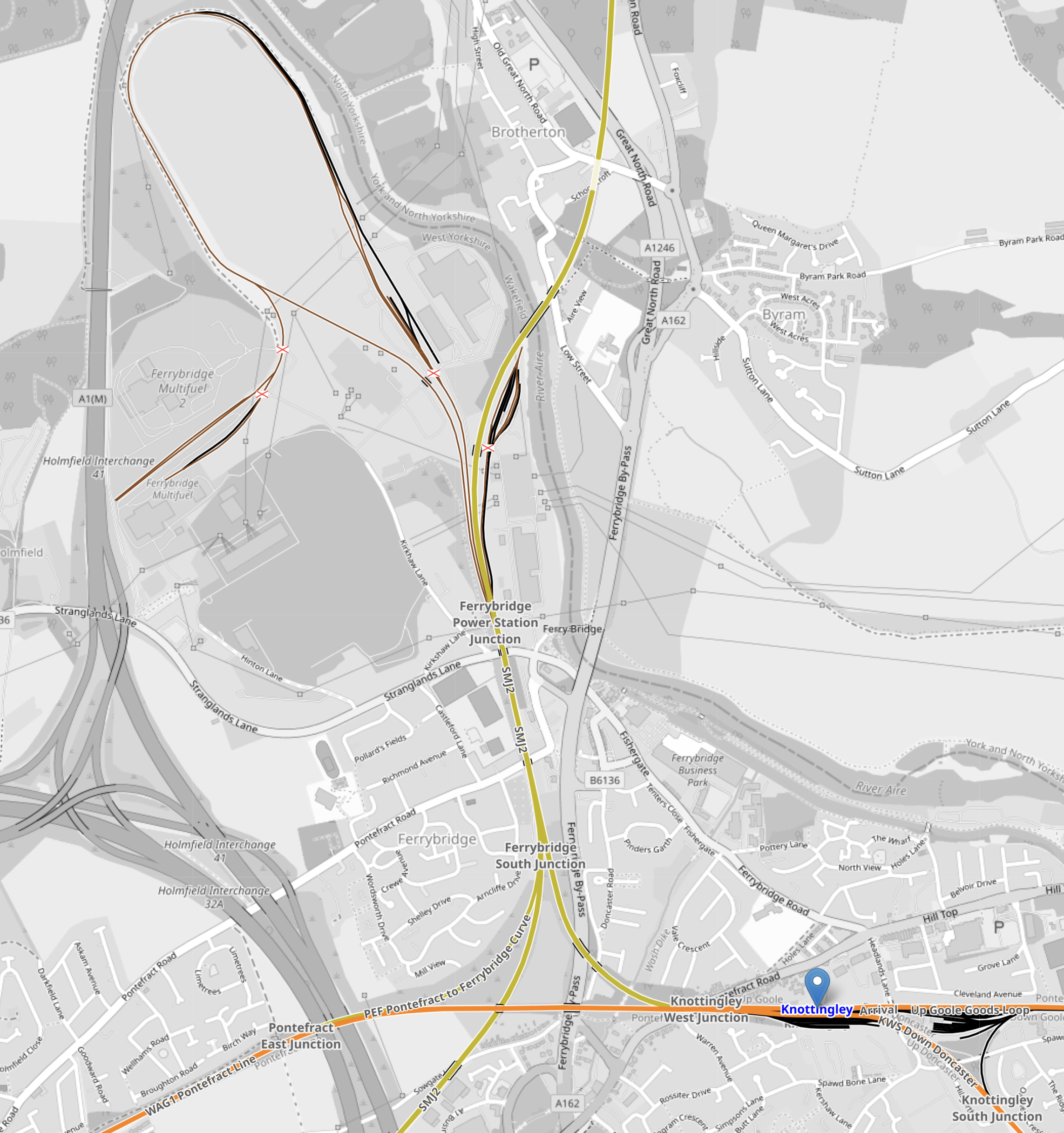
Note.
- The A 62 and A 1(M) motorways running down the West side of the map.
- Knottingley station is on the Pontefract Line, and is marked by a blue arrow.
- The Pontefract Line could have connections from both East and West to the Ferrybridge power station site via Ferrybridge Power Station junction.
- The loop, where the merry-go-round coal trains turned, appears to be still intact at the North of the power station site.
Will these rail lines be any use in the building and operation of the new power station?
These are my thoughts.
Fuel For The Power Station
The brochure for the consultation says this about the fuel for the Ferrybridge Next Generation Power Station.
Ferrybridge Next Generation Power Station will be designed to run on 100% hydrogen, natural gas or a
blend of natural gas and hydrogen.
The brochure has an informative section, which is entitled Natural Gas Pipeline Corridors.
Additionally, I should say, that I lived within a couple of hundred metres of a major gas pipeline in Suffolk, for over twenty years and it was the most unobtrusive of neighbours.
The brochure also says this about hydrogen safety.
As with all of our sites, appropriate measures will be
in place to ensure safe operation. Hydrogen is not
inherently more dangerous than other fuel sources.Hydrogen is flammable and must be handled with care,
just like other flammable fuels. To ignite, hydrogen
must be combined with an additional oxidising agent,
such as air or pure oxygen, in a specific concentration
and with an ignition source (a spark).
It is nearly sixty years ago now, since I worked as an Instrument Engineer, in ICI’s Castner-Kellner works at Runcorn, where hydrogen, chlorine and caustic soda were produced by the electrolysis of brine.
The plant was an unhealthy one, as it used a lot of mercury and my main task, was to design instruments to detect mercury in air and operators’ urine.
The Wikipedia entry for the Castner-Kellner process is a fascinating read and explains why it is being replaced by much better modern mercury-free processes.
I asked Google AI, if the Castner-Kellner process is still used and received this reply.
No, the Castner-Kellner process, a type of mercury cell for producing chlorine and caustic soda, is now largely obsolete due to occupational health and mercury pollution concerns, though a few plants may still operate globally. Modern chlor-alkali processes primarily use safer diaphragm cell and membrane cell technologies to produce chlorine and other chemicals from brine electrolysis.
I suspect that countries, where life is cheap, still use this process, which is very dangerous to those that work on the plant.
INEOS now own ICI in Cheshire and they still produce a large proportion of the hydrogen, chlorine and caustic soda, that the UK needs, but in a much safer way.
The question has to be asked about how hydrogen will be delivered to the Ferrybridge site.
Consider.
- SSE are developing a large hydrogen store at Aldbrough.
- Centrica are developing a large hydrogen store at Brough.
- Both of these stores could be connected to the German AquaVentus system, as the Germans are short of hydrogen storage.
- There is an East Coast Hydrogen Delivery Plan, which could probably have an extension pipeline to the Ferrybridge site.
- The East Coast Hydrogen Delivery Plan, talks of a hydrogen capacity of 4.4 GW.
I don’t feel, that this is the sort of project, that will be delivered until the mid-2030s, at the earliest.
There is also one other important development, that will require hydrogen at Ferrybridge.
I asked Google AI, if there will be hydrogen-powered coaches by 2030 and received this reply.
Yes, there will be hydrogen-powered coaches and buses by 2030, particularly in the UK and EU, with government strategies and funding promoting their deployment, especially for routes requiring high range and quick refueling where battery-electric models may be less suitable. For example, the EU’s CoacHyfied project is developing fuel cell coaches, and the UK government envisions hydrogen playing a role in its transport decarbonization by 2030, with potential to accelerate its zero-emission bus goals.
The nearest you can get to a hydrogen-powered coach in England, is to take an upmarket Wrightbus upmarket hydrogen-powered bus between Sutton station and Gatwick Airport.
- It is mouse quiet and vibration-free.
- It handles the hills with alacrity.
- I wrote about my journey in Sutton Station To Gatwick Airport By Hydrogen-Powered Bus.
That journey convinced me of the superiority in many ways of a hydrogen bus or coach over its diesel cousins.
I believe that this superiority will see large growth in hydrogen-powered long-distance coaches in the next few years.
But I also feel that some specialist transport, like horse transport, will go the hydrogen route.
As there are services at Ferrybridge, where two important motorways cross, I can envisage that the services will need to be able to refuel passing hydrogen buses, coaches trucks and other heavy vehicles, as well as the occasional car.
So would it be possible to supply hydrogen for the motorway services, by the same route as the power station?
I believe that the hydrogen could come from Saltend to the East of Hull, so I gave Google AI the phrase “Saltend zero-carbon hydrogen” and received this reply.
Saltend is home to several initiatives for producing and utilizing zero-carbon hydrogen, most notably the H2H Saltend project by Equinor, which aims to build the world’s largest hydrogen production plant with carbon capture capabilities by 2026 to supply industrial users at the Saltend Chemicals Park. Additionally, a new green hydrogen facility is planned for the park by Meld Energy with a target operation in early 2027, and a separate low-carbon hydrogen plant by ABP, HiiROC, and px Group is also being developed to meet local industrial demand. These projects collectively contribute to the broader Zero Carbon Humber initiative, which seeks to significantly reduce industrial emissions in the region.
Note.
- Saltend will certainly have enough zero-carbon hydrogen for everybody who wants it.
- Delivery dates in a couple of years are being talked about.
- Local industrial demand could be satisfield using specialised trucks, just as ICI used in the 1960s.
- As the Germans want to connect their AquaVentus system to Humberside, any excess hydrogen, could always be sold across the North Sea.
- OpenRailwayMap shows that Saltend is rail-connected.
But how do you get hydrogen between Saltend and Ferrybridge?
I am sure, that hydrogen could be delivered by truck from Saltend to Ferrybridge, but would the locals allow a stream of hydrogen trucks on the roads.
On the other hand, both Saltend and Ferrybridge are both rail-connected, so would it be possible to deliver the hydrogen by rail?
Google AI says this about railway wagons for hydrogen.
Railway wagons for hydrogen transport include liquid hydrogen tank cars (tankers) for transporting cryogenic liquid hydrogen and compressed gas tank cars for carrying hydrogen in its gaseous state or bound within carrier mediums like ammonia or methanol. Hydrogen fuel cell technology is also being developed for use on trains themselves, with a hydrogen fuel cell generator wagon providing power for main-line, non-electrified freight routes.
I believe that it will be possible to develop trains of an appropriate length to shuttle hydrogen between where it is produced and where it is used.
Such a specially-designed shuttle train would be ideal for moving hydrogen between Saltend and Ferrybridge.
- Once at Ferrybridge, the train would be connected to the local hydrogen system feeding the power station, the motorway services and any local businesses that needed hydrogen.
- The trains could be hydrogen fuel cell powered, so they could use any convenient route.
- Like hydrogen powered buses, I suspect they could be mouse quiet.
- The trains would be sized to perhaps deliver a day’s hydrogen at a time.
- There could only be minor changes needed to the rail system.
- If required, the trains could could deliver their cargo in the dead of night.
It could even be based on the contept of the TruckTrain, which I wrote about in The TruckTrain.
Hydrogen Coaches? Setra Begins Testing Of A Technology Carrier With Cellcentric Fuel Cell Module
The title of this post, is the same as that of this article on Sustainable Bus.
This paragraph introduces the article.
Daimler Buses has started test drives of its first Setra coach equipped with a hydrogen fuel cell drive, named the technology carrier “H2 Coach.” The 13.9-meter high-decker, model S 517 HD, combines two hydrogen tanks with a total capacity of 46 kilograms and a fuel cell module capable of as many as 300 kW, developed.
Dailmler have also said this about the interim approval for the H2 Coach.
This approval allows test drives both on Daimler Buses’ internal testing grounds and on public roads. The vehicle is intended to offer a zero-emission alternative to diesel-powered coaches, with lower noise, higher range, and shorter refueling times compared with battery-electric vehicles, contributing to improved air quality in cities and holiday regions.
I’ll go along with that.
As Wrightbus and others are developing hydrogen coaches, I believe this could be the first big hydrogen application in road transport.
Which Companies Are Developing Hydrogen-Powered Coaches?
Google AI gave me this answer.
Companies actively developing or deploying hydrogen-powered coaches include Wrightbus (UK), partnering with Symbio, and Temsa and Caetanobus (Turkey). Toyota is converting used coaches with fuel cell modules, while Daimler Buses is road-testing its H2 Coach precursor. Other companies in the broader hydrogen transport space with relevant technology are Hyundai, Volvo, and Tata Motors.
As Symbio’s Wikipedia entry is in French, I am fairly certain, that Symbio is a French company in Grenoble.
This press release from Symbio is entitled Symbio And Wrightbus Unveil TThe Successful Outcome Of Their UK Government-Funded Partnership At CENEX EXPO 2024: A 300 kW Hydrogen-Powered Demonstrator Coach.
This is the sub-heading.
A partnership to develop a 300 kW, zero-emission demonstrator fuel cell coach and future 75 kW city bus applications.
These two introductory paragraphs add more details.
Symbio and Wrightbus signed a partnership to develop and demonstrate a zero-emission, hydrogen fuel cell coach designed for on-road public transportation in the UK. The joint project started in January 2024 with the delivery by Symbio to Wrightbus of four 75 kW StackPack™ fuel cell systems, forming a 300-kW power unit that Wrightbus integrated and tested into one of its single-deckers. The tests enabled the innovation teams on both sides to adjust and define the optimal settings for the vehicle’s powertrain. Having successfully completed this objective, the demonstrator is displayed for the first time at the Cenex Expo, starting Sept. 4, and will be operational and hit the road shortly.
This successful project sets the basis for future development of hydrogen-powered city buses equipped with Symbio 75 kW StackPack™ fuel cell systems, specifically designed for bus applications.
Symbio’s approach is different.
- Many drivers of my generation had a Ford XR3i hatchback.
- This sporty car had an 80 kW engine, a top speed of 115 mph and an acceleration time of 0-60 mph, of under 9 seconds.
- It was also great fun!
I do wonder if one of Symbio’s 75 kW StackPack™ fuel cell systems could be developed and fitted into a small hatchback, to create an afffordable zero-carbon runabout.
Already the press release says that Wrightbus and Symbio are co-operating with each other on 75 kW city bus applications.
Lord Bamford’s company ; JCB found Hyperdrive Innovation to develop batteries for their diggers. These batteries are now used in Hitachi’s Battery Intercity Express Trains.
Now, it looks like his son’s company have found Symbio to develop the fuel-cells needed for their innovative buses and coaches. Would one or two 75kW fuel cells be idea for smaller tractors and diggers?
Centrica Secures Investment Stake In Gasrec Helping Boost UK Bio-LNG Ambitions
The title of this post, is the same as that of this press release from Centrica.
This is the sub-heading.
Centrica has secured a minority stake in Gasrec, the UK’s largest dual provider of bio-LNG (bio-Liquified Natural Gas) and bio-CNG (bio-Compressed Natural Gas) to the road transport sector,
These first two paragraphs give more details.
Gasrec says the investment will drive the next phase of its infrastructure ambitions, with plans to open a UK wide network of open-access refuelling stations supplying renewable bio-LNG for the decarbonisation of heavy goods vehicles.
Centrica is taking a 16% stake and becomes one of three major shareholders in Gasrec, alongside global integrated energy company bp and private family office 44 North.
I have some thoughts.
Does Running A Truck On bio-LNG or bio-CNG. Reduce Carbon Emissions?
This paragraph from the press release, gives the thoughts of Chris O’Shea, who is Group Chief Executive, Centrica.
Chris O’Shea, Group Chief Executive, Centrica plc, said: “Demand for bio-LNG for transport is growing fast as more HGV operators make the switch – drawn by a clean, ready-to-use fuel which slashes CO2 emissions by up to 85 per cent in comparison to diesel*. This investment in Gasrec enhances our collaboration with the leading company in the sector, and puts us in a strong position to energise a vital sector of the industry on its journey to net zero.”
As Centrica is a public company, with shareholders, who would take a dim view of Mr. O’Shea telling porkies, I suspect we can assume that the following is true.
Drawn by a clean, ready-to-use fuel which slashes CO2 emissions by up to 85 per cent in comparison to diesel.
The asterisk in the full quote, refers to this note.
Low Carbon Vehicle Partnership, Innovate UK and Office for Low Emission Vehicles, Low Emission Freight & Logistics Trial (LEFT), Key Findings, November 2020. Using specific feedstocks CO2 reductions of 200% are achievable.
Centrica could be being conservative with their claims.
Decarbonising Buses, Locomotives And Trucks
Despite what Elon Musk, would have us believe, electric trucks will not dominate the future of freight transport.
An electric truck would be the vehicle equivalent of asking Usain Bolt to run a hundred metres with a large refrigerator on his back.
Trucks are going to need a fuel without a weight penalty and with a long range.
I asked Google for information about Cummins diesel, natural gas and hydrogen engines and received this AI Overview.
Cummins offers engines powered by diesel, natural gas, and hydrogen. While diesel engines are well-established, Cummins is also developing both natural gas and hydrogen engines, particularly focusing on hydrogen as a pathway to zero-carbon solutions for various applications. Cummins utilizes a fuel-agnostic platform, meaning a common base engine can be adapted for different fuel types, including diesel, natural gas, and hydrogen.
Recently, GB Railfreight purchased thirty Class 99 locomotives from Stadler.
- They can use electrification, where it exists.
- Where electrification doesn’t exist, they can use an onboard Cummins diesel engine, which is built in Darlington.
- In electric-mode, they have 6.2 MW of power, and are the most powerful locomotives ever to run on UK railways.
- In diesel-mode, they have 1.8 MW of power, which is more than enough to haul a large container train in and out of Felixstowe.
I had thought that at some future date, Cummins would convert these locomotives to electro-hydrogen.
But now that Gasrec is providing bio-LNG and bio-CNG, GB Railfreight, have the option of converting both hydrogen and biomethane.
Similar logic can be applied to Wrightbus’s Streetdeck Ultroliner, one version of which is fitted with a Cummins engine, that can be converted to electric, hydrogen or natural gas, which of course includes biomethane. This page on the Wrightbus web site describes the bus.
Wrightbus are also going back into coach manufacture, as I wrote about in Wrightbus Goes Back To The Future As It Relaunches The Contour Coach. As with the Streetdeck Ultroliner, Cummins seem to be providing one of the power units.
It seems to me, that the zero- and low-carbon revolution in transport will generate a need for the availability of biomethane, hydrogen and natural gas fuel for transport all over the country.
Gasrec with around twenty biomethane fuelling points around the country, seem well-placed to supply the biomethane in bio-LNG or bio-CNG form.
Could Gasrec Deliver Hydrogen?
Various bus companies in the UK, have had difficulty getting the fuel for their hydrogen buses.
I believe that delivering hydrogen would be very similar to delivering LNG and if Gasrec can deliver LNG successfully and safely, they probably have the technology to do the same for hydrogen.
Centrica Seem To Be Assembling An Interesting Consortium
These are some deals, that I have reported on this blog, that involve Centrica.
- Centrica, along with Hyundai, Kia, Siemens and others have backed Hull-based hydrogen start-up; HiiROC, who can produce affordable hydrogen from any hydrocarbon gas including natural gas, where it is needed.
- Centrica have invested in Sizewell C. Will they be using their share of the electricity to make affordable pink hydrogen using HiiROC?
- In Centrica And Ryze Agree To Develop Hydrogen Pathway, I talked about how Centrica and Ryse were aiming to bring hydrogen to the masses.
- In Recurrent Energy’s Middle Road Project Sold To Centrica, I talked about a Centrica investment in solar power.
- In Aberdeen’s Exceed Secures Centrica Rough Contract, I talked about how Centrica were redeveloping the Rough gas storage site for hydrogen.
- In Lhyfe And Centrica To Develop Offshore Renewable Green Hydrogen In The UK, I talked about developing offshore hydrogen.
- In Centrica Announces Hydrogen Ready Combined Heat And Power Partnership With 2G, the title says it all.
- In Centrica Signs UK Biomethane Agreement With Yorkshire Water And SGN Commercial Services, Centrica appear to be sourcing biomethane from Yorkshire Water.
- In Centrica Invests In Renewable Energy Storage Capabilities To Boost UK’s Energy Security And Accelerate Transition To Net Zero, I talk about Centrica, Goldman Sachs and others, investment in liquid-air energy storage company; Highview Power.
- In British Gas Owner Mulls Mini-Nuke Challenge To Rolls-Royce, I talk about rumours that Centrica might invest in SMRs.
Note.
- A lot of these deals are are about hydrogen production.
- Some of these deals are about biomethane production.
- None of these deals talk about getting hydrogen and biomethane to customers.
It appears to me, that Gasrec have a model that works to get hydrogen, methane and biomethane from production and storage to the end customers.
Developing A Rural Hydrogen Network
In Developing A Rural Hydrogen Network, I talked about supplying all those millions of off-gas grid properties with hydrogen for heating, agricultural and industrial purposes, in the countryside of the UK.
Gasrec have the technology to decarbonise the countryside.
Conclusion
Gasrec would appear to be a very useful partner for Centrica.
Centrica Really Can’t Lose At Sizewell
The title of this post, is the same as that of this article in The Times.
This is the sub-heading.
Centrica’s £1.3 billion investment in Sizewell C guarantees substantial returns, even with cost overruns.
These two-and-a-half paragraphs explain the funding.
Now we know what Ed Miliband means by his “golden age of nuclear” — golden for the companies putting their money into Sizewell C. Yes, reactor projects have a habit of blowing up private investors. But maybe not this one. It looks more like an exercise in transferring risk to consumers and the taxpayer.
Sure, nobody builds a £38 billion nuke on a Suffolk flood plain without a frisson of danger. But the energy secretary and his Treasury chums have done their bit to make things as safe as possible for the companies putting in equity alongside the government’s 44.9 per cent stake: Canada’s La Caisse with 20 per cent, British Gas-owner Centrica (15 per cent), France’s EDF (12.5 per cent) and Amber Infrastructure (7.6 per cent).
For starters, nearly all the debt for the 3.2 gigawatt plant, three-quarters funded by loans, is coming from the state-backed National Wealth Fund. It’s bunging in up to £36.6 billion, with £5 billion more guaranteed by a French export credit agency.
It looks to me that between them the British and French governments are providing £41.5 billion of loans to build the £38 billion nuke.
These are my thoughts.
Hydrogen And Sizewell C
This page on the Sizewell C web site is entitled Hydrogen And Sizewell C.
Under a heading of Hydrogen Buses, this is said.
At Sizewell C, we are exploring how we can produce and use hydrogen in several ways. We are working with Wrightbus on a pilot scheme which, if successful, could see thousands of workers transported to and from site on hydrogen double decker buses. You can read more about the pilot scheme in our press release
Firstly, it could help lower emissions during construction of the power station. Secondly, once Sizewell C is operational, we hope to use some of the heat it generates (alongside electricity) to make hydrogen more efficiently.
This would appear to be a more general statement about hydrogen and that the following is planned.
- Hydrogen-powered buses will be used to bring workers to the site. A press release on the Sizewell C web site, talks about up to 150 buses. That would probably be enough buses for all of Suffolk.
- Hydrogen-powered construction equipment will be used in the building of the power station.
- It also talks about using the excess heat from the power station to make hydrogen more efficiently. I talk about this process in Westinghouse And Bloom Energy To Team Up For Pink Hydrogen.
This is a substantial investment in hydrogen.
Centrica And Electricity From Sizewell C
The article in The Times, also says this.
Even so, there’s a fair bit of protection for the likes of Centrica, which has also agreed a 20-year offtake deal for its share of Sizewell’s electricity. The price of that is not yet known.
Nothing is said in the article about the size of Centrica’s electricity offtake.
- If they get 15 % of Sizewell C, that would by 480 MW.
- If they get 15 % of Sizewell B + C, that would by 660 MW.
If they use their share to generate hydrogen, Suffolk would have a massive hydrogen hub.
To power the buses and construction of Sizewell C, Sizewell B could be used to provide electricity to create the hydrogen.
How Would The Hydrogen Be Produced?
Centrica, along with other companies, who include Hyundai and Kia, are backers of a company in Hull called HiiROC, who use a process called Thermal Plasma Electrolysis to generate hydrogen.
On their web site, they have this sub-heading.
A Transformational New Process For Affordable Clean Hydrogen
The web site also describes the process as scalable from small modular units up to industrial scale. It also says this about the costs of the system: As cheap as SMR without needing CCUS; a fraction of the energy/cost of water electrolysis.
If HiiROC have achieved their objective of scalability, then Centrica could grow their electrolyser to meet demand.
How Would The Hydrogen Be Distributed?
Consider.
- Currently, the Sizewell site has both road and rail access.
- I can still see in my mind from the 1960s, ICI’s specialist articulated Foden trucks lined up in the yard at Runcorn, taking on their cargoes of hydrogen for delivery all over the country.
- As that factory is still producing hydrogen and I can’t remember any accidents in the last sixty years, I am fairly sure that a range of suitable hydrogen trucks could be developed to deliver hydrogen by road.
- The road network to the Siewell site is being updated to ensure smooth delivery of workers and materials.
- The rail access to the Sizewell site is also being improved, for the delivery of bulk materials.
I believe there will be no problems delivering hydrogen from the Sizewell site.
I also believe that there could be scope for a special-purpose self-propelled hydrogen tanker train, which could both distribute and supply the hydrogen to the vehicles, locomotives and equipment that will be using it.
Where Will The Hydrogen Be Used?
I have lived a large part of my life in Suffolk and know the county well.
In my childhood, there was quite a lot of heavy industry, but now that has all gone and employment is based on agriculture, the Port of Felixstowe and service industries.
I can see hydrogen being used in the following industries.
Transport
Buses and heavy trucks would be powered by hydrogen.
The ports in the East of England support a large number of heavy trucks.
Large Construction Projects
Sizewell C is not the only large construction project in the East of England, that is aiming to use low-carbon construction involving hydrogen. In Gallagher Group Host Hydrogen Fuel Trial At Hermitage Quarry, I talked about a hydrogen fuel trial for the Lower Thames Crossing, that involved JCB and Ryse Hydrogen.
Hydrogen for the Lower Thames Crossing could be delivered from Sizewell by truck, down the A12.
Rail
We may not ever see hydrogen-powered passenger trains in this country, but I do believe that we could see hydrogen-powered freight locomotives.
Consider.
- The latest electro-diesel Class 99 locomotives from Stadler have a Cummins diesel engine.
- The diesel engine is used, when there is no electrification.
- Cummins have developed the technology, that allows them to convert their latest diesel engines to hydrogen or natural gas power, by changing the cylinder head and the fuel system.
- Access to the Port of Felixstowe and London Gateway needs a locomotive with a self-powered capability for the last few miles of the route.
A Class 99 locomotive converted to hydrogen would be able to run with out emitting any carbon dioxide from Felixstowe or London Gateway to Glasgow or Edinburgh.
Ports
Ports have three main uses for hydrogen.
- To power ground-handing equipment, to create a pollution-free atmosphere for port workers.
- To fuel ships of all sizes from the humblest work-boat to the largest container ships.
- There may need to be fuel for hydrogen-powered rail locomotives in the future.
There are seven ports with excellent road and/or rail connections to the Sizewell site; Felixstowe, Great Yarmouth, Harwich, Ipswich, London Gateway, Lowestoft and Tilbury.
The proposed Freeport East is also developing their own green hydrogen hub, which is described on this page on the Freeport East web site.
Airports
Airports have two main uses for hydrogen.
- To power ground-handing equipment, to create a pollution-free atmosphere for airport workers.
- In the future, there is likely to be hydrogen-powered aircraft.
There are three airports with excellent road and/or rail connections to the Sizewell site; Norwich, Southend and Stansted.
Agriculture And The Rural Economy
Agriculture and the rural economy would be difficult to decarbonise.
Consider.
- Currently, most farms would use diesel power for tractors and agricultural equipment, which is delivered by truck.
- Many rural properties are heated by propane or fuel oil, which is delivered by truck.
- Some high-energy rural businesses like blacksmiths rely on propane, which is delivered by truck.
- Electrification could be possible for some applications, but ploughing the heavy land of Suffolk, with the added weight of a battery on the tractor, would probably be a mathematical impossibility.
- JCB are developing hydrogen-powered construction equipment and already make tractors.
- Hydrogen could be delivered by truck to farms and rural properties.
- Many boilers can be converted from propoane to run on hydrogen.
I feel, that hydrogen could be the ideal fuel to decarbonise agriculture and the rural economy.
I cover this application in detail in Developing A Rural Hydrogen Network.
Exports
Consider.
- Sizewell B and Sizewell C nuclear powerstations have a combined output of 4.4 GW.
- A rough calculation shows that there is a total of 7.2 GW of wind farms planned off the Suffolk coast.
- The East Anglian Array wind farm alone is said in Wikipedia to be planned to expand to 7.2 GW.
- The Sizewell site has a high capacity connection to the National Grid.
Nuclear plus wind should keep the lights on in the East of England.
Any excess electricity could be converted into hydrogen.
This Google Map shows the location of Sizewell B in relation to Belgium, Germany and The Netherlands.
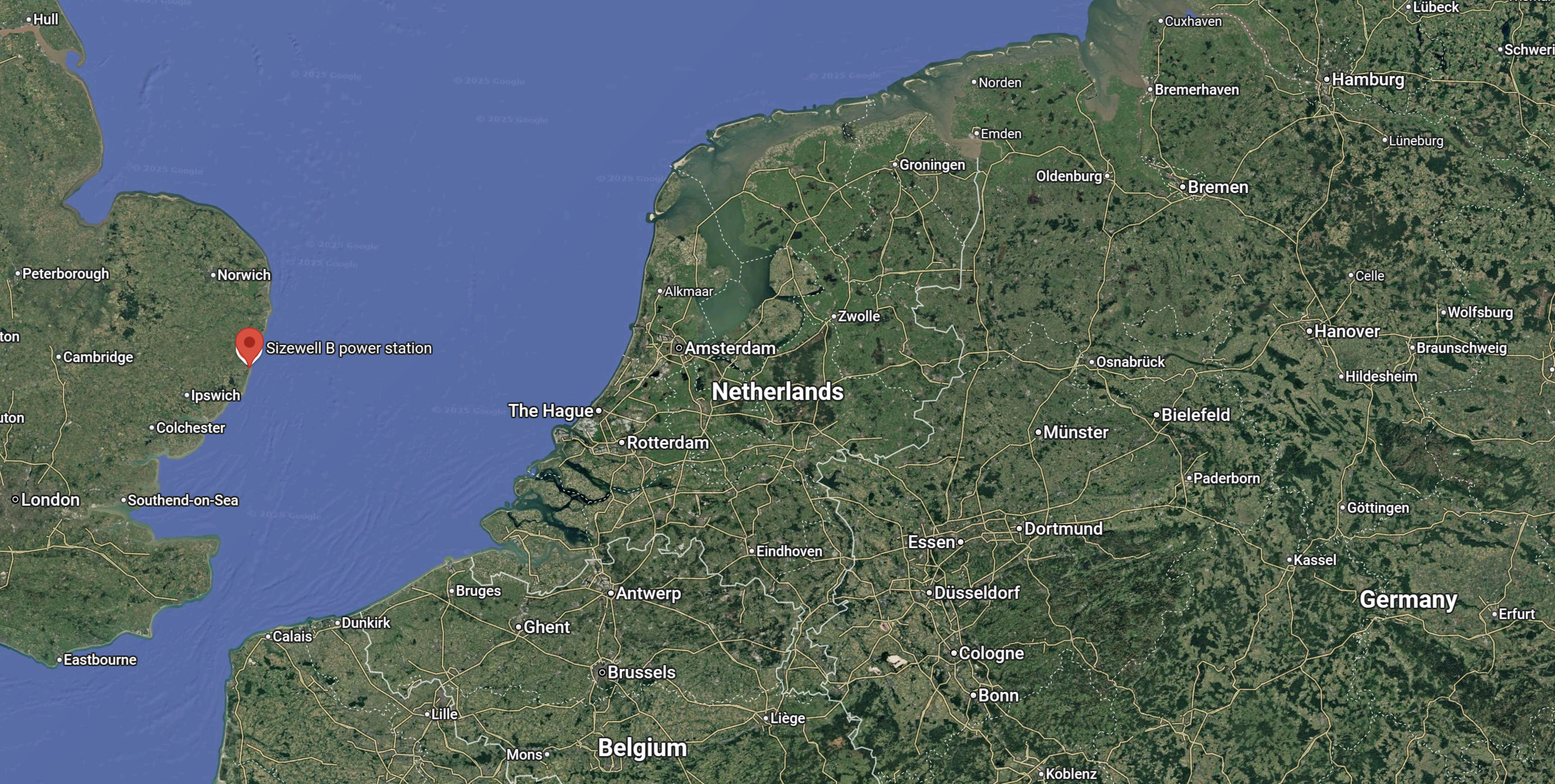
The Sizewell site is indicated by the red arrow.
The offshore oil and gas industry has used technology like single buoy moorings and coastal tankers to collect offshore natural gas for decades.
I don’t see why coastal hydrogen tankers couldn’t export excess hydrogen to places around the North Sea, who need the fuel.
It should be born in mind, that Centrica have a good reputation in doing natural gas trading. This expertise would surely be useful in hydrogen trading.
Conclusion
I believe that a hydrogen hub developed at Sizewell makes sense and I also believe that Centrica have the skills and technology to make it work.
 The Anonymous Widower
