Northern Powerhouse Rail – Significant Upgrades And Journey Time Improvements To The Hope Valley Route Between Manchester And Sheffield
In this article on Transport for the North, which is entitled Northern Powerhouse Rail Progress As Recommendations Made To Government, one of the recommendations proposed for Northern Powerhouse Rail is significant upgrades and journey time improvements to the Hope Valley Line between Manchester and Sheffield.
I shall look at a few of the possibilities for the route.
Northern Powerhouse Rail’s Objective For The Route
Wikipedia, other sources and my calculations say this about the trains between Manchester and Sheffield.
- The distance between the two stations is 42.6 miles
- The current service takes 49 to 57 minutes and has a frequency of two trains per hour (tph)
- This gives an average speed of 52.2 mph for the fastest journey.
- The proposed service with Northern Powerhouse Rail will take 40 minutes and have a frequency of four tph.
- This gives an average speed of 63.9 mph for the journey.
This last figure of 63.9 mph, indicates to me that a 100 mph train will be able to meet Northern Powerhouse Rail’s objective.
Current Trains On The Hope Valley Line
In July this year, I went along the Hope Valley Line between Manchester Piccadilly and Dore and Totley stations, which I wrote about in Along The Hope Valley Line – 13th July 2020.
My train was a pair of refurbished Class 150 trains.
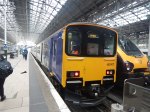
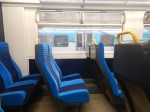

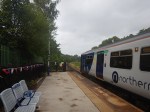
These trains can handled the current timetable but they have an operating speed of only 75 mph.
Looking at Real Time Trains for last week, it now appears that Northern are using new three-car Class 195 trains.
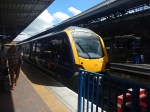
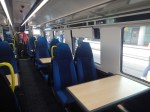
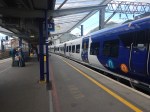
These are much better.
- They are 100 mph trains with much better acceleration.
- The train was still running the timetable for the slower trains.
With thirteen stops, I suspect that these new trains could be under fifty minutes between Manchester and Sheffield.
Will The Hope Valley Line Be Electrified?
Consider.
- Currently, the Hope Valley Line is electrified between Manchester Piccadilly and Hazel Grove stations.
- In the future, the line is likely to be electrified between Sheffield and Dore & Totley stations, in conjunction with rebuilding the Midland Main Line, to the North of Clay Cross North junction for High Speed Two.
- After the electrification at the Eastern end, just over thirty miles will be without electrification.
- The Hope Valley Line has an operating speed of 90 mph.
This Hitachi infographic shows the specification of the Hitachi Regional Battery train.

As these are a 100 mph train with a range of 90 km or 56 miles on battery power, these trains could work Manchester and Sheffield in the required time of forty minutes. provided they could be charged at the Sheffield end of the route.
TransPennine’s Class 802 trains can be fitted with batteries to become Regional Battery Trains, so it would appear that TransPennine’s services on this route could go zero-carbon.
In addition Northern, who are the other passenger operator on the route are working with CAF on battery electric trains, as I wrote about in Northern’s Battery Plans,
I don’t believe there are pressing reasons to electrify the Hope Valley Line to allow passenger trains to meet Northern Powerhouse Rail’s objective.
Will Operating Speed On The Hope Valley Line Be Increased?
Under Plans in the Wikipedia entry for the Hope Valley Line, this is said.
Network Rail, in partnership with South Yorkshire ITA, will redouble the track between Dore Station Junction and Dore West Junction, at an estimated cost of £15 million. This costing is based on four additional vehicles in traffic to deliver the option, however, this will depend on vehicle allocation through the DfT rolling stock plan. This work will be programmed, subject to funding, in conjunction with signalling renewals in the Dore/Totley Tunnel area.
Other proposals include a 3,600 feet (1,100 m) loop in the Bamford area, in order to fit in an all-day (07:00–19:00) hourly Manchester–Sheffield via New Mills Central stopping service, by extending an existing Manchester–New Mills Central service. Planning permission for this was granted in February 2018, but delays mean that this will now not be completed until 2023.
These changes to allow three fast trains, a stopping train and freight trains each hour were also supported in a Transport for the North investment report in 2019, together with “further interventions” for the Northern Powerhouse Rail programme.
It would also probably be a good idea, to increase the operating speed of the line to 100 mph where possible.
Effect On Passenger Services
100 mph trains on a track with an operating speed of 100 mph, could show some impressive timings.
On the Great Eastern Main Line, which is a very busy 100 mph double-track railway, 100 mph trains, achieve a 77 mph average for 90 minutes over the 115 miles, between London Liverpool Street and Norwich with a single stop.
A one-stop Manchester and Sheffield service at this speed would take just 33.2 minutes.
The stopping trains would be more of a challenge to get under forty minutes, but at least if they were battery electric trains, they’d have the better acceleration and deceleration of the electric trains.
- Fifty minutes would be a realistic time.
- Ten minutes turnround time at each end, would be ideal for charging the batteries and give an efficient two hour round trip.
Efficient timetabling could create a very comprehensive service for the Hope Valley Line.
Freight Trains On The Hope Valley Line
Under Freight in the Wikipedia entry for the Hope Valley Line, this is said.
Over a million tons of cement a year is taken away by rail from Earle’s Sidings at Hope.
That is a very large number of freight trains, all of which are currently hauled by diesel locomotives.
- Looking at Real Time Trains, there are nearly always two freight trains in every hour of the day.
- If you look at the routes, they go to a myriad number of destinations.
- Following the routes between Dore Junction and the quarries to the South of the Hope Valley Line, there are several tunnels.
- There are numerous quarries in a cluster, all served by their own rail lines.
Electrifying the delivery of the cement and limestone from the quarries would be a large and very expensive operation.
This Google Map shows Earle’s Sidings at Hope.
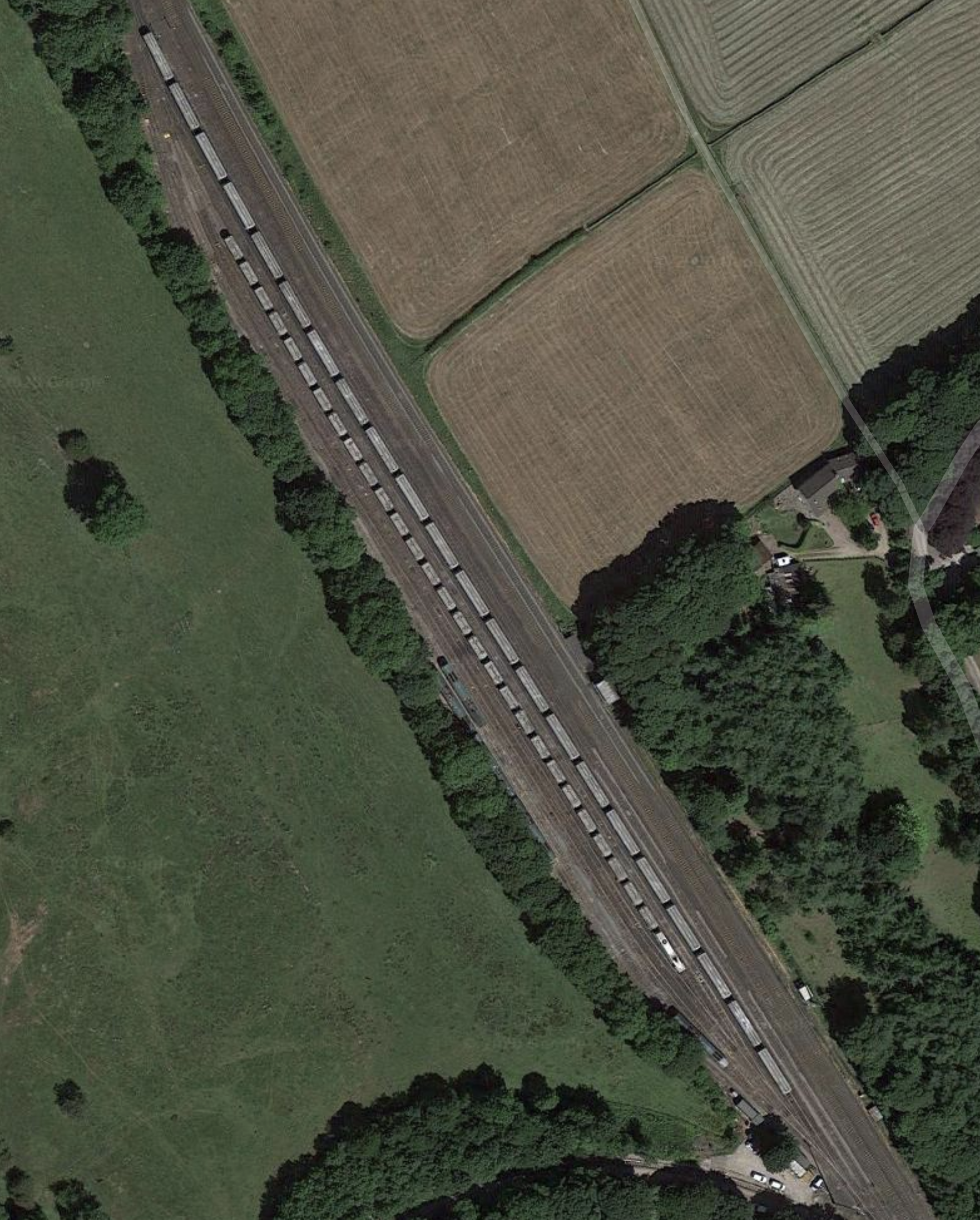
Perhaps a half-way house solution would be to use diesel to haul trains between the quarries and Earle’s sidings, where the locomotive is changed for an electric one?
- But that would then mean that all routes from between the Peak District quarries and their destinations would need to be fully-electrified.
- It should be noted that that the problem of zero-carbon trains, also exists at port and rail freight interchanges, where safe operation with 25 KVAC overhead wires everywhere can be a nightmare.
- Rail freight companies are unlikely to change their old diesel locomotives for new expensive electric locomotives, until all possible routes are fully electrified.
- It is also a big problem, all over the world.
Perhaps, what is needed is a self-powered zero-carbon locomotive with sufficient power to haul the heaviest trains?
I believe such a locomotive is possible and in The Mathematics Of A Hydrogen-Powered Freight Locomotive, I explored the feasibility of such a locomotive, which was based on a Stadler Class 68 locomotive.
The zero-carbon locomotive, that is eventually developed, may be very different to my proposal, but the commercial opportunities for such a locomotive are so large, that I’m sure the world’s best locomotive designers are working on developing powerful locomotives for all applications.
Conclusion
Northern Powerhouse Rail’s ambition for Manchester and Sheffield via the Hope Valley Line is simply stated as four tph in forty minutes. But this may be something like.
- Three fast tph in forty minutes.
- One stopping tph in perhaps fifty minutes.
- One freight tph in each direction to and from the quarries that lie to the South of the line.
I didn’t realise how close that the line is to that objective, once the following is done.
- Introduce 100 mph passenger trains on the route.
- Improve the track as has been planned for some years.
Note that all the passenger trains, that now run the route; Class 185, 195 and 802 trains, are all 100 mph trains, although they are diesel-powered.
With a length of just under 43 miles, the route is also ideal for battery electric trains to work the passenger services, be the trains be from Hitachi, CAF or another manufacturer, after High Speed Two electrifies the Midland Main Line to the North of Clay Cross North Junction, in preparation for high speed services between London and Sheffield.
I would recommend, that one of High Speed Two’s first Northern projects, should be to upgrade the Midland Main Line between Clay Cross North junction and Sheffield station to the standard that will be required for High Speed Two.
I would also recommend, that the Government sponsor the development of a hydrogen electric locomotive with this specification.
- Ability to use 25 KVAC overhead or 750 VDC electrification
- 110 mph operating speed on electrification.
- Ability to use hydrogen.
- 100 mph operating speed on hydrogen.
- 200 mile range on hydrogen.
A locomotive with this specification would go a long way to decarbonise rail freight in the UK and would have a big worldwide market.
Project Management Recommendations
This project divides neatly into three.
- Perform the upgrades at Dore Junction and add the loop in the Bamford area, as detailed in Wikipedia, which will increase the capacity of the Hope Valley Line.
- Electrify the Midland Main Line between Clay Cross North junction and Sheffield, as will be needed for High Speed Two. This electrification will allow battery electric trains to run between Manchester and Sheffield and between Sheffield and London.
- Procurement of the trains. CAF and Hitachi are currently finalising suitable designs for this type of operation.
It would also be helpful, if the freight trains could be hauled by zero-carbon hydrogen electric locomotives, to create a much-improved zero-carbon route between Manchester and Sheffield.
Northern Powerhouse Rail – A New Line Between Manchester And Leeds Via The Centre Of Bradford
In this article on Transport for the North, which is entitled Northern Powerhouse Rail Progress As Recommendations Made To Government, one of the recommendations proposed for Northern Powerhouse Rail is a new rail line between Manchester and Leeds via the centre of Bradford.
I shall look at a few of the possibilities for various sections of the route.
Current And Proposed Timings Between Manchester And Leeds
These are the current typical timings between Manchester Victoria and Leeds stations.
- 55 minutes for 43 miles, which is an average speed of 47 mph.
With Northern Powerhouse Rail, a time of 25 minutes is the objective, which is an average speed of 103.2 mph.
- As my helicopter flies it is just 35.7 miles, so a 25 minutes journey time would require an average speed of 85.7 mph.
It is obvious that a new much straighter line is needed with an operating speed of at least 100 mph.
One of the best 100 mph lines in the UK is the Great Eastern Main Line between Liverpool Street and Norwich.
- It is generally only double-track.
- The fastest services take 90 minutes for the 115 miles, which is an average speed of 77 mph.
- It is a busy line with lots of suburban services closer to London and freight trains to and from Felixstowe.
But even a line built to the standard of the Great Eastern Main Line wouldn’t be good enough for Northern Powerhouse Rail’s objective of 25 minutes.
The mathematics tell me, that a new line is needed, built as straight as possible between Manchester and Leeds.
High Speed Two’s Approach To Manchester
This map clipped from High Speed Two’s interactive map, shows the route of High Speed Two as it approaches Manchester Piccadilly station.
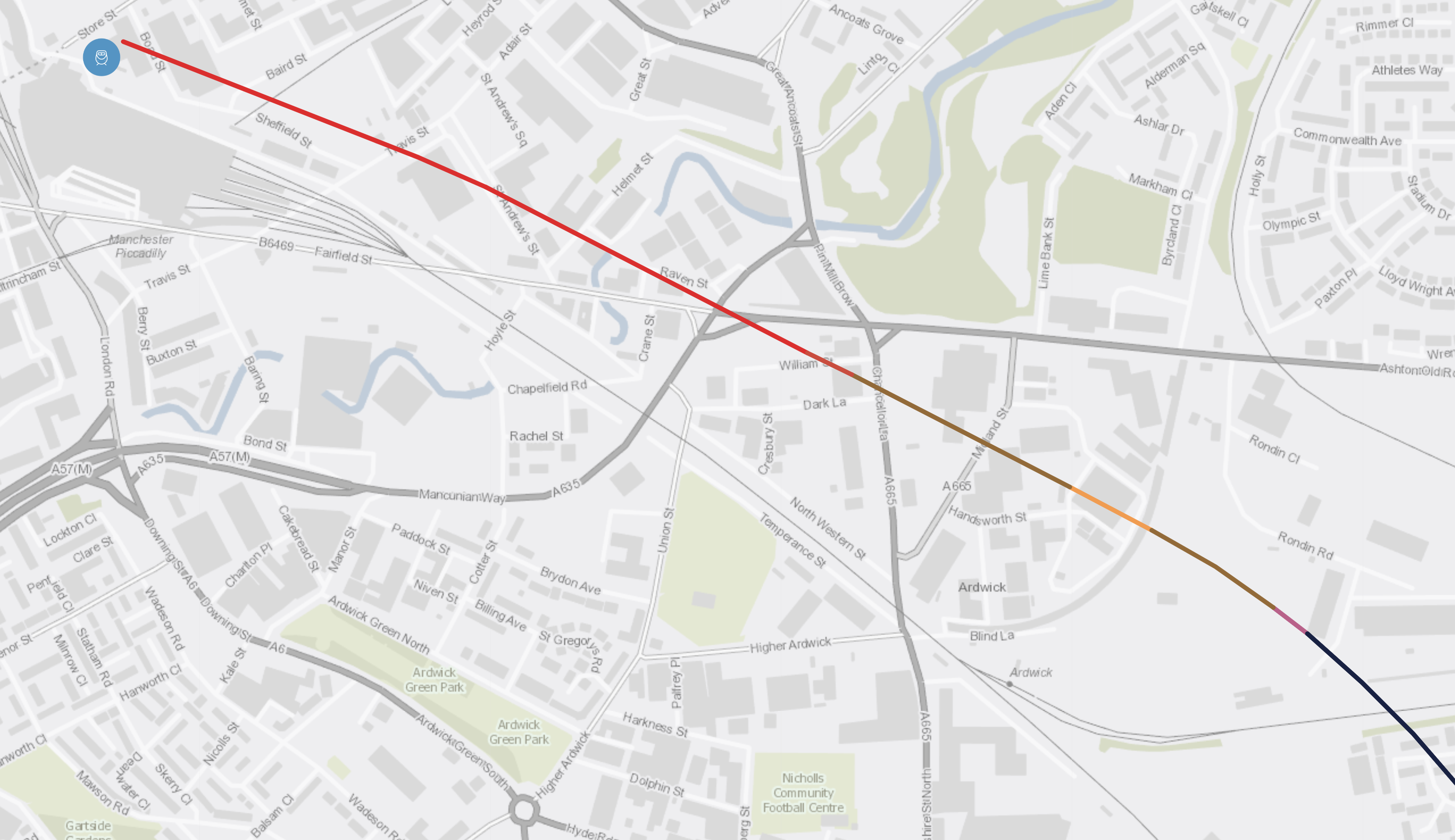
The colours of High Speed Two indicate the type of construction.
- Black is a bored tunnel. Only in the South East corner, where it continues to Manchester Airport.
- Purple is a tunnel portal.
- Brown is a track between retaining walls. Used through Manchester Interchange or Airport station.
- Red is a viaduct.
- Orange is a box structure
This Google Map shows a similar area.
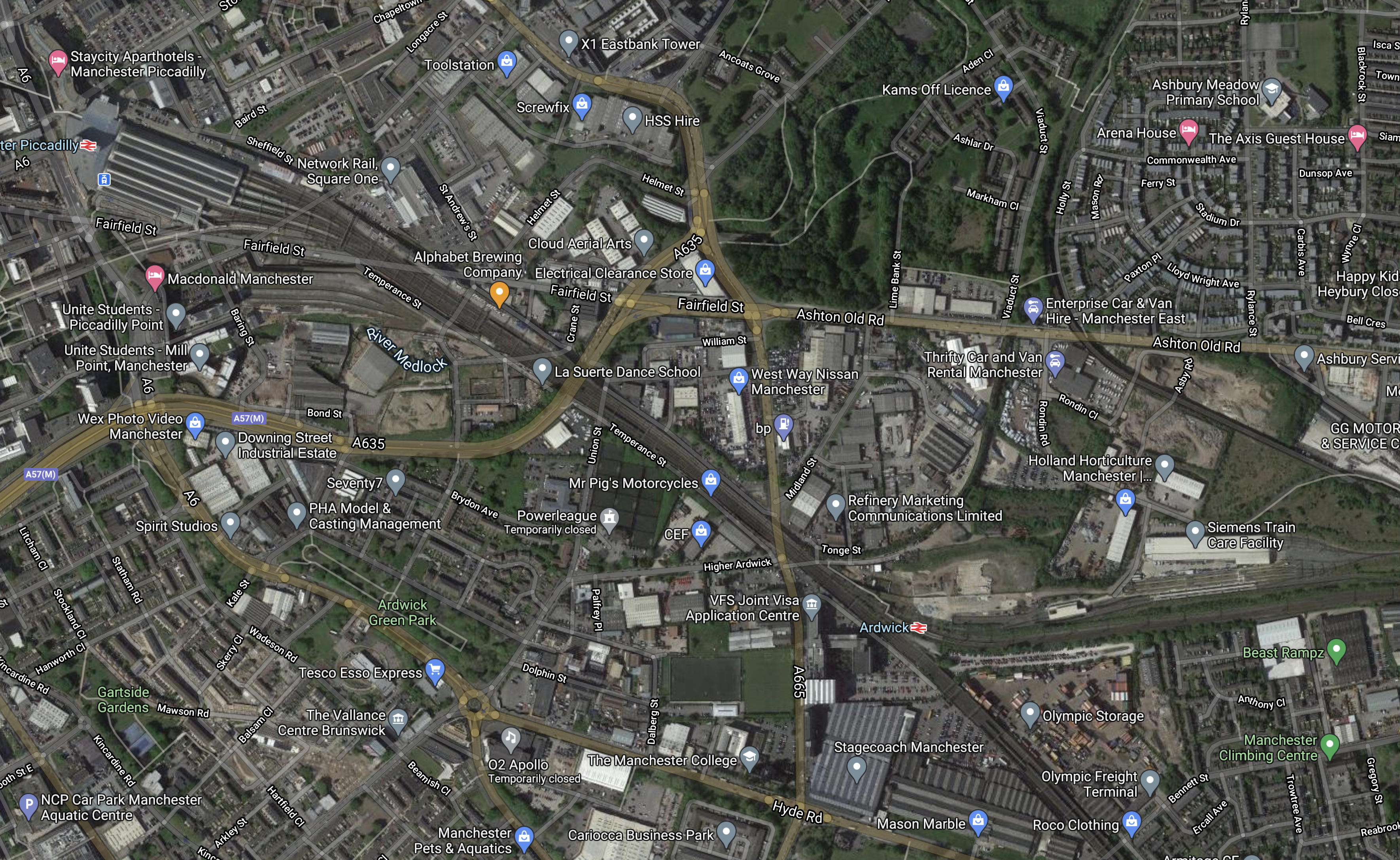
Are High Speed Two serious about demolishing a large area of Manchester to the North and East of Manchester Piccadilly station?
- It will cause massive disruption all over the centre of Manchester.
- How many businesses will be ruined by this plan?
- How many residents are there in the area?
- How will trains from the new platforms at Piccadilly station continue to Bradford, Huddersfield, Leeds and Sheffield?
- Mrs. Merton could have said “Let’s all have a reverse!” And she’d have been joking!
- You can’t go through the new platforms, as that would mean demolishing most of Manchester City Centre.
What High Speed Two are proposing is complete and utter rubbish!
In Whither HS2 And HS3?, which I wrote in May 2015, I said this.
I do think though that our designs for HS2 are rather dated and don’t take things that are happening or have happened into account.
Crossrail in London has shown that putting a large twin rail tunnel under a major city, is not the problem it once was. Crossrail have also been very innovative in creating stations with the minimum disturbance to existing infrastructure. As an example, the new Whitechapel station for Crossrail has also used a technique called uphill excavation, where you create escalator and lift shafts upwards from the tunnels, rather than traditionally from the surface, which is much more disruptive.
These techniques can revolutionise the construction of HS2.
Take cities like Birmingham, Leeds, Manchester, Newcastle and Sheffield, which have developed and are continually developing extensive local rail, tram and bus networks. So why are we in Birmingham still talking about creating an HS2 station at Curzon Street? Surely, we just dig a very deep pair of HS2 tunnels under the city and then uphill excavate into not only New Street, but Moor Street and Snow Hill as well. The tunnels would be only made as long as necessary, although the underground station could be very large. But it probably wouldn’t be much bigger than the enormous double-ended Liverpool Street/Moorgate station being created for Crossrail.
The great advantage of this method of construction is that you can continue to develop your network of local trains, trams and other transport links, untroubled by the construction of the new station deep below. Anybody, who thinks this is not possible, should spend half-an-hour walking around Whitechapel station, where the Hammersmith and City, District and East London Lines are passing untroubled over the giant hole and through the building site for the new station.
To some the example of Crossrail in London, would not be a good one, as Crossrail is years late. But the tunnelling under London and the excavations for the stations have gone well and were delivered on time.
In the related post, I went on to propose a double-ended underground station in Manchester with connections to both Piccadilly and Victoria stations. It could even have other connections to locations in the City Centre like Piccadilly Gardens.
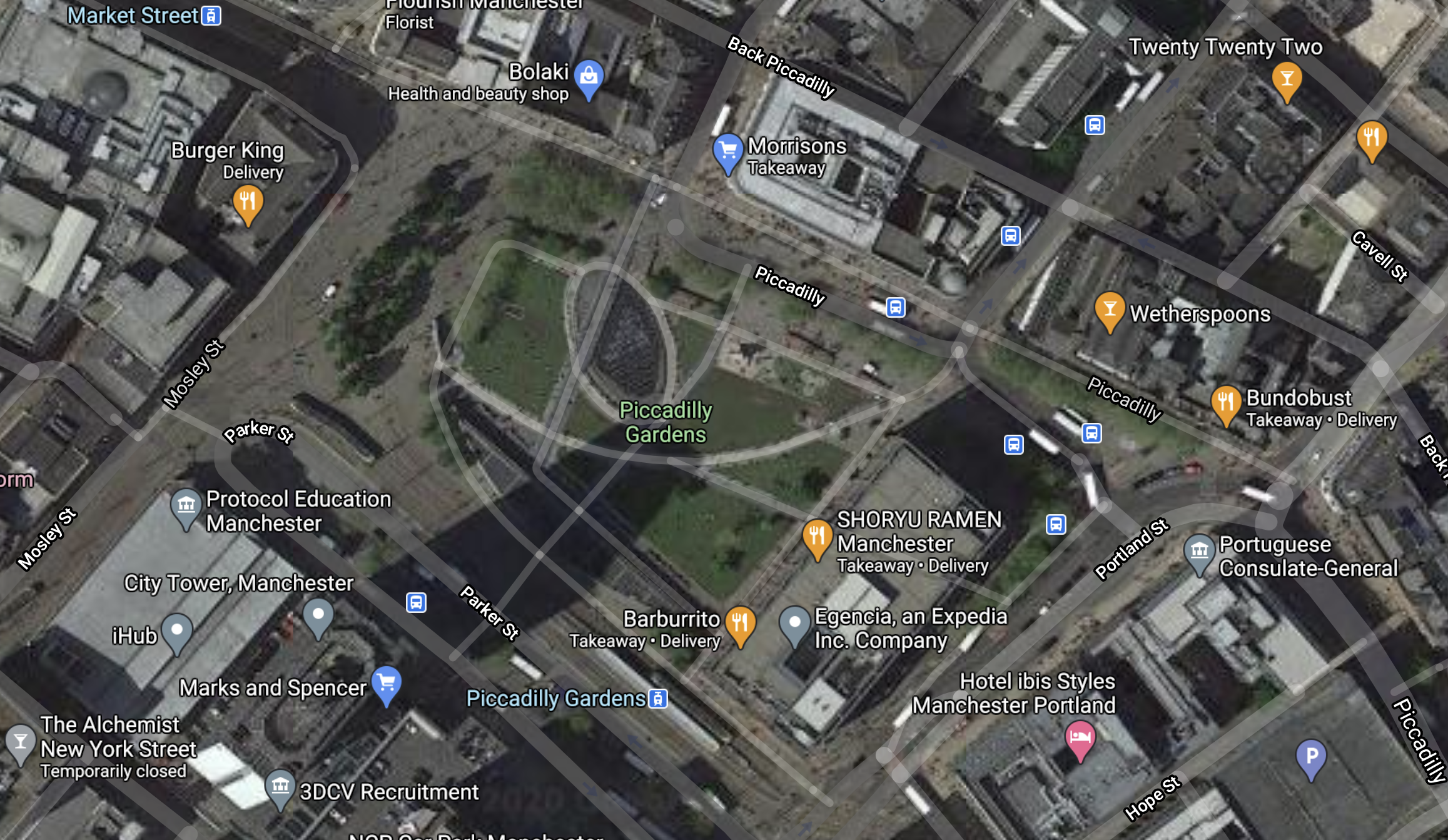
There’s certainly space for a stylish entrance at the busy tram and bus interchange.
By applying the lessons learned in the building of Crossrail and other projects like Stuttgart 21, which I wrote about in Stuttgart Hauptbahnhof, I’m sure that a massive underground station in Manchester could be built successfully, on time and on budget.
I am not alone in thinking this way. In The Rival Plans For Piccadilly Station, That Architects Say Will ‘Save Millions’, I write about a plan from world-class architects Weston Williamson, who designed the superb new London Bridge station.
This visualisation from Weston Williamson, shows their proposed station.

Note.
- In the visualisation, you are observing the station from the East.
- The existing railway lines into Piccadilly station are shown in red.
- Stockport and Manchester Airport are to the left, which is to the South.
- Note the dreaded Castlefield Corridor in red going off into the distance to Oxford Road and Deansgate stations.
- The new high speed lines are shown in blue.
- To the left they go to Manchester Airport and then on to London, Birmingham and the South, Warrington and Liverpool and Wigan, Preston, Blackpool, Barrow-in-Furness, the North and Scotland.
- To the right, they go to Huddersfield, Bradford, Leeds, Hull and the North East, and Sheffield, Doncaster and the East.
- Between it looks like a low-level High Speed station with at least four tracks and six platforms.
- The Manchester Mretrolink is shown in yellow.
- The potential for over-site development is immense. If the Station Square Tower was residential, the penthouses would be some of the most desirable places to live in the North.
This station would enable improvements to rail services in the North and Scotland.
- It would be a through station, to allow East to West services, like Liverpool and Hull.
- Fewer services would have to reverse.
- All services using the underground station, that went to the West would serve Manchester Airport.
- TransPennine services like Liverpool and Edinburgh and Liverpool and Scarborough, would use the station and also call at Manchester Airport.
- TransPennine services like Glasgow and Manchester Airport could be extended to Leeds and Hull.
- TransPennine services would not need to use the overcrowded Castlefield Corridor.
- All existing services to the main section of the existing Piccadilly station, could continue operation as now, during the construction and operation of the underground station. Some would eventually be replaced by high speed services using the underground station.
Manchester Airport would have one of the best train services of any airport in the world. It would certainly be on a par with Schiphol.
Careful alignment of the tunnels under Manchester, could also ease the building of the new line between Manchester and Leeds.
Huddersfield And Westtown (Dewsbury)
The only part of an upgraded TransPennine route between Manchester and Leeds, that is in the planning and design phase and visible to the public, is the upgrade between Huddersfield to Westtown (Dewsbury), which is described on this page of the Network Rail web site. This is the introductory paragraph.
We’re proposing an upgrade to a section of railway between Huddersfield and Westtown (Dewsbury) to deliver passenger benefits along the TransPennine railway.
Network Rail provide this very useful map.
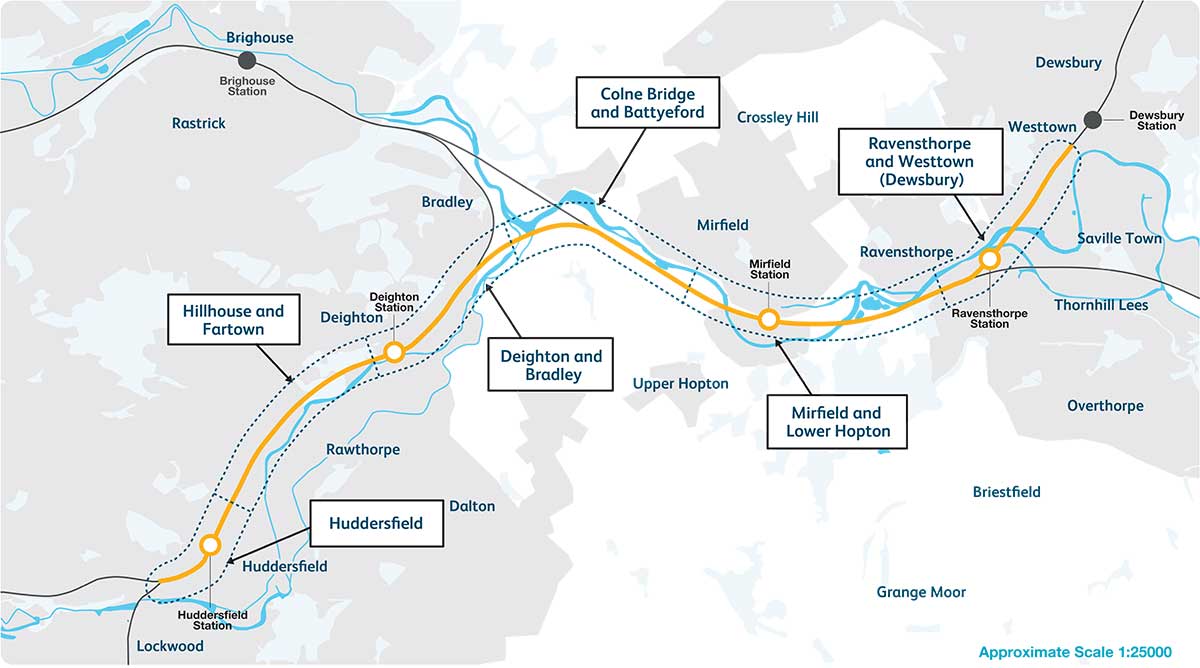
This article on Rail Technology Magazine is entitled Network Rail Reveals Detailed £2.9bn Upgrade Plans For TransPennine Route, which gives the major details of the upgrade.
- Improvement between Huddersfield and Westtown
- Grade separation or a tunnel at Ravensthorpe
- Rebuilding and electrification of eight miles of track.
- Possible doubling the number of tracks from two to four.
- Improved stations at Huddersfield, Deighton, Mirfield and Ravensthorpe.
This project would be a major improvement to the Huddersfield Line, but I have one problem with this project. – It doesn’t go anywhere near Bradford.
This Google Map shows Bradford, Leeds, Brighouse and Dewsbury.
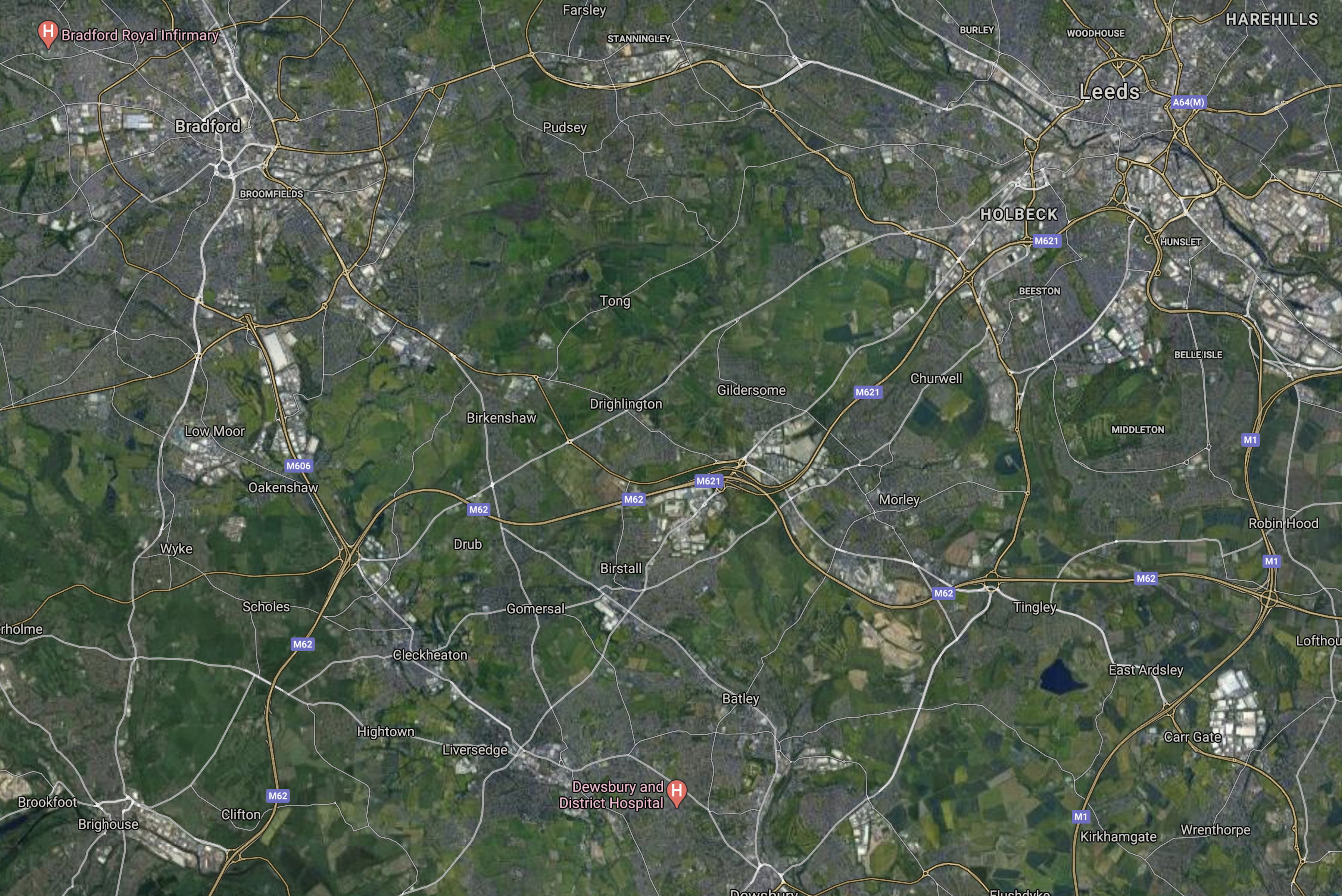
Note.
- Bradford is in the North-West corner of the map, with the red arrow marking Bradford Royal Infirmary.
- Leeds is in the North-East corner of the map.
- Brighouse is in the South-West corner of the map.
- The red arrow at the bottom of the map marks Dewsbury and District Hospital, with the towns of Morley and Dewsbury to the East.
The route Network rail are improving goes South-Westerly from Leeds and through both Morley and Leeds, before turning to the West and then going South to Huddersfield.
I am left with the conclusion, that Network Rail’s plans may do wonders for travel between Leeds and Huddersfield, but they don’t do anything for Bradford.
But the plans will have positive effects on travellers between Leeds and Manchester.
Eight Miles Of Electrification
Eight miles of electrification may not seem much, but to a Hitachi Regional Battery train, travelling at speed it is a few minutes to add some charge to the batteries, especially if the train stops at Dewsbury and/or Huddersfield stations.
This Hitachi infographic gives the specification for the Hitachi Regional Battery train.
Note.
- It has a range of 90 km or 56 miles on battery power.
- It can travel at up to 100 mph on battery power.
- TransPennine’s Class 802 trains can be converted to Regional Battery trains, by simply swapping the diesel engines for battery packs.
If these trains fully-charged their batteries on the eight miles of electrification, they could do the following.
- Going East they could easily reach Leeds, which is under ten miles from Dewsbury station. At a pinch they could even reach York, which is thirty-five miles from Dewsbury.
- Going West they could reach Manchester, which is twenty-six miles from Huddersfield station. At a pinch, they could just about reach Liverpool, which is fifty-seven miles from Huddersfield.
Note that North of York and West of Manchester are both fully electrified.
This eight miles of electrification would enable the following.
- Several of TransPennine Express services run by Class 802 trains to become all-electric services.
- Other operators like Northern could use battery electric trains for stopping services along the route.
- It might even enable some freight trains to run through the area, with hybrid power.
It looks to me, that Network Rail have chosen this section to electrify, so that it gives a lot of benefit to battery electric trains.
Will Services Be Faster Between Huddersfield And Leeds?
I estimate the the straightened track, the better acceleration of electric trains and other improvements would save up to perhaps ten minutes.
Timings between Manchester and Leeds, would probably be around 45 minutes, which is nowhere near Northern Powerhouse Rail’s objective of 25 minutes
The Problem Of Bradford
Bradford has two central stations; Bradford Interchange and Bradford Forster Square. which have no connection between them.
This Google Map shows the two stations.
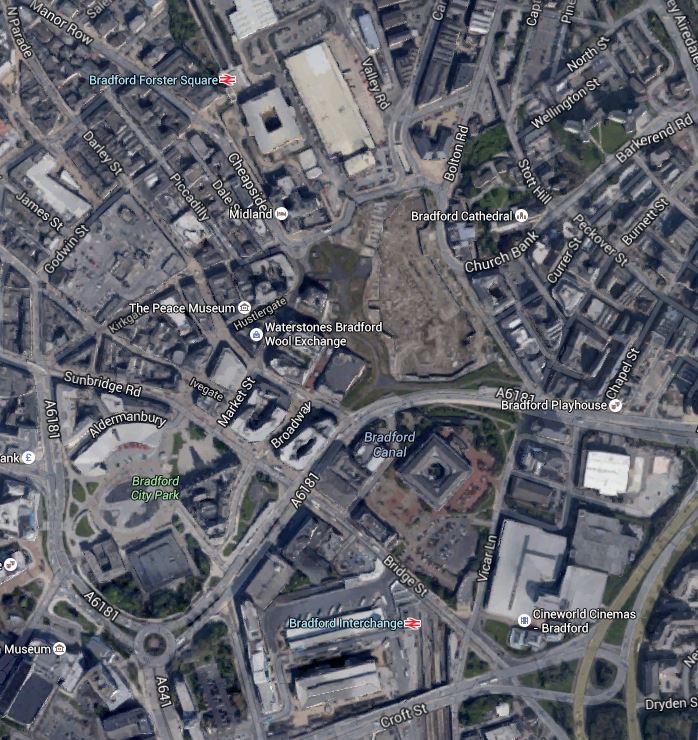
It is an area crowded with buildings between the two stations.
There is a Wikipedia entry called Bradford Crossrail, where this is said about the reasons for the two stations.
These stations were built in the nineteenth century by different railway companies with an individual, rather than a comprehensive plan for rail development in the city.
The Wikipedia entry also says this about Northern Powerhouse Rail and the city.
The Northern Powerhouse Rail project has also mooted a project to link Leeds and Manchester with a through route at Bradford. Whilst this would either involve a bypass line south of the city and a parkway station at Low Moor or a new route tunnelling through the city centre, neither option mentions connecting the lines from both north and south of the city together.
I will look at the two solutions to connect Northern Powerhouse Rail to the City.
Low Moor Station
The diagram shows the connections between Bradford Interchange, Bradford Low Moor, Huddersfield and Leeds stations.
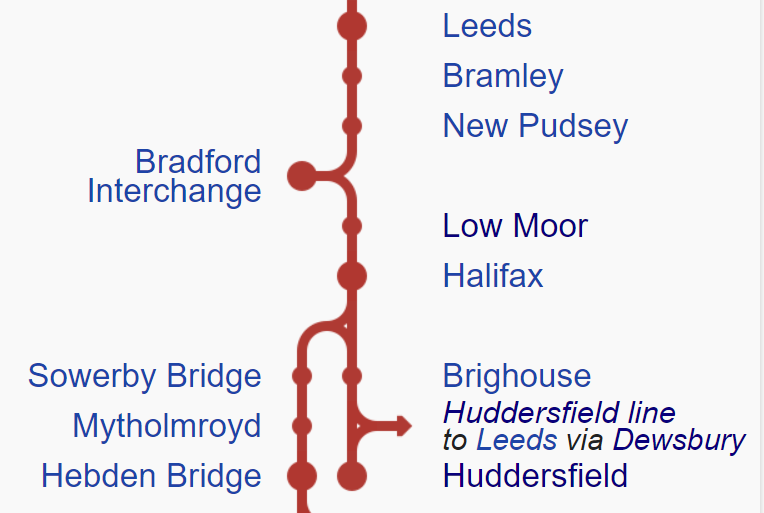
It would appear that if a connection were to be made between Low Moor and New Pudsey stations. that could be a solution.
This Google Map shows where the lines to Huddersfield and Leeds join outside Bradford Interchange station.
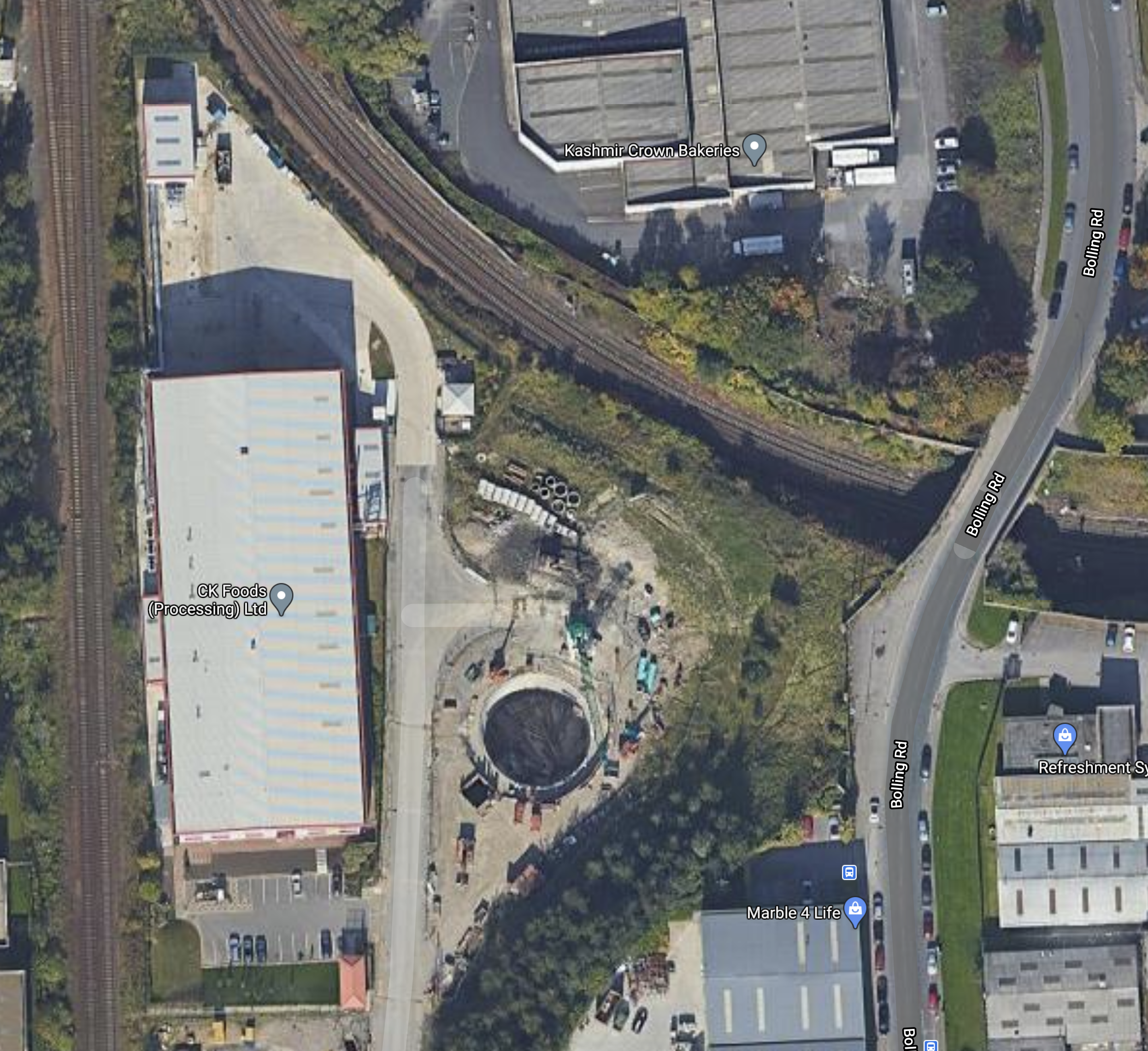
Note,
- Bradford Interchange station is to the North.
- Bradford Low Moor station is to the South.
- New Pudsey station is to the East.
I suspect it would be possible to create a curve that allowed trains to go between Bradford Low Moor and New Pudsey stations, but I doubt it would be a fast route.
A Bradford Tunnel
This would be the bold option, where all sorts of routes could be possible.
- It could go under the City Centre in such a way, that it had pedestrian connections to both current stations and important places with a large number of visitors.
- It could connect to Huddersfield in the West and Leeds in the East.
- It might even loop under the City Centre, as the Wirral Line does under Liverpool.
A tunnel under the City, would be my preferred solution.
A Tunnel Between Manchester And Leeds
So far, various people or organisations have advocated the following tunnels on the route.
- High Speed Two are proposing a tunnel between Manchester Airport and Manchester City Centre.
- Weston Williamson are proposing a Manchester High Speed station underneath Manchester Piccadilly station.
- A tunnel has been proposed to connect to Bradford City Centre.
I feel strongly, that a tunnel can be built under the Pennines to link Manchester and Leeds.
Rail Tunnels through the Pennines have been dug before, notably at Standedge, Totley and Woodhead.
I answered the question in detail in Will HS2 And Northern Powerhouse Rail Go For The Big Bore? and this was the conclusion of that post.
I believe that my naïve analysis in this post shows that a TransPennine tunnel is possible.
But I believe that the right tunnel could have one big advantage.
Suppose it was built to handle the following.
-
- A capacity of eighteen tph, which is the same as High Speed Two.
- An operating speed of 140 mph or more. The Gotthard Base Tunnel has a maximum operating speed of 160 mph.
- High Speed Two’s Full-Size trains.
- The largest freight trains
It would be future proofed for longer than anybody could envisage.
There are also other smaller advantages.
-
- It would by-pass a lot of difficult areas.
- It would cause very little aural and visual disruption.
- IIf it were designed with care, it would not affect the flora and fauna.
- As with the Swiss tunnel, it could be dug level, which would save energy and allow trains to run faster.
- It could be running twelve tph between Leeds and Manchester Airport via Bradford, Huddersfield and Manchester Piccadilly.
- Existing surface railways at the Eastern end could serve Cleethorpes, Darlington, Doncaster, Edinburgh, Hull, Middlesbrough, Newcastle, Scarborough, Sheffield and York
- Existing surface railways at the Western end could serve Barrow, Blackpool, Carlisle, Chester, Glasgow, Liverpool. North Wales, Preston and Wigan.
It would be more like Thameslink for the North turned on its side, rather than Crossrail for the North.
Would such a TransPennine tunnel be realisable?
Consider.
- 3D design software has improved tremendously over the last decade.
- The Swiss have shown that these long tunnels can be built through solid rock.
- There is plenty of space to put the tunnel.
- It doesn’t have to be one continuous tunnel.
- It might be possible to built it as a base tunnel, which would be low down and level between two valleys on either side of the Pennines.
I think there could be a lot of flexibility on how the tunnel would be designed and built.
Conclusion
A Manchester and Leeds tunnel via Bradford, could be one of the boldest projects ever undertaken in the UK.
I believe that we have the capabilities to build it.
Project Management Recommendations
This is a large project that will take several years.
- But the Swiss have dug the Gotthard Base Tunnel of a similar size through solid rock in recent years.
- It would be a political symbol to the North, that Government is serious about levelling up.
- In thirty years or so, it won’t be found to have been built with inadequate capacity.
Other projects, such as the Huddersfield and Westtown Improvement will hold the fort, whilst the tunnel is built.
How Many Trains Are Needed To Run A Full Service On High Speed Two?
The latest High Speed Two schedule was published in the June 2020 Edition of Modern Railways.
The Two Train Classes
Two separate train classes have been proposed for High Speed Two.
Full-Size – Wider and taller trains built to a European loading gauge, which would be confined to the high-speed network (including HS1 and HS2) and other lines cleared to their loading gauge.
Classic-Compatible – Conventional trains, capable of high speed but built to a British loading gauge, permitting them to leave the high speed track to join conventional routes such as the West Coast Main Line, Midland Main Line and East Coast Main Line.
The Wikipedia entry for High Speed Two has a section entitled Rolling Stock, where this is said about the design.
Both types of train would have a maximum speed of at least 360 km/h (225 mph) and a length of 200 metres (660 ft); two units could be joined together for a 400-metre (1,300 ft) train. It has been reported that these longer trains would have approximately 1,100 seats.
These are some of my thoughts.
Seating Density
I would assume that this means that a single 200 metre train, will have a capacity of approximately 550 seats or a density of 2.75 seats per metre. How does that compare with other trains?
- 9-car Class 801 train – 234 metres – 611 seats – 2.61 seats/metre
- 7-car Class 807 train – 182 metres – 453 seats – 2.49 seats/metre
- 9-car Class 390 train – 217.5 metres – 469 seats – 2.16 seats/metre
- 11-car Class 390 train – 265.3 metres – 589 seats – 2.22 seats/metre
- 12-car Class 745/1 train – 236.6 metres – 767 seats – 3.24 seats/metre
- 16-car Class 374 train – 390 metres – 902 seats – 2.31 seats/metre
Note.
- What I find strange with these figures, is that I feel most crowded and cramped in a Class 390 train. Could this be because the Pendelino trains are eighteen years old and train interior design has moved on?
- But I always prefer to travel in a Hitachi Class 80x train or a Stadler Class 745 train.
I very much feel that a seating density of 2.75 seats per metre, designed using some of the best modern practice, could create a train, where travelling is a very pleasant experience.
Step-Free Access
I have travelled in high speed trains all over Europe and have yet to travel in one with step-free access.
Surely, if Stadler can give their trains step-free access everybody can.
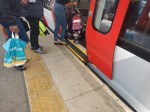
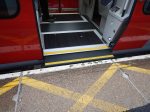
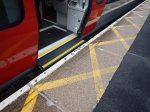
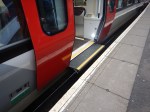
The pictures shows step-free access on Stadler Class 745 and Class 755 trains.
If I turned up pushing a friend in a wheelchair, would I be able to push them in easily? Or better still will they be able to wheel themselves in?
A Greater Anglia driver tp;d me recently, that now they never have to wait anymore for wheelchairs to be loaded.
So surely, it is in the train operator’s interest to have step-free access, if it means less train delays.
Double-Deck Trains
In my view double-deck trains only have one only good feature and that is the ability to see everything, if you have a well-designed window seat.
I may be seventy-three, but I am reasonably fit and only ever travel on trains with airline-sized hand baggage. So I don’t find any problem travelling upstairs on a double-deck bus or train!
But it could have been, so very different, if my stroke had been a bit worse and left me blind or in a wheelchair for life.
I have seen incidents on the Continent, which have been caused by double-deck trains.
- A lady of about eighteen in trying to get down with a heavy case dropped it. Luckily it only caused the guy she was travelling with, to roll unhurt down the stairs.
- Luggage is often a problem on Continental trains because of the step-up into the train and access is worse on double deck trains.
- I also remember on a train at Leipzig, when several passengers helped me lift a guy and his wheelchair out of the lower deck of a double-deck train, which was lower than the platform, as they often are with double-deck trains.
I am not totally against double-deck trains, but they must be designed properly.
Consider.
- High Speed Two’s Full-Size trains will only use London Euston, Old Oak Common, Birmingham Interchange, Birmingham Curzon Street, Manchester Airport, Manchester Piccadilly, East Midlands Hub and Leeds stations.
- All stations used by Full-Size trains will be brand-new or substantially rebuilt stations.
- Someone sitting in a wheelchair surely has the same right to a view from the top-deck of a double-deck train as anybody else.
- Jumbo jets seemed to do very well without a full-length top-deck.
- The A 380 Superjumbo has been designed so that entry and exit on both decks is possible.
I feel if High Speed Two want to run double-deck trains, an elegant solution can surely be found.
A Crude Estimate On The Number Of Trains
This is my crude estimate to find out how many trains, High Speed Two will need.
Western Leg
These are the services for the Western Leg between London , Birmingham, Liverpool, Manchester, Edinburgh and Glasgow.
- Train 1 – London Euston and Birmingham Curzon Street – 400 metre Full-Size – 45 minutes – 2 hour Round Trip – 4 trains
- Train 2 – London Euston and Birmingham Curzon Street – 400 metre Full-Size – 45 minutes – 2 hour Round Trip – 4 trains
- Train 3 – London Euston and Birmingham Curzon Street – 400 metre Full-Size – 45 minutes – 2 hour Round Trip – 4 trains
- Train 4 – London Euston and Lancaster – Classic Compatible – 2 hours 3 minutes – 5 hour Round Trip – 5 trains
- Train 4 – London Euston and Liverpool – Classic Compatible – 1 hours 34 minutes – 4 hour Round Trip – 4 trains
- Train 5 – London Euston and Liverpool – Classic Compatible – 1 hours 34 minutes – 4 hour Round Trip – 4 trains
- Train 6 – London Euston and Macclesfield – Classic Compatible – 1 hours 30 minutes – 4 hour Round Trip – 4 trains
- Train 7 – London Euston and Manchester – 400 metre Full-Size – 1 hour and 11 minutes – 3 hour Round Trip – 6 trains
- Train 8 – London Euston and Manchester – 400 metre Full-Size – 1 hour and 11 minutes – 3 hour Round Trip – 6 trains
- Train 9 – London Euston and Manchester – 400 metre Full-Size – 1 hour and 11 minutes – 3 hour Round Trip – 6 trains
- Train 10 – London Euston and Edinburgh – Classic Compatible – 3 hours 48 minutes – 8 hour Round Trip – 8 trains
- Train 10 – London Euston and Glasgow – Classic Compatible – 3 hours 40 minutes – 8 hour Round Trip – 8 trains
- Train 11 – London Euston and Edinburgh – Classic Compatible – 3 hours 48 minutes – 8 hour Round Trip – 8 trains
- Train 11 – London Euston and Glasgow – Classic Compatible – 3 hours 40 minutes – 8 hour Round Trip – 8 trains
- Train 12 – Birmingham Curzon Street and Edinburgh or Glasgow – Classic Compatible – 3 hours 20 minutes – 7 hour Round Trip – 7 trains
- Train 13 – Birmingham Curzon Street and Manchester – 200 metre Full-Size – 41 minutes – 2 hour Round Trip – 2 trains
- Train 14 – Birmingham Curzon Street and Manchester – 200 metre Full-Size – 41 minutes – 2 hour Round Trip – 2 trains
Note.
- I have assumed 400 metre Full-Size trains will be a pair of 200 metre trains.
- Trains 4, 10 and 11 are pairs of 200 metre long Classic-Compatible trains, that split and join at Crewe. Carlisle and Carlisle respectively.
- Trains 5 and 6 are single 200 metre long Classic-Compatible trains.
- The full schedule will need 34 Full-Size trains and 56 Classic-Compatible trains
According to Wikipedia, the first order will be for 54 Classic-Compatible trains, so I would assume, that more trains will be ordered.
Eastern Leg
These are the services for the Eastern Leg between London , Birmingham, East Midlands Hub, Leeds, Sheffield, York and Newcastle.
- Train 15 – Birmingham Curzon Street and Leeds – 200 metre Full-Size – 49 minutes – 2 hour Round Trip – 2 trains
- Train 16 – Birmingham Curzon Street and Leeds – 200 metre Full-Size – 49 minutes – 2 hour Round Trip – 2 trains
- Train 17 – Birmingham Curzon Street and Newcastle – Classic Compatible – 1 hour 57 minutes – 5 hour Round Trip – 5 trains
- Train 18 – London Euston and Sheffield – Classic Compatible – 1 hour 27 minutes – 4 hour Round Trip – 4 trains
- Train 18 – London Euston and Leeds – Classic Compatible – 1 hour 21 minutes – 3 hour Round Trip – 3 trains
- Train 19 – London Euston and Leeds – 400 metre Full-Size – 1 hour and 21 minutes – 3 hour Round Trip – 6 trains
- Train 20 – London Euston and Leeds – 400 metre Full-Size – 1 hour and 21 minutes – 3 hour Round Trip – 6 trains
- Train 21 – London Euston and Sheffield – Classic Compatible – 1 hour 27 minutes – 4 hour Round Trip – 4 trains
- Train 21 – London Euston and York – Classic Compatible – 1 hour 24 minutes – 3 hour Round Trip – 3 trains
- Train 22 – London Euston and Newcastle – Classic Compatible – 2 hour 17 minutes – 5 hour Round Trip – 5 trains
- Train 23 – London Euston and Newcastle – Classic Compatible – 2 hour 17 minutes – 5 hour Round Trip – 5 trains
Note.
- I have assumed 400 metre Full-Size trains will be a pair of 200 metre trains.
- Trains 15 and 16 work as a pair,
- Trains 18 and 21 are pairs of 200 metre long Classic-Compatible trains, that split and join at East Midlands Hub.
- Trains 22 and 23 are single 200 metre long Classic-Compatible trains
- The full schedule will need 16 Full-Size trains and 29 Classic-Compatible trains.
Adding the two legs together and I estimate that 50 Full-Size trains and 85 Classic-Compatible trains, will be needed to run a full schedule.
Trains Per Hour On Each Section
It is possible to make a table of how many trains run on each section of the High Speed Two network in trains per hour (tph)
- London Euston (stops) – 1-11, 18-23 – 17 tph
- London Euston and Old Oak Common – 1-11, 18-23 – 17 tph
- Old Oak Common (stops) – 1-11, 18-23 – 17 tph
- Old Oak Common and Birmingham Interchange – 1-11, 18-23 – 17 tph
- Birmingham Interchange (stops) – 2, 3, 7, 11, 20 – 5 tph
- Birmingham Curzon Street (stops) – 1-3, 12-14, 15-17 – 9 tph
- Birmingham and Crewe – 4,5, 7-9, 10-14 – 10 tph
- Crewe (stops) – 4,5 – 2 tph
- Crewe and Liverpool – 4,5 – 2 tph
- Crewe and Lancaster – 4, 10-12 – 4 tph
- Crewe and Manchester – 7-9, 13, 14 – 5 tph
- Crewe and Wigan via Warrington – 4 – 1 tph
- Crewe and Wigan via High Speed Two (new route) – 10-12 – 3 tph
- Lancaster (stops) 4 – 1 tph
- Lancaster and Carlisle – 10-12 – 3 tph
- Carlisle and Edinburgh – 10-12 – 2.5 tph
- Carlisle and Glasgow – 10-12 – 2.5 tph
- Birmingham and Stoke – 6 – 1 tph
- Stoke (stops) – 6 – 1 tph
- Stoke and Macclesfield – 6 – 1 tph
- Macclesfield (stops) – 6 – 1 tph
- Birmingham and East Midlands Hub – 15-17, 18-20, 21-23 – 9 tph
- East Midlands Hub (stops) – 15-17, 18-20, 21 – 7 tph
- East Midlands Hub and Sheffield – 18, 21 – 2 tph
- Sheffield (stops) – 18, 21 – 2 tph
- Midlands Hub and Leeds – 15, 16, 18-20 – 5 tph
- Leeds (stops) – 15, 16, 18-20 – 5 tph
- East Midlands Hub and York – 17, 21-23 – 4 tph
- York (stops) – 17, 21-23 – 4 tph
- York and Newcastle – 17, 22, 23 – 3 tph
- Newcastle (stops) – 17, 22, 23 – 3 tph
These are a few thoughts.
Capacity Of The Southern Leg
The busiest section is between London Euston and Birmingham Interchange, which handles 17 tph.
As the maximum capacity of High Speed Two is laid down in the Phase One Act as 18 tph, this gives a path for recovery, according to the article.
Trains Serving Euston
The following train types serve London Euston station.
- Full-Size – 8 tph
- 400 metre Classic-Compatible – 5 tph
- 200 metre Classic-Compatible – 4 tph
In the current service proposal, , Trains 5,6, 22 and 23 are just single 200 metre Classic Compatible trains.
This is inefficient and another four tph could be run into Euston station, by the use of appropriate splitting and joining.
- Train 5 could run an identical manner to Train 4 to give extra services to Lancaster, Preston, Wigan North Western and Warrington Bank Quay.
- Train 6 to Macclesfield is a problem and perhaps should call at Birmingham Interchange, where it could split and join to serve somewhere else like Wolverhampton and Shrewsbury.
- Trains 22 and 23 could split and join at East Midlands Hub and serve other places in the East of England like Cleethorpes, Hull, Lincoln, Middlesbrough and Scarborough.
Paths are expensive entities to provide and every path into Euston should support a 400 metre train or a pair of 200 metre trains.
Platform Use At Euston
This page on the High Speed Two web site, gives details of Euston High Speed Two station.
HS2 will deliver eleven new 400m long platforms, a new concourse and improved connections to Euston and Euston Square Underground stations. Our design teams are also looking at the opportunity to create a new northerly entrance facing Camden Town as well as new east-west links across the whole station site.
So how will the eleven platforms be used?
Destinations served from London are planned to be as follows.
- Birmingham Curzon Street – Full-Size – 3 tph
- Edinburgh/Glasgow – Classic-Compatible – 2 tph
- Lancaster – Classic-Compatible – 1 tph
- Leeds – Full-Size – 2 tph – Classic-Compatible – 1 tph
Liverpool – Classic-Compatible – 2 tph
- Macclesfield – Classic-Compatible – 1 tph
- Manchester Piccadilly – Full-Size – 3 tph
- Newcastle – Classic-Compatible – 2 tph
- Sheffield – Classic-Compatible – 2 tph
- York – Classic-Compatible – 1 tph
That is ten destinations and there will be eleven platforms.
I like it! Lack of resources is often the reason systems don’t work well and there are certainly enough platforms.
Could platforms be allocated something like this?
- Birmingham Curzon Street – Full-Size
- Edinburgh/Glasgow – Classic-Compatible
- Leeds – Full-Size
- Liverpool – Classic-Compatible – Also serves Lancaster
- Macclesfield – Classic-Compatible
- Manchester Piccadilly – Full-Size
- Newcastle – Classic-Compatible
- Sheffield – Classic-Compatible – Also serves Leeds and York
Note.
- No platform handles more than three tph.
- There are three spare platforms.
- Each platform would only be normally used by one train type.
- Only Birmingham Interchange, East Midlands Hub, Leeds, Preston and York are not always served from the same platform.
Platform arrangements could be very passenger- and operator-friendly.
Platform Use At Birmingham Curzon Street
Birmingham Curzon Street station has been designed to have seven platforms.
Destinations served from Birmingham Curzon Street station are planned to be as follows.
- Edinburgh/Glasgow – Classic-Compatible – 1 tph
- Leeds – Full-Size – 2 tph
- London Euston – Full-Size – 3 tph
- Manchester Piccadilly – Full-Size – 2 tph
- Newcastle – Classic-Compatible – 1 tph
- Nottingham – Classic-Compatible – 1 tph
Note.
- The Nottingham service has been proposed by Midlands Engine Rail, but will be running High Speed Two Classic Compatible trains.
- That is six destinations and there will be seven platforms.
I like it! For the same reason as London Euston.
Could platforms be allocated something like this?
- Edinburgh/Glasgow – Classic-Compatible
- Leeds – Full-Size
- London Euston – Full-Size
- Manchester Piccadilly – Full-Size
- Newcastle/Nottingham – Classic-Compatible
Note.
- No platform handles more than three tph.
- There are two spare platforms.
- Each platform would only be normally used by one train type.
- Only East Midlands Hub is not always served from the same platform.
Platform arrangements could be very passenger- and operator-friendly.
Back-to-Back Services via Birmingham Curzon Street
The current plan for High Speed Two envisages the following services between the main terminals served by Full-Size trains.
- London Euston and Birmingham Curzon Street – 3 tph – 45 minutes
- London Euston and Leeds – 2 tph – 81 minutes
- London Euston and Manchester Piccadilly – 3 tph – 71 minutes
- Birmingham Curzon Street and Leeds – 2 tph – 40 minutes
- Birmingham Curzon Street and Manchester Piccadilly – 2 tph – 41 minutes
Suppose a traveller wanted to go between East Midlands Hub and Manchester Airport stations.
Wouldn’t it be convenient if the Leeds to Birmingham Curzon Street train, stopped in Birmingham Curzon Street alongside the train to Manchester Airport and Piccadilly, so passengers could just walk across?
Or the two services could be run Back-to-Back with a reverse in Birmingham Curzon Street station?
Note.
- The current fastest times between Nottingham and Manchester Airport stations are around two-and-a-half hours, with two changes.
- With High Speed Two, it looks like the time could be under the hour, even allowing up to eight minutes for the change at Birmingham Curzon Street.
The design of the track and stations for High Speed Two, has some interesting features that will be exploited by the train operator, to provide better services.
Capacity Of The Western Leg Between Birmingham And Crewe
The section is between Birmingham and Crewe, will be running 10 tph.
As the maximum capacity of High Speed Two is laid down in the Phase One Act as 18 tph, this gives plenty of room for more trains.
But where will they come from?
High Speed One copes well with a few interlopers in the shape of Southeastern’s Class 395 trains, which run at 140 mph, between the Eurostars.
High Speed Two is faster, but what is to stop an operator running their own Classic-Compatible trains on the following routes.
- Birmingham Curzon Street and Liverpool via Crewe, Runcorn and Liverpool South Parkway.
- Birmingham Curzon Street and Holyhead via Crewe, Chester and an electrified North Wales Coast Line.
- Birmingham Curzon Street and Blackpool via Crewe, Warrington Bank Quay, Wigan North Western and Preston.
- Birmingham Curzon Street and Blackburn and Burnley via Crewe, Warrington Bank Quay, Wigan North Western and Preston.
Note.
- If these trains were say 130 metres long, they could call at all stations, without any platform lengthening.
- I’m sure that the clever engineers at Hitachi and Hyperdrive Innovation could come up with battery electric Classic-Compatible train, that could run at 225 mph on High Speed Two and had a battery range to reach Holyhead, with a small amount of electrification.
- A pair of trains, could work the last two services with a Split/Join at Preston.
The advantages of terminating these service in Birmingham Curzon Street would be as follows.
- A lot more places get a fast connection to the High Speed Two network.
- Passengers can reach London with an easy change at Birmingham Curzon Street station.
- They can also walk easily between the three Birmingham stations.
But the big advantage is the trains don’t use valuable paths on High Speed Two between Birmingham Curzon Street and London Euston.
Crewe Station
In the current Avanti West Coast timetable, the following trains pass through Crewe.
- London Euston and Blackpool – 4 trains per day (tpd)
- London Euston and Chester – 1 tph
- London Euston and Edinburgh/Glasgow – 2 tph
- London Euston and Liverpool – 1 tph
- London Euston and Manchester Piccadilly – 1 tph
Most trains stop at Crewe.
In the proposed High Speed Two timetable, the following trains will pass through Crewe.
- London Euston and Edinburgh/Glasgow – 2 tph
- London Euston and Lancaster/Liverpool – 2 tph
- London Euston and Manchester – 3 tph
- Birmingham Curzon Street and Edinburgh/Glasgow -1 tph
- Birmingham Curzon Street and Manchester – 2 tph
Note.
- Only the Lancaster and Liverpool trains stop at Crewe station.
- North of Crewe there will be a three-way split of High Speed Two routes to Liverpool, Wigan and the North and Manchester Airport and Piccadilly.
- High Speed Two will loop to the East and then join the West Coast Main Line to the South of Wigan.
- High Speed Two trains will use the West Coast Main Line to the North of Wigan North Western station.
This map of High Speed Two in North West England was captured from the interactive map on the High Speed Two web site.

Note.
- The current West Coast Main Line (WCML) and Phase 2a of High Speed Two are shown in blue.
- Phase 2b of High Speed Two is shown in orange.
- The main North-South route, which is shown in blue, is the WCML passing through Crewe, Warrington Bank Quay and Wigan North Western as it goes North.
- The Western Branch, which is shown in blue, is the Liverpool Branch of the WCML, which serves Runcorn and Liverpool.
- High Speed Two, which is shown in orange, takes a faster route between Crewe and Wigan North Western.
- The Eastern Branch, which is shown in orange, is the Manchester Branch of High Speed Two, which serves Manchester Airport and Manchester Piccadilly.
- The route in the East, which is shown in blue, is the Macclesfield Branch of High Speed Two, which serves Stafford, Stoke-on-Trent and Macclesfield.
The route of Northern Powerhouse Rail between Manchester Airport and Liverpool has still to be finalised.
Liverpool Branch
Consider.
- The Liverpool Branch will take two tph between London Euston and Liverpool.
- In the future it could take up to 6 tph on Northern Powerhouse Rail between Liverpool and Manchester Piccadilly via Manchester Airport.
I believe that Liverpool Lime Street station, after the recent updating can handle all these trains.
Manchester Branch
This document on the Government web site is entitled HS2 Phase 2b Western Leg Design Refinement Consultation.
It indicates two important recently-made changes to the design of the Manchester Branch of High Speed Two.
- Manchester Airport station will have four High Speed platforms instead of two.
- Manchester Piccadilly station will have six High Speed platforms instead of four.
These changes will help the use of these stations by Northern Powerhouse Rail..
Consider.
- The Manchester Branch will be new high speed track, which will probably be built in a tunnel serving Manchester Airport and Manchester Piccadilly stations.
- The Manchester Branch will terminate in new platforms.
- The Manchester Branch will take five tph between Birmingham Curzon Street or London Euston and Manchester Airport and Manchester Piccadilly.
- In the future it could take up to six tph on Northern Powerhouse Rail between Liverpool and Manchester Piccadilly via Manchester Airport.
- London Euston and Old Oak Common will be new stations on a tunnelled approach to London and will handle 18 tph.
If London Euston and Old Oak Common can handle 18 tph, I can’t see why Manchester Airport and Piccadilly stations can’t handle somewhere near a similar number of trains.
At the moment eleven tph have been allocated to the Manchester Branch.
I believe that if infrastructure for Northern Powerhouse Rail was designed so that as well as connecting to Manchester and Liverpool, it connected Manchester and the West Coast Main Line running North to Preston, Carlisle and Scotland, services to the following destinations would be possible.
- Barrow
- Blackburn
- Blackpool
- Edinburgh
- Glasgow
- Windermere
Note.
- Edinburgh and Glasgow would probably be a service that would alternate the destination, as it is proposed for High Speed Two’s Birmingham and Scotland service.
- There would probably be a need for a North Wales and Manchester service via Chester.
- All trains would be Classic-Compatible.
If the Manchester Branch were to be built to handle 18 tph, there would be more than enough capacity.
Crewe, Wigan And Manchester
My summing up earlier gave the number of trains between Crewe, Wigan and Manchester as follows.
- Crewe and Manchester – 5 tph
- Crewe and Wigan via Warrington – 1 tph
- Crewe and Wigan via High Speed Two (new route) – 3 tph
This map of High Speed Two where the Manchester Branch leaves the new High Speed Two route between Crewe and Wigan was captured from the interactive map on the High Speed Two web site.
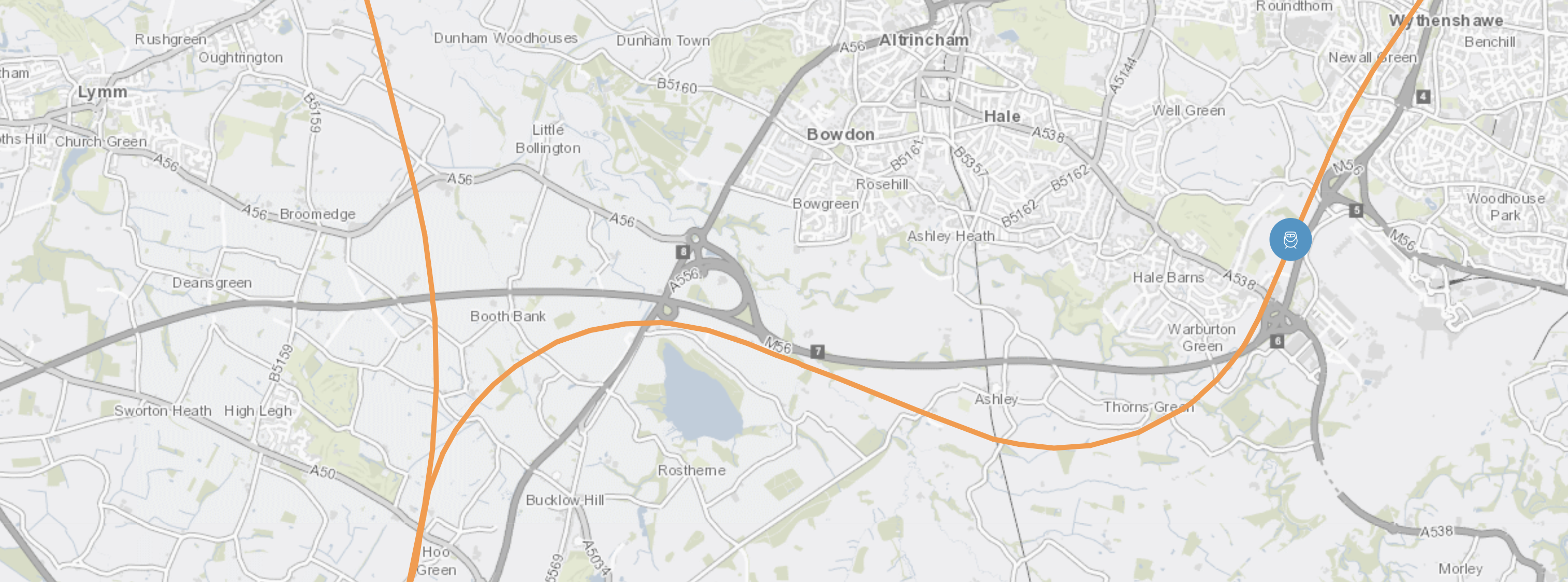
Note.
- The Manchester Branch runs to the South of the M56,
- The large blue dot indicates Manchester Airport station.
- Wigan is to the North.
- Crewe is to the South.
- Manchester Piccadilly is to the North East.
I believe this junction will be turned into a full triangular junction, to connect Wigan directly to Manchester Airport and Manchester Piccadilly.
- Barrow, Blackburn, Blackpool, Preston and Windermere could all have high speed connections to Manchester Airport and Manchester Piccadilly. Trains could be shorter Classic-Compatible trains.
- A Manchester and Scotland service would take the same route.
Another pair of tracks could leave the junction to the West to create a direct route between Manchester Airport and Liverpool for Northern Powerhouse Rail, by sneaking along the M56.
Suppose extra services were as follows.
- Manchester and Barrow – 1 tph
- Manchester and Blackburn – 1 tph
- Manchester and Blackpool – 1 tph
- Manchester and Liverpool – 6 tph
- Manchester and Scotland – 1 tph
- Manchester and Windermere – 1 tph
The frequencies from the junction would be as follows.
- To and from Crewe – High Speed Two (Manchester) – 5 tph – High Speed Two (North) – 3 tph = 8 tph
- To and from Liverpool – Northern Powerhouse Rail – 6 tph = 6 tph
- To and from Manchester – High Speed Two – 5 tph – Northern Powerhouse Rail – 6 tph – Local – 4 tph – Scotland – 1 tph = 16 tph
- To and from Wigan – High Speed Two – 3 tph – Local – 4 tph – Scotland – 1 tph = 8 tph.
Only the Manchester Branch would be working hard.
The Liverpool Connection
I indicated that another pair of tracks would need to extend the Manchester Branch towards Liverpool in the West for Northern Powerhouse Rail.
- Would these tracks have a station at Warrington?
- Would there be a connection to allow services between Liverpool and the North and Scotland?
It might even be possible to design a Liverpool connection, that avoided using the current Liverpool Branch and increased the capacity and efficiency of all trains to Liverpool.
Capacity Of The Western Leg Between Wigan And Scotland
The sections between Crewe and Carlisle, will be running at the following frequencies.
- Wigan and Lancaster – 4 tph
- Lancaster and Carlisle – 3 tph
- Carlisle and Edinburgh – 2.5 tph
- Carlisle and Glasgow – 2.5 tph
Note.
- The unusual Scottish frequencies are caused by splitting and joining at Carlisle and alternate services to Edinburgh and Glasgow.
- Any local high speed services and a Scotland service from Manchester, will increase the frequencies.
Over this section the services will be running on an improved West Coast Main Line.
But in some cases the trains will be replacing current services, so the increase in total frequencies will be less than it first appears.
Avanti West Coast currently run the following Scottish services.
- One tph – London Euston and Glasgow via the most direct route.
- One tph – London Euston and alternately Edinburgh and Glasgow via Birmingham.
This means that effectively Glasgow has 1.5 tph and Edinburgh 0.5 tph from London Euston.
The capacity of the current eleven-car Class 390 trains is 145 First and 444 Standard Class seats, which compares closely with the 500-600 seats given in Wikipedia for High Speed Two trains. So the capacity of the two trains is not that different.
But High Speed Two will be running 2.5 tph Between London Euston and both Edinburgh and Glasgow.
I would expect, that Class 390 services to Scotland will be discontinued and replaced by High Speed Two services.
Capacity Of The Eastern Leg Between Birmingham And East Midlands Hub
The section is between Birmingham and East Midlands Hub, will be running 9 tph
As the maximum capacity of High Speed Two is laid down in the Phase One Act as 18 tph, this gives plenty of room for more trains.
But where will they come from?
Midlands Engine Rail is proposing a service between Birmingham Curzon Street and Nottingham.
- It will have a frequency of one tph.
- It will be run by High Speed Two Classic-Compatible trains.
- The journey will take 33 minutes.
- It will run on High Speed Two infrastructure between Birmingham Curzon Street and East Midlands Hub.
If High Speed Two has been designed with this service in mind, I doubt it will be a difficult service to setup.
- There might be enough capacity on High Speed Two for two tph on the route,
- It could possibly be extended to Lincoln.
It will also depend on the service timing being consistent with an efficient use of trains and platforms.
- Thirty-three minutes is not a good timing, as it means twenty-seven minutes wait in a platform to get a round trip time, that suits clock-face time-tabling.
- The current Lincoln and Nottingham service takes 56 minutes for 34 miles.
- LNER’s London Kings Cross and Lincoln service travels the 16 miles between Lincoln and Newark in 25 minutes.
- I estimate that after track improvements, with a single stop at Newark Castle station, that Nottingham and Lincoln could be achieved in several minutes under fifty minutes.
- This would enable a sub-ninety minute journey time between Birmingham Curzon Street and Lincoln, with enough time to properly turn the trains at both ends of the route.
- The three hour round trip would mean that an hourly service would need three trains.
This is probably just one of several efficient time-tabling possibilities.
Are there any other similar services?
The obvious one is surely Cambridge and Birmingham
- It would run via Peterborough, Grantham, Nottingham and East Midlands Hub.
- It would connect the three big science, engineering and medical centres in the Midlands and the East.
- It could be run by High Speed Two Classic-Compatible trains.
It might even be a replacement for CrossCountry’s Stansted Airport and Birmingham service.
Capacity Of The Eastern Leg Between East Midlands Hub And Sheffield
The section between East Midlands Hub and Sheffield, will be running 2 tph
As the maximum capacity of High Speed Two is laid down in the Phase One Act as 18 tph, this gives plenty of room for more trains.
But where will they come from?
This map of High Speed Two where the Sheffield Branch leaves the new High Speed Two route between East Midlands Hub and Leeds was captured from the interactive map on the High Speed Two web site.
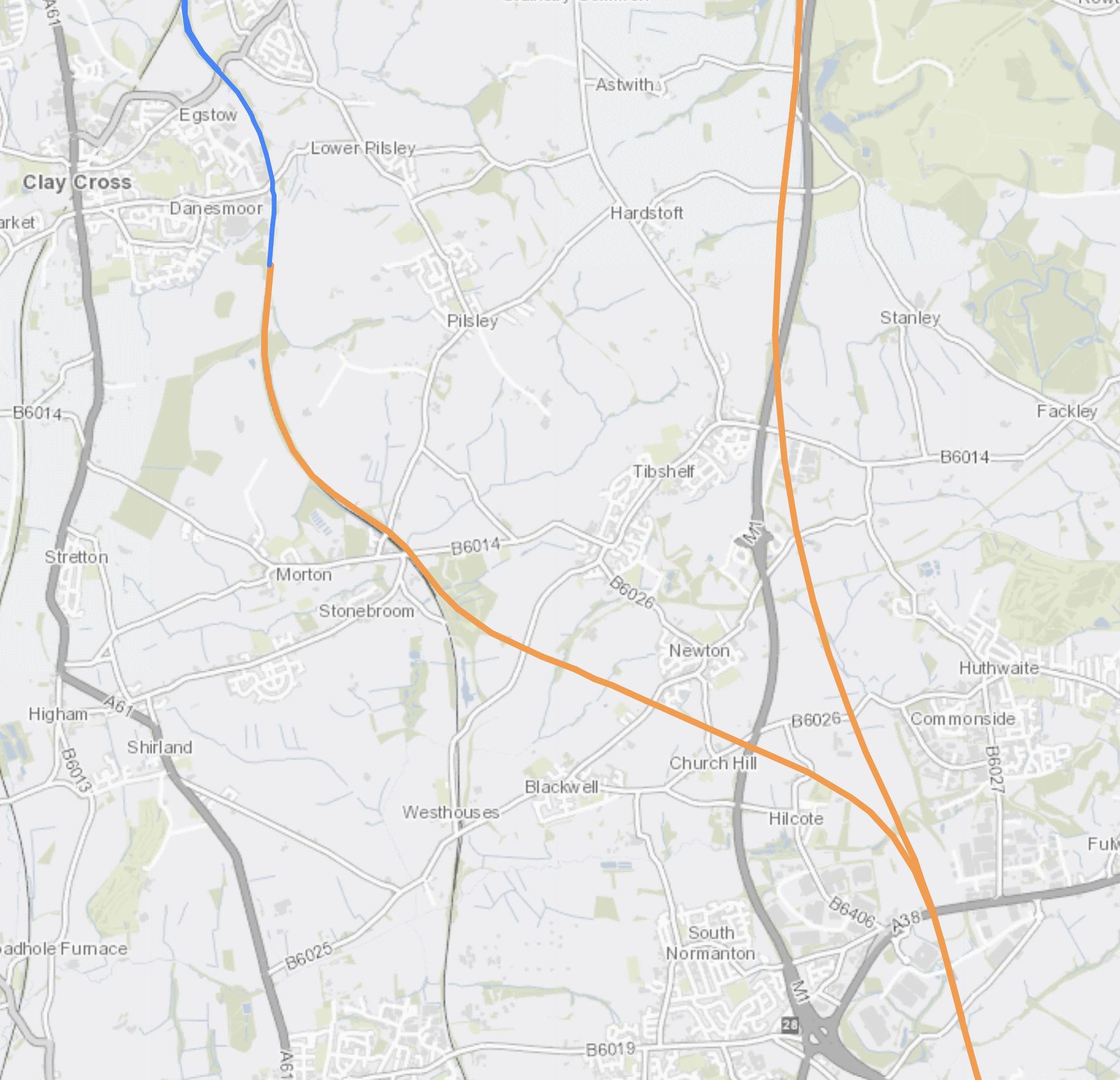
Note.
- The main route of High Speed Two between East Midlands Hub, is shown in orange and follows the route of the M1 Motorway, towards the East of the map.
- The Sheffield Branch is new track to Clay Cross North Junction, where is takes over the Midland Main Line to Sheffield, which is shown in blue.
- The line going South in the middle of the map is the Erewash Valley Line, which goes through Langley Mill and Ilkeston stations.
I suspect Clay Cross to Sheffield will be an electrified high speed line, with a maximum speed of at least 140 mph.
Could the Erewash Valley Line have been used as an alternative route to Sheffield?
This map of High Speed Two captured from their interactive map, shows the connection of High Speed Two and the Erewash Valley Line to East Midlands Hub.
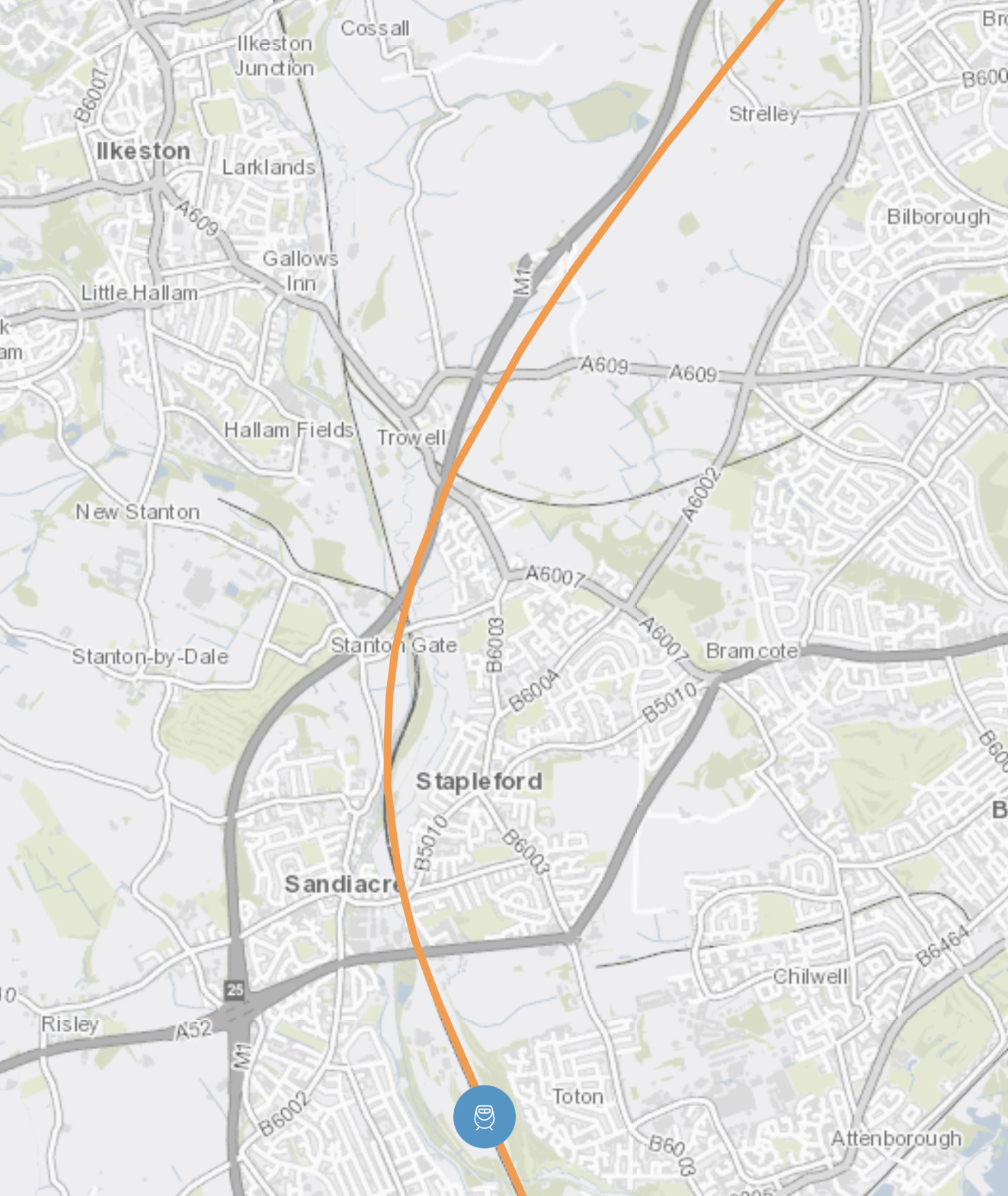
Note.
- East Midlands Hub is shown by the big blue dot.
- High Speed Two is shown in orange.
- The route to Leeds vaguely follows the M1 Motorway.
- The Erewash Valley Line goes North to the East of Ilkeston.
Would have been quicker and easier to electrify the Erewash Valley Line, as the High Speed Two route to Chesterfield and Sheffield?
- Network Rail updated the route a few years ago.
- It does not have the problems of electrification, through a World Heritage Site, as does the route through Derby.
- It could surely handle two tph, even if they were High Speed Two Classic Compatible trains.
- Sheffield will be just under ninety minutes from London by High Speed Two, as opposed to two hours now.
I suspect that it all comes down to saving a few minutes to Sheffield and the civic pride of having a High Speed Two connection.
So it looks like we’ll have the following capacity between East Midlands Hub and Sheffield.
- Between East Midlands Hub and Clay Cross North Junction, there will be the High Speed Two capacity of 18 tph.
- Between Clay Cross and Sheffield, there will probably be an upgraded capacity of perhaps 8-10 tph.
It seems a lot of capacity for just two tph.
Consider.
- High Speed Two is planning to run three tph between Birmingham Curzon Street and East Midlands Hub
- Midlands Rail Engine is planning to run one tph between Birmingham Curzon Street and East Midlands Hub
- Four tph is considered a Turn-Up-And-Go service, and could exist between Birmingham Curzon Street and East Midlands Hub.
- Sheffield and Leeds, both probably need a Turn-Up-And-Go service, to and from East Midlands Hub.
- Semi-fast services between Sheffield and East Midlands Hub, calling at Chesterfield, Alfreton, Langley Mill and Ilkeston would be possible, by using the Erewash Valley Line.
- The Maid Marian Line will join the Robin Hood Line in adding extra connectivity to East Midlands Hub Station.
- Leeds and East Midlands Hub could have a six tph service courtesy of High Speed Two and Midlands Rail Engine.
Using High Speed Two’s web site, the following times should be possible.
- Sheffield and East Midlands Hub – 27 minutes
- Sheffield and Birmingham Curzon Street – 47 minutes.
Both services allow time for an efficient service.
There are certainly many options to create a Turn-Up-And-Go service between Sheffield and East Midlands Hub and also improve connections to other locations across the area.
Capacity Of The Eastern Leg Between East Midlands Hub And Leeds
The section is between East Midlands Hub and Leeds, will be running 5 tph
High Speed Two between Midlands Hub and Leeds is a totally new high speed line.
- As the maximum capacity of High Speed Two is laid down in the Phase One Act as 18 tph, this gives plenty of room for more trains.
- The Southern section of the leg closely follows the M1 Motorway.
- Leeds, York and Newcastle will be 27, 36 and 93 minutes from East Midlands Hub, respectively.
This map of High Speed Two, which shows the route of the line in Yorkshire, was captured from the interactive map on the High Speed Two web site.
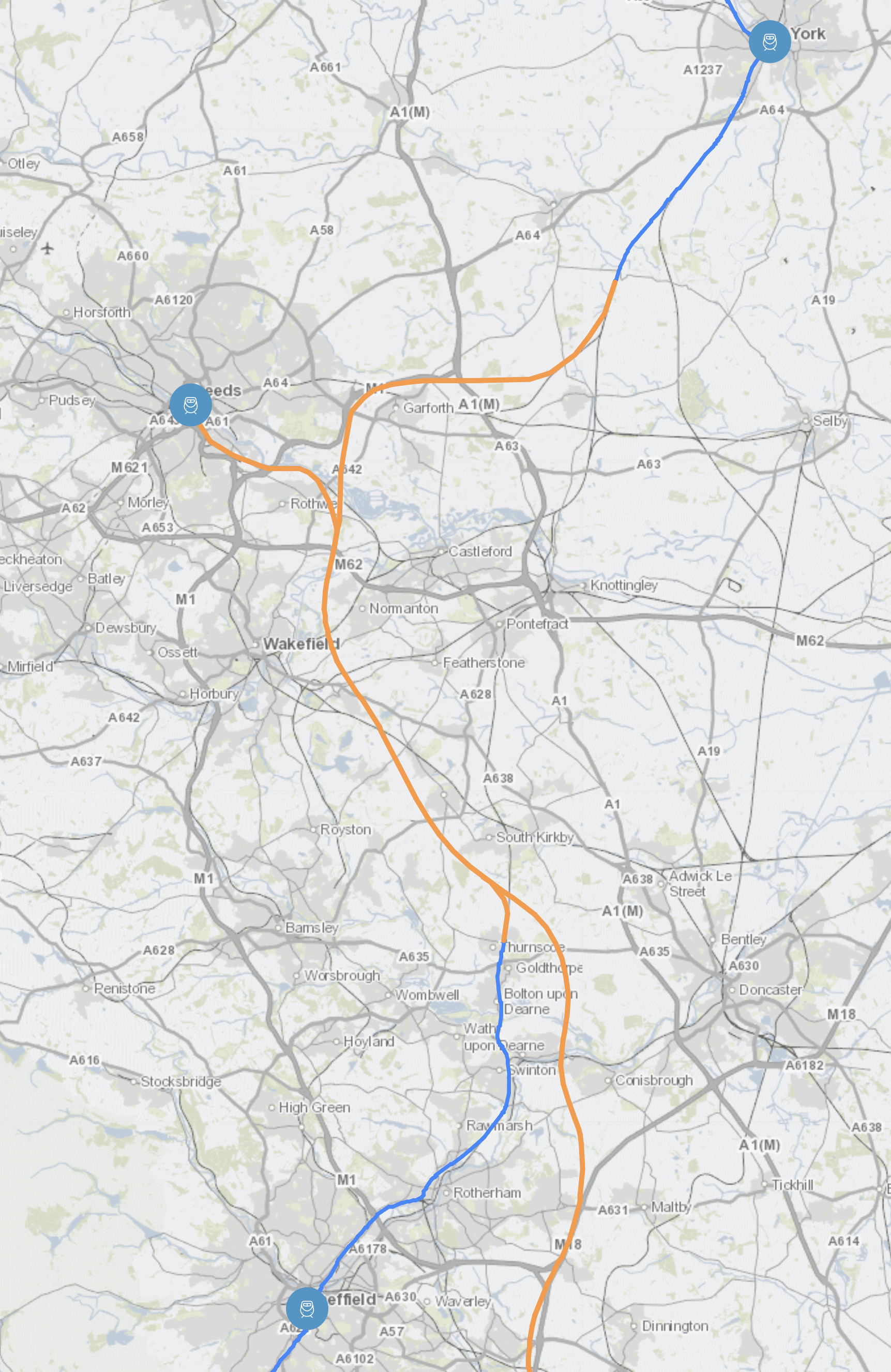
Note.
- Sheffield is marked by the blue dot in the South.
- Leeds is marked by the blue dot in the North West.
- York is marked by the blue dot in the North East.
- New routes are shown in orange.
- Upgraded routes are shown in blue.
The route seems to open up several possibilities for extra routes.
- Leeds and Sheffield will be used by Northern Powerhouse Rail and there will be four tph, taking 28 minutes.
- Leeds and Bedford via East Midlands Hub has been proposed by Midlands Rail Engine.
- Services between Sheffield and the North via York must be a possibility.
This map of High Speed Two, which shows the routes to the East of Leeds, was captured from High Speed Two’s interactive map.
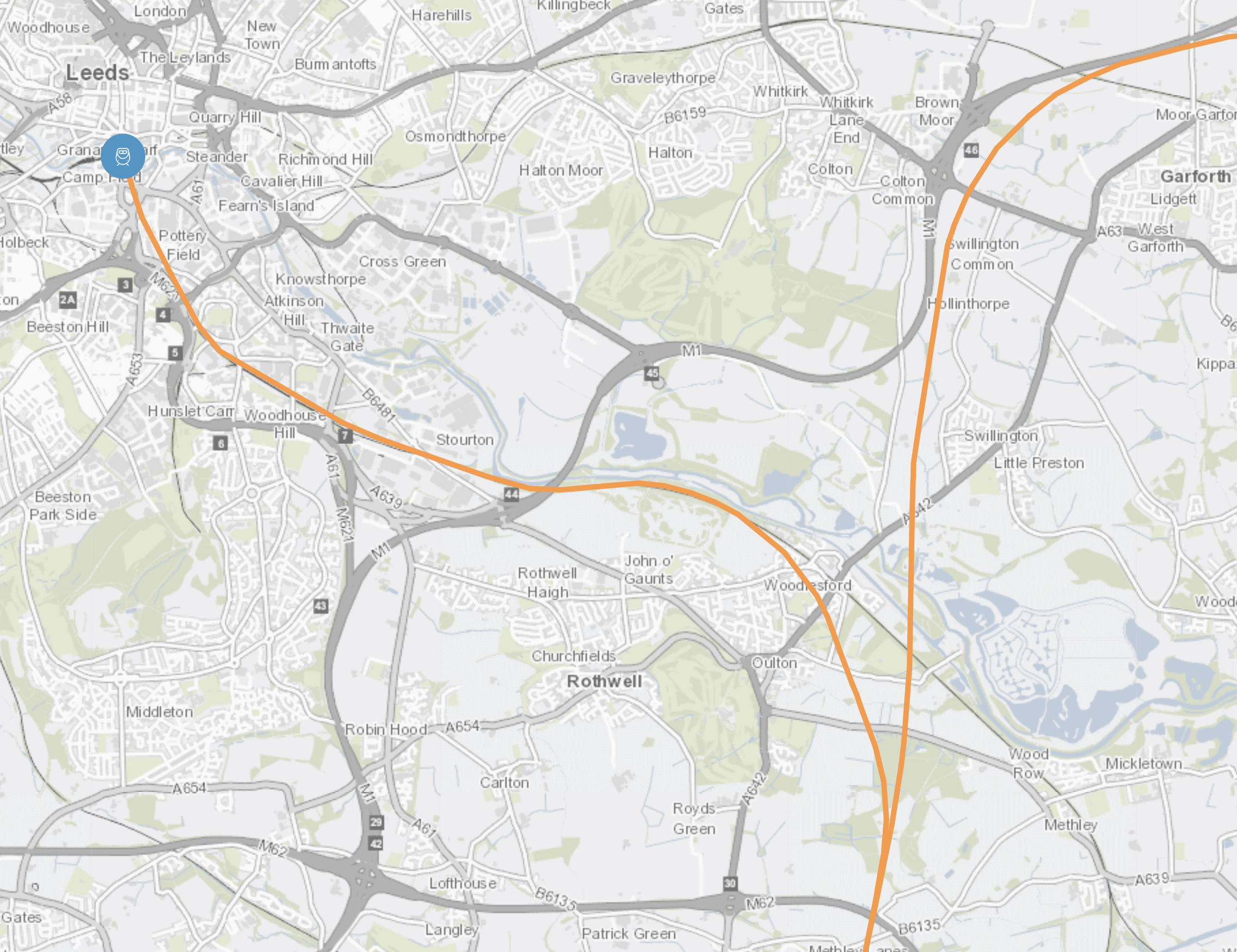
I think that two things might be missing.
- A full triangular junction would surely allow services between Leeds and the North via York.
- A high speed connection to Hull.
We shall see in the future.
Capacity Of The Eastern Leg Between York And Newcastle
The section between York and Newcastle, will be running at a frequency of 3 tph.
Over this section the services will be running on an improved East Coast Main Line.
Conclusion
I shall split the conclusions into various sections.
Route And Track Layout
I think there may be places, where the route and track layout might need to be improved.
- The Manchester Branch probably needs a triangular junction with the Western Leg of High Speed Two.
- How Liverpool is served by Northern Powerhouse Rail needs to be decided.
- The approach to Leeds probably needs a triangular junction with the Eastern Leg of High Speed Two.
- It is not clear how services will reach Hull.
Hopefully, these issues will become clear in the next year or so.
Capacity
The sections with the highest levels of capacity would appear to be the following.
- London Euston and Birmingham Interchange.
- The Manchester Branch
- The section shared with the East Coast Main Line between York and Newcastle.
- The section shared with the West Coast Main Line between Wigan and Scotland.
But on these sections extra trains can be run.
- Birmingham and North West England
- Birmingham and East Midlands Hub
- East Midlands Hub and Leeds
- East Midlands Hub and Sheffield
- East Midlands Hub and York
I can see, this capacity being filled by high speed local services, like those proposed by Midlands Rail Engine.
Rolling Stock
The only comment, I will make, is that there could be a need for a shorter Classic-Compatible train to work local services.
CrossCountry’s Bournemouth And Manchester Piccadilly Service
Whilst I was at Basingstoke station yesterday one of CrossCountry‘s services between Bournemouth and Manchester Piccadilly came through, so I took these pictures.


It was a long formation of Class 220 trains.
Could This Service Be Replaced By Hitachi Regional Battery Trains?
This Hitachi infographic gives the specification of the Hitachi Regional Battery Train.
I feel that in most condition, the range on battery power can be up to 56 miles.
I can break the Bournemouth and Manchester Piccadilly route into a series of legs.
- Bournemouth and Basingstoke – 60 miles – 750 VDC third-rail electrification
- Basingstoke and Reading – 15.5 miles – No electrification
- Reading and Didcot North Junction – 18 miles – 25 KVAC overhead electrification
- Didcot North Junction and Oxford – 10 miles – No electrification
- Oxford and Banbury – 22 miles – No electrification
- Banbury and Leamington Spa – 20 miles – No electrification
- Leamington Spa and Coventry – 10 miles – No electrification
- Coventry and Manchester Piccadilly – 101 miles – 25 KVAC overhead electrification
Note.
- 63 % of the route is electrified.
- The short 15.5 mile gap in the electrification between Basingstoke and Reading should be an easy route for running on battery power.
- But the 62 mile gap between Didcot North Junction and Coventry might well be too far.
The train would also need to be able to work with both types of UK electrification.
If some way could be found to bridge the 62 mile gap reliably, Hitachi’s Regional Battery Trains could work CrossCountry’s service between Bournemouth and Manchester Piccadilly.
Bridging The Gap
These methods could possibly be used to bridge the gap.
A Larger Battery On The Train
If you look at images of MTU’s Hybrid PowerPack, they appear to show a basic engine module with extra battery modules connected to it.
Will Hitachi and their battery-partner; Hyperdrive Innovation use a similar approach, where extra batteries can be plugged in as required?
This modular approach must offer advantages.
- Battery size can be tailored to routes.
- Batteries can be changed quickly.
The train’s software would know what batteries were fitted and could manage them efficiently.
I wouldn’t be surprised to see Hitachi’s Regional Battery Train able to handle a gap only six miles longer than the specification.
Battery And Train Development
As Hitachi’s Regional Battery Train develops, the following should happen.
- Useable battery capacity will increase.
- The train will use less electricity.
- Actions like regenerative braking will improve and recover more electricity.
- Driving and train operating strategies will improve.
These and other factors will improve the range of the train on batteries.
A Charging Station At Banbury Station
If some form of Fast Charge system were to be installed at Banbury station, this would enable a train stopping at Banbury to take on enough power to reliably reach Oxford or Coventry depending, on their final destination.
This method may add a few minutes to the trip, but it should work well.
Electrification Of A Section Of The Chiltern Main Line
This could be an elegant solution.
I have just flown my helicopter between Bicester North and Warwick Parkway stations and these are my observations.
- The Chiltern Main Line appears to be fairly straight and has received a top class Network Rail makeover in the last couple of decades.
- There are a couple of tunnels, but most of the bridges are new.
- Network Rail have done a lot of work on this route to create a hundred mph main line.
- It might be possible to increase the operating speed, by a few mph.
- The signalling also appears modern.
My untrained eye, says that it won’t be too challenging to electrify between say Bicester North station or Aynho Junction in the South and Leamington Spa or Warwick Parkway stations in the North. I would think, that the degree of difficulty would be about the same, as the recently electrified section of the Midland Main Line between Bedford and Corby stations.
The thirty-eight miles of electrification between Bicester North and Warwick Parkway stations would mean.
- The electrification is only eight-and-a-half miles longer than Bedford and Corby.
- There could be journey time savings.
- As all trains stop at two stations out of Banbury, Leamington Spa, Warwick and Warwick Parkway, all pantograph actions could be performed in stations, if that was thought to be preferable.
- Trains would be able to leave the electrification with full batteries.
- The electrification may enable some freight trains to be hauled between Didcot and Coventry or Birmingham using battery electric locomotives.
Distances of relevance from the ends of the electrification include.
- London Marylebone and Bicester North stations – 55 miles
- London Marylebone and Aynho junction – 64 miles
- Didcot North and Aynho junctions – 28 miles
- Leamington Spa and Coventry stations – 10 miles
- Leamington Spa and Birmingham Snow Hill stations – 23 miles
- Leamington Spa and Stratford-upon-Avon stations – 15 miles
- Warwick Parkway and Birmingham New Street stations – 20 miles
- Warwick Parkway and Birmingham Snow Hill stations – 20 miles
- Warwick Parkway and Kidderminster – 40 miles
- Warwick Parkway and Stratford-upon-Avon stations – 12 miles
These figures mean that the following services would be possible using Hitachi’s Regional Battery Train.
- Chiltern Railways – London Marylebone and Birmingham Moor Street
- Chiltern Railways – London Marylebone and Birmingham Snow Hill
- Chiltern Railways – London Marylebone and Kidderminster
- Chiltern Railways – London Marylebone and Stratford-upon-Avon
- CrossCountry – Bournemouth and Manchester Piccadilly
- CrossCountry – Southampton Central and Newcastle
- Midlands Connect – Oxford and Birmingham More Street – See Birmingham Airport Connectivity.
Other services like Leicester and Oxford via Coventry may also be possible.
As I see it, the great advantage of this electrification on the Chiltern Main Line is that is decarbonises two routes with the same thirty-eight miles of electrification.
Conclusion
CrossCountry’s Bournemouth And Manchester Piccadilly service could be run very efficiently with Hitachi’s proposed Regional Battery Train.
My preferred method to cross the electrification gap between Didcot North junction and Coventry station would be to electrify a section of the Chiltern Main Line.
- The electrification would be less than forty miles.
- I doubt it would be a challenging project.
- It would also allow Hitachi’s proposed trains to work Chiltern Main Line routes between London Marylebone and Birmingham.
I am fairly certain, that all passenger services through Banbury would be fully electric.
Beeching Reversal – East Didsbury – Stockport
This is one of the Beeching Reversal projects that the Government and Network Rail are proposing to reverse some of the Beeching cuts.
This project has been puzzling me.
Search Google for “East Didsbury and Stockport Rail Link” and all you find is grandiose plans for billion pound extensions to the Manchester Metrolink.
Having researched a lot of the proposed Beeching Reversal projects, it appears to me, that the ones likely to be built, will give a lot of benefit for millions, not billions of pounds.
I just wonder, if in this project, Manchester is stealing an idea from Birmingham – the four-poster station!
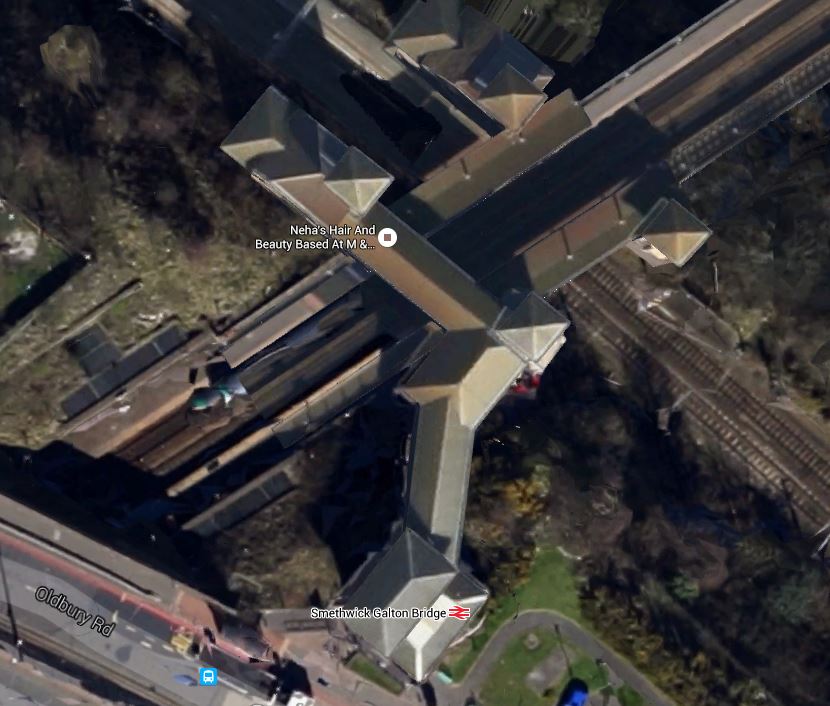
This Google Map shows Smethwick Galton Bridge station.
This extract from the Wikipedia entry, describes the station.
The station was opened in September 1995 as part of the Jewellery Line scheme to reopen the line between Smethwick and Birmingham Snow Hill station. It was built as an interchange station between two lines, and the platforms on both lines opened at the same time.
Note.
- The four lift towers with stairs, that connect the four platforms, have pyramid roofs.
- The station is fully step-free.
- The rail lines are at different levels.
These pictures show the station.
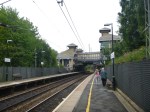
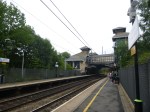

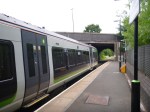
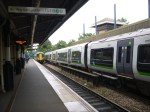


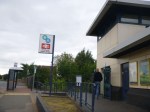


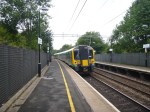
It is a very practical architectural idea and the world needs more four-poster stations to connect rail lines where they cross at different levels.
Could A Four-Poster Station Link East Didsbury And Stockport?
These are my thoughts.
The Location
This Google Map shows the general area, where the station could be built.
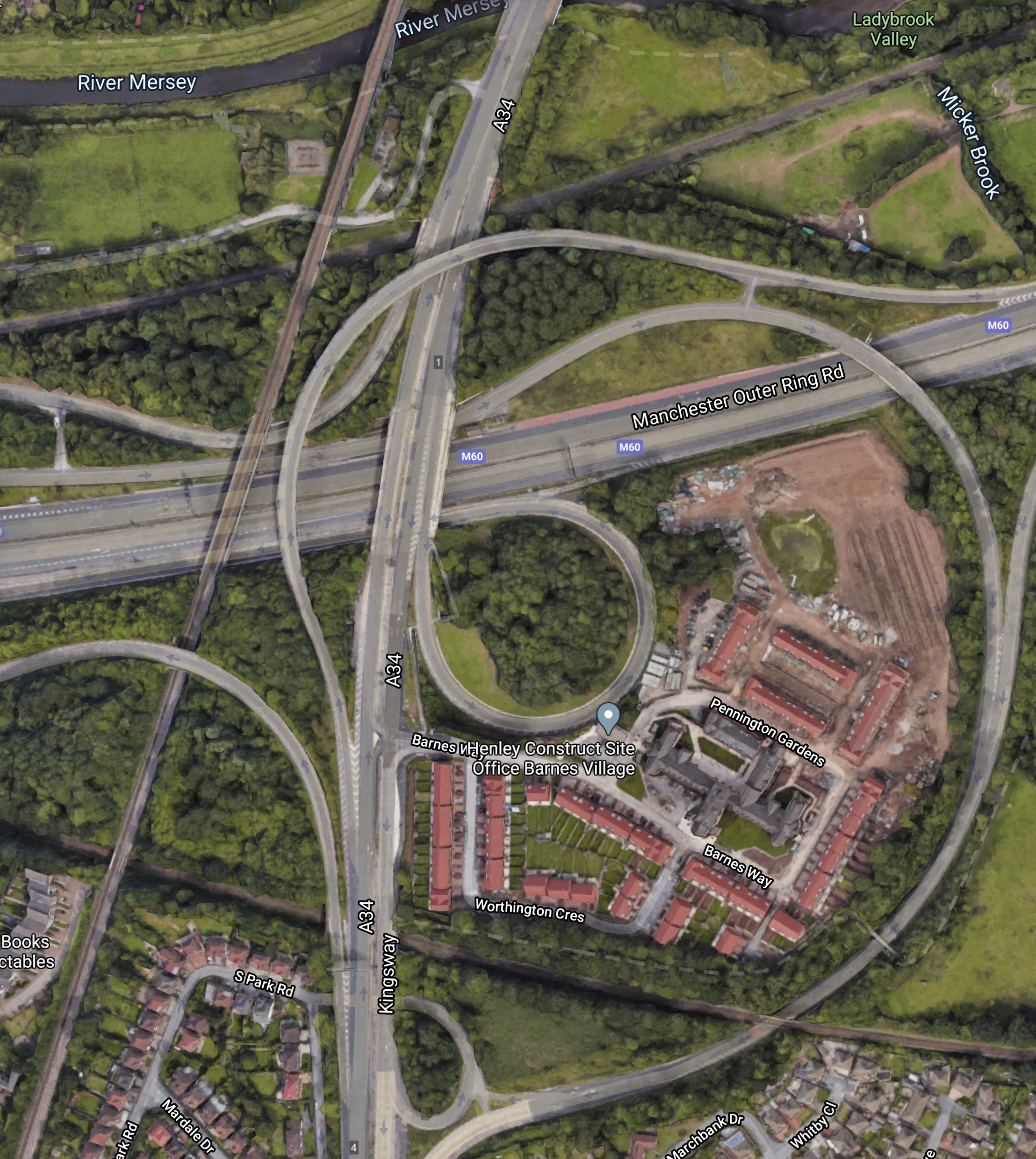
It is a spaghetti of motorways and rail lines with a lumpy sauce of new housing called Barnes Village in the middle.
Note, where the two rail lines cross in the South-West corner of the map.
This second Google Map, shows an enlarged image of the location, where the two rail lines cross.
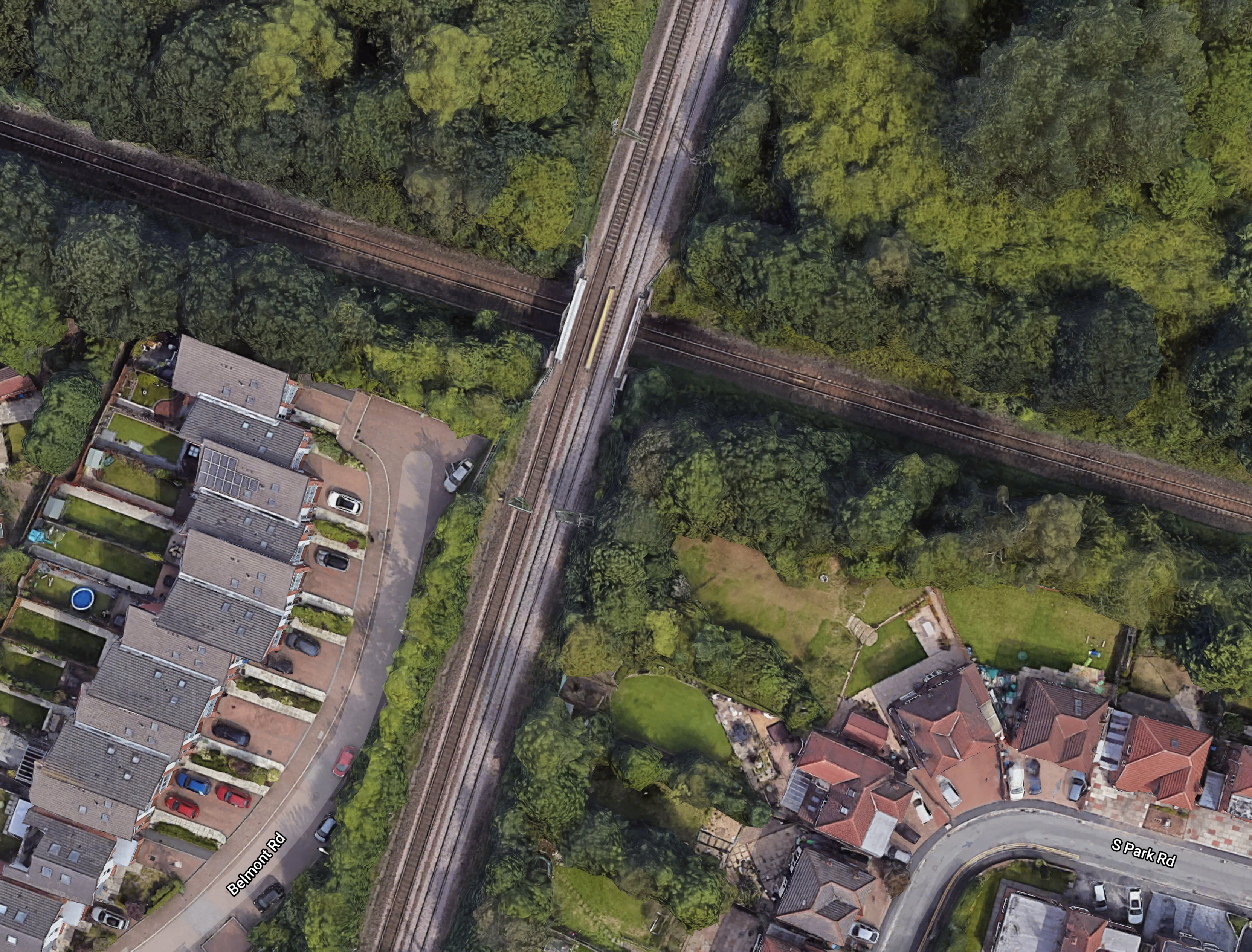
Note.
- The Styal Line runs North-South.
- The line running East-West is the Mid-Cheshire Line between Altrincham and Stockport stations.
I suspect most travellers joining the rail network at this point, would walk or cycle in from nearby locations or turn up in a taxi.
The Styal Line
The Styal Line has the following characteristics.
- It is an electrified double-track line.
- It connects Manchester Piccadilly and Wilmslow stations.
- There is a spur that serves Manchester Airport station.
- East Didsbury station, is the station North of where the two lines cross.
- Gatley station, is the station South of where the two lines cross.
- It is the route of trains to and from Manchester Airport.
These trains go through East Didsbury and Gatley stations in trains per hour (tph)
- 1 tph – Northern – Liverpool Lime Street and Crewe
- 1 tph – Northern – Liverpool Lime Street and Manchester Airport
- 1 tph – Northern – Manchester Airport and Blackpool North
- 1 tph – Northern – Manchester Airport and Cumbria
- 1 tph – Trains for Wales – Manchester Airport and Chester
- 1 tph – TransPennine Express – Manchester Airport and Redcar Central
- 1 tph – TransPennine Express – Manchester Airport and Newcastle
- 1 tph – TransPennine Express – Manchester Airport and Glasgow Central or Edinburgh
Freight trains also use the route.
This means that currently, there are eight tph between the Castlefield Corridor (Deansgate, Manchester Oxford Road and Manchester Piccadilly) and Manchester Airport, all of which go through the location, where the four-poster station could possibly be built.
So could the new station, be used to take pressure off the overloaded Castlefield Corridor?
The Mid-Cheshire Line
The Mid-Cheshire Line has the following characteristics.
- At this point it is a single-track without electrification.
- It connects Stockport and Altrincham stations.
Re-Doubling Of The Mid Cheshire Line Between Stockport and Altrincham And Associated Station Reopenings is another of the Beeching Reversal projects and envisages the following.
- Re-doubling the route.
- Possible electrification
- Reopening some stations.
This is the only passenger service that uses the route.
- 1 tph – Northern – Manchester Piccadilly and Chester
Up to two-three freight tph, also use the route.
In the related post, I said this about the desired frequency of services between Manchester and Chester stations.
It could be argued that two tph between Manchester Piccadilly and Chester are needed now and that four tph should be the preferred frequency.
There certainly needs to be four tph going through the proposed four-poster station.
Conclusion
I am being drawn to the conclusion, that this station if it were to be built, would help a lot of problems with Manchester’s railways.
- It would allow a sort out of train services to Manchester Airport.
- It would connect Stockport and Manchester Airport.
- It would connect Stockport and East Didsbury.
- It could help a solution to the problem of the Castlefield Corridor.
The station should be built.
Beeching Reversal – Re-Doubling Of The Mid Cheshire Line Between Stockport and Altrincham And Associated Station Reopenings
This is one of the Beeching Reversal projects that the Government and Network Rail are proposing to reverse some of the Beeching cuts.
Much of this project appears to be about bringing the former Stockport, Timperley and Altrincham Junction Railway, back up to somewhere near its original state.
This map clipped from Wikipedia shows the railway.
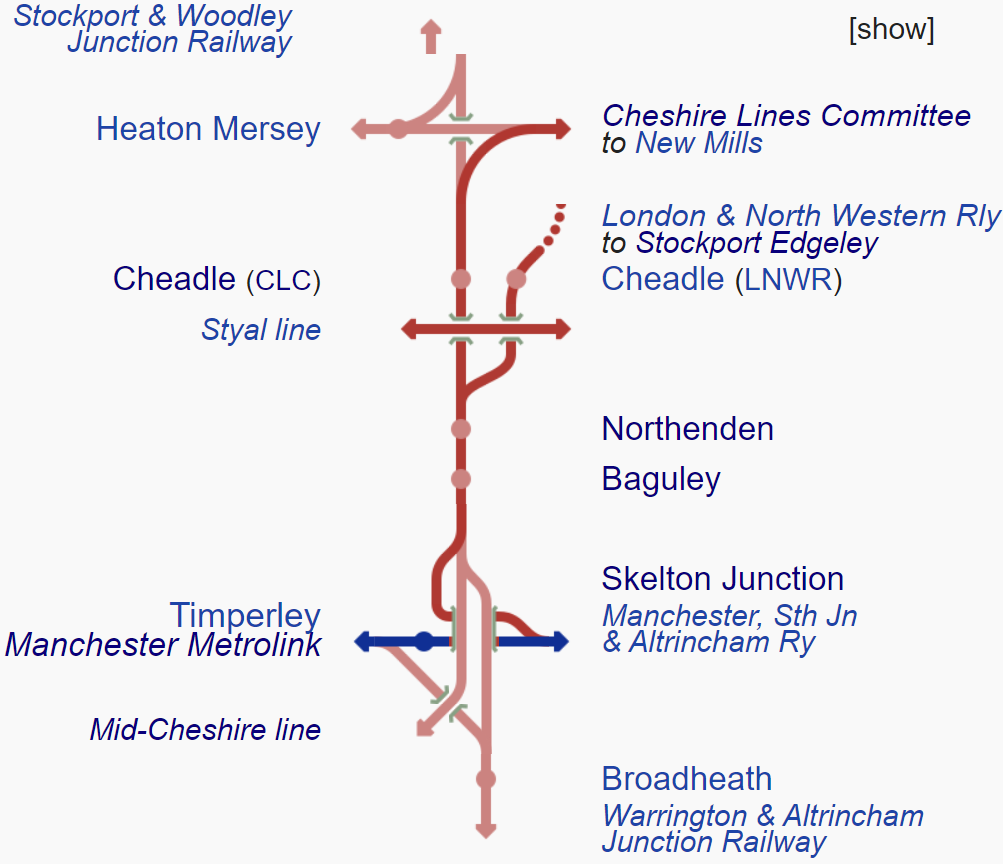
Note.
- Stockport Edgeley is now just Stockport station.
- Altrincham station is on the Mid-Cheshire Line.
- Baguley, Northenden and both Cheadle stations are now closed.
I have just flown my virtual helicopter between Stockport and Altrincham stations and much of the route is already double-track.
- At Cheadle Village Junction, which appears to be behind Cheadle Heath Police Station, the track becomes single.
- Just before Sharston Junction, which appears to be to the North-East of Sharston, the track becomes double again.
I estimate, that the single-track section is just over two miles long.
I was also able to ascertain, that there appeared to be plenty of space, where British Rail singled the track.
There is also a second section of single-track, through Navigation Road station, which is shown in this Google Map.
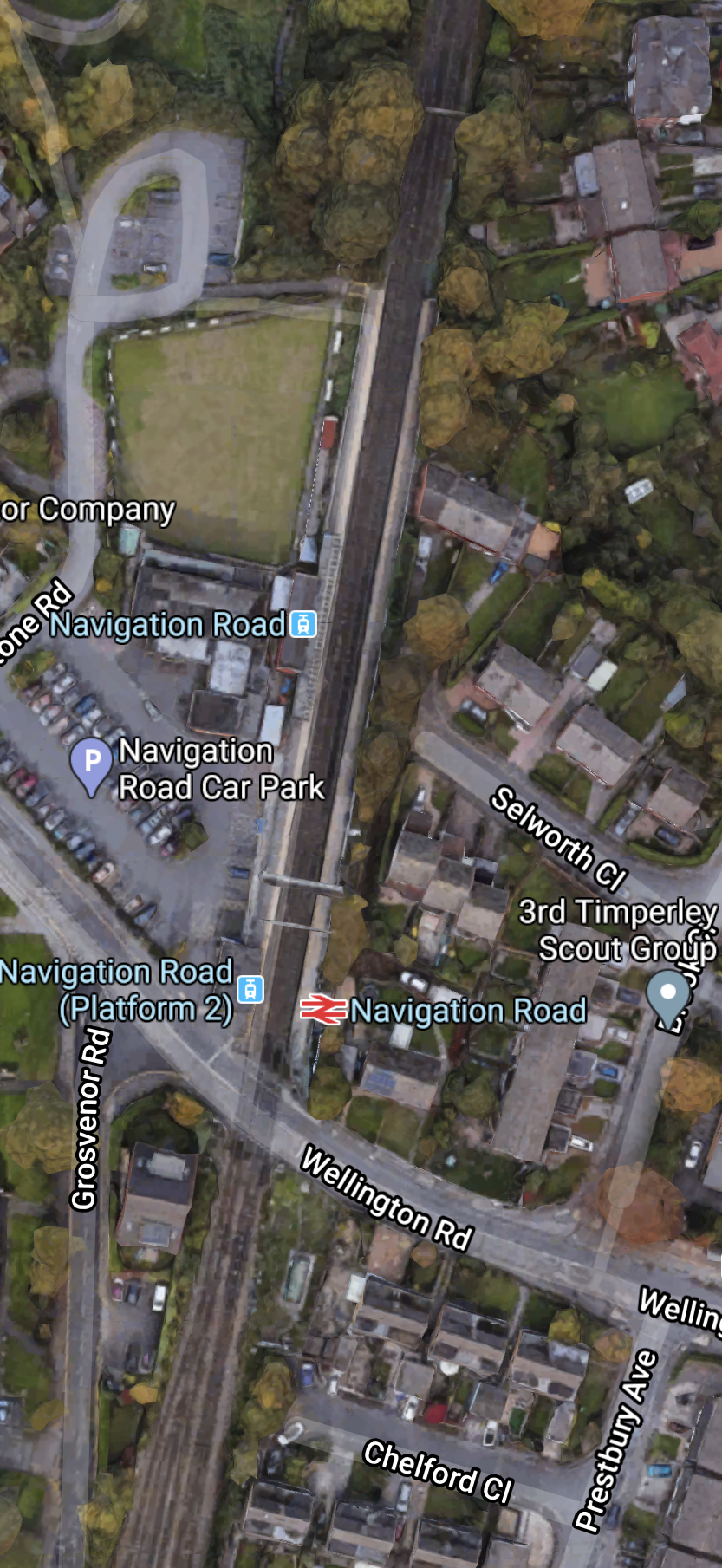
Note.
- Both tracks through Navigation Road station are bi-directional.
- The Metrolink track is on the West.
- The National Rail track is on the East.
- South of Navigation Road station, both Metrolink and National Rail get two tracks.
In the twenty-four hours to 0600 this morning, a total of seventeen freight movements, went through this section.
- Some were biomass trains between Liverpool and Drax power station, up to 6400 tonnes.
- Some were stone trains from the quarries in the Peak District.
- Some were Network Rail engineering trains.
I suspect this abort section of single track for both Metrolink and Network Rail is an absolute pain.
The single track must cause a lot of problems as the route is sometimes used by two or three trains per hour (tph) in both directions.
As some of the trains are some of the UK’s longest freight trains, it could also be very challenging for the signalling and the signallers.
Work That Could Be Done
These sub-projects could be performed.
Elimination of Single Track At Cheadle
I think this is essential and could greatly increase the capacity of the route.
This Youtube video from Don Coffey, shows the view from the cab, which travelling from Manchester to Chester. If you watch from about thirteen minutes, you’ll see the single-track section.
Sorting Out Navigation Road
As with the single-track section at Cheadle, I think this is essential and could greatly increase the capacity of the route.
Watch the same Youtube video from about twenty-two minutes, and you’ll see the single-track section, through Navigation Road station.
In Tram-Trains To Hale Station, I talked about the possibilities of using a variant of Class 399 tram-trains, similar to those running on the Sheffield Supertram.
Signalling
It could be there are minor adjustments or major work to get the most out of a double-track railway.
Electrification
This is an excerpt from the Wikipedia entry for the Mid-Cheshire Line.
In March 2015, the Electrification Task Force said that the Mid-Cheshire line was a tier 1 priority for being electrified in the CP6 period (2019-2024)
Would electrification be installed to perhaps run electric trains between Manchester Piccadilly and Chester?
Baguley Station
I covered Baguley station in Glazebrook Junction And Skelton Junction, where I said this.
Baguley station could be an interesting station, as it would be possible to create an interchange with the Manchester Metrolink. Wikipedia says this.
Proposals were made in the early 2000s to reopen a station in the Baguley area when the extension of the Metrolink out to Wythenshawe and Manchester Airport is actioned. In May 2011 re-opening of the station on the Stockport-Altrincham line was included in Transport for Greater Manchester’s Passenger Plan. The station would be on Southmoor Road and would be a tram/train interchange with the Baguley tram stop, which opened in 2014.
This Google Map shows the possible Baguley Interchange.
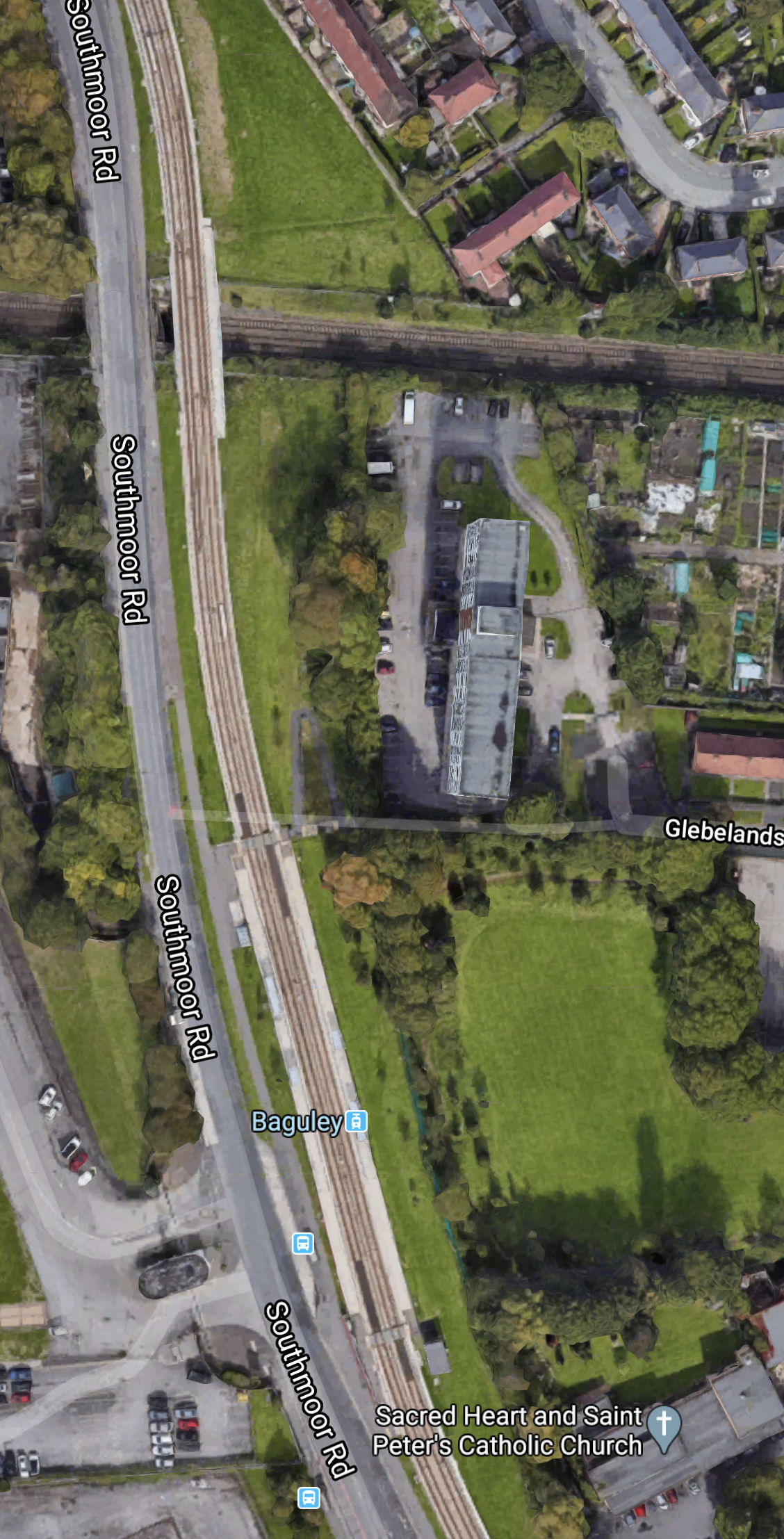
Note.
-
- The North-South road is Southmoor Road.
- The Metrolink branch to the Airport runs alongside.
- The Stockport and Altrincham Line crosses East-West towards the North of the map.
If you take a train between Manchester Piccadilly and Chester via Stockport, Navigation Road, Altrincham and Knutsford, you cross on the railway through here.
So perhaps a Baguley Interchange station, would help some people get to and from Manchester Airport?
Baguley station certainly has possibilities.
Cheadle North Station
Could Cheadle North station be replaced?
This article on the Manchester Evening News is entitled Cheadle ‘On Cusp’ Of Having Own Railway Station For First Time Since Mid-1960s, where this is said.
If ministers back the proposals, the railway station is likely to be built next to the Alexandra Hospital along the mid-Cheshire line – close to where the original Cheadle (later Cheadle North) station was.
This Google Map shows the Cheadle Alexandra Hospital and the Mid-Cheshire Line.
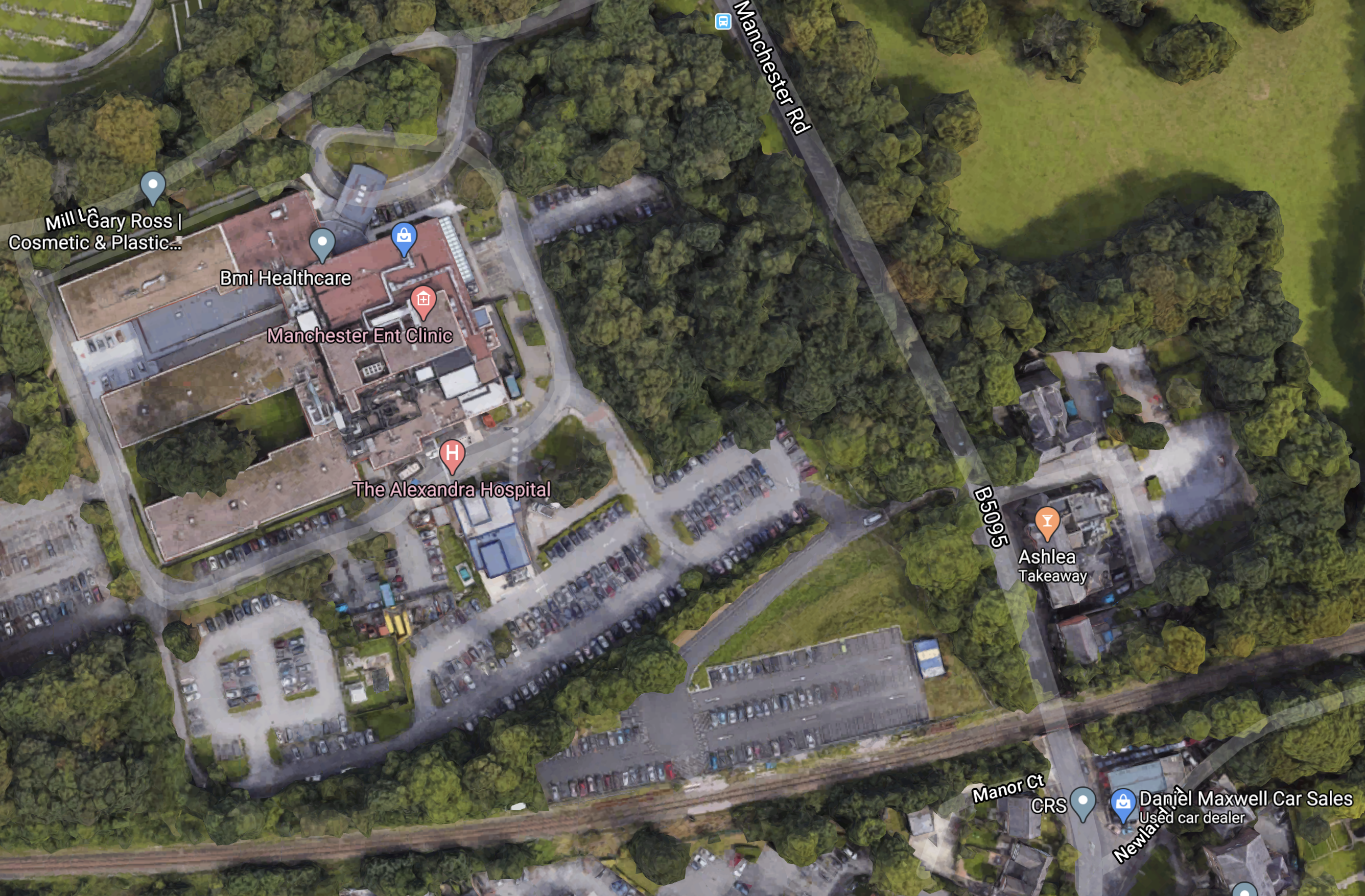
Note.
- The hospital is the largest private hospital in the UK, outside London.
- The railway, which is single-track at this point, runs along the South side of the site.
If the line is double-tracked, as seems likely, adding a small station would not be a challenging addition.
Northenden Station
Could Northenden station be replaced?
Future Train Services
The train service between Manchester Piccadilly and Chester is as follows.
- The service is 45 miles.
- It takes 90 minutes.
- There are stops at Stockport, Navigation Road, Altrincham, Hale, Ashley, Mobberley, Knutsford, Plumley, Lostock Gtalam, Northwich, Greenbank, Cuddington, Delamere and Mouldsworth.
It could be argued that two tph between Manchester Piccadilly and Chester are needed now and that four tph should be the preferred frequency.
There are other services.
Conclusion
After restoring the double-track on this route, there are possibilities to spend, as much money as you want.
In Tram-Trains To Hale Station, these were my conclusions.
- Tram-trains can deliver a capacity improvement through Navigation Road station.
- Tram-trains could be extensively tested on the existing Manchester Metrolink network.
- Tram-trains could be used to build a simple extension to Hale station from Altrincham.
- The Manchester and Chester service via Stockport, Navigation Road and Altrincham stations could be run by tram-trains.
A comprehensive network of tram-trains could be developed between, through and beyond Altrincham, Crewe and Chester.
Cheshire would have a quality commuter and local train network into Manchester.
After all in the next couple of years, Merseyrail’s Cheshire network will be getting a major upgrade with new trains and perhaps another new route.
Should High Speed Two’s Macclesfield And London Service Call At Birmingham Interchange?
Connecting Manchester City Centre to the High Speed Two network will be a major undertaking.
- It looks increasingly likely that High Speed Two and Northern Powerhouse Rail will have a shared line running from the main High Speed Two route through Crewe to Manchester Piccadilly via Manchester Airport.
- Between Manchester Airport and Manchester Piccadilly will be in a high speed tunnel.
- Northern Powerhouse Rail will connect Liverpool Lime Street and Warrington to Manchester Airport and Manchester Piccadilly.
- There will be a major problem keeping train services running between Manchester and Birmingham, London and the South.
But just at Project Rio kept Manchester connected during the rebuilding of the West Coast Main Line in the early years of this century, I believe that a similar creditable alternative route may be starting to evolve.
Avanti’s Additional Class 807 Trains Will Be Delivered
These trains will allow additional services and release some Class 390 trains to reinforce other services.
Avanti West Coast’s Future West Coast Main Line Service
The small fleet of Class 807 trains are needed to provide extra services on the West Coast Main Line.
- But if these trains are successful, will more be used as replacements for the nearly twenty-years-old Class 390 trains?
- Will they also be given more traction power to double as the classic-compatible trains for High Speed Two.
- Other operators might also like to purchase a high capacity 200 metre long high speed train, which would share routes used by High Speed Two.
In Thoughts On Class 807 Trains And High Speed Two’s Classic-Compatible Trains, I discuss the design of extra trains for High Speed Two and the West Coast Main Line.
Surely, though having similar trains handling both roles on the West Coast Main Line and High Speed Two, would be an advantage to Avanti West Coast?
London And Manchester Services
Currently, there are these services between London Euston and Manchester Piccadilly stations.
- Via Milton Keynes Central, Stoke-on-Trent and Stockport
- Via Stoke-on-Trent, Macclesfield and Stockport
- Via Stafford, Crewe, Wilmslow and Stockport
All services have a frequency of one train per hour (tph)
High Speed Two plans to run these services between the South and the Manchester area.
- 1 tph – 200 metres – London Euston and Wigan North Western via Old Oak Common, Crewe and Warrington Bank Quay
- 1 tph – 200 metres – London Euston and Macclesfield via Old Oak Common, Stafford and Stoke.
- 1 tph – 400 metres – London Euston and Manchester Piccadilly via Old Oak Common, Birmingham Interchange and Manchester Airport
- 2 tph – 400 metres – London Euston and Manchester Piccadilly via Old Oak Common and Manchester Airport
- 2 tph – 200 metres – Birmingham Curzon Street and Manchester Piccadilly via Manchester Airport
- 1 tph – 200 metres – Birmingham Curzon Street and Wigan North |Western
Note.
- I have included Wigan North Western, as it has good connections to North Manchester.
- Services can’t go via Manchester Airport until the tunnel is completed.
- The 400 metre services will need to use dedicated High Speed Two tracks, so will need to use the tunnel via Manchester Airport.
Wigan and Macclesfield stations will not be requiring major rebuilding, during the construction of High Speed Two. That should mean the stations will not need to be closed for long periods.
- Macclesfield station could probably handle up to three tph from the South.
- Wigan North Western station could probably handle two tph from the South.
- Work in the Manchester Piccadilly area, may well close the station at times.
I suspect Macclesfield and Wigan North Western could be very useful alternative stations for travelling to and from the South.
Manchester And Birmingham Via Macclesfield
I can see that there could be difficulties for some passengers, if they found themselves at Macclesfield wanting to go to the Birmingham area.
A solution would be for the Macclesfield and London service to stop at Birmingham Interchange, which will be extremely well-connected.
Birmingham Interchange
This map from High Speed Two, shows Birmingham Interchange and Birmingham International stations.
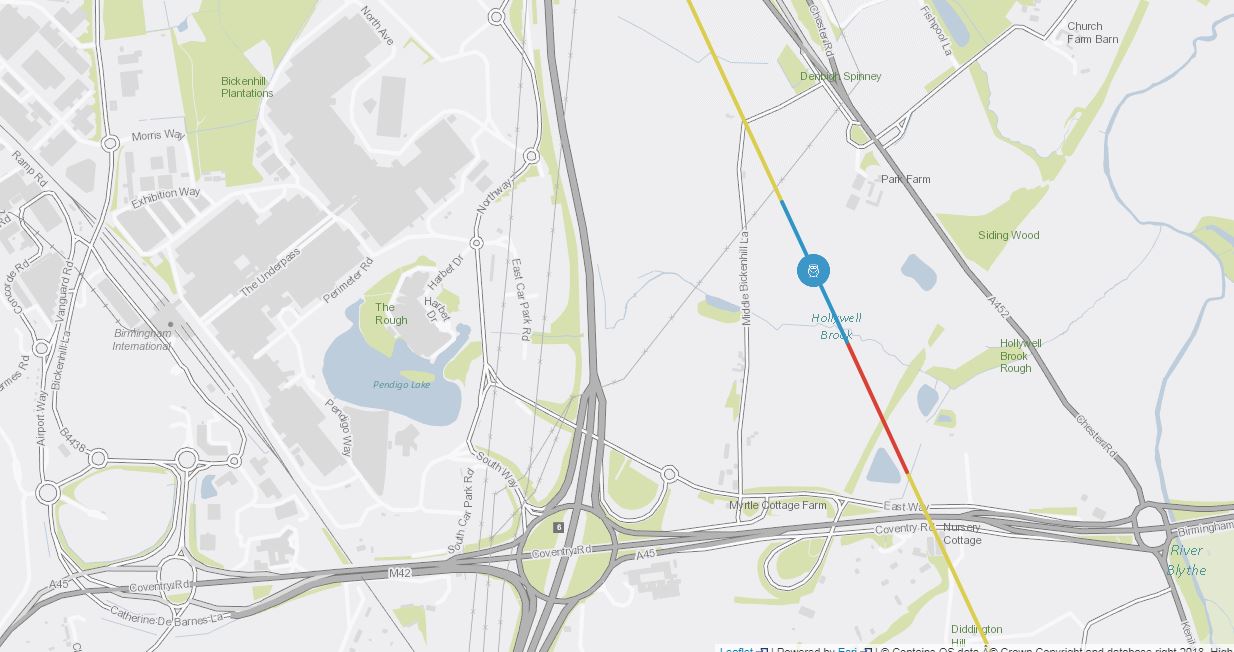
Note.
- Birmingham Interchange station is marked by the blue dot.
- Birmingham International station is to the West of the M42.
The two stations will be connected by an automatic people mover.
Destinations and their frequencies available from Birmingham Interchange, when High Speed Two is complete will include.
- 2 tph – Birmingham Curzon Street
- 1 tph – Carlisle
- 1 tph – East Midlands Hub
- 1 tph – Edinburgh Haymarket
- 1 tph – Edinburgh Waverley
- 1 tph – Glasgow Central
- 1 tph – Leeds
- 5 tph – London Euston
- 1 tph – Manchester Airport
- 1 tph – Manchester Piccadilly
- 5 tph – Old Oak Common
- 1 tph – Preston
It looks like if you miss your train to many important cities at Birmingham Interchange, it will be an hour to wait for the next train.
Destinations and their frequencies available from Birmingham International are currently.
- 8 tph – Birmingham New Street
- 1 tph – Bournemouth
- 1 tph – Crewe
- 0.5 tph to Edinburgh Waverley
- 0.5 tph to Glasgow Central
- 7 tph – London Euston
- 1 tph – Macclesfield
- 1 tph – Manchester Piccadilly
- 1 tph – Reading
- 1 tph – Shrewsbury
- 1 tph – Southampton
- 1 tph – Stafford
- 1 tph – Stoke-on-Trent
- 2 tph – Wolverhampton
Note that 0.5 tph is one train per two hours.
These two lists can be combined.
- 10 tph – Birmingham Curzon Street/New Street
- 1 tph – Bournemouth
- 2 tph – Carlisle
- 1 tph – Crewe
- 1 tph – East Midlands Hub
- 1.5 tph – Edinburgh Haymarket
- 1.5 tph – Edinburgh Waverley
- 1.5 tph – Glasgow Central
- 1 tph – Leeds
- 12 tph – London Euston
- 1 tph – Macclesfield
- 1 tph – Manchester Airport
- 2 tph – Manchester Piccadilly
- 5 tph – Old Oak Common
- 1 tph – Preston
- 1 tph – Reading
- 1 tph – Shrewsbury
- 1 tph – Southampton
- 1 tph – Stafford
- 1 tph – Stoke-on-Trent
- 2 tph – Wolverhampton
This list is surely missing Bristol, Cardiff, Liverpool, Sheffield and Newcastle.
Conclusion
We should not underestimate the importance of Macclesfield and Wigan North Western stations in getting to and from Manchester during the building of High Speed Two.
Along The Hope Valley Line – 13th July 2020
These pictures show my return trip between Manchester Piccadilly and Dore & Totley stations.




There are an assorted set of stations.
- Some stations appear to have new platforms.
- Marple station has a impressive step-free bridge.
- Some stations may be Listed or should be.
- There are walking routes from some stations.
- Some stations need improvements to the access.
I also have some thoughts on the service.
The Class 150 Trains
The Class 150 trains have these characteristics.
- Installed Power – 426 kW
- Weight – 35.8 tonnes
- Operating Speed – 75 mph.
This compares with these for a Class 195 train.
- Installed Power – 780 kW
- Weight – 40 tonnes
- Operating Speed – 100 mph.
- Acceleration – 0.83 m/sec/sec
Unfortunately, I can’t find the acceleration for a Class 150 train, but I suspect that it’s not as good as the Class 195 train.
- I was in a Class 150 train, for both journeys.
- IThe train was on time both ways.
- The engine under my carriage wasn’t working that hard.
- The train was trundling around at around 60 mph.
- The operating speed of the line is 90 mph.
So I suspect, that a well-driven Class 195 train will shave a few minutes from the journey time.
Transport For The North’s Plan For Manchester And Sheffield
Transportbfor the North objective for Manchester Piccadilly and Sheffield stations can be summed up as follows.
Four tph in forty minutes.
As current trains take over anhour, it could be a tough ask!
The Timetable
The timetable isn’t very passenger-friendly with no easy-to-remember clock-face timetable.
This must be sorted.
Hopefully, it will increase the number of passengers riding on the route.
Battery Electric Trains
Consider.
- Sheffield station will be electrified for High Speed Two.
- It is likely that the route between Dore & Totley and Sheffield station will be electrified.
- There is electrification at the Manchester end of the route.
- The distance without electrification in the middle is probably about thirty-six miles.
- Fifty-sixty miles seems a typical range quoted for a battery electric train by train manufacturers.
As electric trains generally accelerate faster than their diesel equivalent, these could run the route reliably and save time on the journey.
Conclusion
I’m coming round to the opinion, that Transport for the North’s objectives for the route can be met without electrification.
Macclesfield Station And High Speed Two
Today, I went to Macclesfield station.
In the latest iteration of High Speed Two, two new destinations were added to the High Speed Two Network; Macclesfield and Lancaster.
These pictures show Macclesfield station.
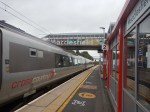

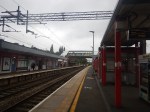
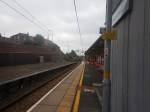
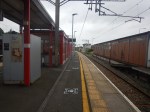
It is a modern station, with three through platforms, two bridges and some Modernist architecture from the 1970s, that could be improved.
This Google Map shows the layout of the station.
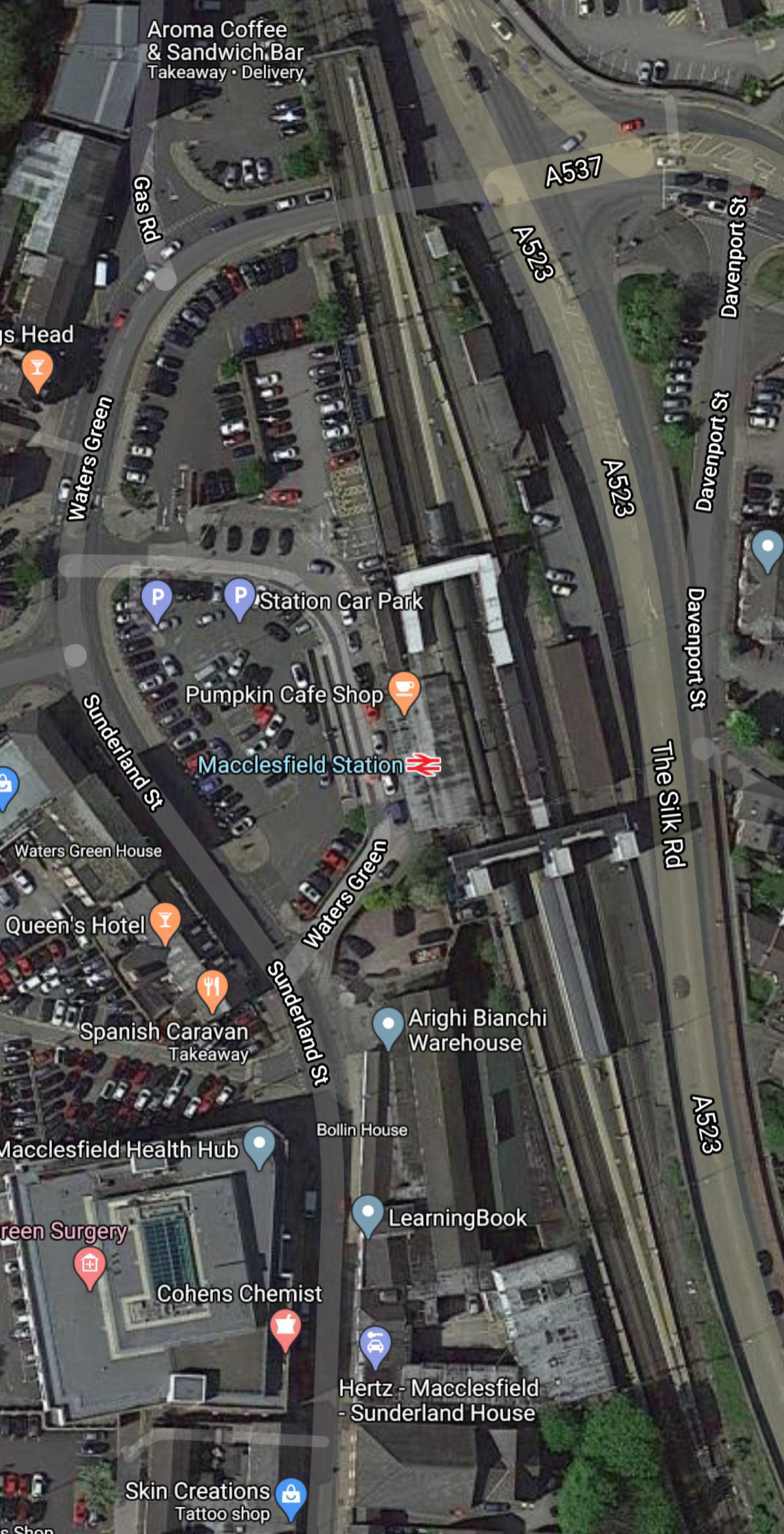
Note.
- Platform 1 is in the West and is used by trains to Stockport and Manchester Piccadilly.
- Platform 2 is in the middle and is used by trains going to Stoke, London and the South.
- Platform 3 is in the East and appears to be used a couple of times per day.
- It also appears there might have been a fourth platform.
All platforms appear capable of handling an eleven-car Class 390 train, which are over two hundred and sixty metres in length.
Is the plan to use Macclesfield as a High Speed Two terminal feasible?
Which Trains Will High Speed Two Use On Macclesfield Services?
It appears that High Speed Two will have two types of trains.
- Trains built to the European loading gauge, that will only be able to work on high lines like High Speed One and High Speed Two. Examples would be Eurostar’s Class 373 and Class 374 trains.
- Trains built to the UK loading gauge, that could also work on existing UK 125 mph routes like the East Coast, Great Western, Midland and West Coast Main Lines. Examples would be Class 800. Class 801, Class 802, Class 390 and Class 745 trains.
The second type, which are referred to, as class-compatible trains will be used to Macclesfield, as these services will share track with Class 390 and other trains, that have been or will be built to the smaller UK loading gauge.
Will Classic-Compatible High Speed Two Trains Fit Into Macclesfield Station?
Currently, every hour, one eleven-car Class 390 train calls in Macclesfield station in both directions, as they provide one of Avanti \west Coast’s three trains per hour (tph) between London Euston and Manchester Piccadilly stations.
The current trains are sixty metres longer than the proposed classic-compatible High Speed Two trains, that could be terminating in Macclesfield station.
How Would Passengers Who Started And Finished Their Journeys In Macclesfield, Connect to Manchester?
Currently, these hourly services connect Manchester Piccadilly and Stoke stations.
- Avanti West Cost – Manchester Piccadilly and London Euston.
- CrossCountry – Manchester Piccadilly and Bournemouth
- CrossCountry – Manchester Piccadilly and Bristol
- Northern – Manchester Piccadilly and Stoke, which stops at all stations.
The characteristics would be common to all these four trains.
- Services call at Stockport, Macclesfield and Stoke stations.
- As services share tracks with a High Speed Two service, they must be reasonably fast.
- All except the Northern service are 125 mph trains.
- The Northern service is run by a 90 mph Class 323 electric train.
- As Manchester Piccadilly and Stoke via Stockport is a fully-electrified route, the trains should probably be able to take advantage.
In an ideal world should the frequency be six tph or one train every ten minutes in each direction?
Which Platforms Would Be Used To Terminate High Speed Two Services?
Trains built to the UK loading gauge could probably terminate in any of the three platforms.
But it might be advantageous to terminate all services in the same platform.
Platform 3 would be the obvious choice.
- It shares an island platform with classic services going South between Manchester Piccadilly and Stoke.
- Passengers starting their journeys in Manchester Piccadilly or Stockport could just walk across from their connecting train to the High Speed Two train.
It must surely be a possibility to make Platform 2 able to operate bi-directionally, so that all trains between Manchester Piccadilly and Stoke stations in both directions, stop in Platform 2, alongside the High Speed Two train for London and the South, that is waiting in Platform 3. The combined frequency would be eight tph. All passengers would just walk across the island platform to change trains.
Could A North-Facing Bay Platform Be Fitted Into The Northern End Of The Island Platform 2/3?
If you are going to provide a High Speed Two service to and from Macclesfield station, it needs to have superb and comprehensive connections to as many places as possible.
The station currently has four tph to Manchester Piccadilly, Stockport and Stoke, but would a North-facing bay platform with level access to the High Speed Two platform make any of the following feasible?
- Run a second local stopping service between Manchester Piccadilly and Macclesfield to give all intermediate stations two tph to High Speed Two.
- Run hourly services to places that don’t have good connections to high speed services to London and the South.
- The Stockport and Stalybridge Line could be used to connect Stalybridge and Huddersfield to High Speed Two.
- There might even be a way of creating a link between Macclesfield and Manchester Airport.
Note.
- Looking at the platform layout at Macclesfield station, fitting in a bay platform would appear to be feasible.
- The important Stockport station, which seems to have been forgotten by High Speed Two would probably have at least six tph to High Speed Two at Macclesfield station.
- The local train could be timed to arrive at Macclesfield station, a convenient time before the High Speed Two train is scheduled to depart.
The bay platform could even be part of Platform 3, if it was decided that trains stopping in Platform 3, never used the platform as a through platform. It would be Macclesfield’s version of the Clapham Kiss.
I suspect more space could be found, by moving the signal box at the end of the station.
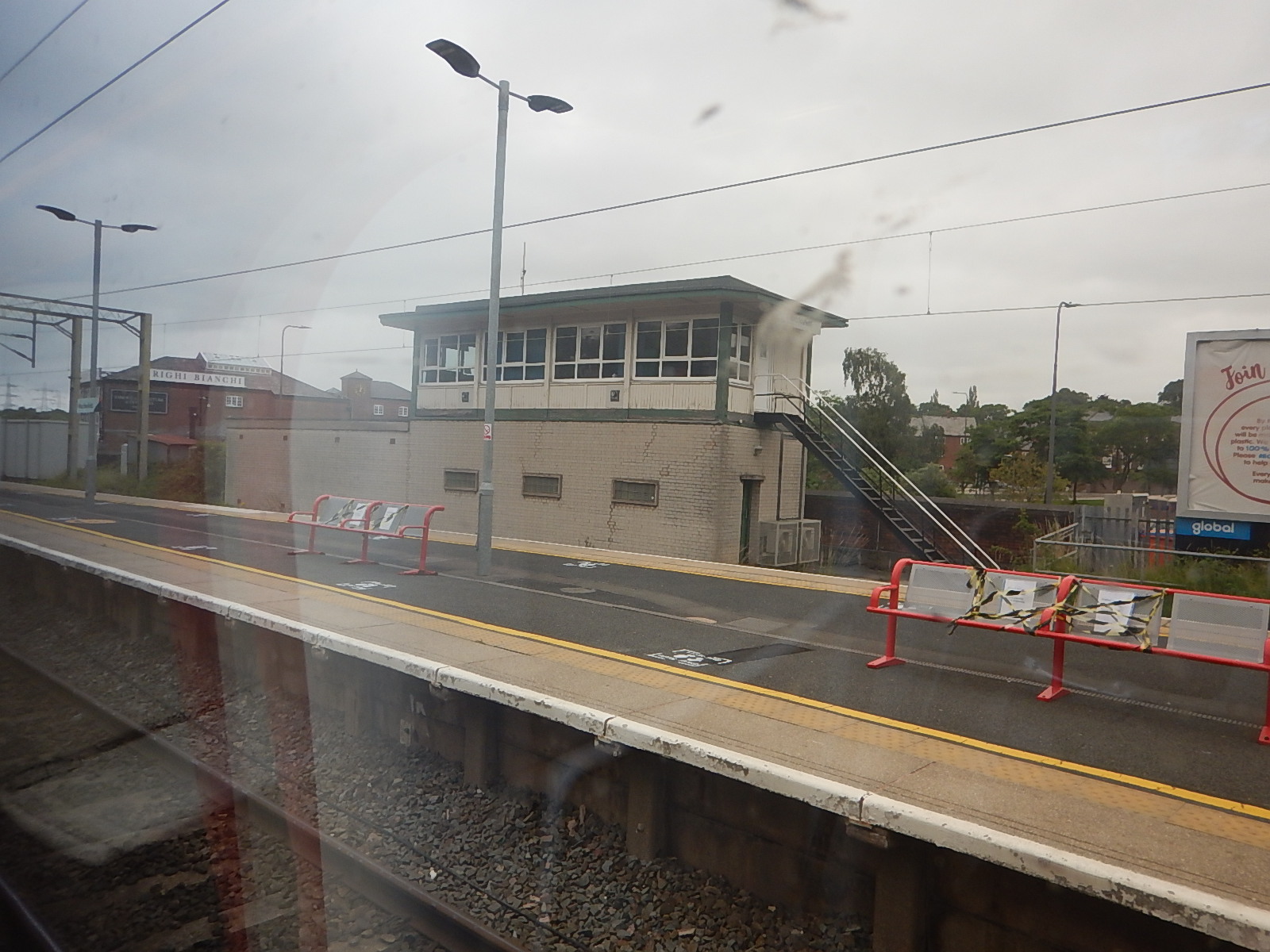
\remember that these days most signalling is controlled from centralised Rail Operation Centres.
Could High Speed Two Trains Run Between Macclesfield And Manchester Piccadilly?
As I said earlier, High Speed Two’s classic-compatible trains will be the same cross-section and shorter, than an eleven-car Class 390 train.
So the answer to my question must be yes!
- This would enable a stop at Stockport station.
- No platform lengthening would be required at Manchester Piccadilly and Stockport stations.
High Speed Two must have good reasons for using Macclesfield as a terminal.
- There are capacity issues between Macclesfield and Manchester Piccadilly stations.
- Macclesfield offers opportunities to connect to places, that are difficult to reach from Manchester Piccadilly station.
But these problems could probably be overcome by digital signalling or extension of the Manchester Metrolink.
Could More High Speed Two Services Run Between Macclesfield Station and The South?
Consider.
- I believe that Macclesfield station could handle more than an hourly High Speed Two train.
- It is a general principle, that on a metro like the London Overground or Merseyrail, that a single platform can handle up to four or even six tph.
- Four tph would surely be too high, but Macclesfield could easily handle a second classic-compatible train to and from Birmingham Curzon Street via Stoke and Stafford.
- During the inevitable works at Manchester Piccadilly station to sccomodate High Speed Two, Macclesfield could offer an alternative route, between London and Manchester.
Using Macclesfield station, as an alternative terminal for Manchester Piccadilly, builds in extra capacity for the future and offers a valuable alternative route during construction and upgrade works.
Rationalisation Between Cross Country And High Speed Two
Consider.
- In a lot of locations North of Birmingham, CrossCountry and High Speed Two seem to provide similar services between the same stations.
- Using currently proposed connections between High Speed Two and the classic network, CrossCountry’s services could run faster.
- CrossCountry’s new fleet of trains will probably be multi-mode trains, that will be very similar to the classic-compatible High Speed Two trains.
- Some of the routes used by CrossCountry’s services will have a substantial upgrade to allow higher speeds and more trains, to speed up High Speed Two services.
There must be a case for rationalisation of services.
Conclusion
The more I look at High Speed Two terminating at Macclesfield station, the more I like it.
I can see these services running from the station in the future.
- High Speed Two – Macclesfield and London Euston – One tph – This service would additionally call at Birmingham Interchange to link up with CrossCountry to the South.
- High Speed Two – Macclesfield and Birmingham Curzon Street – One tph
- CrossCountry – Macclesfield and Bournemouth, Plymouth or Reading – One tph.
- Northern and others – Macclesfield and Manchester Piccadilly via Stockport – Four-six tph
- Northern – Macclesfield and Huddersfield via Stockport and Stalybridge – Two tph
- Northern – Macclesfield and Manchester Airport – Two tph.
Obviously, this is all speculation, but Macclesfield will develop into an important rail hub to the South-East of Manchester.
Beeching Reversal – Sheaf Valley Stations
This is one of the Beeching Reversal projects that the Government and Network Rail are proposing to reverse some of the Beeching cuts.
Stations To Be Rebuilt
As you approach Sheffield station, you pass four station sites, three of which are demolished and the fourth is just a shadow of its former self.
Dore & Totley
Dean & Totley station used to have four platforms and this Google Map, shows what is left after British Rail’s vandalism in the mid-1980s.
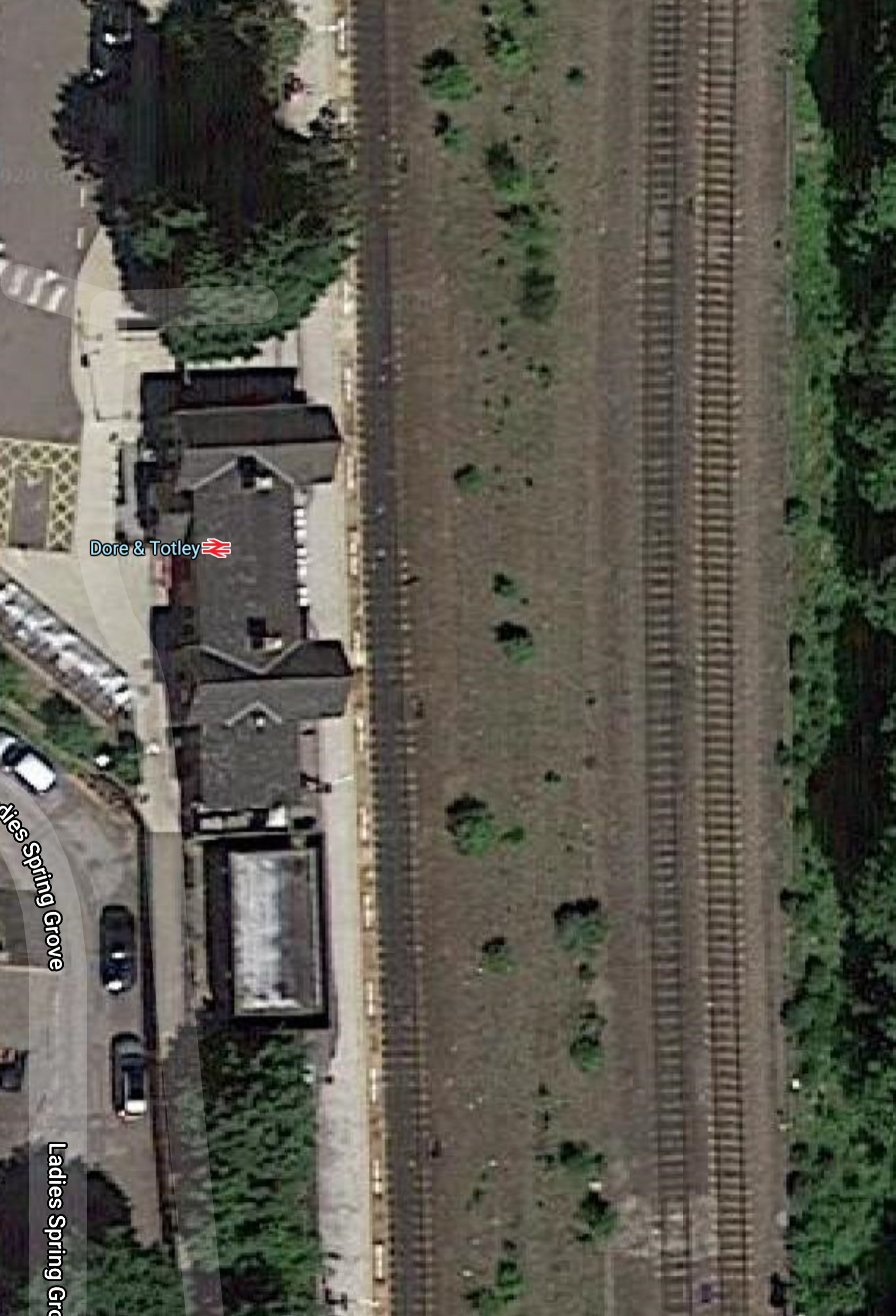
Note.
- The station has only one platform.
- The single track in the platform handles all trains to and from the Hope Valley Line.
- At present it appears to be two trains per hour (tph) in both directions.
- The two tracks at the right are the Midland Main Line.
Transport for the North wants to run four tph between Manchester Piccadilly and Sheffield through here, that will take forty minutes between the two cities.
Updates planned for the station include.
- A second platform for Manchester-bound trains.
- A new bridge with lifts.
- Platforms long enough to take a pair of Class 185 trains or a five-car Class 802 train.
- A full hourly service.
There certainly seems to be enough space for another platform and track through the middle of the station.
At some point in the near future, the two Midland Main Line tracks will be electrified, as part of the upgrade for High Speed Two.
Between Dore & Totley And Beauchief
This Google Map shows a typical section of the line between Dore & Totley and Beauchief stations.
Note the two Midland Main Line tracks on the right and single-track to the Hope Valley Line on the left.
It would appear that the fourth track can be squeezed in between the single track and the Midland Main Line.
Beauchief
Beauchief station used to have four platforms before it was demolished.
This Google Map shows the station’s former location.
Note.
- The building with the red dot is the former Beauchief Hotel. which was by the station.
- On a larger screen you can see three tracks going into Sheffield.
I’m fairly certain that four tracks and two platforms for a station can be fitted into this narrow trackbed.
Millhouses & Eccleshall
Millhouses and Eccleshall station used to have four platforms before it was demolished.
This Google Map shows the station’s former location.
Note.
- Wikipedia says the station was accessed from the Archer Road bridge, which is in the South East corner of the map.
- It looks like there are three tracks with space for four.
- The road to the North-West of the railway is called Old Station Road.
As at Beauchief, it will be tight.
Heeley
Heeley station used to have four platforms before it was demolished.
This Google Map shows the station’s former location.
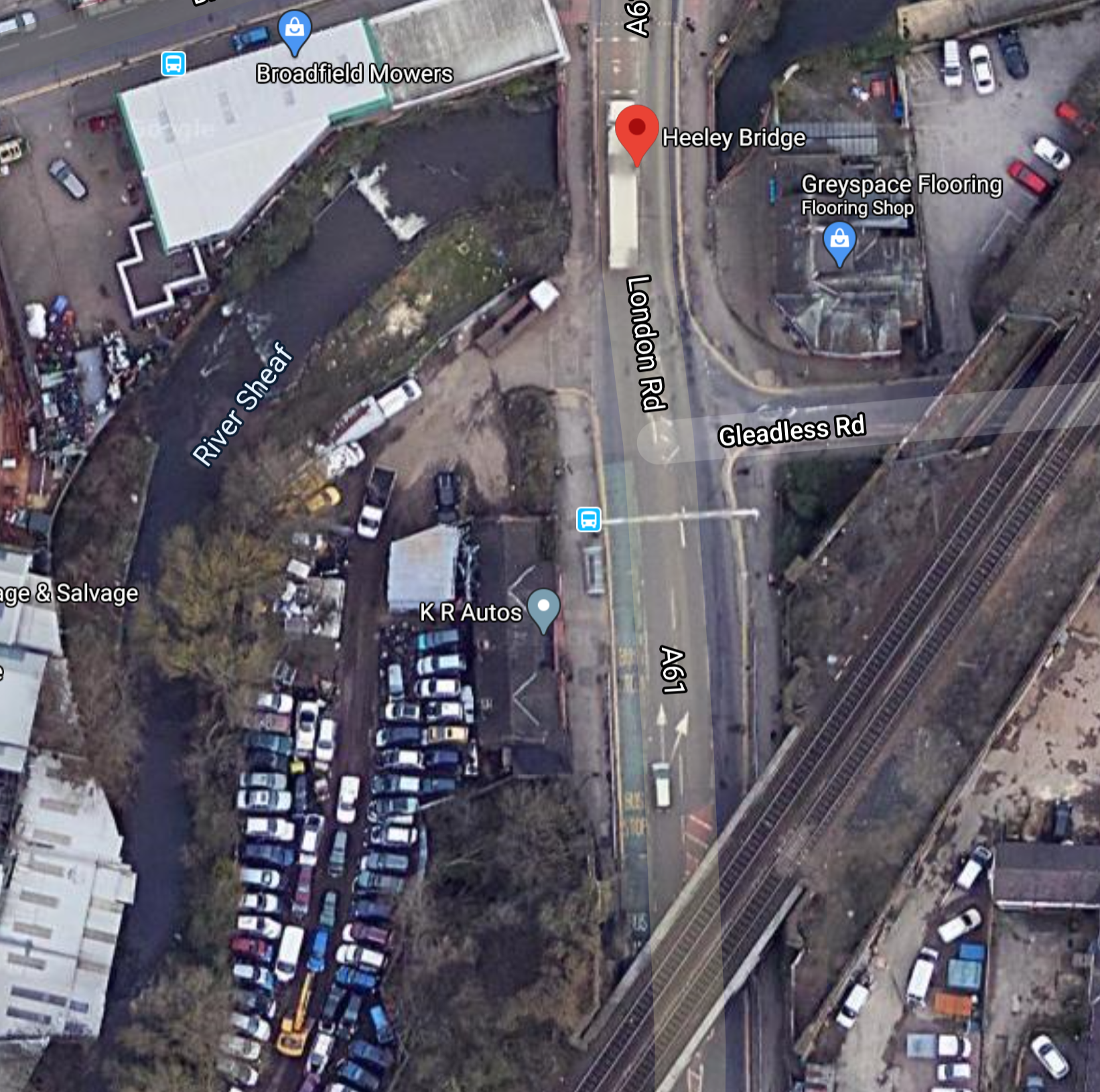
Note.
- The red arrow indicates Heeley Bridge, which Wikipedia says is near the station site.
- There appears to be only two tracks through here.
It is easy to follow the tracks from here to Sheffield station.
Could A Four Track Railway Be Rebuilt Between Dore & Totley And Sheffield Stations?
I’ve not seen anything that says that building a four-track railway through here is not possible.
In a few years, there could be the following tracks and platforms, on this section.
- Two fast tracks for High Speed Two, Midland Main Line and CrossCountry trains, that will be electrified with 25 KVAC overhead electrification, between Clay Cross North Junction and Sheffield station.
- The High Speed Two trains will be classic-compatible and up to 200 metres long.
- The two fast tracks will not have any platforms.
- Two slow tracks for local services, that will be appropriately electrified.
- The slow tracks will have step-free platforms, that will be long enough to take a five-car Class 802 train or a pair of Class 185 trains.
I can’t for the life of me understand, why this stretch of four-track main line between Dore & Totley and Sheffield stations was ever simplified, as at other places on the UK network, extra tracks were being added to the main lines, at the same time.
Future Services On The Fast Lines
Currently, the following services take the fast lines between Sheffield and Chesterfield stations via Dore & Totley station.
- East Midlands Railway – Sheffield and London St. Pancras – 2 tph
- East Midlands Railway – Sheffield and Norwich via Nottingham – 1 tph
- CrossCountry – Edinburgh/Newcastle and Derby/Birmingham and the South – 2 tph
- Northern – Sheffield and Nottingham – 1 tph
That is a very modest six tph.
High Speed Two are currently planning to run two tph between Sheffield and London Euston.
There may or may not be other changes.
- As Birmingham Curzon Street and Sheffield will be just forty-seven minutes by High Speed Two all the way, will these destinations have a direct high speed classic-compatible service? There’s plenty of space capacity on High Speed Two.
- I don’t think the Sheffield and St. Pancras services will be dropped, but they might be.
- CrossCountry will probably be running intelligent multi-mode trains capable of 125 mph running and up to 140 mph in places.
- Northern’s service between Sheffield and Nottingham might go via a reopened Barrow Hill Line.
But the biggest change will be that these two fast lines will be to High Speed Two standards.
- Sheffield and Chesterfield will be electrified.
- There will in-cab digital signalling, which theoretically could probably allow eighteen tph on the route.
- High Speed Two Trains between Sheffield and Chesterfield will take twelve minutes.
- Sheffield station will have been modified as required, to be able to handle all trains very efficiently.
But it would still be carrying a modest eight tph.
If required Sheffield would have the capacity to accept more trains from the South.
I wouldn’t be surprised to see, the following trains added.
- An extra tph to and from London Euston via High Speed Two.
- Two tph to and from Birmingham Curzon Street via High Speed Two.
I also wouldn’t be surprised to see CrossCountry using classic-compatible High Speed Two trains and switching to High Speed Two between Birmingham New Street and Sheffield. But these trains would still use the same tracks to access Sheffield station.
But I am led to the conclusion, that Sheffield will have more than enough capacity linking the City to Chesterfield and the South.
Future Services On The Slow Lines
Or should I use lines connecting to the Hope Valley Line rather than slow lines?
Currently, the following services take the slow lines between Sheffield and Dore & Totley stations.
- East Midlands Railway – Liverpool Lime Street and Sheffield – via Manchester Piccadilly – 1 tph
- TransPennine Express – Manchester Airport and Cleethorpes via Manchester Piccadilly – 1 tph
- Northern – Sheffield and Manchester Piccadilly – 1 tph
Transport for the North aims to run a four tph service with a forty minute journey time between Manchester Piccadilly and Sheffield.
Consider.
- 100 mph TransPennine Express trains take fifty-three minutes between Sheffield and Manchester Piccadilly without a stop.
- Classic-compatible trains with a battery capability could easily handle the route.
- Northern’s services on the Hope Valley Line are timed for 75 mph trains.
- Dore & Totley and Hazel Grove stations are twenty-nine miles apart.
If between Dore & Totley and Sheffield stations were to be electrified and track improvements like passing loops were to be made to the Hope Valley Line, I believe that to achieve a forty minute all-stops timing between Sheffield and Manchester Piccadilly, would need a train with the following specification.
- Electric train with batteries.
- Four cars
- 100 mph or faster operating speed.
- Step-free access between platform and train.
- Sparkling acceleration and deceleration.
- Ability to run under in-cab digital signalling to keep out of the way of freight services.
Looking at Crossrail between London Paddington and Maidenhead stations, the London route is probably as difficult as the Hope Valley Line and it has been designed as a forty minute service with ten stops, using a modern electric train.
If TransPennine fitted batteries to their Class 802 trains, these trains would fit the Northern Powerhouse Rail requirements.
East Midlands Railway and Northern would find that the following trains could be used.
- Bombardier – Aventra with batteries
- Bombardier – Class 377 train with batteries
- Bombardier – Class 379 train with batteries
- CAF – Class 331 train with batteries
- Hitachi – Class 385 train with batteries
- Porterbrook – Battery/FLEX train based on Class 350 train
- Stadler – Flirt with batteries
All would need that between Dore & Totley and Sheffield stations be electrified.
After the upgrades and the new or refurbished trains are running, this would mean that between Dean & Totley and Sheffield would be handling four tph, which would be semi-fast trains between Sheffield and Manchester Piccadilly. Although to current passengers on the line, they would seem to be fast services of a much higher standard.
It would not be very different to how the slow lines into Paddington also handle about four tph of other services, including GWR services and freight.
I believe that to provide an adequate service to the reopened and rebuilt stations of Dore & Totley, Beauchief, Millhouses & Eccleshall and Heeley, that a Turn-Up-And-Go service of at least four tph should be run between Dore & Totley and Sheffield stations.
A Turnback At Dore & Totley
This Google Map shows Dore & Totley station and the area to the South.
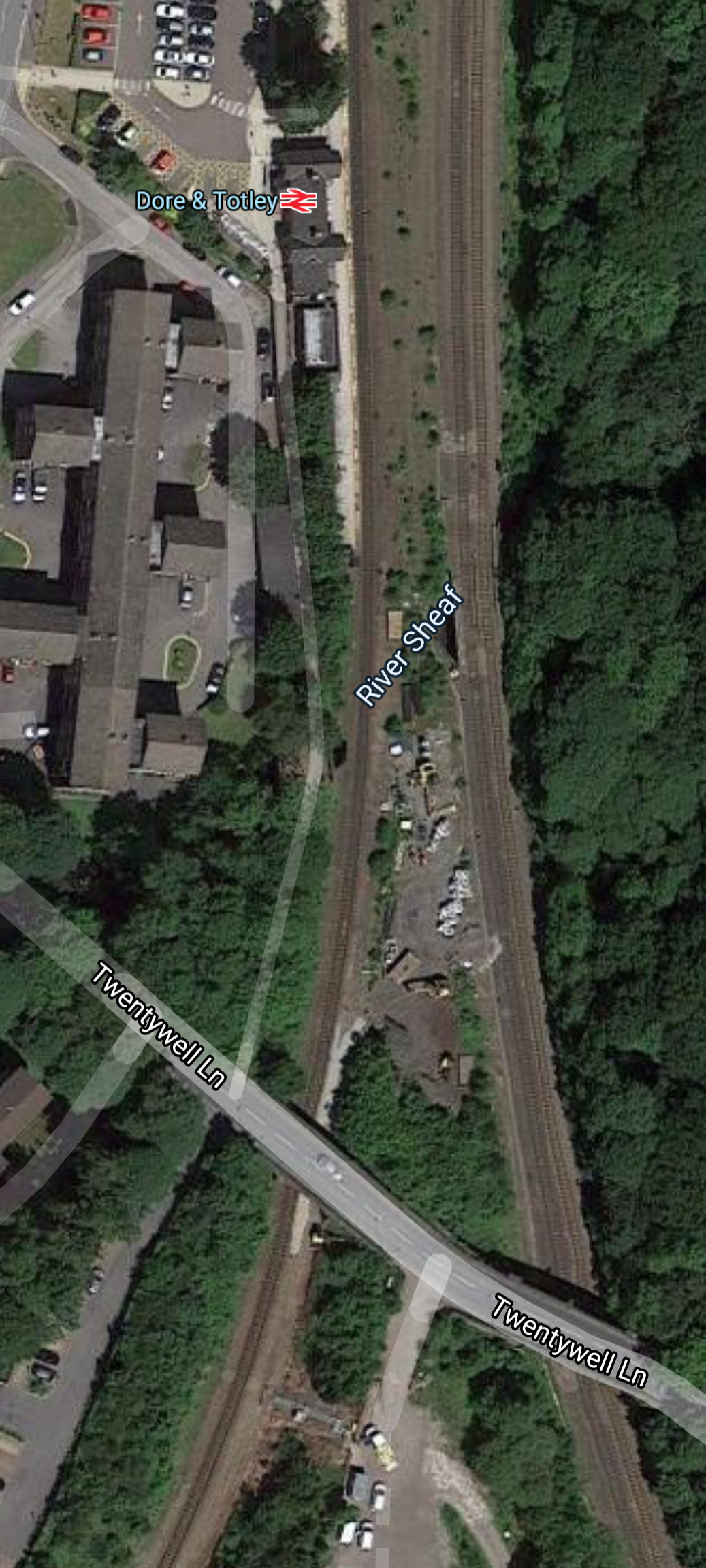
Note.
- There would appear to be a lot of space between the Midland Main Line and the single track, that leads between Dore & Totley station and the Hope Valley Line.
- Flying my helicopter, as low as I dare, it looks like the area is either a rubbish dump or very low grade businesses.
- Crossrail has designed turnbacks at Abbey Wood and Paddington stations, that will handle twelve tph.
I believe that it would be possible to design a turnback at Dore & Totley station, that would handle eight trains per hour, if not twelve tph.
It might even be possible to squeeze in some overnight stabling.
Trains Or Tram-Trains Between Dore & Totley And Sheffield Stations
In my view, it doesn’t matter.
Crossrail’s 12 tph turnbacks can handle a 205 metre long Class 345 train, so I’m sure a well-designed turnback at Dore & Totley could handle a mixture of any trams or tram-trains below a defined maximum length of say 140 metres, which would be defined by a pair of Class 185 trains, which might have to be turned back during service disruption.
Where Would The Services Terminate in The East?
It is my view that cross-city services like Birmingham’s Cross-City Line, Liverpool’s Northern Line, London’s Crossrail and Thameslink, Newcastle’s Metro and Paris’s RER are efficient for both passengers and train operators.
So Dore & Totley station could be one end of a Sheffield cross-city line, with a frequency of at least eight tph through Beauchief, Millhouses & Eccleshall, Heeley and Sheffield stations.
So where would services go on the other side of Sheffield? Wikipedia gives these as services to the East of Sheffield.
- Leeds via Barnsley and Wakefield (fast) – 2 tph
- Leeds via Meadowhall, Barnsley, Wakefield and Castleford (stopping). – 1 tph
- Leeds via Meadowhall, Moorthorpe and Wakefield. – 1 tph
- Scarborough via Meadowhall, Doncaster, Hull and Bridlington. – 1 tph
- Lincoln Central via Worksop and Retford – 1 tph
- Gainsborough Central via Worksop, three trains per week continue to Cleethorpes via Brigg. – 1 tph
- Huddersfield via Meadowhall, Barnsley and Penistone – 1 tph
- Doncaster via Meadowhall and Rotherham, with one train per hour continuing to Adwick – 2 tph
- York via Moorthorpe and Sherburn-in-Elmet. – 3 trains per day (tpd)
For much of the day, that is a frequency of 10 tph, with 5 tph calling at Meadowhall, 2 tph calling at Worksop and two fast tph passing Meadowhall without stopping.
But there are other rail projects under development.
- High Speed Two will enable a new fast service between Sheffield and Leeds via Meadowhall and a new station in the Dearne Valley.
- The Sheffield Region Transport Plan 2019 envisages a new station at Barnsley Dearne Valley. See Sheffield Region Transport Plan 2019 – A New Station At Barnsley Dearne Valley.
- The Sheffield Region Transport Plan 2019 envisages tram-trains running between Sheffield and Doncaster-Sheffield Airport See Sheffield Region Transport Plan 2019 – Tram-Trains Between Sheffield And Doncaster-Sheffield Airport.
- The Sheffield Region Transport Plan 2019 envisages a new Station at Waverley. See Sheffield Region Transport Plan 2019 – A New Tram-Train Route To A New station At Waverley.
- High Speed Two might enable a fast classic-compatible service between Sheffield and Scarborough via York.
- The possible opening of the South Yorkshire Joint Railway to passenger traffic, may open up further opportunities. See Beeching Reversal – South Yorkshire Joint Railway.
- The possible reinstatement of the Barrow Hill Line. See Reinstatement Of The Barrow Hill Line Between Sheffield And Chesterfield.
- The development of the Stocksbridge Railway for passenger services.
I can see classic-compatible High Speed Two trains serving the following places to the East of Sheffield.
- Leeds
- Hull via Doncaster
- Scarborough via York
- Cleethorpes via Doncaster, Scunthorpe and Grimsby.
A train like a five-car Class 802 train would probably be enough for most routes except Leeds.
I can see the following terminals for tram-trains to the East of Sheffield.
- Doncaster and Doncaster-Sheffield Airport
- Waverley station, which could be on a loop from the Sheffield and Lincoln Line.
- Barnsley Dearne Valley
There may well be others.
If Sheffield were Karlsruhe in Germany, the tram-trains would probably serve the following routes.
- Huddersfield via Penistone.
- Lincoln via Worksop and Gainsborough.
- Manchester via the Hope Valley Line.
But the Germans have a much larger electrified core, than Sheffield will have, even if High Speed Two electrifies between Dore & Totley and Thurnscoe stations via Sheffield.
I can make a table of destinations and distances and how they could be served.
- Barnsley – 16 miles – Possible return trip from Sheffield for a battery electric train.
- Barnsley Dearne Valley – 8 miles from Rotherham Parkgate – Possible return trip from Sheffield via Rotherham Parkgate for a battery electric tram-train.
- Doncaster – 11 miles from Rotherham Parkgate – Possible return trip from Sheffield via Rotherham Parkgate for a battery electric tram-train.
- Chesterfield via Barrow Hill – 17 miles – Possible return trip from Sheffield for a battery electric tram-train.
- Doncaster Sheffield Airport – 10 miles from Doncaster – Possible return trip from Sheffield via Rotherham Parkgate and Doncaster for a battery electric tram-train.
- Gainsborough Lea Road. – 32 miles – See Lincoln Central.
- Huddersfield – 36 miles – Possible battery electric train with charging at Huddersfield.
- Hull – 59 miles – Possible battery electric train with charging at Doncaster and Hull.
- Lincoln Central – 48 miles – Possible battery electric train with charging at Lincoln and/or Gainsborough Lea Road. Otherwise diesel.
- Penistone – 23 miles – Possible return trip from Sheffield for a battery electric train, using Newton’s friend on the way back.
- Retford – 23 miles – Possible return trip from Sheffield for a battery electric train.
- Waverley – About 6 miles – Possible return trip from Sheffield for a battery electric tram-train.
- Worksop – 16 miles – Possible return trip from Sheffield for a battery electric train.
It looks to me like a mix of battery electric trains and tram-trains could run most of the services from Sheffield, if services that used new High Speed Two infrastructure used classic-compatible trains or trains like the existing Class 802 trains, that have been converted to battery electric operation.
Note.
- I am assuming, that a battery electric train has a range of 56 miles on a single charge.
- Rotherham Parkgate station is changed to a through station.
- Tram-trains passing through Doncaster can recharge on the station’s 25 KVAC overhead electrification.
- Charging can be provided as required at other stations.
There are lots of possibilities.
Consider, this for tram-train extensions to Barnsley Dearne Valley, Doncaster and Doncaster Sheffield Airport.
- Extend the tram-train service at Rotherham Parkgate to either Doncaster and Doncaster Airport or Barnsley Dearne Valley stations.
- Run tram-trains between Dore & Totley and Rotherham Parkgate via Sheffield, Meadowhall and Rotherham Central.
This would give a double-ended route across Sheffield and Rotherham between Dore & Totley and the existing Supertram network in the West and Barnsley Dearne Valley, Doncaster and Doncaster Sheffield Airport in the East.
Consider how to connect the branch to Waverley station to the Supertram network.
- Waverley station will be either on or on a loop from the Sheffield and Lincoln Line.
- The Sheffield and Lincoln Line has no obvious connection with the Supertram network.
- The Sheffield and Lincoln Line goes straight in to Sheffield station.
- Trains to Lincoln always appear to use Platform 4 in Sheffield station.
- Sheffield station has four through platforms.
This Google Map shows where the Sheffield and Lincoln Line passes behind the Supertram Depot at Nunnery.
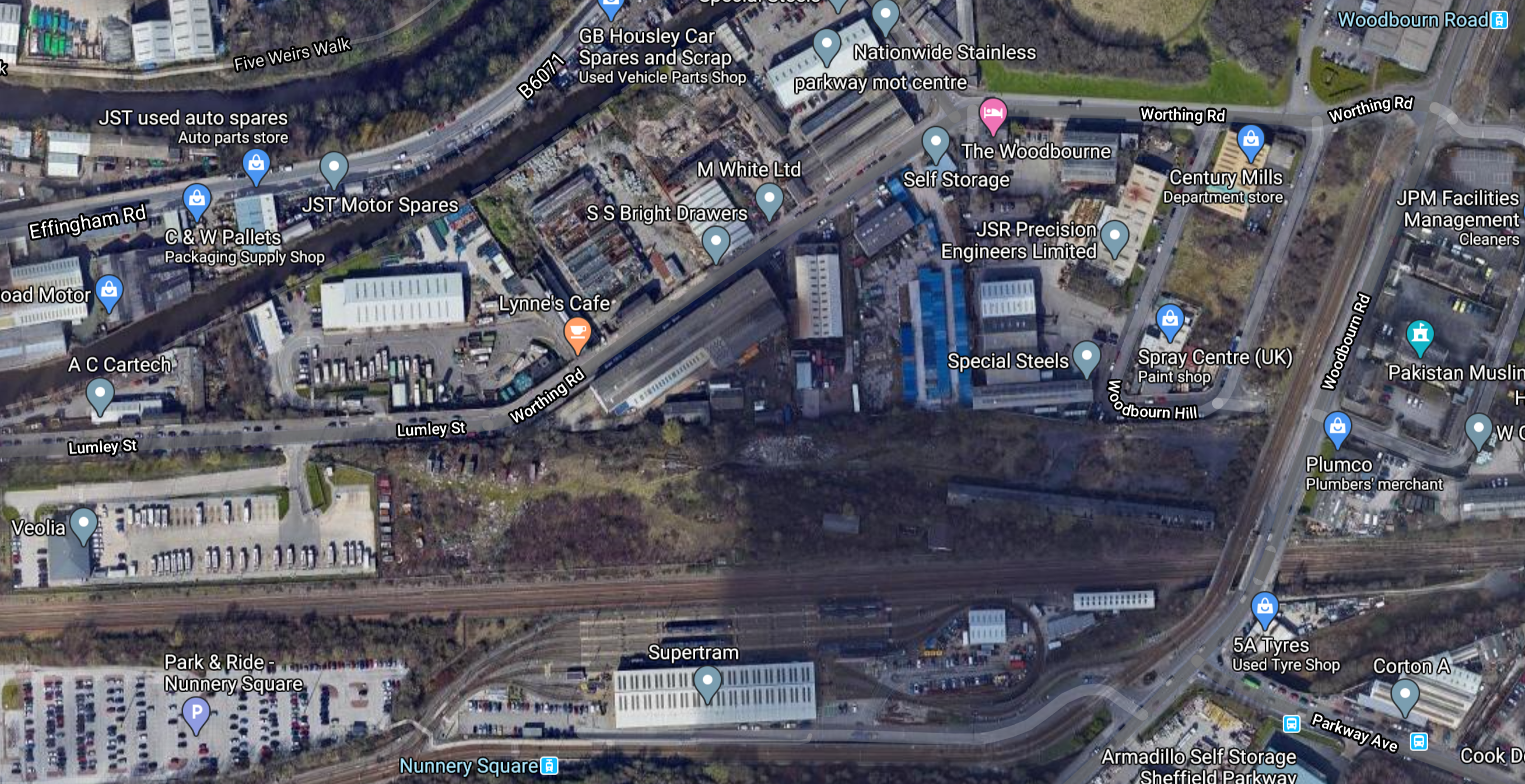
Note.
- The Nunnery Square Park and Ride is in the South West corner of the map.
- The Supertram depot is to the East of the Park-and-Ride, with the Nunnery Square tram stop to the South.
- The Woodbourn Road tram stop is in the North East corner of the map.
This second Google Map shows the lines around the Park-and-Ride.
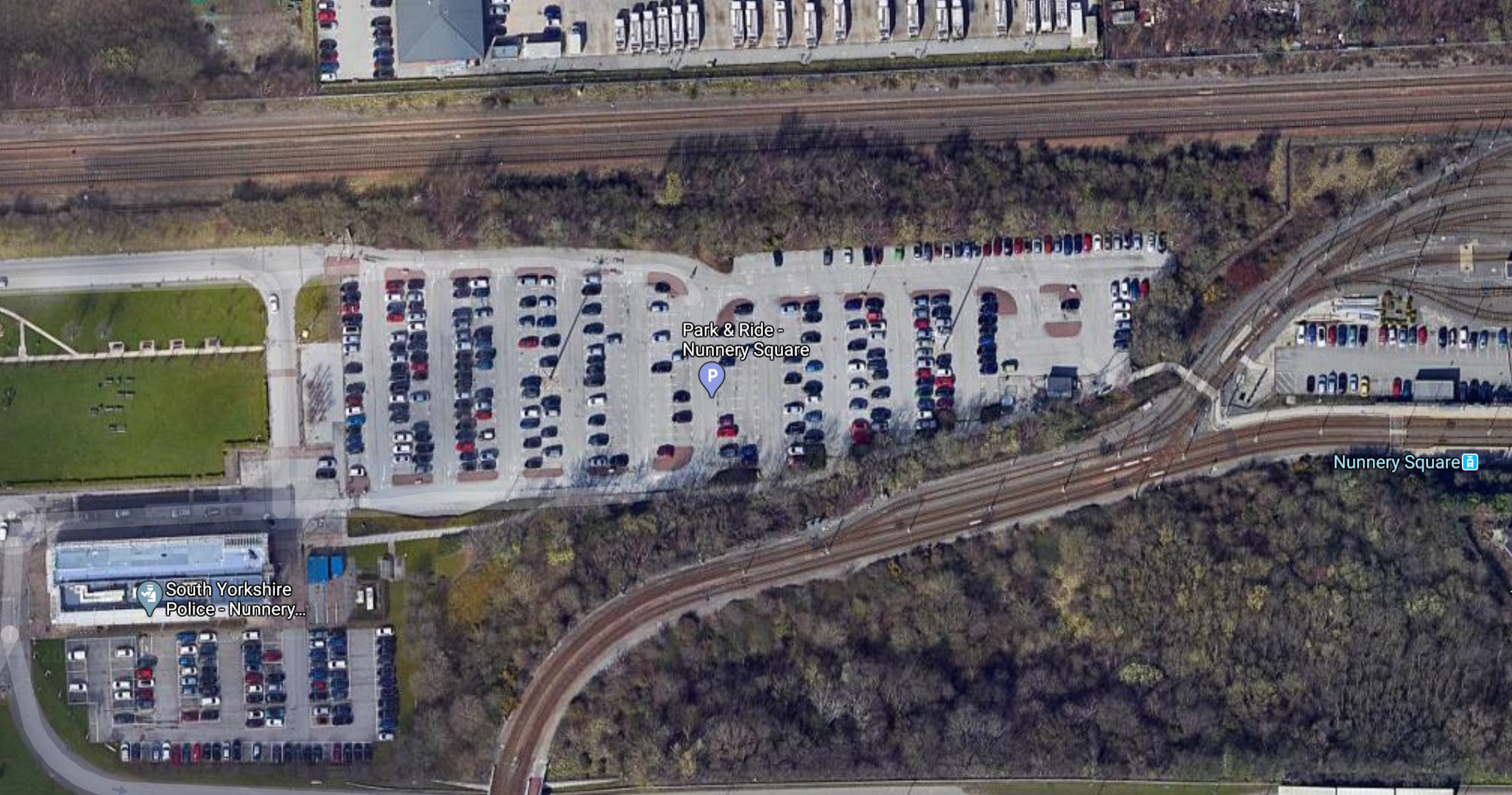
I suspect that a connection between the Supertram system and the Sheffield and Lincoln Line, could be built to the North of the Nunnery Depot.
But would it be easier to continue to Sheffield station or pass through the station and terminate at Dore & Totley station?
I can’t be sure looking at the maps, but it could be logical that trains to and from Lincoln use the Southern pair of tracks past the Nunnery Depot, as they would be on the right side of the tracks for Lincoln.
This would make it easier to do the following.
- Create a connection between the Nunnery Depot and the Sheffield and Lincoln Line, which would surely be needed for efficient maintenance and operation of tram-trains running to and from Waverley.
- Allow tram-trains used to serve the proposed Waverley station to return to the Depot every night.
- Allow tram-trains working between Sheffield and Meadowhall to use the Lincoln and Sheffield Line to enter the Nunnery Depot.
- Build a tram stop/station by the Park-and-Ride.
There would also be less need to build another depot.
Looking at the maps, could there be space to extend the Nunnery Depot?
Conclusion
This could be a very good project.
- It fits in well with the plans and needs of High Speed Two.
- It connects the new Waverley station to Sheffield station.
- It fits well with the Sheffield Region Transport Plan 2019.
- It connects Sheffield, Rotherham and Doncaster to Doncaster Sheffield Airport.
- It opens up the Hope Valley Line to improve services between Manchester and Sheffield.
I also don’t think, there’s any great risk!
I

