Is There A Case For A Round-The-Wash Service Between Doncaster And Ipswich/Norwich?
I suggested this service in The Integrated Rail Plan For The North And Midlands And The East Coast Main Line.
Effectively, it would join East Midlands Railway’s Doncaster and Peterborough service with Greater Anglia’s Cambridge and Ipswich service.
- The service could go via Scunthorpe, Grimsby Town, Cleethorpes, Grimsby Town, Market Rasen, Lincoln, Sleaford, Spalding, Peterborough, March, Ely, Cambridge North, Cambridge, Newmarket, Bury St. Edmunds and Stowmarket.
- There would be reverses at Cleethorpes and Cambridge.
- There may be extra stops in Lincolnshire and across Suffolk.
- The service would not use the East Coast Main Line, but would use the new Werrington Dive-Under and the Great Northern and Great Eastern Joint Line to the East of the East Coast Main Line.
- The frequency would be one train per two hours (1tp2h).
- Ideal trains could be Class 755 trains, perhaps running on batteries or hydrogen.
It would be paired with a new Doncaster and Norwich service, that could partly replace East Midlands Railway’s Liverpool and Norwich service.
- The service could go via Scunthorpe, Grimsby Town, Cleethorpes, Grimsby Town, Market Rasen, Lincoln, Sleaford, Spalding, Peterborough, March, Ely, Cambridge North, Cambridge, Cambridge North, Ely, Thetford, Attleborough and Wymondham.
- There would be reverses at Cleethorpes and Cambridge.
- There may be extra stops in Lincolnshire and across Norfolk.
As with the Ipswich train it would not use the East Coast Main Line and have a frequency of 1tp2h.
The Objectives Of The Service
I believe this service could have several objectives.
Remove Slower Trains From The East Coast Main Line Between Peterborough And Doncaster
There aren’t many except freight, but this plan could provide a better solution to the Liverpool and Norwich service.
Providing Better Connections To The Biggest Growth Point In The UK – Cambridge
Cambridge needs better connections, so that it can bring in the staff and workers, that the high-tech capital of the UK needs.
Better Connection Of East Anglia And Lincolnshire To Northern England And Scotland
In Peterborough and Doncaster the route has two main interchanges to bring about these connections.
Promoting Tourism
For a start the route has five cathedrals; Bury St. Edmunds, Ely, Lincoln, Norwich and Peterborough and the historic city of Cambridge.
But I do believe that there are numerous places, where tourists might stay on the route and use it to explore the East of the country.
A Few Questions
These are a few questions.
Would The Route Be Electrified?
I don’t believe it will be fully electrified for two reasons.
Freight locomotives will increasingly become hydrogen-powered and also be able to use electrification, where it exists.
Plans by the likes of Hitachi ABB Power Grids and Furrer and Frey are likely to enable discontinuous and battery-electric trains to be able to work the route.
This philosophy would avoid all the disruption and reconstruction of structures of electrification and probably be much more affordable.
Would York Or Leeds Make A Better Northern Terminal For The Route?
Both have possibilities.
- York would need running on the East Coast Main Line.
- Leeds would probably need trains capable of 125 mph running.
On the other hand both Leeds and York would have superb connectivity.
Conclusion
I feel this would be a very valuable new service and it could be created without building any new infrastructure other than perhaps some strategic stations.
Hitachi Rail And Angel Trains To Create Intercity Battery Hybrid Train On TransPennine Express
The title of this post, is the same as that of this Press Release from Hitachi Rail.
The press release starts with these three points.
- Hitachi Rail, Angel Trains and TransPeninne Express (TPE) agree to trial retrofitting battery on intercity train
- Trial, starting next year, can cut fuel usage by at least 20% and reduce emissions on Transpennine network from 2022 onwards
- Tri-mode service can cut noise pollution in urban areas and improve air quality.
Hitachi also point to this infographic.
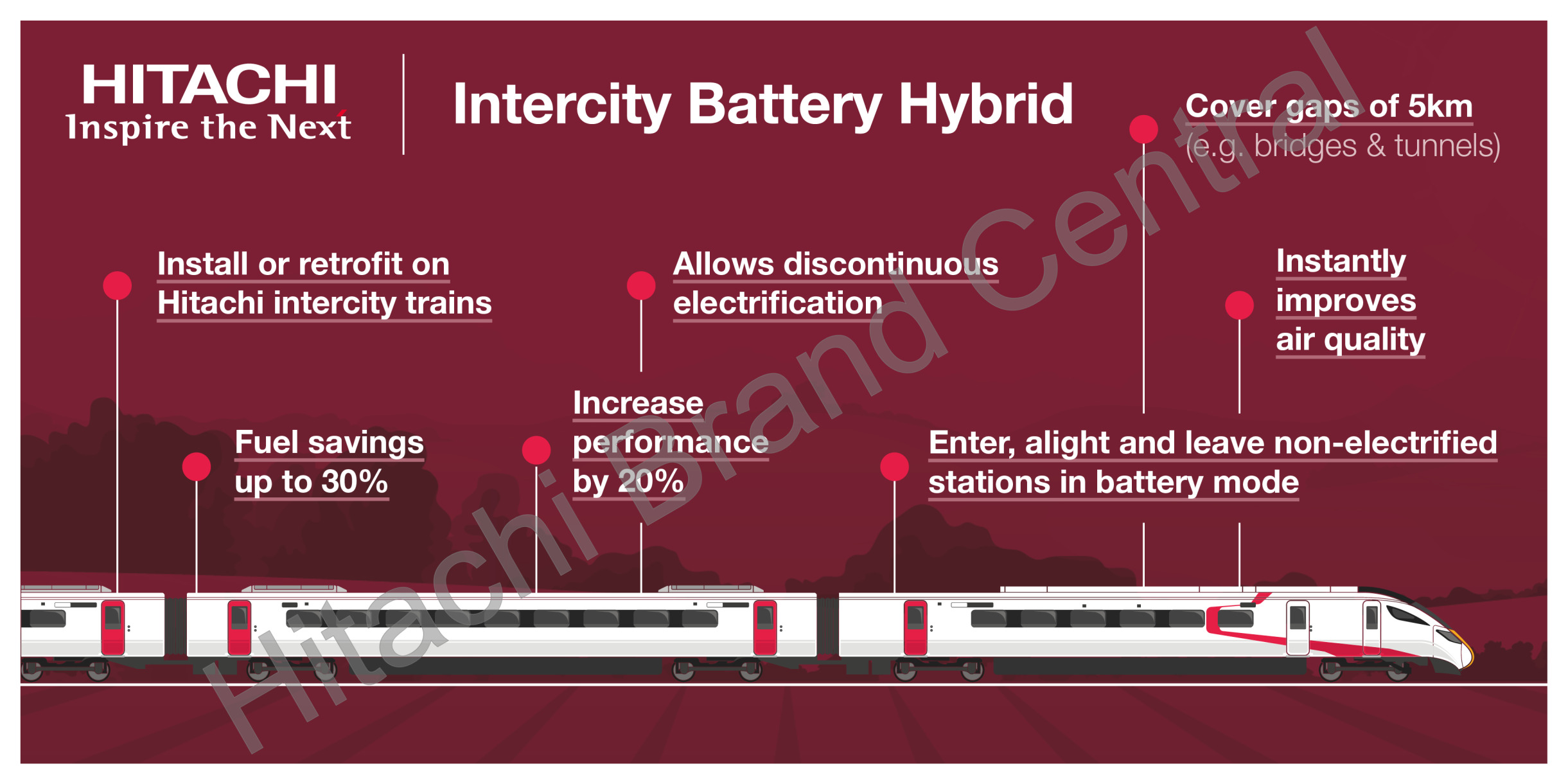
This very much looks to be a step forward from the Intercity Tri-Mode Battery Train that was announced in December 2020 in this press release from Hitachi which is entitled Hitachi And Eversholt Rail To Develop GWR Intercity Battery Hybrid Train – Offering Fuel Savings Of More Than 20%.
The Intercity Tri-Mode Battery Train is described in this Hitachi infographic.

The specifications are very similar, except for the following.
- The battery range is given as five kilometres.
- Fuel savings are up to 30% instead of at least 20%.
- A performance increase of 30 % is claimed.
- The upgrade appears to be able to be fitted to Hitachi intercity trains, as opposed to a straight replacement of one engine by batteries.
It looks to me, that Hitachi have been working hard to improve their design.
I think this paragraph of the press release is key.
The trial will see a diesel engine replaced by batteries to help power a five-carriage train, along with the two remaining engines. The power provided by the batteries will help to reduce the amount of fuel required to operate the train.
Hitachi don’t say, but I suspect the trains and their batteries have a lot of energy saving features.
- Regenerative braking is already used to power some services like lighting and air-conditioning on the trains.
- But I suspect regenerative braking will also be used to recharge the batteries.
- A sophisticated computer system will drive the train in the most optimal manner.
- Hopefully, diesel will only be used as a last resort.
Features like these and others will enable the trains to jump gaps in the electrification. As more and more tricks are added and batteries hold more charge, the gaps the trains will be able to cross will get larger.
Five kilometres might not sound much, but I think it could be surprisingly useful.
I will use an example from the Midland Main Line to illustrate how the trains and discontinuous electrification might work.
In Discontinuous Electrification Through Leicester Station, I described the problems at Leicester station and how discontinuous electrification could solve the problem.
The following is a modified extract from that post.
This Google Map shows the bridge and the Southern end of the station.
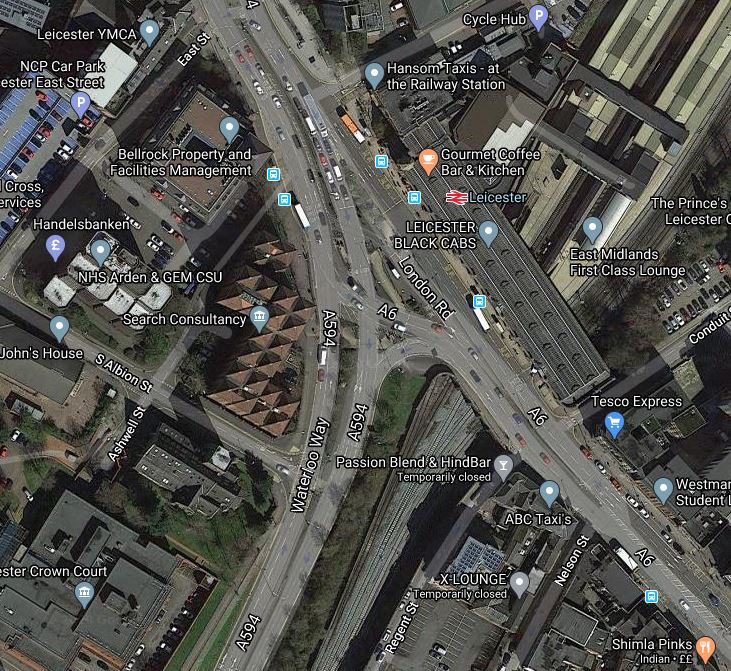
It looks to me, that Leicester station and the road, would have to be closed to traffic for some time, if the bridge were to be rebuilt, to allow the erection of electrification through the area. Leicester and all train passengers would love that!
A solution could be discontinuous electrification.
- The electrification from the South, would finish on the South side of bridge.
- The electrification from the North, would finish at a convenient point in Leicester station or just to the North.
- Electric trains would cover the gap of up to five kilometres on battery power.
Note.
Pantographs could be raised and lowered, where the wires exist.
Trains would probably use a stopping profile in Leicester station, that ensured they stopped with full batteries.
This would mean they had enough electricity to get back up to speed and reconnect to the electrification on the other side of the station.
To get an idea at how long five kilometres is in the Centre of Leicester, this Google Map shows the Leicester station.

Note that the platforms are around three hundred metres long.
In other words the electrification can be kept well away from the station and its troublesome bridge.
How much money would be saved and disruption avoided?
Application To The TransPennine Express Routes
These are the various routes, where Class 802 trains could be used.
Liverpool Lime Street And Edinburgh, Newcastle, Scarborough Or York
Sections are as follows.
- Liverpool Lime Street and Manchester Victoria – 31.7 miles – Electrified
- Manchester Victoria and Stalybridge – 8 miles – Electrified probably by 2024
- Stalybridge and Huddersfield – 18 miles – Diesel
- Huddersfield and Dewsbury – 8 miles – Electrified probably by 2024
- Dewsbury and Leeds – 9.2 miles – Diesel
- Leeds and York – 25.6 miles – Electrified probably by 2024
- York and Newcastle – 80.2 miles – Electrified
Note.
- All services take a common route between Liverpool Lime Street and York.
- A surprising amount is electrified.
- A further 42 miles are being electrified.
- The 3 km Morley Tunnel between Dewsbury and Leeds might not be electrified.
- The 5 km Standedge Tunnel between Huddersfield and Stalybridge might not be electrified.
It looks to me that the 5 km battery range will avoid electrification of two long Victorian tunnels.
Manchester Airport And Newcastle Or Redcar Central
Sections are as follows.
- Manchester Airport and Manchester Victoria – 13.2 miles – Electrified
- Manchester Victoria and Stalybridge – 8 miles – Electrified probably by 2024
- Stalybridge and Huddersfield – 18 miles – Diesel
- Huddersfield and Dewsbury – 8 miles – Electrified probably by 2024
- Dewsbury and Leeds – 9.2 miles – Diesel
- Leeds and York – 25.6 miles – Electrified probably by 2024
- York and Newcastle – 80.2 miles – Electrified
- Northallerton and Redcar Central – 29 miles – Diesel
The route goes through the Morley and Standedge tunnels.
Manchester Piccadilly And Hull
Sections are as follows.
- Manchester Piccadilly and Stalybridge – 7.5 miles – Electrified probably by 2024
- Stalybridge and Huddersfield – 18 miles – Diesel
- Huddersfield and Dewsbury – 8 miles – Electrified probably by 2024
- Dewsbury and Leeds – 9.2 miles – Diesel
- Leeds and Selby – 21 miles – Diesel
- Selby and Hull – 31miles – Diesel
The route goes through the Morley and Standedge tunnels.
Manchester Piccadilly And Huddersfield
The route goes through the Standedge tunnel.
Huddersfield And Leeds
The route goes through the Morley tunnel.
Manchester Airport And Cleethorpes
The Hope Valley Line which is part of this route has three tunnels.
Perhaps they will use a bit of diesel to get through Totley.
The Future
This paragraph sums up what Hitachi and Angel Trains could see as a possible future direction.
Once complete, the trial provides a pathway for Hitachi Rail, the train builder and maintainer, and Angel Trains, the train’s owner to develop plans to retrofit batteries to the wider fleet.
These plans will probably go in the directions like decarbonisation, more efficient operation and better standards for passengers.
Conclusion
This looks like a solution that has been helped by real ale in an appropriate hostelry.
- The battery range has been chosen so Network Rail don’t necessarily have to electrify the tunnels.
- Full electrification can be used either side of the tunnels.
- Will any stations not be electrified. After all if the trains are using battery power in stations do they need electrification?
- It might be useful to have some more bi-mode freight locomotives, that could traverse the tunnels on diesel or batteries.
Hitachi and Network Rail certainly seem to be cooking up a solution.
Iron Ore Miner Orders Heavy-Haul Battery Locomotive
The title of this post, is the same as that of this article on Railway Gazette.
This is the first two paragraphs.
Mining company Roy Hill has ordered a Wabtec FLXdrive battery-electric heavy-haul freight locomotive. This will replace one the four ES44ACi diesel-electric locos used to haul its 2 700 m long iron ore trains, and is expected to reduce fuel costs and emissions by ‘double digit’ percentages while also cutting maintenance costs.
The locomotive is scheduled to be delivered in 2023. It will have a capacity of 7 MWh, an upgrade from the 2·4 MWh prototype which Wabtec and BNSF tested in revenue service in California earlier this year.
Note.
- It will have a 7 MWh battery.
- 2700 metres is 1.6 miles.
It looks to me, that the three diesel locomotives and one battery locomotive are arranged as a massive hybrid locomotive and I suspect that with sophisticated control systems, those double digit cuts in fuel costs and emissions would be possible.
A couple of years ago, I took this picture near Shenfield.
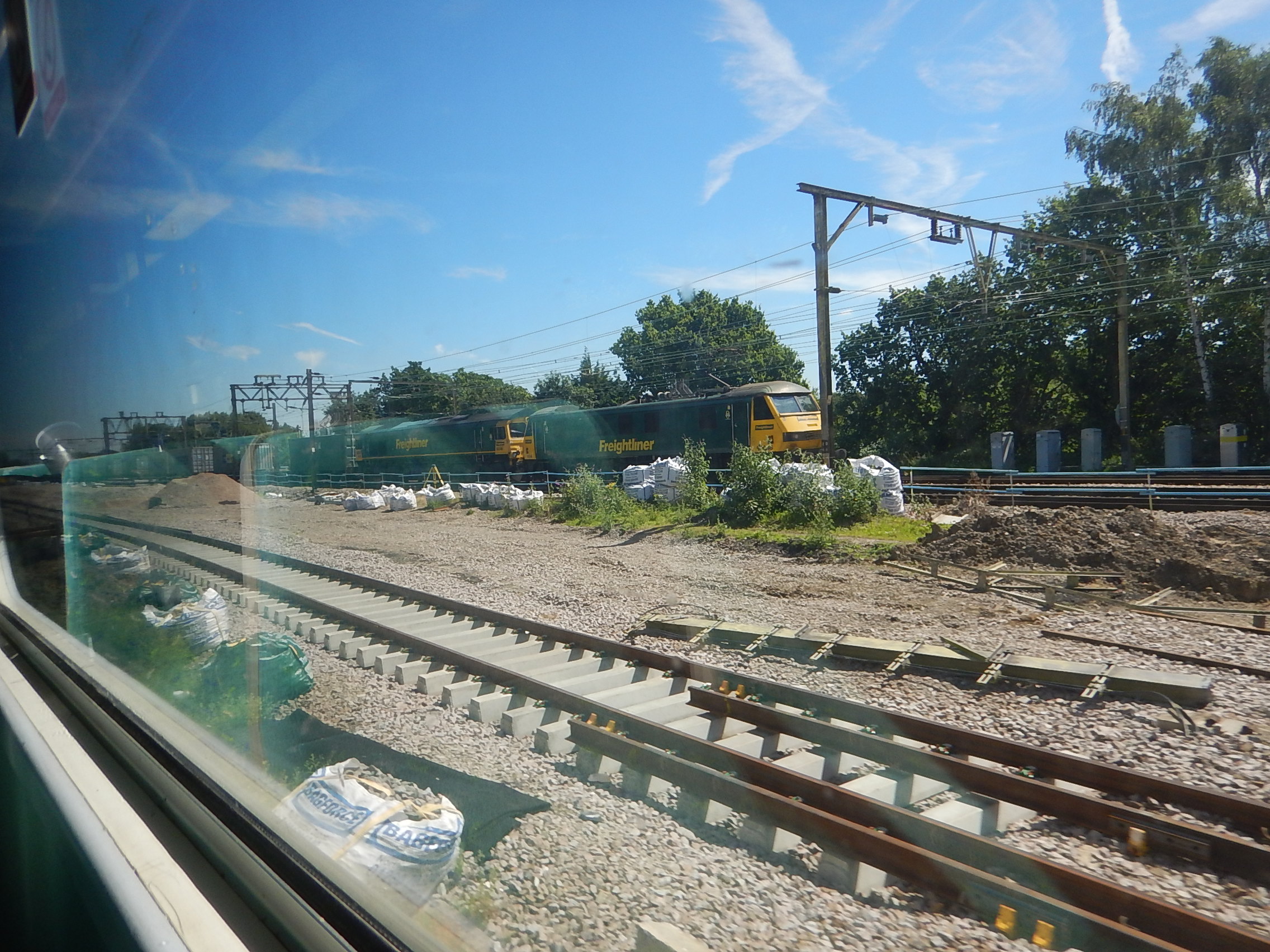
This double-headed train has a Class 90 electric locomotive and a Class 66 diesel locomotive at the front of a long freight train.
- The Class 90 locomotive has an TDM system for multiple working.
- The Class 66 locomotive has an AAR system for multiple working.
So does this mean that the two locomotives can’t work together, which if it does begs the question of what is happening.
- Had the Class 66 locomotive failed and Class 90 was acting as a Thunderbird?
- Was the Class 66 locomotive being moved from one depot to another for maintenance or repair?
- Was it an experiment to see if the two locomotives could work together?
I sometimes think that I didn’t see this unusual formation, but then the camera doesn’t lie.
But could we learn from what Wabtec are doing for Roy Hill in Australia?
The Class 93 Locomotive
Rail Operations Group have already ordered thirty Class 93 tri-mode locomotives from Stadler, which have following power ratings.
- Electric – 4000 kW
- Diesel – 900 kW
- Hybrid – 1300 kW
If this locomotive is capable of hauling the heaviest intermodal freight trains out of Felixstowe, Southampton and other ports and freight terminals, it could contribute to substantial reductions in the diesel fuel used and emissions.
As an example, I will use a freight train between Felixstowe North Terminal and Trafford Park Euro Terminal.
- It is a route of 280 miles.
- I will ignore that it goes along the North London Line through North London and along the Castlefield Corridor through Manchester Piccadilly station.
- There is fifteen miles without electrification at the Felixstowe end.
- There is under three miles without electrification at the Manchester end.
On this service , it could be as much as 94 % of diesel and emissions are saved, if the Class 93 locomotive can haul a heavy freight train out of Felixstowe. A few miles of strategically-placed electrification at the Ipswich end would help, if required.
It must also be born in mind, that the Class 93 locomotive is a 110 mph locomotive on electric power and could probably do the following.
- Run at 100 mph on the busy Great Eastern Main Line.
- Run at faster speeds on the West Coast Main Line.
- Fit in well with the 100 mph passenger trains, that run on both routes.
So not only does it save diesel and carbon emissions, but it will save time and make the freight train easier to timetable on a route with lots of 100 mph passenger trains.
The Class 93 locomotive looks like it could be a game-changer for long-distance intermodal freight, especially, if there were short sections of strategically-placed electrification, added to the electrified network.
Emissions could also be reduced further by using some for of sustainable fuel.

The picture shows a Class 66 locomotive, which is powered by Hydrotreated Vegetable Oil or HVO.
I can see that all diesel-powered trains and locomotives will be powered by sustainable fuels by the end of this decade.
A Wabtec Battery-Electric Locomotive
Wabtec is building a battery-electric locomotive for Roy Hill in Australia.
This article on Railway Age talks about Wabtec’s FLXdrive battery locomotives and describes some features of the locomotive for Roy Hill in Australia.
It mentions pantographs and overhead wires to charge the batteries.
- Wabtec’s prototype battery locomotive has a power output of 3.24 MW and a battery size of 2.4 MWh
- The Roy Hill battery locomotive has a power output of 3.24 MW and a battery size of 7 MWh
I could envisage Wabtec designing a UK-sized battery-electric locomotive with these characteristics.
- 2.5 MW power output, which is similar to a Class 66 locomotive.
- A battery size of perhaps 1.8 MWh based on Wabtec’s FLXdrive technology.
- A pantograph to charge the batteries and also power the locomotive where electrification exists.
- 75 mph operating speed.
- Ability to work in tandem with a Class 66 locomotive.
All technology is under Wabtec’s control.
This locomotive could have a range of at least fifty miles on battery power.
I think this locomotive could handle these routes.
- Peterborough and Doncaster via the Great Northern and Great Eastern Joint Line via Lincoln, with some form of charging at halfway.
- Felixstowe and Nuneaton, with some extra electrification at some point between Peterborough and Leicester.
- Oxford and Birmingham, with possibly some extra electrification in the middle.
One option for charging electrification, would surely be to electrify passing loops.
I think a battery-electric locomtive based on Wabtec’s FLXdrive technology could be a very useful locomotive.
Could Wabtec’s Battery-Electric Locomotive Pair-Up With A Class 66 Locomotive?
Roy Hill will use their locomotive to form a consist of three diesel locomotives and one battery locomotive to obtain double-digit savings of fuel and emissions, when hauling iron-ore trains that are 1.6 miles long on a route of 214 miles.
We don’t have massive iron-ore trains like this, but we do move huge quantities of segregates and stone around the country in trains generally hauled by Class 66 locomotives.
So could a Class 66 or another suitable locomotive be paired-up with a battery-electric locomotive to make savings of fuel and emissions?
I would suggest that if it works in Australia, the technology will probably work in the UK.
The biggest problem for Wabtec is that the heavy end of the market may well be a good one for hydrogen-powered locomotives. But Wabtec are going down that route too!
Conclusion
I am convinced that the two decarbonisation routes I have outlined here are viable for the UK.
But I also feel that locomotive manufacturers will produce hydrogen-powered locomotives.
Other companies like Alstom, Siemens and Talgo will also offer innovative solutions.
Improving The Cross Country Route
The Cross Country Route is one of the UK’s forgotten railway lines.
- It runs between York and Bristol Temple Meads.
- Intermediate stations include Leeds, Wakefield Westgate, Rotherham Central, Meadowhall, Sheffield, Chesterfield, Derby, Burton-on-Trent, Tamworth, Birmingham New Street, University, Bromsgrove, Worcestershire Parkway, Cheltenham Spa and Bristol Parkway.
- At the Northern end trains can swap to the electrified East Coast Main Line and can extend services to Edinburgh and Aberdeen.
- At the Southern end trains can swap to the Great Western Main Line and extend services to Taunton, Exeter, Plymouth and Penzance.
- Trains can also swap to the South Wales Main Line in the Bristol area, to serve Cardiff and South Wales.
- Operating speeds are generally around 100 mph, but there are sections of 125 mph running.
- Some sections of the route have 25 KVAC overhead electrification.
I very much believe that it is a route that is ripe for improvement.
These are my thoughts.
Extra And Rebuilt Stations
Recently, Worcestershire Parkway station has been opened on the route.
Bromsgrove station was rebuilt and reopened in 2016.
Derby station was remodelled in 2018.
In addition, there are aspirations for other mew stations and station improvements on the route.
- University station is being rebuilt for the 2022 Commonwealth Games.
- Sheffield Region are proposing a station at Barnsley Dearne Valley. I wrote about this in Sheffield Region Transport Plan 2019 – A New Station At Barnsley Dearne Valley.
- Sheffield Region may be creating a new station in Rotherham.
I can see more station improvements and additions on the Cross Country Route.
New Trains
Most services are run by CrossCountry, who only use diesel trains.
Their core services are as follows.
Plymouth And Edinburgh uses the route between York and Bristol Temple Meads. The service runs under wires North of Leeds and at Bristol Parkway and at Birmingham New Street.
Southampton Central And Newcastle uses the route between York and Birmingham New Street. The service runs under wires North of Leeds and at Reading and at Birmingham New Street.
Bournemouth and Manchester Piccadilly uses the route at Birmingham New Street. The service runs under wires North of Birmingham New Street.
Bristol Temple Meads and Manchester Piccadilly uses the route between Bristol Temple Meads and Birmingham New Street. The service runs under wires at Bristol Parkway and North of Birmingham New Street.
Cardiff Central and Nottingham uses the route between Gloucester and Derby. The service runs under the wires West of Bristol Parkway and at Birmingham New Street.
Birmingham New Street and Nottingham uses the route between Birmingham New Street and Derby. The service runs under the wires at Birmingham New Street.
Birmingham New Street and Stansted Airport does not use the route. The service runs under the wires at Birmingham New Street and around Cambridge and Peterborough.
Birmingham New Street and Leicester does not use the route. The service runs under the wires at Birmingham New Street.
Note.
- Several services run under wires for sufficient time to charge a battery-electric train.
- Several services turn in stations for sufficient time to charge a battery-electric train.
- At least six or possibly seven of the services run for at least fifty miles on tracks that can handle 125 mph running. Some of this track will be upgraded to 140 mph with digital signalling.
This Hitachi infographic shows the Hitachi Intercity Tri-Mode Battery Train.
I believe that Hitachi could produce a version of this train, that would partially meet CrossCountry’s need for a new fleet to reduce their carbon footprint.
For the purpose of this analysis, I will assume this about the trains.
- Battery power will always be used in stations.
- The trains have a battery range of around forty miles at 100 mph.
- Running at 125 mph will need 25 KVAC overhead electrification.
This table shows the current electrification status of the Cross Country Route.
- York and South Kirby junction- 45.4 miles – Electrified
- South Kirby junction and Birmingham New Street – 96.6 miles – Not Electrified
- Birmingham New Street and Bromsgrove – 16 miles – Electrified
- Bromsgrove and Bristol Parkway – 69.8 miles – Not Electrified
- Bristol Parkway and Bristol Temple Meads – 4.8 miles- Not Electrified
The trains would appear to still need to use diesel on some parts of the route.
Or Hitachi ABB Power Grids could install short lengths of 25 KVAC overhead electrification to top up the trains’ batteries in appropriate places.
I believe CrossCountry could decarbonise this route using battery-electric trains and discontinuous electrification.
This would surely refresh the line and attract passengers, but would the trains speed up the service?
- Birmingham New Street and Leeds is 116.4 miles and currently takes just under two hours at an average speed of 59.3 mph in a Class 221 train.
- Several sections of line between Birmingham New Street and Leeds can sustain 125 mph running.
- London Liverpool Street and Norwich is 114.5 miles and has regularly been achieved by British Rail-era electric trains in ninety minutes on a 100 mph line, which is an average speed of 76 mph.
- Averaging 76 mph between Birmingham New Street and Leeds would give a time of 92 minutes.
For these and other reasons, I am fairly sure that a battery-electric train capable of running at 125 mph with fast acceleration could run between Birmingham New Street and Leeds in under ninety minutes, with the addition of some discontinuous electrification.
- There is currently one tph between Birmingham New Street and Leeds, which also serves Sheffield.
- There is also one tph between Birmingham New Street and Sheffield by a different route.
- There is two tph between Birmingham New Street and Nottingham.
- My calculations indicate that the Nottingham and Sheffield services would take under an hour to and from Birmingham New Street, with the Leeds service taking thirty minutes longer.
In normal circumstances no diesel would be used.
Track Improvements And Discontinuous Electrification
This table shows the current electrification status of the Cross Country Route.
- York and South Kirby junction- 45.4 miles – Electrified
- South Kirby junction and Birmingham New Street – 96.6 miles – Not Electrified
- Birmingham New Street and Bromsgrove – 16 miles – Electrified
- Bromsgrove and Bristol Parkway – 69.8 miles – Not Electrified
- Bristol Parkway and Bristol Temple Meads – 4.8 miles – Not Electrified
Solutions will have to be found to decarbonise a lot of the route.
I have flown my virtual helicopter from Tamworth to Sheffield and this part of the route seems to the sort of route that could be upgraded to a full 125 mph line, as it is fairly straight and some sections already allow trains to travel at this speed.
As the 15.5 miles between Clay Cross North Junction and Sheffield will be updated and electrified for High Speed Two’s spur into Sheffield sometime in the future, I would feel that as updating this section benefits High Speed Two, the Midland Main Line, the Cross Country Route and the Hope Valley Line, that this section should be rebuilt as necessary and electrified, as soon as is practically possible.
I believe that Clay Cross North Junction and Sheffield is one of the most important routes in the country to be electrified, if not the most important.
This table shows the electrification status of the Cross Country Route after electrification of Clay Cross North Junction and Sheffield.
- York and South Kirby junction- 45.4 miles – Electrified
- South Kirby junction and Sheffield – 18.8 miles – Not Electrified
- Sheffield and Clay Cross North junction – 15.5 miles – Electrified
- Clay Cross North junction and Birmingham New Street – 62.1 miles – Not Electrified
- Birmingham New Street and Bromsgrove – 16 miles – Electrified
- Bromsgrove and Bristol Parkway – 69.8 miles – Not Electrified
- Bristol Parkway and Bristol Temple Meads – 4.8 miles – Not Electrified
It looks that by electrifying the 15.5 miles between Sheffield and Clay Cross North junction, the gap of 18.8 miles between South Kirby junction and Sheffield could be easily bridged by a battery-electric train.
The section between Clay Cross North junction and Birmingham New Street can be split into three.
- Clay Cross North junction and Derby – 20.9 miles
- Derby and Tamworth – 23.9 miles
- Tamworth and Birmingham New Street – 17.3 miles
If Hitachi ABB Power Grids installed discontinuous electrification at Derby and Tamworth, this should bridge the gap to the electrification at Birmingham.
As some of this section can sustain 125 mph running, it may be better to fully electrify part of the route.
This table shows the electrification status of the route would become
- York and South Kirby junction- 45.4 miles – Electrified
- South Kirby junction and Sheffield – 18.8 miles – Not Electrified
- Sheffield and Clay Cross North junction – 15.5 miles – Electrified
- Clay Cross North junction and Derby – 20.9 miles – Not Electrified
- Derby and Tamworth – 23.9 miles – Not Electrified
- Tamworth and Birmingham New Street – 17.3 miles – Not Electrified
- Birmingham New Street and Bromsgrove – 16 miles – Electrified
- Bromsgrove and Bristol Parkway – 69.8 miles – Not Electrified
- Bristol Parkway and Bristol Temple Meads – 4.8 miles – Not Electrified
I have also flown my virtual helicopter from Bromsgrove to Westerleigh junction, where the Cross Country Route joins the electrified Great Western Main Line, about 4.5 miles East of Bristol Parkway station.
It looks to me that this Southern short section of electrified line would be able to charge a battery-electric train so that it could reach Bristol Temple Meads station.
But the sixty-plus miles of route without electrification between Bromsgrove and Westerleigh junction would be too far to travel without some electrification.
This could either be full electrification or discontinuous using the methods proposed by Hitachi ABB Power Grids.
It certainly looks to me, that Hitachi’s technology or similar, that I talked about in Solving The Electrification Conundrum could be used to run battery-electric trains between York and Bristol Temple Meads on the Cross Country Route.
Digital Signalling
I would assume this will be installed on the route, to give more precise control of trains on the more complicated sections of the route.
East Coast Main Line Improvements
There are several improvements to the North of York, that will reduce journey times on all services using the East Coast Main Line.
These could contribute time saving of up to ten minutes, according to High Speed Two’s Journey Planner and current timetables.
Comparison With The Proposed Eastern Leg Of High Speed Two
With all the talk about possible cancellation of the Eastern Leg of High Speed Two could an improved Cross Country Route be used in the interim?
I will look at a few timings from Birmingham.
Birmingham And Leeds
A fully-developed High Speed Two is claiming forty-nine minutes, as against the one hour and fifty-eight minutes today.
I have stated that ninety minutes is an attainable time on a 116.4 mile journey, where a good proportion of 125 mph running will be possible, sustained by electrification.
But with full electrification, more 125 mph running and even some 140 mph running under the control of digital signalling, I suspect that ninety minutes is only an upper limit to the journey time between Birmingham and Leeds.
High Speed Two are saying they will run two tph between Birmingham and Leeds, which is twice the current frequency.
I could see that an improved frequency on the Cross Country Route could be very convenient, if it increased the frequency between the two cities to four tph.
Is it going to annoy passengers, that services will leave from two different stations in Birmingham and if you go to the wrong one, you’ll have to wait thirty minutes for the next train?
Birmingham And Middlesbrough
Times between Birmingham and Middlesbrough will be determined by adding a Leeds and Middlesbrough time to the Birmingham and Leeds times.
The best time between Leeds and Middlesbrough today is one hour and 23 minutes, which I suspect will lose a few minutes due to East Coast Main Line improvements North of York.
This gives using High Speed Two to Leeds a time of two hours and eight minutes, as against two hours and forty-nine minutes using an improved Cross Country Route.
Birmingham And Newcastle
A fully-developed High Speed Two is claiming one hour and fifty-seven minutes, as against the three hours and twenty-six minutes today.
Based on the current and possible times between Birmingham at Leeds using CrossCountry, I feel times to stations North of Leeds will be reduced by at least twenty-eight minutes, putting the Birmingham and Newcastle time a few minutes under three hours.
Birmingham And Nottingham
A fully-developed High Speed Two is claiming twenty minutes to East Midlands Hub, which when adding in the tram to Nottingham City Centre will be thirty-five minutes..
,Current services are one hour and ten minutes today.
On an improved Cross Country Route, with with battery-electric trains and some 125 mph running, I can see this time shrink to under an hour, even with the reverse at Derby.
Midlands Connect are also proposing a high speed service between Birmingham Curzon Street and Nottingham station, which will take thirty-three minutes.
High Speed Two are saying they will run three tph between Birmingham and East Midlands Hub, which compares with two tph using the Cross Country Route.
Birmingham And Sheffield
A fully-developed High Speed Two is claiming fifty-seven minutes, as against the one hour and fifteen minutes today.
I have stated that an hour is an attainable time on this route, with battery-electric trains and some 125 mph running.
A time of an hour would be very competitive with the Eastern Leg of High Speed Two.
High Speed Two are saying they will run two tph between Birmingham and Sheffield with a change at East Midlands Hub, which compares with two tph using the Cross Country Route.
Conclusion
A fully developed East Coast Main Line will give High Speed Two a good run for its money on services between London and Yorkshire, North East England and Scotland. I indicated my thoughts and conclusions in What Is Possible On The East Coast Main Line?.
I also believe that an improved Cross Country Route could give the Eastern Leg of High Speed Two a very good run for its money.
Perhaps, we should safeguard the route of Eastern Leg of High Speed Two for building later to increase capacity when it is needed, but in the interim we should upgrade the following routes.
- Cross Country Route
- East Coast Main Line
- Midland Main Line
- Northern Powerhouse Rail
- West Coast Main Line
These routes should have at least these minimum standards.
- All passenger trains electric or battery-electric.
- All freight locomotives electric, battery-electric or hydrogen-electric.
- Where possible all lines should allow 125 mph running.
- Universal in-cab digital signalling
- There should be sections of 140 mph running, where possible.
We will need the Eastern Leg of High Speed Two in the future, but we don’t need it in the next few years.
Thoughts On The Eastern Leg Of High Speed Two
These are a few thoughts on the Eastern Leg of High Speed Two.
Serving The North-East Quarter Of England From London
In Anxiety Over HS2 Eastern Leg Future, I gave a table of timings from London to towns and cities in the North-East quarter of England from Lincoln and Nottingham Northwards.
I’ll repeat it here.
- Bradford – Will not be served by High Speed Two – One hour and fifty-four minutes
- Cleethorpes – Will not be served by High Speed Two – Two hours and fifty-one minutes
- Darlington – One hour and forty-nine minutes – One hour and forty-nine minutes
- Doncaster – Will not be served by High Speed Two – One hour
- Edinburgh – Three hours and forty minutes via Western Leg – Three hours and thirty minutes.
- Grimsby – Will not be served by High Speed Two – Two hours and thirty-six minutes
- Harrogate – Will not be served by High Speed Two – One hour and fifty-two minutes
- Huddersfield – Will not served by High Speed Two – Two hours and eight minutes
- Hull – Will not be served by High Speed Two – One hour and fifty minutes
- Leeds – One hour and twenty-one minutes – One hour and thirty minutes
- Lincoln – Will not be served by High Speed Two – One hour and fifty-one minutes
- Middlesbrough – Will not be served by High Speed Two – Two hours and twenty minutes
- Newcastle – Two hours and seventeen minutes – Two hours and sixteen minutes
- Nottingham – One hour and seven minutes – One hour and fifty minutes
- Scarborough – Will not be served by High Speed Two – Two hours and fifty-seven minutes
- Sheffield – One hour and twenty-seven minutes – One hour and twenty-seven minutes
- Skipton – Will not be served by High Speed Two – Two hours and seven minutes
- Sunderland – Will not be served by High Speed Two – Two hours and thirty minutes
- York – One hour and twenty-four minutes – One hour and twenty-four minutes
Note.
- I have included all destinations served by Grand Central, Hull Trains and LNER.
- I have included Nottingham and Sheffield for completeness and in case whilst electrification is installed on the Midland Main Line, LNER run services to the two cities.
- I suspect LNER services to Bradford, Harrogate, Huddersfield and Skipton will split and join at Leeds.
There are a total of nineteen destination in this table.
- Twelve are not served by High Speed Two.
- Six are not more than fifteen minutes slower by the East Coast Main Line.
Only Nottingham is substantially quicker by High Speed Two.
Serving The North-East Quarter Of England From Birmingham
Fenland Scouser felt the above table might be interesting to and from Birmingham with or without the Eastern Leg of High Speed Two.
I think, I can give more information than that and it should be possible to give for each destination the following.
- Whether of not the route exists on High Speed Two.
- Time on High Speed Two from Birmingham.
- Time on High Speed Two and Northern Powerhouse Rail from Birmingham via Manchester
- Time by current trains from Birmingham
In the following table, the fields are in the order of the previous table.
- Bradford – No direct route – No time – One hour and three minutes – Two hours and twenty-seven minutes
- Cleethorpes – No direct route – No time – Three hours and eight minutes – Three hours and eighteen minutes
- Darlington – Route Exists – One hour and twenty-three minutes – One hour and forty minutes – Two hours and fifty-five minutes
- Doncaster – No direct route – No time – One hour and thirty-six minutes – Two hours and nineteen minutes
- Edinburgh- Route Exists – Three hours and fourteen minutes – Four hours – Four hours and thirteen minutes
- Grimsby – No direct route – No time – Two hours and fifty-three minutes – Three hours and three minutes
- Harrogate – No direct route – No time – One hour and twenty-eight minutes – Three hours
- Huddersfield – No direct route – No time – Fifty-six minutes – Two hours and eleven minutes
- Hull – No direct route – No time – One hour and forty-four minutes – Three hours and two minutes
- Leeds – Route Exists – Forty-nine minutes – One hour and six minutes – One hour and fifty-nine minutes
- Lincoln – No direct route – No time – Two hours and fifty-three minutes – Two hours and thirteen minutes
- Middlesbrough – No direct route – No time – Two hours and twenty-nine minutes – Three hours and thirty-two minutes
- Newcastle – No direct route – No time – Two hours and four minutes – Three hours and twenty-six minutes
- Nottingham – Route Exists – Fifty-seven minutes – Two hours and fifty-five minutes – One hour and ten minutes
- Sheffield – Route Exists – Thirty-five minutes – One hour and thirty-four minutes – One hour and fifteen minutes
- Skipton – No direct route – No time – One hour and forty-three minutes – Two hours and fifty-two minutes
- Sunderland – No direct route – No time – Two hours and fifty-nine minutes – Three hours and fifty-eight minutes
- York – Route Exists – Fifty-seven minutes – One hour and twenty-eight minutes – Two hours and twenty-seven minutes
Note.
- No time means just that!
- One of the crucial times is that Birmingham Curzon Street and Leeds is just an hour and six minutes via High Speed Two and Northern Powerhouse Rail. This time gives good times to all destinations served from Leeds.
- Nottingham and Sheffield are both around an hour and fifteen minutes from Birmingham New Street, by the current trains.
I’ll now look at some routes in detail.
Birmingham And Leeds
The time of one hour and six minutes is derived from the following.
- Birmingham Curzon Street and Manchester Piccadilly by High Speed Two – Forty-one minutes
- Manchester Piccadilly and Leeds by Northern Powerhouse Rail – Twenty-five minutes
It would be seventeen minutes slower than the direct time of forty-nine minutes.
But it is quicker than the current time of one hour and fifty-nine minutes
Note.
- As Manchester Piccadilly will have a time to and from London of one hour and eleven minutes, Leeds will have a time of one hour and twenty-six minutes to London via Northern Powerhouse Rail and Manchester.
- If the Eastern Leg is built, The London and Leeds time will be one hour and twenty-one minutes.
- The Eastern Leg would therefore save just five minutes.
The Northern Powerhouse route could probably mean that Huddersfield, Bradford and Hull would be served by High Speed Two from London.
Manchester Airport, Manchester Piccadilly and Leeds would be connected by a tunnel deep under the Pennines.
- Manchester Piccadilly, Huddersfield and Bradford could be underground platforms added to existing stations.
- Piccadilly and Leeds would have a journey time of under 25 minutes and six trains per hour (tph).
- The tunnel would also carry freight.
- It would be modelled on the Gotthard Base Tunnel in Switzerland.
I wrote full details in Will HS2 And Northern Powerhouse Rail Go For The Big Bore?
Birmingham And Nottingham
The time of two hours and fifty-five minutes is derived from the following.
- Birmingham Curzon Street and Manchester Piccadilly by High Speed Two – Forty-one minutes
- Manchester Piccadilly and Leeds by Northern Powerhouse Rail – Twenty-five minutes
- Leeds and Nottingham – One hour and forty-nine minutes
It would be one hour and fifty-eight minutes slower than the direct time of fifty-nine minutes.
The current time of one hour and ten minutes is much quicker.
Birmingham And Sheffield
The time of two hours and thirty-four minutes is derived from the following.
- Birmingham Curzon Street and Manchester Piccadilly by High Speed Two – Forty-one minutes
- Manchester Piccadilly and Leeds by Northern Powerhouse Rail – Twenty-five minutes
- Leeds and Sheffield – One hour and twenty-eight minutes
It would be one hour and fifty-nine minutes slower than the direct time of thirty-five minutes.
The current time of one hour and fifteen minutes is much quicker.
Conclusions On The Timings
I am led to the following conclusions on the timings.
The building of the Eastern Leg of High Speed Two gives the fastest times between Birmingham and Leeds, Nottingham and Sheffield.
But if the Eastern Leg of High Speed Two is not built, then the following is true, if Northern Powerhouse Rail is created between Manchester and Leeds.
The time of an hour and six minutes between Birmingham Curzon Street and Leeds is probably an acceptable time.
This time probably enables acceptable times between Birmingham Curzon Street and destinations North of Leeds.
But with Nottingham and Sheffield the current CrossCountry service is faster than the route via Manchester.
The speed of the CrossCountry services surprised me, but then there is a section of 125 mph running between Derby and Birmingham, which is used by CrossCountry services between Birmingham New Street and Leeds, Nottingham and Sheffield.
This table gives details of these services.
- Birmingham New Street and Leeds – 116,4 miles – One hour and 58 minutes – 59.3 mph
- Birmingham New Street and Nottingham – 57.2 miles – One hour and 14 minutes – 46.4 mph
- Birmingham New Street and Sheffield – 77.6 miles – One hour and 18 minutes – 59.7 mph
Note.
- The Leeds and Sheffield services are run by 125 mph Class 220 trains.
- The Notting service is run by 100 mph Class 170 trains.
- All trains are diesel-powered.
As there is 125 mph running between Derby and Birmingham, the train performance probably accounts for the slower average speed of the Nottingham service.
CrossCountry And Decarbonisation
Consider.
- CrossCountry has an all-diesel fleet.
- All train companies in the UK are planning on decarbonising.
- Some of CrossCountry’s routes are partially electrified and have sections where 125 mph running is possible.
The only standard train that is built in the UK that would fit CrossCountry’s requirements, would appear to be one of Hitachi’s 125 mph trains like a bi-mode Class 802 train.
- These trains are available in various lengths
- Hitachi will be testing battery packs in the trains in the next year, with the aim of entering service in 2023.
- Hitachi have formed a company with ABB, which is called Hitachi ABB Power Grids to develop and install discontinuous electrification.
When CrossCountry do replace their fleet and run 125 mph trains on these services several stations will be connected to Birmingham for High Speed Two.
The route between Leeds and Birmingham via Sheffield is part of the Cross Country Route, for which electrification appears to have planned in the 1960s according to a section in Wikipedia called Abortive British Rail Proposals For Complete Electrification,
I suspect that the following times could be achieved with a frequency of two tph
- Birmingham New Street and Leeds – 90 minutes
- Birmingham New Street and Nottingham – 60 minutes
- Birmingham New Street and Sheffield – 60 minutes
It is not the Eastern Leg of High Speed Two, but it could do in the interim.
Electrification Of The Midland Main Line
I don’t believe that the Midland Main Line needs full electrification to speed up services to Derby, Nottingham and Sheffield, but I believe that by fitting batteries to Hitachi’s Class 810 trains, that will soon be running on the line and using the Hitachi ABB Power Grids system of discontinuous electrification, that the route can be decarbonised.
I would also apply full digital in-cab signalling to the Midland Main Line.
Conclusion
We will need the Eastern Leg of High Speed Two at some time in the future, but if we do the following we can do more than cope.
- Create Northern Powerhouse Rail between Manchester and Leeds, so that High Speed Two can serve Leeds and Hull via Manchester.
- Decarbonise CrossCountry with some 125 mph battery-electric trains.
- Electrify the Midland Main Line.
I would also deliver as much as possible before Phase 1 and 2a of High Speed Two opens.
LNER To Serve Cleethorpes
Under the proposed new LNER timetable, which will start in May 2022, there will be a new train service between London Kings Cross and Cleethorpes.
According to this article on the Lincolnite, which is entitled Direct Cleethorpes To London Rail Link ‘Close’ To Getting Go Ahead, there will be one service per day.
It will leave Cleethorpes at 06:24 and Grimsby Town at 06:32 before arriving at King’s Cross at 09:25.
The return will leave King’s Cross at 16:10 and arrive in Grimsby Town at 19:05 and Cleethorpes at 19:20.
The August 2021 Edition of Modern Railways makes these points about the service.
- The larger Azuma fleet makes this extension possible.
- ,A more regular service would require additional trains.
- LNER is examining whether other intermediate stations east of Lincoln could be served.
I would have thought, that Market Rasen station could be a possibility for an intermediate stop.
I have a few thoughts.
Extra Services
This single service is ideal for though living in Lincolnshire, but it doesn’t suit those people, who perhaps need to go to the area from London for business or family reasons.
- Lincoln appears to get around five or six trains per day in each direction to and from King’s Cross.
- Services are roughly one train per two hours.
- I suspect the Lincoln service can be run by a single train, that shuttles between King’s Cross and Lincoln stations.
I believe, that Cleethorpes needs at least a pair of services to and from London, so that travellers can spend a day in North-East Lincolnshire.
- This would probably need more trains.
- Services would go via Lincoln and Lincoln may get extra services to London.
- Selected services could stop at intermediate stations, like Market Rasen.
There are surely possibilities for a integrated timetable between King’s Cross and Lincoln, Market Rasen, Grimsby Town and Cleethorpes.
Battery-Electric Operation
Consider.
- LNER’s Class 800 trains are prime candidates for conversion to Hitachi Intercity Tri-Mode Battery Trains, so they can run away from the overhead wires of the East Coast Main Line to places like Lincoln, by the use of battery power.
- These battery trains could charge using the electrification between King’s Cross and Newark North Gate stations.
- The distance between Lincoln Central station and the East Coast Main Line is 16.6 miles.
- In Plans To Introduce Battery Powered Trains In Scotland, I quote Hitachi, as saying they expect a sixty mile range for battery trains.
I am sure, that these trains would have sufficient range on battery to be able to work King’s Cross and Lincoln services without using diesel.
But could the Hitachi trains reach Cleethorpes with some well-positioned charging?
- The distance between Lincoln and Cleethorpes stations is 47.2 miles.
- In Solving The Electrification Conundrum, I describe Hitachi’s solution to running battery-electric trains, by using well-placed short lengths of 25 KVAC overhead electrification controlled by an intelligent power system.
With a range of sixty miles on batteries and charging at Lincoln and Cleethorpes stations, it would appear that battery electric operation of Class 800 trains between King’s Cross and Cleethorpes is a distinct possibility.
Lincoln Station
Lincoln station has three operational through platforms and I suspect all would need to be electrified, so that trains could be charged as they passed through.
These are distances from Lincoln station.
- Cleethorpes – 47.2 miles
- Doncaster – 36.9 miles
- Nottingham – 33.9 miles
- Peterborough – 56.9 miles
- Sheffield – 48.5 miles
It does appear that if Lincoln station were to be electrified, most services from the city could be run using battery-electric trains.
Cleethorpes Station
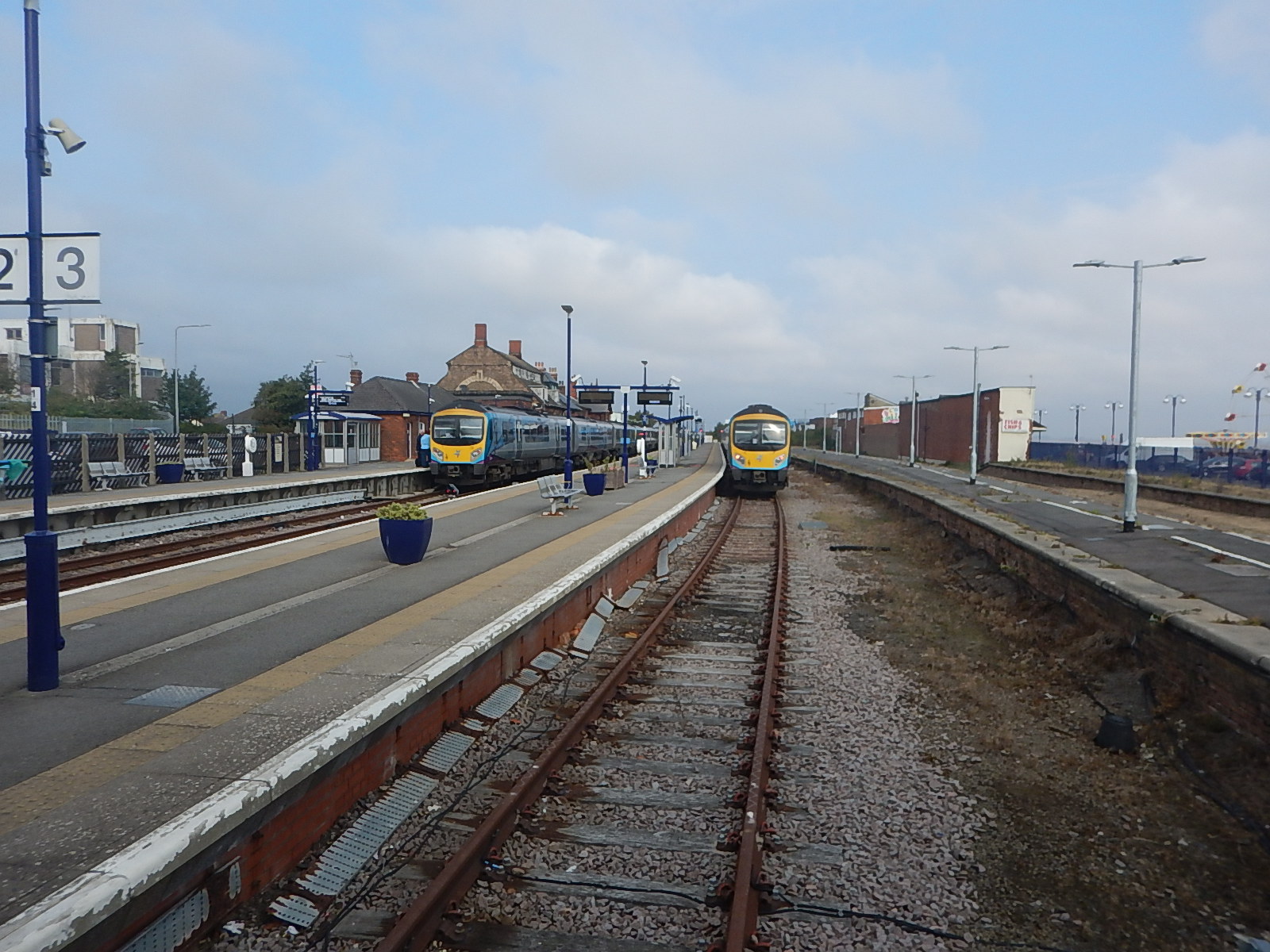
This picture shows Cleethorpes station with two TransPennine Express Class 185 trains in the station.
Note.
- The Class 185 trains are diesel, but could be replaced by Hitachi Class 802 trains, which could be converted to battery-electric operation.
- Cleethorpes and Doncaster are 52.1 miles apart, which could be in range of Hitachi’s battery-electric trains.
- It doesn’t look to be too challenging to electrify a couple of platforms to charge the battery-electric trains.
- Cleethorpes station could surely charge both the LNER and the TransPennine Express trains.
- The Cleethorpes and Barton-on-Humber service which is under fifty miles for a round trip could also be replaced with battery-electric trains.
Cleethorpes station could be totally served by battery-electric trains.
Battery-Electric Trains For Lincolnshire
At the present time, there is a surplus of good redundant electrical multiple units and the rolling stock leasing companies are looking for places where they can be used.
Porterbrook are already looking to convert their fleet of Class 350 trains to battery-electric operation and I am certain, that now that Hitachi and others have solved the charging problem, a lot more trains will be converted.
Most would appear to be four-car 100 mph trains, which will be very convenient and should fit most platforms.
Conclusion
Running battery-electric Class 800 trains to Lincoln, Grimsby Town and Cleethorpes could be the start of decarbonisation of Lincolnshire’s railways.
What would battery-electric trains do for the economy of Lincolnshire?
East Kilbride Electrification Underway
The title of this post, is the same as that of this article on Modern Railways.
These are the last two paragraphs.
As well as electrification, improvements on the line will include an upgrade of East Kilbride station, relocation of Hairmyres station 600 metres to the west, platform extensions and accessibility upgrades. The aim is to provide a four trains per hour eight-car electric service at peak periods. A parallel project will cover electrification between Busby Junction and Barrhead.
The Scottish Government’s plan is to decarbonise its passenger rail services by 2035, chiefly through electrification. It has recently been confirmed that partial electrification of the Borders and Fife Circle routes will follow after the East Kilbride and Barrhead lines, with battery EMUs deployed on these lines.
Because partial electrification is mentioned, it looks like Scotland is getting serious about using battery-electric trains.
This map clipped from Wikipedia, shows the section of the Glasgow South Western Line, that includes Kilmarnock station and the branch to East Kilbride station.
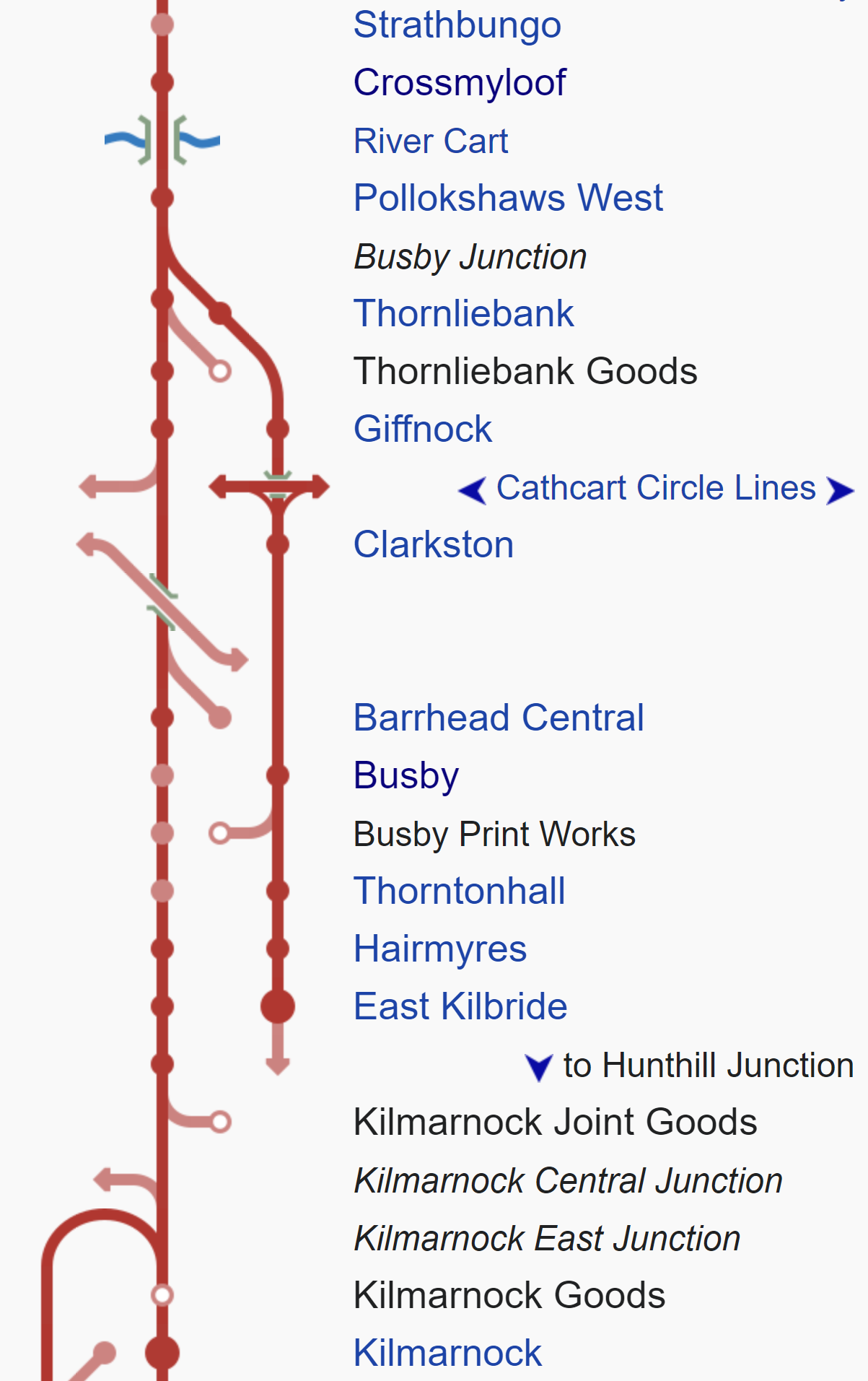
The route North of Strathbungo continues to Glasgow Central station.
Which Sections Will Be Electrified?
I will take each of the sections in turn starting at the North.
Between Muirhouse South And Busby Junctions
This sentence is from the Modern Railways article.
Contractor SPL will commence on-site activities between Muirhouse South Junction and Busby Junction, including piling and construction steelwork foundations to support overhead masts.
On the map, Muirhouse South Junction is to the North of Stratbumgo and Busby junction is clearly marked and is where the East Kilbride branch joins the main line.
This section of new electrification is only around two miles long.
This article on Rail Technology Magazine is entitled Network Rail: Strathbungo Locals Vote For New Footbridge.
There have been many bridge replacements for electrification, but this surely must be one of the first, where local people have voted for their preferred design.
The only other bridges on this section appear to be two substantial road bridges, where with any luck, it should be possible to squeeze the wires underneath.
Between Busby Junction And Barrhead Station
The other section listed for electrification is between Busby junction and Barrhead station.
This second section is only around 3.7 miles long and there are only two overbridges, both of which look modern.
Taking the two sections of electrification together they total under twelve track-miles and they are in a continuous straight line
I doubt, that together, they are the one of the world’s most challenging railway electrification projects.
Busby Junction and East Kilbride Station
There is no specific information about electrification between Busby junction and East Kilbride station.
- The branch is 7.8 miles long.
- There are fifteen overbridges on the branch.
In Plans To Introduce Battery Powered Trains In Scotland, Hitachi are quoted as saying that their trains will do sixty miles on batteries.
This should be more than enough range to run services to East Kilbride on battery power.
Barrhead and Kilmarnock Stations
There is no specific information about electrification between Barrhead and Kilmarnock stations.
- The distance is 16.8 miles.
- There are eleven overbridges between the two stations.
It would appear that Hitachi’s quoted sixty mile range, would be sufficient to enable battery-electric trains to run between the electrification at Barrhead and Kilmarnock station.
Operation
The various services between Glasgow Central and East Kilbride and Kilmarnock stations will probably operate as follows.
- Glasgow Central To East Kilbride – Electrification for traction and battery charging to Crossmyloof station and then battery power.
- East Kilbride To Glasgow Central – Battery power and gravity to Crossmyloof station and then electrification.
- Glasgow Central To Barrhead – Electrification for traction all the way.
- Barrhead to Glasgow Central – Electrification for traction all the way.
- Glasgow Central To Kilmarnock – Electrification for traction and battery charging to Barrhead station and then battery power.
- East Kilbride To Glasgow Central – Battery power to Barrhead station and then electrification.
Note.
- All power changeovers could be arranged to take place in stations.
- Gravity can be used to assist trains from East Kilbride to Glasgow Central.
- Glasgow Central and Barrhead services don’t need trains with batteries.
- The return trip between Crossmyloof and Glasgow central stations, should be more than enough to charge the batteries.
The project would appear to have been very well-designed for a fleet of battery-electric trains, with respect to reliability and electrical efficiency.
Onward To Carlisle And Stranraer
Hitachi’s system for discontinuous electrification, that I discussed in Solving The Electrification Conundrum, would appear to be ideal to extend electric trains to Carlisle and Stranraer.
Barrhead and Carlisle are 108 miles apart and Barrhead and Stranraer are 90 miles apart.
By adding two or three intermediate sections of 25 KVAC overhead electrification, it should be possible for electric trains to reliably travel between Glasgow Central and Carlisle or Stranraer.
Project Management
This electrification project could be a Project Manager’s dream.
Electrification projects in the UK can turn out to be nightmares, as if it can go wrong, it inevitably will.
But with this project, it appears that it is planned to get the often-troublesome job of erecting the gantries out of the way early.
The electrification between Muirhouse South junction and Barrhead station can even be completed first, so that passengers can see the benefit of electric trains and the electrification can be fully tested.
There are then a series of independent projects, that can be performed in the most convenient order.
- Track upgrades.
- Rebuild East Kilbride station.
- Move Hairmyres station to its new position.
- Platform extensions.
- Improve accessibility.
- Deliver the new battery-electric trains.
Note.
- It looks to me, that all of these smaller projects can be performed, whilst maintaining a full rail service on the railway. Doing that with conventional electrification usually results in some disruption.
- Late delivery of the battery-electric trains will not delay the overall project, if there are enough diesel multiple units to fill in.
- Passengers will see benefits and new facilities delivered in a stream, rather than all at once.
Similar processes can be used to extend the network to Carlisle and Stranraer.
Conclusion
This is a well-designed project.
East-West Rail ‘Must Use Electric Trains’ – Layla Moran MP
The title of this post, is the same as that of this article on the BBC.
These are the first three paragraphs.
It is of “paramount importance” that a £5bn direct rail line between Oxford and Cambridge uses electric trains, an MP has said.
The East West Rail project aims to connect the university cities by the end of the decade, but its electrification is yet to be confirmed.
MP Layla Moran said: “We’re in a climate emergency. No rail line should be designed for diesel by default.”
All trains need to be electric, but that doesn’t mean the lines need to be fully-electrified.
And if you design a railway for 100 mph diesel trains, you’ve also designed it for 100 mph electric trains.
In Solving The Electrification Conundrum, I explained how Hitachi Rail and Hitachi ABB Power Grids, have developed a practical solution to running battery-electric trains on railways without full electrification.
Their system would be ideal for the East-West Rail Link and fulfil Ms. Moran’s wish of electric trains.
There just wouldn’t be large numbers of electrification gantries marching all over the countryside.
Will Hitachi ABB Power Grids Technology Be Used At Headbolt Lane Station?
Today, I was sent a link to the North Cheshire Rail User Group’s Newsletter for Spring 2021.
Current Progress on Merseyrail’s Class 777 Trains
This is said in the newsletter about the progress of the new Class 777 trains.
At a recent meeting of the Liverpool City Region rail user groups hosted by Liam Robinson, Chair of
Merseytravel, a short presentation was given detailing progress in bringing the new Class 777 Stadler fleet into
operation. NCRUG has been keeping a keen watch on the introduction of this new fleet; later model Class 777’s
have the ability to leave the 3rd rail and operate under battery power for 20 miles or more with a full load thus
permitting expansion of the Merseyrail network beyond its current limits.Particularly of interest in our patch is the Ellesmere Port to Helsby line, although at one point in the meeting I
did raise the concept of ultimately having a complete Merseyrail service circling the Mersey Estuary on a metro
styled basis Ambitious certainly, but unrealistic as a long-term goal? There would be considerable work required
at Liverpool south Parkway to connect the Merseyrail line to the network, however the terrain is suitably flat and
the trains will be capable. This obvious evolution of the network did seem to take the meeting by surprise.Unfortunately the much anticipated introduction of the Class 777’s has been delayed for a number of factors,
not least of all the pandemic but border issues and storage also play a part. Trails are taking place on the Kirby
and Ormskirk lines, and full introduction might not be until as late as next year. The Liverpool City Region has a
clearly defined set of (deliverable) objectives for development of the rail network and the expansion has been
prioritised with a line to Skelmersdale being top of the list and the first step of that being a new station at Headbolt
Lane, Kirby – plans are already well developed for this. It is expected to be this line where proof of concept trails
will be conducted for the battery powered 777’s, although Merseyrail does have authorisation to use Ellesmere
Port–Helsby on account of the low traffic movements on that line! Network expansion is being considered to
Widnes via Hunts Cross and possibly as far as Warrington, but when the question of Ellesmere Port–Helsby
was raised, the route, although under consideration, was not high on the priority list. I suspect it will be at least
several years away and I’m sure the delayed introduction of the type will not only come as a disappointment for
NCRUG but also the Community Rail Partnership and CWaC Council, who have funded a basic feasibility study
into possible demand. Therefore we are left with the Northern Trains service for the foreseeable future – 3 return
trains daily on the current schedule.
After reading this extract, I am puzzled. The original priority was to use the battery capabilities of the new Class 777 trains to extend the Ellesmere Port service to Helsby.
- Ellesmere Port and Helsby stations are 5.2 miles apart.
- Ellesmere Port has a two trains per hour (tph) service to Birkenhead and Liverpool.
- Ellesmere Port and Helsby stations are linked by a three trains per day (tpd) service.
Helsby station has comprehensive connections to Chester, Leeds, Liverpool, Manchester and Warrington Bank Quay station.
Two tph between Ellesmere Port and Helsby stations would certainly improve train services in the area and probably explains the disappointment shown by the writer of the newsletter.
So why have Merseyrail switched the emphasis to battery trains to Headbolt Lane and Skelmersdale from Ellesmere Port and Helsby?
Headbolt Lane Station
Headbolt Lane station is a station of an unusual design, which I wrote about in Headbolt Lane Station Fly-Through.
- Two platforms appear to face West towards Liverpool.
- One platform appears to face East towards Wigan and Manchester.
- The platforms meet head-on and a walkway runs between them to allow passengers to access all platforms.
- There appears to be provision for a fourth platform to serve Skelmersdale. which is to the East of Headbolt Lane.
I think the design means that access to all platforms is level, passengers can enter from both sides of the railway and the station doesn’t need an expensive bridge.
Between Kirkby And Headbolt Lane Stations
Headbolt Lane and Kirkby stations are a couple of miles apart at most. So were Merseyrail hoping to extend the third-rail electrification to Headbolt Lane station, but the Office of Rail and Road has more or less said that no more third-rail electrification is allowed. See ORR’s Policy On Third Rail DC Electrification Systems.
So are Merseyrail having to use battery power between Kirkby and Headbolt Lane stations?
If they are then they have the trains.
As according to the extract from the Cheshire Rail User Group’s Newsletter, the Class 777 trains have a range of twenty miles on battery power, then this should be no problem.
The Skelmersdale Shuttle
The design of Headbolt Lane station does mean that there will be no through running between Liverpool and Skelmersdale.
So it looks to me, that to allow full step-free access to all platforms, the Skelmersdale service will be a battery-electric shuttle train.
- It could also be the only train on a single-track between Headbolt Lane and Skelmersdale, which would simplify signalling and operation.
- Two tph could be possible with a single train.
- The train would be charged in either termini using an appropriate charging system.
How many other simple branch lines could be run that way or built new?
Headbolt Lane And Manchester Victoria Via Wigan Wallgate
Consider.
- The distance between Headbolt Lane and Manchester Victoria stations is just under thirty miles, which is well within range of the average battery-electric trains currently under development.
- As the current Kirkby and Manchester Victoria stations is run by Northern Trains and they are likely to be acquiring some Class 331 trains with a battery capability, these will surely be an ideal train.
- The train would be charged in the East-facing platform at Headbolt Lane station using an appropriate charging system.
Headbolt Lane station would be a diesel-free station. As incidentally, so would Kirkby and Skelmersdale stations.
Charging Trains At Headbolt Lane Station
It would appear that both East-facing platforms at Headbolt Lane station will need to charge these trains.
- A Class 777 train with a third-rail capability and the ability in the future to access overhead electrification.
- A Class 331 train with no third-rail capability and the ability to access overhead electrification.
Class 777 trains from Liverpool would hopefully have enough power in their batteries to return to Kirkby.
It would appear that a short length of 25 KVAC overhead electrification in both platforms would be ideal for charging trains to and from Manchester and Skelmersdale.
If one of Hitachi ABB Power Grids’s containerised overhead electrification power systems could handle both platforms, it would surely be ideal.
A crossover to allow Manchester and Skelmersdale trains to use either East-facing platform, might be desirable, as it could improve reliability.
Conclusion
It looks like Hitachi ABB Power Grids can provide a sensible solution to handling battery-electric trains at Headbolt Lane station. Or for that matter at any station, where battery-electric trains interface with the UK rail network.
Using Hitachi ABB Power Grids Technology At Uckfield Station
This post describes how the ABB Power Grids technology could be used to allow battery-electric trains to run between London Bridge and Uckfield stations.
The London Bridge And Uckfield Route
The London Bridge And Uckfield route has these characteristics.
- It is forty-six miles long
- The Southern section between Heald Green junction and Uckfield station is 24.7 miles and is not electrified.
- A service takes approximately eighty minutes.
- Trains run at a frequency of one train per hour (tph)
- The route has been upgraded to be able to handle twelve car trains.
- The route is currently run by Class 171 diesel trains.
- Govia Thameslink Railway is the operator.
It looks to me if you assume a ten minute turnround, then that gives a three-hour round trip.
This would mean the following.
- Trains would have ten minutes charging time at Uckfield.
- If twelve car trains were running on the branch then nine four-car trains would be required for an hourly service.
- Two tph would require twice as many trains.
It looks to me, that Network Rail have arranged the route and the timetables for a fleet of battery-electric trains.
The Battery-Electric Trains
There have been several hints in the rail media, that battery-electric Bombardier Electrostars will be used for the London Bridge and Uckfield route.
I wrote Battery Electrostars And The Uckfield Branch in September 2019.
- In the related post I suggested Class 377, Class 379 or Class 387 trains.
- All are four-car Bombardier Electrostars.
- All are 100 or 110 mph trains.
- The Class 387 trains are already dual voltage, but I suspect all trains could be converted to third-rail or dual-voltage.
- My choice would be Class 379 trains, as they are being made redundant by Greater Anglia and thirty quality trains are looking for a new home.
But all three types would be acceptable and Govia Thameslink Railway has both of the other types in its extensive fleet.
Charging The Battery-Electric Trains
This picture shows the single twelve-car platform at Uckfield station.

There would appear to be plenty of space on the side away from the platform.
There would appear to be two main methods of charging the trains.
A Length Of 750 VDC Third-Rail Electrification On The Side Away From The Platform
- The electrification would be long enough to charge a twelve-car train.
- It could even be made very safe, if an interlock were to be provided, that ensured that the third-rail were only to be live, when a train was in the station that needed charging.
This would be possible, but I suspect the Anti-Third-Rail Electrification Mafia will get this simple method stopped.
A Length Of 25 KVAC Overhead Electrification Powered By One Of Hitachi ABB Power Grids Containised Power Systems
The electrification would be long enough to charge a twelve-car train.
The driver or an automated system would raise the pantographs after the train stopped in the station.
Interlocks could be provided to increase safety.
The overhead electrification would be powered by one or more of Hitachi ABB Power Grids’s containerised power systems
Lightweight catenary could be used to reduce visual intrusion.
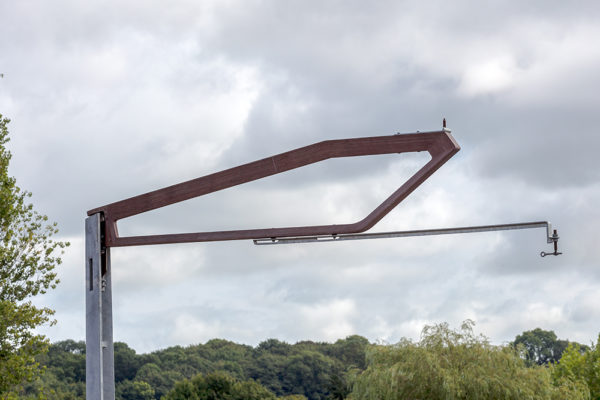
The curved beam at the top of this overhead electrification gantry is laminated wood.
Because of the higher voltage used, I suspect that the Hitachi ABB Power Grids could charge a twelve-car train in under ten minutes.
 The Anonymous Widower