A Quick Visit To Hartlepool – 19th September 2026
I went to Hartlepool today from King’s Cross station.
These were my objectives.
- Assess Grand Central Trains current offering.
- See how Hartlepool station has improved since my last visit.
- Take some pictures of Hartlepool Nuclear Power Station.
These are some pictures I took.
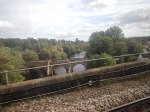
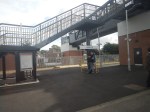
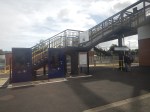
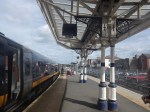
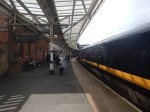
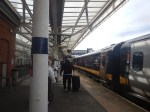
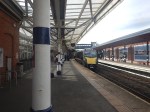
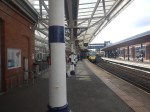
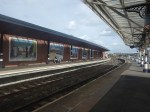
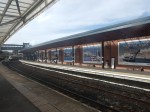
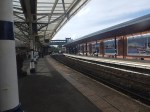
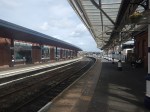

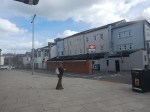


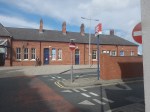
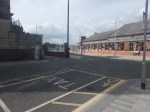
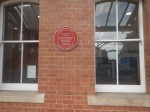
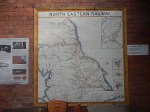
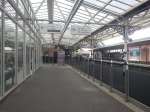
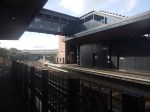
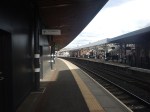
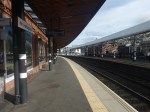
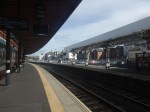
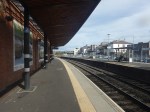
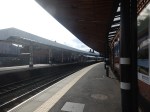
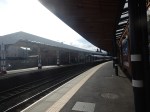
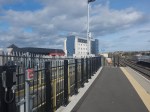
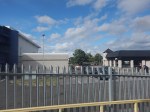
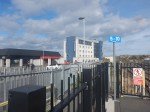

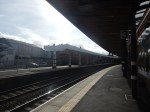
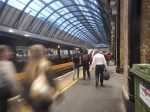
Note.
Here are my thoughts on my objectives.
Grand Central Trains And Their Class 180 Trains
This is a summary of my journey from King’s Cross and Hartlepool.
- The journey took eight minutes under three hours and we arrived thirteen minutes late.
- The train was four minutes early at the Newark Crossing, one minute early at Doncaster and on-time at York. Was this good driving or was the driver having assistance from the digital signalling?
- Delays seemed to build up after York.
There was no trolley, so I didn’t have any refreshment.
This is a summary of my journey from Hartlepool and King’s Cross.
- The journey took seven minutes over three hours and we arrived one minute late.
- The train was two minutes late at York and Doncaster and a minute late at the Newark Crossing.
- As the train ran smoothly into King’s Cross, was it using the digital signalling, as I observed in Did My InterCity225 From Leeds Arrive Like An Airliner In King’s Cross?
- At King’s Cross we shared Platform 4, with a five-car Azuma, which shows the advantage of splitting the platforms into a and b.
There was again no trolley, but the buffet was in the next car.
Six Hours In A Class 180 Train Was Not Good For Me
I have not felt well today and I blame six hours in Class 180 trains yesterday.
I used to feel like this, after a ride in a Class 390 train, but since they have been fitted with better air-conditioning, I have not had a problem.
Hopefully, the Class 820 trains will be better.
GC Applies For Manchester Paths
The title of this post, is the same as that of a short news item in the August 2026 Edition of Modern Railways.
This is the body of the news item.
Open Access Operator Grand Central has applied to operate five trains per day between St. Pancras International and Manchester Piccadilly from December 2029. These would operate via the Midland Main Line using GC’s five-car Class 180 DMU fleet currently employed on its East Coast Main Line operations. These are due to be replaced by a fleet of tri-mode Class 820s being constructed by Hitachi Rail, which were ordered last year and are being financed by Angel Trains.
Meanwhile, GC is also bidding to operate trains between London Waterloo and Bristol Temple Meads, running via the South West Main Line and Salisbury. The operator says that under these proposals, trains would begin operating from December 2027 with seven trains per day running using stock currently off lease.
These are my thoughts on the St. Pancras International and Manchester Piccadilly service.
The Route Between The Midland Main Line And Manchester Piccadilly
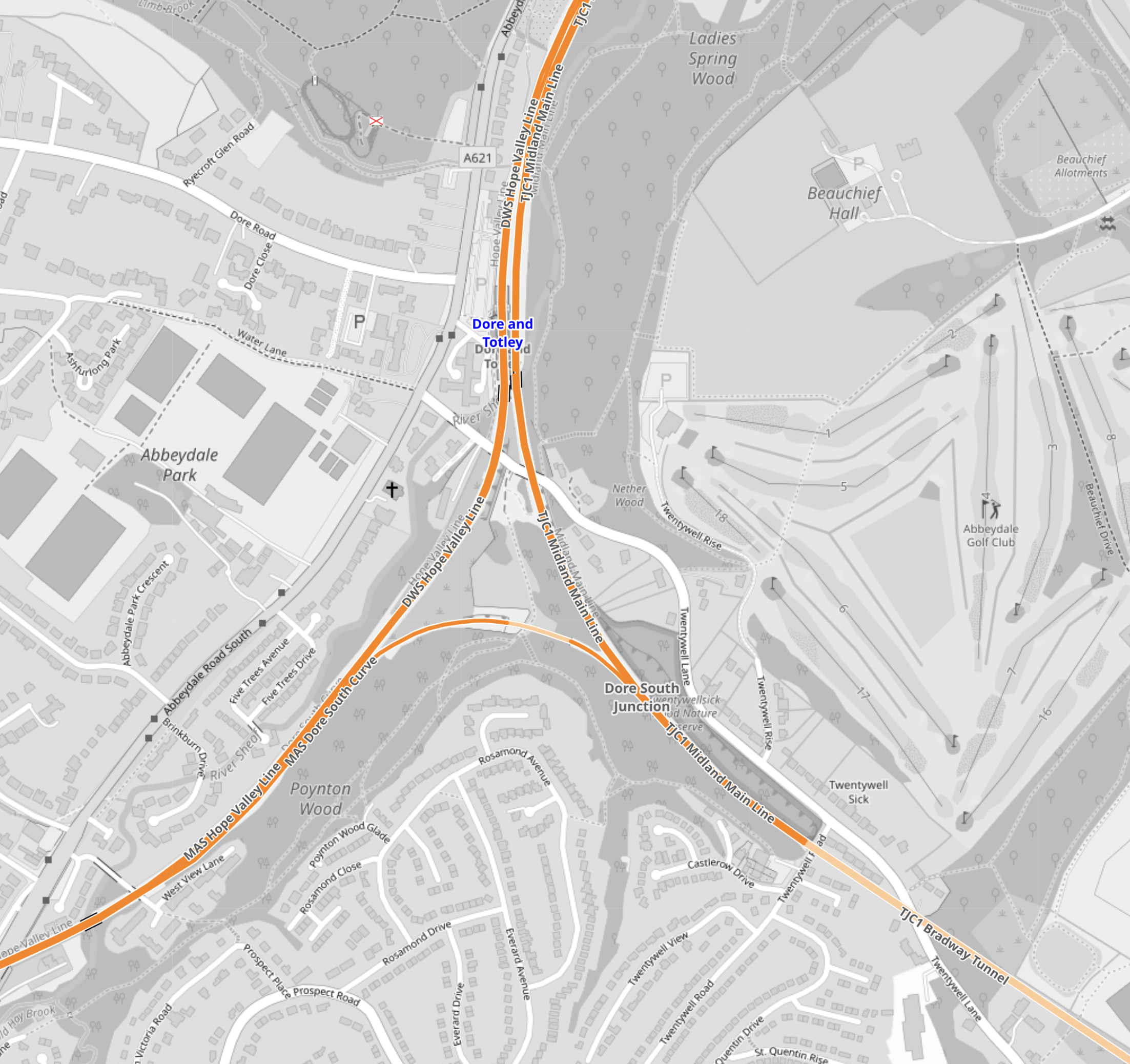
This OpenRailwayMap shows Dore Junction, where the Midland Main Line meets the Hope Valley Line between Chesterfield and Sheffield stations.
Note.
- Dore Junction is a triangular junction in the middle of the map.
- Dore and Totley station is on the North point of the junction, which leads to Sheffield station.
- Dore & Totley Station – 1st April 2025 shows the station before and after its rebuilding.
- The South-East point of the junction leads to Chesterfield station.
- The South-West point of the junction leads to the Hope Valley Line and eventually to Manchester Piccadilly station.
There are three routes that trains can take between the Midland Main Line at Chesterfield station and the Hope Valley Line.
- They can take the Dore South Curve shown in the map.
- They can go directly into Sheffield station and reverse.
- They can go via Barrow Hill and enter Sheffield station from the East.
Note.
- The first route doesn’t call at Sheffield.
- The second route is taken by trains between Liverpool and Norwich.
- I wrote about the third route in Reinstatement Of The Barrow Hill Line Between Sheffield And Chesterfield.
The reinstatement of the Barrow Hill Line may ease operations in Sheffield and allow a new station or two.
The Current Hope Valley Service Between Manchester Piccadilly And Sheffield
There are two passenger services between Manchester Piccadilly and Sheffield stations.
- A Northern Trains local train that stops everywhere.
- An East Midlands Railway faster train, that only stops at Stockport.
Both trains are hourly.
The Northern End Of Grand Central’s St. Pancras International And Manchester Piccadilly Service
I would feel that the ideal route for Grand Central’s new service would call at Chesterfield, Sheffield, Stockport and Manchester Piccadilly.
Hopefully, it could use the Barrow Hill Line to avoid a reverse at Sheffield.
Where Would Grand Central’s St. Pancras International And Manchester Piccadilly Service Call On The Midland Main Line?
East Midlands Railway services to Sheffield call at Leicester, Loughborough, East Midlands Parkway, Long Eaton, Derby and Chesterfield.
I would expect Grand Central’s service would only call at a selection of those stations.
Would St. Pancras International Be Able To Handle The Extra Trains?
East Midlands Railway run the following services from St. Pancras International.
- Nottingham
- Sheffield
- Corby
Note.
- All services are two trains per hour (tph)
- Nottingham and Sheffield services can be five- or ten-car trains.
- Corby services can be four- or eight-car trains.
- There are only four East Midlands Railway platforms at St. Pancras International, but they are 260 metres long.
- 260 metre platforms will take a pair of five-car Class 800/801/802 Hitachi trains, which have the standard Hitachi car length of 26 metres. The architects got that right,
- Each platform can take one ten-car train or two five-car trains.
- East Midlands Railway’s Class 810 trains are 120 metres long.
- East Midlands Railway’s Class 360 trains are 80 metres long.
- Grand Central Trains’s Class 180 trains are 116.52 metres long.
- The train length of Grand Central Trains’s Class 820 trains has not been disclosed, but if they had the standard Hitachi car length of 26 metres, they’d be 130 metres long.
I am fairly certain, that St. Pancras International can handle two Hitachi trains in the same platform.
This leads me to believe that Grand Central Trains Class 180 and Class 820 trains could also share a platform with an East Midlands Railway Class 810 train.
The Route And Electrification Between Manchester Piccadilly And Hazel Grove
This OpenRailwayMap shows the Manchester Piccadilly end of the route.
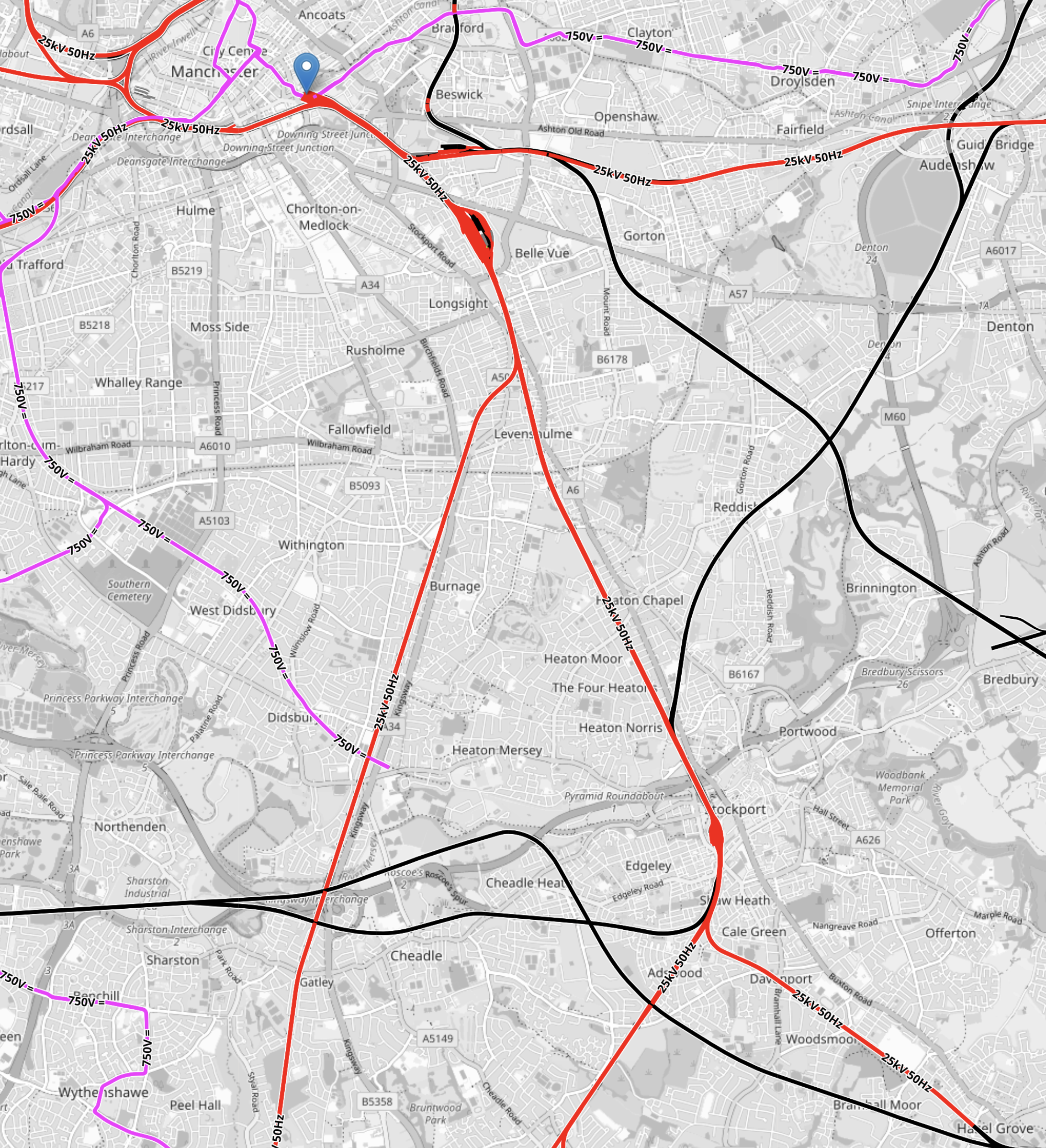
Note.
- Tracks shown in black are not electrified.
- Tracks shown in red are electrified with 25 KVAC overhead.
- Tracks shown in mauve are the Manchester Metrolink.
- Manchester Piccadilly station is indicated by the blue arrow.
- Hazel Grove station is in the South-East corner of the map.
- Between Manchester Piccadilly and Hazel Grove stations is fully-electrified.
- The red knot of electrified tracks close to Manchester Piccadilly station is Longsight depot.
- The Southern red knot of electrified tracks is Stockport station.
- Manchester Piccadilly and Hazel Grove stations are 8.7 miles apart and local trains take about 15 minutes.
The Route And Electrification Between Hazel Grove And Sheffield
This OpenRailwayMap shows the route between Hazel Grove and Sheffield.
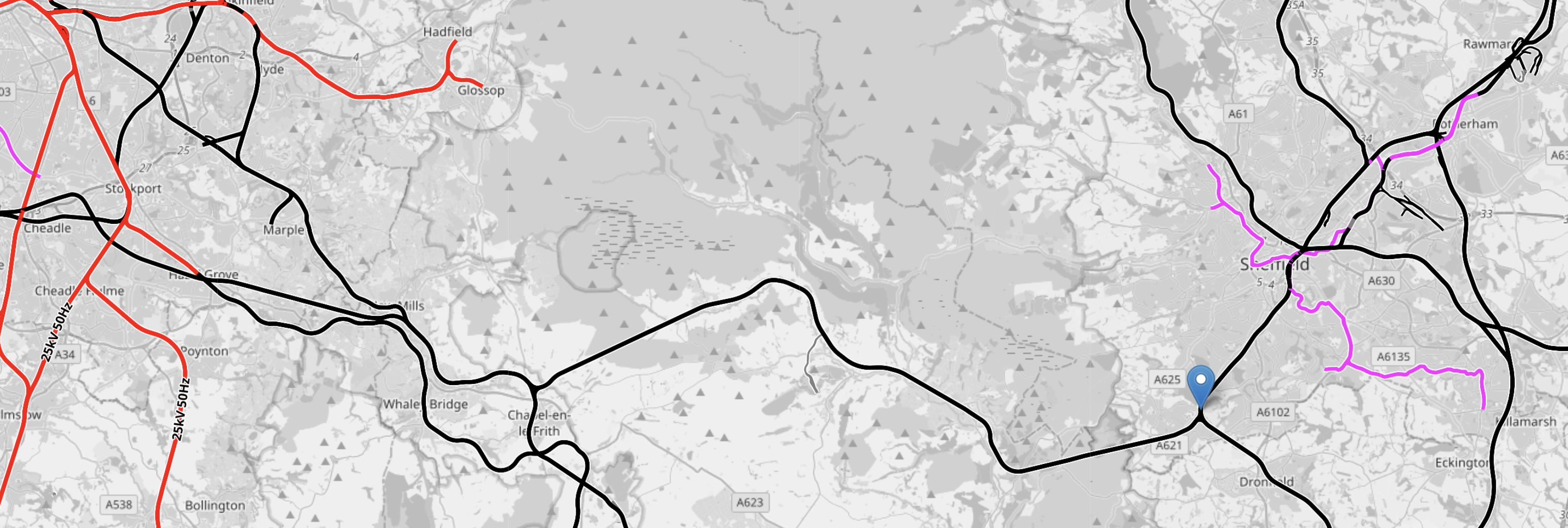
Note.
- Tracks shown in black are not electrified.
- Tracks shown in red are electrified with 25 KVAC overhead.
- Tracks shown in mauve are the Manchester Metrolink and Sheffield Supertram.
- Stockport and Hazel Grove can be picked out on the electrified tracks in the North-East corner of the map
- Dore and Totley station is indicated by the blue arrow.
- Sheffield station is to the North-East of Dore and Totley station.
- The mauve tracks are the Sheffield Supertram.
- Leading West from Dore and Totley station is the Hope Valley Line which connects Sheffield and Hazel Grove stations.
- Dore and Totley and Hazel Grove stations are 29.7 miles apart.
- Leading South-East from Dore and Totley station is the Midland Main Line to Chesterfield, Derby and the South.
- The electrification from St. Pancras International finishes just North of Market Harborough station.
Dore and Totley and Market Harborough stations are 67.1 miles apart.
Will Tri-Mode Trains We Able To Go Between St. Pancras International And Manchester Piccadilly Stations
It would appear that the gap in the electrification between Market Harborough and Hazel Grove is a few miles under a hundred miles.
Both Hitachi Rail and CAF have said that their five-car trains should be able to handle up to 122 miles.
So there should be enough range to go via Barrow Hill, which would remove the reversal at Sheffield station.
These are my thoughts on the London Waterloo and Bristol Temple Meads service.
The Route Between Bristol Temple Meads And Salisbury
Currently, there are two Great Western Railway services between Bristol Temple Meads and Salisbury.
- One calls at Bath Spa, Bradford-on-Avon, Trowbridge, Westbury, Dilton Marsh and Warminster.
- One calls at Keynsham, Oldfield Park, Bath Spa, Freshford, Avoncliff, Bradford-on-Avon, Trowbridge, Westbury and Warminster.
Note.
- Both services call at Bath Spa, Bradford-on-Avon, Trowbridge, Westbury and Warminster.
- Only Bath Spa and Westbury have a frequent service to London.
- There are five other stations, that are called at occasionally by Bristol Temple Meads and Salisbury services.
I do feel that Grand Central Trains have a lot of scope to create a very passenger-friendly timetable.
Tales Of Woe And Opportunity On The West Of England
The title of this post, is the same as that of the Railtalk editorial in the September 2027 Edition of Modern Railways.
These is the opening four paragraphs.
The West of England Line from London Waterloo to Exeter was once an important main line, the London & South Western Railway’s great rival to Brunel’s ‘billiard’ table, but its role is much diminished since the glory days.
Largely singled west of Salisbury in the 1960s, and with many of its coastal branches closed, a casual onlooker might conclude it has rather lost its purpose.
Yet recent journeys on the route suggest otherwise. Travelling from Waterloo on the way West one late afternoon was instructive.
On a baking hot day in London, the six-car South Western Railway Class 159 departed on time, full and standing. More passengers joined at Clapham Junction, and Woking.
The two problems of the line are mentioned in the text from the article.
- The singling of the West of England Line, to the West of Salisbury was typical of many short-sighted acts of vandalism inflicted by the Treasury on British Rail.
- The Class 159 diesel trains date from the early 1990s and probably need replacing.
This OpenRailwayMap shows middle part of the route between Basingstoke and Salisbury.
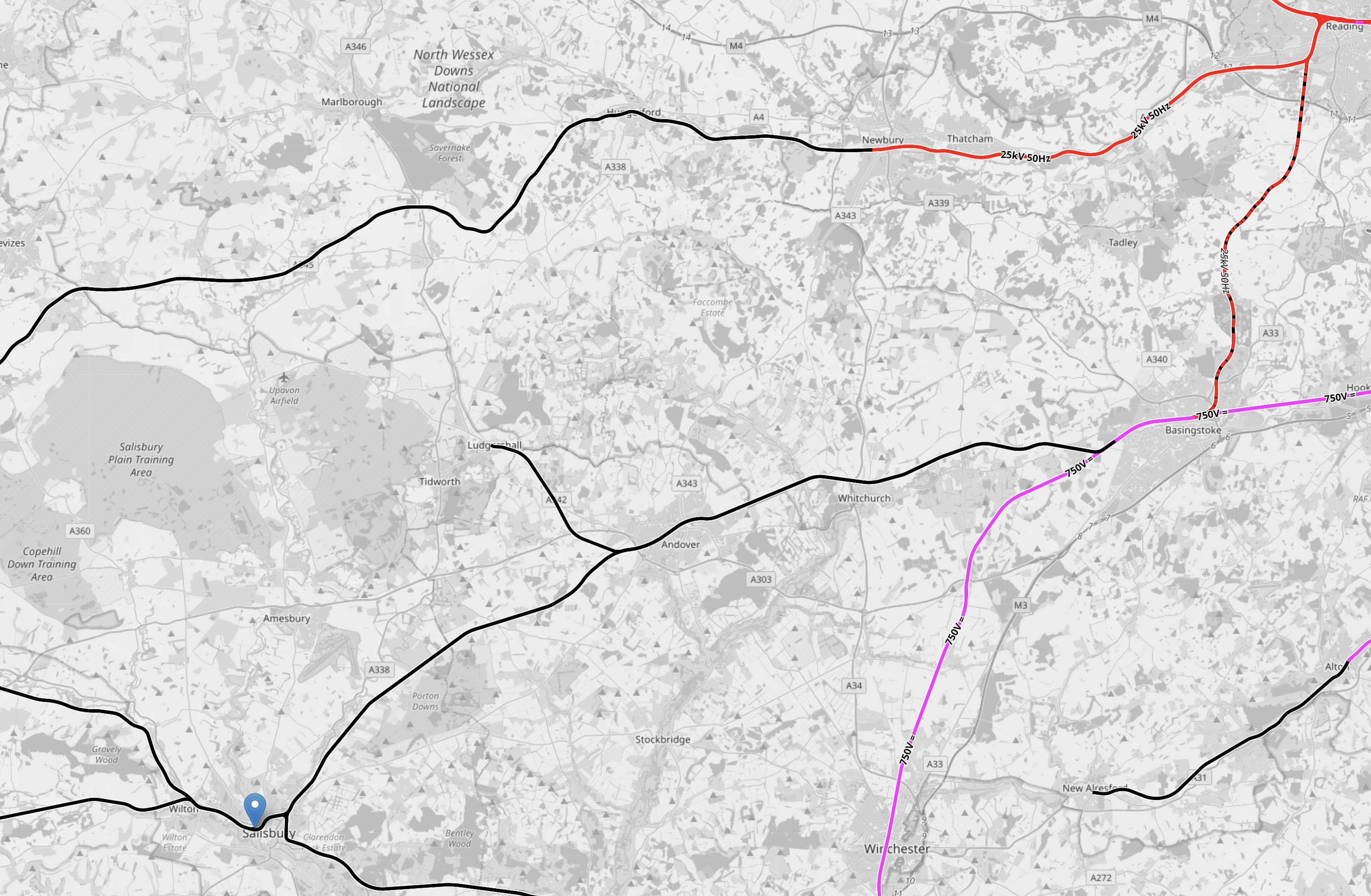
Note.
- Tracks shown in black are not electrified.
- Tracks shown in red are electrified with 25 KVAC overhead,
- Tracks shown in dashed red and black are proposed to be electrified.
- Tracks shown in mauve are electrified with 750 VDC third rail.
- Reading station is in the North-East corner of the map.
- The Reading and Basingstoke Line runs South from Reading station and is shown dashed.
- Basingstoke station is on the third-rail electrified South West Main Line between London Waterloo and Southampton.
- Salisbury station is indicated by the blue arrow.
- Linking Basingstoke and Salisbury is the unelectrified West of England Main Line between London Waterloo and Exeter.
- The branch line going North from the West of England Main Line to the East of Salisbury is used by the Army to move tanks.
- Ludgershall Town Council want passenger trains on the branch line to support housing at Tidworth with trains to Andover on the West of England Main Line.
- I wrote about this branch line in A Branch Line For Ludgershall
- Across the top of the map is the Reading and Taunton Line, which is electrified as far as Newbury.
I will now look at replacing the Class 159 trains.
Consider.
- Between Exeter St. David’s and Basingstoke stations is not electrified and is 124.3 miles.
- I believe that both Hitachi and CAF have the capability to produce a zero-carbon train with a range of 125 miles.
- The Office of Rail and Road will not allow any more third-rail electrification.
- Trains could have a generous turnround time at Exeter St. David’s which could allow trains to be charged, before returning to London.
- Basingstoke and Salisbury is only 35.8 miles, so a train terminating at Salisbury from London, should be able to return to London.
- Trains could be charged using short length of overhead electrification.
- Five-car trains, which could run in pairs might be ideal.
- I believe several manufacturers could make trains capable of running the route.
I also believe that once the charging strategy is known and any infrastructure has been installed, the new trains can be introduced into service to run alongside the Class 159 trains.
This would hopefully avoid, the current problems of the Class 820 trains on the Midland Main Line.
North-East-Based Turntide Receives Initial Battery Production Order From Hitachi Rail For Arriva’s Grand Central Intercity UK Battery Trains
The title of this post, is the same as that of this news item from Turntide Technologies.
This is the sub-heading.
New batteries to enable greener train operations to remove over 600 engines on existing trains, offering lower cost of operations, more range, and path to zero-emissions travel.
These are the initial three paragraphs, that add more detail.
Turntide Technologies (Turntide), a global leader in electrification and hybridisation solutions and a long-standing North East manufacturer, received its first order from Hitachi Rail to begin production of its next-generation modular battery system for the first U.K.-manufactured battery trains for Arriva’s Grand Central.
First announced on July 2, 2025, this partnership involved an R&D component and has officially moved into production with the potential to support either new battery trains or retrofitting over 600 engines on existing Hitachi Rail U.K. fleets.
This new battery system will allow for lower cost of operations, extended range, and a path to zero-emission travel, while reducing reliance on fossil fuels and improving air quality and noise pollution. Turntide’s bespoke batteries are designed to deliver even greater power density in the same footprint of a diesel engine. This battery production is an advanced manufacturing milestone for Arriva’s Grand Central new fleet, which is being built in Newton Aycliffe, County Durham by Hitachi Rail.
In Are Hitachi’s Tri-Mode Trains Exceeding Expectations?, I said this.
I asked Google AI, the question in the title of this post and received this answer.
Yes, Hitachi’s tri-mode (battery-hybrid) trains are exceeding expectations, particularly following successful trials in the UK in late 2024. Trials of the battery-equipped Class 802/2 demonstrated superior performance to initial forecasts, leading to a £300 million order for a new fleet to be delivered in 2028.
Key findings from trials and operational expectations:
Performance Exceeded: The trial, conducted with TransPennine Express and Angel Trains, showed fuel cost savings of 35%–50%, surpassing initial predictions of up to 30%.
Operational Capability: The battery technology enabled trains to reach speeds greater than 75 mph and provided enough range for zero-emission, silent running in and out of stations, significantly reducing noise and improving air quality.
Energy Efficiency: The battery matched the weight of a diesel engine, meaning no extra track degradation.
Future Impact: The success of the trial led to an order from Arriva Group for a new fleet for Grand Central services, which will increase seating capacity by 20% and are expected to significantly reduce carbon emissions.
These trains, designed to run on electric, battery, or diesel power, are part of a push to modernize rail services, with the technology allowing for the gradual elimination of diesel-only operation on certain routes.
In The Data Sheet For Hitachi Battery Electric Trains, I came to these conclusions.
- The battery pack has a capacity of 750 kWh.
- A five-car train needs three battery-packs to travel 100 miles.
- A nine-car train needs five battery-packs to travel 100 miles.
- The maximum range of a five-car train with three batteries is 117 miles.
- The maximum range of a nine-car train with five batteries is 121 miles.
Hitachi have seen my figures and told me they’re not far out.
As battery technology gets better, these distances will increase
What Battery Range Do Arriva Grand Central Trains Need?
Arriva Grand Central Trains currently run services to Bradford Interchange and Sunderland and hope of adding services to Cleethorpes.
All services would go between Doncaster and Kings Cross, with some stopping additionally at Peterborough.
The lengths of unelectrified track on each route is as follows.
- Bradford Interchange – Shaftholme junction and Bradford Interchange is not electrified – 47.8 miles
- Cleethorpes – Doncaster and Cleethorpes is not electrified – 52.1 miles
- Sunderland – Northallerton and Sunderland is not electrified – 47.4 miles
Note.
- Bradford Interchange station is on a tightly hemmed-in site and putting charging infrastructure in the station might be difficult.
- All Bradford Interchange services will soon be passing electrification at Mirfield station, so there may be scope for a quick charge and continue.
- Cleethorpes station is an open-air station with four platforms.
- I believe it is likely, that Cleethorpes station will also be a destination station for other battery-electric trains from LNER, Northern Trains and TransPennine, so I would suspect that charging facilities will be installed.
- Cleethorpes station could be an ideal location for one of Siemens’ Rail Charging Converters.
- Sunderland station is underground and has a unique layout where both platforms are electrified for the Metro. It is all explained in the Wikipedia entry for the station.
- The Wikipedia entry shows an open-air siding without electrification. One possibility would be for the Class 820 trains to park there and use their on-board diesel to top-up the batteries, so they could reach Northallerton.
- It appears that Grand Central visit Ryhope Grange Sidings between arriving and leaving for King’s Cross. The trains could have their batteries topped up there if needed.
It does look like a five-car train with a battery range of at least 105 miles would be able to handle these three routes.
The Arriva Grand Central Trains Fleet Are Now Class 820 trains
They have a Wikipedia entry.
The order was for nine trains of five cars.
- Wikipedia describes them as tri-mode trains.
- I believe they will have three battery packs and one diesel generator.
- Three battery packs should give a range of 117 miles.
- Google AI says that on one diesel generator, these trains can limp home at 60 miles per hour.
- Google AI says that the diesel generator will be able to charge the batteries at the destination station?
- From comments on the Internet, it appears that Hitachi have a very clever train control system, that ekes out the available power.
It looks to me that Hitachi have designed a train that can handle an unelectrified branch line of up to 60 miles or 120 miles if there are charging facilities at the destination station.
Did LNER And TransPennine Express Not Want To Be First With Battery-Electric Intercity Trains?
Consider.
- TransPennine and LNER are under government control.
- TransPennine provided the train for the testing, so they must know all the results and their drivers, who were probably involved certainly do.
- LNER must have the best initial route in King’s Cross and Lincoln, where only the last 16.6 miles, between Newark and Lincoln is not electrified.
- Surely, both companies should have been given at least one of the first batteries, so they could start training staff in how to use and service the batteries.
I have also totalled how many existing diesel power-packs are in existing Hitachi trains and it is 759.
This figure surprised me, as the sub-heading in the Turntide news item said the number of engines in existing trains was over 600. But then East Midlands Railway are still introducing their fleet of 33 x Class 810 trains, which have a total of 132 engines, and 627 could be described as over 600 engines.
How Much Would A Turntide Battery-Pack Cost?
Consider.
- This is a bespoke product for Hitachi.
- Hitachi have stated that the weight is the same as a diesel-pack, so that track-access rules and charges won’t change.
- As a Control Engineer, I wouldn’t be surprised, that the battery-pack is designed to tell the train control system, that it is a diesel power pack. So it acts just like one!
- In the 1960s, I was designing, building and installing transisterised control systems to replace electronic valve and relay equipment in a rolling mills. The two generations of control systems were interchangeable. Are diesel-packs and battery-packs the same?
- Why did Hitachi choose a small supplier in Gateshead, rather than one of a number of capable companies in Japan? You don’t go halfway around the world, if the quality is available locally.
- Deployment of these trains, will avoid the cost of scores of miles of overhead electrification.
- A lot of routes won’t even need chargers at the remote destination, as the range will be sufficient for an out and back journey from the current electrification.
- Fuel cost savings of 35%–50% were achieved in development testing.
- I have ridden in three battery-electric trains. All were mouse quiet. Will that increase ridership?
I believe these batteries are no ordinary batteries. So they won’t come cheap!
I wouldn’t be surprised that the cost of each battery-pack between a half-a-million pounds and a million pounds, with support.
Will These Trains Create Growth In The Economy?
I have ridden in all current variants of the Hitachi Intercity Express Trains, with the possible exception of the Class 805 train and as each version has been introduced, they are no worse, but often better than previous versions.
I have had two or maybe three return trips to Nottingham and Sheffield in the latest variant, which is East Midlands Railway’s Class 810 train.
This is without doubt the pick of the bunch.
I therefor believe that if this continuous improvement carries on, that the new Class 820 train, that has been ordered by Grand Central will be even better.
- My experience of battery-electric trains, says it will be quieter.
- The environment of stations will be improved.
- Train fuel costs will be reduced.
- I believe that ridership will be increased, as people will be intrigued by a 125 mph train running on batteries.
- The trains will have the ability to divert via Lincoln using the GNGE Diversion on the East Coast Main Line during engineering works.
- Because of their regenerative braking, the trains should be able to do very quick extra stops at intermediate stations.
- New routes will be developed.
- Less ugly electrification will be erected on scenic routes like Settle and Carlisle, and across the Highlands of Scotland.
I believe strongly, that at the end of the day, that battery-electric trains will increase the profits of operators and Network Rail, and reduce the cost to the taxpayers of the railways.
Grand Central’s New Trains Will Improve Services
All these stations will be served by the new Class 820 trains.
- Barnetby
- Bradford Interchange
- Brighouse
- Cleethorpes
- Doncaster
- Eaglescliffe
- Grimsby
- Habrough
- Halifax
- Hartlepool
- Low Moor
- Mirfield
- Northallerton
- Peterborough
- Pontefract Monkhill
- Scunthorpe
- Seaham
- Sunderland
- Thirsk
- Wakefield Kirkgate
- York
Passengers should notice the following from the new Grand Central trains.
- A quieter ride.
- Less vibration.
- Slightly faster services due to faster stops at stations.
- No diesel smoke and much less noise from trains in stations.
Note.
- Cross Country, Hull Trains, LNER, Lumo, TransPennine Express and other operators will come under pressure to follow suit.
- Batteries, will not have the power for freight trains, so will we see a new generation of hydrogen freight locomotives?
But will the improved services bring that exclusive growth to the economy?
Only time will tell!
Private And Public Operators
In the UK, we have.
- Private open access operators like Grand Central, Hull Trains and Lumo, who can buy trains on a loan from a leasing company.
- Public operators like LNER and TransPennine Express, who probably have to get sign off from the Treasury.
- Several companies like Great Western Railways and East Midlands Railway, who are soon to be taken over by Great British Railways, who are stuck in a sort of limbo.
My late friend ; David, who rose to the highest level in banking in the UK, would have come up with a solution.
He would probably have said, that there’s is very little difference between the groups of operators.
- The train services they offer vary only on destinations and prices.
- The ticketing system is now unified, so if you turn up at the last minute and want to go to Newcastle and Lumo and LNER both have tickets, you are offered a choice and you can pick the one that’s best for you.
- All services will soon be running similar battery-electric trains, fprobably from the same Hitachi factory in Newton Aycliffe.
- Food and beverage service is not competitive and could be improved.
- Staff are probably on similar employment agreements.
So why shouldn’t Great British Railways be able to lease trains and even battery packs from companies like Angel Trains, who are funding the trains for Grand Central?
It might get more battery trains running on tracks all over Great Britain sooner than it appears they will now!
Creating More Capacity At King’s Cross Station
I took these pictures as I walked through King’s Cross station today.


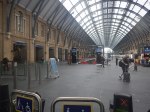
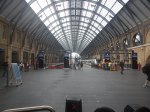
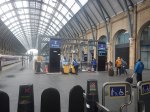
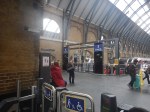
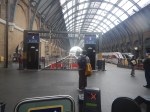
Note.
- Each of the eight platforms in the main train shed, has been formally divided into a and b sections.
- In the first picture, a sign to the right of the clock, showing 0a and 0b, indicates that Platform 0 has been similarly divided.
- I would assume, that any services run by 10-car trains would use both the a and b platforms.
- Services run by 5-car trains, can use any free ‘a’ or ‘b’ platform.
It would appear to me, that 18 x 5-car platforms must be able to handle more trains than 9 x 10-car platforms.
This information screen, which is one of several, explains what has been done.
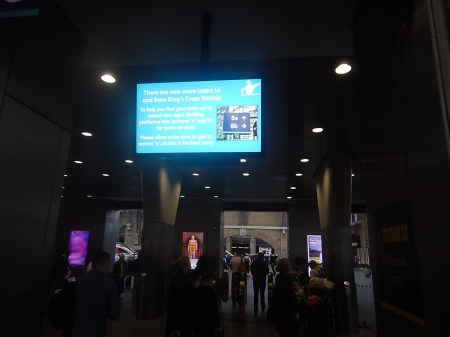
This is the message on the screen, which is only visible about once every ten minutes.
- There are now more trains to and from King’s Cross station.
- To help you find your train we’ve added new signs dividing platforms into sections ‘a’ and ‘b’ for some services.
- Please allow extra time to get to section ‘a’, as this is furthest away.
It’s not a good way to present information.
It is one of the worst examples of mushroom management, I’ve seen in a long time.
I suspect, that experienced travellers will understand it, but will the less experienced?
Will It Increase The Capacity?
I believe it is a well-known rule, that you get more bricks in a box, if they are all the same size and they are a fraction of the size of the box.
So by having five- and ten-car trains and platforms, Network Rail are minimising wasted space in the station, which is increasing the capacity.
The new digital signaling gives precise control of the trains and theoretically, would obtain the maximum number of trains in the station.
But all trains, that will use the station must follow these rules.
- Five- or ten-cars long.
- Trains must have a digital-signalling capability.
- Be able to cruise at 125 mph, so they can keep up with other trains.
Terminal stations on the East Coast Main Line, like Aberdeen, Bradford Forster Square, Edinburgh, Harrogate, Hull, Inverness, Leeds and others must also be capable of handling five- or ten-car trains.
Can East Midlands Railway Reach Nottingham Without More Electrification?
I went to Nottingham for the day yesterday.
- My Super Off-Peak Return ticket cost me £55.30 with a Senior Railcard.
- The Class 810 train is without doubt the best Hitachi Intercity Express Train of a good bunch.
- St. Pancras and Nottingham is 126.4 miles.
- There is no electrification between South Wigston Junction and Nottingham, which is 31.1 miles, although the change seems to be said to take place at Kilby Bridge junction.
- It would appear that, when the Class 810 trains are fitted with batteries, they will need a range of at least 62.2 miles, to do a return trip to Nottingham.
- In The Data Sheet For Hitachi Battery Electric Trains, I state that the maximum range of a three-battery five-car train is 117 miles. This figure has been seen by Hitachi and they didn’t say it was too high.
- I look forward to doing the same trip in a few months, using batteries to the North of the section between Kilby Bridge and South Wigston junctions.
It could be the first battery-electric 125 mph express train.
Now that is what I call affordable electrification.
I have some further thoughts.
Kilby Bridge And Wigston Junctions
This Google Map shows the Midland Main Line between Kilby Bridge and Wigston junctions.
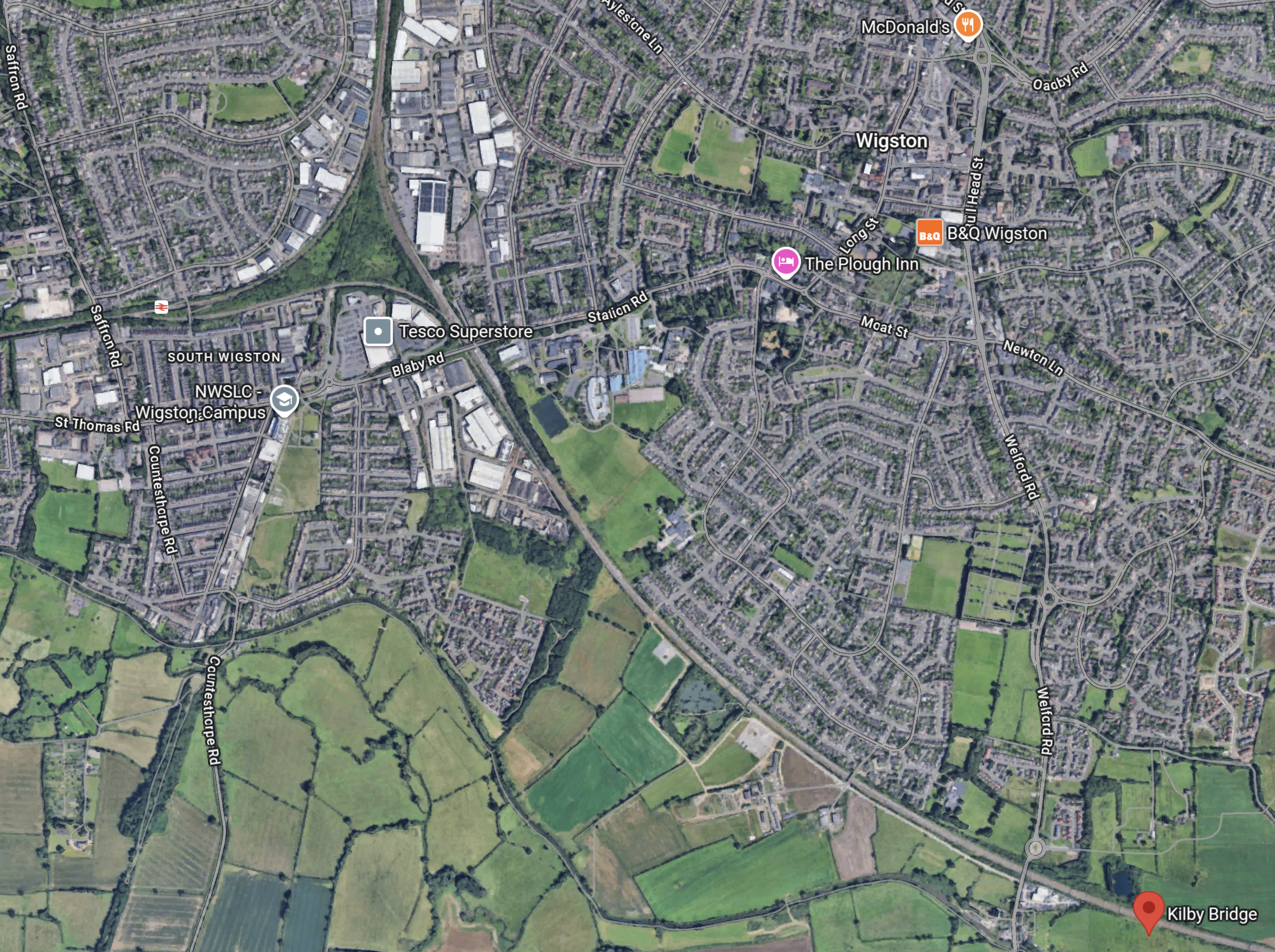
Note.
- Kilby Bridge junction is marked by the red arrow in the South-East corner.
- The Midland Main Line runs through Kilby Bridge junction.
- South-East it goes to London.
- North-West is leads to the large triangular Wigston junction, with South Wigston station at its Western point.
- The Northern point of Wigston junction leads to Leicester.
- There are three tracks between Wigston and Kilby Bridge junctions.
- All tracks to the South of South Wigston junction are electrified.
- The distance between Wigston and Kilby Bridge junctions is two miles.
- The maximum speed between Wigston and Kilby Bridge junctions appears to be at least 100 mph.
It looks to me, that this section of track has been designed, so that trains can reliably raise and lower pantographs at the highest speed possible.
The Electrification Problem At Leicester
Some years ago I came back to London from Leicester with a group of drivers. At one point, the conversation turned to electrification and they said that they had met a Network Rail engineer, who had told them, that the bridge over Leicester station was rather low for electrification and the track couldn’t be lowered because Leicester’s main sewer was underneath the railway.
In Leicester Station – 4th Jan 2022, I show a selection of pictures of Leicester station’s Grade II Listed frontage.
I doubt it would be possible to seriously alter Leicester station to electrify it, as the Heritage Taliban would have a field day.
But if I’m right that all services will be run North of Wigston on batteries, there will be no need to electrify through Leicester station.
Not only would using battery-electric trains probably be more affordable than electrification, but also because of the Leicester electrification problem, it would be less inconvenient for passengers.
Changing From Electric Going North
This OpenRailwayMap shows the electrification between Wigston Junction and Leicester station.
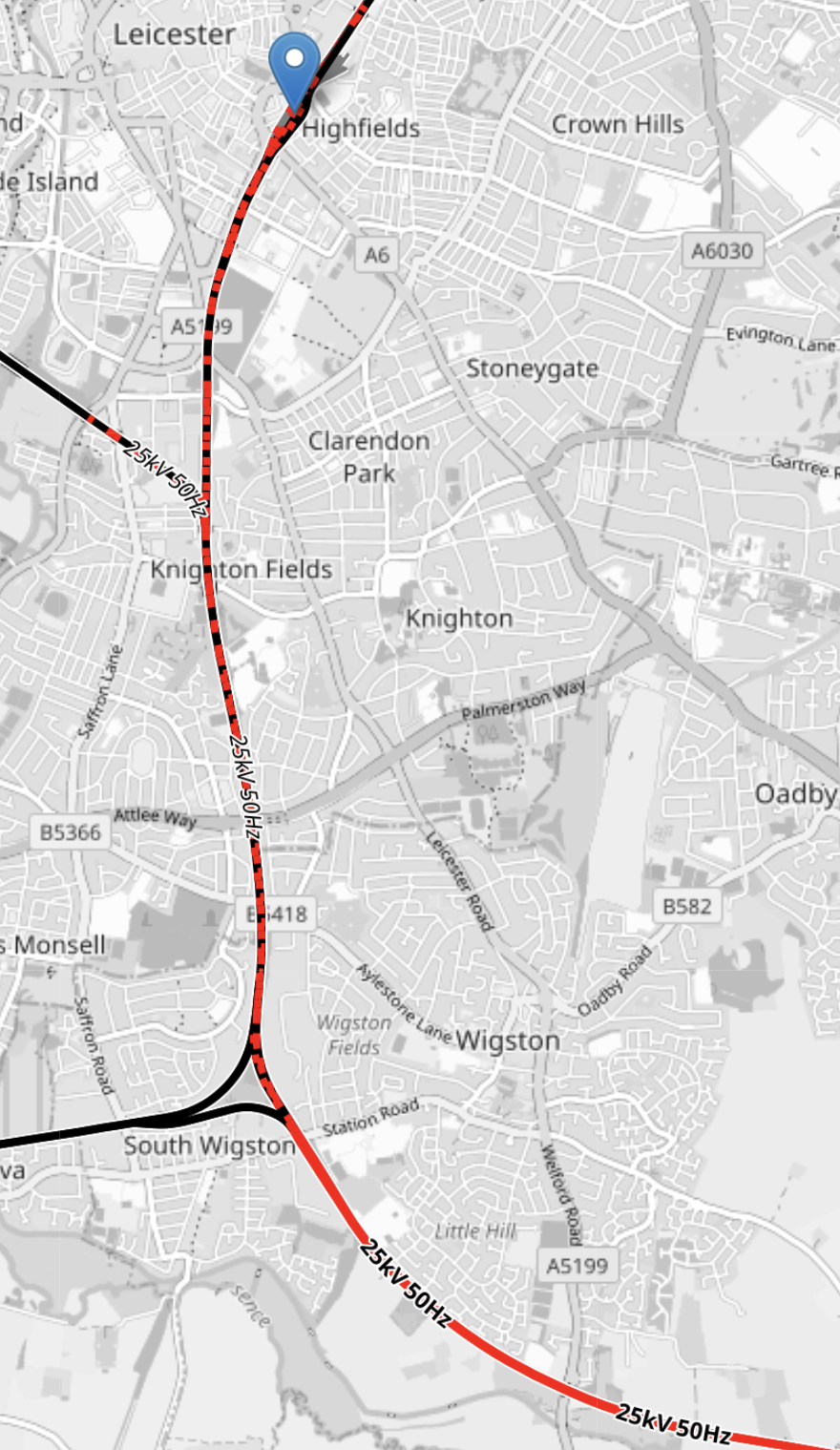
Note.
- Leicester station is marked by the blue arrow.
- The triangular Wigston junction is clearly visible.
- Kilby Bridge junction is South-East of Wigston junction.
- Leicester station and South Wigston junction is 3.6 miles and the tracks are shown as dashed black and red, which means future electrification.
I wonder, if in the future, if the battery-electric don’t have enough range, this is a simple section of electrification, that could be installed. Every extra mile of electrification between Leicester station and South Wigston junction would mean two miles could be chopped from the distance the trains had to travel on batteries.
But in the interim, going North, the driver would just make sure there was enough electricity in the batteries and momentum in the train, when passing South Wigston.
As trains arriving at South Wigston junction will typically have been running for over an hour, they should have full batteries to start theur explore of the North.
Changing To Electric Going South
The trains from the North, must have enough juice in the battery to reach South Wigston, so they can connect to the electrification for the run to London.
Could A Four-Battery Class 810 Train Reach Sheffield?
Consider.
- St. Pancras and Sheffield is 164.7 miles.
- There is no electrification between South Wigston Junction and Sheffield, which is 89.4 miles, although the change seems to be said to take place at Kilby Bridge junction.
- It would appear that, when the Class 810 trains are fitted with batteries, they will need a range of at least 178.8 miles to do a return trip to Sheffield.
- If a three-battery five-car Class 810 train has a battery range of 117 miles, on a pro-rata basis a four-battery five-car will only have a range of 156 miles.
That would be a big ask.
Could A Three-Battery Class 810 Train Reach Sheffield?
What would happen if one diesel engine was still installed?
These are my thoughts.
- As a Graduate Control Engineer, I wouldn’t be surprised that Hitachi have a strategy to do this with a tri-mode version of the Class 810 train.
- Hitachi have already announced the Class 820 train for Grand Central Trains and this is a tri-mode version of their InterCity Express, which is described in this Wikipedia entry.
- As Grand Central have said that the Class 820 trains, will be replacing the Class 180 trains, that run to Bradford Interchange and Sunderland, a tri-mode Class 810 would surely be able to run to Sheffield.
Could East Midlands Parkway Station Be Used For Opportunity Charging?
This Google Map shows East Midlands Parkway station with the massive derelict Radcliffe-on-Soar coal-powered power station alongside.
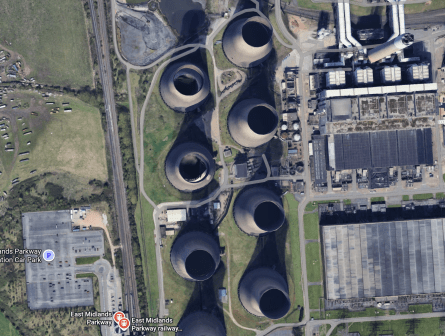
Note.
- The Midland Main Line running North-South across the map.
- East Midlands Parkway station on its Western side.
- The derelict Radcliffe-on-Soar coal-powered power station on its Eastern side.
A vast site like this must have uses.
I asked Google AI,”What Are The Plans For Radcliffe-on-Soar Power Station?” and received this reply.
The former Ratcliffe-on-Soar power station site is undergoing a multi-year decommissioning and demolition process, lasting until at least 2030 or 2031, to be transformed into a zero-carbon technology, energy, and advanced manufacturing hub.
Key details of the redevelopment include:
Site Vision: The 273-acre brownfield site has been earmarked to become a major business hub focused on advanced manufacturing (e.g., electric car batteries), low-carbon energy production, energy storage, and AI-driven data centres.
Economic Status: The site is a core component of the East Midlands Freeport, which offers significant financial incentives to attract business investment and create an estimated 7,000 to 8,000 jobs.
Demolition Timeline: The first demolition works are expected to begin in 2026, with the iconic cooling towers and main chimneys scheduled for controlled demolition between 2029 and 2030.
Planning Framework: A Local Development Order (LDO) granted by Rushcliffe Borough Council is in place to fast-track the planning process for these modern, green-focused industrial uses.
As the site will need to be supplied with a reliable energy supply for some of the proposed uses, I suspect power could be supplied to electrify the lines through East Midlands Parkway station, so that trains going to the North could take the opportunity to have a Formula One-style “Splash-and-Dash!”
Would Opportunity Charging At East Midlands Parkway Station Allow Extra Destinations?
Holders of the East Midlands Franchise have in the past, served other destinations in the past, either with regular services or engineering or seasonal diversions.
Possible destinations could be.
Cleethorpes
Distance to South Wigston – 112.4 miles
Doncaster
Distance to South Wigston – 108.1 miles – But could top up at Doncaster.
Rotherham Central
Distance to South Wigston – 102.2 miles
Scunthorpe
Distance to South Wigston – 112.4 miles

