Solving The Electrification Conundrum
The title of this post, is the same as an article in the July 2021 Edition of Modern Railways.
This is the introductory sub-heading.
Regional and rural railways poses a huge problem for the railway to decarbonise.
Lorna McDonald of Hitachi Rail and Jay Mehta of Hitachi ABB Power Grids tell Andy Roden why they believe they have the answer.
These are my thoughts on what is said.
Battery-Electric Trains
The article starts by giving a review of battery-electric trains and their use on routes of moderate but important length.
- Some short routes can be handled with just a charge on an electrified main line.
- Some will need a recharge at the termini.
- Other routes might need a recharge at some intermediate stations, with a possible increase in dwell times.
It was in February 2015, that I wrote Is The Battery Electric Multiple Unit (BEMU) A Big Innovation In Train Design?, after a ride in public service on Bombardier’s test battery-electric train based on a Class 379 train.

I also wrote this in the related post.
Returning from Harwich, I travelled with the train’s on-board test engineer, who was monitoring the train performance in battery mode on a laptop. He told me that acceleration in this mode was the same as a standard train, that the range was up to sixty miles and that only minimal instruction was needed to convert a driver familiar to the Class 379 to this battery variant.
It was an impressive demonstration, of how a full-size train could be run in normal service without connection to a power supply. I also suspect that the partners in the project must be very confident about the train and its technology to allow paying passengers to travel on their only test train.
A couple of years later, I met a lady on another train, who’d used the test train virtually every day during the trial and she and her fellow travellers felt that it was as good if not better than the normal service from a Class 360 train or a Class 321 train.
So why if the engineering, customer acceptance and reliability were proven six years ago, do we not have several battery electric trains in service?
- There is a proven need for battery-electric trains on the Marshlink Line and the Uckfield Branch in Sussex.
- The current Class 171 trains are needed elsewhere, so why are no plans in place for replacement trains?
- The government is pushing electric cars and buses, but why is there such little political support for battery-electric trains?
It’s almost as if, an important civil servant in the decision process has the naive belief that battery-electric trains won’t work and if they do, they will be phenomenally expensive. So the answer is an inevitable no!
Only in the South Wales Metro, are battery-electric trains considered to be part of the solution to create a more efficient and affordable electric railway.
But as I have constantly pointed out since February 2015 in this blog, battery-electric trains should be one of the innovations we use to build a better railway.
Hydrogen Powered Trains
The article says this about hydrogen powered trains.
Hybrid hydrogen fuel cells can potentially solve the range problem, but at the cost of the fuel eating up internal capacity that would ideally be used for passengers. (and as Industry and Technology Editor Roger Ford points out, at present hydrogen is a rather dirty fuel). By contrast, there is no loss of seating or capacity in a Hitachi battery train.
I suspect the article is referring to the Alstom train, which is based on the technology of the Alstom Coradia iLint.

I have ridden this train.
- It works reliably.
- It runs on a 100 km route.
- The route is partially electrified, but the train doesn’t have a pantograph.
- It has a very noisy mechanical transmission.
Having spoken to passengers at length, no-one seemed bothered by the Hindenburg possibilities.
It is certainly doing some things right, as nearly fifty trains have been ordered for train operating companies in Germany.
Alstom’s train for the UK is the Class 600 train, which will be converted from a four-car Class 321 train.
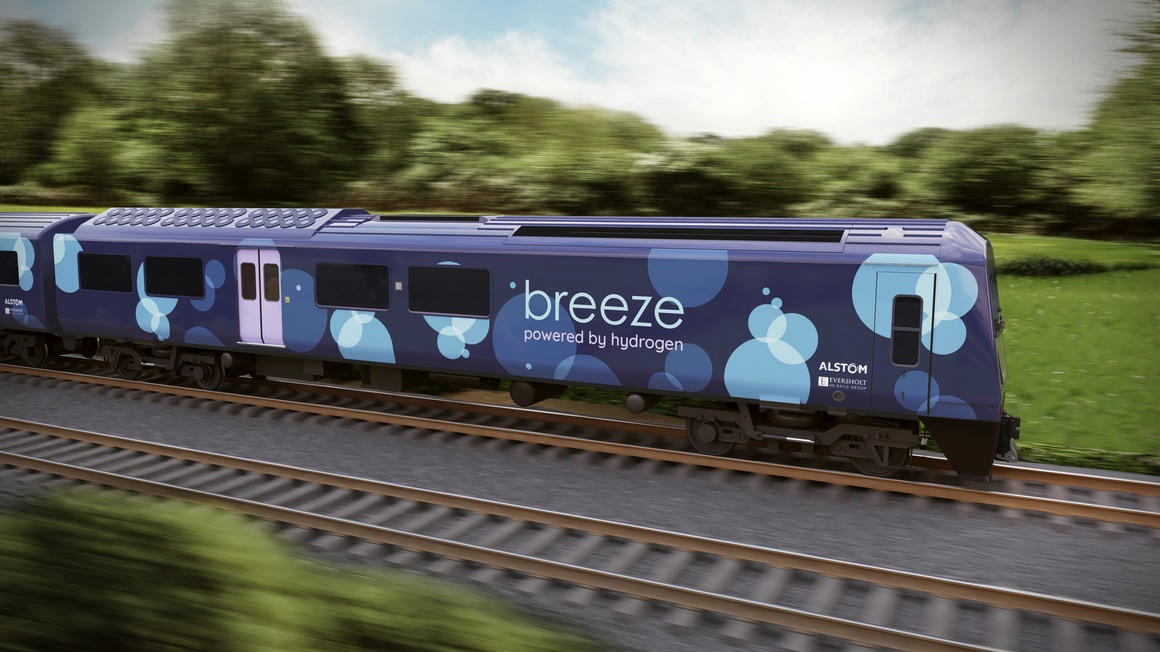
Note.
- Half of both driver cars is taken up by a hydrogen tank.
- Trains will be three-cars.
- Trains will be able to carry as many passengers as a two-car Class 156 train.
It is an inefficient design that can be improved upon.
Porterbrook and Birmingham University appear to have done that with their Class 799 train.
- It can use 25 KVAC overhead or 750 VDC third-rail electrification.
- The hydrogen tanks, fuel cell and other hydrogen gubbins are under the floor.
This picture from Network Rail shows how the train will appear at COP26 in Glasgow in November.
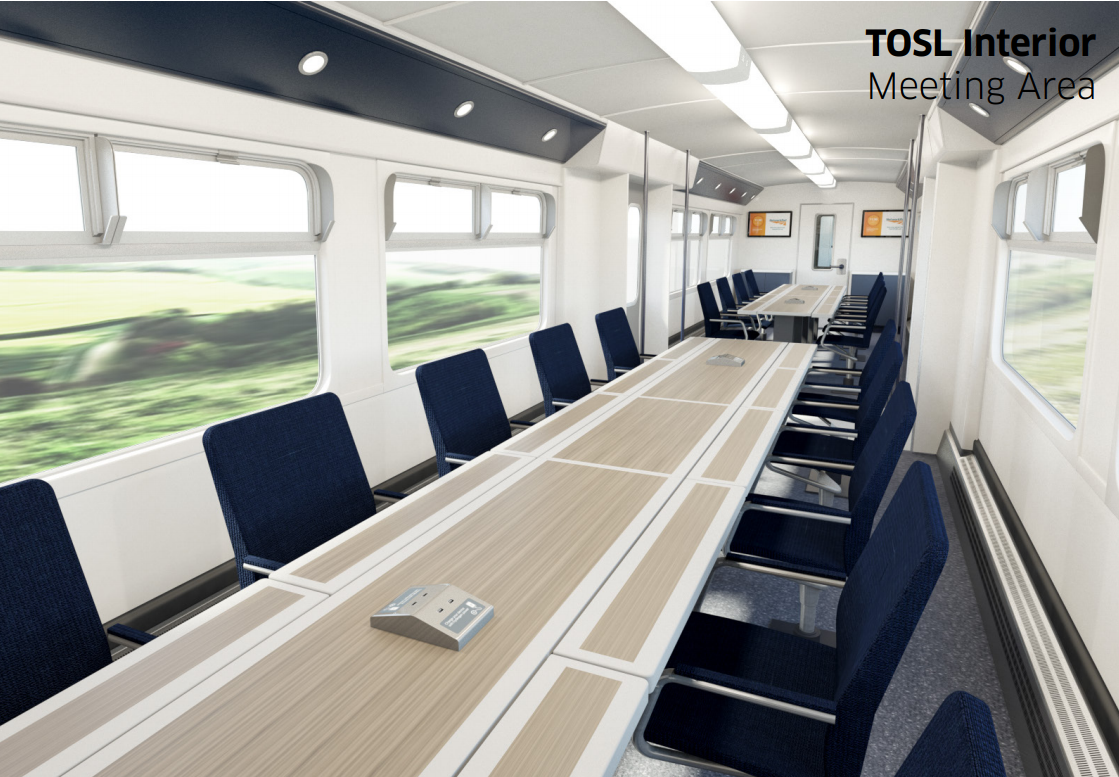
Now that’s what I call a train! Let alone a hydrogen train!
Without doubt, Porterbrook and their academic friends in Birmingham will be laying down a strong marker for hydrogen at COP26!
I know my hydrogen, as my first job on leaving Liverpool University with my Control Engineering degree in 1968 was for ICI at Runcorn, where I worked in a plant that electrolysed brine into hydrogen, sodium hydroxide and chlorine.
My life went full circle last week, when I rode this hydrogen powered bus in London.
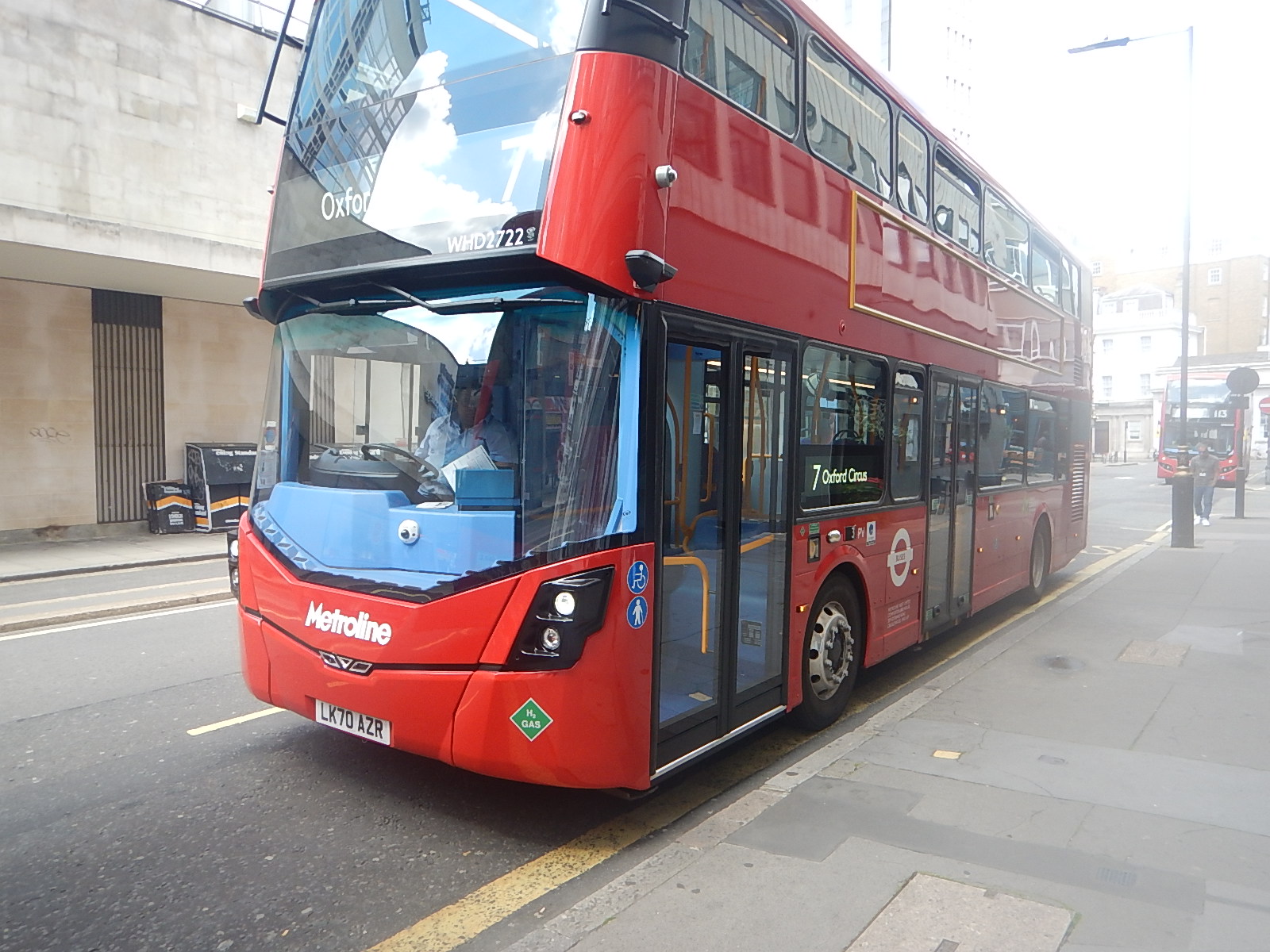
The hydrogen is currently supplied from the same chemical works in Runcorn, where I worked. But plans have been made at Runcorn, to produce the hydrogen from renewable energy, which would make the hydrogen as green hydrogen of the highest standard. So sorry Roger, but totally carbon-free hydrogen is available.
The bus is a Wightbus Hydroliner FCEV and this page on the Wrightbus web site gives the specification. The specification also gives a series of cutaway drawings, which show how they fit 86 passengers, all the hydrogen gubbins and a driver into a standard size double-deck bus.
I believe that Alstom’s current proposal is not a viable design, but I wouldn’t say that about the Porterbrook/Birmingham University design.
Any Alternative To Full Electrification Must Meet Operator And Customer Expectations
This is a paragraph from the article.
It’s essential that an alternative traction solution offers the same levels of performance and frequency, while providing an increase in capacity and being economically viable.
In performance, I would include reliability. As the on-board engineer indicated on the Bombardier test train on the Harwich branch, overhead electrification is not totally reliable, when there are winds and/or criminals about.
Easy Wins
Hitachi’s five-car Class 800 trains and Class 802 trains each have three diesel engines and run the following short routes.
- Kings Cross and Middlesbrough- 21 miles not electrified – Changeover in Northallerton station
- Kings Cross and Lincoln – 16.6 miles not electrified – Changeover in Newark Northgate station
- Paddington and Bedwyn – 13.3 miles not electrified – Changeover in Newbury station
- Paddington and Oxford – 10.3 miles not electrified – Changeover in Didcot Parkway station
Some of these routes could surely be run with a train, where one diesel engine was replaced by a battery-pack.
As I’m someone, who was designing, building and testing plug-compatible transistorised electronics in the 1960s to replace older valve-based equipment in a heavy engineering factory, I suspect that creating a plug-compatible battery-pack that does what a diesel engine does in terms of power and performance is not impossible.
What would be the reaction to passengers, once they had been told, they had run all the way to or from London without using any diesel?
Hopefully, they’d come again and tell their friends, which is what a train operator wants and needs.
Solving The Electrification Conundrum
This section is from the article.
Where electrification isn’t likely to be a viable proposition, this presents a real conundrum to train operators and rolling stock leasing companies.
This is why Hitachi Rail and Hitachi ABB Power Grids are joining together to present a combined battery train and charging solution to solve this conundrum. In 2020, Hitachi and ABB’s Power Grids business, came together in a joint venture, and an early outcome of this is confidence that bringing together their expertise in rail, power and grid management, they can work together to make electrification simpler cheaper and quicker.
I agree strongly with the second paragraph, as several times, I’ve been the mathematician and simulation expert in a large multi-disciplinary engineering project, that went on to be very successful.
The Heart Of The Proposition
This is a paragraph from the article.
The proposition is conceptually simple. Rather than have extended dwell times at stations for battery-powered trains, why not have a short stretch of 25 KVAC overhead catenary (the exact length will depend on the types of train and the route) which can charge trains at linespeed on the move via a conventional pantograph?
The article also mentions ABB’s related expertise.
- Charging buses all over Europe.
- Creating the power grid for the Great Western Electrification to Cardiff.
I like the concept, but then it’s very similar to what I wrote in The Concept Of Electrification Islands in April 2020.
But as they are electrical power engineers and I’m not, they’d know how to create the system.
Collaboration With Hyperdrive Innovation
The article has nothing negative to say about the the collaboration with Hyperdrive Innovation to produce the battery-packs.
Route Modelling
Hitachi appear to have developed a sophisticated route modelling system, so that routes and charging positions can be planned.
I would be very surprised if they hadn’t developed such a system.
Modular And Scalable
This is a paragraph from the article.
In the heart of the system is a containerised modular solution containing everything needed to power a stretch of overhead catenary to charge trains. A three-car battery train might need one of these, but the great advantage is that it is scalable to capacity and speed requirements.
This all sounds very sensible and can surely cope with a variety of lines and traffic levels.
It also has the great advantage , that if a line is eventually electrified, the equipment can be moved on to another line.
Financing Trains And Chargers
The article talks about the flexibility of the system from an operator’s point of view with respect to finance.
I’ve had some good mentors in the area of finance and I know innovative finance contributed to the success of Metier Management Systems, the project management company I started with three others in 1977.
After selling Metier, I formed an innovative finance company, which would certainly have liked the proposition put forward in the article.
No Compromise, Little Risk
I would agree with this heading of the penultimate section of the article.
In February 2015, when I rode that Class 379 train between Manningtree and Harwich, no compromise had been made by Bombardier and it charged in the electrified bay platform at Manningtree.
But why was that train not put through an extensive route-proving exercise in the UK after the successful trial at Manningtree?
- Was it the financial state of Bombardier?
- Was it a lack of belief on the part of politicians, who were too preoccupied with Brexit?
- Was it that an unnamed civil servant didn’t like the concept and stopped the project?
Whatever the reason, we have wasted several years in getting electric trains accepted on UK railways.
If no compromise needs to be made to create a battery-electric train, that is equivalent to the best-in-class diesel or electric multiple units, then what about the risk?
The beauty of Hitachi’s battery-electric train project is that it can be done in phases designed to minimise risk.
Phase 1 – Initial Battery Testing
Obviously, there will be a lot of bench testing in a laboratory.
But I also believe that if the Class 803 trains are fitted with a similar battery from Hyperdrive Innovation, then this small fleet of five trains can be used to test a lot of the functionality of the batteries initially in a test environment and later in a real service environment.
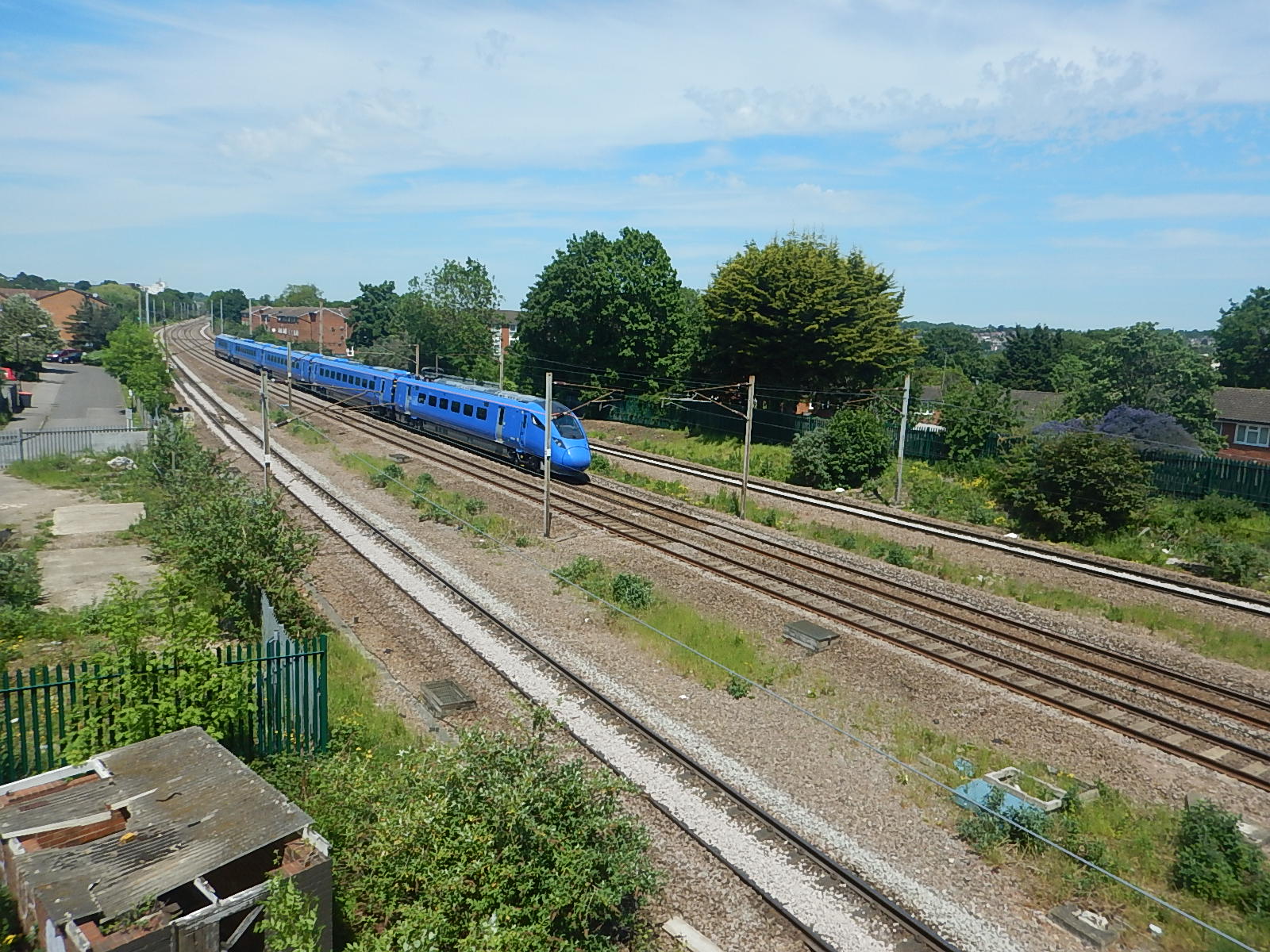
The picture shows a Class 803 train under test through Oakleigh Park station.
This phase would be very low risk, especially where passengers are concerned.
Phase 2 – Battery Traction Testing And Route Proving
I am a devious bastard, when it comes to software development. The next set of features would always be available for me to test earlier, than anybody else knew.
I doubt that the engineers at Hyperdrive Innovation will be any different.
So I wouldn’t be surprised to find out that the batteries in the Class 803 trains can also be used for traction, if you have the right authority.
We might even see Class 803 trains turning up in some unusual places to test the traction abilities of the batteries.
As East Coast Trains, Great Western Railway and Hull Trains are all First Group companies, I can’t see any problems.
I’m also sure that Hitachi could convert some Class 800 or Class 802 trains and add these to the test fleet, if East Coast Trains need their Class 803 trains to start service.
This phase would be very low risk, especially where passengers are concerned.
Possibly, the worse thing, that could happen would be a battery failure, which would need the train to be rescued.
Phase 3 – Service Testing On Short Routes
As I indicated earlier, there are some easy routes between London and places like Bedwyn, Lincoln, Middlesbrough and Oxford, that should be possible with a Class 800 or Class 802 train fitted with the appropriate number of batteries.
Once the trains have shown, the required level of performance and reliability, I can see converted Class 800, 801 and Class 802 trains entering services on these and other routes.
Another low risk phase, although passengers are involved, but they are probably subject to the same risks, as on an unmodified train.
Various combinations of diesel generators and batteries could be used to find out, what is the optimum combination for the typical diagrams that train operators use.
Hitachi didn’t commit to any dates, but I can see battery-electric trains running on the Great Western Railway earlier than anybody thinks.
Phase 4 – Service Testing On Medium Routes With A Terminal Charger System
It is my view that the ideal test route for battery-electric trains with a terminal charger system would be the Hull Trains service between London Kings Cross and Hull and Beverley.
The route is effectively in three sections.
- London Kings Cross and Temple Hirst junction – 169.2 miles – Full Electrification
- Temple Hirst junction and Hull station – 36.1 miles – No Electrification
- Hull station and Beverley station – 8.3 miles – No Electrification
Two things would be needed to run zero-carbon electric trains on this route.
- Sufficient battery capacity in Hull Trains’s Class 802 trains to reliably handle the 36.1 miles between Temple Hirst junction and Hull station.
- A charging system in Hull station.
As Hull station also handles other Class 800 and Class 802 trains, there will probably be a need to put a charging system in more than one platform.
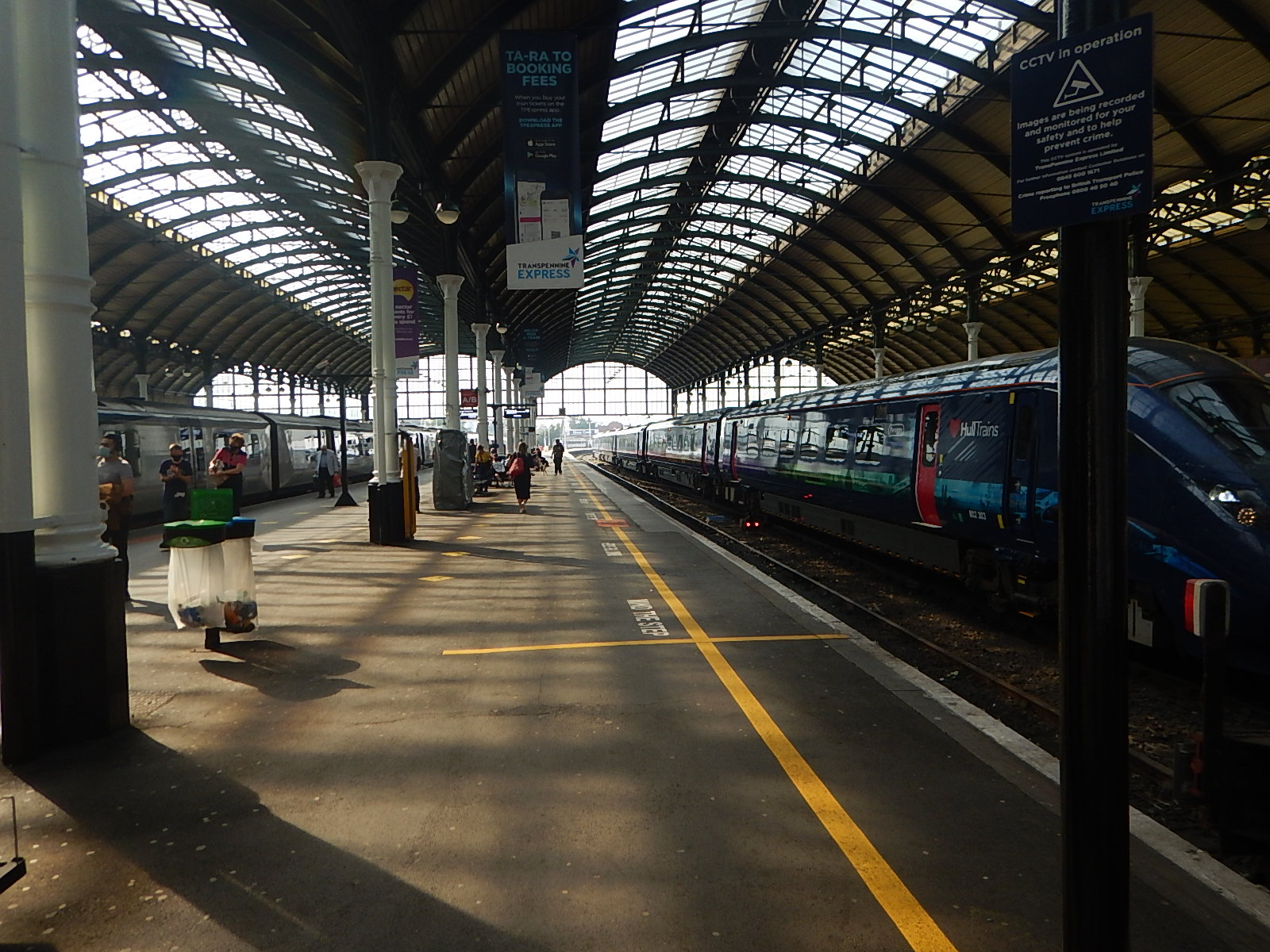
Note.
- Hull station has plenty of space.
- No other infrastructure work would be needed.
- There is a large bus interchange next door, so I suspect the power supply to Hull station is good.
Hull would be a very good first destination for a battery-electric InterCity train.
Others would include Bristol, Cheltenham, Chester, Scarborough, Sunderland and Swansea.
The risk would be very low, if the trains still had some diesel generator capacity.
Phase 5 – Service Testing On Long Routes With Multiple Charger Systems
Once the performance and reliability of the charger systems have been proven in single installations like perhaps Hull and Swansea stations, longer routes can be prepared for electric trains.
This press release from Hitachi is entitled Hitachi And Eversholt Rail To Develop GWR Intercity Battery Hybrid Train – Offering Fuel Savings Of More Than 20%.
The press release talks about Penzance and London, so would that be a suitable route for discontinuous electrification using multiple chargers?
These are the distances between major points on the route between Penzance and London Paddington.
- Penzance and Truro – 35.8 miles
- Truro and Bodmin Parkway – 26.8 miles
- Bodmin Parkway and Plymouth – 26.9 miles
- Plymouth and Newton Abbot – 31,9 miles
- Newton Abbot and Exeter – 20.2 miles
- Exeter and Taunton – 30.8 miles
- Taunton and Westbury – 47.2 miles
- Westbury and Newbury – 42.5 miles
- Newbury and Paddington – 53 miles
Note.
- Only Newbury and Paddington is electrified.
- Trains generally stop at Plymouth, Newton Abbott, Exeter and Taunton.
- Services between Paddington and Exeter, Okehampton, Paignton, Penzance, Plymouth and Torquay wouldn’t use diesel.
- Okehampton would be served by a reverse at Exeter.
- As Paignton is just 8.1 miles from Newton Abbot, it probably wouldn’t need a charger.
- Bodmin is another possible destination, as Great Western Railway have helped to finance a new platform at Bodmin General station.
It would certainly be good marketing to run zero-carbon electric trains to Devon and Cornwall.
I would class this route as medium risk, but with a high reward for the operator.
In this brief analysis, it does look that Hitachi’s proposed system is of a lower risk.
A Few Questions
I do have a few questions.
Are The Class 803 Trains Fitted With Hyperdrive Innovation Batteries?
East Coast Trains‘s new Class 803 trains are undergoing testing between London Kings Cross and Edinburgh and they can be picked up on Real Time Trains.
Wikipedia says this about the traction system for the trains.
While sharing a bodyshell with the previous UK A-train variants, the Class 803 differs in that it has no diesel engines fitted. They will however be fitted with batteries to enable the train’s on-board services to be maintained, in case the primary electrical supplies have failed.
Will these emergency batteries be made by Hyperdrive Innovation?
My experience of similar systems in other industries, points me to the conclusion, that all Class 80x trains can be fitted with similar, if not identical batteries.
This would give the big advantage of allowing battery testing to be performed on Class 803 trains under test, up and down the East Coast Main Line.
Nothing finds faults in the design and manufacture of something used in transport, than to run it up and down in real conditions.
Failure of the catenary can be simulated to check out emergency modes.
Can A Class 801 Train Be Converted Into A Class 803 Train?
If I’d designed the trains, this conversion would be possible.
Currently, the electric Class 801 trains have a single diesel generator. This is said in the Wikipedia entry for the Class 800 train about the Class 801 train.
These provide emergency power for limited traction and auxiliaries if the power supply from the overhead line fails.
So it looks like the difference between the powertrain of a Class 801 train and a Class 803 train, is that the Class 801 train has a diesel generator and the Class 803 train has batteries. But the diesel generator and batteries, would appear to serve the same purpose.
Surely removing diesel from a Class 801 train would ease the maintenance of the train!
Will The System Work With Third-Rail Electrification?
There are three routes that if they were electrified would probably be electrified with 750 DC third-rail electrification, as they have this electrification at one or both ends.
- Basingstoke and Exeter
- Marshlink Line
- Uckfield branch
Note.
- Basingstoke and Exeter would need a couple of charging systems.
- The Marshlink line would need a charging system at Rye station.
- The Uckfield branch would need a charging system at Uckfield station.
I am fairly certain as an Electrical Engineer, that the third-rails would only need to be switched on, when a train is connected and needs a charge.
I also feel that on some scenic and other routes, 750 VDC third-rail electrification may be more acceptable , than 25 KVAC overhead electrification. For example, would the heritage lobby accept overhead wires through a World Heritage Site or on top of a Grade I Listed viaduct?
I do feel that the ability to use third-rail 750 VDC third-rail electrification strategically could be a useful tool in the system.
Will The System Work With Lightweight Catenary?
I like the design of this 25 KVAC overhead electrification, that uses lightweight gantries, which use laminated wood for the overhead structure.
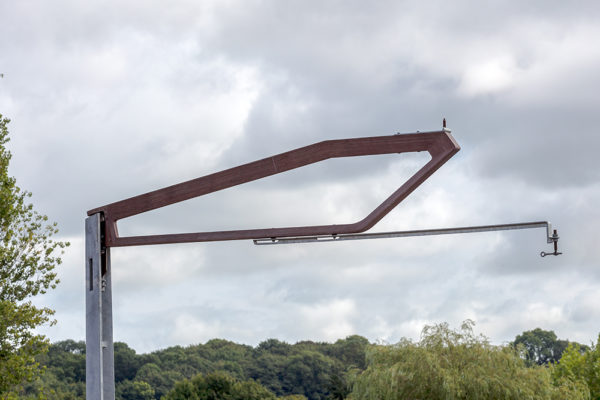
There is also a video.
Electrification doesn’t have to be ugly and out-of-character with the surroundings.
Isuspect that both systems could work together.
Would Less Bridges Need To Be Rebuilt For Electrification?
This is always a contentious issue with electrification, as rebuilding bridges causes disruption to both rail and road.
I do wonder though by the use of careful design, that it might be possible to arrange that the sections of electrification and the contentious bridges were kept apart, with the bridges arranged to be in sections, where the trains ran on batteries.
I suspect that over the years as surveyors and engineers get more experienced, better techniques will evolve to satisfy all parties.
Get this right and it could reduce the cost of electrification on some lines, that will be difficult to electrify.
How Secure Are The Containerised Systems?
Consider.
- I was delayed in East Anglia two years ago, because someone stole the overhead wires at two in the morning.
- Apparently, overhead wire stealing is getting increasingly common in France and other parts of Europe.
I suspect the containerised systems will need to be more secure than those used for buses, which are not in isolated locations.
Will The Containerised Charging Systems Use Energy Storage?
Consider.
- I’ve lived in rural locations and the power grids are not as good as in urban areas.
- Increasingly, batteries of one sort or another are being installed in rural locations to beef up local power supplies.
- A new generation of small-footprint eco-friendly energy storage systems are being developed.
In some locations, it might be prudent for a containerised charging system to share a battery with the local area.
Will The Containerised Charging Systems Accept Electricity From Local Sources Like Solar Farms?
I ask the question, as I know at least one place on the UK network, where a line without electrification runs through a succession of solar farms.
I also know of an area, where a locally-owned co-operative is planning a solar farm, which they propose would be used to power the local main line.
Will The System Work With Class 385 Trains?
Hitachi’s Class 385 trains are closely related to the Class 80x trains, as they are all members of Hitachi’s A-Train family.
Will the Charging Systems Charge Other Manufacturers Trains?
CAF and Stadler are both proposing to introduce battery-electric trains in the UK.
I also suspect that the new breed of electric parcel trains will include a battery electric variant.
As these trains will be able to use 25 KVAC overhead electrification, I would expect, that they would be able to charge their batteries on the Hitachi ABB charging systems.
Will The System Work With Freight Trains?
I believe that freight services will split into two.
Heavy freight will probably use powerful hydrogen-electric locomotives.
In Freightliner Secures Government Funding For Dual-Fuel Project, which is based on a Freightliner press release, I detail Freightliner’s decarbonisation strategy, which indicates that in the future they will use hydrogen-powered locomotives.
But not all freight is long and extremely heavy and I believe that a battery-electric freight locomotive will emerge for lighter duties.
There is no reason it could not be designed to be compatible with Hitachi’s charging system.
In Is This The Shape Of Freight To Come?, I talked about the plans for 100 mph parcel services based on redundant electric multiple units. Eversholt Rail Group have said they want a Last-Mile capability for their version of these trains.
Perhaps they need a battery-electric capability, so they can deliver parcels and shop supplies to the remoter parts of these islands?
Where Could Hitachi’s System Be Deployed?
This is the final paragraph from the article.
Hitachi is not committing to any routes yet, but a glance at the railway map shows clear potential for the battery/OLE-technology to be deployed on relatively lightly used rural and regional routes where it will be hard to make a case for electrification. The Cambrian Coast and Central Wales Lines would appear to be worthy candidates, and in Scotland, the West Highland Line and Far North routes are also logical areas for the system to be deployed.
In England, while shorter branch lines could simply be operated by battery trains, longer routes need an alternative. Network Rail’s Traction Decarbonisation Network Strategy interim business case recommends hydrogen trains for branch lines in Norfolk, as well as Par to Newquay and Exeter to Barnstaple. However, it is also entirely feasible to use the system on routes likely to be electrified much later in the programme, such as the Great Western main line West of Exeter, Swansea to Fishguard and parts of the Cumbrian Coast Line.
Everyone is entitled to their own opinion and mine would be driven by high collateral benefits and practicality.
These are my thoughts.
Long Rural Lines
The Cambrian, Central Wales (Heart Of Wales), Far North and West Highland Lines may not be connected to each other, but they form a group of rail routes with a lot of shared characteristics.
- All are rural routes of between 100 and 200 miles.
- All are mainly single track.
- They carry occasional freight trains.
- They carry quite a few tourists, who are there to sample, view or explore the countryside.
- All trains are diesel.
- Scotrail have been experimenting with attaching Class 153 trains to the trains on the West Highland Line to act as lounge cars and cycle storage.
Perhaps we need a long-distance rural train with the following characteristics.
- Four or possibly five cars
- Battery-electric power
- Space for a dozen cycles
- A lounge car
- Space for a snack trolley
- Space to provide a parcels service to remote locations.
I should also say, that I’ve used trains on routes in countries like Germany, Poland and Slovenia, where a similar train requirement exists.
Norfolk Branch Lines
Consider.
- North of the Cambridge and Ipswich, the passenger services on the branch lines and the important commuter routes between Cambridge and Norwich and Ipswich are run by Stadler Class 755 trains, which are designed to be converted to battery-electric trains.
- Using Hitachi chargers at Beccles, Bury St. Edmunds, Lowestoft, Thetford and Yarmouth and the existing electrification, battery-electric Class 755 trains could provide a zero-carbon train service for Norfolk and Suffolk.
- With chargers at Dereham and March, two important new branch lines could be added and the Ipswich and Peterborough service could go hourly and zero carbon.
- Greater Anglia have plans to use the Class 755 trains to run a London and Lowestoft service.
- Could they be planning a London and Norwich service via Cambridge?
- Would battery-electric trains running services over Norfolk bring in more visitors by train?
Hitachi may sell a few chargers to Greater Anglia, but I feel they have enough battery-electric trains.
Par And Newquay
The Par and Newquay Line or the Atlantic Coast Line, has been put forward as a Beeching Reversal project, which I wrote about in Beeching Reversal – Transforming The Newquay Line.
In that related post, I said the line needed the following.
- An improved track layout.
- An hourly service.
- An improved Par station.
- A rebuilt Newquay station with a second platform, so that more through trains can be run.
I do wonder, if after the line were to be improved, that a new three-car battery-electric train shuttling between Par and Newquay stations could be the icing on the cake.
Exeter And Barnstaple
The Tarka Line between Exeter and Barnstaple is one of several local and main lines radiating from Exeter St. David’s station.
- The Avocet Line to Exmouth
- The Great Western Main Line to Taunton, Bristol and London
- The Great Western Main Line to Newton Abbott, Plymouth and Penzance
- The Riviera Line to Paignton
- The West of England Line to Salisbury, Basingstoke and London.
Note.
- The Dartmoor Line to Okehampton is under development.
- Several new stations are planned on the routes.
- I have already stated that Exeter could host a charging station between London and Penzance, but it could also be an electrified hub for battery-electric trains running hither and thither.
Exeter could be a city with a battery-electric metro.
Exeter And Penzance
Earlier, I said that I’d trial multiple chargers between Paddington and Penzance to prove the concept worked.
I said this.
I would class this route as medium risk, but with a high reward for the operator.
But it is also an enabling route, as it would enable the following battery-electric services.
- London and Bodmin
- London and Okehampton
- London and Paignton and Torquay
It would also enable the Exeter battery-electric metro.
For these reasons, this route should be electrified using Hitachi’s discontinuous electrification.
Swansea And Fishguard
I mentioned Swansea earlier, as a station, that could be fitted with a charging system, as this would allow battery-electric trains between Paddington and Swansea via Cardiff.
Just as with Exeter, there must be scope at Swansea to add a small number of charging systems to develop a battery-electric metro based on Swansea.
Cumbrian Coast Line
This is a line that needs improvement, mainly for the tourists and employment it could and probably will bring.
These are a few distances.
- West Coast Main Line (Carnforth) and Barrow-in-Furness – 28.1 miles
- Barrow-in-Furness and Sellafield – 25 miles
- Sellafield and Workington – 18 miles
- Workington and West Coast Main Line (Carlisle) – 33 miles
Note.
- The West Coast Main Line is fully-electrified.
- I suspect that Barrow-in-Furness, Sellafield and Workington have good enough electricity supplies to support charging systems for the Cumbrian Coast Line.
- The more scenic parts of the line would be left without wires.
It certainly is a line, where a good case for running battery-electric trains can be made.
Crewe And Holyhead
In High-Speed Low-Carbon Transport Between Great Britain And Ireland, I looked at zero-carbon travel between the Great Britain and Ireland.
One of the fastest routes would be a Class 805 train between Euston and Holyhead and then a fast catamaran to either Dublin or a suitable rail-connected port in the North.
- The Class 805 trains could be made battery-electric.
- The trains could run between Euston and Crewe at speeds of up to 140 mph under digital signalling.
- Charging systems would probably be needed at Chester, Llandudno Junction and Holyhead.
- The North Wales Coast Line looks to my untrained eyes, that it could support at least some 100 mph running.
I believe that a time of under three hours could be regularly achieved between London Euston and Holyhead.
Battery-electric trains on this route, would deliver the following benefits.
- A fast low-carbon route from Birmingham, London and Manchester to the island of Ireland. if coupled with the latest fast catamarans at Holyhead.
- Substantial reductions in journey times to and from Anglesey and the North-West corner of Wales.
- Chester could become a hub for battery-electric trains to and from Birmingham, Crewe, Liverpool, Manchester and Shrewsbury.
- Battery-electric trains could be used on the Conwy Valley Line.
- It might even be possible to connect the various railways, heritage railways and tourist attractions in the area with zero-carbon shuttle buses.
- Opening up of the disused railway across Anglesey.
The economics of this corner of Wales could be transformed.
My Priority Routes
To finish this section, I will list my preferred routes for this method of discontinuous electrification.
- Exeter and Penzance
- Swansea and Fishguard
- Crewe and Holyhead
Note.
- Some of the trains needed for these routes have been delivered or are on order.
- Local battery-electric services could be developed at Chester, Exeter and Swansea by building on the initial systems.
- The collateral benefits could be high for Anglesey, West Wales and Devon and Cornwall.
I suspect too, that very little construction work not concerned with the installation of the charging systems will be needed.
Conclusion
Hitachi have come up with a feasible way to electrify Great Britain’s railways.
I would love to see detailed costings for the following.
- Adding a battery pack to a Class 800 train.
- Installing five miles of electrification supported by a containerised charging system.
They could be on the right side for the Treasury.
But whatever the costs, it does appear that the Japanese have gone native, with their version of the Great British Compromise.
Department Of Transport Claims London and Sheffield Times Could Be Cut By Thirty Minutes
In this article on the BBC, which is entitled Government Announce £401m Boost For Rail Services, this is said.
The funding announcement coincided with the completion of the first phase of the £1.5bn Midland Main Line Upgrade, which has supported the launch of East Midlands Railway’s (EMR) first electric services on the route between Corby in Northamptonshire and London St Pancras.
The project will see journey times between Sheffield and London cut by up to 30 minutes, the DfT said.
So how feasible is the claim of a thirty minute cut in London and Sheffield timings?
On Monday, the 07:30 train from London to Sheffield, covered the 164.7 miles in two hours and twelve minutes at an average speed of 74.9 mph.
If that train had done the trip in one hour and forty-two minutes, that would have been an average speed of 96.9 mph.
By the time, the new Class 810 trains arrive in a couple of years, they will be able to use the new electrification to Market Harborough, when on Monday the 82.8 miles without a stop, was covered in an hour, at an average speed of 82.8 mph.
These new trains are 125 mph electric trains under the wires and they will have two separate fast lines on which to run.
Example time savings at various average speeds to Market Harborough are as follows.
- 100 mph – 10 minutes saving.
- 110 mph – 14.8 minutes saving.
- 125 mph – 20.3 minutes saving
- 130 mph – 21.8 minutes saving
- 140 mph – 24.6 minutes saving
Note.
- The faster the average, the greater the time saving.
- Faster than 125 mph would only be possible with full in-cab digital signalling, which is currently being installed on the East Coast Main Line.
- I have been to Leicester in an InterCity 125, which was running at 125 mph most of the way.
But it does look like the new Class 810 trains will be able to save around twenty minutes to Sheffield, by making full use of the electrification between London and Market Harborough.
They would need to save just ten minutes between Market Harborough and Sheffield.
The Monday Train covered the 81.9 miles between Market Harborough and Sheffield in one hour and twelve minutes, which is an average speed of 68.3 mph.
To obtain the saving of ten minutes, it would need to do the journey in one hour and two minutes, which would be an average speed of 79.3 mph.
Given that the new Class 810 trains are designed to cruise at 125 mph on diesel, I don’t think this is an impossible objective.
What Will Be The Ultimate Time Between London and Sheffield On The Midland Main Line?
I believe that the following two sections of the Midland Main Line can be easily electrified.
- Between Leicester and Derby without the problem of the bridge at the South end of Leicester station, which would be so disruptive.
- Clay Cross North Junction and Sheffield which will be electrified for High Speed Two. I doubt Derby and Clay Cross Junction will be electrified as it’s a World Heritage Site.
On my Monday train, the following are times North of Leicester.
- Leicester and Derby is 29.3 miles, which is covered in 32 minutes at an average speed of 55 mph, which includes five stops. Raise this to 110 mph and the journey time is just 16 minutes or a saving of 16 minutes.
- Derby and Clay Cross North Junction is 21.8 miles, which is covered in 13 minutes at an average speed of 100 mph. By averaging 120 mph, there would be a saving of 2.1 minutes.
- Cross North Junction and Sheffield is 15.5 miles, which is covered in 16 minutes at an average speed of 58.2 mph.
Note.
- Savings would come between Leicester and Derby because of 125 mph linespeed and faster stops because of electrification.
- I believe that Hitachi battery-electric trains could sustain 125 mph on battery alone between Derby and Clay Cross North Junction, if they entered the section without electrification at full speed with full batteries. Now that is what I call a battery-electric train!
- There must be a minute or two to be saved on an electrified section into Sheffield with the stop at Chesterfield.
Add up all the savings and I feel that an hour and a half is possible between London and Sheffield.
And what time is High Speed Two claiming? One hour and twenty-seven minutes!
Could A Battery-Electric Train Cruise At 125 mph?
This may seem a silly idea, but then trains don’t care where they get their electricity from.
On the 21.8 miles between Derby and Clay Cross North, a sizeable proportion of energy will be used to accelerate the train up to the linespeed for the electrified section.
When the train enters the section without electrification, it will have two sources of energy.
- The electricity in the full batteries.
- The kinetic energy in the train at the required speed.
As the train runs through the section air and rolling resistance will tend to slow the train and electricity from the battery will be used to maintain speed.
In How Much Power Is Needed To Run A Train At 125 mph?. I estimated that for a Class 801 train to maintain 125 mph needs 3.42 kWh per vehicle mile.
A simple sum of 21.8 * 5 * 3.42 gives an energy need of 372.8 kWh to run between Derby and Clay Cross North Junction.
I’m sure than Hitachi can fit a 400 kWh battery in a five-car Class 810 train.
Would a slightly larger battery and in-cab signalling allow battery-electric trains to run at 140 mph? If the track allowed it, I don’t see why not!
Conclusion
I believe the Department of Transport’s statement of saving thirty minutes between London and Sheffield is feasible.
But so is a time of an hour-and-a half, which will give High Speed Two a run for its money!
Dartmoor Rail Service Reopens This Year In Reversal Of Beeching Cuts
The title of this post is the same as that of this article on The Times.
This is the introductory paragraph.
A largely redundant Victorian railway line will be reopened this year as part of plans to resurrect routes closed in the infamous Beeching cuts.
This line was always likely to be one of the first to reopen, as there is a terminal station at Okehampton, with a bus interchange and other facilities, that has been hosting a service from Exeter on summer Sundays for some years.
The BBC have a reporter there this morning and the station looks in better condition, than some I could name.
This paragraph from The Times describes works to be done.
Network Rail said engineers would start a range of works including improvements to drainage, fencing by the trackside, rebuilding embankments and upgrading Okehampton station. Some 11 miles of track will also be replaced. It is envisaged that test trains will run later this year before it fully reopens to passengers.
Some of the BBC footage, showed a great pile of new track by the station, so it looks like Network Rail are starting to relay the track.
It is hoped to run a one train per two hour service by the end of the year, which could go hourly next year.
In Okehampton Railway Return ‘Clear Reality’ After £40m Commitment In Budget, I said more about this reopening project and I speculated that both Okehampton and Barnstaple services will terminate at Exmouth Junction, as the Barnstaple services do now.
Barnstaple has roughly an hourly service from Exeter and to run two hourly services between Exeter and Coleford Junction, where the two routes divide, may need extra work to be done, so that trains can pass each other at convenient points.
This extra work probably explains, why the service won’t be hourly until next year.
I do wonder, if this reopening also enables other improvement and possibilities.
Meldon Quarry
Meldon Quarry used to be an important source of track ballast for British Rail and it is situated a few miles past Okehampton.
This Google Map shows Meldon Quarry and Okehampton.
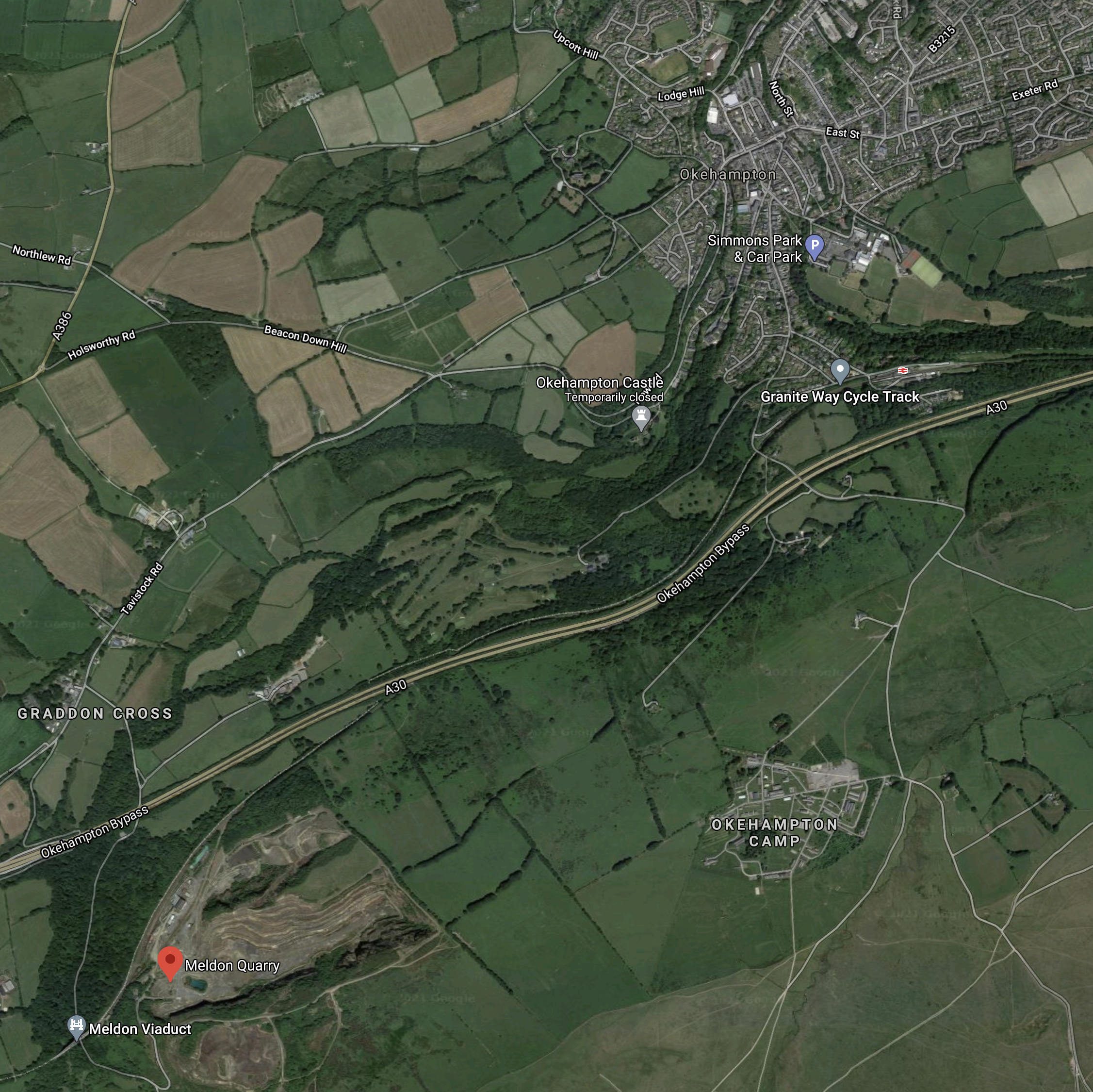
Note.
- Meldon Quarry is in the South-West corner of the map marked by a red marker.
- To its West is Meldon Viaduct, which is part of the old railway line between Okehampton and Plymouth, which is now a walking and cycling route.
- The town of Okehampton is in the North-East of the map.
- Okehampton station is in the South-East of the town close to the A 30.
I wouldn’t be surprised to find, that Network Rail are upgrading the line to Okehampton, so that if they need to obtain quality track ballast from Meldon Quarry, it would not require upgrades to the track East of Okehampton.
Okehampton Camp
Note Okehampton Camp to the South of Okehampton.
Many Army bases like this one need heavy vehicles to be transported to and from the base.
Have Network Rail future-proofed the design of the route to Okehampton, so that heavy vehicles can be transported to the area?
A Railhead For North Devon And North Cornwall
There are two main roads between Exeter and Cornwall.
- The A30 goes to the North of Dartmoor and via Launceston
- The A38 goes to the South of Dartmoor and then via Plymouth
In the past, I’ve always driven to and from Cornwall via the Northern route and I describe one journey in Dancing with Hippopotami.
This Google Map shows the A30, as it passes Okehampton.
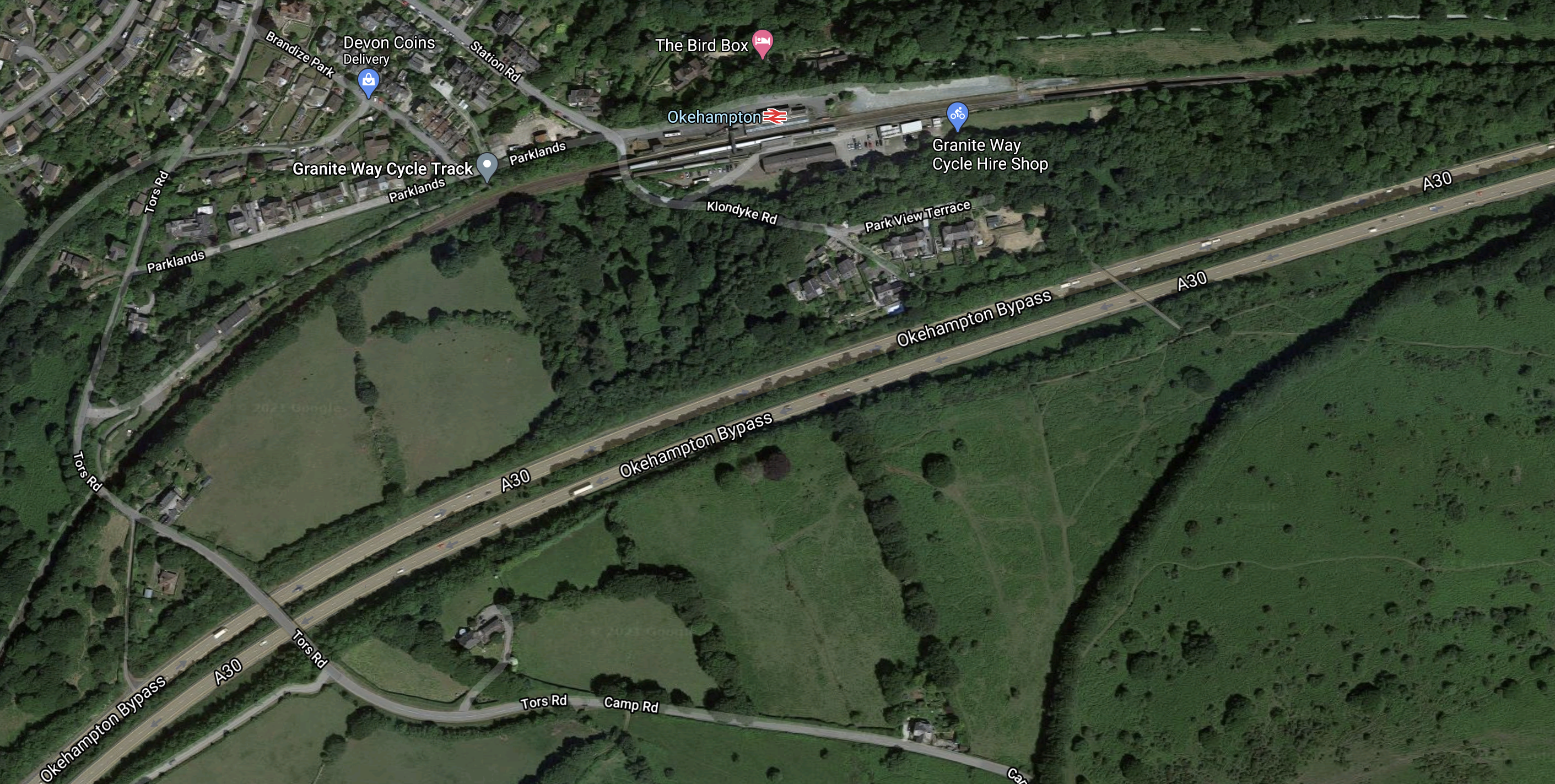
Note that although the station and the A30 are physically close, there would be a few minutes to drive between the two.
But I do feel there is scope to create an appropriate transport interchange between.
- Trains to and from Exeter.
- Buses and coaches to North Cornwall and North Devon.
- Cars on the A30.
It could effectively become a parkway station.
An Alternative Route In Case Of Trouble Or Engineering Works At Dawlish
Bodmin Parkway and Okehampton stations are about 43 miles apart and I suspect a coach could do the journey in around fifty minutes.
Would this be a sensible alternative route in times of disruption?
- It is dual-carriageway all the way.
- Okehampton station can certainly handle a five-car Class 802 train and could probably be improved to handle a nine- or even ten-car train.
- Trains from London could get to Okehampton with a reverse at Exeter St. Davids.
I don’t know the area well, but it must be a possibility.
Could Okehampton Have A London Service?
As I said in the previous section, it looks like Okehampton station can handle five-, nine- and possibly ten-car Class 802 trains and there are many pictures of Great Western Railway’s InterCity 125s or HSTs at Okehampton station in years gone by.
I think it would be feasible to run a small number of services between Okehampton and London.
- The service would have to reverse at Exeter St. Davids station.
- As one service every two hours runs between London Paddington and Exeter St. Davids stations, a service to Okehampton could be run as an extension to the current Exeter service.
- It could also stop at Crediton station.
There must also be the possibility of running a pair of five car trains from Paddington, that split at Exeter St. Davids, with one service going to Okehampton and the second one to Paignton.
- Exeter St. Davids and Paignton are 26.3 miles apart and a fast train takes 34 minutes
- Exeter St. Davids and Okehampton are probably a slightly shorter distance.
I suspect that a sensible timetable could be devised.
The specification of the Hitachi InterCity Tri-Mode Train is given in this Hitachi infographic.

Note.
- It is intended to run these trains to Exeter, Plymouth and Penzance.
- The range of the train on batteries is not given.
These trains could use a mixture of diesel and battery power to travel to and from Okehampton and Paignton.
But I also believe that as Hitachi develop this train and batteries have an increased capacity, that it will be possible for the trin to do a round trip from Exeter to Okehampton or Paignton without using diesel, provided the train can leave Exeter with a full battery.
According to Hitachi’s infographic, the train will take 10-15 minutes to fully charge at a station like Exeter. But that would add up to fifteen minutes to the timetable.
I feel if the roughly thirty-five miles of track between Exeter St Davids station and Cogload Junction, which is to the North of Taunton, were to be electrified, then this would mean.
- Trains would be fully charged for their excursions round Devon.
- Trains would be fully charged for onward travel to Plymouth and Penzance.
- Trains going to London would leave Taunton with full batteries to help them on their way on the ninety mile stretch without electrification to Newbury.
- Trains going between Exeter and Bristol could take advantage of the electrification.
Eventually, this section of electrification might even help to enable trains to run between London and Exeter without using diesel.
As the railway runs alongside the M5 Motorway, this might ease planning for the electrification.
The gap in the electrification between Cogload Junction and Newbury could be difficult to bridge without using diesel.
- Cogload Junction and Newbury are 85 miles apart.
- I’ve never seen so many bridges over a railway.
- I actually counted twenty-one bridges on the twenty miles between Westbury and Pewsey stations.
- I suspect some will object, if some of the bridges are replaced with modern ones.
- There would be a lot of disruption and expense, if a large proportion of these bridges were to be replaced.
- Currently, Great Western Railway run expresses to Exeter, Plymouth and Penzance via Taunton and Newbury.
I think, there needs to be some very radical thinking and low cunning to solve the problem.
- Battery technology and the best efforts of engineers from Hitachi and Hyperdrive Innovation may stretch the battery range sufficiently.
- It might be possible to extend the electrification at the Newbury end to perhaps Bedwyn, as there are only a few bridges. This would shorten the distance by up to thirteen miles.
- It may also be possible to extend the electrification at the Taunton end.
- I would expect some bridges could be dealt with using discontinuous electrification techniques.
But I believe that full electrification between Newbury and Cogload junction might be an extremely challenging project.
There must also be the possibility of using lightweight overhead line structures, where challenges are made about inappropriate overhead gantries.
There is also a video.
Note.
- Electrification doesn’t have to be ugly and out-of-character with the surroundings.
- The main overhead structure of this gantry is laminated wood.
These gantries would surely be very suitable for the following.
- Electrifying secondary routes and especially scenic ones.
- Electrifying single lines and sidings.
- Electrifying a bay platform, so that battery electric trains could be charged.
Innovative design could be one of the keys to more electrification.
Thoughts On Batteries In East Midland Railway’s Class 810 Trains
Since Hitachi announced the Regional Battery Train in July 2020, which I wrote about in Hyperdrive Innovation And Hitachi Rail To Develop Battery Tech For Trains, I suspect things have moved on.
This is Hitachi’s infographic for the Regional Battery Train.

Note.
- The train has a range of 90 km/56 miles on battery power.
- Speed is given at between 144 kph/90 mph and 162 kph/100 mph
- The performance using electrification is not given, but it is probably the same as similar trains, such as Class 801 or Class 385 trains.
- Hitachi has identified its fleets of 275 trains as potential early recipients.
It is also not stated how many of the three diesel engines in a Class 800 or Class 802 trains will be replaced by batteries.
I suspect if the batteries can be easily changed for diesel engines, operators will be able to swap diesel engines and battery packs according to the routes.
Batteries In Class 803 Trains
I first wrote about the Class 803 trains for East Coast Trains in Trains Ordered For 2021 Launch Of ‘High-Quality, Low Fare’ London – Edinburgh Service, which I posted in March 2019.
This sentence from Wikipedia, describes a big difference between Class 803 and Class 801 trains.
Unlike the Class 801, another non-bi-mode AT300 variant which despite being designed only for electrified routes carries a diesel engine per unit for emergency use, the new units will not be fitted with any, and so would not be able to propel themselves in the event of a power failure. They will however be fitted with batteries to enable the train’s on-board services to be maintained, in case the primary electrical supplies would face a failure.
Nothing is said about how the battery is charged. It will probably be charged from the overhead power, when it is working.
The Intercity Tri-Mode Battery Train
Hitachi announced the Intercity Tri-Mode Battery Train in this press release in December 2020.
This is Hitachi’s infographic for the Intercity Tri-Mode Battery Train.
Note.
- The train is battery-powered in stations and whilst accelerating away.
- It says that only one engine will be replaced by batteries.
- Fuel and carbon savings of 20 % are claimed.
Nothing has been said in anything, I’ve read about these trains, as to whether there is regenerative braking to batteries. I would be very surprised if fuel and carbon savings of 20 % could be attained without regenerative braking to batteries.
In Do Class 800/801/802 Trains Use Batteries For Regenerative Braking?, I discussed the question in the title.
This is a shortened version of what I said in that post.
If you type “Class 800 regenerative braking” into Google, you will find this document on the Hitachi Rail web site, which is entitled Development of Class 800/801 High-speed Rolling Stock for UK Intercity Express Programme.
If you search for brake in the document, you find this paragraph.
In addition to the GU, other components installed under the floor of drive cars include the traction converter, fuel tank, fire protection system, and brake system.
Note that GU stands for generator unit.
The document provides this schematic of the traction system.

Note that BC which is described as battery charger.
Is that for a future traction battery or a smaller one used for hotel power as in the Class 803 train?
As a Control and Electrical Engineer, it strikes me that it wouldn’t be the most difficult problem to add a traction battery to the system.
From what Hitachi have indicated in videos, it appears that they are aiming for the battery packs to be a direct replacement for the generator unit.
Generator Unit Arrangement In Class 810 Trains
When I wrote Rock Rail Wins Again!, which was about the ordering of these trains, the reason for four engines wasn’t known.
It now appears, that the extra power is needed to get the same 125 mph performance on diesel.
The formation of a five-car Class 802 train is as follows.
DPTS-MS-MS-MC-DPTF
Note.
- The three generator units are in the three middle cars.
- The three middle cars are motored.
- The two driver cars are trailer cars.
How are Hitachi going to put four generator units into the three middle cars?
- I wonder if, the engines can be paired, with some auxiliaries like fuel-tanks and radiators shared between the generators.
- A well-designed pair might take up less space than two singles.
- A pair could go in the centre car and singles either side.
It will be interesting to see what the arrangement is, when it is disclosed.
Is there the possibility, that some of the mathematics for the Intercity Tri-Mode Battery Train has indicated that a combination of generator units and battery packs can give the required 125 mph performance?
- Battery packs could need less space than diesel generators.
- Regenerative braking could be used to charge the batteries.
- How far would the train be able to travel without electrification?
- Trains would not run the diesel engines in the station.
- Could the fuel and carbon savings of 20 %, that are promised for the Intercity Tri-Mode Battery Train, be realised?
There may be a train buried in the mathematics, that with some discontinuous electrification could handle the East Midlands Railway Intercity services, that generates only a small amount of carbon!
Would A Mix Of Diesel Generators And Battery Packs Enable 125 mph Running?
Consider.
- The trial Intercity Tri-Mode Battery Train intended for the London Paddington and Penzance route, will probably have two diesel generators and a battery pack according to what Hitachi have said in their infographic for the Intercity Tri-Mode Battery Train.
- East of Plymouth some of the stretches of the route are challenging, which resulted in the development and ordering of Class 802 trains, that are more powerful, than the Class 800 trains used on easier routes.
- An Intercity Tri-Mode Battery Train with two diesel generators and a battery pack, needs to be as powerful as a Class 802 train with three diesel generators.
- So effectively does that mean that in the right installation with top class controlling software, that in fast running, a battery pack can be considered equivalent to a diesel generator?
I don’t know, but if it’s possible, it does bring other advantages.
- Fuel and carbon savings of 20 %
- No diesel running in stations or whilst accelerating away.
- Better passenger environment.
Configurations of 3-plus-1 and 2-plus 2 might be possible.
Beeching Reversal – Consett-Newcastle Connection
This is one of the Beeching Reversal projects that the Government and Network Rail are proposing to reverse some of the Beeching cuts. There used to be a direct line between Newcastle and Consett, which was the Derwent Valley Railway, which connected Consett to the Tyne Valley Line.
I would assume that the basis of the plan, is to reinstate this route and build a new station at Consett.
The Former Route
I will show the route starting from the Tyne Valley Line.
Connection To The Tyne Valley Line
This Google Map shows the MetroCentre with the Tyne Valley Line running along its North side.

Note.
- The River Tyne running along the North side of the map.
- MetroCentre station on the Tyne Valley Line is by the North-East corner of the MetroCentre.
- The River Derwent meanders its way to the River Tyne, to the West of the MetroCentre.
- The Derwent Valley Line used to come through this area to join the Tyne Valley Line.
I have a feeling that much of the route of the Derwent Valley Line lies under the new roads.
This map clipped from the Wikipedia entry for the Derwent Valley Line, shows how, the line connected to the Tyne Valley Line.

This Google Map shows the area.

Note.
- The Scotswood Railway Bridge is the dark-coloured bridge in the North-West corner of the map.
- The Tyne Valley Line runs East-West across the map.
- Swalwell station must have been in the area of the junction on the A1.
As the old route appears to be blocked, another route must be found to connect to the Tyne Valley Line.
Perhaps there would be enough space to squeeze a railway line alongside the River Derwent.
Between Swalwell And Nine Arches Viaduct
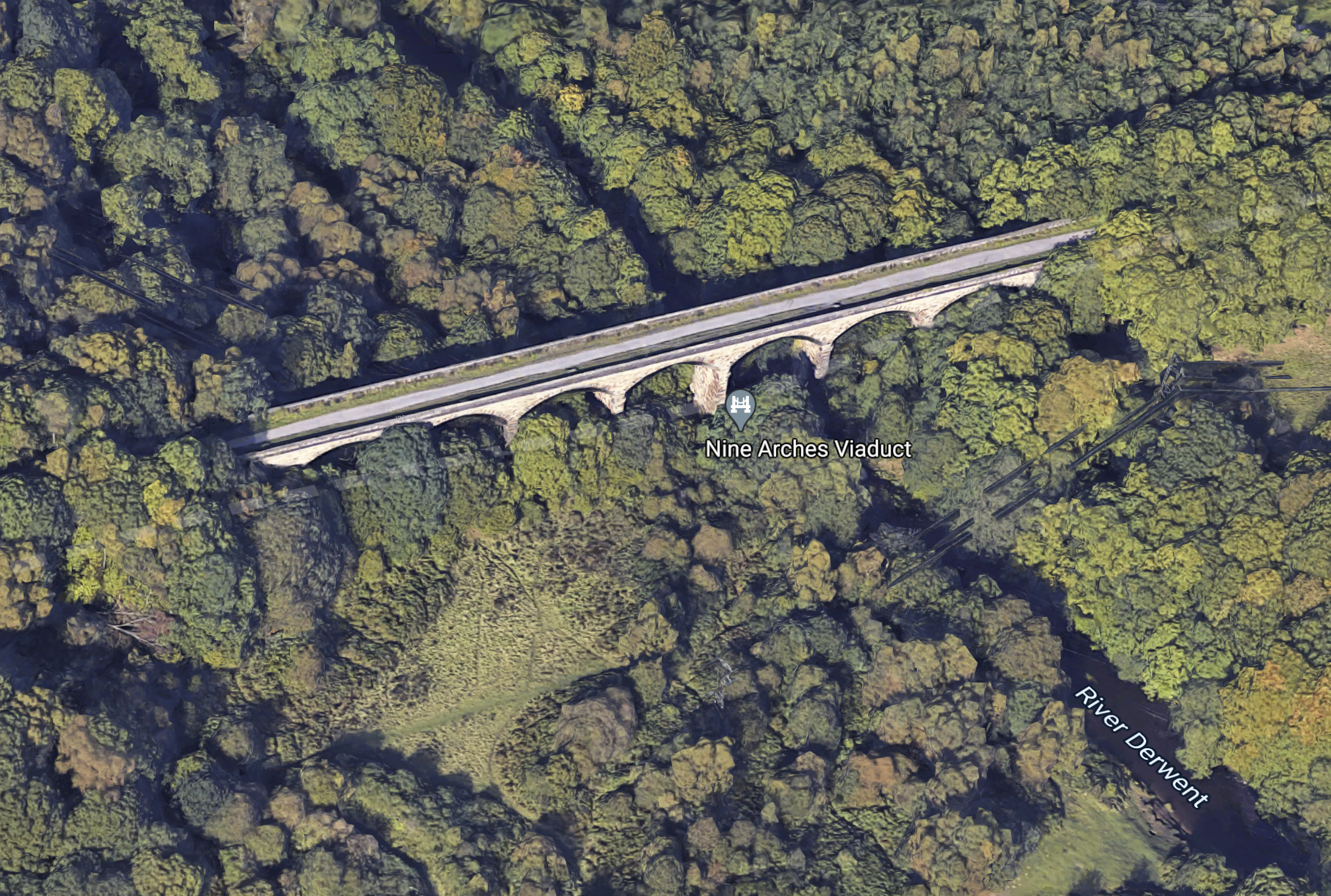
The Nine Arches Viaduct is an iconic feature of the line. This image of the bridge was taken from a Google Map.
This second image shows it as a map.
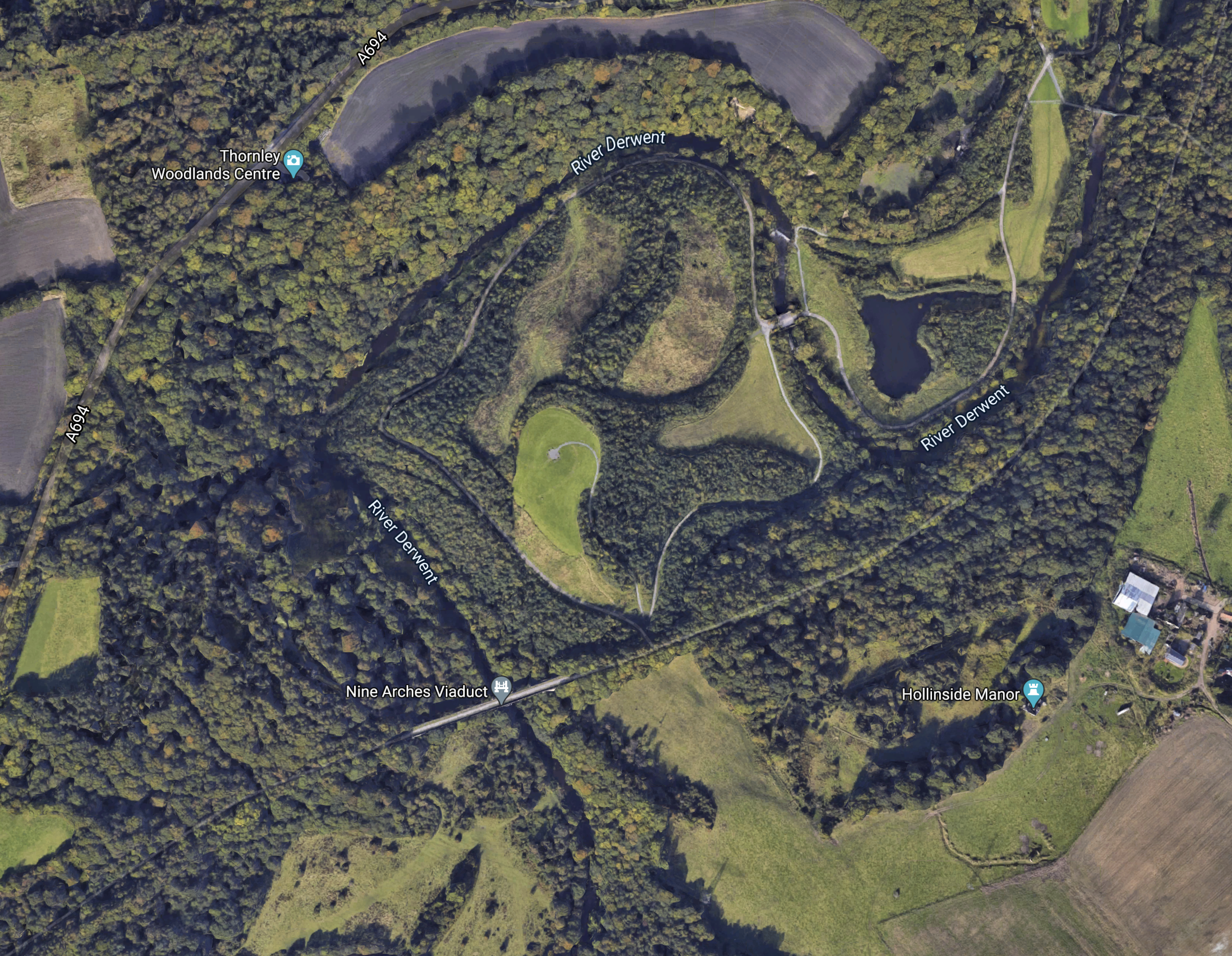
Note that I have arranged the map, so that the path that uses the route of the Derwent Valley Line runs between the South-West and North-East corners of the map.
This third Google Map has the Nine Arches Viaduct in the South-West corner and Swalwell in the North-East corner.

Note the tadpole-shaped green space by the bridge.
Between Nine Arches Viaduct and Lintz Green
This Google Map shows this section.

Note.
- The Nine Arches Viaduct is in the North-East corner.
- Lintz Green is in the South West corner.
On the Derwent Valley Railway, there were stations at Lintz Green and Rowlands Gill.
The History section in the Wikipedia entry for the Derwent Valley Railway, explains why a more direct route wasn’t taken in this area.
Between Lintz Green And Ebchester
This Google Map shows this section.

Note.
Lintz Green is at the Eastern edge of the map.
Ebchester is in the South-West corner.
On the Derwent Valley Railway, there were stations at High Westwood and Ebchester.
Between Ebchester and Consett
This Google Map shows this section.
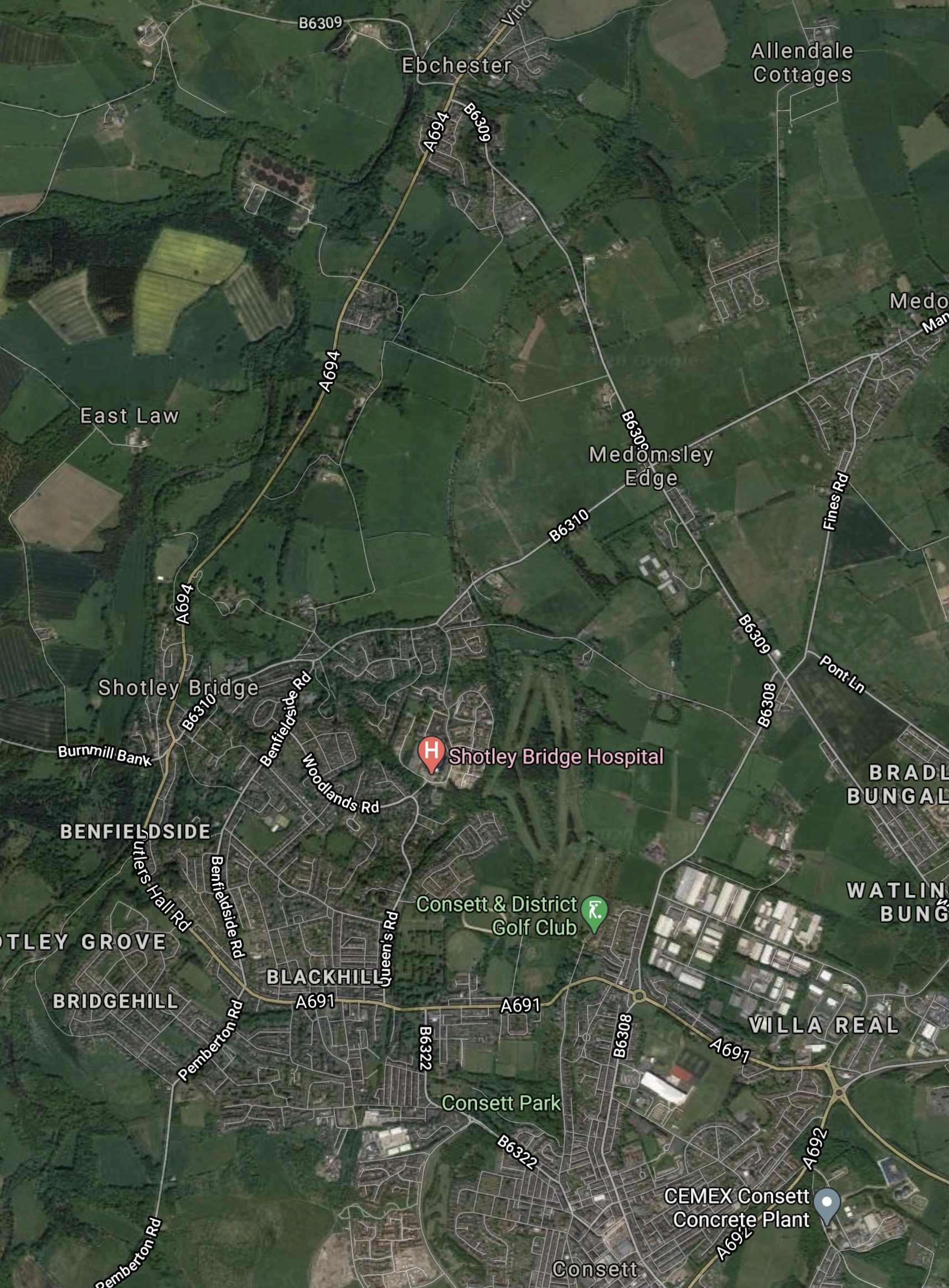
Note.
- Ebchester is at the Northern edge of the map in the centre.
- Consett is in the South of the map.
- Shotley Bridge Hospital is an NHS hospital.
On the Derwent Valley Railway, there were stations at Shotley Bridge, Blackhill and Consett.
Consett Station
A new station would have to be built in Consett.
Consett is a town of around 25,000 and is shown in this Google Map.

Note that the red arrow shows the rough location of the original station near Annfield Plain. The station and the tracks were demolished in the 1980s to make way for new roads.
How thinking on transport has changed in forty years!
Is This Route Feasible?
Google gives the distance between the Metrocentre and Consett as 11.5 miles and Wikipedia says that Consett is about 900 feet above sea level.
To put the altitude into perspective, this is higher than Merthyr Tydfil, but not as high as Buxton, so I feel that trains could ascend to Consett, as steam trains did in far-off Victorian days, when they carried over half a million passengers every year, according to Wikipedia.
I would say, that although restoring the route could be challenging, it would not be filed under Impossible.
These are a few other thoughts.
Would The Route Carry Freight?
If we’re talking about long freight trains with lots of containers or many trucks of coal, the answer is probably a negative.
But rail freight is changing, I can see many towns in the UK getting a high speed parcels service using modified electric multiple units.
- Rail Operations Group and others are planning to experiment with this type of service.
- With on-line shopping, 25,000 residents can generate a lot of deliveries and returns.
- The average guy on the Consett omnibus, is getting more worried about carbon emissions.
But trains like these could fit in with the passenger service on the route and could even unload at a well-designed passenger terminal in Consett.
The route would also have to be able to take maintenance and construction trains, just like the London Underground and the Tyne and Wear Metro do!
Would The Route Be Single- Or Double-Track?
Consider.
- The original Victorian route was double-track.
- The more trains on the route, the greater the need for a full double-track railway.
- Would the Nine Arches Viaduct accommodate a double-track.
- Single-track railways are easier to construct and more affordable.
Hopefully a serious study, will give an answer.
How Would Trains Go Between MetroCentre and Newcastle Stations?
Currently, there are three trains per hour (tph) between MetroCentre and Newcastle stations.
The Tyne and Wear Metro generally runs on the principle of five tph, so a one or two tph service between Consett and Newcastle would fit in well with the Tyne and Wear Metro, even if it was not their service.
This Google Map shows MetroCentre station.

Could a third platform be fitted here to run a shuttle service to Consett?
Trains between MetroCentre and Newcastle stations, go via Dunston station, Norwood Junction and the King Edward VII Bridge.
Note.
- Norwood Junction also allows trains to go between The Tyne Valley Line and the East Coast Main Line in both North and South directions.
- The comprehensive track layout to the South of Newcastle allows access to everywhere.
The Consett trains could even be run on a Back-to-Back basis to Ashington and Blyth, which is now being called the Northumberland Line in the media.
Would The Line Be Zero-Carbon?
I feel strongly, that all new or reopened railways should be zero-carbon.
But whether it should be electrified is another matter and depends on the rolling stock.
Battery Electric Trains To Consett
If the route to Consett is to be zero-carbon, then the obvious choice for the route are battery electric trains.
- To run these successfully, there would probably need to be some electrification along the Tyne Valley Line, as far as the junction with the new Derwent Valley Line, so trains started the climb to Consett with full batteries.
- If necessary, some parts of the Derwent Valley Line could be electrified, to assist the trains up the hill.
- Coming down from Consett, they could use Newton’s friend, with regenerative braking charging the batteries.
- Intriguingly, between MetroCentre and Hexham is under twenty miles, so why not run these services using similar battery electric trains.
I also think, that if the electrification were to be 25 KVAC, then it could enable battery electric trains like Hitachi’s Regional Battery Train or CAF’s proposed battery-electric Class 331 train, to run between Newcastle and Carlisle stations.
The Tyne And Wear Metro’s New Trains
I believe that the new trains being built by Stadler for the Tyne and Wear Metro, will be very similar to the Class 777 trains for Merseyrail.
The Class 777 trains are known to have this features.
- A capacity of 484 passengers.
- An operating speed of 75 mph.
- A weight of 99 tonnes.
- Ability to use 750 VDC third-rail electrification.
- A small battery to be used for hotel power, when there is no electrification.
- Some will be fitted with batteries to allow route extension on unelectrified lines, like between Ormskirk and Preston, which is 15.3 miles.
- In the future, they will be able to use 25 KVAC overhead electrification.
The new Tyne and Wear trains appear to be different to the Class 777 trains in the following ways.
- A different length, with five cars instead of four.
- Ability to use 750 VDC overhead instead of 750 VDC third-rail electrification.
- Longitudinal instead of transverse seating.
These facts should also be born in mind.
Stadler built the Class 399 tram-trains for Sheffield, that can use both 750 VDC and 25 KVAC overhead electrification from the same pantograph.
Parts of the Tyne and Wear Metro use tram-train operation under the Karlsruhe model, which is also used in Sheffield.
Could The Tyne And Wear Metro’s New Trains Work Between Newcastle And Consett Stations?
I feel if the following conditions were to be met, that the Tyne And Wear Metro’s new trains, would be able to work the route.
- Batteries with sufficient range to work the route were fitted.
- Ability to use both 750 VDC and 25 KVAC overhead electrification.
- Sufficient electrification were erected to power the train and charge the batteries on their journey between Newcastle and MetroCentre stations.
It is my view, that the trains could be ideal for the route.
They could also work between Newcastle and Hexham, with slightly larger batteries than their Liverpool cousins.
What Size Batteries Would Be Needed For A Service To Consett?
I will do a calculation based on the Class 777 train figures.
- The train weight is 99 tonnes.
- Each of 484 passengers weighs 80 Kg with baggage, bikes and buggies.
- This adds up to 38.7 tonnes giving a train weight of 137.7 tonnes.
Using Omni’s Potential Energy Calculator gives a value of 103 kWh to lift the full train the 900 feet to Consett.
In an article in the October 2017 Edition of Modern Railways, which is entitled Celling England By The Pound, Ian Walmsley says this in relation to trains running on the Uckfield Branch, which is not very challenging.
A modern EMU needs between 3 and 5 kWh per vehicle mile for this sort of service.
The new Tyne and Wear Metro trains have five cars, so assuming 3 kWh per vehicle mile, would need the following energy to power the train to Consett.
5* 3 * 11.5 = 172.5 kWh
I wouldn’t be surprised to see a 400 kWh battery on the train.
On the flat, it would do about twenty-seven miles, which would mean the train could provide a service between Newcastle and Hexham.
Incidentally, the distance between Newcastle and Ashington is under twenty five miles of which a couple of miles are electrified.
Conclusion
Newcastle and Consett would appear to be an ideal route to reopen.
It would require.
- A dozen miles of new track. much of which would be on an dismantled alignment.
- An appropriate number of new stations.
- Some electrification between Newcastle and MetroCentre stations.
- A number of the new Stadler trains for the Tyne and Wear Metro to be fitted with batteries.
A service of one or two tph could be provided.
In addition, the following could be possible.
- The Newcastle and Hexham service could be run by the same battery electric trains.
- The Consett and Newcastle service could be run Back-to-Back with the proposed Newcastle and Ashington service.
This scheme has collateral benefits.
Northern Powerhouse Rail – Significant Upgrades And Electrification Of The Rail Lines From Leeds And Sheffield To Hull
In this article on Transport for the North, which is entitled Northern Powerhouse Rail Progress As Recommendations Made To Government, one of the recommendations proposed for Northern Powerhouse Rail is significant upgrades and electrification of the rail lines from Leeds and Sheffield to Hull.
Northern Powerhouse Rail’s Objective For The Leeds and Hull Route
Wikipedia, other sources and my calculations say this about the trains between Leeds and Hull.
- The distance between the two stations is 51.7 miles
- The current service takes around 57 minutes and has a frequency of one train per hour (tph)
- This gives an average speed of 54.4 mph for the fastest journey.
- The proposed service with Northern Powerhouse Rail will take 38 minutes and have a frequency of two tph.
- This gives an average speed of 81.6 mph for the journey.
This last figure of nearly 82 mph, indicates to me that a 100 mph train will be able to meet Northern Powerhouse Rail’s objective.
Northern Powerhouse Rail’s Objective For The Sheffield and Hull Route
Wikipedia, other sources and my calculations say this about the trains between Sheffield and Hull.
- The distance between the two stations is 59.4 miles
- The current service takes around 80 minutes and has a frequency of one tph.
- This gives an average speed of 44.6 mph for the fastest journey.
- The proposed service with Northern Powerhouse Rail will take 50 minutes and have a frequency of two tph.
- This gives an average speed of 71,3 mph for the journey.
This last figure of over 70 mph, indicates to me that a 90 mph train will be able to meet Northern Powerhouse Rail’s objective.
Services From Hull Station
Hull station is a full interchange, which includes a large bus station.
- Currently, the station has seven platforms.
- There appears to be space for more platforms.
- Some platforms are long enough to take nine-car Class 800 trains, which are 234 metres long.
- There are some good architectural features.
If ever there was a station, that had basic infrastructure, that with appropriate care and refurbishment, could still be handling the needs of its passengers in a hundred years, it is Hull.
- It would be able to handle a 200 metre long High Speed Two Classic-Compatible train, tomorrow.
- It would probably be as no more difficult to electrify than Kings Cross, Liverpool Lime Street, Manchester Piccadilly or Paddington.
- It would not be difficult to install charging facilities for battery electric trains.
These are some pictures of the station.







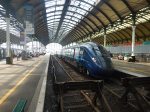

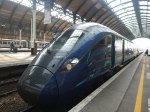


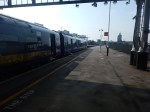

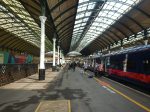
Currently, these are the services at the station, that go between Hull and Leeds, Selby or Sheffield.
- Hull Trains – 7 trains per day (tpd) – Hull and London via Brough, Selby and Doncaster.
- LNER – 1 tpd – Hull and London via Brough, Selby and Doncaster.
- Northern Trains – 1 tph – Hull and Halifax via Brough, Selby, Leeds and Bradford Interchange.
- Northern Trains – 1 tph – Hull and Sheffield via Brough, Gilberdyke, Goole, Doncaster, Rotherham Central and Meadowhall.
- Northern Trains – 1 tph – Hull and York via Brough and Selby.
- Northern Trains – 1 tph – Bridlington and Sheffield via Hull, Brough, Goole, Doncaster and Meadowhall.
- TransPennine Express – 1 tph – Hull and Manchester Piccadilly or Manchester Airport via Brough, Selby, Leeds, Huddersfield and Stalybridge.
Note.
- I have included services through Selby, as the station is on the way to Leeds and is a notorious bottleneck.
- All services go through Brough.
- All trains work on diesel power to and from Hull.
- Hull Trains and LNER use Hitachi bi-mode trains, that work most of the route to and from London, using the 25 KVAC overhead electrification.
- Northern use a variety of diesel trains only some of which have a 100 mph operating speed.
There would also appear to be freight trains working some of the route between Hull and Brough stations.
Upgrading The Tracks
I very much believe that to meet Northern Powerhouse Rail’s objectives as to time, that the lines to Hull from Leeds and Sheffield must have a 100 mph operating speed.
Hull And Leeds And On To London
This Google Map shows a typical section of track.
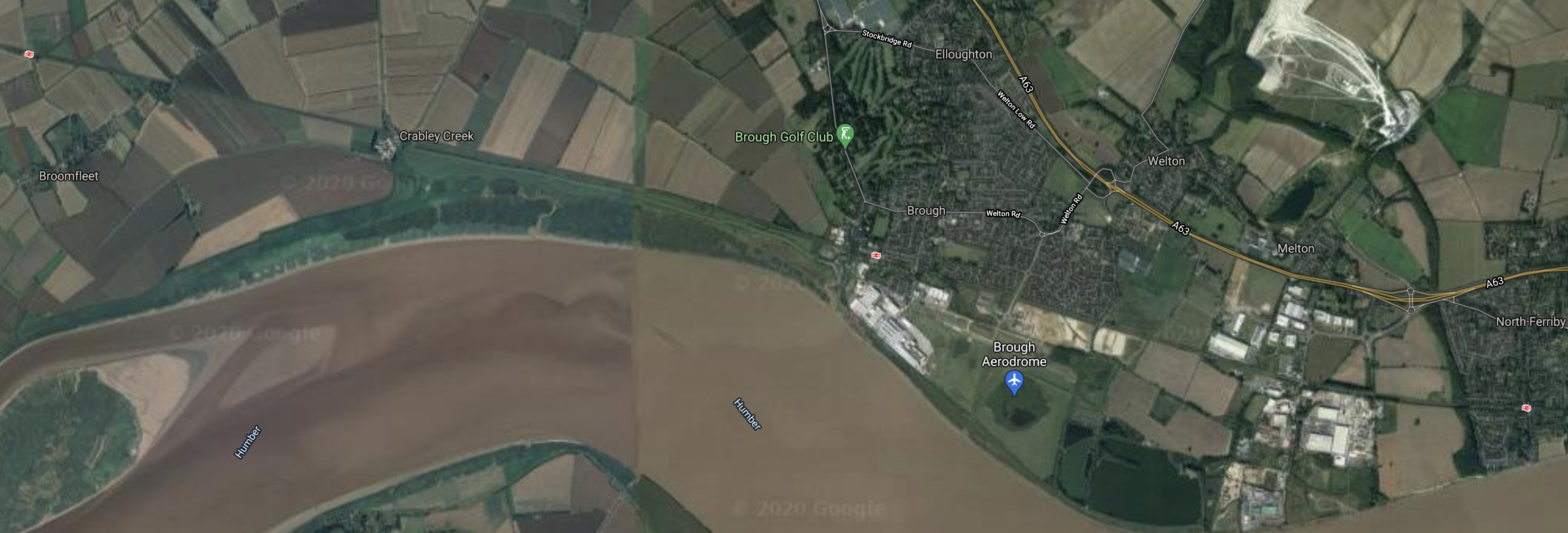
Note.
- Broomfleet station is in the North-West corner of the map.
- Brough station is just to the East of the middle of the map.
- Ferriby station is in the South-East corner of the map.
The Hull and Selby Line is fairly straight for most of its route.
The Selby Swing Bridge
The main problem is the Selby swing bridge, which is shown in this Google Map.
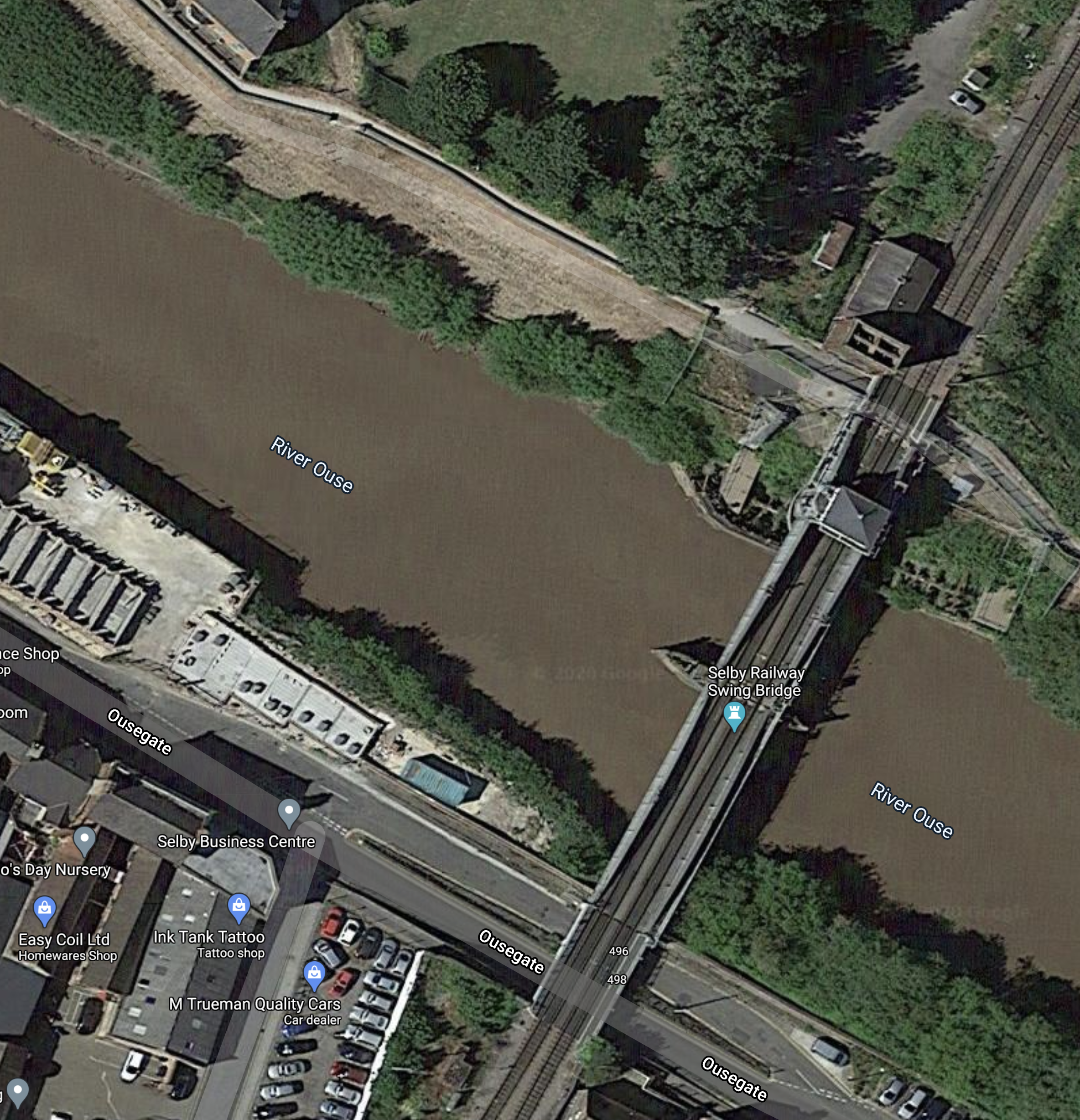
Note.
- The bridge was opened in 1891.
- It is a Grade II Listed structure.
- It is a double-track bridge.
- It swings through ninety degrees to allow ships to pass through.
- It has a low speed limit of 25 mph.
- The bridge regularly carries the biomass trains to Drax power station.
This page on the Fairfield Control Systems web site, describes the major refurbishment of the bridge.
- The bridge structure has been fully refurbished.
- A modern control system has been installed.
- The page says the bridge glides to an exact stop.
Network Rail are claiming, it will be several decades before any more work needs to be done on parts of the bridge.
It looks to me, that Network Rail have decided to live with the problems caused by the bridge and automate their way round it, if possible.
Level Crossings
One general problem with the route between Hull and Selby is that it has around a dozen level crossing, some of which are just simple farm crossings.
The main route West from Selby goes to Leeds and it is double track, fairly straight with around a dozen level crossings.
West from Selby, the route to the East Coast Main Line to and from London is also double track and reasonably straight.
But it does have level crossings at Common Lane and Burn Lane.
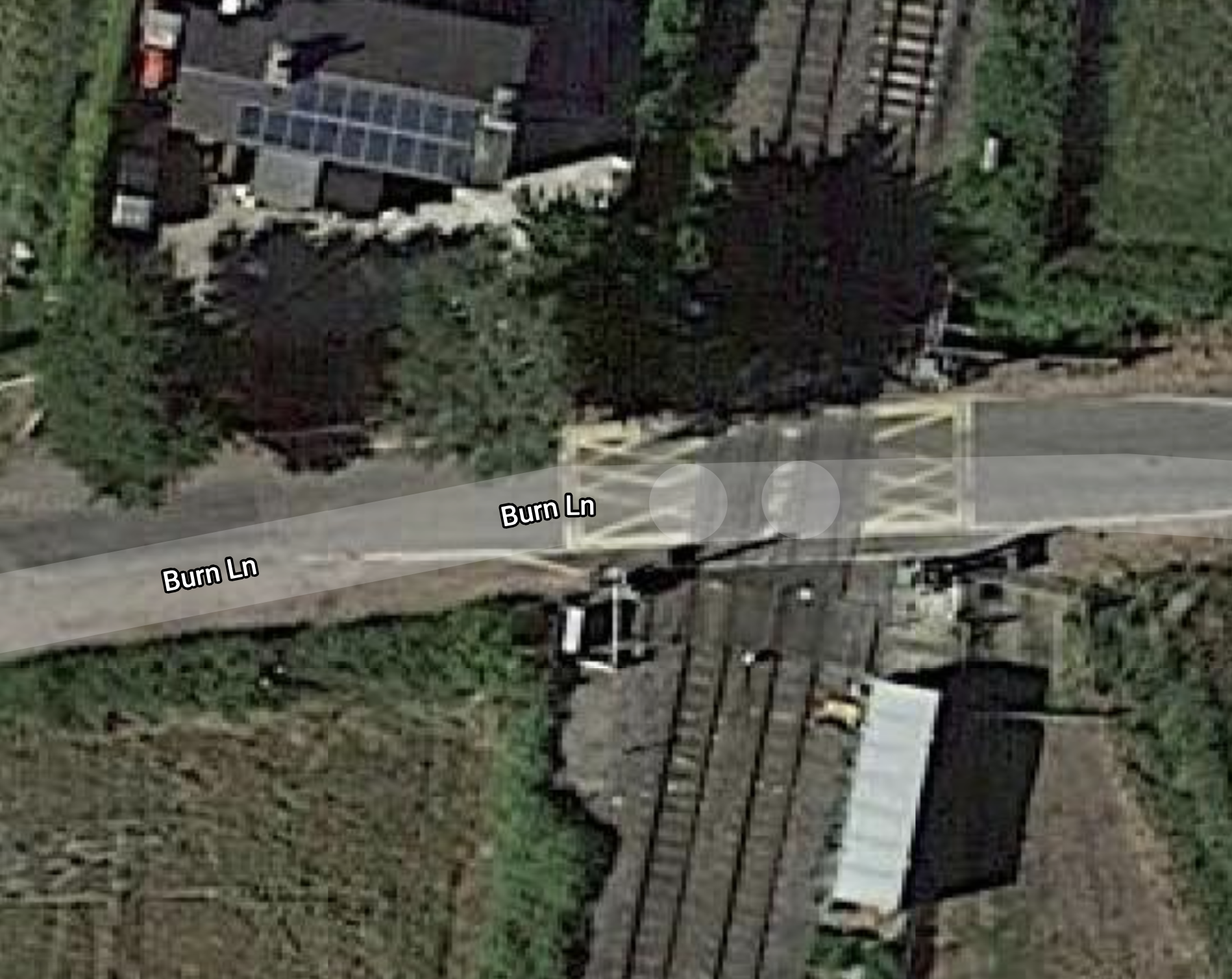
The Google Map show Burn Lane level crossing, which is typical of many in the area.
Hull And Sheffield
The other route West from Hull goes via Goole and Doncaster.
This Google Map shows the Hull and Doncaster Branch between Goole and Saltmarshe stations.
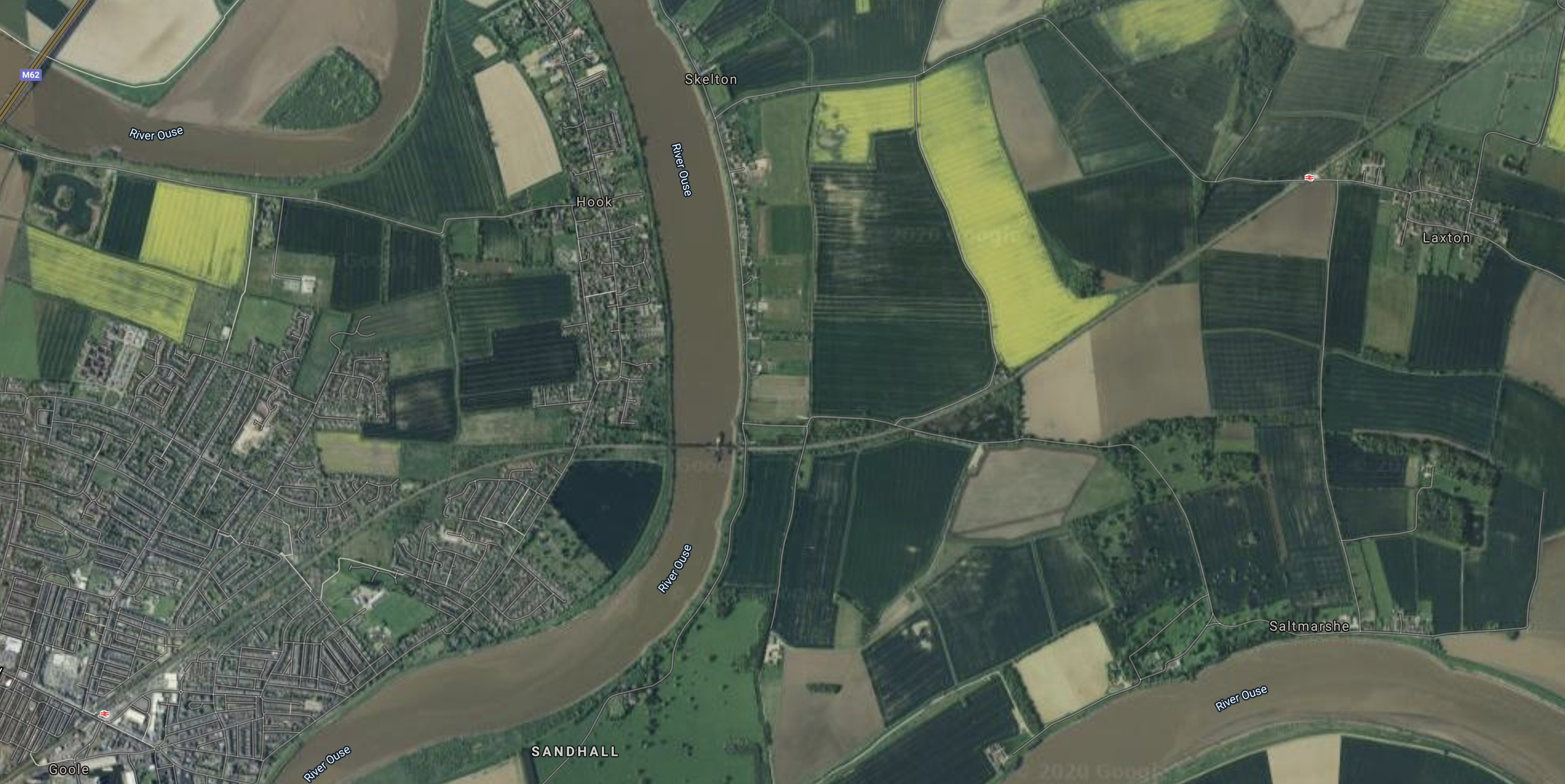
Note.
- The Hull and Doncaster Branch runs diagonally across the map.
- Goole and its station is in the South West corner of the map.
- The Hull and Doncaster Branch goes leaves the map at the North-East corner and then joins the Selby Line to the West of Gilberdyke station.
This Google Map shows that where the railway crosses the River Ouse there is another swing bridge.
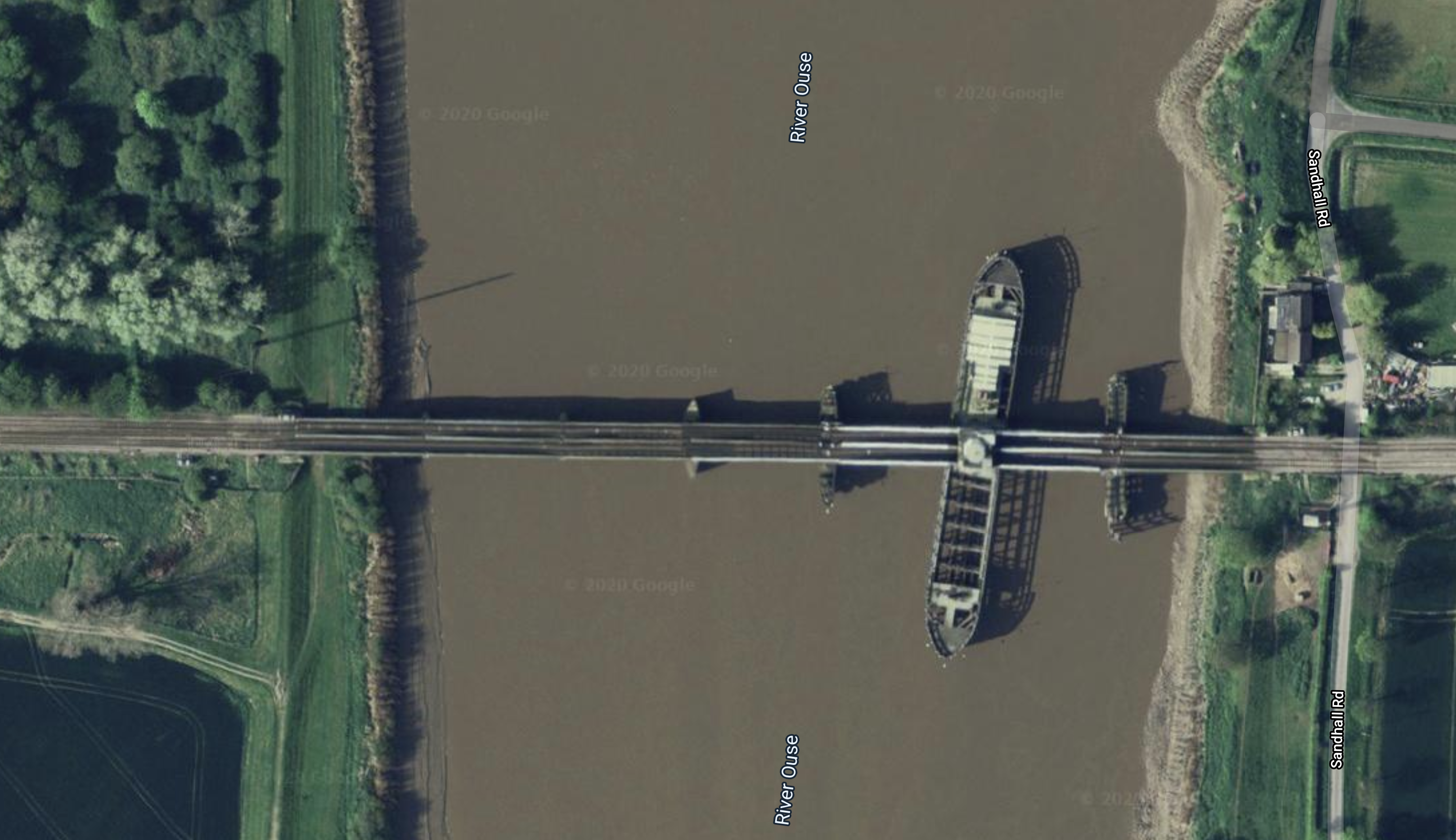
This is the Goole Railway Swing Bridge.
- The bridge was opened in 1869.
- The maximum speed for any train is 60 mph, but some are slower.
- It is a Grade II* Listed structure.
- In the first decade of this century the bridge was strengthened.
- It appears to carry a lesser number of freight trains than the Selby bridge
As with the Selby bridge, it appears to be working at a reasonable operational standard.
I’ve followed the line as far as Doncaster and it is fairly straight, mostly double-track with about a half-a-dozen level crossings.
Updating To 100 mph
It looks to my naïve eyes, that updating the lines to an operating speed of 100 mph, should be possible.
But possibly a much larger problem is the up to thirty level crossings on the triangle of lines between Hull, Leeds and Sheffield.
Full ERTMS In-Cab Digital Signalling
This is currently, being installed between London and Doncaster and will allow 140 mph running, which could save several minutes on the route.
The next phase could logically extend the digital signalling as far as York and Leeds.
Extending this signalling to Hull and Sheffield, and all the lines connecting the cities and towns of East Yorkshire could be a sensible development.
It might even help with swing bridges by controlling the speed of approaching trains, so that they arrive at the optimal times to cross.
Electrification
Eventually, all of these routes will be fully electrified.
- Hull and Leeds via Brough, Selby and Garforth.
- Hull and Scarborough via Beverley and Seamer.
- Hull and Sheffield via Brough, Goole, Doncaster and Rotherham.
- Hull and York via Brough and Selby.
- York and Scarborough via Seamer.
But there are two problems which make the electrification of the routes to Hull challenging.
- The Grade II Listed Selby swing bridge.
- The Grade II* Listed Goole Railway swing bridge.
There will be diehard members of the Heritage Lobby, who will resist electrification of these bridges.
Consider.
- Both bridges appear to work reliably.
- Adding the complication of electrification may compromise this reliability.
- Train manufacturers have developed alternative zero-carbon traction systems that don’t need continuous electrification.
- Hitachi have developed battery electric versions of the Class 800 and Class 802 trains, that regularly run to and from Hull.
- Other manufacturers are developing hydrogen-powered trains, that can use both hydrogen and overhead electrification for traction power.
My Project Management experience tells me, that electrification of these two bridges could be the major cost and the most likely cause of delay to the completion of the electrification.
It should also be noted that Network Rail are already planning to electrify these routes.
- Huddersfield and Dewsbury on the TransPennine Route, which might be extended to between Huddersfield and Leeds.
- York and Church Fenton
There is also electrification at Doncaster, Leeds and York on the East Coast Main Line, which would probably have enough power to feed the extra electrification.
Hitachi’s Regional Battery Trains
Hitachi and Hyperdrive Innovation are developing a Regional Battery Train.
This Hitachi infographic gives the specification.
Note.
- The train has a range of 90 kilometres or 56 miles on battery power.
- It has an operating speed of 100 mph on battery power.
- Class 800 and Class 802 trains can be converted to Hitachi Regional Battery Trains, by swapping the diesel engines for battery packs.
When running on electrification, they retain the performance of the train, that was converted.
Discontinuous Electrification
I would propose using discontinuous electrification. by electrifying these sections.
- Hull and Brough – 10.5 miles
- Hull and Beverley – 13 miles
- Doncaster and Sheffield – 20 miles
- Selby and Leeds – 21 miles
- Selby and Temple Hirst Junction – 5 miles
- Seamer and Scarborough – 3 miles
This would leave these gaps in the electrification in East Yorkshire.
- Brough and Doncaster – 30 miles
- Brough and Selby – 21 miles
- Brough and Church Fenton – 31 miles
- Seamer and Beverley – 42 miles
- Seamer and York – 39 miles
A battery electric train with a range of fifty miles would bridge these gaps easily.
This approach would have some advantages.
- There would only need to be 72.5 miles of double-track electrification.
- The swing bridges would be untouched.
- TransPennine services terminating in Hull and Scarborough would be zero-carbon, once Huddersfield and Dewsbury is electrified.
- LNER and Hull Trains services to London Kings Cross would be zero-carbon and a few minutes faster.
- LNER could run a zero-carbon service between London Kings Cross and Scarborough.
But above all, it would cost less and could be delivered quicker.
Collateral Benefits Of Doncaster and Sheffield Electrication
The extra electrification between Doncaster and Sheffield, would enable other services.
- A zero-carbon service between London Kings Cross and Sheffield.
- Extension of Sheffield’s tram-train to Doncaster and Doncaster Sheffield Airport.
- A possible electric service along the Dearne Valley.
As plans for Sheffield’s rail and tram system develop, this electrification could have a substantial enabling effect.
Hydrogen
This map shows the Zero Carbon Humber pipeline layout.

Note.
- The orange line is a proposed carbon dioxide pipeline
- The black line alongside it, is a proposed hydrogen pipeline.
- Drax, Keadby and Saltend are power stations.
- Easington gas terminal is connected to gas fields in the North Sea and also imports natural gas from Norway using the Langeled pipeline.
- There are fourteen gas feels connected to Easington terminal. Some have been converted to gas storage.
I can see hydrogen being used to power trains and buses around the Humber.
Conclusion
Discontinuous electrification could be the key to fast provision of electric train services between Leeds and Sheffield and Hull.
If long journeys from Hull were run using battery electric trains, like the Hitachi Regional Battery Train, perhaps hydrogen trains could be used for the local services all over the area.
Project Management Recommendations
I have proposed six sections of electrification, to create a network to allow all services that serve Hull and Scarborough to be run by battery electric trains.
Obviously with discontinuous electrification each section or group of sections to be electrified is an independent project.
I proposed that these sections would need to be electrified.
- Hull and Brough – 10.5 miles
- Hull and Beverley – 13 miles
- Doncaster and Sheffield – 20 miles
- Selby and Leeds – 21 miles
- Selby and Temple Hirst Junction – 5 miles
- Seamer and Scarborough – 3 miles
They could be broken down down into four sections.
- Hull station, Hull and Brough and Hull and Beverley
- Doncaster and Sheffield
- Selby station, Selby and Leeds and Selby and Temple Hirst Junction.
- Scarborough station and Scarborough and Seamer.
I have split the electrification, so that hopefully none is challenging.
Hopes Rekindled Of Full Midland Main Line Electrification
The title of this post, is the same as that of this article on Rail Magazine.
This is the key section of the article.
During a House of Commons debate on transport on September 17, HS2 Minister Andrew Stephenson said in response to a question from Alex Norris (Labour/Co-op, Nottingham North): “We are currently delivering the Midland Main Line upgrade, which includes electrification from London to Kettering, with additional electrification to Market Harborough being developed.
“Further electrification of the MML is currently at an early stage, but it is being examined by Network Rail.”
Stephenson said the DfT will continue to work closely with NR on the development of a proposal that would include approaches to advancing the delivery of electrification across the route.
The title of the article, probably sums it up well.
Electrification Of The Midland Main Line
Having read lots of stories about electrification of Midland Main Line, I think the following must be born in mind.
- Electrification on the line will reach as far North as Market Harborough station.
- The route between Sheffield station and Clay Cross North Junction will be shared with High Speed Two. It will obviously need to be electrified for High Speed Two.
- The section of the Midland Main Line between Derby and Clay Cross North Junction, runs through the World Heritage Site of the Derwent Valley Mills. The Heritage Taliban will love the electrification, with a vengeance.
- Electrification through Leicester station could be tricky, as the station building and the A6 road are over the tracks and there is limited clearance. Electrification could involve major disruption to the trains for some time.
These are some of the distances involved of sections of the route that are not electrified.
- Market Harborough and Derby are 54 miles apart.
- Market Harborough and Clay Cross North Junction are 67 miles apart.
- Market Harborough and Chesterfield are 70 miles apart.
- Market Harborough and Nottingham are 44 miles apart
- Market Harborough and Leicester are 16 miles apart.
- Derby and Clay Cross North Junction are 21 miles apart.
Since 2017, when electrification for the full route was originally abandoned, there have been big changes in rolling stock technology.
The biggest change has been the development of battery trains.
Hitachi’s Regional Battery Trains
This infographic from Hitachi gives the specification for their Regional Battery Train.
Note.
- The trains have a range of 56 miles on battery power.
- The trains can cruise at 100 mph on battery power.
- Hitachi have said that all of their AT-300 trains can be converted into Regional Battery Trains.
- Trains are converted by removing the diesel engines and replacing them with battery packs.
- I suspect these battery packs look like a diesel engine in terms of control inputs and performance to the driver and the train’s computer.
It is extremely likely, that the bi-mode Class 810 trains, which are a version of the AT-300 train, that have been ordered for the Midland Main Line can be converted into Regional Battery Trains.
These trains have four diesel engines, as opposed to the Class 800 and Class 802 trains, which only have three.
These are reasons, why the trains could need four engines.
- The trains need more power to work the Midland Main Line. I think this is unlikely.
- Four engine positions gives ,more flexibility when converting to Regional Battery Trains.
- Four battery packs could give a longer range of up to 120 kilometres or 75 miles.
It could just be, that Hitachi are just being conservative, as engines can easily be removed or replaced. The fifth-car might even be fitted with all the wiring and other gubbins, so that a fifth-engine or battery pack can be added.
I suspect the train’s computer works on a Plug-And-Play principle, so when the train is started, it looks round each car to see how many diesel engines and battery packs are available and it then controls the train according to what power is available.
London St. Pancras And Sheffield By Battery Electric Train
Any battery electric train going between London St. Pancras and Sheffield will need to be charged, at both ends of the route.
- At the London end, it will use the electrification currently being erected as far as Market Harborough station.
- At the Sheffield end, the easiest way to charge the trains, would be to bring forward the electrification and updating between Sheffield station and Clay Cross North Junction, that is needed for High Speed Two.
This will leave a 67 mile gap in the electrification between Market Harborough station and Clay Cross North junction.
It looks to me, the Class 810 trains should be able to run between London St. Pancras and Sheffield, after the following projects are undertaken.
- Class 810 trains are given four battery packs and a battery range of 75 miles.
- Electrification is installed between Sheffield station and Clay Cross North Junction.
Trains would need to leave Market Harborough station going North and Clay Cross Junction going South with full batteries.
Note.
- Trains currently take over an hour to go between Chesterfield to Sheffield and then back to Chesterfield, which would be more than enough to fully charge the batteries.
- Trains currently take around an hour to go between London St. Pancras and Market Harborough, which would be more than enough to fully charge the batteries.
- Chesterfield station is only three miles further, so if power changeover, needed to be in a station, it could be performed there.
- Leeds and Sheffield are under fifty miles apart and as both stations would be electrified, London St. Pancras and Sheffield services could be extended to start and finish at Leeds.
London St. Pancras and Sheffield can be run by battery electric trains.
London St. Pancras And Nottingham By Battery Electric Train
Could a battery electric train go from Market Harborough to Nottingham and back, after being fully-charged on the hour-long trip from London?
- The trip is 44 miles each way or 88 miles for a round trip.
- Services have either three or eight stops, of which two or three respectively are at stations without electrification.
- Trains seem to take over thirty minutes to turnback at Nottingham station.
Extra power North of Market Harborough will also be needed.
- To provide hotel power for the train, during turnback at Nottingham station.
- To compensate for power losses at station stops.
If 75 miles is the maximum battery range, I doubt that a round trip is possible.
I also believe, that Hitachi must be developing a practical solution to charging a train during turnback, at a station like Nottingham, where trains take nearly thirty minutes to turnback.
If the Class 810 trains have a battery range of 75 miles, they would be able to handle the London St. Pancras and Nottingham service, with charging at Nottingham.
Conclusion
It appears that both the Nottingham and Sheffield services can be run using battery electric Class 810 trains.
- All four diesel engines in the Class 810 trains would need to be replaced with batteries.
- The route between Clay Cross North Junction and Sheffield station, which will be shared with High Speed Two, will need to be electrified.
- Charging facilities for the battery electric trains will need to be provided at Nottingham.
On the other hand using battery electric trains mean the two tricky sections of the Derwent Valley Mills and Leicester station and possibly others, won’t need to be electrified to enable electric trains to run on the East Midlands Railway network.
Will it be the first main line service in the world, run by battery electric trains?
CrossCountry’s Bournemouth And Manchester Piccadilly Service
Whilst I was at Basingstoke station yesterday one of CrossCountry‘s services between Bournemouth and Manchester Piccadilly came through, so I took these pictures.


It was a long formation of Class 220 trains.
Could This Service Be Replaced By Hitachi Regional Battery Trains?
This Hitachi infographic gives the specification of the Hitachi Regional Battery Train.
I feel that in most condition, the range on battery power can be up to 56 miles.
I can break the Bournemouth and Manchester Piccadilly route into a series of legs.
- Bournemouth and Basingstoke – 60 miles – 750 VDC third-rail electrification
- Basingstoke and Reading – 15.5 miles – No electrification
- Reading and Didcot North Junction – 18 miles – 25 KVAC overhead electrification
- Didcot North Junction and Oxford – 10 miles – No electrification
- Oxford and Banbury – 22 miles – No electrification
- Banbury and Leamington Spa – 20 miles – No electrification
- Leamington Spa and Coventry – 10 miles – No electrification
- Coventry and Manchester Piccadilly – 101 miles – 25 KVAC overhead electrification
Note.
- 63 % of the route is electrified.
- The short 15.5 mile gap in the electrification between Basingstoke and Reading should be an easy route for running on battery power.
- But the 62 mile gap between Didcot North Junction and Coventry might well be too far.
The train would also need to be able to work with both types of UK electrification.
If some way could be found to bridge the 62 mile gap reliably, Hitachi’s Regional Battery Trains could work CrossCountry’s service between Bournemouth and Manchester Piccadilly.
Bridging The Gap
These methods could possibly be used to bridge the gap.
A Larger Battery On The Train
If you look at images of MTU’s Hybrid PowerPack, they appear to show a basic engine module with extra battery modules connected to it.
Will Hitachi and their battery-partner; Hyperdrive Innovation use a similar approach, where extra batteries can be plugged in as required?
This modular approach must offer advantages.
- Battery size can be tailored to routes.
- Batteries can be changed quickly.
The train’s software would know what batteries were fitted and could manage them efficiently.
I wouldn’t be surprised to see Hitachi’s Regional Battery Train able to handle a gap only six miles longer than the specification.
Battery And Train Development
As Hitachi’s Regional Battery Train develops, the following should happen.
- Useable battery capacity will increase.
- The train will use less electricity.
- Actions like regenerative braking will improve and recover more electricity.
- Driving and train operating strategies will improve.
These and other factors will improve the range of the train on batteries.
A Charging Station At Banbury Station
If some form of Fast Charge system were to be installed at Banbury station, this would enable a train stopping at Banbury to take on enough power to reliably reach Oxford or Coventry depending, on their final destination.
This method may add a few minutes to the trip, but it should work well.
Electrification Of A Section Of The Chiltern Main Line
This could be an elegant solution.
I have just flown my helicopter between Bicester North and Warwick Parkway stations and these are my observations.
- The Chiltern Main Line appears to be fairly straight and has received a top class Network Rail makeover in the last couple of decades.
- There are a couple of tunnels, but most of the bridges are new.
- Network Rail have done a lot of work on this route to create a hundred mph main line.
- It might be possible to increase the operating speed, by a few mph.
- The signalling also appears modern.
My untrained eye, says that it won’t be too challenging to electrify between say Bicester North station or Aynho Junction in the South and Leamington Spa or Warwick Parkway stations in the North. I would think, that the degree of difficulty would be about the same, as the recently electrified section of the Midland Main Line between Bedford and Corby stations.
The thirty-eight miles of electrification between Bicester North and Warwick Parkway stations would mean.
- The electrification is only eight-and-a-half miles longer than Bedford and Corby.
- There could be journey time savings.
- As all trains stop at two stations out of Banbury, Leamington Spa, Warwick and Warwick Parkway, all pantograph actions could be performed in stations, if that was thought to be preferable.
- Trains would be able to leave the electrification with full batteries.
- The electrification may enable some freight trains to be hauled between Didcot and Coventry or Birmingham using battery electric locomotives.
Distances of relevance from the ends of the electrification include.
- London Marylebone and Bicester North stations – 55 miles
- London Marylebone and Aynho junction – 64 miles
- Didcot North and Aynho junctions – 28 miles
- Leamington Spa and Coventry stations – 10 miles
- Leamington Spa and Birmingham Snow Hill stations – 23 miles
- Leamington Spa and Stratford-upon-Avon stations – 15 miles
- Warwick Parkway and Birmingham New Street stations – 20 miles
- Warwick Parkway and Birmingham Snow Hill stations – 20 miles
- Warwick Parkway and Kidderminster – 40 miles
- Warwick Parkway and Stratford-upon-Avon stations – 12 miles
These figures mean that the following services would be possible using Hitachi’s Regional Battery Train.
- Chiltern Railways – London Marylebone and Birmingham Moor Street
- Chiltern Railways – London Marylebone and Birmingham Snow Hill
- Chiltern Railways – London Marylebone and Kidderminster
- Chiltern Railways – London Marylebone and Stratford-upon-Avon
- CrossCountry – Bournemouth and Manchester Piccadilly
- CrossCountry – Southampton Central and Newcastle
- Midlands Connect – Oxford and Birmingham More Street – See Birmingham Airport Connectivity.
Other services like Leicester and Oxford via Coventry may also be possible.
As I see it, the great advantage of this electrification on the Chiltern Main Line is that is decarbonises two routes with the same thirty-eight miles of electrification.
Conclusion
CrossCountry’s Bournemouth And Manchester Piccadilly service could be run very efficiently with Hitachi’s proposed Regional Battery Train.
My preferred method to cross the electrification gap between Didcot North junction and Coventry station would be to electrify a section of the Chiltern Main Line.
- The electrification would be less than forty miles.
- I doubt it would be a challenging project.
- It would also allow Hitachi’s proposed trains to work Chiltern Main Line routes between London Marylebone and Birmingham.
I am fairly certain, that all passenger services through Banbury would be fully electric.
Could Hitachi’s Class 800 Trains Work The Cornish Main Line On Battery Power?
The distance between Plymouth and Penzance stations along the Cornish Main Line is just seventy-nine miles and thirty-eight chains. I’ll call it 79.5 miles.
Hitachi’s proposed train is described in this infographic.
The range on battery power of 90 km or 56 miles, will not be quite enough to get all the way between Plymouth and Penzance!
But note the phrase – Allows Discontinuous Electrification; at the top of the infographic.
Will Electrification Be Needed?
Obviously or the train could perhaps wait at Truro for ten minutes to charge the batteries.
But how customer-unfriendly and disruptive to good operating practice is that?
Could Bigger Batteries Be Fitted?
This obviously is a possibility, but surely an operator would prefer all of their trains to have the same battery range and updating them all for a longer distance might not be an economic proposition.
Could Intelligent Discontinuous Third-Rail Electrification Be Used?
Third-rail electrification, is hated by the Health & Safety Taliban, as it occasionally kills people trespassing or falling on the railway. But in the UK, we have around 1,500 miles of third-rail electrified line, that generally operates to a high level of safety.
Can my modern successors make third-rail electrification absolutely safe in new installations?
Third-Rail And Discontinuous Electrification Installations!
To connect to overhead electrification, the driver or an automatic system on the train, must raise the pantograph. It doesn’t often go wrong, but when it does, it can bring down the wires. This section on panotograph weaknesses from Wikipedia give more details.
With third-rail, the connection and disconnection is automatic, with far less to go wrong.
These pictures show a gap in the third-rail electrification at the Blackfriars station, which was rebuilt in 2012, so it must meet all modern regulations.
Note the gap in the third-rail, which carries the current.
- The third-rail shoes on the train disconnect and connect automatically, as the train passes through.
- The only rails with voltage are between the tracks for safety.
- The high-tech shields appear to be real tree wood painted yellow.
As an Electrical Engineer, I actually suspect, that this gap in the conductor rail, is to isolate the North and South London electricity supplies from each other,, so that a catastrophic failure on one side doesn’t affect both halves of Thameslink.
Third-Rail Electrification In Stations
Most rail passengers in the UK, understand third-rail electrification, if they’ve ever used trains in the South of London or Merseyside.
Electrifying stations using third-rail equipment could enable battery trains to go further.
- Stopping trains could top-up their batteries.
- Passing trains, that were low on power could make a pit-stop.
- All trains would connect automatically to the third-rail, when in the station.
The safety level would be raised by making sure that the third-rail was electrically-dead unless a train was over the top.
I am by training a Control Engineer and one of my first jobs in a dangerous factory as a fifteen-year-old, was designing and building safety systems, that cut power to guillotines, when the operator put their hands somewhere they shouldn’t! I remember endlessly testing the system with an old broom, which survived unscathed.
I believe that only switching on the electrification, when a train completes the circuit, is a fairly simple operation for modern control switchgear. I can imagine an intelligent switch constantly monitoring the resistance and only switching on power, when the resistance in the circuit looks like a train.
Third-Rail Electrification In Discrete Locations
Overhead electrification can receive complaints in scenic locations, but third-rail electrification can be invisible in tunnels and over bridges and viaducts.
The Cornish Main Line has four tunnels, two bridges, which include the Royal Albert Bridge, and no less than thirty-two viaducts.
How many of these could be used to hide electrification?
- Any electrified sections could be intelligently controlled to increase safety.
- Power for the electrification could come from local renewable sources, using techniques like Riding Sunbeams.
I can see engineers developing several techniques for discrete electrification.
Third-Rail And Charging Battery Trains
I like the Vivarail’s Fast Charge concept of using third-rail equipment to charge battery trains.
This press release from the company describes how they charge their battery electric Class 230 trains.
- The system is patented.
- The system uses a trickle-charged battery pack, by the side of the track to supply the power.
- The first system worked with the London Underground 3rd and 4th rail electrification standard.
As the length of rails needed to be added at charging points is about a metre, installing a charging facility in a station, will not be the largest of projects.
Under How Does It Work?, the press release says this.
The concept is simple – at the terminus 4 short sections of 3rd and 4th rail are installed and connected to the electronic control unit and the battery bank. Whilst the train is in service the battery bank trickle charges itself from the national grid – the benefit of this is that there is a continuous low-level draw such as an EMU would use rather than a one-off huge demand for power.
The train pulls into the station as normal and the shoe-gear connects with the sections of charging rail. The driver need do nothing other than stop in the correct place as per normal and the rail is not live until the train is in place.
That’s it!
As an electrical engineer, I’m certain the concept could be adapted to charge the batteries of a conventional third-rail train.
Vivarail’s press release says this about modification to the trains.
The train’s shoe-gear is made of ceramic carbon so it is able to withstand the heat generated during the fast charge process.
That wouldn’t be a major problem to solve.
Hitachi And Third Rail
The picture shows a Hitachi Class 395 train at Gillingham station.

The silver-coloured third-rail equipment is clearly visible, under the javelin logo.
These trains are cousins of all the new Hitachi trains in the UK, so I suspect fitting third-rail equipment to Class 80x trains, is just a matter of finding the appropriate documents on the computer and raiding the parts bin.
I suspect, as Hitachi will probably be building some more trains for Southeastern to start the Highspeed service between London St. Pancras and Hastings, that Hitachi are already working on the design of a third-rail high-speed train with batteries.
I doubt that Hitachi have any fears about fitting third-rail gear to their trains, as an optional extra.
Electrifying Between Plymouth And Penzance
Obviously, Plymouth and Penzance stations would have charging facilities, but now many would the trains handle the 79.5 miles in between?
There are three possibilities.
Limited-Third Rail Electrification
As I indicated earlier short lengths of intelligent third-rail electrification could be added at various places on the route.
A full battery would take the train fifty-six miles and as the Cornish Main Line is nearly eighty miles long, I suspect that the train would need almost a full charge halfway along the route.
- Hitachi claim in the infographic, that a full-charge takes 10-15 minutes, when the train is static, so I will assume the largest figure of this range, as charging on the move might not be as efficient, with everything happening at 90 mph.
- So I will assume a fifteen minute charge time.
- Typically, a Class 80x takes two hours between Penzance and Plymouth, which is an average speed of just 40 mph.
- In fifteen minutes, the train will go ten miles. So a rough estimate would say ten miles should be electrified.
As electrification in stations would allow trains to have a bigger sup, a scientifically-correct simulation would show the best philosophy.
The London Paddington and Penzance services call at the following stations, that are West of Plymouth.
Liskeard, Saltash, St. Germans, Bodmin Parkway, Lostwithiel, Par, St Austell, Truro, Redruth, Camborne, Hayle and St Erth
Note.
- Some smaller stations do get skipped.
- According to Real Time Trains, stops seem to take 1-2 minutes.
- Trains are usually nine- or ten-cars, but I feel that the proposed improvements between Bodmin General and Bodmin Parkway stations, that I wrote about in Increased Service Provision Bodmin General-Bodmin Parkway, may result in a large reorganisation of services between London and Cornwall.
Could it be that electrifying the major stations with third-rail electrification would enable enough power to be taken on board by a train running between London Paddington and Penzance, so that the journey could be completed?
Vivarail Fast Chargers
Vivarail’s Fast Chargers could be fitted at all or selected stations and trains could take a sip as and when they need.
A charger would also be needed at any Cornish terminal station, that would have services from battery electric trains.
A Mixture Of Third-Rail Electrification And Vivarail Fast Chargers
Both technologies are interchangeable and can be used with compatible battery electric trains.
I would expect an accurate mathematical model will indicate the best layout of electrification and Fast Chargers.
Beeching Reversal – Charfield Station
This is one of the Beeching Reversal projects that the Government and Network Rail are proposing to reverse some of the Beeching cuts.
Wikipedia says this about the Proposed Reopening of Charfield station.
Services between Bristol and Birmingham pass through Charfield. There have been discussions about the viability of reopening the station. The costs would be shared between Gloucestershire and South Gloucestershire councils since, although the station would be in South Gloucestershire, the nearby town of Wotton-under-Edge would be a principal beneficiary.
This Google Map shows the village with the Bristol and Birmingham Line passing through.
Note, that the road running down the East side of the railway is called Station Road.
There appear to be these services running through the location.
- CrossCountry – Plymouth and Edinburgh/Glasgow via Bristol Temple Meads, Bristol Parkway, Cheltenham Spa and Birmingham New Street
- CrossCountry – Exeter St. Davids and Manchester Piccadilly via Bristol Temple Meads, Bristol Parkway, Cheltenham Spa and Birmingham New Street
- GWR – Great Malvern and Westbury via Bristol Temple Meads, Bristol Parkway, Gloucester and Cheltenham Spa
Note.
All services appear to be hourly.
Bristol Parkway station is thirteen miles away by rail, so is an easy drive, but a very stiff walk or cycle.
Timings by rail from Charfield based on passing GWR trains include.
- Bristol Parkway – 15 minutes
- Bristol Temple Meads – 27 minutes
- Cheltenham Spa – 38 minutes
- Gloucester – 24 minutes
There may be a possibility of improving these times, as the current timetable might have been written for slow trains and a Class 158, Class 165 or Class 166 train can do better.
CrossCountry times include.
- Birmingham New Street – 68 minutes
- Bristol Parkway – 11 minutes
- Bristol Temple Meads – 23 minutes
- Cheltenham Spa – 17 minutes
- Worcestershire Parkway – 32 minutes
I would think, that Charfield station could receive one GWR stopping train and one fast CrossCountry train per hour.
Discontinuous Electrification Between Birmingham And Bristol
Hitachi have changed the rules on electrification, by the announcement of the development of battery electric trains in collaboration with Hyperdrive Innovation, which I wrote about in Hyperdrive Innovation And Hitachi Rail To Develop Battery Tech For Trains.
The proposed train is described in this Hitachi infographic.
It will have a range on battery power of 90 km or 56 miles.
Consider.
- Midlands Connect have ambitions see an extra hourly service between Birmingham and Bristol Temple Meads, with all services running five minutes faster. See Midlands Rail Hub.
- CrossCountry will likely be getting new trains, to replace their exclusively all-diesel fleet. They could be tri-mode trains to make the most of long stretches of electrification on their routes, batteries for short gaps of up to fifty miles and diesel power everywhere else.
- There are electrified stations at Bristol Parkway and possibly Bristol Temple Meads in a few years.
- There is full electrification between Birmingham New Street and Bromsgrove stations.
- Bromsgrove and Bristol Parkway are seventy miles apart.
- There is a possibility, that Cheltenham Spa station will get a charging facility so that London Paddington and Cheltenham Spa services could be run by Class 800 trains converted to battery electric operation.
I don’t think it is an unreasonable prediction to make that Hitachi and other train manufacturers like Stadler with their Class 755 trains, have the technology to run low-carbon services between Bristol Temple Meads and Birmingham New Street stations.
- Trains would leave Bromsgrove and Bristol Parkway with full batteries.
- Quick battery top-ups can be taken at Cheltenham Spa and Worcestershire Parkway stations.
- The fast acceleration of the electric trains will allow extra stops.
I think it would also be possible for GWR to use battery electric Class 387 trains between Great Malvern and Westbury.
Charfield could be an electric train-only station.
Conclusion
The reopening of Charfield station is really a simple station rebuilding and reopening and local passenger forecasts will probably make the decision.
But these forecasts must take into account, the likely partial decarbonisation of the route through the station, which would surely increase ridership.
The new station could also be built with provision for a possible charging facility, in case it might be needed in the future.
 The Anonymous Widower