Thoughts On Batteries On A Hitachi Regional Battery Train
This article is a repeat of Thoughts On Batteries On A Hitachi Intercity Tri-Mode Battery Train, but for their other train with batteries; the Hitachi Regional Battery Train.
This Hitachi infographic describes a Hitachi Regional Battery Train.

Hitachi are creating the first of these battery trains, by replacing one of the diesel power-packs in a Class 802 train with a battery-pack from Hyperdrive Innovation of Sunderland.
The Class 802 train has the following characteristics.
- Five cars.
- Three diesel power-packs, each with a power output of 700 kW.
- 125 mph top speed on electricity.
- I believe all intermediate cars are wired for diesel power-packs, so can all intermediate cars have a battery?
In How Much Power Is Needed To Run A Train At 125 Or 100 mph?, I estimated that the trains need the following amounts of energy to keep them at a constant speed.
- Class 801 train – 125 mph 3.42 kWh per vehicle mile
- Class 801 train – 100 mph 2.19 kWh per vehicle mile
The figures are my best estimates.
We also know that according to Hitachi, the battery train has a range of 90 kilometres or 56 miles at a speed of 100 mph.
So applying the formula for energy needed gives that the battery size to cover 56 miles at a constant 100 mph will be.
56 * 2.19 * 5 = 613.2 kWh.
In the calculation for the Hitachi Intercity Tri-Mofr Battery Train, I had assumed that a 600 kWh battery was feasible, as it would lay less than the diesel engine it replaced.
I can also apply the formula for a four-car train.
56 * 2.19 * 4 = 490.6 kWh.
That too, would be very feasible.
Conclusion
I can’t wait to ride in one of Hitachi’s two proposed battery-electric trains.
Thoughts On Batteries On A Hitachi Intercity Tri-Mode Battery Train
This Hitachi infographic describes a Hitachi Intercity Tri-Mode Battery Train.

Hitachi are creating the first of these battery trains, by replacing one of the diesel power-packs in a Class 802 train with a battery-pack from Hyperdrive Innovation of Sunderland.
This press release from Hitachi is entitled Hitachi And Eversholt Rail To Develop GWR Intercity Battery Hybrid Train – Offering Fuel Savings Of More Than 20%, gives a few more details.
The Class 802 train has the following characteristics.
- Five cars.
- Three diesel power-packs, each with a power output of 700 kW.
- 125 mph top speed on electricity.
- I believe all intermediate cars are wired for diesel power-packs, so can all intermediate cars have a battery?
In How Much Power Is Needed To Run A Train At 125 Or 100 mph?, I estimated that the trains need the following amounts of energy to keep them at a constant speed.
- Class 801 train – 125 mph 3.42 kWh per vehicle mile
- Class 801 train – 100 mph 2.19 kWh per vehicle mile
The figures are my best estimates.
The Wikipedia entry for the Class 800 train, also gives the weight of the diesel power-pack and all its related gubbins.
The axle load of the train is given as 15 tonnes, but for a car without a diesel engine it is given as 13 tonnes.
As there are four axles to a car, I can deduce that the diesel power-pack and the gubbins, weigh around eight tonnes.
How much power would a one tonne battery hold?
This page on the Clean Energy institute at the University of Washington is entitled Lithium-Ion Battery.
This is a sentence from the page.
Compared to the other high-quality rechargeable battery technologies (nickel-cadmium or nickel-metal-hydride), Li-ion batteries have a number of advantages. They have one of the highest energy densities of any battery technology today (100-265 Wh/kg or 250-670 Wh/L).
Using these figures, a one-tonne battery would be between 100 and 265 kWh in capacity, depending on the energy density.
As it is likely that if the diesel power-pack replacement would probably leave things like fuel tanks and radiators behind, so that the diesel engines could be reinstalled, I would expect that a battery of around four tonnes would be fitted.
On the basis of the University of Washington’s figures a 400 kWh battery pack would certainly be feasible.
Using. the energy use at 100 mph of 2.19 kWh per vehicle mile, I can get the following ranges for different battery sizes.
- 400 kWh battery – 36.53 miles
- 500 kWh battery – 45.67 miles
- 600 kWh battery – 54.80 miles
- 800 kWh battery – 73.06 miles
As Lincoln and Newark are just 16.6 miles apart, it looks to me that a 500 or 600 kWh battery could be a good choice for that route, as it would leave enough hotel power for the turnround.
It should also handle shorter routes like these.
- Newbury and Bedwyn – 13.3 miles.
- Didcot and Oxford – 10.3 miles
- Newark and Lincoln – 16.6 miles
- Leeds and Harrogate – 18.3 miles
- Northallerton and Middlesbrough – 20 miles
- Hull and Temple Hirst Junction and Hull – 36.1 miles
Some routes like Temple Hirst Junction and Hull would need charging at the destination.
The Range Of A Five Car Train With Three Batteries
Suppose a Hitachi Intercity Tri-Mode Battery Train had three battery-packs and no diesel engines.
- It would be based on Hitachi Intercity Tri-Mode Battery Train technology.
- It would have two driver cars without batteries.
- It would have three intermediate cars with 600 kWh batteries.
- It would have 1800 kWh in the batteries.
- The train would be optimised for 100 mph running.
- My estimate says it would need 2.19 kWh per vehicle mile to cruise at 100 mph.
It could have a range of up to 164 miles.
If the batteries were only 500 kWh, the range would be 137 miles.
The Ultimate Battery Train
I think it would be possible to put together a nine car battery-electric train with a long range.
- It would be based based on Hitachi Intercity Tri-Mode Battery Train technology, which would be applied to a Class 800 or Class 802 train.
- It would have two driver cars without batteries.
- It would have seven intermediate cars with 600 kWh batteries.
- It would have a total battery capacity of 4200 kWh.
- The train would be optimised for 100 mph running.
- My estimate in How Much Power Is Needed To Run A Train At 125 Or 100 mph?, said it would need 2.19 kWh per vehicle mile to cruise at 100 mph.
That would give a range of over 200 miles.
If the batteries were only 500 kWh, the range would be 178 miles.
Aberdeen, Inverness, Penzance and Swansea here we come.
Can Hitachi Increase The Range Further?
There are various ways that the range can be improved.
- More electrically-efficient on-board systems like air-conditioning.
- A more aerodynamic nose.
- Regenerative braking to the batteries.
- Batteries with a higher energy density.
- Better driver assistance software.
Note.
- Hitachi have already announced that the Class 810 trains for East Midlands Railway will have a new nose profile.
- Batteries are improving all the time.
I wouldn’t be surprised to see a ten percent improvement in range by 2030.
Conclusion
I was surprised at some of the results of my estimates.
But I do feel that Hitachi trains with 500-600 kWh batteries could bring a revolution to train travel in the UK.
Edinburgh And Aberdeen
Consider.
- The gap in the electrification is 130 miles between Edinburgh Haymarket and Aberdeen.
- There could be an intermediate charging station at Dundee.
- Charging would be needed at Aberdeen.
I think Hitachi could design a train for this route.
Edinburgh And Inverness
Consider.
- The gap in the electrification is 146 miles between Stirling and Inverness.
- This could be shortened by 33 miles, if there were electrification between Stirling and Perth.
- Charging would be needed at Inverness.
I think Hitachi could design a train for this route.
What Is Possible On The East Coast Main Line?
In the Wikipedia entry for the Class 91 locomotive, there is an amazing story.
This picture shows one of these locomotives at Kings Cross.
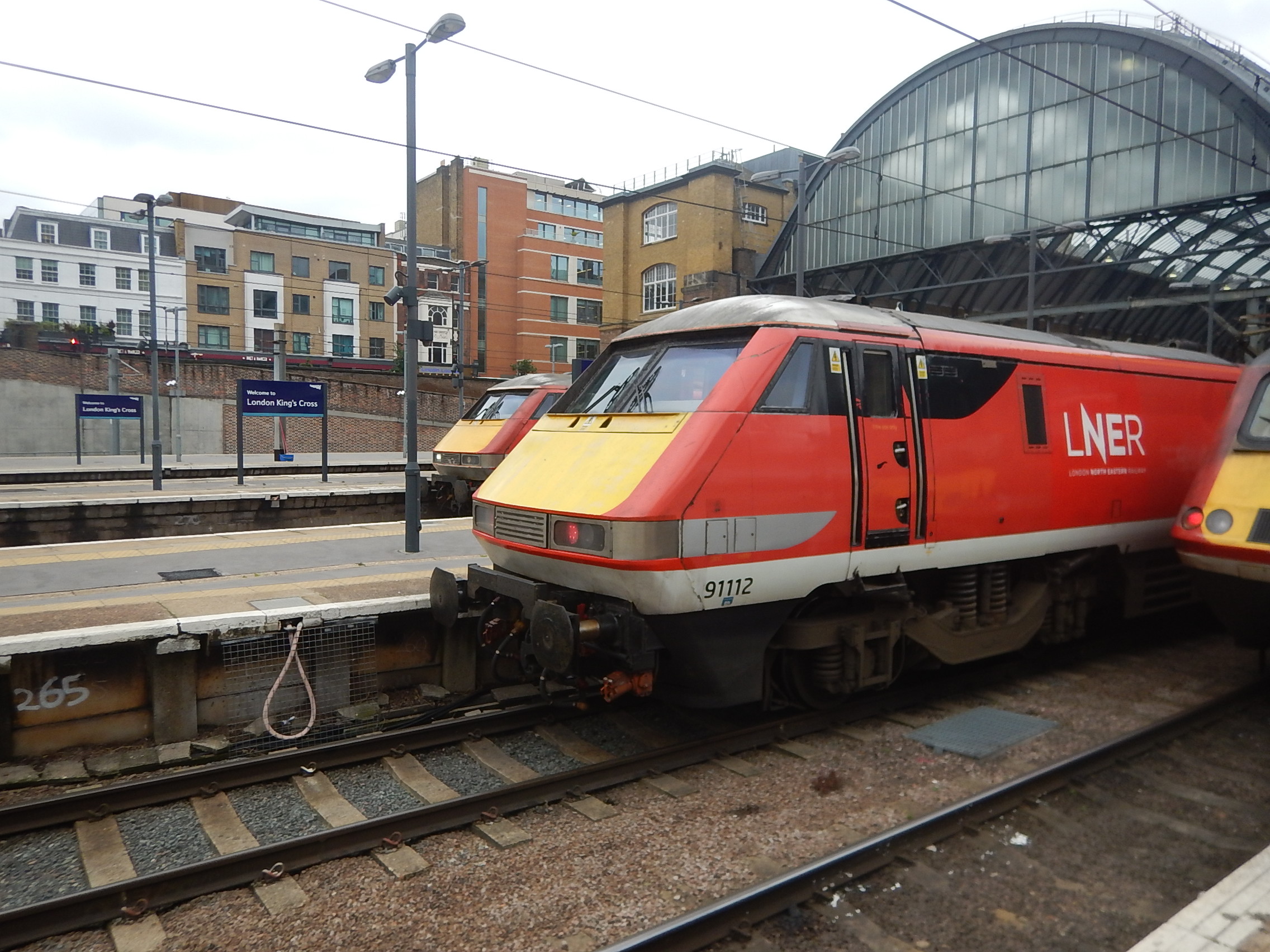
Note.
- They have a design speed of 140 mph.
- They have a power output of 4.8 MW.
- They were built around 1990 by British Rail at Crewe.
They were designed to run services between London King’s Cross and Edinburgh as fast as possible, as the motive power of the InterCity 225 trains.
This section in the Wikipedia entry for the Class 91 locomotive is entitled Speed Record. This is the first paragraph.
A Class 91, 91010 (now 91110), holds the British locomotive speed record at 161.7 mph (260.2 km/h), set on 17 September 1989, just south of Little Bytham on a test run down Stoke Bank with the DVT leading. Although Class 370s, Class 373s and Class 374s have run faster, all are EMUs which means that the Electra is officially the fastest locomotive in Britain. Another loco (91031, now 91131), hauling five Mk4s and a DVT on a test run, ran between London King’s Cross and Edinburgh Waverley in 3 hours, 29 minutes and 30 seconds on 26 September 1991. This is still the current record. The set covered the route in an average speed of 112.5 mph (181.1 km/h) and reached the full 140 mph (225 km/h) several times during the run.
Note.
- For the British locomotive speed record, locomotive was actually pushing the train and going backwards, as the driving van trailer (DVT) was leading.
- How many speed records of any sort, where the direction isn’t part of the record, have been set going backwards?
- I feel that this record could stand for many years, as it is not very likely anybody will build another 140 mph locomotive in the foreseeable future. Unless a maverick idea for a high speed freight locomotive is proposed.
I have a few general thoughts on the record run between Kings Cross and Edinburgh in three-and-a-half hours.
- I would assume that as in normal operation of these trains, the Class 91 locomotive was leading on the run to the North.
- For various reasons, they would surely have had at least two of British Rail’s most experienced drivers in the cab.
- At that time, 125 mph InterCity 125 trains had been the workhorse of East Coast Main Line for well over ten years, so British Rail wouldn’t have been short of experienced high speed drivers.
- It was a Thursday, so they must have been running amongst normal traffic.
- On Monday, a typical run between Kings Cross and Edinburgh is timetabled to take four hours and twenty minutes.
- High Speed Two are predicting a time of three hours and forty-eight minutes between Euston and Edinburgh via High Speed Two and the West Coast Main Line.
The more you look at it, a sub-three-and-and-a-half hour time, by 1980s-technology on a less-than-perfect railway was truly remarkable.
So how did they do it?
Superb Timetabling
In Norwich-In-Ninety Is A Lot More Than Passengers Think!, I talk about how Network Rail and Greater Anglia created a fast service between Liverpool Street and Norwich.
I suspect that British Rail put their best timetablers on the project, so that the test train could speed through unhindered.
Just as they did for Norwich-in-Ninety and probably will be doing to the East Coast Main Line to increase services and decrease journey times.
A Good As ERTMS Signalling
Obviously in 1991, there was no modern digital in-cab signalling and I don’t know the standard of communication between the drivers and the signallers.
On the tricky sections like Digswell Viaduct, through Hitchin and the Newark Crossing were other trains stopped well clear of any difficult area, as modern digital signalling can anticipate and take action?
I would expect the test train got a signalling service as good as any modern train, even if parts of it like driver to signaller communication may have been a bit experimental.
There may even have been a back-up driver in the cab with the latest mobile phone.
It must have been about 1991, when I did a pre-arranged airways join in my Cessna 340 on the ground at Ipswich Airport before take-off on a direct flight to Rome. Air Traffic Control had suggested it to avoid an intermediate stop at say Southend.
The technology was arriving and did it help the drivers on that memorable run North ensure a safe and fast passage of the train?
It would be interesting to know, what other equipment was being tested by this test train.
A Possible Plan
I suspect that the plan in 1991 was to use a plan not unlike one that would be used by Lewis Hamilton, or in those days Stirling Moss to win a race.
Drive a steady race not taking any chances and where the track allows speed up.
So did British Rail drive a steady 125 mph sticking to the standard timetable between Kings Cross and Edinburgh?
Then as the Wikipedia extract indicated, at several times during the journey did they increase the speed of the train to 140 mph.
And the rest as they say was an historic time of 3 hours, 29 minutes and 30 seconds. Call it three-and-a-half-hours.
This represented a start-to-stop average speed of 112.5 mph over the 393 miles of the East Coast Main Line.
Can The Current Trains Achieve Three-And-A-Half-Hours Be Possible Today?
Consider.
- The best four hours and twenty minutes timings of the Class 801 trains, represents an average speed of 90.7 mph.
- The Class 801 trains and the InterCity 225 trains have similar performance.
- There have been improvements to the route like the Hitchin Flyover.
- Full ERTMS in-cab signalling is being installed South of Doncaster.
- I believe ERTMS and ETC could solve the Newark Crossing problem! See Could ERTMS And ETCS Solve The Newark Crossing Problem?
- I am a trained Control Engineer and I believe if ERTMS and ETC can solve the Newark Crossing problem, I suspect they can solve the Digswell Viaduct problem.
- The Werrington Dive Under is being built.
- The approaches to Kings Cross are being remodelled.
I can’t quite say easy-peasy. but I’m fairly certain the Kings Cross and Edinburgh record is under serious threat.
- A massive power supply upgrade to the North of Doncaster is continuing. See this page on the Network Rail web site.
- ERTMS and ETC probably needs to be installed all the way between Kings Cross and Edinburgh.
- There may be a need to minimise the number of slower passenger trains on the East Coast Main Line.
- The Northumberland Line and the Leamside Line may be needed to take some trains from the East Coast Main Line.
Recent Developments Concerning the Hitachi Trains
There have been several developments since the Hitachi Class 800 and Class 801 trains were ordered.
- Serious engineers and commentators like Roger Ford of Modern Railways have criticised the lugging of heavy diesel engines around the country.
- Network Rail have upgraded the power supply South of Doncaster and have recently started to upgrade it between Doncaster and Edinburgh. Will this extensive upgrade cut the need to use the diesel power-packs?
- Hitachi and their operators must have collected extensive in-service statistics about the detailed performance of the trains and the use of the diesel power-packs.
- Hitachi have signed an agreement with Hyperdrive Innovation of Sunderland to produce battery-packs for the trains and two new versions of the trains have been announced; a Regional Battery Train and an Intercity Tri-Mode Battery Train.
- East Coast Trains have ordered five five-car Class 803 trains, each of which will have a small battery for emergency use and no diesel power-packs.
- Avanti West Coast have ordered ten seven-car Class 807 trains, each of which have no battery or diesel power-packs.
And these are just the ones we know about.
The Class 807 Trains And Liverpool
I find Avanti West Coast’s Class 807 trains the most interesting development.
- They have been partly financed by Rock Rail, who seem to organise train finance, so that the train operator, the train manufacturer all get the best value, by finding good technical solutions.
- I believe that these trains have been designed so they can run between Euston and Liverpool Lime Street stations in under two hours.
- Does the absence of battery or diesel power-packs save weight and improve performance?
- Euston and Liverpool Lime Street in two hours would be an average of only 96.8 mph.
- If the Class 807 trains could achieve the same start-stop average of 112.5 mph achieved by the InterCity 225 test run between Kings Cross and Edinburgh, that would mean a Euston and Liverpool Lime Street time of one hour and forty-three minutes.
- Does Thunderbird provision on the West Coast Main Line for the Class 390 trains mean that the Class 807 trains don’t need emergency power?
- Have diesel power-packs been rarely used in emergency by the Hitachi trains?
I believe the mathematics show that excellent sub-two hour times between Euston and Liverpool Lime Street are possible by Avanti West Coast’s new Class 807 trains.
The Class 803 Trains And Edinburgh
East Coast Trains ordered their Class 803 trains in March 2019, nine months before Avanti West Coast ordered their Class 807 trains.
In Trains Ordered For 2021 Launch Of ‘High-Quality, Low Fare’ London – Edinburgh Service, I outlined brief details of the trains and the proposed service.
- FirstGroup is targeting the two-thirds of passengers, who fly between London and Edinburgh.
- They are also targeting business passengers, as the first train arrives in Edinburgh at 10:00.
- The trains are five-cars.
- The trains are one class with onboard catering, air-conditioning, power sockets and free wi-fi.
- Stops will be five trains per day with stops at Stevenage, Newcastle and Morpeth.
- The trains will take around four hours.
- The service will start in Autumn 2021.
I also thought it would be a successful service
As I know Edinburgh, Liverpool and London well, I believe there are similarities between the Euston-Liverpool Lime Street and Kings Cross-Edinburgh routes.
- Both routes are between two cities known all over the world.
- Both routes are fully-electrified.
- Both routes have the potential to attract passengers from other transport modes.
The two services could even be run at similar speeds.
- Euston-Liverpool Lime Street in two hours will be at 96.8 mph
- Kings Cross-Edinburgh in four hours will be at 98.3 mph.
Does this explain the similar lightweight trains?
Could Lightweight Trains Help LNER?
There is one important factor, I haven’t talked about in detail in this post. Batteries and diesel power-packs on the Hitachi trains.
I have only mentioned them in the following circumstances.
- When trains are not fitted with battery and/or diesel power-packs.
- When battery developments are being undertaken.
Let’s consider the LNER fleet.
- LNER has thirteen nine-car Class 800 trains, each of which has five diesel power-packs
- LNER has ten five-car Class 800 trains, each of which has three diesel power-packs
- LNER has thirty nine-car Class 801 trains, each of which has one diesel power-pack
- LNER has twelve five-car Class 801 trains, each of which has one diesel power-pack
There are sixty-five trains, 497 coaches and 137 diesel power-packs.
And look at their destinations.
- Aberdeen – No Electrification from Edinburgh
- Alnmouth – Fully Electrified
- Berwick-upon-Tweed – Fully Electrified
- Bradford Forster Square – Fully Electrified
- Darlington – Fully Electrified
- Doncaster – Fully Electrified
- Durham – Fully Electrified
- Edinburgh – Fully Electrified
- Glasgow – Fully Electrified
- Grantham – Fully Electrified
- Harrogate – No Electrification from Leeds – Possible Battery Destination
- Huddersfield – No Electrification from Leeds – Possible Battery Destination – Probable Electrification
- Hull – No Electrification from Temple Hirst Junction – Possible Battery Destination
- Inverness – No Electrification from Stirling
- Leeds – Fully Electrified
- Lincoln – No Electrification from Newark North Gate – Possible Battery Destination
- Middlesbrough – No Electrification from Northallerton – Possible Battery Destination
- Newcastle – Fully Electrified
- Newark North Gate – Fully Electrified
- Northallerton – Fully Electrified
- Peterborough – Fully Electrified
- Skipton – Fully Electrified
- Retford – Fully Electrified
- Stevenage – Fully Electrified
- Stirling – Fully Electrified
- Sunderland – No Electrification from Northallerton – Possible Battery Destination
- Wakefield Westgate – Fully Electrified
- York – Fully Electrified
The destinations can be summarised as followed.
- Not Electrified – 2
- Possible Battery Destination – 6
- Fully Electrified – 20
This gives a total of 28.
Could the trains be matched better to the destinations?
- Some routes like Edinburgh, Glasgow, Newcastle and Stirling could possibly be beneficially handled by lightweight trains without any diesel or battery power-packs.
- Only Aberdeen and Inverness can’t be reached by all-electric or battery-electric trains.
- In LNER Seeks 10 More Bi-Modes, I proposed a hydrogen-electric flagship train, that would use hydrogen North of the existing electrification.
There certainly appear to be possibilities.
Example Journey Times To Edinburgh
This table shows the various time for particular start-stop average speeds between Kings Cross and Edinburgh.
- 80 mph – 4:54
- 85 mph – 4:37
- 90 mph – 4:12
- 98.2 mph – 4:00
- 100 mph – 3:56
- 110 mph – 3:34
- 120 mph – 3:16
- 125 mph – 3:08
Note.
- Times are given in h:mm.
- A few mph increase in average speed reduces journey time by a considerable amount.
The figures certainly show the value of high speed trains and of removing bottlenecks, as average speed is so important.
Decarbonisation Of LNER
LNER Seeks 10 More Bi-Modes was based on an article in the December 2020 Edition of Modern Railways, with the same title. These are the first two paragraphs of the article.
LNER has launched the procurement of at least 10 new trains to supplement its Azuma fleet on East Coast main line services.
In a Prior Information Notice published on 27 October, the operator states it is seeking trains capable of operating under 25kW overhead power with ‘significant self-power capability’ for operation away from overhead wires. ‘On-board Energy Storage for traction will be specified as a mandatory requirement to reduce, and wherever practical eliminate, diesel usage where it would otherwise be necessary, although LNER anticipates some degree of diesel traction may be required to meet some self-power requirements. Suppliers tendering are asked to detail their experience of designing and manufacturing a fleet of multi-mode trains with a range of traction options including battery-electric, diesel-electric, hydrogen-electric, battery-diesel, dual fuel and tri-mode.
From this, LNER would appear to be serious about decarbonisation and from the destination list I published earlier, most services South of the Scottish Central Belt can be decarbonised by replacing diesel-power packs with battery power-packs.
That last bit, sounds like a call for innovation to provide a solution to the difficult routes to Aberdeen and Inverness. It also looks as if it has been carefully worded not to rule anybody out.
This press release from Hitachi is entitled Hitachi And Eversholt Rail To Develop GWR Intercity Battery Hybrid Train – Offering Fuel Savings Of More Than 20%.
It announces the Hitachi Intercity Tri-mode Battery Train, which is described in this Hitachi infographic.
As the Hitachi press release is dated the 15th of December 2020, which is after the publication of the magazine, it strikes me that LNER and Hitachi had been talking.
At no point have Hitachi stated what the range of the train is on battery power.
To serve the North of Scotland these gaps must be bridged.
- Aberdeen and Edinburgh Haymarket – 130 miles
- Inverness and Stirling – 146 miles
It should also be noted that distances in Scotland are such, that if these gaps could be bridged by battery technology, then probably all of the North of Scotland’s railways could be decarbonised. As Hitachi are the major supplier of Scotland’s local and regional electric trains, was the original Prior Information Notice, written to make sure Hitachi responded?
LNER run nine-car Class 800 trains on the two long routes to Aberdeen and Inverness.
- These trains have five diesel power-packs under coaches 2,3, 5, 7 and 8.
- As five-car Class 800 trains have diesel power-packs under coaches 2, 3 and 4, does this mean that Hitachi can fit diesel power-packs under all cars except for the driver cars?
- As the diesel and battery power-packs appear to be interchangeable, does this mean that Hitachi could theoretically build some very unusual trains?
- Hitachi’s trains can be up to twelve-cars in normal mode and twenty-four cars in rescue mode.
- LNER would probably prefer an all Azuma fleet, even if a few trains were a bit longer.
Imagine a ten-car train with two driver and eight intermediate cars, with all of the intermediate cars having maximum-size battery-packs.
Supposing, one or two of the battery power-packs were to be replaced with a diesel power-pack.
There are a lot of possibilities and I suspect LNER, Hitachi and Hyperdrive Innovation are working on a train capable of running to and from the North of Scotland.
Conclusion
I started by asking what is possible on The East Coast Main Line?
As the time of three-and-a-half hours was achieved by a short-formation InterCity 225 train in 1991 before Covids, Hitchin, Kings Cross Remodelling, Power Upgrades, Werrington and lots of other work, I believe that some journeys between Kings Cross and Edinburgh could be around this time within perhaps five years.
To some, that might seem an extraordinary claim, but when you consider that the InterCity 225 train in 1991 did it with only a few sections of 140 mph running, I very much think it is a certainly at some point.
As to the ultimate time, earlier I showed that an average of 120 mph between King’s Cross and Edinburgh gives a time of 3:16 minutes.
Surely, an increase of fourteen minutes in thirty years is possible?
Will Hitachi Announce A High Speed Metro Train?
As the UK high speed rail network increases, we are seeing more services and proposed services, where local services are sharing tracks, where trains will be running at 125 mph or even more.
London Kings Cross And Cambridge/Kings Lynn
This Great Northern service is run by Class 387 trains.
- Services run between London Kings Cross and King’s Lynn or Cambridge
- The Class 387 trains have a maximum operating speed of 110 mph.
- The route is fully electrified.
- The trains generally use the fast lines on the East Coast Main Line, South of Hitchin.
- Most trains on the fast lines on the East Coast Main Line are travelling at 125 mph.
When in the future full digital in-cab ERTMS signalling is implemented on the East Coast Main Line, speeds of up to 140 mph should be possible in some sections between London Kings Cross and Hitchin.
The Digswell Viaduct Problem
I also believe that digital signalling may be able to provide a solution to the twin-track bottleneck over the Digswell Viaduct.
Consider.
- Airliners have been flown automatically and safely from airport to airport for perhaps four decades.
- The Victoria Line in London, has been running automatically and safely at over twenty trains per hour (tph) for five decades. It is now running at over 30 tph.
- I worked with engineers developing a high-frequency sequence control system for a complicated chemical plant in 1970.
We also can’t deny that computers are getting better and more capable.
For these reasons, I believe there could be an ERTMS-based solution to the problem of the Digswell Viaduct, which could be something like this.
- All trains running on the two track section over the Digswell Viaduct and through Welwyn North station would be under computer control between Welwyn Garden City and Knebworth stations.
- Fast trains would be slowed as appropriate to create spaces to allow the slow trains to pass through the section.
- The train drivers would be monitoring the computer control, just as they do on the Victoria Line.
Much more complicated automated systems have been created in various applications.
The nearest rail application in the UK, is probably the application of digital signalling to London Underground’s Circle, District, Hammersmith & City and Metropolitan Lines.
This is known at the Four Lines Modernisation and it will be completed by 2023 and increase capacity by up to twenty-seven percent.
I don’t think it unreasonable to see the following maximum numbers of services running over the Digswell Viaduct by 2030 in both directions in every hour.
- Sixteen fast trains
- Four slow trains
That is one train every three minutes.
Currently, it appears to be about ten fast and two slow.
As someone, who doesn’t like to be on a platform, when a fast train goes through, I believe that some form of advanced safety measures should be installed at Welwyn North station.
It would appear that trains between London Kings Cross and King’s Lynn need to have this specification.
- Ability to run at 125 mph on the East Coast Main Line
- Ability to run at 140 mph on the East Coast Main Line, under control of full digital in-cab ERTMS signalling.
This speed increase could reduce the journey time between London Kings Cross and Cambridge to just over half-an-hour with London Kings Cross and King’s Lynn under ninety minutes.
The only new infrastructure needed would be improvements to the Fen Line to King’s Lynn to allow two tph, which I think is needed.
Speed improvements between Hitchin and Cambridge could also benefit timings.
London Kings Cross And Cambridge/Norwich
I believe there is a need for a high speed service between London Kings Cross and Norwich via Cambridge.
- The Class 755 trains, that are capable of 100 mph take 82 minutes, between Cambridge and Norwich.
- The electrification gap between Ely and Norwich is 54 miles.
- Norwich station and South of Ely is fully electrified.
- Greater Anglia’s Norwich and Cambridge service has been very successful.
With the growth of Cambridge and its incessant need for more space, housing and workers, a high speed train between London Kings Cross and Norwich via Cambridge could tick a lot of boxes.
- If hourly, it would double the frequency between Cambridge and Norwich until East-West Rail is completed.
- All stations between Ely and Norwich get a direct London service.
- Cambridge would have better links for commuting to the city.
- Norwich would provide the quality premises, that Cambridge is finding hard to develop.
- London Kings Cross and Cambridge would be just over half an hour apart.
- If the current London Kings Cross and Ely service were to be extended to Norwich, no extra paths on the East Coast Main Line would be needed.
- Trains could even split and join at Cambridge or Ely to give all stations a two tph service to London Kings Cross.
- No new infrastructure would be required.
The Cambridge Cruiser would become the Cambridge High Speed Cruiser.
London Paddington And Bedwyn
This Great Western Railway service is run by Class 802 trains.
- Services run between London Paddington and Bedwyn.
- Services use the Great Western Main Line at speeds of up to 125 mph.
- In the future if full digital in-cab ERTMS signalling is implemented, speeds of up to 140 mph could be possible on some sections between London Paddington and Reading.
- The 13.3 miles between Newbury and Bedwyn is not electrified.
As the service would need to be able to run both ways between Newbury and Bedwyn, a capability to run upwards of perhaps thirty miles without electrification is needed. Currently, diesel power is used, but battery power would be better.
London Paddington And Oxford
This Great Western Railway service is run by Class 802 trains.
- Services run between London Paddington and Oxford.
- Services use the Great Western Main Line at speeds of up to 125 mph.
- In the future if full digital in-cab ERTMS signalling is implemented, speeds of up to 140 mph could be possible on some sections between London Paddington and Didcot Parkway.
- The 10.3 miles between Didcot Parkway and Oxford is not electrified.
As the service would need to be able to run both ways between Didcot Parkway and Oxford, a capability to run upwards of perhaps thirty miles without electrification is needed. Currently, diesel power is used, but battery power would be better.
Local And Regional Trains On Existing 125 mph Lines
In The UK, in addition to High Speed One and High Speed Two, we have the following lines, where speeds of 125 mph are possible.
- East Coast Main Line
- Great Western Main Line
- Midland Main Line
- West Coast Main Line
Note.
- Long stretches of these routes allow speeds of up to 125 mph.
- Full digital in-cab ERTMS signalling is being installed on the East Coast Main Line to allow running up to 140 mph.
- Some of these routes have four tracks, with pairs of slow and fast lines, but there are sections with only two tracks.
It is likely, that by the end of the decade large sections of these four 125 mph lines will have been upgraded, to allow faster running.
If you have Hitachi and other trains thundering along at 140 mph, you don’t want dawdlers, at 100 mph or less, on the same tracks.
These are a few examples of slow trains, that use two-track sections of 125 nph lines.
- East Midlands Railway – 1 tph – Leicester and Lincoln – Uses Midland Main Line
- East Midlands Railway – 1 tph – Liverpool and Norwich – Uses Midland Main Line
- East Midlands Railway – 2 tph – St. Pancras and Corby – Uses Midland Main Line
- Great Western Railway – 1 tph – Cardiff and Portsmouth Harbour – Uses Great Western Main Line
- Great Western Railway – 1 tph – Cardiff and Taunton – Uses Great Western Main Line
- Northern – 1 tph – Manchester Airport and Cumbria – Uses West Coast Main Line
- Northern – 1 tph – Newcastle and Morpeth – Uses East Coast Main Line
- West Midlands Trains – Some services use West Coast Main Line.
Conflicts can probably be avoided by judicious train planning in some cases, but in some cases trains capable of 125 mph will be needed.
Southeastern Highspeed Services
Class 395 trains have been running Southeastern Highspeed local services since 2009.
- Services run between London St. Pancras and Kent.
- Services use Speed One at speeds of up to 140 mph.
- These services are planned to be extended to Hastings and possibly Eastbourne.
The extension would need the ability to run on the Marshlink Line, which is an electrification gap of 25.4 miles, between Ashford and Ore.
Thameslink
Thameslink is a tricky problem.
These services run on the double-track section of the East Coast Main Line over the Digswell Viaduct.
- 2 tph – Cambridge and Brighton – Fast train stopping at Hitchin, Stevenage and Finsbury Park.
- 2 tph – Cambridge and Kings Cross – Slow train stopping at Hitchin, Stevenage, Knebworth, Welwyn North, Welwyn Garden City, Hatfield, Potters Bar and Finsbury Park
- 2 tph – Peterborough and Horsham – Fast train stopping at Hitchin, Stevenage and Finsbury Park.
Note.
- These services are run by Class 700 trains, that are only capable of 100 mph.
- The fast services take the fast lines South of the Digswell Viaduct.
- South of Finsbury Park, both fast services cross over to access the Canal Tunnel for St, Pancras station.
- I am fairly certain, that I have been on InterCity 125 trains running in excess of 100 mph in places between Finsbury Park and Stevenage.
It would appear that the slow Thameslink trains are slowing express services South of Stevenage.
As I indicated earlier, I think it is likely that the Kings Cross and King’s Lynn services will use 125 mph trains for various reasons, like London and Cambridge in under half an hour.
But if 125 mph trains are better for King’s Lynn services, then they would surely improve Thameslink and increase capacity between London and Stevenage.
Looking at average speeds and timings on the 25 miles between Stevenage and Finsbury Park gives the following.
- 100 mph – 15 minutes
- 110 mph – 14 minutes
- 125 mph – 12 minutes
- 140 mph – 11 minutes
The figures don’t appear to indicate large savings, but when you take into account that the four tph running the Thameslink services to Peterborough and Cambridge stop at Finsbury Park and Stevenage and have to get up to speed, I feel that the 100 mph Class 700 trains are a hindrance to more and faster trains on the Southern section of the East Coast Main Line.
It should be noted, that faster trains on these Thameslink services would probably have better acceleration and and would be able to execute faster stops at stations.
There is a similar less serious problem on the Midland Main Line branch of Thameslink, in that some Thameslink services use the fast lines.
A couple of years ago, I had a very interesting chat with a group of East Midlands Railway drivers. They felt that the 100 mph Thameslink and the 125 mph Class 222 trains were not a good mix.
The Midland Main Line services are also becoming more complicated, with the new EMR Electric services between St. Pancras and Corby, which will be run by 110 mph Class 360 trains.
Hitachi’s Three Trains With Batteries
Hitachi have so far announced three battery-electric trains. Two are based on battery packs being developed and built by Hyperdrive Innovation.
Hyperdrive Innovation
Looking at the Hyperdrive Innovation web site, I like what I see.
Hyperdrive Innovation provided the battery packs for JCB’s first electric excavator.
Note that JCB give a five-year warranty on the Hyperdrive batteries.
Hyperdrive have also been involved in the design of battery packs for aircraft push-back tractors.
The battery capacity for one of these is given as 172 kWh and it is able to supply 34 kW.
I was very surprised that Hitachi didn’t go back to Japan for their batteries, but after reading Hyperdrive’s web site about the JCB and Textron applications, there would appear to be good reasons to use Hyperdrive.
- Hyperdrive have experience of large lithium ion batteries.
- Hyperdrive have a design, develop and manufacture model.
- They seem to able to develop solutions quickly and successfully.
- Battery packs for the UK and Europe are made in Sunderland.
- Hyperdrive are co-operating with Nissan, Warwick Manufacturing Group and Newcastle University.
- They appear from the web site to be experts in the field of battery management, which is important in prolonging battery life.
- Hyperdrive have a Taiwanese partner, who manufactures their battery packs for Taiwan and China.
- I have done calculations based on the datasheet for their batteries and Hyperdrive’s energy density is up with the best
I suspect, that Hitachi also like the idea of a local supplier, as it could be helpful in the negotiation of innovative applications. Face-to-face discussions are easier, when you’re only thirty miles apart.
Hitachi Regional Battery Train
The first train to be announced was the Hitachi Regional Battery Train, which is described in this Hitachi infographic.
Note.
- It is only a 100 mph train.
- The batteries are to be designed and manufactured by Hyperdrive Innovation.
- It has a range of 56 miles on battery power.
- Any of Hitachi’s A Train family like Class 800, 802 or 385 train can be converted to a Regional Battery Train.
No orders have been announced yet.
But it would surely be very suitable for routes like.
- London Paddington And Bedwyn
- London Paddington And Oxford
It would also be very suitable for extensions to electrified suburban routes like.
- London Bridge and Uckfield
- London Waterloo and Salisbury
- Manchester Airport and Windermere.
- Newcastle and Carlisle
It would also be a very sound choice to extend electrified routes in Scotland, which are currently run by Class 385 trains.
Hitachi InterCity Tri-Mode Battery Train
The second train to be announced was the Hitachi InterCity Tri-Mode Battery Train, which is described in this Hitachi infographic.
Note.
- Only one engine is replaced by a battery.
- The batteries are to be designed and manufactured by Hyperdrive Innovation.
- Typically a five-car Class 800 or 802 train has three diesel engines and a nine-car train has five.
- These trains would obviously be capable of 125 mph on electrified main lines and 140 mph on lines fully equipped with digital in-cab ERTMS signalling.
Nothing is said about battery range away from electrification.
Routes currently run from London with a section without electrification at the other end include.
- London Kings Cross And Harrogate – 18.3 miles
- London Kings Cross And Hull – 36 miles
- London Kings Cross And Lincoln – 16.5 miles
- London Paddington And Bedwyn – 13.3 miles
- London Paddington And Oxford – 10.3 miles
In the March 2021 Edition of Modern Railways, LNER are quoted as having aspirations to extend the Lincoln service to Cleethorpes.
- With all energy developments in North Lincolnshire, this is probably a good idea.
- Services could also call at Market Rasen and Grimsby.
- Two trains per day, would probably be a minimum frequency.
But the trains would need to be able to run around 64 miles each way without electrification. Very large batteries and/or charging at Cleethorpes will be needed.
Class 803 Trains For East Coast Trains
East Coast Trains have ordered a fleet of five Class 803 trains.
- These trains appear to be built for speed and fast acceleration.
- They have no diesel engines, which must save weight and servicing costs.
- But they will be fitted with batteries for emergency power to maintain onboard train services in the event of overhead line failure.
- They are planned to enter service in October 2021.
Given that Hyperdrive Innovation are developing traction batteries for the other two Hitachi battery trains, I would not be the least bit surprised if Hyperdrive were designing and building the batteries for the Class 803 trains.
- Hyperdrive batteries are modular, so for a smaller battery you would use less modules.
- If all coaches are wired for a diesel engine, then they can accept any power module like a battery or hydrogen pack, without expensive redesign.
- I suspect too, that the battery packs for the Class 803 trains could be tested on an LNER Class 801 train.
LNER might also decide to replace the diesel engines on their Class 801 trains with an emergency battery pack, if it were more energy efficient and had a lighter weight.
Thoughts On The Design Of The Hyperdrive innovation Battery Packs
Consider.
- Hitachi trains have a sophisticated computer system, which on start-up can determine the configuration of the train or whether it is more than one train running as a longer formation or even being hauled by a locomotive.
- To convert a bi-mode Class 800 train to an all-electric Class 801 the diesel engines are removed. I suspect that the computer is also adjusted, but train formation may well be totally automatic and independent of the driver.
- Hyperdrive Innovation’s battery seem to be based on a modular system, where typical modules have a capacity of 5 kWh, weighs 32 Kg and has a volume of 0.022 cu metres.
- The wet mass of an MTU 16V 1600 R80L diesel engine commonly fitted to AT-300 trains of different types is 6750 Kg or nearly seven tonnes.
- The diesel engine has a physical size of 1.5 x 1.25 x 0.845 metres, which is a volume of 1.6 cubic metres.
- In How Much Power Is Needed To Run A Train At 125 mph?, I calculated that a five-car Class 801 electric train, needed 3.42 kWh per vehicle-mile to maintain 125 mph.
- It is likely, than any design of battery pack, will handle the regenerative braking.
To my mind, the ideal solution would be a plug compatible battery pack, that the train’s computer thought was a diesel engine.
But then I have form in the area of plug-compatible electronics.
At the age of sixteen, for a vacation job, I worked in the Electronics Laboratory at Enfield Rolling Mills.
It was the early sixties and one of their tasks was at the time replacing electronic valve-based automation systems with new transistor-based systems.
The new equipment had to be compatible to that which it replaced, but as some were installed in dozens of places around the works, they had to be able to be plug-compatible, so that they could be quickly changed. Occasionally, the new ones suffered infant-mortality and the old equipment could just be plugged back in, if there wasn’t a spare of the new equipment.
So will Hyperdrive Innovation’s battery-packs have the same characteristics as the diesel engines that they replace?
- Same instantaneous and continuous power output.
- Both would fit the same mountings under the train.
- Same control and electrical power connections.
- Compatibility with the trains control computer.
I think they will as it will give several advantages.
- The changeover between diesel engine and battery pack could be designed as a simple overnight operation.
- Operators can mix-and-match the number of diesel engines and battery-packs to a given route.
- As the lithium-ion cells making up the battery pack improve, battery capacity and performance can be increased.
- If the computer, is well-programmed, it could reduce diesel usage and carbon-emissions.
- Driver conversion from a standard train to one equipped with batteries, would surely be simplified.
As with the diesel engines, all battery packs could be substantially the same across all of Hitachi’s Class 80x trains.
What Size Of Battery Would Be Possible?
If Hyperdrive are producing a battery pack with the same volume as the diesel engine it replaced, I estimate that the battery would have a capacity defined by.
5 * 1.6 / 0.022 = 364 kWh
In an article in the October 2017 Edition of Modern Railways, which is entitled Celling England By The Pound, Ian Walmsley says this in relation to trains running on the Uckfield Branch, which is not very challenging.
A modern EMU needs between 3 and 5 kWh per vehicle mile for this sort of service.
As a figure of 3.42 kWh per vehicle-mile to maintain 125 mph, applies to a Class 801 train, I suspect that a figure of 3 kWh or less could apply to a five-car Class 800 train trundling at around 80-100 mph to Bedwyn, Cleethorpes or Oxford.
- A one-battery five-car train would have a range of 24.3 miles
- A two-battery five-car train would have a range of 48.6 miles
- A three-battery five-car train would have a range of 72.9 miles
Note.
- Reducing the consumption to 2.5 kWh per vehicle-mile would give a range of 87.3 miles.
- Reducing the consumption to 2 kWh per vehicle-mile would give a range of 109.2 miles.
- Hitachi will be working to reduce the electricity consumption of the trains.
- There will also be losses at each station stop, as regenerative braking is not 100 % efficient.
But it does appear to me, that distances of the order of 60-70 miles would be possible on a lot of routes.
Bedwyn, Harrogate, Lincoln and Oxford may be possible without charging before the return trip.
Cleethorpes and Hull would need a battery charge before return.
A Specification For A High Speed Metro Train
I have called the proposed train a High Speed Metro Train, as it would run at up to 140 mph on an existing high speed line and then run a full or limited stopping service to the final destination.
These are a few thoughts.
Electrification
In some cases like London Kings Cross and King’s Lynn, the route is already electrified and batteries would only be needed for the following.
- Handling regenerative braking.
- Emergency power in case of overhead line failure.
- Train movements in depots.
But if the overhead wires on a branch line. are in need of replacement, why not remove them and use battery power? It might be the most affordable and least disruptive option to update the power supply on a route.
The trains would have to be able to run on both types of electrification in the UK.
- 25 KVAC overhead.
- 750 VDC third rail.
This dual-voltage capability would enable the extension of Southeastern Highspeed services.
Operating Speed
The trains must obviously be capable of running at the maximum operating speed on the routes they travel.
- 125 mph on high speed lines, where this speed is possible.
- 140 mph on high speed lines equipped with full digital in-cab ERTMS signalling, where this speed is possible.
The performance on battery power must be matched with the routes.
Hitachi have said, that their Regional Battery trains can run at up to 100 mph, which would probably be sufficient for most secondary routes in the UK and in line with modern diesel and electric multiple units.
Full Digital In-cab ERTMS Signalling
This will be essential and is already fitted to some of Hitachi’s trains.
Regenerative Braking To Batteries
Hitachi’s battery electric trains will probably use regenerative braking to the batteries, as it is much more energy efficient.
It also means that when stopping at a station perhaps as much as 70-80% of the train’s kinetic energy can be captured in the batteries and used to accelerate the train.
In Kinetic Energy Of A Five-Car Class 801 Train, I showed that at 125 mph the energy of a full five-car train is just over 100 kWh, so batteries would not need to be unduly large.
Acceleration
This graph from Eversholt Rail, shows the acceleration and deceleration of a five-car Class 802 electric train.
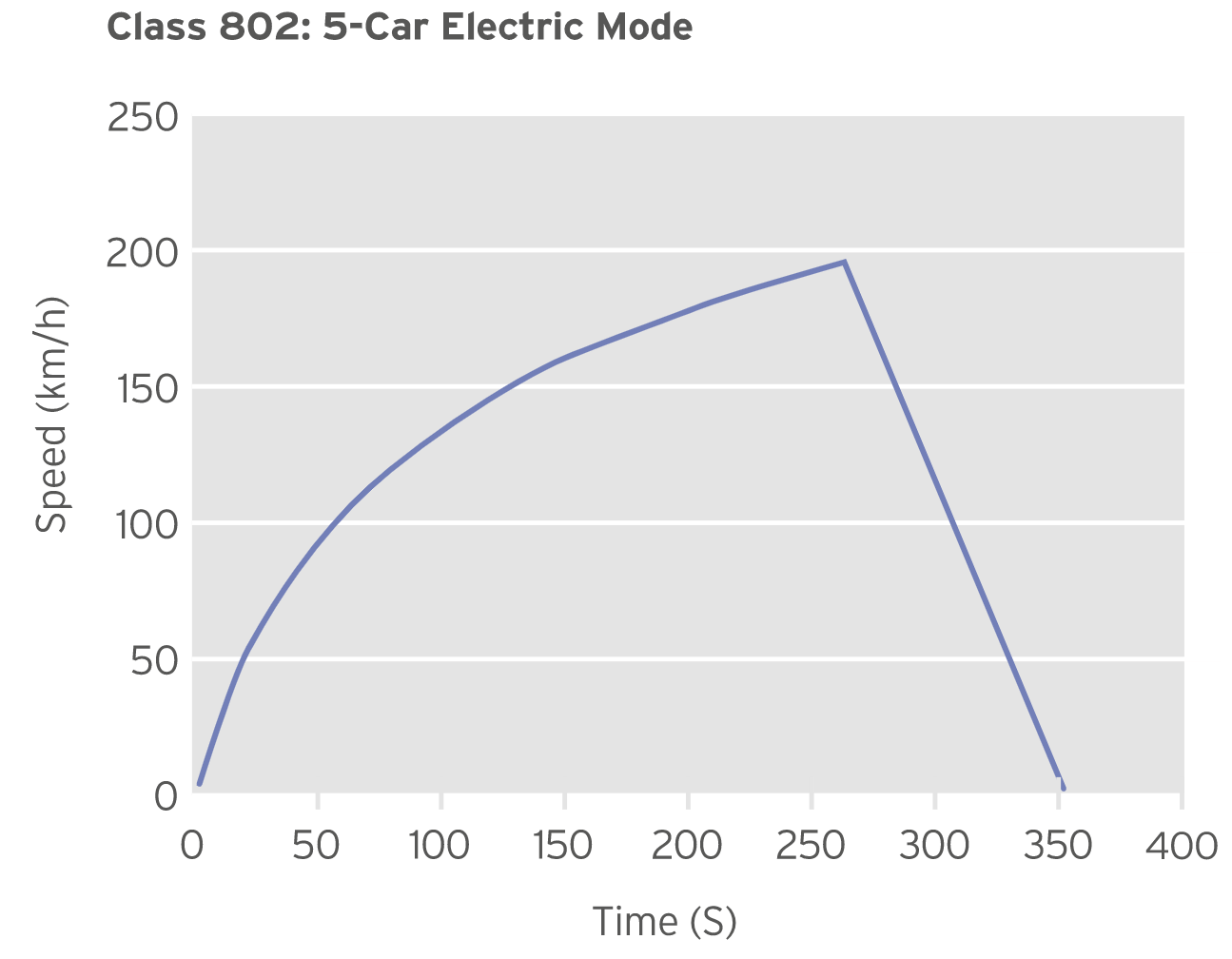
As batteries are just a different source of electric power, I would think, that with respect to acceleration and deceleration, that the performance of a battery-electric version will be similar.
Although, it will only achieve 160 kph instead of the 200 kph of the electric train.
I estimate from this graph, that a battery-electric train would take around 220 seconds from starting to decelerate for a station to being back at 160 kph. If the train was stopped for around eighty seconds, a station stop would add five minutes to the journey time.
London Kings Cross And Cleethorpes
As an example consider a service between London Kings Cross and Cleethorpes.
- The section without electrification between Newark and Cleethorpes is 64 miles.
- There appear to be ambitions to increase the operating speed to 90 mph.
- Local trains seem to travel at around 45 mph including stops.
- A fast service between London Kings Cross and Cleethorpes would probably stop at Lincoln Central, Market Rasen and Grimsby Town.
- In addition, local services stop at Collingham, Hykeham, Barnetby and Habrough.
- London Kings Cross and Newark takes one hour and twenty minutes.
- London Kings Cross and Cleethorpes takes three hours and fifteen minutes with a change at Doncaster.
I can now calculate a time between Kings Cross and Cleethorpes.
- If a battery-electric train can average 70 mph between Newark and Cleethorpes, it would take 55 minutes.
- Add five minutes for each of the three stops at Lincoln Central, Market Rasen and Grimsby Town
- Add in the eighty minutes between London Kings Cross and Newark and that would be two-and-a-half hours.
That would be very marketing friendly and a very good start.
Note.
- An average speed of 80 mph would save seven minutes.
- An average speed of 90 mph would save twelve minutes.
- I suspect that the current bi-modes would be slower by a few minutes as their acceleration is not as potent of that of an electric train.
I have a feeling London Kings Cross and Cleethorpes via Lincoln Central, Market Rasen and Grimsby Town, could be a very important service for LNER.
Interiors
I can see a new lightweight and more energy efficient interior being developed for these trains.
In addition some of the routes, where they could be used are popular with cyclists and the current Hitachi trains are not the best for bicycles.
Battery Charging
Range On Batteries
I have left this to last, as it depends on so many factors, including the route and the quality of the driving or the Automatic Train Control
Earlier, I estimated that a five-car train with all three diesel engines replaced by batteries, when trundling around Lincolnshire, Oxfordshire or Wiltshire could have range of up to 100 miles.
That sort of distance would be very useful and would include.
- Ely and Norwich
- Newark and Cleethorpes
- Salisbury and Exeter
It might even allow a round trip between the East Coast Main Line and Hull.
The Ultimate Battery Train
This press release from Hitachi is entitled Hitachi And Eversholt Rail To Develop GWR Intercity Battery Hybrid Train – Offering Fuel Savings Of More Than 20%.
This is a paragraph.
The projected improvements in battery technology – particularly in power output and charge – create opportunities to replace incrementally more diesel engines on long distance trains. With the ambition to create a fully electric-battery intercity train – that can travel the full journey between London and Penzance – by the late 2040s, in line with the UK’s 2050 net zero emissions target.
Consider.
- Three batteries would on my calculations give a hundred mile range.
- Would a train with no diesel engines mean that fuel tanks, radiators and other gubbins could be removed and more or large batteries could be added.
- Could smaller batteries be added to the two driving cars?
- By 2030, let alone 2040, battery energy density will have increased.
I suspect that one way or another these trains could have a range on battery power of between 130 and 140 miles.
This would certainly be handy in Scotland for the two routes to the North.
- Haymarket and Aberdeen, which is 130 miles without electrification.
- Stirling and Inverness, which is 111 miles without electrification, if the current wires are extended from Stirling to Perth, which is being considered by the Scottish Government.
The various sections of the London Paddington to Penzance route are as follows.
- Paddington and Newbury – 53 miles – electrified
- Newbury and Taunton – 90 miles – not electrified
- Taunton and Exeter – 31 miles – not electrified
- Exeter and Plymouth – 52 miles – not electrified
- Plymouth and Penzance – 79 miles – not electrified
The total length of the section without electrification between Penzance and Newbury is a distance of 252 miles.
This means that the train will need a battery charge en route.
I think there are three possibilities.
- Trains can take up to seven minutes for a stop at Plymouth. As London and Plymouth trains will need to recharge at Plymouth before returning to London, Plymouth station could be fitted with comprehensive recharge facilities for all trains passing through. Perhaps the ideal solution would be to electrify all lines and platforms at Plymouth.
- Between Taunton and Exeter, the rail line runs alongside the M5 motorway. This would surely be an ideal section to electrify, as it would enable battery electric trains to run between Exeter and both Newbury and Bristol.
- As some trains terminate at Exeter, there would probably need to be charging facilities there.
I believe that the date of the late 2040s is being overly pessimistic.
I suspect that by 2040 we’ll be seeing trains between London and Aberdeen, Inverness and Penzance doing the trips without a drop of diesel.
But Hitachi are making a promise of London and Penzance by zero-carbon trains, by the late-2040s, because they know they can keep it.
And Passengers and the Government won’t mind the trains being early!
Conclusion
This could be a very useful train to add to Hitachi’s product line.
Hitachi Targets Next Year For Testing Of Tri-Mode IET
The title of this post, is the same as that of this article on Rail Magazine.
This is the first two paragraphs.
Testing of a five-car Hitachi Class 802/0 tri-mode unit will begin in 2022, and the train could be in traffic the following year.
It is expected that the train will save more than 20% of fuel on Great Western Railway’s London Paddington-Penzance route.
This is the Hitachi infographic, which gives the train’s specification.
I have a few thoughts and questions.
Will The Batteries Be Charged At Penzance?
Consider.
- It is probably not a good test of customer reaction to the Intercity Tri-Mode Battery Train, if it doesn’t work on batteries in stations through Cornwall.
- Every one of the eight stops in Cornwall will need an amount of battery power.
- London trains seem to take at least half-an-hour to turn round at Penzance.
- London trains seem to take around 7-13 minutes for the stop at Plymouth.
So I think, that batteries will probably need to be charged at Penzance and possibly Plymouth, to achieve the required battery running,
There is already sufficient time in the timetable.
A charging facility in Penzance station would be a good test of Hitachi’s method to charge the trains.
Will Hyperdrive Innovation’s Battery Pack Be A Simulated Diesel Engine?
At the age of sixteen, for a vacation job, I worked in the Electronics Laboratory at Enfield Rolling Mills.
It was the early sixties and one of their tasks was at the time replacing electronic valve-based automation systems with new transistor-based systems.
The new equipment had to be compatible to that which it replaced, but as some were installed in dozens of places around the works, they had to be able to be plug-compatible, so that they could be quickly changed. Occasionally, the new ones suffered infant-mortality and the old equipment could just be plugged back in, if there wasn’t a spare of the new equipment.
So will Hyperdrive Innovation’s battery-packs have the same characteristics as the diesel engines that they replace?
- Same instantaneous and continuous power output.
- Both would fit the same mountings under the train.
- Same control and electrical power connections.
- Compatibility with the trains control computer.
I think they will as it will give several advantages.
- The changeover between diesel engine and battery pack could be designed as a simple overnight operation.
- Operators can mix-and-match the number of diesel engines and battery-packs to a given route.
- As the lithium-ion cells making up the battery pack improve, battery capacity and performance can be increased.
- If the computer, is well-programmed, it could reduce diesel usage and carbon-emissions.
- Driver conversion from a standard train to one equipped with batteries, would surely be simplified.
As with the diesel engines, all battery packs could be substantially the same across all of Hitachi’s Class 80x trains.
How Many Trains Can Eventually Be Converted?
Great Western Railway have twenty-two Class 802/0 trains.
- They are five-cars.
- They have three diesel engines in cars 2, 3 and 4.
- They have a capacity of 326 passengers.
- They have an operating speed of 125 mph on electrification.
- They will have an operating speed of 140 mph on electrification with in-cab ERTMS digital signalling.
- They have an operating speed of 110 mph on diesel.
- They can swap between electric and diesel mode at line speed.
Great Western Railway also have these trains that are similar.
- 14 – nine-car Class 802/1 trains
- 36 – five-car Class 800/0 trains
- 21 – nine-car Class 800/3 trains
Note.
- The nine-car trains have five diesel engines in cars 2,3, 5, 7 and 8
- All diesel engines are similar, but those in Class 802 trains are more powerful, than those in Class 800 trains.
This is a total of 93 trains with 349 diesel engines.
In addition, there are these similar trains in service or on order with other operators.
- LNER – 13 – nine-car Class 800/1 trains
- LNER – 10 – five-car Class 800/2 trains
- LNER – 12 – five-car Class 801/1 trains
- LNER – 30 – nine-car Class 801/2 trains
- TransPennine Express – 19 – five-car Class 802/2 trains
- Hull Trains – 5 – five-car Class 802/3 trains
- East Coast Trains – 5 – five-car Class 803 trains
- Avanti West Coast – 13 – five-car Class 805 trains
- Avanti West Coast – 10 – seven-car Class 807 trains
- East Midland Railway – 33 – five-car Class 810 trains
Note.
- Class 801 trains have one diesel engine for emergency power.
- Class 803 trains have no diesel engines, but they do have a battery for emergency power.
- Class 805 trains have an unspecified number of diesel engines. I will assume three.
- Class 807 trains have no batteries or diesel engines.
- Class 810 trains have four diesel engines.
This is a total of 150 trains with 395 diesel engines.
The Rail Magazine finishes with this paragraph.
Hitachi believes that projected improvements in battery technology, particularly in power output and charge, could enable diesel engines to be incrementally replaced on long-distance trains.
Could this mean that most diesel engines on these Hitachi trains are replaced by batteries?
Five-Car Class 800 And Class 802 Trains
These trains are mainly regularly used to serve destinations like Bedwyn, Cheltenham, Chester, Harrogate, Huddersfield, Hull, Lincoln, Oxford and Shrewsbury, which are perhaps up to fifty miles beyond the main line electrification.
- They have three diesel engines, which are used when there is no electrification.
- I can see many other destinations, being added to those reached by the Hitachi trains, that will need similar trains.
I suspect a lot of these destinations can be served by five-car Class 800 and Class 802 trains, where a number of the diesel engines are replaced by batteries.
Each operator would add a number of batteries suitable for their routes.
There are around 150 five-car bi-mode Hitachi trains in various fleets in the UK.
LNER’s Nine-Car Class 800 Trains
These are mainly used on routes between London and the North of Scotland.
In LNER Seeks 10 More Bi-Modes, I suggested that to run a zero-carbon service to Inverness and Aberdeen, LNER might acquire rakes of carriages hauled by zero-carbon hydrogen electric locomotives.
- Hydrogen power would only be used North of the current electrification.
- Scotland is looking to have plenty of hydrogen in a couple of years.
- No electrification would be needed to be erected in the Highlands.
- InterCity 225 trains have shown for forty years, that locomotive-hauled trains can handle Scottish services.
- I also felt that the trains could be based on a classic-compatible design for High Speed Two.
This order could be ideal for Talgo to build in their new factory at Longannet in Fife.
LNER’s nine-car Class 800 trains could be converted to all-electric Class 801 trains and/or moved to another operator.
There is also the possibility to fit these trains with a number of battery packs to replace some of their five engines.
If the planned twenty percent fuel savings can be obtained, that would be a major improvement on these long routes.
LNER’s Class 801 Trains
These trains are are all-electric, but they do have a diesel engine for emergencies.
Will this be replaced by a battery pack to do the same job?
- Battery packs are probably cheaper to service.
- Battery packs don’t need diesel fuel.
- Battery packs can handle regenerative braking and may save electricity.
The installation surely wouldn’t need too much test running, as a lot of testing will have been done in Class 800 and Class 802 trains.
East Coast Trains’ Class 803 Trains
These trains have a slightly different powertrain to the Class 801 trains. Wikipedia says this about the powertrain.
Unlike the Class 801, another non-bi-mode AT300 variant which despite being designed only for electrified routes carries a diesel engine per unit for emergency use, the new units will not be fitted with any, and so would not be able to propel themselves in the event of a power failure. They will however be fitted with batteries to enable the train’s on-board services to be maintained, in case the primary electrical supplies would face a failure.
The trains are in the process of being built, so I suspect batteries can be easily fitted.
Could it be, that all five-car trains are identical body-shells, already wired to be able to fit any possible form of power? Hitachi have been talking about fitting batteries to their trains since at least April 2019, when I wrote, Hitachi Plans To Run ScotRail Class 385 EMUs Beyond The Wires.
- I suspect that Hitachi will use a similar Hyperdrive Innovation design of battery in these trains, as they are proposing for the Intercity Tri-Mode Battery Train.
- If all trains fitted with diesel engines, use similar MTU units, would it not be sensible to only use one design of battery pack?
- I suspect, that as the battery on a Class 803 train, will be mainly for emergency use, I wouldn’t be surprised to see that these trains could be the first to run in the UK, with a battery.
- The trains would also be simpler, as they are only battery-electric and not tri-mode. This would make the software easier to develop and test.
If all trains used the same battery pack design, then all features of the pack, would be available to all trains to which it was fitted.
Avanti West Coast’s Class 805 Trains
In Hitachi Trains For Avanti, which was based on an article with the same time in the January 2020 Edition of Modern Railways, I gave this quote from the magazine article.
Hitachi told Modern Railways it was unable to confirm the rating of the diesel engines on the bi-modes, but said these would be replaceable by batteries in future if specified.
Note.
- Hitachi use diesel engines with different ratings in Class 800 and Class 802 trains, so can probably choose something suitable.
- The Class 805 trains are scheduled to be in service by 2022.
- As they are five-cars like some Class 800 and Class 802 trains will they have the same basic structure and a powertrain with three diesel engines in cars 2, 3 and 4?
I think shares a basic structure and powertrain will be very likely, as there isn’t enough time to develop a new train.
I can see that as Hitachi and Great Western Railway learn more about the performance of the battery-equipped Class 802 trains on the London and Penzance route, that batteries could be added to Avanti West Coast’s Class 805 trains. After all London Euston and North Wales and London Paddington and Cornwall are routes with similar characteristics.
- Both routes have a high speed electrified section out of London.
- They have a long section without electrification.
- Operating speeds on diesel are both less than 100 mph, with sections where they could be as low as 75 mph.
- The Cornish route has fifteen stops and the Welsh route has seven, so using batteries in stations will be a welcome innovation for passengers and those living near the railway.
As the order for the Avanti West Coast trains was placed, whilst Hitachi were probably designing their battery electric upgrade to the Class 800 and Class 802 trains, I can see batteries in the Class 805 trains becoming an early reality.
In Hitachi Trains For Avanti, I also said this.
Does the improvement in powertrain efficiency with smaller engines running the train at slower speeds help to explain this statement from the Modern Railways article?
Significant emissions reduction are promised from the elimination of diesel operation on electrified sections as currently seen with the Voyagers, with an expected reduction in CO2 emissions across the franchise of around two-thirds.
That is a large reduction, which is why I feel, that efficiency and batteries must play a part.
Note.
- The extract says that they are expected savings not an objective for some years in the future.
- I have not done any calculations on how it might be achieved, as I have no data on things like engine size and expected battery capacity.
- Hitachi are aiming for 20 % fuel and carbon savings on London Paddington and Cornwall services.
- Avanti West Coast will probably only be running Class 805 trains to Chester, Shrewsbury and North Wales.
- The maximum speed on any of the routes without electrification is only 90 mph. Will less powerful engines be used to cut carbon emissions?
As Chester is 21 miles, Gobowen is 46 miles, Shrewsbury is 29.6 miles and Wrexham General is 33 miles from electrification, could these trains have been designed with two diesel engines and a battery pack, so that they can reach their destinations using a lot less diesel.
I may be wrong, but it looks to me, that to achieve the expected reduction in CO2 emissions, the trains will need some radical improvements over those currently in service.
Avanti West Coast’s Class 807 Trains
In the January 2020 Edition of Modern Railways, is an article, which is entitled Hitachi Trains For Avanti.
This is said about the ten all-electric Class 807 trains for Birmingham, Blackpool and Liverpool services.
The electric trains will be fully reliant on the overhead wire, with no diesel auxiliary engines or batteries.
It may go against Hitachi’s original design philosophy, but not carrying excess weight around, must improve train performance, because of better acceleration.
I believe that these trains have been designed to be able to go between London Euston and Liverpool Lime Street stations in under two hours.
I show how in Will Avanti West Coast’s New Trains Be Able To Achieve London Euston and Liverpool Lime Street In Two Hours?
Consider.
- Current London Euston and Liverpool Lime Street timings are two hours and thirteen or fourteen minutes.
- I believe that the Class 807 trains could perhaps be five minutes under two hours, with a frequency of two trains per hour (tph)
- I have calculated in the linked post, that only nine trains would be needed.
- The service could have dedicated platforms at London Euston and Liverpool Lime Street.
- For comparison, High Speed Two is promising one hour and thirty-four minutes.
This service would be a Marketing Manager’s dream.
I can certainly see why they won’t need any diesel engines or battery packs.
East Midland Railway’s Class 810 Trains
The Class 810 trains are described like this in their Wikipedia entry.
The Class 810 is an evolution of the Class 802s with a revised nose profile and facelifted end headlight clusters, giving the units a slightly different appearance. Additionally, there will be four diesel engines per five-carriage train (versus three on the 800s and 802s), and the carriages will be 2 metres (6.6 ft) shorter.
In addition, the following information has been published about the trains.
- The trains are expected to be capable of 125 mph on diesel.
- Is this speed, the reason for the fourth engine?
- It is planned that the trains will enter service in 2023.
I also suspect, that like the Class 800, Class 802 and Class 805 trains, that diesel engines will be able to be replaced with battery packs.
Significant Dates And A Possible Updating Route For Hitachi Class 80x Trains
I can put together a timeline of when trains are operational.
- 2021 – Class 803 trains enter service.
- 2022 – Testing of prototype Intercity Tri-Mode Battery Train
- 2022 – Class 805 trains enter service.
- 2022 – Class 807 trains enter service.
- 2023 – First production Intercity Tri-Mode Battery Train enters service.
- 2023 – Class 810 trains enter service.
Note.
- It would appear to me, that Hitachi are just turning out trains in a well-ordered stream from Newton Aycliffe.
- As testing of the prototype Intercity Tri-Mode Battery Train proceeds, Hitachi and the operators will learn how, if batteries can replace some or even all of the diesel engines, the trains will have an improved performance.
- From about 2023, Hitachi will be able to design tri-mode trains to fit a customer’s requirements.
- Could the powertrain specification of the Class 810 trains change, in view of what is shown by the testing of the prototype Intercity Tri-Mode Battery Train?
- In parallel, Hyperdrive Innovation will be building the battery packs needed for the conversion.
Batteries could be fitted to the trains in three ways,
- They could be incorporated into new trains on the production line.
- Batteries could be fitted in the depots, during a major service.
- Trains could be returned to Newton Aycliffe for battery fitment.
Over a period of years as many trains as needed could be fitted with batteries.
Conclusion
I believe there is a plan in there somewhere, which will convert many of Hitachi’s fleets of trains into tri-mode trains with increased performance, greater efficiency and less pollution and carbon emissions.
Shooter Urges Caution On Hydrogen Hubris
The title of this post is the same as that of an article in the January 2021 Edition of Modern Railways.
This is the first paragraph.
Vivarail Chairman Adrian Shooter has urges caution about the widespread enthusiasm for hydrogen technology. In his keynote speech to the Golden Spanner Awards on 27 November, Mr. Shooter said the process to create ‘green hydrogen’ by electrolysis is ‘a wasteful use of electricity’ and was skeptical about using electricity to create hydrogen to then use a fuel cell to power a train, rather than charging batteries to power a train. ‘What you will discover is that a hydrogen train uses 3.5 times as much electricity because of inefficiencies in the electrolysis process and also in the fuel cells’ said Mr. Shooter. He also noted the energy density of hydrogen at 350 bar is only one-tenth of a similar quantity of diesel fuel, severely limiting the range of a hydrogen-powered train between refuelling.
Mr. Shooter then made the following points.
- The complexity of delivering hydrogen to the railway depots.
- The shorter range available from the amount of hydrogen that can be stored on a train compared to the range of a diesel train.
- He points out limitations with the design of the Alstom Breeze train.
This is the last paragraph.
Whilst this may have seemed like a challenge designed purely to promote the battery alternatives that Vivarail is developing, and which he believes to be more efficient, Mr. Shooter explained: ‘I think that hydrogen fuel cell trains could work in this country, but people just need to remember that there are downsides. I’m sure we’ll see some, and in fact we should because competition improves the breed.’
i think Mr. Shooter may have made several good points.
These are my thoughts.
Creating Green Hydrogen
I haven’t done an analysis of the costs of creating green hydrogen from electrolysis, but I have a feeling, that electrolysis won’t be the only way to create large amounts of carbon-free hydrogen, in a few years.
These methods are currently available or under development or construction.
- The hydrogen tram-buses in Pau have a personal electrolyser, that provides hydrogen at 350 bar.
- London’s hydrogen buses will be provided with hydrogen from an electrolyser at Herne Bay by truck. Will the trucks be hydrogen-powered?
Some industrial processes like the Castner-Kellner process create hydrogen as a by-product.
In Shell Process To Make Blue Hydrogen Production Affordable, I describe the Shell Blue Hydrogen Process, which appears to be a way of making massive amounts of carbon-free hydrogen for processes like steel-making and cement production. Surely some could be piped or transported by truck to the rail depot.
In ITM Power and Ørsted: Wind Turbine Electrolyser Integration, I describe how ITM Power and Ørsted plan to create the hydrogen off shore and bring it by pipeline to the shore.
Note.
- The last two methods could offer savings in the cost of production of carbon-free hydrogen.
- Surely, the delivery trucks if used, must be hydrogen-powered.
- The Shell Blue Hydrogen Process uses natural gas as a feedstock and converts it to hydrogen using a newly-developed catalyst. The carbon-dioxide is captured and used or stored.
- If the local gas network has been converted to hydrogen, the hydrogen can be delivered to the depot or filling station through that gas network.
I very much feel that affordable hydrogen can be supplied to bus, train, tram or transport depot. For remote or difficult locations. personal electrolysers, powered by renewable electricity, can be used, as at Pau.
Hydrogen Storage On Trains
Liquid hydrogen could be the answer and Airbus are developing methods of storing large quantities on aircraft.
In What Size Of Hydrogen Tank Will Be Needed On A ZEROe Turbofan?, I calculated how much liquid hydrogen would be needed for this ZEROe Turbofan.
I calculate that to carry the equivalent amount of fuel to an Airbus A320neo would need a liquid hydrogen tank with a near 100 cubic metre capacity. This sized tank would fit in the rear fuselage.
I feel that in a few years, a hydrogen train will be able to carry enough liquid hydrogen in a fuel tank, but the fuel tank will be large.
In The Mathematics Of A Hydrogen-Powered Freight Locomotive, I calculated how much liquid hydrogen would be needed to provide the same amount of energy as that carried in a full diesel tank on a Class 68 locomotive.
The locomotive would need 19,147 litres or 19.15 cubic metres of liquid hydrogen, which could be contained in a cylindrical tank with a diameter of 2 metres and a length of 6 metres.
Hydrogen Locomotives Or Multiple Units?
We have only seen first generation hydrogen trains so far.
This picture shows the Alstom Coradia iLint, which is a conversion of a Coradia Lint.

It is a so-so train and works reasonably well, but the design means there is a lot of transmission noise.
This is a visualisation of an Alstom Breeze or Class 600 train.
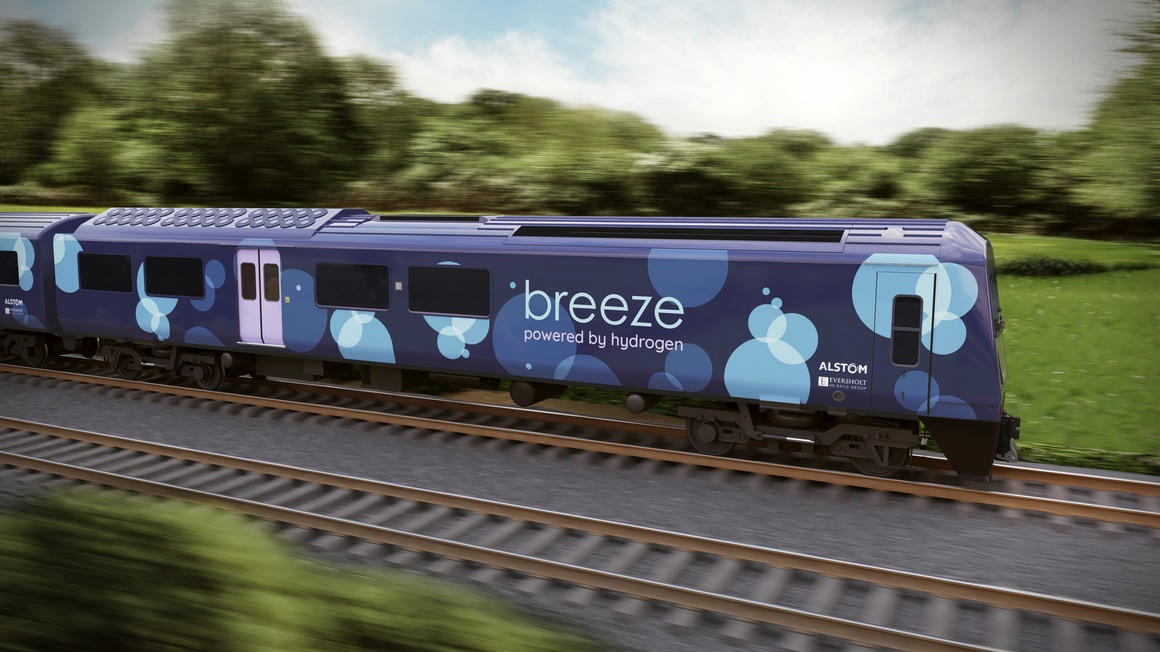
Note that the front half of the first car of the train, is taken up with a large hydrogen tank. It will be the same at the other end of the train.
As Mr. Shooter said, Alstom are converting a three-car train into a two-car train. Not all conversions live up to the hype of their proposers.
I would hope that the next generation of a hydrogen train designed from scratch, will be a better design.
I haven’t done any calculations, but I wonder if a lighter weight vehicle may be better.
Hydrogen Locomotives
I do wonder, if hydrogen locomotives are a better bet and easier to design!
- There is a great need all over the world for zero-carbon locomotives to haul freight trains.
- Powerful small gas-turbine engines, that can run on liquid hydrogen are becoming available.
- Rolls-Royce have developed a 2.5 MW gas-turbine generator, that is the size of a beer-keg.
In The Mathematics Of A Hydrogen-Powered Freight Locomotive, I wondered if the Rolls-Royce generator could power a locomotive, the size of a Class 68 locomotive.
This was my conclusion.
I feel that there are several routes to a hydrogen-powered railway locomotive and all the components could be fitted into the body of a diesel locomotive the size of a Class 68 locomotive.
Consider.
- Decarbonising railway locomotives and ships could be a large market.
- It offers the opportunities of substantial carbon reductions.
- The small size of the Rolls-Royce 2.5 MW generator must offer advantages.
- Some current diesel-electric locomotives might be convertible to hydrogen power.
I very much feel that companies like Rolls-Royce and Cummins (and Caterpillar!), will move in and attempt to claim this lucrative worldwide market.
In the UK, it might be possible to convert some existing locomotives to zero-carbon, using either liquid hydrogen, biodiesel or aviation biofuel.
Perhaps, hydrogen locomotives could replace Chiltern Railways eight Class 68 locomotives.
- A refuelling strategy would need to be developed.
- Emissions and noise, would be reduced in Marylebone and Birmingham Moor Street stations.
- The rakes of carriages would not need any modifications to use existing stations.
It could be a way to decarbonise Chiltern Railways without full electrification.
It looks to me that a hydrogen-powered locomotive has several advantages over a hydrogen-powered multiple unit.
- It can carry more fuel.
- It can be as powerful as required.
- Locomotives could work in pairs for more power.
- It is probably easier to accommodate the hydrogen tank.
- Passenger capacity can be increased, if required by adding more coaches.
It should also be noted that both hydrogen locomotives and multiple units can build heavily on technology being developed for zero-carbon aviation.
The Upward Curve Of Battery Power
Sparking A Revolution is the title an article in Issue 898 of Rail Magazine, which is mainly an interview with Andrew Barr of Hitachi Rail.
The article contains a box, called Costs And Power, where this is said.
The costs of batteries are expected to halve in the next years, before dropping further again by 2030.
Hitachi cites research by Bloomberg New Energy Finance (BNEF) which expects costs to fall from £135/kWh at the pack level today to £67/kWh in 2030 and £47/kWh in 3030.
United Kingdom Research and Innovation (UKRI) are predicting that battery energy density will double in the next 15 years, from 700 Wh/l to 1400 Wh/l in 2-35, while power density (fast charging) is likely to increase four times in the same period from 3 kW/kg to 12 kW/kg in 2035.
These are impressive improvements that can only increase the performance and reduce the cost of batteries in all applications.
Hitachi’s Regional Battery Train
This infographic gives the specification of Hitachi Regional Battery Train, which they are creating in partnership with Hyperdrive Innovation.
Note that Hitachi are promising a battery life of 8-10 years.
Financing Batteries
This paragraph is from this page on BuyaCar, which is entitled Electric Car Battery Leasing: Should I Lease Or Buy The Batteries?
When you finance or buy a petrol or diesel car it’s pretty simple; the car will be fitted with an engine. However, with some electric cars you have the choice to finance or buy the whole car, or to pay for the car and lease the batteries separately.
I suspect that battery train manufacturers, will offer similar finance models for their products.
This paragraph is from this page on the Hyperdrive Innovation web site.
With a standardised design, our modular product range provides a flexible and scalable battery energy storage solution. Combining a high-performance lithium-ion NMC battery pack with a built in Battery Management System (BMS) our intelligent systems are designed for rapid deployment and volume manufacture, supplying you with class leading energy density and performance.
I can envisage that as a battery train ages, every few years or so, the batteries will get bigger electrically, but still be the same physical size, due to the improvements in battery technology, design and manufacture.
I have been involved in the finance industry both as a part-owner of a small finance company and as a modeller of the dynamics of their lending. It looks to me, that train batteries could be a very suitable asset for financing by a fund. But given the success of energy storage funds like Gore Street and Gresham House, this is not surprising.
I can envisage that battery electric trains will be very operator friendly, as they are likely to get better with age and they will be very finance-friendly.
Charging Battery Trains
I must say something about the charging of battery trains.
Battery trains will need to be charged and various methods are emerging.
Using Existing Electrification
This will probably be one of the most common methods used, as many battery electric services will be run on partly on electrified routes.
Take a typical route for a battery electric train like London Paddington and Oxford.
- The route is electrified between London Paddington and Didcot Junction.
- There is no electrification on the 10.4 miles of track between Didcot Junction and Oxford.
If a full battery on the train has sufficient charge to take the train from Didcot Junction to Oxford and back, charging on the main line between London Paddington and Didcot Junction, will be all that will be needed to run the service.
I would expect that in the UK, we’ll be seeing battery trains using both 25 KVAC overhead and 750 VDC third rail electrification.
Short Lengths Of New Strategic Electrification
I think that Great Western Railway would like to run either of Hitachi’s two proposed battery electric trains to Swansea.
As there is 45.7 miles pf track without .electrification, some form of charging in Swansea station, will probably be necessary.
The easiest way would probably be to electrify Swansea station and perhaps for a short distance to the North.
This Google Map shows Swansea station and the railway leading North.
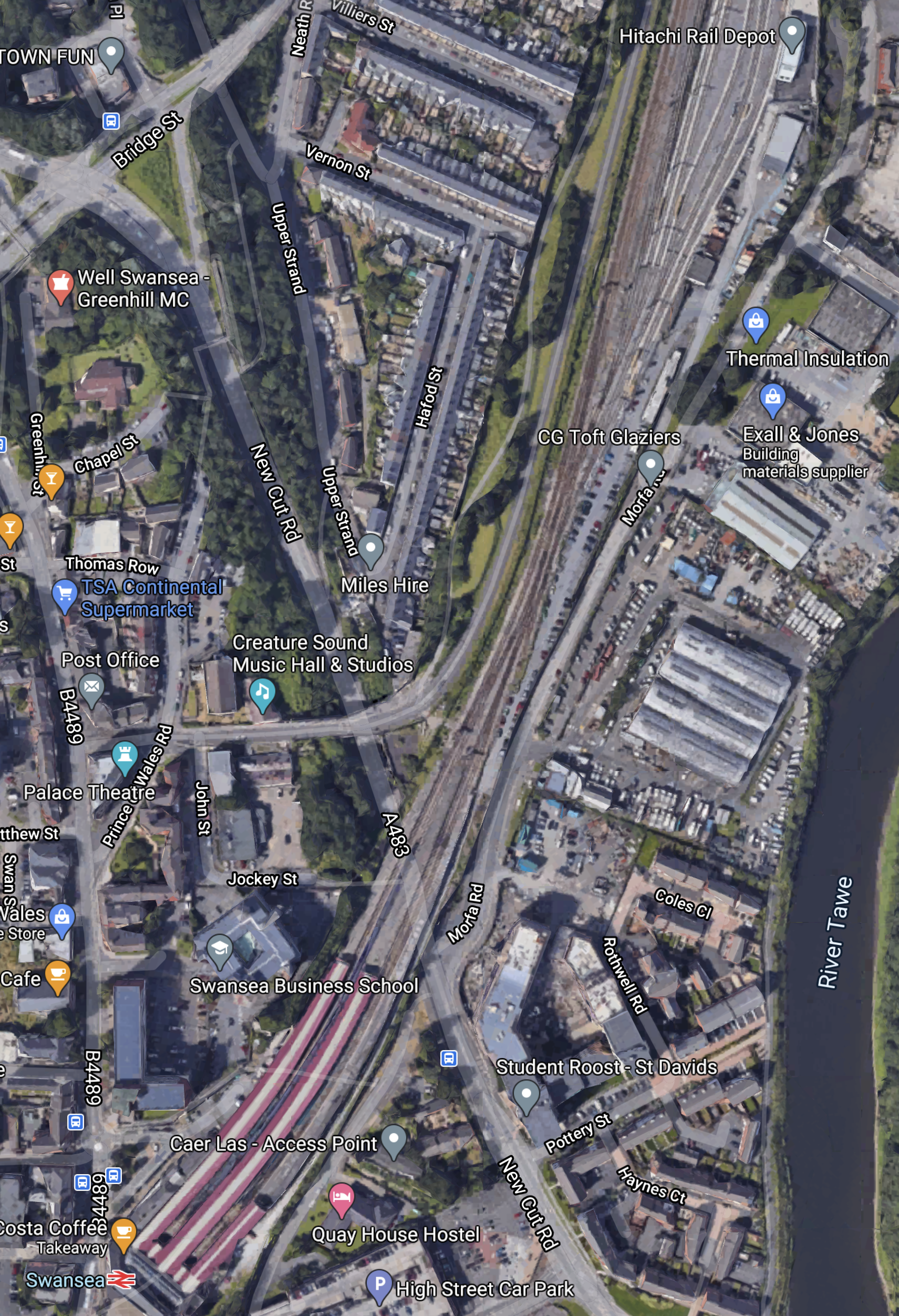
Note.
- There is a Hitachi Rail Depot at the Northern edge of the map.
- Swansea station is in South-West corner of the map.
- Swansea station has four platforms.
Swansea station would probably make an excellent battery train hub, as trains typically spend enough time in the station to fully charge the batteries before continuing.
There are other tracks and stations of the UK, that I would electrify to enable the running of battery electric trains.
- Leeds and York, which would enable carbon-free London and Edinburgh services via Leeds and help TransPennine services. This is partially underway.
- Leicester and East Midlands Parkway and Clay Cross North Junction and Sheffield – These two sections would enable EMR InterCity services to go battery electric.
- Sheffield and Leeds via Meadowhall, Barnsley Dearne Valley and the Wakefield Line, which would enable four trains per hour (tph) between Sheffield and Leeds and an extension of EMR InterCity services to Leeds.
- Hull and Brough, would enable battery electric services to Hull and Beverley.
- Scarborough and Seamer, would enable electric services services to Scarborough and between Hull and Scarborough.
- Middlesbrough and Redcar, would enable electric services services to Teesside.
- Crewe and Chester and around Llandudno Junction station – These two sections would enable Avanti West Coast service to Holyhead to go battery electric.
- Shrewsbury station – This could become a battery train hub, as I talked about for Swansea.
- Taunton and Exeter and around Penzance, Plymouth and Westbury stations – These three sections would enable Great Western Railway to cut a substantial amount of carbon emissions.
- Exeter, Yeovil Junction and Salisbury stations. – Electrifying these three stations would enable South Western Railway to run between London and Exeter using Hitachi Regional Battery Trains, as I wrote in Bi-Modes Offered To Solve Waterloo-Exeter Constraints.
We will also need fast chargers for intermediate stations, so that a train can charge the batteries on a long route.
I know of two fast chargers under development.
- Opbrid at Furrer + Frey
- Vivarail’s Fast Charge, which I wrote about in Vivarail’s Plans For Zero-Emission Trains.
I believe it should be possible to battery-electrify a route by doing the following.
- Add short lengths of electrification and fast charging systems as required.
- Improve the track, so that trains can use their full performance.
- Add ERTMS signalling.
- Add some suitable trains.
Note.
- I feel ERTMS signalling with a degree of automatic train control could be used with automatic charging systems, to make station stops more efficient.
- In my view, there is no point in installing better modern trains, unless the track is up to their performance.
Limach And Hyperdrive Partner On Electric Machines
The title of this post, is the same as that as of this article on International Rental News.
This second deal from Hyperdrive Innovation is with Dutch excavator manufacturer Limach.
This paragraph from the article is important.
The construction industry is responsible for 40% of European carbon emissions, making it an urgent priority for decarbonisation to meet net zero targets.
That is a lot of carbon.
Multi-Million-Pound Battery Partnership Announced
The title of this post, is the same as that as of this article on Eureka magazine.
This is the introductory paragraph.
Hyperdrive Innovation, the UK’s leading designer and manufacturer of lithium-ion battery technology, today announces a new multi-million-pound 4-year supply agreement with Moffett, part of Hiab and world leading forklift truck manufacturer, to supply state-of-the-art battery packs for zero-emission machinery.
This seems to be a big deal for the Sunderland-based manufacturer, who are also working with Hitachi to provide battery packs for Hitachi’s Regional Battery Train.
Hyperdrive Innovation certainly must be developing some of the best battery technology available.
£100m Station Revamp Could Double Local Train Services
The title of this post, is the same as that of this article on the Northern Echo.
This is the opening paragraph.
Officials behind plans for a £100m-plus transformation of Darlington’s Bank Top Station have confirmed it will remain the only one on the East Coast Mainline without a platform specifically for the London to Scotland service.
Darlington station has made various appearances in my life, all of which have been pleasurable ones.
I went several times to ICI’s Wilton site on Teesside in the 1970s, when the route to London was worked by the iconic Class 55 locomotives or Deltics.
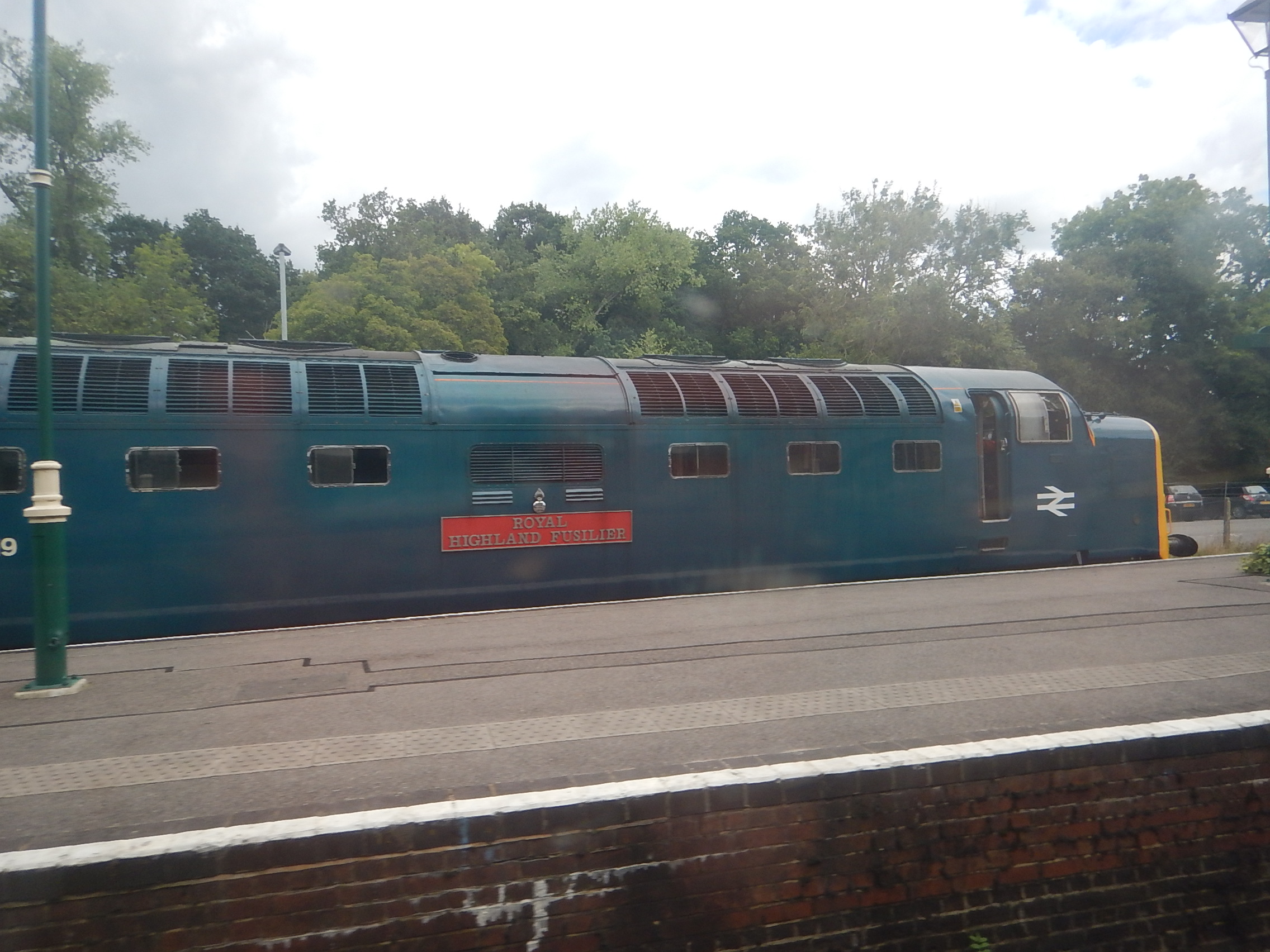
I wrote about one memorable trip home from Darlington in The Thunder of Three-Thousand Three-Hundred Horses.
Over the years, I also seem to have had several clients for my computing skills in the area, including the use of my data analysis software; Daisy at Cummins Engines in the town.
And lately, it’s been for football at Middlesbrough to see Ipswich play, where I’ve changed trains. Sometimes, Town even won.
The improvements planned for the station are two-fold.
Improvement Of Local Services
This paragraph from Wikipedia, sums up the local train services on the Tees Valley Line between Saltburn and Bishop Auckland via Darlington, Middlesbrough and Redcar.
Northern run their Tees Valley line trains twice hourly to Middlesbrough, Redcar and Saltburn (hourly on Sundays), whilst the Bishop Auckland branch has a service every hour (including Sundays). The company also operates two Sundays-only direct trains to/from Stockton and Hartlepool.
If ever a route needed improvement it is this one.
This paragraph from the Northern Echo article, outlines the plans for Darlington station.
The meeting was also told the overhaul, which will see new platforms, a new station building, parking and an interchange for passengers, alongside other improvements, would also double capacity on Tees Valley and Bishop Auckland lines, meaning four trains an hour on the former and two trains an hour on the latter.
I also believe that the route is a shoe-in for zero-carbon services; hydrogen or battery electric.
Hydrogen Trains On Teesside
In Fuelling The Change On Teesside Rails, I discuss using hydrogen powered trains for the lines in the area and they could certainly provide services on more than just the Tees Valley Line.
- Teesside certainly has big plans for hydrogen to fuel its chemical industry.
- Hydrogen powered transport in the area has been backed by the Government, as I wrote about in Tees Valley Wins £1.3million Project To Bring Hydrogen Vehicles To The Region.
- Plans are advancing for a depot for hydrogen-powered trains at Lackenby.
The hydrogen powered trains would probably be this Alstom Breeze.
They would appear to be in pole position to change the image of Teesside’s trains.
Battery Electric Trains On Teesside
But I suspect. that an Anglo-Japanese partnership, based in the North-East could have other ideas.
- Hitachi have a train factory at Newton Aycliffe on the Tees Valley Line.
- Hyperdrive Innovation design and produce battery packs for transport and mobile applications in Sunderland.
The two companies have launched the Regional Battery Train, which is described in this Hitachi infographic.
Note than 90 kilometres is 56 miles, so the train has a very useful range.
Hitachi have talked about fitting batteries to their express trains to serve places like Middlesbrough, Redcar and Sunderland with zero-carbon electric services.
But their technology can also be fitted to their Class 385 trains and I’m sure that Scotland will order some battery-equipped Class 385 trains to expand their vigorous electric train network.
Both Scotland and Teesside will need to charge their battery trains.
Example distances on Teesside include.
- Darlington and Saltburn – 28 miles
- Darlington and Whitby – 47 miles
- Darlington and Bishop Auckland – 12 miles
The last route would be possible on a full battery, but the first two would need a quick battery top-up before return.
So there will need to be strategically-placed battery chargers around the North-East of England. These could include.
- Hexham
- Nunthorpe
- Redcar or Saltburn – This would also be used by TransPennine Express’s Class 802 trains, if they were to be fitted with batteries.
- Whitby
If Grand Central did the right thing and ran battery electric between London and Sunderland, there would probably be a need for a battery charger at Sunderland.
It appears that Adrian Shooter of Vivarail has just announced a One-Size-Fits-All Fast Charge system, that has been given interim approval by Network Rail.
I discuss this charger in Vivarail’s Plans For Zero-Emission Trains, which is based on a video on the Modern Railways web site.
There is more about Vivarail’s plans in the November 2020 Print Edition of the magazine, where this is said on page 69.
‘Network Rail has granted interim approval for the fast charge system and wants it to be the UK’s standard battery charging system’ says Mr. Shooter. ‘We believe it could have worldwide implications.’
I believe that Hitachi and Hyperdrive Innovation, with a little bit of help from friends in Seaham, can build a battery-electric train network in the North-East.
The Choice Between Hydrogen And Battery Electric
Consider.
- The hydrogen trains would need a refuelling system.
- The battery electric trains would need a charging structure, which could also be used by other battery electric services to and from the North-East.
- No new electrification or other infrastructure would be needed.
- If a depot is needed for the battery electric trains, they could probably use the site at Lackenby, that has been identified as a base for the hydrogen trains.
Which train would I choose?
I think the decision will come down to politics, money and to a certain extent design, capacity and fuel.
- The Japanese have just signed a post-Brexit trade deal and France or rather the EU hasn’t.
- The best leasing deal might count for a lot.
- Vivarail have stated that batteries for a battery electric train, could be leased on a per mile basis.
- The Hitachi train will be a new one and the Alstom train will be a conversion of a thirty year old British Rail train.
- The Hitachi train may well have a higher passenger capacity, as there is no need for the large hydrogen tank.
- Some people will worry about sharing the train with a large hydrogen tank.
- The green credentials of both trains is not a deal-breaker, but will provoke discussion.
I feel that as this is a passenger train, that I’m leaning towards a battery electric train built on the route.
An Avoiding Line Through Darlington
The Northern Echo also says this about track changes at the station.
A meeting of Darlington Borough Council’s communities and local services scrutiny committee was told a bus lane-style route off the mainline at the station would enable operators to run more high-speed services.
Councillors heard that the proposed track changes would enable very fast approaches to Darlington and allow other trains to pass as East Coast Mainline passengers boarded.
Some councillors seem to be unhappy about some trains passing through the station without stopping.
Are their fears justified?
This Google Map shows Darlington station.
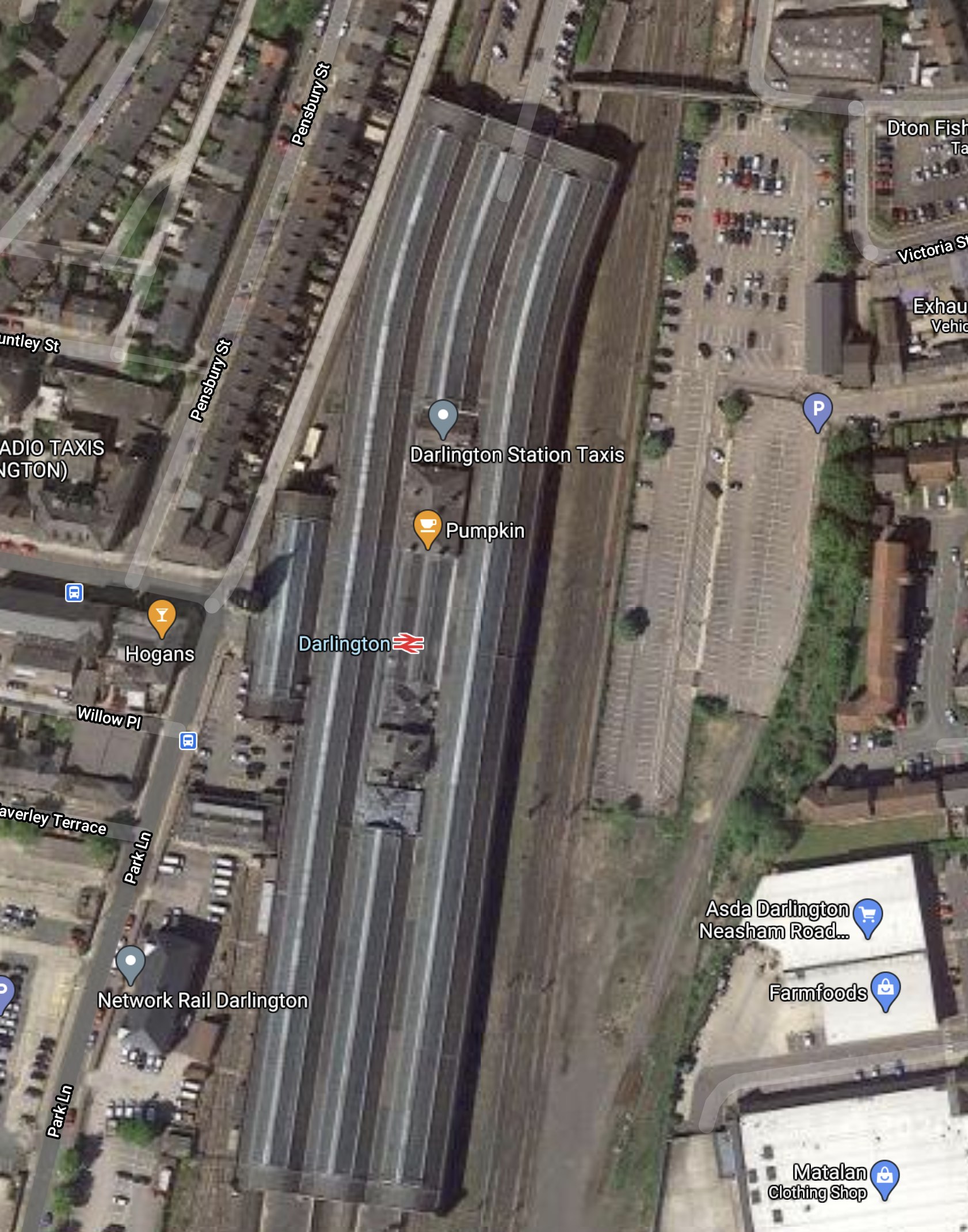
Note.
- The station has two long platforms and two South-facing bay platforms.
- There is plenty of space.
- There already appear to be a pair of electrified avoiding lines on the Eastern side of the station.
Wikipedia also says this about how Darlington station will be changed by High Speed Two.
The new high speed rail project in the UK, High Speed 2, is planned to run through Darlington once Phase 2b is complete and will run on the existing East Coast Main Line from York and Newcastle. Darlington Station will have two new platforms built for the HS2 trains on the Main Line, as the station is built just off the ECML to allow for freight services to pass through.
This would appear to suggest that the two current avoiding lines will be turned into high speed platforms.
Current High Speed Services At Darlington
The current high speed services at Darlington are as follows.
- LNER – two trains per hour (tph) – London Kings Cross and Edinburgh
- Cross Country – one tph – Plymouth and Edinburgh or Glasgow
- Cross Country – one tph – Southampton and Newcastle
- TransPennine Express – one tph – Liverpool and Edinburgh
- TransPennine Express – one tph – Manchester Airport and Newcastle
Northbound, this gives eight tph to Newcastle and four tph to Edinburgh
East Coast Trains
East Coast Trains‘s services are not planned to stop at Darlington.
High Speed Two Trains
Darlington is planned to be served by these High Speed Two trains.
- 1 tph – Birmingham Curzon Street and Newcastle via East Midlands Hub, York and Durham
- 1 tph – London Euston and Newcastle via Old Oak Common and York.
Both will be 200 metre High Speed Two Classic-Compatible trains
Northbound, this gives ten tph to Newcastle and four tph to Edinburgh.
As the Eastern Leg of High Speed Two has some spare capacity, I suspect there could be other services through Darlington.
Improvements To The East Coast Main Line
If you look at the East Coast Main Line between Doncaster and Newcastle, the route is a mixture of two and four-track railway.
- Between Doncaster and York, there are two tracks
- Between York and Northallerton, there are four tracks
- Between Northallerton and Darlington, there are two tracks
- North of Darlington, the route is mainly two tracks.
I have flown my virtual helicopter along much of the route and I can say this about it.
- Much of the route is through agricultural land, and where absolutely necessary extra tracks could possibly be added.
- The track is more-or-less straight for large sections of the route.
- Routes through some towns and cities, are tightly hemmed in by houses.
I also believe that the following developments will happen to the whole of the East Coast Main Line before High Speed Two opens.
- Full ERTMS in-cab digital signalling will be used on all trains on the route.
- The trains will be driven automatically, with the driver watching everything. Just like a pilot in an airliner!
- All the Hitachi Class 80x trains used by operators on the route, will be able to operate at up to 140 mph, once this signalling and some other improvements have been completed.
- All level crossings will have been removed.
- High Speed Two is being built using slab track, as I stated in HS2 Slab Track Contract Awarded. I suspect some sections of the East Coast Main Line, that are used by High Speed Two services, will be upgraded with slab track to increase performance and reduce lifetime costs.
Much of the East Coast Main Line could become a 140 mph high speed line, as against High Speed Two, which will be a 225 mph high speed line.
This will mean that all high speed trains will approach Darlington and most other stations on the route, at 140 mph.
Trains will take around a minute to decelerate from or accelerate to 140 mph and if the station stop took a minute, the trains will be up to speed again in just three minutes. In this time, the train would have travelled two-and-a-half miles.
Conclusion
I think that this will happen.
- The Tees Valley Line trains will be greatly improved by this project.
- Trains will generally run at up to 140 mph on the East Coast Main Line, under full digital control, like a slower High Speed Two.
- There will be two high speed platforms to the East of the current station, where most if not all of the High Speed Two, LNER and other fast services will stop.
- There could be up to 15 tph on the high speed lines.
With full step-free access between the high speed and the local platforms in the current station, this will be a great improvement.
How Many Trains Are Needed To Run A Full Service On High Speed Two?
The latest High Speed Two schedule was published in the June 2020 Edition of Modern Railways.
The Two Train Classes
Two separate train classes have been proposed for High Speed Two.
Full-Size – Wider and taller trains built to a European loading gauge, which would be confined to the high-speed network (including HS1 and HS2) and other lines cleared to their loading gauge.
Classic-Compatible – Conventional trains, capable of high speed but built to a British loading gauge, permitting them to leave the high speed track to join conventional routes such as the West Coast Main Line, Midland Main Line and East Coast Main Line.
The Wikipedia entry for High Speed Two has a section entitled Rolling Stock, where this is said about the design.
Both types of train would have a maximum speed of at least 360 km/h (225 mph) and a length of 200 metres (660 ft); two units could be joined together for a 400-metre (1,300 ft) train. It has been reported that these longer trains would have approximately 1,100 seats.
These are some of my thoughts.
Seating Density
I would assume that this means that a single 200 metre train, will have a capacity of approximately 550 seats or a density of 2.75 seats per metre. How does that compare with other trains?
- 9-car Class 801 train – 234 metres – 611 seats – 2.61 seats/metre
- 7-car Class 807 train – 182 metres – 453 seats – 2.49 seats/metre
- 9-car Class 390 train – 217.5 metres – 469 seats – 2.16 seats/metre
- 11-car Class 390 train – 265.3 metres – 589 seats – 2.22 seats/metre
- 12-car Class 745/1 train – 236.6 metres – 767 seats – 3.24 seats/metre
- 16-car Class 374 train – 390 metres – 902 seats – 2.31 seats/metre
Note.
- What I find strange with these figures, is that I feel most crowded and cramped in a Class 390 train. Could this be because the Pendelino trains are eighteen years old and train interior design has moved on?
- But I always prefer to travel in a Hitachi Class 80x train or a Stadler Class 745 train.
I very much feel that a seating density of 2.75 seats per metre, designed using some of the best modern practice, could create a train, where travelling is a very pleasant experience.
Step-Free Access
I have travelled in high speed trains all over Europe and have yet to travel in one with step-free access.
Surely, if Stadler can give their trains step-free access everybody can.
The pictures shows step-free access on Stadler Class 745 and Class 755 trains.
If I turned up pushing a friend in a wheelchair, would I be able to push them in easily? Or better still will they be able to wheel themselves in?
A Greater Anglia driver tp;d me recently, that now they never have to wait anymore for wheelchairs to be loaded.
So surely, it is in the train operator’s interest to have step-free access, if it means less train delays.
Double-Deck Trains
In my view double-deck trains only have one only good feature and that is the ability to see everything, if you have a well-designed window seat.
I may be seventy-three, but I am reasonably fit and only ever travel on trains with airline-sized hand baggage. So I don’t find any problem travelling upstairs on a double-deck bus or train!
But it could have been, so very different, if my stroke had been a bit worse and left me blind or in a wheelchair for life.
I have seen incidents on the Continent, which have been caused by double-deck trains.
- A lady of about eighteen in trying to get down with a heavy case dropped it. Luckily it only caused the guy she was travelling with, to roll unhurt down the stairs.
- Luggage is often a problem on Continental trains because of the step-up into the train and access is worse on double deck trains.
- I also remember on a train at Leipzig, when several passengers helped me lift a guy and his wheelchair out of the lower deck of a double-deck train, which was lower than the platform, as they often are with double-deck trains.
I am not totally against double-deck trains, but they must be designed properly.
Consider.
- High Speed Two’s Full-Size trains will only use London Euston, Old Oak Common, Birmingham Interchange, Birmingham Curzon Street, Manchester Airport, Manchester Piccadilly, East Midlands Hub and Leeds stations.
- All stations used by Full-Size trains will be brand-new or substantially rebuilt stations.
- Someone sitting in a wheelchair surely has the same right to a view from the top-deck of a double-deck train as anybody else.
- Jumbo jets seemed to do very well without a full-length top-deck.
- The A 380 Superjumbo has been designed so that entry and exit on both decks is possible.
I feel if High Speed Two want to run double-deck trains, an elegant solution can surely be found.
A Crude Estimate On The Number Of Trains
This is my crude estimate to find out how many trains, High Speed Two will need.
Western Leg
These are the services for the Western Leg between London , Birmingham, Liverpool, Manchester, Edinburgh and Glasgow.
- Train 1 – London Euston and Birmingham Curzon Street – 400 metre Full-Size – 45 minutes – 2 hour Round Trip – 4 trains
- Train 2 – London Euston and Birmingham Curzon Street – 400 metre Full-Size – 45 minutes – 2 hour Round Trip – 4 trains
- Train 3 – London Euston and Birmingham Curzon Street – 400 metre Full-Size – 45 minutes – 2 hour Round Trip – 4 trains
- Train 4 – London Euston and Lancaster – Classic Compatible – 2 hours 3 minutes – 5 hour Round Trip – 5 trains
- Train 4 – London Euston and Liverpool – Classic Compatible – 1 hours 34 minutes – 4 hour Round Trip – 4 trains
- Train 5 – London Euston and Liverpool – Classic Compatible – 1 hours 34 minutes – 4 hour Round Trip – 4 trains
- Train 6 – London Euston and Macclesfield – Classic Compatible – 1 hours 30 minutes – 4 hour Round Trip – 4 trains
- Train 7 – London Euston and Manchester – 400 metre Full-Size – 1 hour and 11 minutes – 3 hour Round Trip – 6 trains
- Train 8 – London Euston and Manchester – 400 metre Full-Size – 1 hour and 11 minutes – 3 hour Round Trip – 6 trains
- Train 9 – London Euston and Manchester – 400 metre Full-Size – 1 hour and 11 minutes – 3 hour Round Trip – 6 trains
- Train 10 – London Euston and Edinburgh – Classic Compatible – 3 hours 48 minutes – 8 hour Round Trip – 8 trains
- Train 10 – London Euston and Glasgow – Classic Compatible – 3 hours 40 minutes – 8 hour Round Trip – 8 trains
- Train 11 – London Euston and Edinburgh – Classic Compatible – 3 hours 48 minutes – 8 hour Round Trip – 8 trains
- Train 11 – London Euston and Glasgow – Classic Compatible – 3 hours 40 minutes – 8 hour Round Trip – 8 trains
- Train 12 – Birmingham Curzon Street and Edinburgh or Glasgow – Classic Compatible – 3 hours 20 minutes – 7 hour Round Trip – 7 trains
- Train 13 – Birmingham Curzon Street and Manchester – 200 metre Full-Size – 41 minutes – 2 hour Round Trip – 2 trains
- Train 14 – Birmingham Curzon Street and Manchester – 200 metre Full-Size – 41 minutes – 2 hour Round Trip – 2 trains
Note.
- I have assumed 400 metre Full-Size trains will be a pair of 200 metre trains.
- Trains 4, 10 and 11 are pairs of 200 metre long Classic-Compatible trains, that split and join at Crewe. Carlisle and Carlisle respectively.
- Trains 5 and 6 are single 200 metre long Classic-Compatible trains.
- The full schedule will need 34 Full-Size trains and 56 Classic-Compatible trains
According to Wikipedia, the first order will be for 54 Classic-Compatible trains, so I would assume, that more trains will be ordered.
Eastern Leg
These are the services for the Eastern Leg between London , Birmingham, East Midlands Hub, Leeds, Sheffield, York and Newcastle.
- Train 15 – Birmingham Curzon Street and Leeds – 200 metre Full-Size – 49 minutes – 2 hour Round Trip – 2 trains
- Train 16 – Birmingham Curzon Street and Leeds – 200 metre Full-Size – 49 minutes – 2 hour Round Trip – 2 trains
- Train 17 – Birmingham Curzon Street and Newcastle – Classic Compatible – 1 hour 57 minutes – 5 hour Round Trip – 5 trains
- Train 18 – London Euston and Sheffield – Classic Compatible – 1 hour 27 minutes – 4 hour Round Trip – 4 trains
- Train 18 – London Euston and Leeds – Classic Compatible – 1 hour 21 minutes – 3 hour Round Trip – 3 trains
- Train 19 – London Euston and Leeds – 400 metre Full-Size – 1 hour and 21 minutes – 3 hour Round Trip – 6 trains
- Train 20 – London Euston and Leeds – 400 metre Full-Size – 1 hour and 21 minutes – 3 hour Round Trip – 6 trains
- Train 21 – London Euston and Sheffield – Classic Compatible – 1 hour 27 minutes – 4 hour Round Trip – 4 trains
- Train 21 – London Euston and York – Classic Compatible – 1 hour 24 minutes – 3 hour Round Trip – 3 trains
- Train 22 – London Euston and Newcastle – Classic Compatible – 2 hour 17 minutes – 5 hour Round Trip – 5 trains
- Train 23 – London Euston and Newcastle – Classic Compatible – 2 hour 17 minutes – 5 hour Round Trip – 5 trains
Note.
- I have assumed 400 metre Full-Size trains will be a pair of 200 metre trains.
- Trains 15 and 16 work as a pair,
- Trains 18 and 21 are pairs of 200 metre long Classic-Compatible trains, that split and join at East Midlands Hub.
- Trains 22 and 23 are single 200 metre long Classic-Compatible trains
- The full schedule will need 16 Full-Size trains and 29 Classic-Compatible trains.
Adding the two legs together and I estimate that 50 Full-Size trains and 85 Classic-Compatible trains, will be needed to run a full schedule.
Trains Per Hour On Each Section
It is possible to make a table of how many trains run on each section of the High Speed Two network in trains per hour (tph)
- London Euston (stops) – 1-11, 18-23 – 17 tph
- London Euston and Old Oak Common – 1-11, 18-23 – 17 tph
- Old Oak Common (stops) – 1-11, 18-23 – 17 tph
- Old Oak Common and Birmingham Interchange – 1-11, 18-23 – 17 tph
- Birmingham Interchange (stops) – 2, 3, 7, 11, 20 – 5 tph
- Birmingham Curzon Street (stops) – 1-3, 12-14, 15-17 – 9 tph
- Birmingham and Crewe – 4,5, 7-9, 10-14 – 10 tph
- Crewe (stops) – 4,5 – 2 tph
- Crewe and Liverpool – 4,5 – 2 tph
- Crewe and Lancaster – 4, 10-12 – 4 tph
- Crewe and Manchester – 7-9, 13, 14 – 5 tph
- Crewe and Wigan via Warrington – 4 – 1 tph
- Crewe and Wigan via High Speed Two (new route) – 10-12 – 3 tph
- Lancaster (stops) 4 – 1 tph
- Lancaster and Carlisle – 10-12 – 3 tph
- Carlisle and Edinburgh – 10-12 – 2.5 tph
- Carlisle and Glasgow – 10-12 – 2.5 tph
- Birmingham and Stoke – 6 – 1 tph
- Stoke (stops) – 6 – 1 tph
- Stoke and Macclesfield – 6 – 1 tph
- Macclesfield (stops) – 6 – 1 tph
- Birmingham and East Midlands Hub – 15-17, 18-20, 21-23 – 9 tph
- East Midlands Hub (stops) – 15-17, 18-20, 21 – 7 tph
- East Midlands Hub and Sheffield – 18, 21 – 2 tph
- Sheffield (stops) – 18, 21 – 2 tph
- Midlands Hub and Leeds – 15, 16, 18-20 – 5 tph
- Leeds (stops) – 15, 16, 18-20 – 5 tph
- East Midlands Hub and York – 17, 21-23 – 4 tph
- York (stops) – 17, 21-23 – 4 tph
- York and Newcastle – 17, 22, 23 – 3 tph
- Newcastle (stops) – 17, 22, 23 – 3 tph
These are a few thoughts.
Capacity Of The Southern Leg
The busiest section is between London Euston and Birmingham Interchange, which handles 17 tph.
As the maximum capacity of High Speed Two is laid down in the Phase One Act as 18 tph, this gives a path for recovery, according to the article.
Trains Serving Euston
The following train types serve London Euston station.
- Full-Size – 8 tph
- 400 metre Classic-Compatible – 5 tph
- 200 metre Classic-Compatible – 4 tph
In the current service proposal, , Trains 5,6, 22 and 23 are just single 200 metre Classic Compatible trains.
This is inefficient and another four tph could be run into Euston station, by the use of appropriate splitting and joining.
- Train 5 could run an identical manner to Train 4 to give extra services to Lancaster, Preston, Wigan North Western and Warrington Bank Quay.
- Train 6 to Macclesfield is a problem and perhaps should call at Birmingham Interchange, where it could split and join to serve somewhere else like Wolverhampton and Shrewsbury.
- Trains 22 and 23 could split and join at East Midlands Hub and serve other places in the East of England like Cleethorpes, Hull, Lincoln, Middlesbrough and Scarborough.
Paths are expensive entities to provide and every path into Euston should support a 400 metre train or a pair of 200 metre trains.
Platform Use At Euston
This page on the High Speed Two web site, gives details of Euston High Speed Two station.
HS2 will deliver eleven new 400m long platforms, a new concourse and improved connections to Euston and Euston Square Underground stations. Our design teams are also looking at the opportunity to create a new northerly entrance facing Camden Town as well as new east-west links across the whole station site.
So how will the eleven platforms be used?
Destinations served from London are planned to be as follows.
- Birmingham Curzon Street – Full-Size – 3 tph
- Edinburgh/Glasgow – Classic-Compatible – 2 tph
- Lancaster – Classic-Compatible – 1 tph
- Leeds – Full-Size – 2 tph – Classic-Compatible – 1 tph
Liverpool – Classic-Compatible – 2 tph
- Macclesfield – Classic-Compatible – 1 tph
- Manchester Piccadilly – Full-Size – 3 tph
- Newcastle – Classic-Compatible – 2 tph
- Sheffield – Classic-Compatible – 2 tph
- York – Classic-Compatible – 1 tph
That is ten destinations and there will be eleven platforms.
I like it! Lack of resources is often the reason systems don’t work well and there are certainly enough platforms.
Could platforms be allocated something like this?
- Birmingham Curzon Street – Full-Size
- Edinburgh/Glasgow – Classic-Compatible
- Leeds – Full-Size
- Liverpool – Classic-Compatible – Also serves Lancaster
- Macclesfield – Classic-Compatible
- Manchester Piccadilly – Full-Size
- Newcastle – Classic-Compatible
- Sheffield – Classic-Compatible – Also serves Leeds and York
Note.
- No platform handles more than three tph.
- There are three spare platforms.
- Each platform would only be normally used by one train type.
- Only Birmingham Interchange, East Midlands Hub, Leeds, Preston and York are not always served from the same platform.
Platform arrangements could be very passenger- and operator-friendly.
Platform Use At Birmingham Curzon Street
Birmingham Curzon Street station has been designed to have seven platforms.
Destinations served from Birmingham Curzon Street station are planned to be as follows.
- Edinburgh/Glasgow – Classic-Compatible – 1 tph
- Leeds – Full-Size – 2 tph
- London Euston – Full-Size – 3 tph
- Manchester Piccadilly – Full-Size – 2 tph
- Newcastle – Classic-Compatible – 1 tph
- Nottingham – Classic-Compatible – 1 tph
Note.
- The Nottingham service has been proposed by Midlands Engine Rail, but will be running High Speed Two Classic Compatible trains.
- That is six destinations and there will be seven platforms.
I like it! For the same reason as London Euston.
Could platforms be allocated something like this?
- Edinburgh/Glasgow – Classic-Compatible
- Leeds – Full-Size
- London Euston – Full-Size
- Manchester Piccadilly – Full-Size
- Newcastle/Nottingham – Classic-Compatible
Note.
- No platform handles more than three tph.
- There are two spare platforms.
- Each platform would only be normally used by one train type.
- Only East Midlands Hub is not always served from the same platform.
Platform arrangements could be very passenger- and operator-friendly.
Back-to-Back Services via Birmingham Curzon Street
The current plan for High Speed Two envisages the following services between the main terminals served by Full-Size trains.
- London Euston and Birmingham Curzon Street – 3 tph – 45 minutes
- London Euston and Leeds – 2 tph – 81 minutes
- London Euston and Manchester Piccadilly – 3 tph – 71 minutes
- Birmingham Curzon Street and Leeds – 2 tph – 40 minutes
- Birmingham Curzon Street and Manchester Piccadilly – 2 tph – 41 minutes
Suppose a traveller wanted to go between East Midlands Hub and Manchester Airport stations.
Wouldn’t it be convenient if the Leeds to Birmingham Curzon Street train, stopped in Birmingham Curzon Street alongside the train to Manchester Airport and Piccadilly, so passengers could just walk across?
Or the two services could be run Back-to-Back with a reverse in Birmingham Curzon Street station?
Note.
- The current fastest times between Nottingham and Manchester Airport stations are around two-and-a-half hours, with two changes.
- With High Speed Two, it looks like the time could be under the hour, even allowing up to eight minutes for the change at Birmingham Curzon Street.
The design of the track and stations for High Speed Two, has some interesting features that will be exploited by the train operator, to provide better services.
Capacity Of The Western Leg Between Birmingham And Crewe
The section is between Birmingham and Crewe, will be running 10 tph.
As the maximum capacity of High Speed Two is laid down in the Phase One Act as 18 tph, this gives plenty of room for more trains.
But where will they come from?
High Speed One copes well with a few interlopers in the shape of Southeastern’s Class 395 trains, which run at 140 mph, between the Eurostars.
High Speed Two is faster, but what is to stop an operator running their own Classic-Compatible trains on the following routes.
- Birmingham Curzon Street and Liverpool via Crewe, Runcorn and Liverpool South Parkway.
- Birmingham Curzon Street and Holyhead via Crewe, Chester and an electrified North Wales Coast Line.
- Birmingham Curzon Street and Blackpool via Crewe, Warrington Bank Quay, Wigan North Western and Preston.
- Birmingham Curzon Street and Blackburn and Burnley via Crewe, Warrington Bank Quay, Wigan North Western and Preston.
Note.
- If these trains were say 130 metres long, they could call at all stations, without any platform lengthening.
- I’m sure that the clever engineers at Hitachi and Hyperdrive Innovation could come up with battery electric Classic-Compatible train, that could run at 225 mph on High Speed Two and had a battery range to reach Holyhead, with a small amount of electrification.
- A pair of trains, could work the last two services with a Split/Join at Preston.
The advantages of terminating these service in Birmingham Curzon Street would be as follows.
- A lot more places get a fast connection to the High Speed Two network.
- Passengers can reach London with an easy change at Birmingham Curzon Street station.
- They can also walk easily between the three Birmingham stations.
But the big advantage is the trains don’t use valuable paths on High Speed Two between Birmingham Curzon Street and London Euston.
Crewe Station
In the current Avanti West Coast timetable, the following trains pass through Crewe.
- London Euston and Blackpool – 4 trains per day (tpd)
- London Euston and Chester – 1 tph
- London Euston and Edinburgh/Glasgow – 2 tph
- London Euston and Liverpool – 1 tph
- London Euston and Manchester Piccadilly – 1 tph
Most trains stop at Crewe.
In the proposed High Speed Two timetable, the following trains will pass through Crewe.
- London Euston and Edinburgh/Glasgow – 2 tph
- London Euston and Lancaster/Liverpool – 2 tph
- London Euston and Manchester – 3 tph
- Birmingham Curzon Street and Edinburgh/Glasgow -1 tph
- Birmingham Curzon Street and Manchester – 2 tph
Note.
- Only the Lancaster and Liverpool trains stop at Crewe station.
- North of Crewe there will be a three-way split of High Speed Two routes to Liverpool, Wigan and the North and Manchester Airport and Piccadilly.
- High Speed Two will loop to the East and then join the West Coast Main Line to the South of Wigan.
- High Speed Two trains will use the West Coast Main Line to the North of Wigan North Western station.
This map of High Speed Two in North West England was captured from the interactive map on the High Speed Two web site.

Note.
- The current West Coast Main Line (WCML) and Phase 2a of High Speed Two are shown in blue.
- Phase 2b of High Speed Two is shown in orange.
- The main North-South route, which is shown in blue, is the WCML passing through Crewe, Warrington Bank Quay and Wigan North Western as it goes North.
- The Western Branch, which is shown in blue, is the Liverpool Branch of the WCML, which serves Runcorn and Liverpool.
- High Speed Two, which is shown in orange, takes a faster route between Crewe and Wigan North Western.
- The Eastern Branch, which is shown in orange, is the Manchester Branch of High Speed Two, which serves Manchester Airport and Manchester Piccadilly.
- The route in the East, which is shown in blue, is the Macclesfield Branch of High Speed Two, which serves Stafford, Stoke-on-Trent and Macclesfield.
The route of Northern Powerhouse Rail between Manchester Airport and Liverpool has still to be finalised.
Liverpool Branch
Consider.
- The Liverpool Branch will take two tph between London Euston and Liverpool.
- In the future it could take up to 6 tph on Northern Powerhouse Rail between Liverpool and Manchester Piccadilly via Manchester Airport.
I believe that Liverpool Lime Street station, after the recent updating can handle all these trains.
Manchester Branch
This document on the Government web site is entitled HS2 Phase 2b Western Leg Design Refinement Consultation.
It indicates two important recently-made changes to the design of the Manchester Branch of High Speed Two.
- Manchester Airport station will have four High Speed platforms instead of two.
- Manchester Piccadilly station will have six High Speed platforms instead of four.
These changes will help the use of these stations by Northern Powerhouse Rail..
Consider.
- The Manchester Branch will be new high speed track, which will probably be built in a tunnel serving Manchester Airport and Manchester Piccadilly stations.
- The Manchester Branch will terminate in new platforms.
- The Manchester Branch will take five tph between Birmingham Curzon Street or London Euston and Manchester Airport and Manchester Piccadilly.
- In the future it could take up to six tph on Northern Powerhouse Rail between Liverpool and Manchester Piccadilly via Manchester Airport.
- London Euston and Old Oak Common will be new stations on a tunnelled approach to London and will handle 18 tph.
If London Euston and Old Oak Common can handle 18 tph, I can’t see why Manchester Airport and Piccadilly stations can’t handle somewhere near a similar number of trains.
At the moment eleven tph have been allocated to the Manchester Branch.
I believe that if infrastructure for Northern Powerhouse Rail was designed so that as well as connecting to Manchester and Liverpool, it connected Manchester and the West Coast Main Line running North to Preston, Carlisle and Scotland, services to the following destinations would be possible.
- Barrow
- Blackburn
- Blackpool
- Edinburgh
- Glasgow
- Windermere
Note.
- Edinburgh and Glasgow would probably be a service that would alternate the destination, as it is proposed for High Speed Two’s Birmingham and Scotland service.
- There would probably be a need for a North Wales and Manchester service via Chester.
- All trains would be Classic-Compatible.
If the Manchester Branch were to be built to handle 18 tph, there would be more than enough capacity.
Crewe, Wigan And Manchester
My summing up earlier gave the number of trains between Crewe, Wigan and Manchester as follows.
- Crewe and Manchester – 5 tph
- Crewe and Wigan via Warrington – 1 tph
- Crewe and Wigan via High Speed Two (new route) – 3 tph
This map of High Speed Two where the Manchester Branch leaves the new High Speed Two route between Crewe and Wigan was captured from the interactive map on the High Speed Two web site.
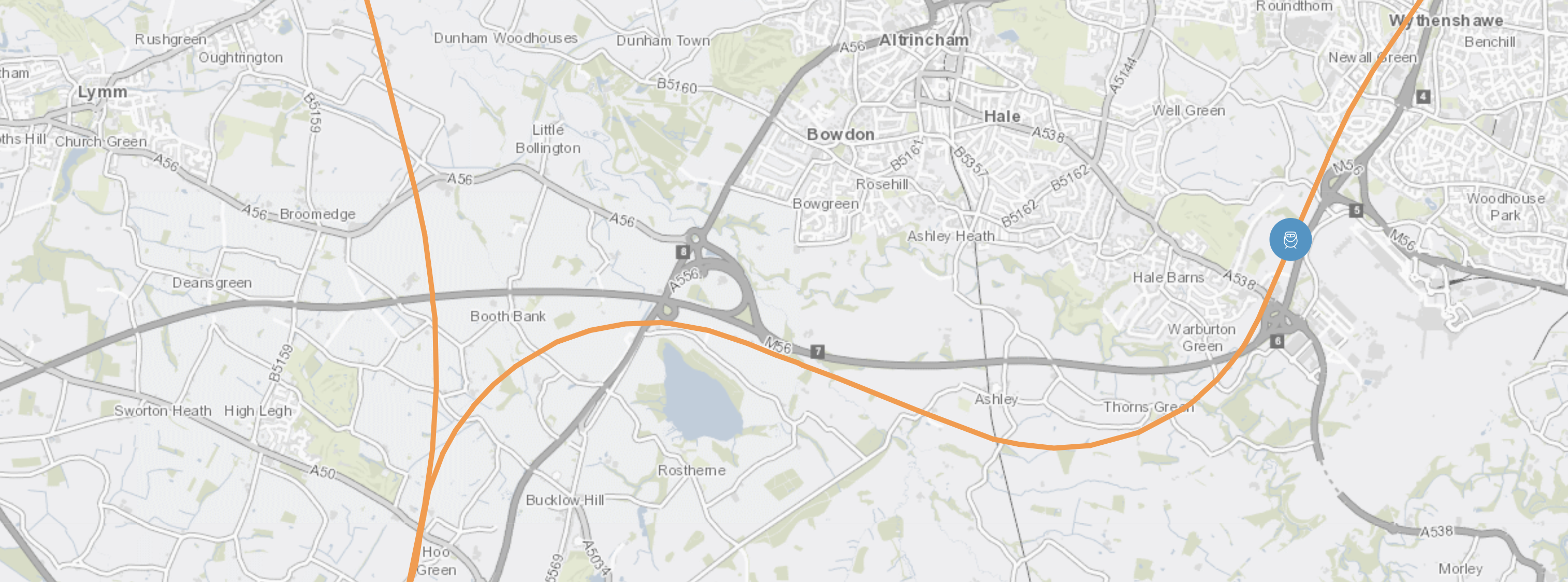
Note.
- The Manchester Branch runs to the South of the M56,
- The large blue dot indicates Manchester Airport station.
- Wigan is to the North.
- Crewe is to the South.
- Manchester Piccadilly is to the North East.
I believe this junction will be turned into a full triangular junction, to connect Wigan directly to Manchester Airport and Manchester Piccadilly.
- Barrow, Blackburn, Blackpool, Preston and Windermere could all have high speed connections to Manchester Airport and Manchester Piccadilly. Trains could be shorter Classic-Compatible trains.
- A Manchester and Scotland service would take the same route.
Another pair of tracks could leave the junction to the West to create a direct route between Manchester Airport and Liverpool for Northern Powerhouse Rail, by sneaking along the M56.
Suppose extra services were as follows.
- Manchester and Barrow – 1 tph
- Manchester and Blackburn – 1 tph
- Manchester and Blackpool – 1 tph
- Manchester and Liverpool – 6 tph
- Manchester and Scotland – 1 tph
- Manchester and Windermere – 1 tph
The frequencies from the junction would be as follows.
- To and from Crewe – High Speed Two (Manchester) – 5 tph – High Speed Two (North) – 3 tph = 8 tph
- To and from Liverpool – Northern Powerhouse Rail – 6 tph = 6 tph
- To and from Manchester – High Speed Two – 5 tph – Northern Powerhouse Rail – 6 tph – Local – 4 tph – Scotland – 1 tph = 16 tph
- To and from Wigan – High Speed Two – 3 tph – Local – 4 tph – Scotland – 1 tph = 8 tph.
Only the Manchester Branch would be working hard.
The Liverpool Connection
I indicated that another pair of tracks would need to extend the Manchester Branch towards Liverpool in the West for Northern Powerhouse Rail.
- Would these tracks have a station at Warrington?
- Would there be a connection to allow services between Liverpool and the North and Scotland?
It might even be possible to design a Liverpool connection, that avoided using the current Liverpool Branch and increased the capacity and efficiency of all trains to Liverpool.
Capacity Of The Western Leg Between Wigan And Scotland
The sections between Crewe and Carlisle, will be running at the following frequencies.
- Wigan and Lancaster – 4 tph
- Lancaster and Carlisle – 3 tph
- Carlisle and Edinburgh – 2.5 tph
- Carlisle and Glasgow – 2.5 tph
Note.
- The unusual Scottish frequencies are caused by splitting and joining at Carlisle and alternate services to Edinburgh and Glasgow.
- Any local high speed services and a Scotland service from Manchester, will increase the frequencies.
Over this section the services will be running on an improved West Coast Main Line.
But in some cases the trains will be replacing current services, so the increase in total frequencies will be less than it first appears.
Avanti West Coast currently run the following Scottish services.
- One tph – London Euston and Glasgow via the most direct route.
- One tph – London Euston and alternately Edinburgh and Glasgow via Birmingham.
This means that effectively Glasgow has 1.5 tph and Edinburgh 0.5 tph from London Euston.
The capacity of the current eleven-car Class 390 trains is 145 First and 444 Standard Class seats, which compares closely with the 500-600 seats given in Wikipedia for High Speed Two trains. So the capacity of the two trains is not that different.
But High Speed Two will be running 2.5 tph Between London Euston and both Edinburgh and Glasgow.
I would expect, that Class 390 services to Scotland will be discontinued and replaced by High Speed Two services.
Capacity Of The Eastern Leg Between Birmingham And East Midlands Hub
The section is between Birmingham and East Midlands Hub, will be running 9 tph
As the maximum capacity of High Speed Two is laid down in the Phase One Act as 18 tph, this gives plenty of room for more trains.
But where will they come from?
Midlands Engine Rail is proposing a service between Birmingham Curzon Street and Nottingham.
- It will have a frequency of one tph.
- It will be run by High Speed Two Classic-Compatible trains.
- The journey will take 33 minutes.
- It will run on High Speed Two infrastructure between Birmingham Curzon Street and East Midlands Hub.
If High Speed Two has been designed with this service in mind, I doubt it will be a difficult service to setup.
- There might be enough capacity on High Speed Two for two tph on the route,
- It could possibly be extended to Lincoln.
It will also depend on the service timing being consistent with an efficient use of trains and platforms.
- Thirty-three minutes is not a good timing, as it means twenty-seven minutes wait in a platform to get a round trip time, that suits clock-face time-tabling.
- The current Lincoln and Nottingham service takes 56 minutes for 34 miles.
- LNER’s London Kings Cross and Lincoln service travels the 16 miles between Lincoln and Newark in 25 minutes.
- I estimate that after track improvements, with a single stop at Newark Castle station, that Nottingham and Lincoln could be achieved in several minutes under fifty minutes.
- This would enable a sub-ninety minute journey time between Birmingham Curzon Street and Lincoln, with enough time to properly turn the trains at both ends of the route.
- The three hour round trip would mean that an hourly service would need three trains.
This is probably just one of several efficient time-tabling possibilities.
Are there any other similar services?
The obvious one is surely Cambridge and Birmingham
- It would run via Peterborough, Grantham, Nottingham and East Midlands Hub.
- It would connect the three big science, engineering and medical centres in the Midlands and the East.
- It could be run by High Speed Two Classic-Compatible trains.
It might even be a replacement for CrossCountry’s Stansted Airport and Birmingham service.
Capacity Of The Eastern Leg Between East Midlands Hub And Sheffield
The section between East Midlands Hub and Sheffield, will be running 2 tph
As the maximum capacity of High Speed Two is laid down in the Phase One Act as 18 tph, this gives plenty of room for more trains.
But where will they come from?
This map of High Speed Two where the Sheffield Branch leaves the new High Speed Two route between East Midlands Hub and Leeds was captured from the interactive map on the High Speed Two web site.
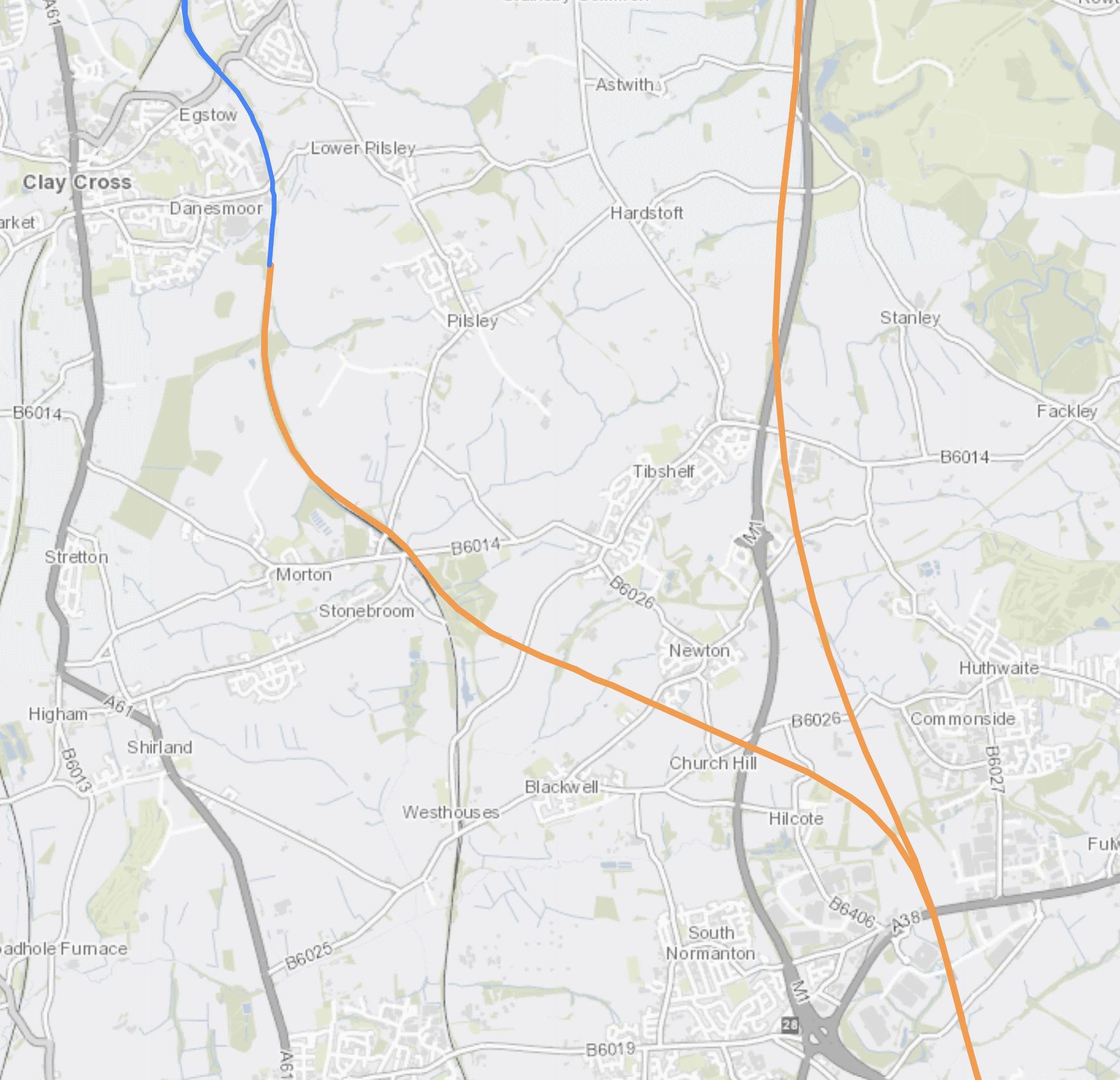
Note.
- The main route of High Speed Two between East Midlands Hub, is shown in orange and follows the route of the M1 Motorway, towards the East of the map.
- The Sheffield Branch is new track to Clay Cross North Junction, where is takes over the Midland Main Line to Sheffield, which is shown in blue.
- The line going South in the middle of the map is the Erewash Valley Line, which goes through Langley Mill and Ilkeston stations.
I suspect Clay Cross to Sheffield will be an electrified high speed line, with a maximum speed of at least 140 mph.
Could the Erewash Valley Line have been used as an alternative route to Sheffield?
This map of High Speed Two captured from their interactive map, shows the connection of High Speed Two and the Erewash Valley Line to East Midlands Hub.
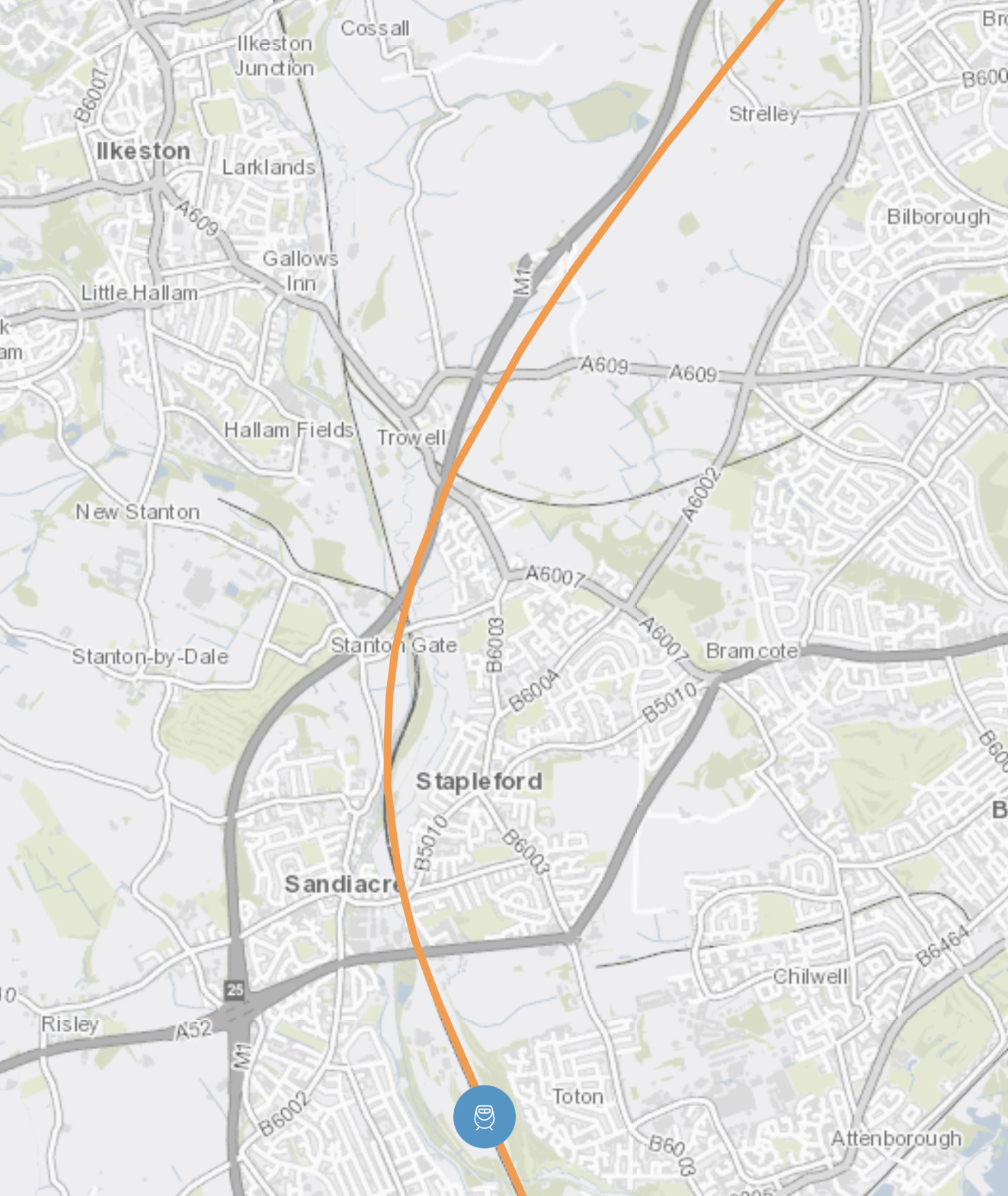
Note.
- East Midlands Hub is shown by the big blue dot.
- High Speed Two is shown in orange.
- The route to Leeds vaguely follows the M1 Motorway.
- The Erewash Valley Line goes North to the East of Ilkeston.
Would have been quicker and easier to electrify the Erewash Valley Line, as the High Speed Two route to Chesterfield and Sheffield?
- Network Rail updated the route a few years ago.
- It does not have the problems of electrification, through a World Heritage Site, as does the route through Derby.
- It could surely handle two tph, even if they were High Speed Two Classic Compatible trains.
- Sheffield will be just under ninety minutes from London by High Speed Two, as opposed to two hours now.
I suspect that it all comes down to saving a few minutes to Sheffield and the civic pride of having a High Speed Two connection.
So it looks like we’ll have the following capacity between East Midlands Hub and Sheffield.
- Between East Midlands Hub and Clay Cross North Junction, there will be the High Speed Two capacity of 18 tph.
- Between Clay Cross and Sheffield, there will probably be an upgraded capacity of perhaps 8-10 tph.
It seems a lot of capacity for just two tph.
Consider.
- High Speed Two is planning to run three tph between Birmingham Curzon Street and East Midlands Hub
- Midlands Rail Engine is planning to run one tph between Birmingham Curzon Street and East Midlands Hub
- Four tph is considered a Turn-Up-And-Go service, and could exist between Birmingham Curzon Street and East Midlands Hub.
- Sheffield and Leeds, both probably need a Turn-Up-And-Go service, to and from East Midlands Hub.
- Semi-fast services between Sheffield and East Midlands Hub, calling at Chesterfield, Alfreton, Langley Mill and Ilkeston would be possible, by using the Erewash Valley Line.
- The Maid Marian Line will join the Robin Hood Line in adding extra connectivity to East Midlands Hub Station.
- Leeds and East Midlands Hub could have a six tph service courtesy of High Speed Two and Midlands Rail Engine.
Using High Speed Two’s web site, the following times should be possible.
- Sheffield and East Midlands Hub – 27 minutes
- Sheffield and Birmingham Curzon Street – 47 minutes.
Both services allow time for an efficient service.
There are certainly many options to create a Turn-Up-And-Go service between Sheffield and East Midlands Hub and also improve connections to other locations across the area.
Capacity Of The Eastern Leg Between East Midlands Hub And Leeds
The section is between East Midlands Hub and Leeds, will be running 5 tph
High Speed Two between Midlands Hub and Leeds is a totally new high speed line.
- As the maximum capacity of High Speed Two is laid down in the Phase One Act as 18 tph, this gives plenty of room for more trains.
- The Southern section of the leg closely follows the M1 Motorway.
- Leeds, York and Newcastle will be 27, 36 and 93 minutes from East Midlands Hub, respectively.
This map of High Speed Two, which shows the route of the line in Yorkshire, was captured from the interactive map on the High Speed Two web site.
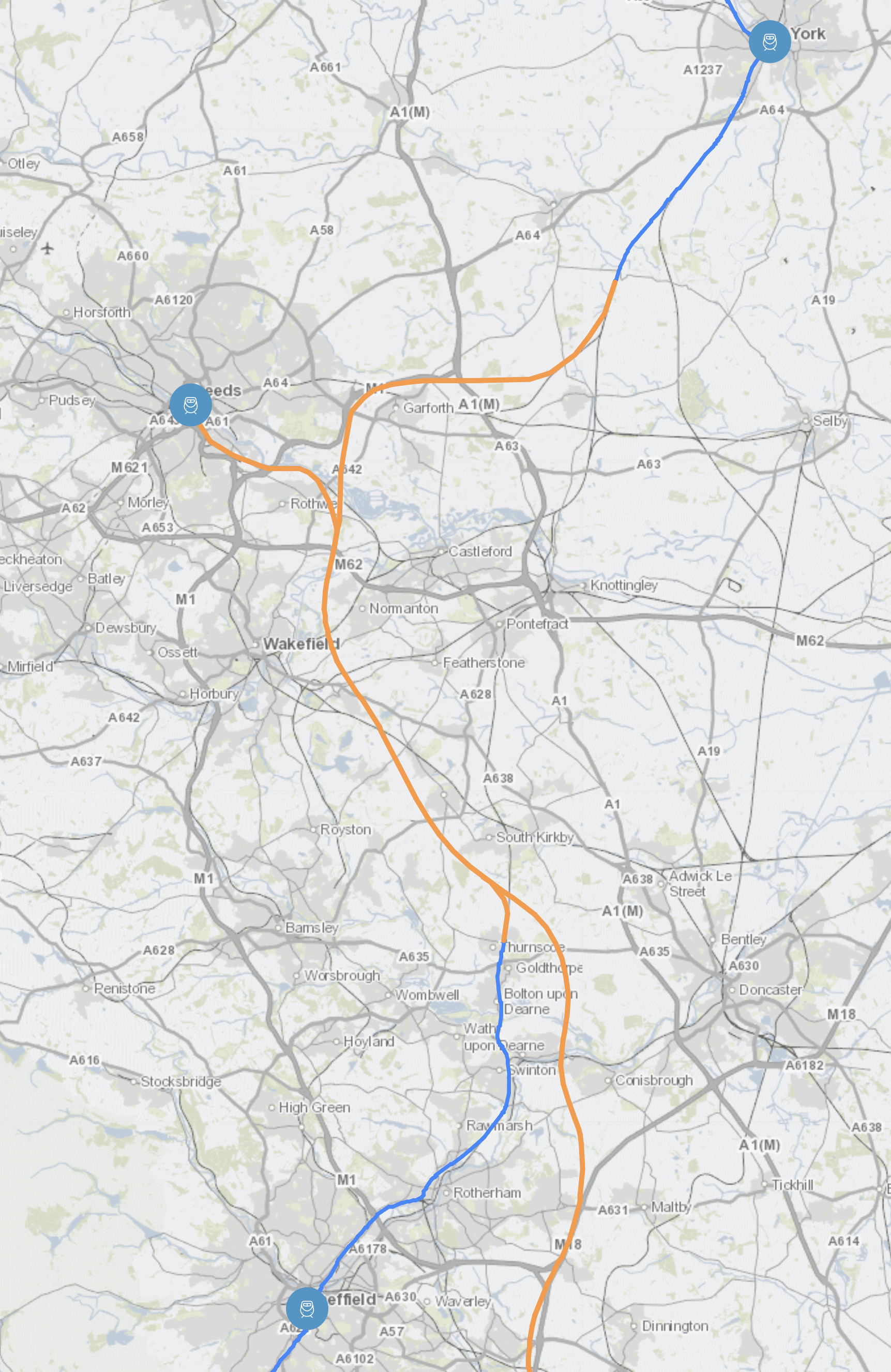
Note.
- Sheffield is marked by the blue dot in the South.
- Leeds is marked by the blue dot in the North West.
- York is marked by the blue dot in the North East.
- New routes are shown in orange.
- Upgraded routes are shown in blue.
The route seems to open up several possibilities for extra routes.
- Leeds and Sheffield will be used by Northern Powerhouse Rail and there will be four tph, taking 28 minutes.
- Leeds and Bedford via East Midlands Hub has been proposed by Midlands Rail Engine.
- Services between Sheffield and the North via York must be a possibility.
This map of High Speed Two, which shows the routes to the East of Leeds, was captured from High Speed Two’s interactive map.
I think that two things might be missing.
- A full triangular junction would surely allow services between Leeds and the North via York.
- A high speed connection to Hull.
We shall see in the future.
Capacity Of The Eastern Leg Between York And Newcastle
The section between York and Newcastle, will be running at a frequency of 3 tph.
Over this section the services will be running on an improved East Coast Main Line.
Conclusion
I shall split the conclusions into various sections.
Route And Track Layout
I think there may be places, where the route and track layout might need to be improved.
- The Manchester Branch probably needs a triangular junction with the Western Leg of High Speed Two.
- How Liverpool is served by Northern Powerhouse Rail needs to be decided.
- The approach to Leeds probably needs a triangular junction with the Eastern Leg of High Speed Two.
- It is not clear how services will reach Hull.
Hopefully, these issues will become clear in the next year or so.
Capacity
The sections with the highest levels of capacity would appear to be the following.
- London Euston and Birmingham Interchange.
- The Manchester Branch
- The section shared with the East Coast Main Line between York and Newcastle.
- The section shared with the West Coast Main Line between Wigan and Scotland.
But on these sections extra trains can be run.
- Birmingham and North West England
- Birmingham and East Midlands Hub
- East Midlands Hub and Leeds
- East Midlands Hub and Sheffield
- East Midlands Hub and York
I can see, this capacity being filled by high speed local services, like those proposed by Midlands Rail Engine.
Rolling Stock
The only comment, I will make, is that there could be a need for a shorter Classic-Compatible train to work local services.
 The Anonymous Widower