Should All High Speed Long Distance Services To Newcastle Extend To Edinburgh?
Look at this Google Map of Newcastle station.
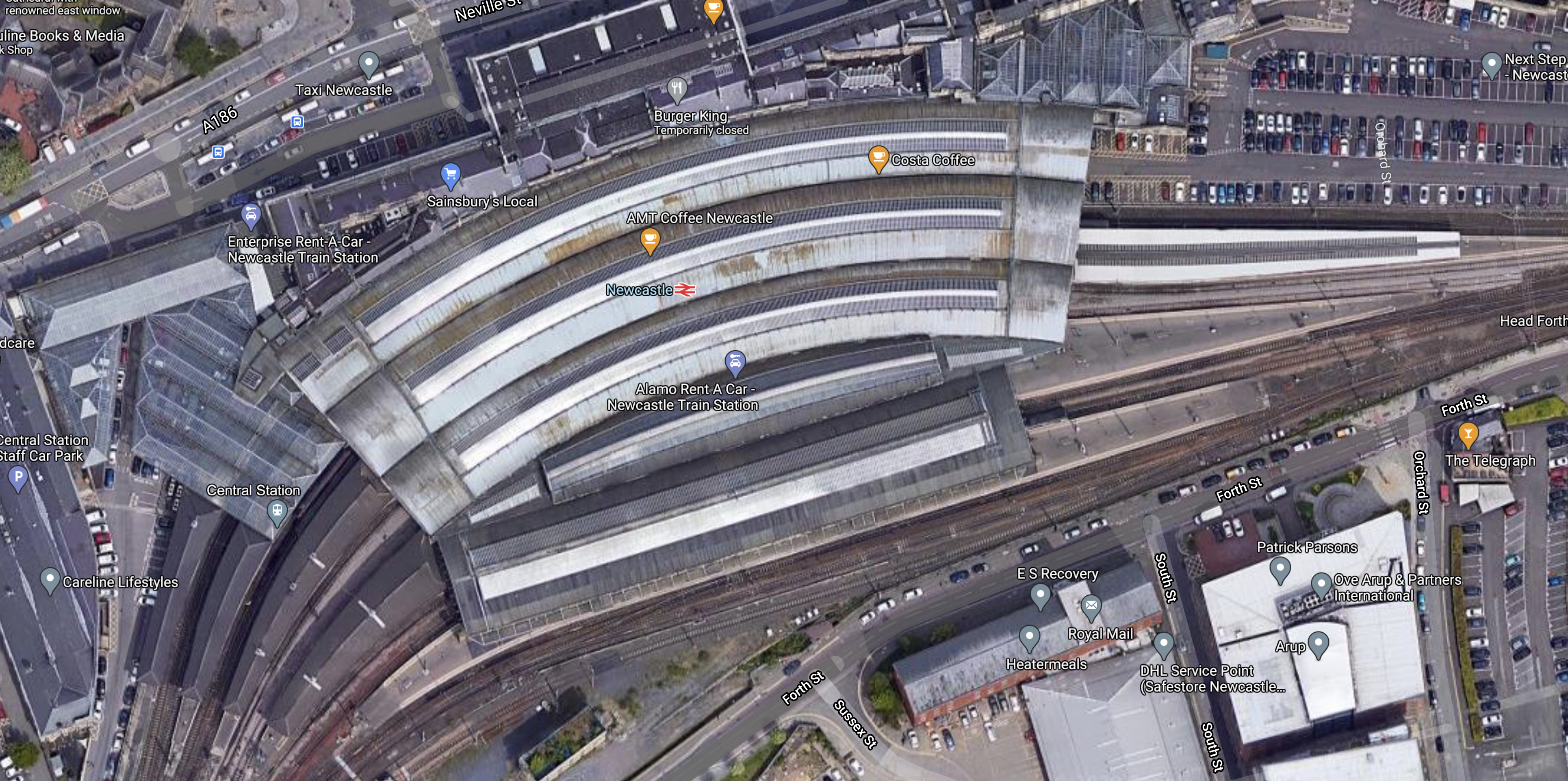
Note.
- It is built on a curve.
- It is on a cramped site.
- Platforms are numbered from 1 at the top to 8 at the bottom.
- Platform 2 seems to be used for all express services going North.
- Platforms 3 and 4 seem to be used for all express services going South.
- Not all platforms would appear to be long enough for nine-car Class 80x trains.
I am certain, that any nation with a sophisticated railway system wouldn’t build a station on a curve with no avoiding lines like Newcastle these days.
Network Rail have a plan to sort out Darlington station and I’m sure they’d like to sort out Newcastle as well!
Current Long Distance Trains Through And To Newcastle
These include.
- CrossCountry – Plymouth and Edinburgh or Glasgow via Alnmouth, Berwick-upon-Tweed and Dunbar.
- CrossCountry – Southampton Central or Reading and Newcastle.
- LNER – King’s Cross and Edinburgh via Berwick-upon-Tweed
- LNER – King’s Cross and Edinburgh via Alnmouth
- TransPennine Express – Liverpool Lime Street and Edinburgh via Morpeth
- TransPennine Express – Manchester Airport and Newcastle.
Note.
- All have a frequency of one train per hour (tph)
- All trains call at Newcastle.
- Two tph terminate at Newcastle and four tph terminate at Edinburgh or beyond.
There is also a new and Edinburgh service from East Coast Trains, that will start this year.
- It will run five trains per day (tpd).
- It will call at Newcastle.
- It will stop at Morpeth between Newcastle and Edinburgh.
There will also be High Speed Two services to Newcastle in a few years.
- There will be two tph between Euston and Newcastle
- There will be one tph between Birmingham Curzon Street and Newcastle.
Note.
- All services will be run by 200 metre long High Speed Two Classic-Compatible trains.
- There is no High Speed Two service to Newcastle, that calls at Leeds.
- Only one High Speed Two service to Newcastle calls at East Midlands Hub.
I suspect High Speed Two services need a dedicated platform at Newcastle, especially, if another High Speed Two service were to be added.
Extra Paths For LNER
In the December 2020 Edition of Modern Railways, there is an article, which is entitled LNER Seeks 10 More Bi-Modes.
This is the last paragraph.
Infrastructure upgrades are due to prompt a timetable recast in May 2022 (delayed from December 2021), from which point LNER will operate 6.5 trains per hour out of King’s Cross, compared to five today. As an interim measure LNER is retaining seven rakes of Mk. 4 coaches hauled by 12 Class 91 locomotives to supplement the Azuma fleet and support its timetable ambitions until new trains are delivered.
There would certainly appear to be a path available if LNER wanted to increase the frequency of trains between King’s Cross and Edinburgh from the current two trains per hour (tph) to three.
I laid out how I would use this third path to Edinburgh in A New Elizabethan.
The Possible Long Distance Trains Through And To Newcastle
These trains can be summed up as follows.
- 1 tph – CrossCountry – Plymouth and Edinburgh or Glasgow via Alnmouth, Berwick-upon-Tweed and Dunbar.
- 1 tph – CrossCountry – Southampton Central or Reading and Newcastle.
- 1 tph – LNER – King’s Cross and Edinburgh via Berwick-upon-Tweed
- 1 tph – LNER – King’s Cross and Edinburgh via Alnmouth
- 1 tph – TransPennine Express – Liverpool Lime Street and Edinburgh via Morpeth
- 1 tph – TransPennine Express – Manchester Airport and Newcastle.
- 5 tpd – East Coast Trains – King’s Cross and Edinburgh via Morpeth
- 2 tph – High Speed Two – Euston and Newcastle
- 1 tph – High Speed Two – Birmingham Curzon Street and Newcastle
- 1 tph – LNER – King’s Cross and Edinburgh – Extra service
This is ten tph and the five tpd of East Coast Trains.
Capacity Between Newcastle And Edinburgh
I wonder what capacity and linespeed would be possible on the East Coast Main Line between Newcastle and Edinburgh.
There are a few freight trains and some suburban electrics at the Northern end, but I suspect that the route could handle ten tph with some upgrades.
Edinburgh As A Terminal
Consider.
- Not all trains terminate at Edinburgh, but several tpd go through to places like Aberdeen, Glasgow, Inverness and Stirling.
- Edinburgh has several shorter East-facing bay platforms, that can take five-car Class 802 trains.
- Edinburgh has undergone a lot of reconstruction in recent years, so that it can turn more trains.
I very much feel that Edinburgh could handle, at least ten tph from the South.
Conclusion
I think it would be possible to extend all trains to Newcastle to at least Edinburgh.
Would it increase passenger capacity between the two capitals?
It would certainly avoid the difficult and expensive rebuilding at Newcastle station.
Department Of Transport Claims London and Sheffield Times Could Be Cut By Thirty Minutes
In this article on the BBC, which is entitled Government Announce £401m Boost For Rail Services, this is said.
The funding announcement coincided with the completion of the first phase of the £1.5bn Midland Main Line Upgrade, which has supported the launch of East Midlands Railway’s (EMR) first electric services on the route between Corby in Northamptonshire and London St Pancras.
The project will see journey times between Sheffield and London cut by up to 30 minutes, the DfT said.
So how feasible is the claim of a thirty minute cut in London and Sheffield timings?
On Monday, the 07:30 train from London to Sheffield, covered the 164.7 miles in two hours and twelve minutes at an average speed of 74.9 mph.
If that train had done the trip in one hour and forty-two minutes, that would have been an average speed of 96.9 mph.
By the time, the new Class 810 trains arrive in a couple of years, they will be able to use the new electrification to Market Harborough, when on Monday the 82.8 miles without a stop, was covered in an hour, at an average speed of 82.8 mph.
These new trains are 125 mph electric trains under the wires and they will have two separate fast lines on which to run.
Example time savings at various average speeds to Market Harborough are as follows.
- 100 mph – 10 minutes saving.
- 110 mph – 14.8 minutes saving.
- 125 mph – 20.3 minutes saving
- 130 mph – 21.8 minutes saving
- 140 mph – 24.6 minutes saving
Note.
- The faster the average, the greater the time saving.
- Faster than 125 mph would only be possible with full in-cab digital signalling, which is currently being installed on the East Coast Main Line.
- I have been to Leicester in an InterCity 125, which was running at 125 mph most of the way.
But it does look like the new Class 810 trains will be able to save around twenty minutes to Sheffield, by making full use of the electrification between London and Market Harborough.
They would need to save just ten minutes between Market Harborough and Sheffield.
The Monday Train covered the 81.9 miles between Market Harborough and Sheffield in one hour and twelve minutes, which is an average speed of 68.3 mph.
To obtain the saving of ten minutes, it would need to do the journey in one hour and two minutes, which would be an average speed of 79.3 mph.
Given that the new Class 810 trains are designed to cruise at 125 mph on diesel, I don’t think this is an impossible objective.
What Will Be The Ultimate Time Between London and Sheffield On The Midland Main Line?
I believe that the following two sections of the Midland Main Line can be easily electrified.
- Between Leicester and Derby without the problem of the bridge at the South end of Leicester station, which would be so disruptive.
- Clay Cross North Junction and Sheffield which will be electrified for High Speed Two. I doubt Derby and Clay Cross Junction will be electrified as it’s a World Heritage Site.
On my Monday train, the following are times North of Leicester.
- Leicester and Derby is 29.3 miles, which is covered in 32 minutes at an average speed of 55 mph, which includes five stops. Raise this to 110 mph and the journey time is just 16 minutes or a saving of 16 minutes.
- Derby and Clay Cross North Junction is 21.8 miles, which is covered in 13 minutes at an average speed of 100 mph. By averaging 120 mph, there would be a saving of 2.1 minutes.
- Cross North Junction and Sheffield is 15.5 miles, which is covered in 16 minutes at an average speed of 58.2 mph.
Note.
- Savings would come between Leicester and Derby because of 125 mph linespeed and faster stops because of electrification.
- I believe that Hitachi battery-electric trains could sustain 125 mph on battery alone between Derby and Clay Cross North Junction, if they entered the section without electrification at full speed with full batteries. Now that is what I call a battery-electric train!
- There must be a minute or two to be saved on an electrified section into Sheffield with the stop at Chesterfield.
Add up all the savings and I feel that an hour and a half is possible between London and Sheffield.
And what time is High Speed Two claiming? One hour and twenty-seven minutes!
Could A Battery-Electric Train Cruise At 125 mph?
This may seem a silly idea, but then trains don’t care where they get their electricity from.
On the 21.8 miles between Derby and Clay Cross North, a sizeable proportion of energy will be used to accelerate the train up to the linespeed for the electrified section.
When the train enters the section without electrification, it will have two sources of energy.
- The electricity in the full batteries.
- The kinetic energy in the train at the required speed.
As the train runs through the section air and rolling resistance will tend to slow the train and electricity from the battery will be used to maintain speed.
In How Much Power Is Needed To Run A Train At 125 mph?. I estimated that for a Class 801 train to maintain 125 mph needs 3.42 kWh per vehicle mile.
A simple sum of 21.8 * 5 * 3.42 gives an energy need of 372.8 kWh to run between Derby and Clay Cross North Junction.
I’m sure than Hitachi can fit a 400 kWh battery in a five-car Class 810 train.
Would a slightly larger battery and in-cab signalling allow battery-electric trains to run at 140 mph? If the track allowed it, I don’t see why not!
Conclusion
I believe the Department of Transport’s statement of saving thirty minutes between London and Sheffield is feasible.
But so is a time of an hour-and-a half, which will give High Speed Two a run for its money!
A New Elizabethan
I can remember The Elizabethan, which was a steam-hauled non-stop express between London and Edinburgh between 1953 and 1961.
- The steam-hauled train took six-hours-and-a-half.
- It used to be the longest non-stop railway service in the world.
- Today, the service could be run by the current or refurbished Azumas or perhaps a new flagship train, built for the service.
- It could be easily under four hours.
It could be an interesting concept, to increase capacity between London and Edinburgh.
The Fastest Rail Journey Between London King’s Cross And Edinburgh
This section in the Wikipedia entry for the Class 91 locomotive is entitled Speed Record. This is the first paragraph.
A Class 91, 91010 (now 91110), holds the British locomotive speed record at 161.7 mph (260.2 km/h), set on 17 September 1989, just south of Little Bytham on a test run down Stoke Bank with the DVT leading. Although Class 370s, Class 373s and Class 374s have run faster, all are EMUs which means that the Electra is officially the fastest locomotive in Britain. Another loco (91031, now 91131), hauling five Mk4s and a DVT on a test run, ran between London King’s Cross and Edinburgh Waverley in 3 hours, 29 minutes and 30 seconds on 26 September 1991. This is still the current record. The set covered the route in an average speed of 112.5 mph (181.1 km/h) and reached the full 140 mph (225 km/h) several times during the run.
Seconds under three-and-a-half-hours was an amazing time nearly thirty years ago, from a short-formation InterCity 225, that went on to become the mainstay of the services on the route.
It makes High Speed Two’s proposed time of three hours and forty-eight minutes appear to lack ambition.
But to be fair to High Speed Two, train services have historically been faster on the the East side of Great Britain.
What Time Could Be Possible Between London King’s Cross And Edinburgh?
In What Is Possible On The East Coast Main Line?, I took a hard look at times on the route, taking into account improvements of the last thirty years and those that will happen in the next few.
This was my conclusion.
I started by asking what is possible on The East Coast Main Line?
As the time of three-and-a-half hours was achieved by a short-formation InterCity 225 train in 1991 before Covids, Hitchin, Kings Cross Remodelling, Power Upgrades, Werrington and lots of other work, I believe that some journeys between Kings Cross and Edinburgh could be around this time within perhaps five years.
To some, that might seem an extraordinary claim, but when you consider that the InterCity 225 train in 1991 did it with only a few sections of 140 mph running, I very much think it is a certainly at some point.
As to the ultimate time, earlier I showed that an average of 120 mph between King’s Cross and Edinburgh gives a time of 3:16 minutes.
Surely, an increase of fourteen minutes in thirty years is possible?
I believe that timings will decrease significantly on the East Coast Main Line with the current trains.
Extra Paths For LNER
In the December 2020 Edition of Modern Railways, there is an article, which is entitled LNER Seeks 10 More Bi-Modes.
This is the last paragraph.
Infrastructure upgrades are due to prompt a timetable recast in May 2022 (delayed from December 2021), from which point LNER will operate 6.5 trains per hour out of King’s Cross, compared to five today. As an interim measure LNER is retaining seven rakes of Mk. 4 coaches hauled by 12 Class 91 locomotives to supplement the Azuma fleet and support its timetable ambitions until new trains are delivered.
There would certainly appear to be a path available if LNER wanted to increase the frequency of trains between London King’s Cross and Edinburgh from the current two trains per hour (tph) to three.
What Would Be The Route?
I feel there could be three possible simple routes.
- A direct non-stop London King’s Cross and Edinburgh service.
- A London King’s Cross and Edinburgh service with a single stop at Newcastle.
- A London King’s Cross and Edinburgh service with stops at Leeds and Newcastle.
Each route would have its own advantages and drawbacks.
Route 1
My thoughts about Route 1.
- This would be the fastest route.
- It would be a serious challenge to the airlines on the London and Edinburgh route.
It would be a marketing man’s dream.
Route 2
My thoughts about Route 2.
- This would be the second fastest route.
- It would be a serious challenge to the airlines on the London and Edinburgh route.
- It would give Newcastle a third hourly service to the capital.
- It would give Newcastle a non-stop train to London every hour.
- It would probably be the fastest train between King’s Cross and Newcastle.
- It would beef up the challenge to the airlines on the London and Newcastle route.
Serving Newcastle may generate extra passengers.
Route 3
My thoughts about Route 3.
- This would be the slowest route as it is 23 miles longer.
- It would be a challenge to the airlines on the London and Edinburgh route.
- It would give Newcastle and Leeds a third hourly service to the capital.
- It would give Leeds a non-stop train to London every hour.
- It would probably be the fastest train between London and Leeds.
- It would beef up the challenge to the airlines on the London and Newcastle and London and Leeds routes.
- There could be an extra call at York
Serving Leeds and Newcastle may generate extra passengers.
Obviously, passenger numbers will determine the best route.
Conclusion
I very much feel that properly thought through, this service could be a success.
Would A Mutant Many-Parent Child Help To Solve London’s Transport Problems?
London needs to increase the capacity of its public transport system, as the City continues to get larger and larger.
Current Major Projects
There are only three major rail projects ongoing in London at the present time.
The Bank Station Upgrade
The Bank Station Upgrade appears to be progressing well, albeit perhaps it’s a bit late due to the pandemic.
It is a complex project and from what I have heard and observed, it has been well designed and planned.
The Barking Riverside Extension
As with the Bank Station Upgrade the Overground extension to the new Barking Riverside station, appears to be going reasonably well.
But compared to that project, it is a relatively simple project, built mainly in the open air, with no tunneling.
Crossrail
Crossrail is in trouble, after what many believe was a very good tunnelling phase of the project.
But then tunnels under London usually seem to go well. I can remember the Victoria Line tunnelling and many other under London since the 1960s and all of these tunnels seem to have been dug without trouble. As I write, there don’t seem to be any tunneling problems with the Thames Tideway Tunnel.
Crossrail now has been reduced to a series of station builds and rebuilds, some of which are as large as the Bank Station Upgrade, with other ongoing projects like the testing of trains and systems.
So why are some of these stations running late in their delivery?
If you walk along the route of Crossrail in the City of London and through Clerkenwell and the West End, it is one massive building side as developers raise massive clusters of new developments around and above the Crossrail stations.
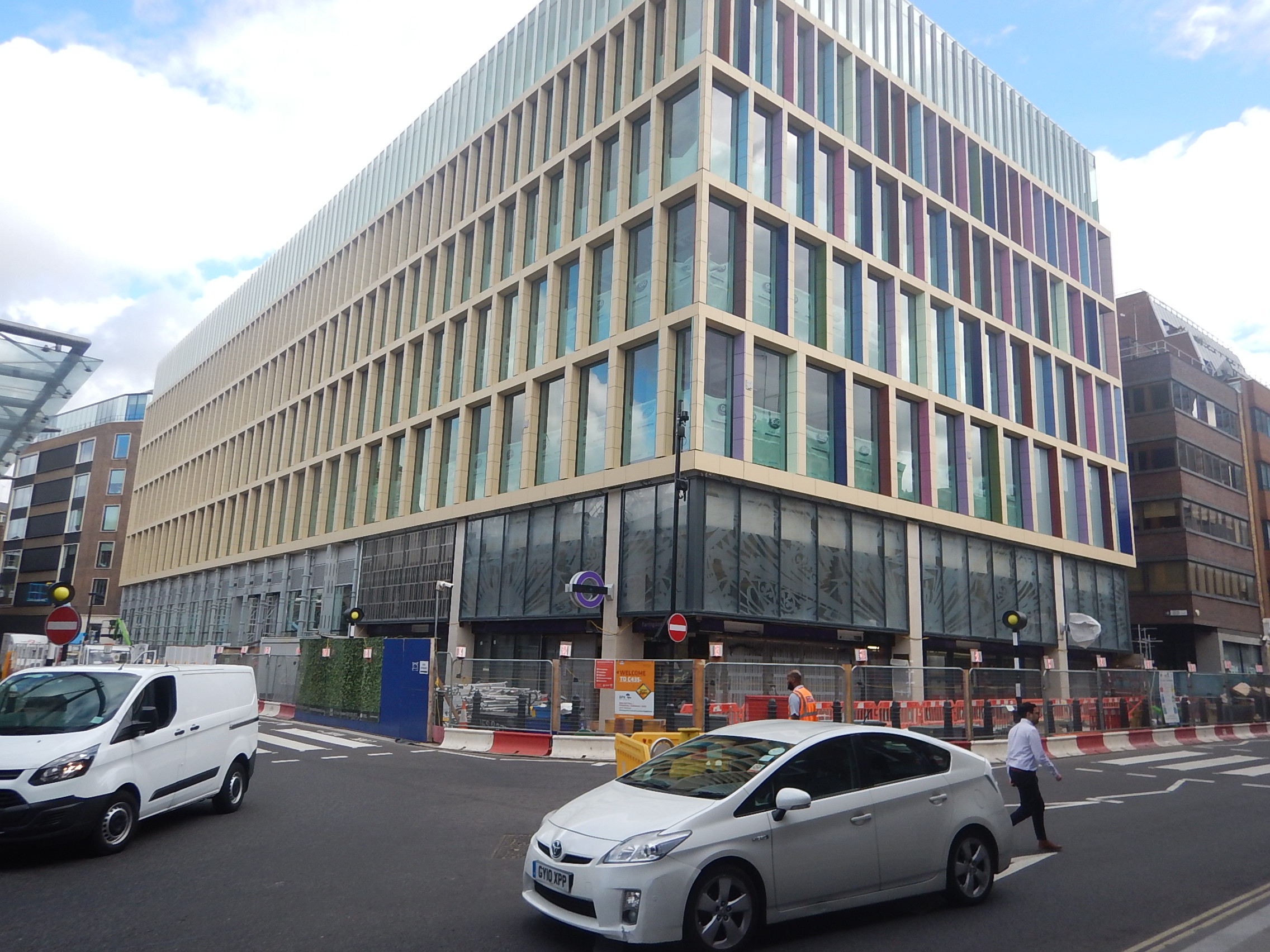
The picture shows Farrington station’s Eastern entrance, with a new development on top.
This one wasn’t a big one, but it went up in record time.
These buildings are often funded by Sovereign Wealth Funds, who want their buildings finished ASAP and as they have bottomless pockets, they are prepared to pay more to get the builders and tradesmen they need.
And where did they get the workers from? Other projects, including Crossrail.
This problem happened in Aberdeen at the height of the oil boom in the last century.
I also think that Brexit worsened the problem, as workers from mainland EU moved to large projects closer to home, like Stuttgart 21 and the new Berlin Brandenburg airport, that were both very much in trouble and could have been offering premium salaries as well!
The solution would have been to phase developments so that the limited pool of workers was not exhausted.
But that probably wouldn’t have suited the developers and politicians for all sorts of reasons.
- An uncompleted building doesn’t bring in money and jobs.
- Early completion must improve chances of letting the building.
- Delaying the building would probably have meant fewer holidays for politicians in exotic locations.
Hopefully, a comprehensive enquiry into the lateness of Crossrail will provide answers.
High Speed Two
High Speed Two is to my mind a London local project. But only in a secondary way!
- Rebuilding Euston station will improve Underground connections and interchange at Euston and Euston Square stations.
- It is claimed by High Speed Two, that the rebuilt Euston station will create 16000 jobs and 2200 homes.
- High Speed Two will enable massive development at Old Oak Common, with tens of thousands of homes and jobs.
- Old Oak Common station will be a very important rail hub in North-West London.
With seventeen trains per hour (tph) between Euston and Old Oak Common will High Speed Two attract local traffic?
- I suspect High Speed Two between Manchester Airport and Manchester Piccadilly and between Birmingham Interchange and Birmingham Curzon Street will also attract local traffic.
- I’ve used TGVs between Nice and Antibes.
- Tourists might visit, just like they did and still do at the Olympic Park.
- Many Londoners will join High Speed Two at Old Oak Common.
Some wag will suggest putting it on the Tube Map. But is it such a stupid idea?
Where Does London Need More Rail Services?
Having lived in London on and off for over seventy years, I feel the worst areas for rail links are probably.
- North West London
- South East London
- South Central London between Wimbledon and Croydon.
- South West London
Note.
- Over the years, there is no doubt that East and North London have improved considerably, with the development of the East London, North London and Gospel Oak to Barking Lines.
- Thameslink has been improved in North London and now it is being supported with improvements to the Northern City Line. Both routes now have new Siemens trains, which give a whole new dimension to using ironing-boards as seats.
- Crossrail will produce major improvements in West, East and South East London.
- Building of a new Penge Interchange station, which I wrote about in Penge Interchange could improve routes to and from South East London.
- Hopefully the work in recent years at Waterloo will improve suburban services out of Waterloo. In An Analysis Of Waterloo Suburban Services Proposed To Move To Crossrail 2, I showed that four tph could be run to Chessington South, Epsom, Hampton Court and Shepperton stations.
It looks like North West and South Central London are missing out.
How Can Services Be Improved In North West London?
There are radial routes from the centre of London to the suburbs.
Starting from the North and going to the West, there are the following lines.
- The High Barnet branch of the Northern Line
- The Mill Hill East branch of the Northern Line
- The Midland Main Line to St. Albans, Luton, Bedford and the East Midlands.
- The Edgware branch of the Northern Line
- The Jubilee Line to Stanmore
- The West Coast Main Line to Watford, Milton Keynes, the West Midlands, the North West of England and West Scotland.
- The Bakerloo Line to Harrow & Wealdstone.
- The Watford DC Line of the London Overground
- The Amersham, Chesham and Watford branches of the Metropolitan Line
- The Chiltern Route to Aylesbury.
- The Chiltern Main Line to High Wycombe, Banbury, Bicester, Birmingham and Oxford.
- The West Ruislip branch of the Central Line.
- The Uxbridge branch of the Metropolitan and Piccadilly Lines
When I used to live at Cockfosters as a child, to visit my many cousins in North West London, there was no alternative but to use a bus and take well over an hour each way.
There are now some circular rail routes in London but nothing in the North West of the capital.
The Dudding Hill Line And The West London Orbital Railway
But there is the little-used freight route called Dudding Hill Line.
- It runs between Cricklewood on the Midland Main Line and Acton Central on the North London Line.
- It is four miles of double-track railway.
This YouTube video shows a cab ride from Acton to Cricklewood.
Plans exist to turn it into the West London Orbital Railway, which will run two services.
- West Hampstead and Hounslow via Cricklewood, Neasden, Harlesden, Old Oak Common Lane, Acton Central, South Acton, Lionel Road, Brentford, Syon Lane and Isleworth
- Hendon and Kew Bridge via Brent Cross West, Neasden, Harlesden, Old Oak Common Lane, Acton Central, South Acton
Note.
- The proposed frequency of both services is four tph.
- There would be some stations to be built, but the track exists.
- There would be no new tunnels.
- The route is technically feasible.
- The route would connect West London to High Speed Two.
- There would be little disruption whilst it was built.
- The services could be run by dual-voltage battery-electric trains charged on the electrification at both ends of the route.
- The scheme represents a high value for money, with a benefit-cost ratio (BCR) of 2.2.
On the other hand, the scheme has two serious problems, as far as the current London Mayor is concerned.
- Transport for London has no money, partly because of London’s Fare Freeze.
- The project is not in South London.
This important and value-for-money project will not be built, whilst Sadiq Khan is still Mayor of London.
Harlesden Interchange
I believe that if we get the interchanges right on the West London Orbital Railway correct we can do things like.
- Increase the benefit cost ratio.
- Link the route to South London to make the Mayor a bit happier about the North London Scheme.
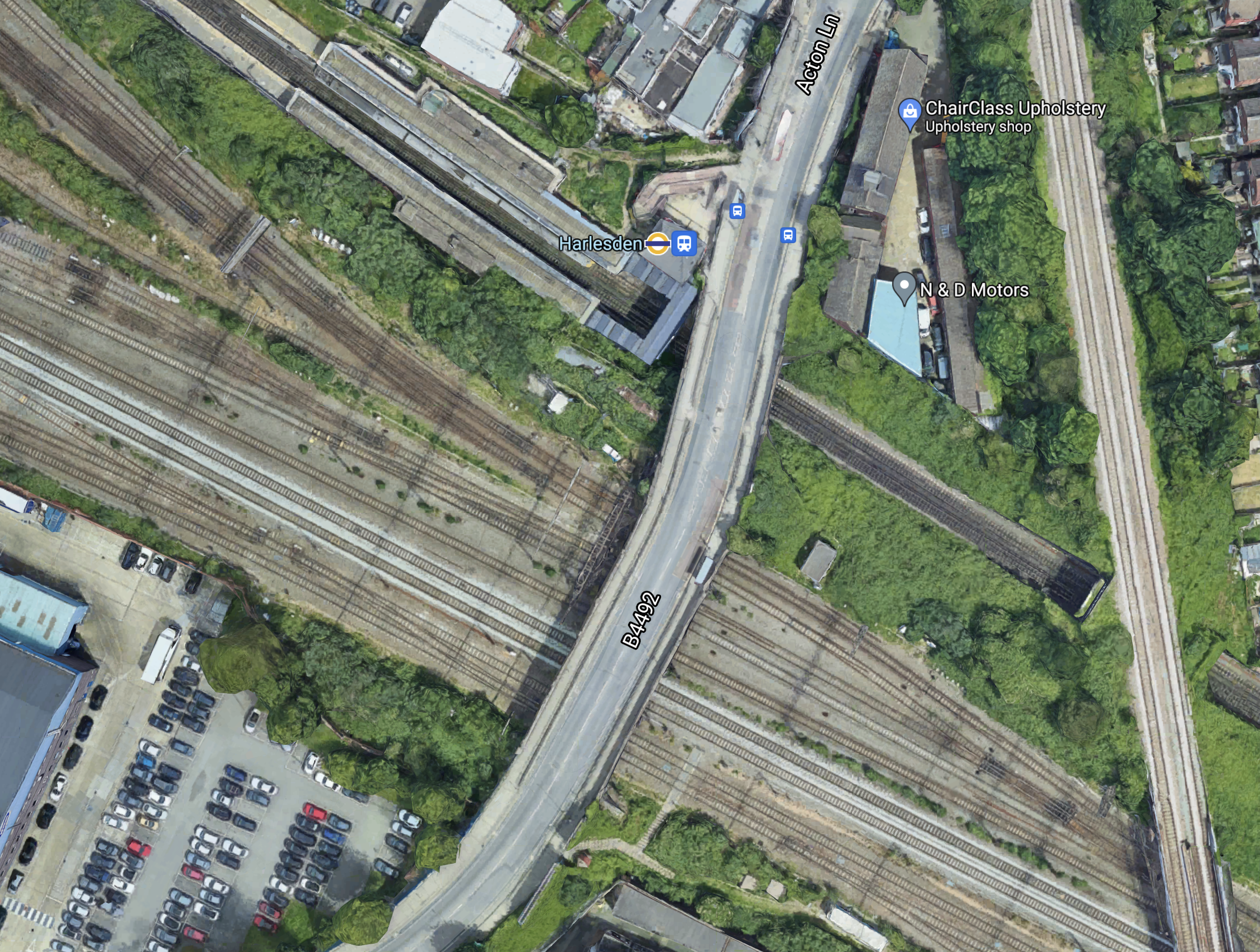
This Google Map shows Harlesden station.
Note.
- The Bakerloo Line/Watford DC Line running North-West/South-East through Harlesden station.
- The West Coast Main Line in the Southern section of the map.
- The Dudding Hill Line running North-South across the map.
Platforms will be built on the Dudding Hill Line to connect that would probably be new or extended platforms in the current Harlesden station to enable interchange between the West London Orbital and the Watford DC Lines.
I also think there is a possibility that platforms could be added to the slow tracks of the West Coast Main Line, so that suburban services into London Euston can also connect to the West London Orbital Line.
It would also enable a connection between Southern’s Clapham Junction and Milton Keynes service and the West London Orbital Railway.
Looking at this from various angles, I think that an architect good at designing three-dimensional structures could develop a quality Harlesden Interchange station.
Neasden Interchange
Like Harlesden, Neasden is another possibility for a comprehensive interchange.
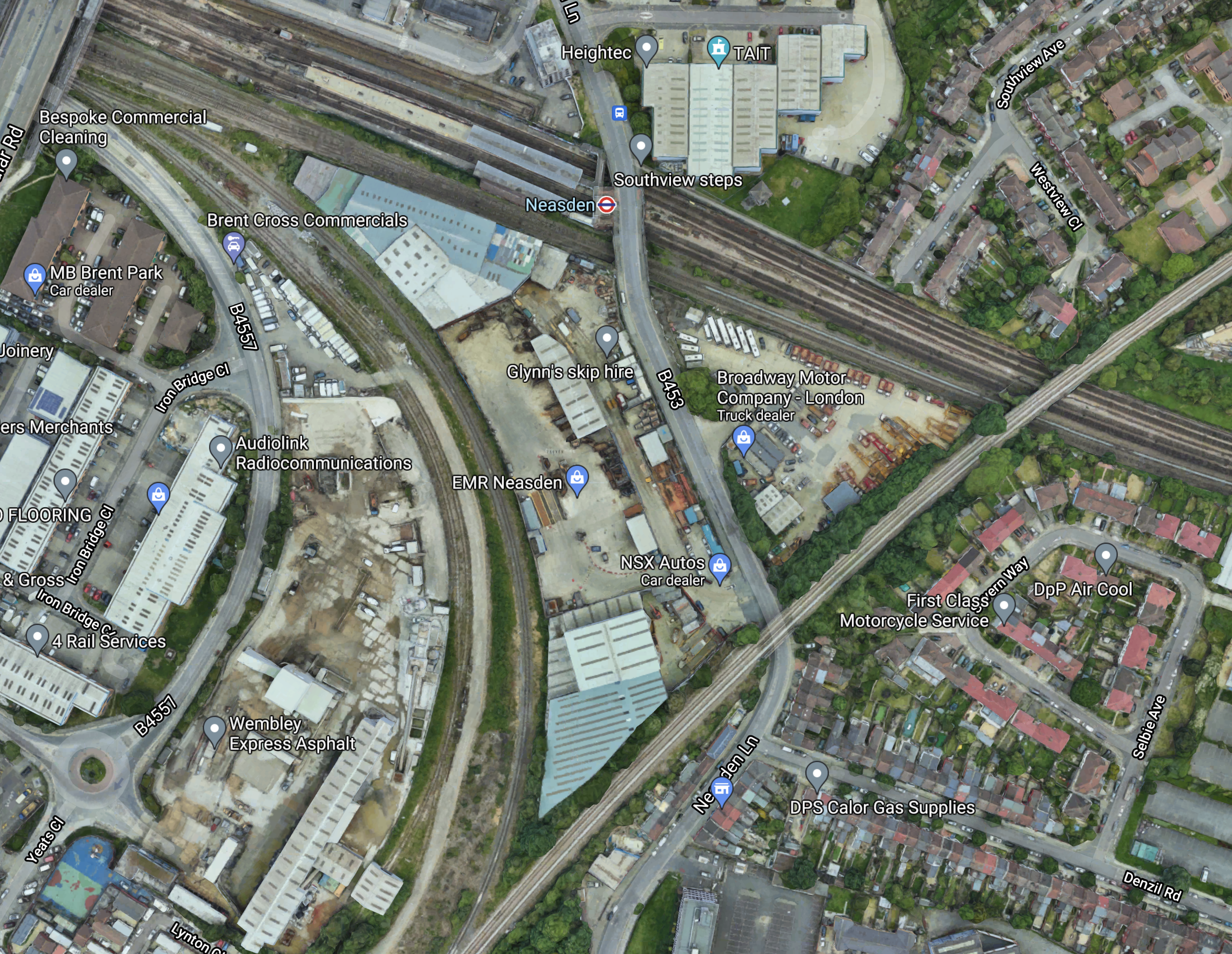
This Google Map shows Neasden station.
Note.
- There are a lot of lines going through Neasden station.
- The Dudding Hill Line goes across the South-East corner of the map.
- There is plenty of space in the area.
This map from cartometro.com shows the lines in the area.
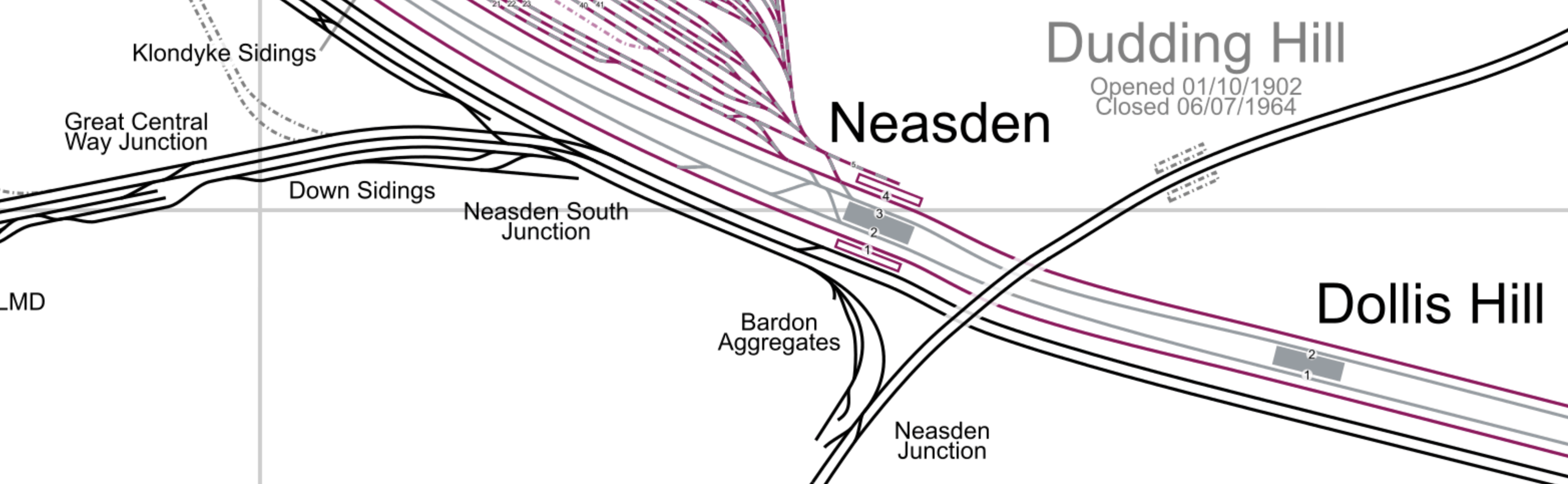
Note.
- The Dudding Hill Line is indicated by the former Dudding Hill station.
- The red tracks are Metropolitan Line tracks.
- The silver tracks are Jubilee Line tracks.
- The Southerly pair of lines through Neasden and Dollis Hill stations are Chiltern’s lines into Marylebone.
- The Chiltern tracks divide to the West of Neasden station, with the Aylesbury line following the other tracks and the Chiltern Main Line diverging to the West.
- London’s largest Underground Depot at Neasden, lies to the North-West in an area of London noted for few merits with the North Circular Road passing through.
I wonder, if the station and the depot offers a unique opportunity to offer large scale additions to London’s housing stock over the top of a rebuilt station and depot.
This Google Map shows the wider area.
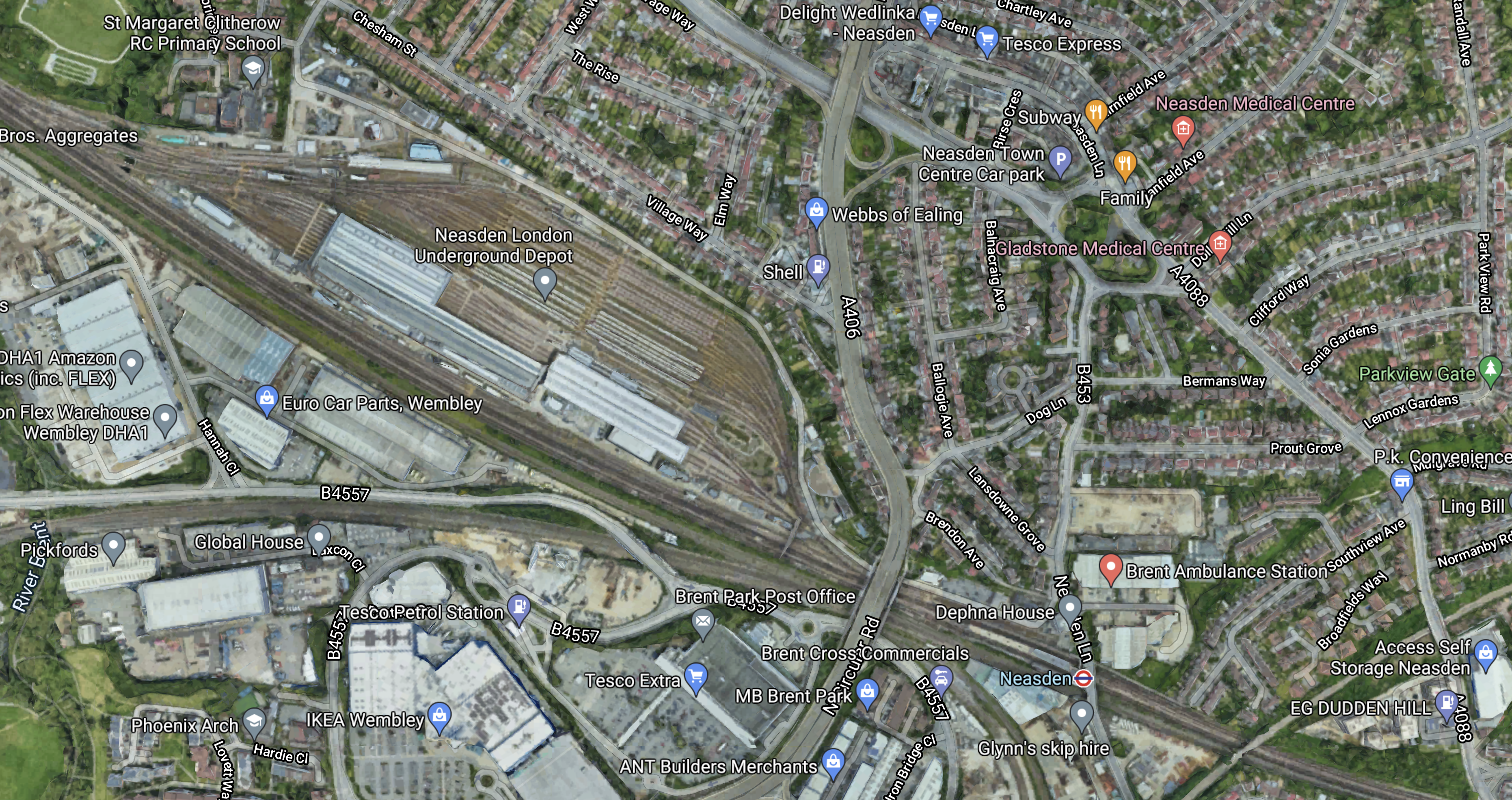
Note.
- Much of the depot appears to be open-air stabling for trains.
- The North Circular Road passes North-South between the depot and Neasden station.
- The Dudding Hill Line cuts across the South-East corner of the map.
- This corner of the map is labelled as Dudden Hill.
- According to Wikipedia, Dudding Hill is considered a more genteel spelling of Dudden Hill and could be as old as 1544.
It looks as if it would be relatively easy to develop over the top of the depot to create housing, industrial or commercial properties.
But why stop there and cover both the North Circular Road and the six tracks through Neasden station?
Neasden station could be rebuilt into a station with platforms on the following lines.
- Metropolitan Line
- Jubilee Line
- Chiltern Lines
- Dudding Hill Lines
Note.
- I estimate that Chiltern has a train about every six minutes, so some could stop.
- There might be space for a bay platform for Chiltern.
Neasden could be a major housing and transport hub.
- There could be large amounts of parking.
- Road access would be good.
- It would have good rail connections.
- It could have a bus interchange.
- London needs housing.
It might even be an alternative to Chiltern’s plan for a West Hampstead Interchange.
The Mayor of London, Transport for London and the Borough of Brent need to be bold!
Improvements To Chiltern’s Routes
Chiltern Railways have some plans that could improve services in North West London.
Using The Acton-Northolt Line
Wikipedia says this about using the Acton-Northolt Line to access new platforms at Old Oak Common station.
Upgrading the Acton–Northolt line (formerly the “New North Main Line”) to new platforms at Old Oak Common. This upgrade will also extend to London Paddington to increase capacity on the Chiltern Main Line as there is no room to expand the station at Marylebone.
This scheme has merit.
- The platforms would be connected to the Chiltern Main Line along the route of a partly-disused railway.
- The route could be double-tracked.
- There must be space for at least two new platforms.
- The new platforms could easily handle four tph.
- There may be a case for some new stations.
The scheme could add valuable extra capacity for Chiltern.
A Chiltern Metro
Wikipedia says this about a proposed metro service between Marylebone and West Ruislip stations.
- The Metro would have a frequency of four tph.
- It would call at Wembley Stadium, Sudbury & Harrow Road, Sudbury Hill Harrow, Northolt Park and South Ruislip.
- The service would require a reversing facility at West Ruislip.
- There would need to be passing loops at Sudbury Hill Harrow, and Wembley Stadium.
Given that the Chiltern Metro was first proposed over a decade ago, perhaps the concept could be increased in scope.
- Housing and other developments along the route may suggest that a station further out like High Wycombe might be a better terminal.
- ERTMS in-cab digital signalling is likely to be installed at some time, which would decrease headways between trains and allow more services.
- Electrification is likely in some form before 2040 and this will improve train performance.
- If Neasden station were to be rebuilt, as a comprehensive transport and residential development, I believe that this Metro service should also call at Neasden, as it would complement the West London Orbital Railway.
I believe that a review of the Chiltern Metro may mean, that an improved version is worth building.
Improvements To The Milton Keynes And Clapham Junction Service
I feel that this service could be key in improving services between North London and South London via the West London Line and High Speed Two’s station at Old Oak Common.
Currently, this service is as follows.
- It runs between Milton Keynes and Clapham Junction stations.
- It has a frequency of one tph.
- It calls at Bletchley, Leighton Buzzard, Tring, Berkhamsted, Hemel Hempstead, Watford Junction, Harrow & Wealdstone, Wembley Central, Shepherd’s Bush, Kensington (Olympia), West Brompton and Imperial Wharf stations.
- The service used to extend to South Croydon via Wandsworth Common, Balham, Streatham Common, Norbury, Thornton Heath, Selhurst and East Croydon.
- It uses Class 377 trains.
- It shares parts of the route with the London Overground.
I also think it has various issues and questions with respect to the future.
- The Class 377 trains are only 100 mph units, whereas the outer suburban trains on the West Coast Main Line are 110 mph Class 350 trains, which will soon be replaced by 110 mph Class 730 trains. Do the slower trains cause timetabling problems?
- Is one tph enough?
- The route doesn’t serve High Speed Two at Old Oak Common station.
- Is the service run by the right operator?
- What is the ideal Southern terminal?
These are my thoughts on the various issues.
The Service As A North-South Link
A friend, who lives in South London has told me, that if you go to an event at Wembley stadium the route is busy.
On the other hand, I’ve used it at midday on a Tuesday and found the trains empty.
But developed properly it could connect the following.
- Milton Keynes Central
- Bletchley for the East West Rail Link
- Watford for the West Coast Main Line to the North
- Wembley Central for Wembley Stadium and other entertainments
- Willesden Junction for the North London Line
- Hythe Road for High Speed Two, Crossrail and the Great Western Railway
- Shepherd’s Bush for the shopping.
- Clapham Junction for most of South London and the South of England
It would be a very useful cross-London route to complement Thameslink and the East London Line.
The Frequency
The current Milton Keynes and Clapham Junction has a frequency of one tph.
This may be enough for some parts of the route, as other services also provide services.
But many would argue, that perhaps South of Watford Junction, the service needs to be increased to connect the area to Old Oak Common and Clapham Junction.
I feel that High Speed Two, Crossrail and the Great Western Railway give so much connectivity, that between Clapham Junction and Willesden Junction needs a frequency of at least eight tph.
As the North London Line and the Watford DC Line are working at a frequency of four tph, this could indicate that a four tph direct service Watford Junction and Clapham Junction be ideal. Perhaps, it could continue North to Milton Keynes with a frequency of two tph.
The Trains
I am absolutely certain, that the full service needs to be operated by dual voltage trains, that are capable of running at 110 mph.
The Class 350/1 trains of West Midlands Trains would probably be ideal for the full service.
- They are dual voltage trains.
- They are 110 mph trains.
- They have a long distance interior.
They are being replaced with new Class 730 trains, so would be available.
If some services were running only as far North as Watford Junction, these could be either Class 378 or Class 710 trains of the London Overground.
The Connection To The West London Line And High Speed Two
This map from Wikipedia by Cnbrb shows the latest iteration of the lines at Old Oak Common station.
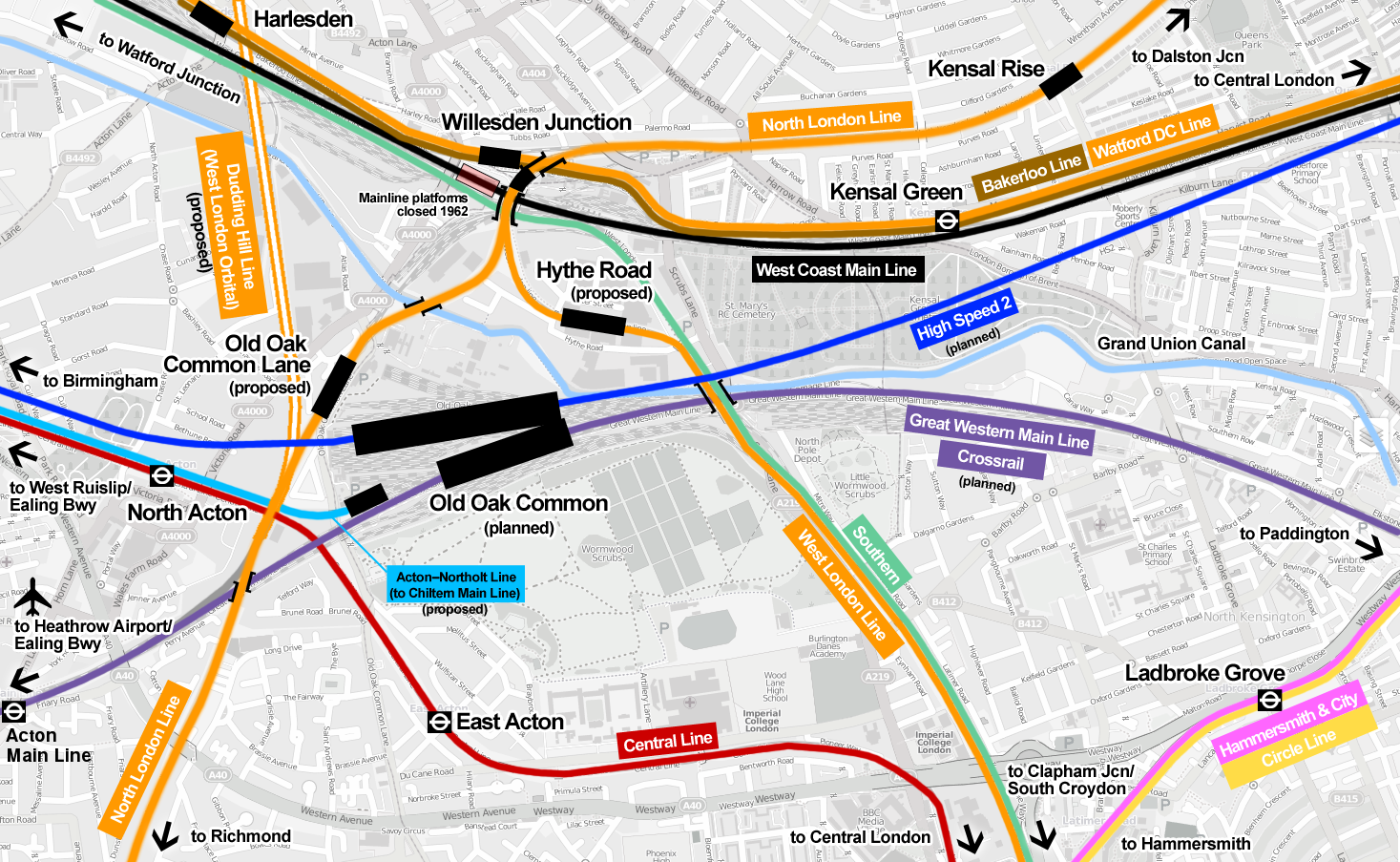
Note.
- The green route is taken by the Milton Keynes and Clapham Junction trains.
- The bright blue is High Speed Two.
- The purple is Crossrail.
- The orange is the Overground
- Hythe Road station is proposed for the West London Line to connect to Old Oak Common station for High Speed Two.
- Hythe Road station will have a bay platform to turn trains from the South.
- Old Oak Common Lane station is proposed for the North London Line to connect to Old Oak Common station for High Speed Two.
But where is the connection between the Milton Keynes and Clapham Junction service and Old Oak Common station for High Speed Two?
- Access from the South is not a problem as the Overground can be used to Hythe Road station.
- Extra services from the South can be run to and from the bay platform at Hythe Road station.
- Access from the East is not a problem as the Overground can be used to Hythe Road station.
- How do passengers go between say Wembley Central and Heathrow?
In addition for access from the West is the Overground can be used to Old Oak Common Lane station.
But as things stand at the moment the Milton Keynes and Clapham Junction service bypasses Hythe Road station and the only ways to go from Milton Keynes to Old Oak Common station for either High Speed Two, Crossrail or the Great Western is to do one of the following.
- Change to the Watford DC Line at Watford Junction, Harrow & Wealdstone or Wembley Central and then change to the Overground at Willesden Junction for either Old Oak Common Lane or Hythe Road station.
- Continue South to Shepherd’s Bush station, cross over to the other platform and then come back to Hythe Road station.
- Go via Euston station. OK for High Speed Two, but not for Crossrail or the Great Western.
They cannot be serious!
I hope that there is a cunning plan to enable the Milton Keynes and Clapham Junction service to connect.
Whilst on the subject of connections at Old Oak Common, where is the promised connection of Crossrail to the West Coast Main Line?
Were all these connections just kicked into the long grass and quietly forgotten, as they were deemed too difficult and/or expensive?
I think serious questions need to be asked about the design of Crossrail and High Speed Two at Old Oak Common.
Why weren’t Crossrail and High Speed Two designed to connect directly to the London Overground at Willesden Junction station perhaps by the use of a North South people mover serving the following lines?
- Bakerloo, Watford DC, West Coast Main and West London Orbital Lines at a rebuilt Harlesden station.
- London Overground at the high-level Willesden Junction station.
- High Speed Two
- Crossrail and the Great Western Railway
- The new Chiltern platforms.
- Central Line at East Acton station.
Note.
- Hythe Road and Old Oak Common stations would not be needed.
- The Milton Keynes and Clapham Junction service would call additionally at the rebuilt Harlesden station.
The current design of Old Oak Common stinks like a horse designed by a committee!
The Northern Terminal
I suggested earlier that some trains use Watford Junction and others use Milton Keynes Central.
Both stations have the capacity and the connectivity.
The Southern Terminal
In the last ten years, South Croydon, East Croydon and Clapham Junction have been used as the Southern terminal.
Thameslink seems to have chosen its various terminals to satisfaction of the travelling public, so perhaps the same method or personnel should be used.
The Operator
The Gibb Report said that this service should be transferred to the London Overground and I wrote about this proposal in Gibb Report – East Croydon – Milton Keynes Route Should Be Transferred To London Overground.
This is one suggestion, but I do wonder, if it should be transferred to West Midlands Trains and run in conjunction with their West Coast Main Line services.
- The service needs 110 mph trains.
- Timetabling and operation should be easier.
- London Overground trains don’t have a long-distance interior.
On the other hand, trains running between Watford Junction and Clapham Junction would probably be better if they were London Overground trains.
Conclusion
I believe that by using the current network and some modern trains and signalling, the passenger services to the West of the capital can be substantially improved.
High-Speed Low-Carbon Transport Between Great Britain And Ireland
Consider.
- According to Statista, there were 13,160,000 passengers between the United Kingdom and the Irish Republic in 2019.
- In 2019, Dublin Airport handled 32,907,673 passengers.
- The six busiest routes from Dublin were Heathrow, Stansted, Amsterdam, Manchester, Birmingham and Stansted.
- In 2018, Belfast International Airport handled 6,269,025 passengers.
- The four busiest routes from Belfast International Airport were Stansted, Gatwick. Liverpool and Manchester, with the busiest route to Europe to Alicante.
- In 2018, Belfast City Airport handled 2,445,529 passengers.
- The four busiest routes from Belfast City Airport were Heathrow, Manchester, Birmingham and London City.
Note.
- The busiest routes at each airport are shown in descending order.
- There is a lot of air passengers between the two islands.
- Much of the traffic is geared towards London’s four main airports.
- Manchester and Liverpool get their fair share.
Decarbonisation of the air routes between the two islands will not be a trivial operation.
But technology is on the side of decarbonisation.
Class 805 Trains
Avanti West Coast have ordered thirteen bi-mode Class 805 trains, which will replace the diesel Class 221 trains currently working between London Euston and Holyhead.
- They will run at 125 mph between Euston and Crewe using electric power.
- If full in-cab digital signalling were to be installed on the electrified portion of the route, they may be able to run at 140 mph in places under the wires.
- They will use diesel power on the North Wales Coast Line to reach Holyhead.
- According to an article in Modern Railways, the Class 805 trains could be fitted with batteries.
I wouldn’t be surprised that when they are delivered, they are a version of the Hitachi’s Intercity Tri-Mode Battery Train, the specification of which is shown in this Hitachi infographic.

Note.
- I suspect that the batteries will be used to handle regenerative braking on lines without electrification, which will save diesel fuel and carbon emissions.
- The trains accelerate faster, than those they replace.
- The claimed fuel and carbon saving is twenty percent.
It is intended that these trains will be introduced next year.
I believe that, these trains will speed up services between London Euston and Holyhead.
- Currently, services take just over three-and-a-half hours.
- There should be time savings on the electrification between London Euston and Crewe.
- The operating speed on the North Wales Coast Line is 90 mph. This might be increased in sections.
- Some extra electrification could be added, between say Crewe and Chester and possibly through Llandudno Junction.
- I estimate that on the full journey, the trains could reduce emissions by up to sixty percent compared to the current diesel trains.
I think that a time of three hours could be achievable with the Class 805 trains.
New trains and a three hour journey time should attract more passengers to the route.
Holyhead
In Holyhead Hydrogen Hub Planned For Wales, I wrote about how the Port of Holyhead was becoming a hydrogen hub, in common with several other ports around the UK including Felixstowe, Harwich, Liverpool and Portsmouth.
Holyhead and the others could host zero-carbon hydrogen-powered ferries.
But this extract from the Wikipedia hints at work needed to be done to create a fast interchange between trains and ferries.
There is access to the port via a building shared with Holyhead railway station, which is served by the North Wales Coast Line to Chester and London Euston. The walk between trains and ferry check in is less than two minutes, but longer from the remote platform 1, used by Avanti West Coast services.
This Google Map shows the Port of Holyhead.

I think there is a lot of potential to create an excellent interchange.
HSC Francisco
I am using the high-speed craft Francisco as an example of the way these ships are progressing.
- Power comes from two gas-turbine engines, that run on liquified natural gas.
- It can carry 1024 passengers and 150 cars.
- It has a top speed of 58 knots or 67 mph. Not bad for a ship with a tonnage of over 7000.
This ship is in service between Buenos Aires and Montevideo.
Note.
- A craft like this could be designed to run on zero-carbon liquid hydrogen or liquid ammonia.
- A high speed craft already runs between Dublin and Holyhead taking one hour and forty-nine minutes for the sixty-seven miles.
Other routes for a specially designed high speed craft might be.
- Barrow and Belfast – 113 miles
- Heysham and Belfast – 127 miles
- Holyhead and Belfast – 103 miles
- Liverpool and Belfast – 145 miles
- Stranraer and Larne – 31 miles
Belfast looks a bit far from England, but Holyhead and Belfast could be a possibility.
London And Dublin Via Holyhead
I believe this route is definitely a possibility.
- In a few years, with a few improvements on the route, I suspect that London Euston and Holyhead could be fairly close to three hours.
- With faster bi-mode trains, Manchester Airport and Holyhead would be under three hours.
- I would estimate, that a high speed craft built for the route could be under two hours between Holyhead and Dublin.
It certainly looks like London Euston and Dublin and Manchester Airport and Dublin would be under five hours.
In A Glimpse Of 2035, I imagined what it would be like to be on the first train between London and Dublin via the proposed fixed link between Scotland and Northern Ireland.
- I felt that five-and-a-half hours was achievable for that journey.
- The journey would have used High Speed Two to Wigan North Western.
- I also stated that with improvements, London and Belfast could be three hours and Dublin would be an hour more.
So five hours between London Euston and Dublin using current technology without massive improvements and new lines could be small change well spent.
London And Belfast Via Holyhead
At 103 miles the ferry leg may be too long for even the fastest of the high speed craft, but if say the craft could do Holyhead and Belfast in two-and-a-half hours, it might just be a viable route.
- It might also be possible to run the ferries to a harbour like Warrenpoint, which would be eighty-six miles.
- An estimate based on the current high speed craft to Dublin, indicates a time of around two hours and twenty minutes.
It could be viable, if there was a fast connection between Warrenpoint and Belfast.
Conclusion
Once the new trains are running between London Euston and Holyhead, I would expect that an Irish entrepreneur will be looking to develop a fast train and ferry service between England and Wales, and the island of Ireland.
It could be sold, as the Greenest Way To Ireland.
Class 807 Trains
Avanti West Coast have ordered ten electric Class 807 trains, which will replace some of the diesel Class 221 trains.
- They will run at 125 mph between Euston and Liverpool on the fully-electrified route.
- If full in-cab digital signalling were to be installed on the route, they may be able to run at 140 mph in places.
- These trains appear to be the first of the second generation of Hitachi trains and they seem to be built for speed and a sparking performance,
- These trains will run at a frequency of two trains per hour (tph) between London and Liverpool Lime Street.
- Alternate trains will stop at Liverpool South Parkway station.
In Will Avanti West Coast’s New Trains Be Able To Achieve London Euston and Liverpool Lime Street In Two Hours?, I came to the conclusion, that a two-hour journey time was possible, when the new Class 807 trains have entered service.
London And Belfast Via Liverpool And A Ferry
Consider.
- An hour on the train to and from London will be saved compared to Holyhead.
- The ferry terminal is in Birkenhead on the other side of the Mersey and change between Lime Street station and the ferry could take much longer than at Holyhead.
- Birkenhead and Belfast is twice the distance of Holyhead and Dublin, so even a high speed craft would take three hours.
This Google Map shows the Ferry Terminal and the Birkenhead waterfront.
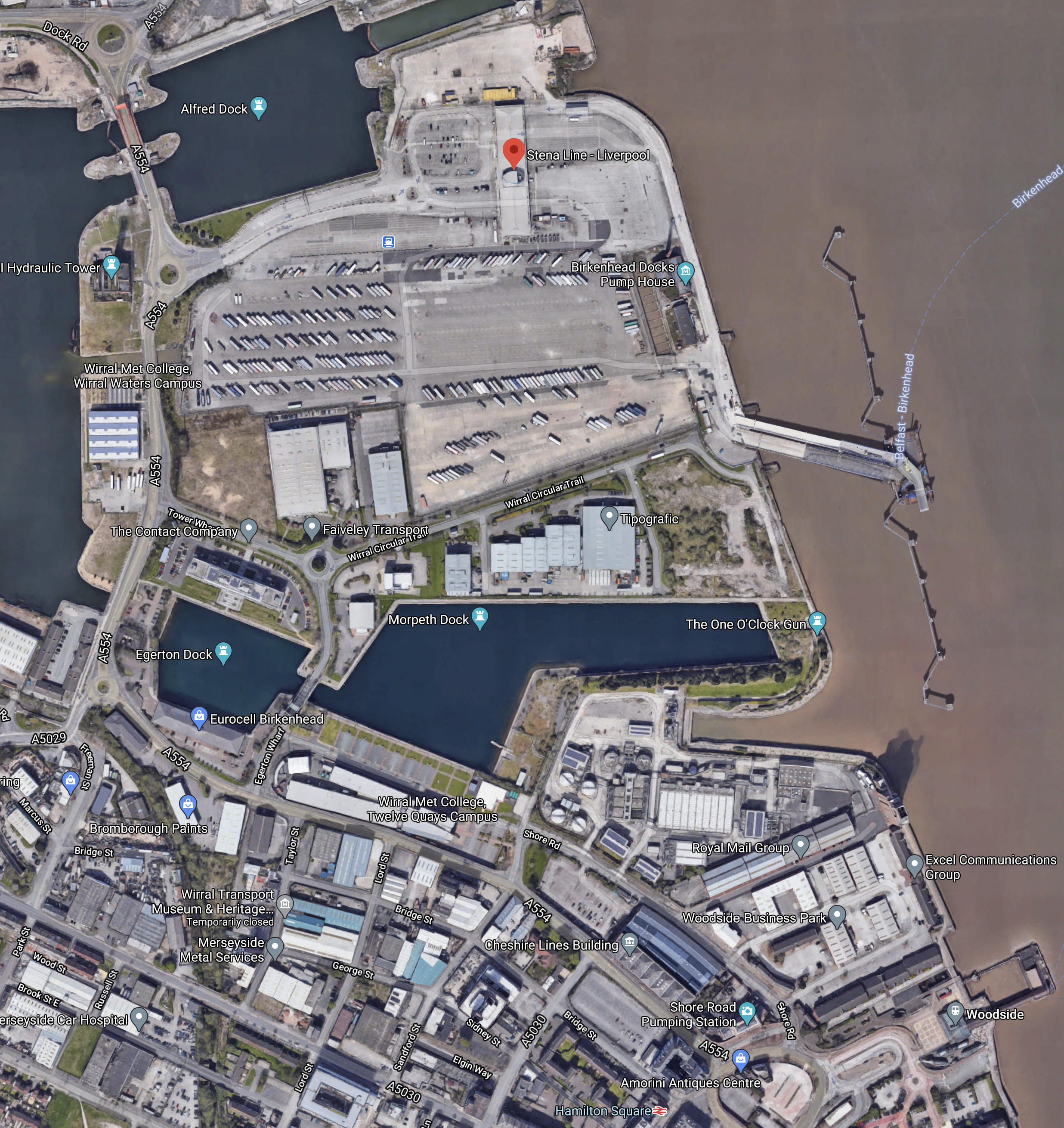
Note.
- The Ferry Terminal is indicated by the red arrow at the top of the map.
- There are rows of trucks waiting for the ferries.
- In the South East corner of the map, the terminal of the Mersey Ferry sticks out into the River
- Hamilton Square station is in-line with the Mersey Ferry at the bottom of the map and indicated with the usual red symbol.
- There is a courtesy bus from Hamilton Square station to the Ferry Terminal for Ireland.
There is a fourteen tph service between Hamilton Square and Liverpool Lime Street station.
This route may be possible, but the interchange could be slow and the ferry leg is challenging.
I don’t think the route would be viable unless a much faster ferry is developed. Does the military have some high speed craft under development?
Conclusion
London and Belfast via Liverpool and a ferry is probably a trip for enthusiasts or those needing to spend a day in Liverpool en route.
Other Ferry Routes
There are other ferry routes.
Heysham And Barrow-in-Furness
,These two ports might be possible, but neither has a good rail connection to London and the South of England.
They are both rail connected, but not to the standard of the connections at Holyhead and Liverpool.
Cairnryan
The Cairnryan route could probably be improved to be an excellent low-carbon route to Glasgow and Central Scotland.
Low-Carbon Flight Between The Islands Of Great Britain And Ireland
I think we’ll gradually see a progression to zero-carbon flight over the next few years.
Sustainable Aviation Fuel
Obviously zero-carbon would be better, but until zero-carbon aircraft are developed, there is always sustainable aviation fuel.
This can be produced from various carbon sources like biowaste or even household rubbish and disposable nappies.
British Airways are involved in a project called Altalto.
- Altalto are building a plant at Immingham to turn household rubbish into sustainable aviation fuel.
- This fuel can be used in jet airliners with very little modification of the aircraft.
I wrote about Altalto in Grant Shapps Announcement On Friday.
Smaller Low-Carbon Airliners
The first low- and zero-carbon airliners to be developed will be smaller with less range, than Boeing 737s and Airbus A 320s. These three are examples of four under development.
- Aura Aero Era – 19 passengers – 500 miles
- Eviation Alice – 9 passengers – 620 miles
- Faradair Aerospace BEHA – 19 passengers – 1150 miles
- Heart Aerospace ES-19 – 19 passengers – 400 km.
I feel that a nineteen seater aircraft with a range of 500 miles will be the first specially designed low- or zero-carbon airliner to be developed.
I believe these aircraft will offer advantages.
- Some routes will only need refuelling at one end.
- Lower noise and pollution.
- Some will have the ability to work from short runways.
- Some will be hybrid electric running on sustainable aviation fuel.
They may enable passenger services to some smaller airports.
Air Routes Between The Islands Of Great Britain And Ireland
These are distances from Belfast City Airport.
- Aberdeen – 228 miles
- Amsterdam – 557 miles
- Birmingham – 226 miles
- Blackpool – 128 miles
- Cardiff – 246 miles
- Edinburgh – 135 miles
- Gatwick – 337 miles
- Glasgow – 103 miles
- Heathrow – 312 miles
- Jersey – 406 miles
- Kirkwall – 320 miles
- Leeds – 177 miles
- Liverpool – 151 miles
- London City – 326 miles
- Manchester – 170 miles
- Newcastle – 168 miles
- Southampton – 315 miles
- Southend – 344 miles
- Stansted – 292 miles
- Sumburgh – 401 miles
Note.
- Some airports on this list do not currently have flights from Belfast City Airport.
- I have included Amsterdam for comparison.
- Distances to Belfast International Airport, which is a few miles to the West of Belfast City Airport are within a few miles of these distances.
It would appear that much of Great Britain is within 500 miles of Belfast City Airport.
These are distances from Dublin Airport.
- Aberdeen – 305 miles
- Amsterdam – 465 miles
- Birmingham – 199 miles
- Blackpool – 133 miles
- Cardiff – 185 miles
- Edinburgh – 208 miles
- Gatwick – 300 miles
- Heathrow – 278 miles
- Jersey – 339 miles
- Kirkwall – 402 miles
- Leeds – 190 miles
- Liverpool – 140 miles
- London City – 296 miles
- Manchester – 163 miles
- Newcastle – 214 miles
- Southampton – 268 miles
- Southend – 319 miles
- Stansted – 315 miles
- Sumburgh – 483 miles
Note.
- Some airports on this list do not currently have flights from Dublin Airport.
- I have included Amsterdam for comparison.
It would appear that much of Great Britain is within 500 miles of Dublin Airport.
I will add a few long routes, that someone might want to fly.
- Cork and Aberdeen – 447 miles
- Derry and Manston – 435 miles
- Manston and Glasgow – 392 miles
- Newquay and Aberdeen – 480 miles
- Norwich and Stornaway – 486 miles.
I doubt there are many possible air services in the UK and Ireland that are longer than 500 miles.
I have a few general thoughts about low- and zero-carbon air services in and around the islands of Great Britain and Ireland.
- The likely five hundred mile range of the first generation of low- and zero-carbon airliners fits the size of the these islands well.
- These aircraft seem to have a cruising speed of between 200 and 250 mph, so flight times will not be unduly long.
- Airports would need to have extra facilities to refuel or recharge these airliners.
- Because of their size, there will need to be more flights on busy routes.
- Routes which are less heavily used may well be developed, as low- or zero-carbon could be good for marketing the route.
I suspect they could be ideal for the development of new routes and even new eco-friendly airports.
Conclusion
I have come to the conclusion, that smaller low- or zero-carbon are a good fit for the islands of Great Britain and Ireland.
But then Flybe and Loganair have shown that you can make money flying smaller planes around these islands with the right planes, airports, strategy and management.
Hydrogen-Powered Planes From Airbus
Hydrogen-powered zero-carbon aircraft could be the future and Airbus have put down a marker as to the way they are thinking.
Airbus have proposed three different ZEROe designs, which are shown in this infographic.

The turboprop and the turbofan will be the type of designs, that could be used around Great Britain and Ireland.
The ZEROe Turboprop
This is Airbus’s summary of the design for the ZEROe Turboprop.
Two hybrid hydrogen turboprop engines, which drive the six bladed propellers, provide thrust. The liquid hydrogen storage and distribution system is located behind the rear pressure bulkhead.
This screen capture taken from the video, shows the plane.
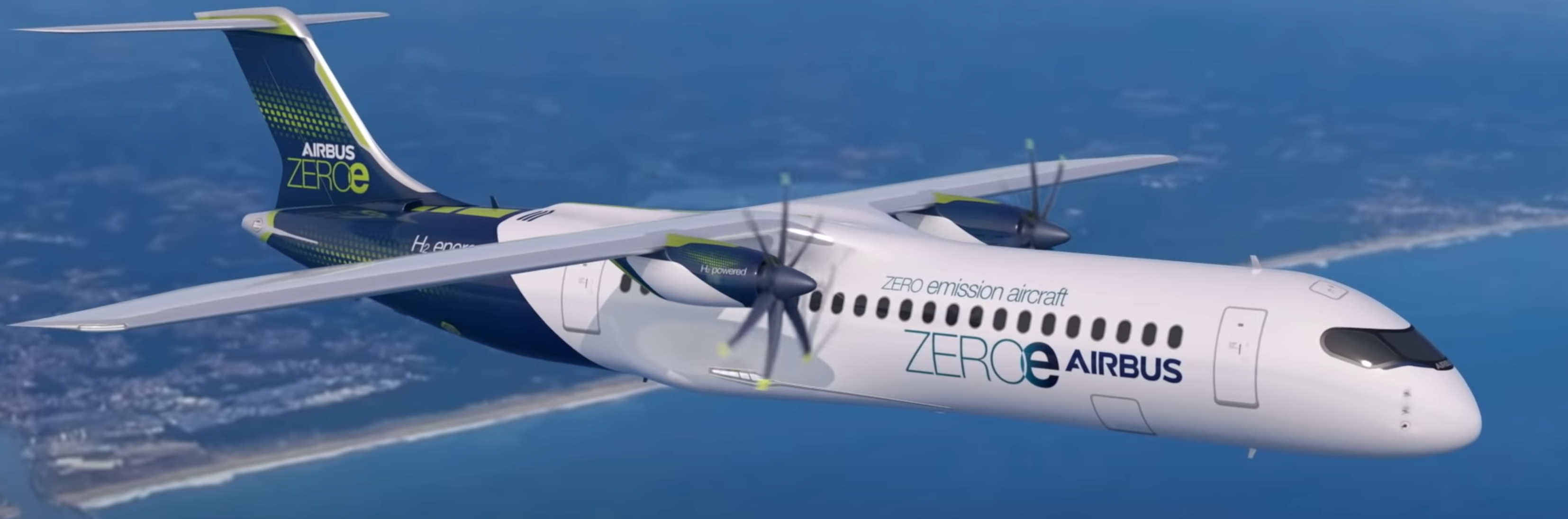
It certainly is a layout that has been used successfully, by many conventionally-powered aircraft in the past. The De Havilland Canada Dash 8 and ATR 72 are still in production.
I don’t think the turboprop engines, that run on hydrogen will be a problem.
If you look at the Lockheed-Martin C 130J Super Hercules, you will see it is powered by four Rolls-Royce AE 2100D3 turboprop engines, that drive 6-bladed Dowty R391 composite constant-speed fully-feathering reversible-pitch propellers.
These Rolls-Royce engines are a development of an Allison design, but they also form the heart of Rolls-Royce’s 2.5 MW Generator, that I wrote about in Our Sustainability Journey. The generator was developed for use in Airbus’s electric flight research program.
I wouldn’t be surprised to find the following.
- , The propulsion system for this aircraft is under test with hydrogen at Derby and Toulouse.
- Dowty are testing propellers suitable for the aircraft.
- Serious research is ongoing to store enough liquid hydrogen in a small tank that fits the design.
Why develop something new, when Rolls-Royce, Dowty and Lockheed have done all the basic design and testing?
This screen capture taken from the video, shows the front view of the plane.

From clues in the picture, I estimate that the fuselage diameter is around four metres. Which is not surprising, as the Airbus A320 has a height of 4.14 metres and a with of 3.95 metres. But it’s certainly larger than the fuselage of an ATR-72.
So is the ZEROe Turboprop based on a shortened Airbus A 320 fuselage?
- The ATR 72 has a capacity of 70 passengers.
- The ZEROe Turboprop has a capacity of less than a hundred passengers.
- An Airbus A320 has six-abreast seating.
- Could the ZEROe Turboprop have sixteen rows of seats, as there are sixteen windows in front of the wing?
- With the seat pitch of an Airbus A 320, which is 81 centimetres, this means just under thirteen metres for the passengers.
- There could be space for a sizeable hydrogen tank in the rear part of the fuselage.
- The plane might even be able to use the latest A 320 cockpit.
It looks to me, that Airbus have designed a larger ATR 72 based on an A 320 fuselage.
I don’t feel there are any great technical challenges in building this aircraft.
- The engines appear to be conventional and could even have been more-or-less fully developed.
- The fuselage could be a development of an existing design.
- The wings and tail-plane are not large and given the company’s experience with large composite structures, they shouldn’t be too challenging.
- The hydrogen storage and distributing system will have to be designed, but as hydrogen is being used in increasing numbers of applications, I doubt the expertise will be difficult to find.
- The avionics and other important systems could probably be borrowed from other Airbus products.
Given that the much larger and more complicated Airbus A380 was launched in 2000 and first flew in 2005, I think that a prototype of this aircraft could fly around the middle of this decade.
It may seem small at less than a hundred seats, but it does have a range of greater than a 1000 nautical miles or 1150 miles.
Consider.
- It compares closely in passenger capacity, speed and range, with the De Havilland Canada Dash 8/400 and the ATR 72/600.
- The ATR 72 is part-produced by Airbus.
- The aircraft is forty percent slower than an Airbus A 320.
- It looks like it could be designed to have a Short-Takeoff-And Landing (STOL) capability.
I can see the aircraft replacing Dash 8s, ATR 72s and similar aircraft all over the world. There are between 2000 and 3000 operational airliners in this segment.
The ZEROe Turbofan
This is Airbus’s summary of the design.
Two hybrid hydrogen turbofan engines provide thrust. The liquid hydrogen storage and distribution system is located behind the rear pressure bulkhead.
This screen capture taken from the video, shows the plane.

This screen capture taken from the video, shows the front view of the plane.
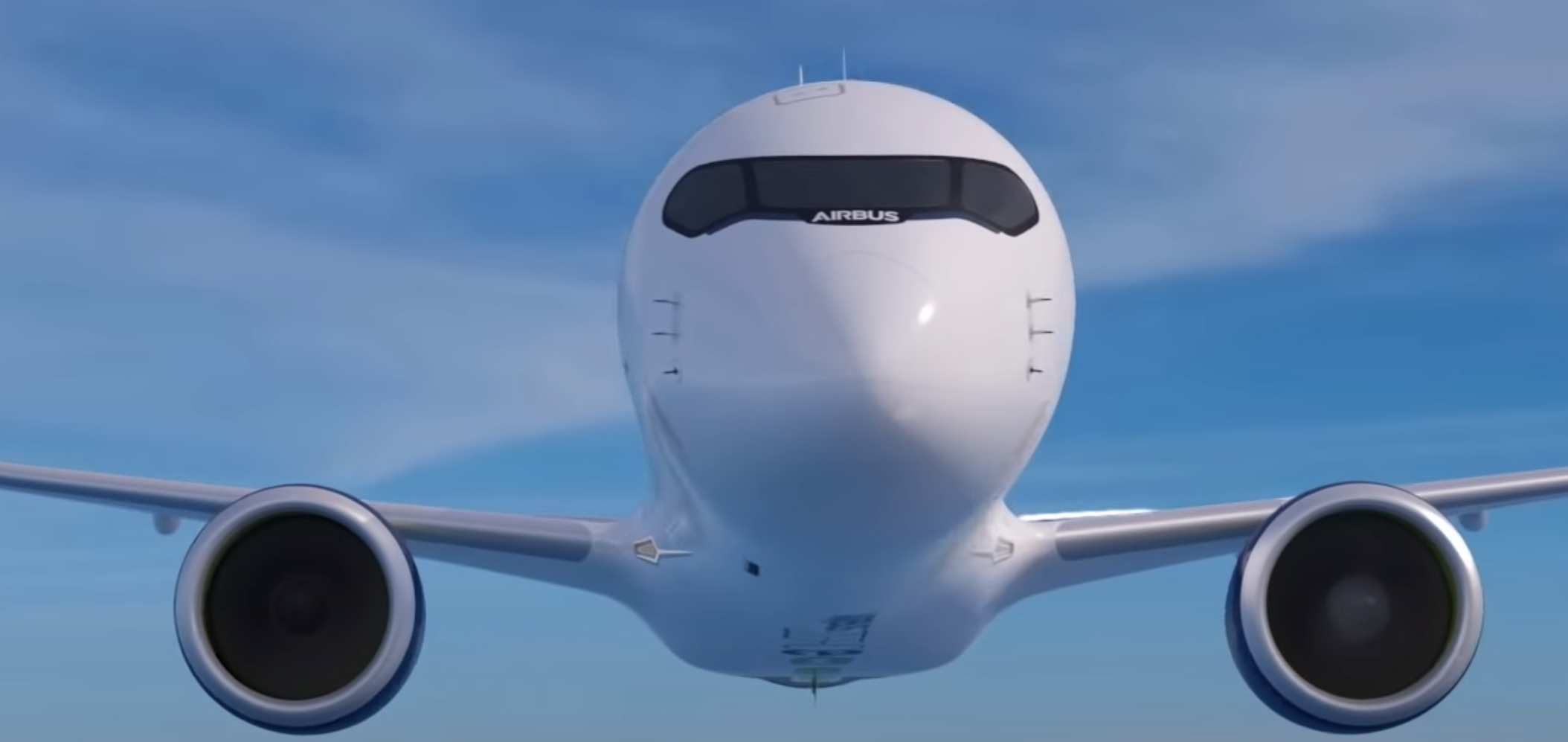
The aircraft doesn’t look very different different to an Airbus A320 and appears to be fairly conventional. It does appear to have the characteristic tall winglets of the A 320 neo.
I don’t think the turbofan engines, that run on hydrogen will be a problem.
These could be standard turbofan engines modified to run on hydrogen, fuelled from a liquid hydrogen tank behind the rear pressure bulkhead of the fuselage.
If you want to learn more about gas turbine engines and hydrogen, read this article on the General Electric web site, which is entitled The Hydrogen Generation: These Gas Turbines Can Run On The Most Abundant Element In the Universe,
These are my thoughts of the marketing objectives of the ZEROe Turbofan.
- The cruising speed and the number of passengers are surprisingly close, so has this aircraft been designed as an A 320 or Boeing 737 replacement?
- I suspect too, that it has been designed to be used at any airport, that could handle an Airbus A 320 or Boeing 737.
- It would be able to fly point-to-point flights between most pairs of European or North American cities.
It would certainly fit the zero-carbon shorter range airliner market!
In fact it would more than fit the market, it would define it!
I very much believe that Airbus’s proposed zero-carbon hydrogen-powered designs and others like them will start to define aviation on routes of up to perhaps 3000 miles, from perhaps 2035.
- The A 320 neo was launched in December 2010 and entered service in January 2016. That was just five years and a month.
- I suspect that a lot of components like the fuselage sections, cockpit, avionics, wings, landing gear, tailplane and cabin interior could be the same in a A 320 neo and a ZEROe Turbofan.
- Flying surfaces and aerodynamics could be very similar in an A 320 neo and a ZEROe Turbofan
- There could even be commonality between the ZEROe Turboprop and the ZEROe Turbofan, with respect to fuselage sections, cockpit, avionics and cabin interior.
There also must be the possibility, that if a ZEROe Turbofan is a hydrogen-powered A 320 neo, that this would enable the certification process to be simplified.
It might even be possible to remanufacture a A 320 neo into a ZEROe Turbofan. This would surely open up all sorts of marketing strategies.
My project management, flying and engineering knowledge says that if they launched the ZEROe Turbofan this year, it could be in service by the end of the decade on selected routes.
Conclusion
Both the ZEROe Turboprop and ZEROe Turbofan are genuine zero-carbon aircraft, which fit into two well-defined market segments.
I believe that these two aircraft and others like them from perhaps Boeing and Bombardier could be the future of aviation between say 500 and 3000 miles.
With the exception of the provision of hydrogen refuelling at airports, there will be no need for any airport infrastructure.
I also wouldn’t be surprised that the thinking Airbus appear to have applied to creating the ZEROe Turbofan from the successful A 320 neo, could be applied to perhaps create a hydrogen-powered A 350.
I feel that Airbus haven’t fulling disclosed their thinking. But then no company would, when it reinvents itself.
T also think that short-haul air routes will increasing come under pressure.
The green lobby would like airlines to decarbonise.
Governments will legislate that airlines must decarbonise.
The rail industry will increasingly look to attract customers away from the airlines, by providing more competitive times and emphasising their green credentials.
Aircraft manufacturers will come under pressure to deliver zero-carbon airliners as soon as they can.
I wouldn’t be surprised to see a prototype ZEROe Turbofan or Boeing’s equivalent fly as early as 2024.
Short Term Solutions
As I said earlier, one solution is to use existing aircraft with Sustainable Aviation Fuel.
But many believe this is greenwash and rather a cop out.
So we must do better!
I don’t believe that the smaller zero- and low-carbon aircraft with a range of up to 500 miles and a capacity of around 19 seats, will be able to handle all the passengers needing to fly between and around the islands of Great Britain and Ireland.
- A Boeing 737 or Airbus A 320 has a capacity of around two hundred passengers, which would require ten times the number of flights, aircraft and pilots.
- Airports would need expansion on the airside and the terminals to handle the extra planes.
- Air Traffic Control would need to be expanded to handle the extra planes.
But the smaller planes would be ideal for the thinner secondary routes.
So I tend to think, that the greens will have to lump it, as Sustainable Aviation Fuel will increasingly be the only viable solution.
This will increase the need for Airbus or Boeing to develop a viable A 320 or 737-sized aircraft as soon as possible.
Air Bridges
I said earlier, that I believe using ferries between Ireland and Holyhead and new bi-mode Class 805 trains between London Euston and Holyhead could be a competitor to airlines.
- The ferries would be high speed craft capable of Holyhead and Ireland in around 90-100 minutes.
- The ferries would be zero-carbon.
- The trains would have a sixty percent reduction in carbon emissions compared to current trains on the route.
If we can skim across the water in a zero-carbon high speed craft, are there any reasons we can’t cross the water in a low- or zero-carbon aircraft.
In the next few sub-sections, I’ll suggest a few air bridges.
Glasgow
Glasgow Airport could be an ideal airport for a low or zero-carbon air bridge to Northern Ireland.
- A rail link could eventually be built.
- There is a reasonable amount of traffic.
- The distance to Belfast City Airport is only 103 miles.
As the airport serves islands and other places that could be ideal low- and zero-carbon routes, I could see Glasgow becoming a hub for battery and hydrogen-powered aircraft.
Heathrow
Heathrow must prepare itself for an uncertain future.
It will be some years before a third runway is both needed and will have been constructed.
I believe the following will happen.
- Smaller up to nineteen seat low- or zero-carbon airliners will be in service by 2025.
- From around 2024, Heathrow will get requests to refuel or charge low- or zero-carbon airliners.
- Low- or-zero- carbon A 320-size airliners will be in service by 2030.
- Most ground equipment at Heathrow like tugs and fuel bowsers will be zero-carbon.
If I were Boris or Prime Minister, I would say that Heathrow could have its third runway with the following conditions.
- All aircraft using the third runway must be zero-carbon
- All air-side vehicles must be zero-carbon.
- All vehicles bringing passengers on the last mile to the airport must be zero-carbon.
- All aircraft using the airport that are not zero-carbon must use sustainable aviation fuel.
I suspect that the conditions would be met by a large margin.
When an airport knows it is effectively going to be closed, it will make sure it survives.
Liverpool
Liverpool Airport could be an ideal airport for a low or zero-carbon air bridge to the island of Ireland.
- There is a nearby Liverpool South Parkway station, with frequent services to both the local area and places further away.
- An improved London train service starts in 2022 or 2023.
- There would need to be a people mover between the station and the airport.
- The airport can probably have piped hydrogen from across the Mersey.
- There is already significant traffic to and from the island of Ireland.
- Flight times Between Liverpool and Dublin and Belfast would be under an hour.
I also feel that Liverpool could develop lots of other low- and zero-carbon routes to perhaps Cardiff, Edinburgh, Glasgow, Norwich, Southampton and the Isle of Man.
I could even see Liverpool having a Turn-Up-And-Go shuttle service to Dublin and Belfast, with small zero-carbon planes running every fifteen minutes or so.
Manston
I wouldn’t rule out Manston as a low- and zero-carbon airport for flights to the Benelux countries and Northern France and parts of Germany.
These are a few distances from Manston Airport.
- Amsterdam – 160 miles
- Brussels – 134 miles
- Cologne – 253 miles
- Dusseldorf – 234 miles
- Frankfurt – 328 miles
- Geneva – 414 miles
- Hamburg – 396 miles
- Le Touquet – 59 miles
- Lille – 49 miles
- Luxembourg – 243 miles
- Ostend – 66 miles
- Strasbourg – 339 miles
Manston’s position on the tip of Kent gives it an advantage and I think low- and zero-carbon services could reach Cologne, Frankfurt, Geneva, Hamburg and Strasbourg.
The airport also has other advantages.
- A big electrolyser to produce hydrogen is being built at Herne Bay.
- The area is rich in wind and solar energy.
- I suspect the airspace to the East of the airport isn’t very busy and short hops to the Continent could be easy to slot in.
There is a new station being built at Thanet Parkway, which is on the Ashford and Ramsgate Line, which has regular services to London, including some services on High Speed One.
This Google Map shows the location of the airport and the station.
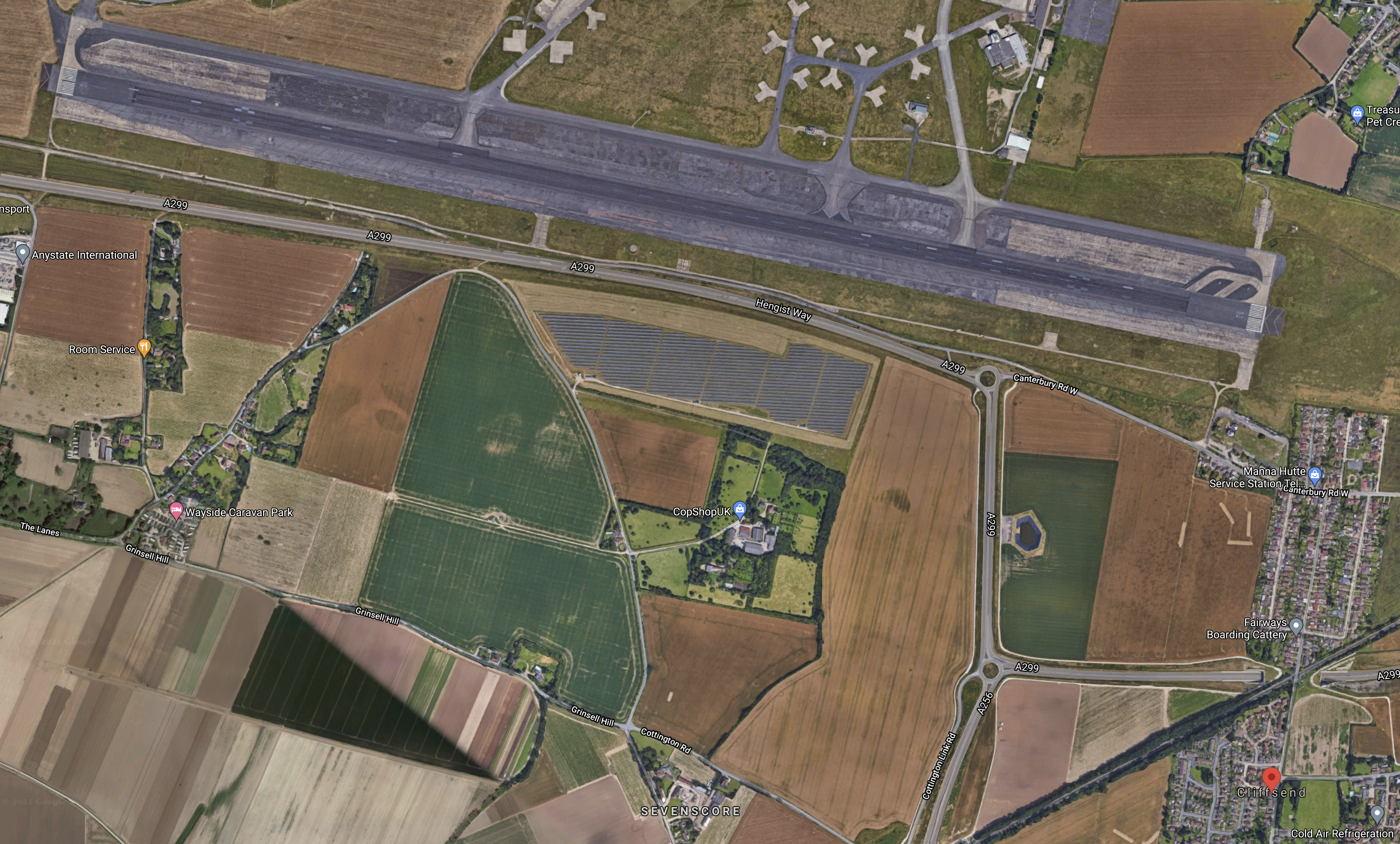
Note.
- The runway of Manston Airport.
- The Ashford and Ramsgate Line running across the South-East corner of the map.
- The station could be built to the West of the village of Cliffsend, which is indicated by the red arrow.
- I’m sure, a people mover or a zero-carbon bus could be built to connect the station and the airport.
There would need to be improvements in the frequency of services to and from London, but I’m sure Manston Airport could become an ideal airport for low- and zero-carbon aircraft serving the near Continent.
Southampton
Southampton Airport could be the ideal design for an airport to serve an air bridge.
- The Southampton Airport Parkway station is connected to the terminal.
- The station has numerous rail services, including a fast service to and from London.
- The airport is expanding and could make sure all works are compatible with a low- and zero-carbon future.
Southampton is not ideally placed for services to Ireland, but with low- and zero-carbon aircraft it could be ideal for running services to the Channel Islands and Western France.
Other Airports
I suspect other airports will go the low- and zero-carbon route.
Conclusion
I started this post, with the intention of writing about writing about low- and zero-carbon transport between the islands of Great Britain and Ireland.
But it has grown.
I have now come to the conclusion that there are several low- and zero-carbon routes that could be developed.
The most promising would appear to be.
- London Euston and Belfast by new Class 805 train to Holyhead and then zero-carbon high speed ferry.
- London Euston and Dublin by new Class 805 train to Holyhead and then zero-carbon high speed ferry.
- Glasgow and Belfast by train to Cairnryan and then zero-carbon high speed ferry.
- Point-to-point air routes using new small nineteen seat low- or zero-carbon airliners with a range of 500 miles.
- London Euston and Belfast by new Class 807 train to Liverpool Airport and then smaller low- or zero-carbon airliner.
- London Euston and Dublin by new Class 807 train to Liverpool Airport and then and then smaller low- or zero-carbon airliner.
- Other air bridges will develop.
But I am fairly certain by the end of the decade, there will be A320-size airlines powered by hydrogen taking us to Ireland and Western Europe.
I believe that the survival and ultimate prospering of Airbus and Boeing depends on the development of a range of zero-carbon airliners.
For this reason alone, they will succeed.
Could Trains From The North Connect To High Speed One At St. Pancras?
I was casually flying my virtual helicopter over the throat of St. Pancras International station, when I took a few pictures.
This Google Map shows the Northern ends of the platforms and the tracks leading in.
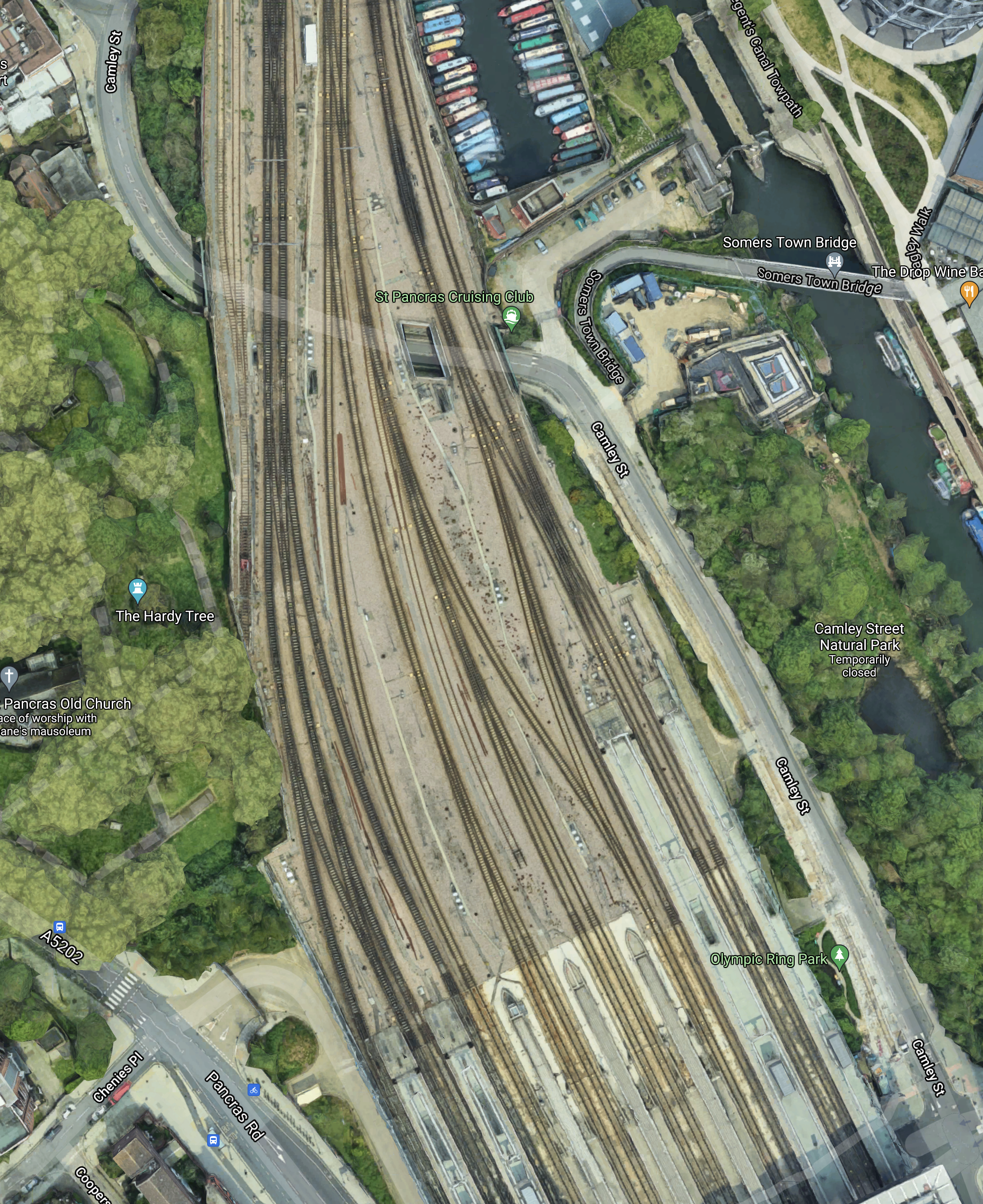
Note.
- Platforms 1-4 to the West with darker tracks handle the East Midlands Railway services.
- Platforms 5-10 in the centre with lighter tracks formed of three shorter islands handle the Eurostar services.
- Platforms 11-13 to the East with longer platforms handle the Southeastern HighSpeed services.
This Google Map shows the East Midlands Railway platforms.
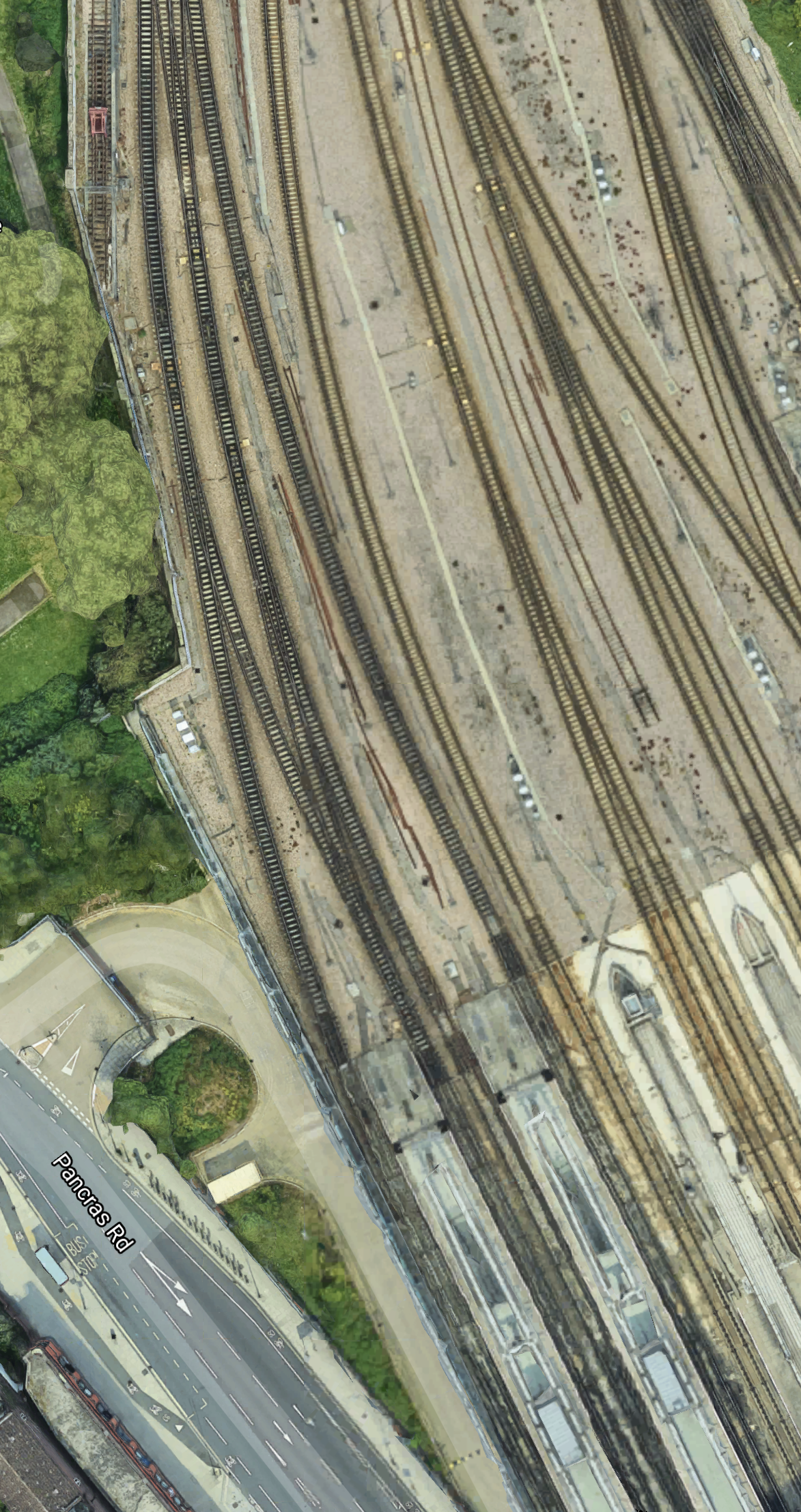
Note.
- There are two island platforms; 1-2 and 3-4.
- The four platforms are served by two tracks, that connect to the fast lines of the Midland Main Line.
- The platforms will be able to handle a pair of Class 810 trains, which will be 240 metres long.
- Will the two trains per hour (tph) using Class 360 trains between London and Corby always use the same platform at St. Prancras station?
This Google Map shows the Eurostar platforms.
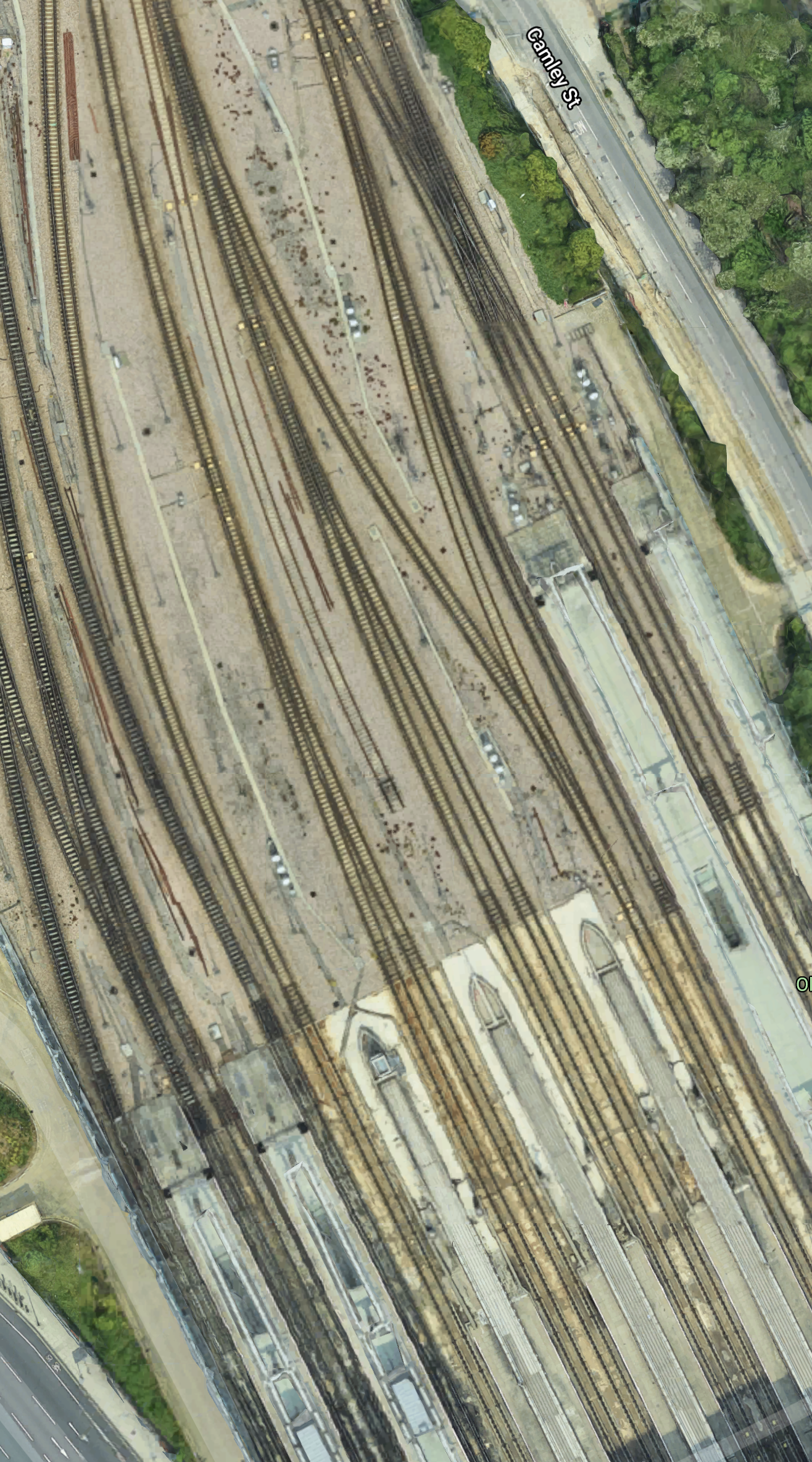
Note.
There are three island platforms; 5-6, 7-8 and 9-10.
The two island platforms in the West are for East Midlands Railway services.
The two longer island platforms in the East are for Southeastern HighSpeed services.
The six platforms connect to two fast lines, that are shared with the Southeastern services.
This Google Map shows the lines proceeding to the North.
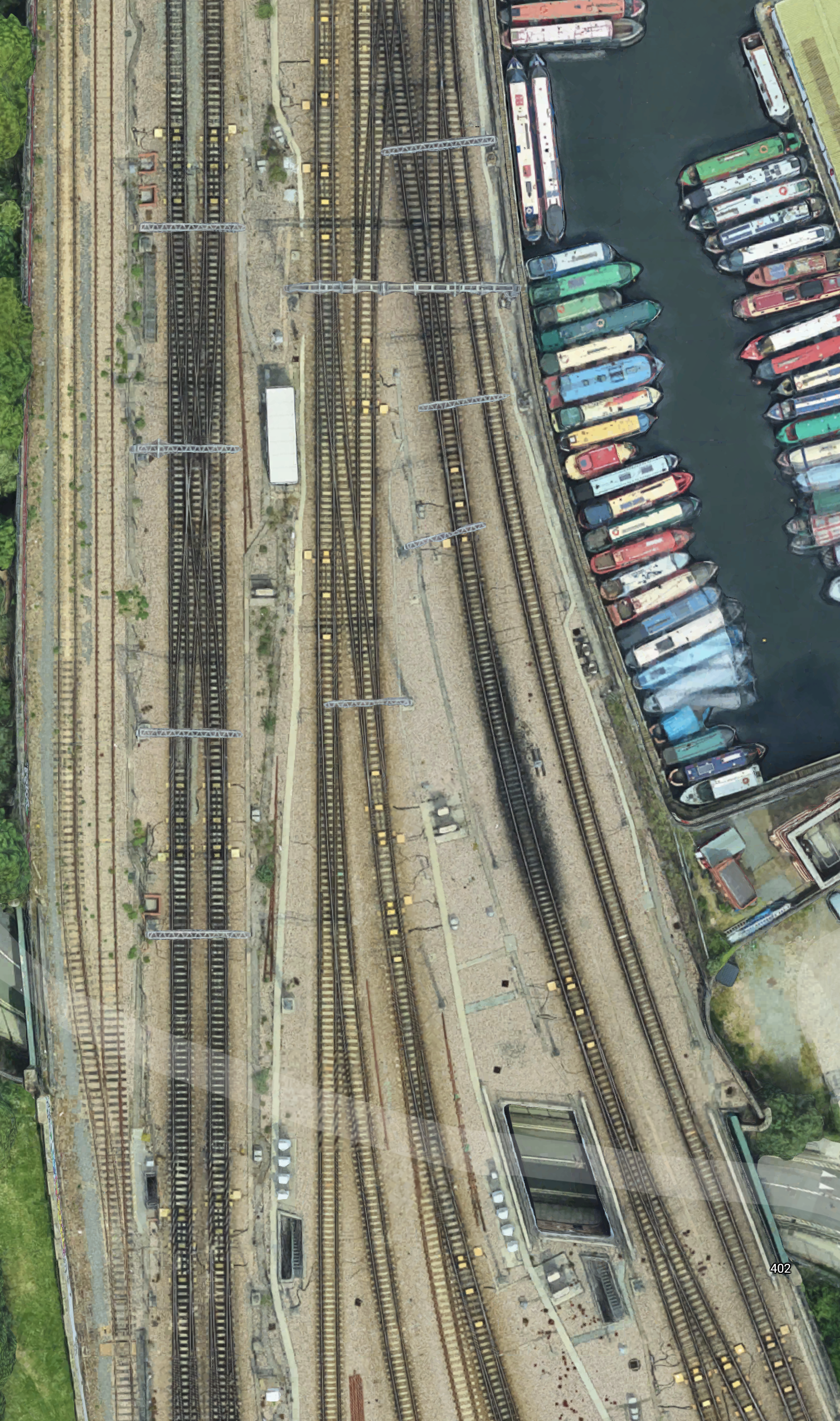
Note.
- There are four sets of tracks.
- The two light-coloured tracks on the left are for Thameslink or sidings.
- The next two dark-coloured tracks are the two tracks of the Midland Main Line.
- The next set of tracks are those connecting to the six Eurostar platforms.
- The two tracks on the right are those connecting to the Southeastern Highspeed platforms.
- There are crossovers between the Eurostar and Southeastern Highspeed tracks to allow efficient operation of the trains going to and from the twin tracks of High Speed One.
This Google Map shows where the Midland Main Line and High Speed One divide.
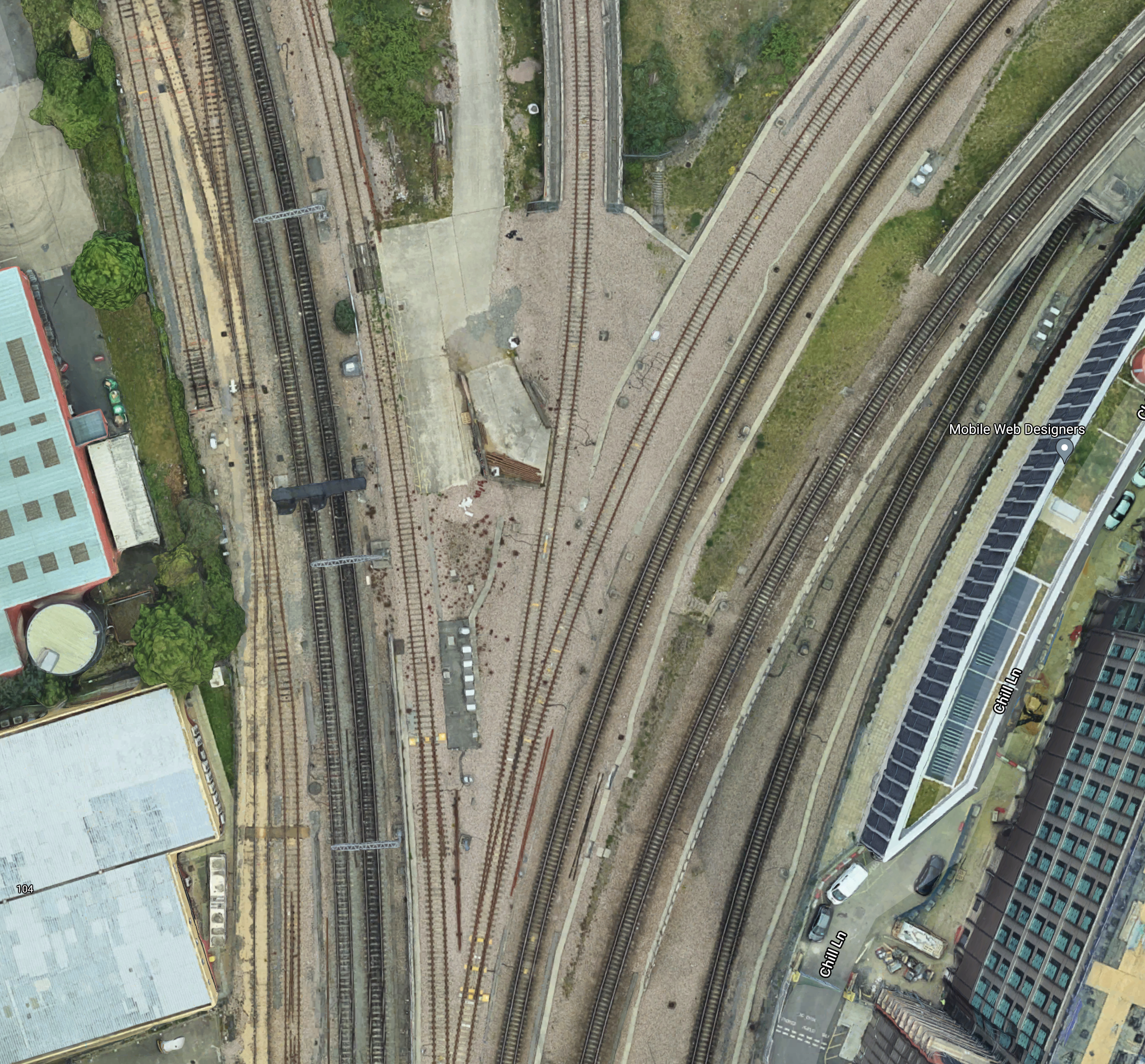
Note.
The two dark-coloured tracks of the Midland Main Line running North.
There appear to be four tracks running North East towards High Speed One.
Between the two sets of tracks two further tracks lead to the North.
The track closest to the Midland Main Line joins to the slow lines of the Midland Main Line.
The other one connects to the North London Line.
This Google Map shows the connecting lines to the High Speed One tunnel.
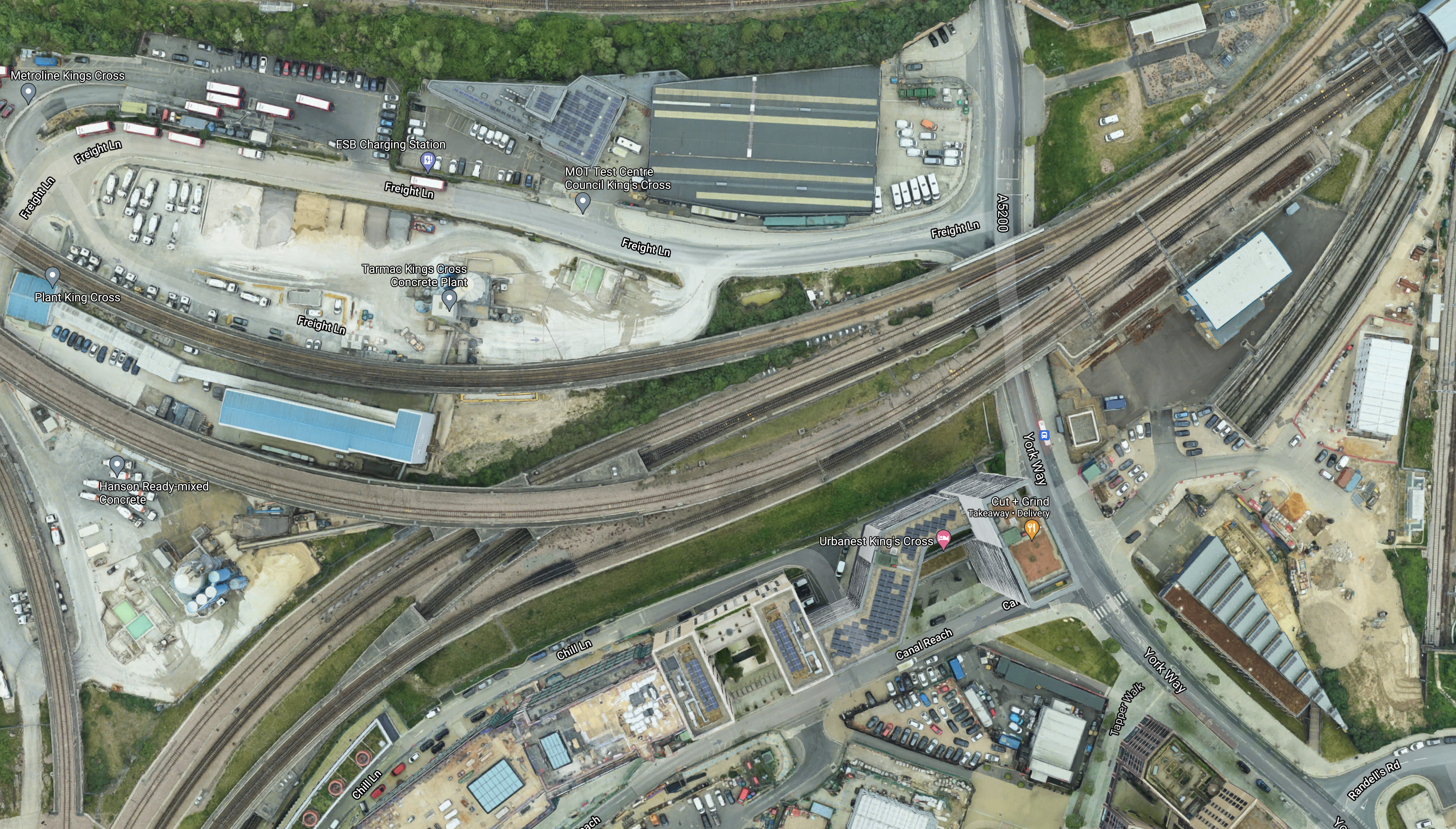
Note the tunnel portal is in the North-East corner of the map.
- It looks to me that the following connections are possible.
- St. Pancras station Eurostar platforms and Midland Main Line.
- St. Pancras station Eurostar platforms and North London Line to the West.
- High Speed One and North London Line to the West.
These connections are in addition to those connections needed to run scheduled services.
They would enable trains to take the following routes.
- St. Pancras station Eurostar platforms and Midland Main Line.
- St. Pancras station Eurostar platforms and the West Coast Main Line via North London Line
- High Speed One and the West Coast Main Line via North London Line
- St. Pancras station Eurostar platforms and the Great Western Main Line via North London Line
- High Speed One and the Great Western Main Line via North London Line
I suspect most of the times, that these routes are used it is for engineering purposes or behaps dragging a failed train out of St. Pancras.
But the track layout would seem to allow the following.
Direct electric freight and passenger services between High Speed One and Birmingham, Cardiff, Glasgow, Liverpool and Manchester.
Direct electric passenger services between High Speed One and Sheffield and Leeds, with a reverse at St. Pancras, after the Midland Main Line were to be fully electrified.
Was this by design for Eurostar or was it just what Network Rail ended up with?
A Modern Regional Eurostar Service
These are my thoughts on a modern Regional Eurostar service.
Rolling Stock
High Speed Two is coming and this year, the company will order some of the rolling stock.
There will be fifty-four trains
The trains will be Classic-Compatible for running on the West Coast Main Line.
They will be 200 metres long and be able to run in pairs.
They will be able to operate at 225 mph.
The operating speed of High Speed One is 186 mph.
I can see no reason why trains of this type, couldn’t run between St. Pancras and many destinations in Europe.
North Of England And The Continent
Could this be the service pattern?
- One train could start in the North West and another in the North East.
- Both trains would proceed to St. Pancras picking up passengers en route.
- At St. Pancras the two trains would join together.
- The driver could then position themselves in the front cab and take High Speed One, through the Channel Tunnel.
The train could even split at Calais to serve two different Continental destinations.
Going North, the spitting and joining would be reversed.
What Infrastructure Would Be Needed?
I suspect the following will be needed.
- The West Coast Main Line and the Midland Main Line would need in-cab digital ERTMS signalling.
- Full electrification of the Midland Main Line would probably be necessary, as I don’t think the tunnel allows diesel trains to pass through.
- Some platform lengthening might be needed.
It would not be an expensive scheme.
What Timings Would Be Possible?
Using current timings you get the following times.
- Leeds and Paris – Five hours
- Leeds and Brussels – Four hours forty minutes
- Manchester and Paris – Five hours
- Manchester and Brussels – For hours forty minutes
- Newcastle and Paris – Six hours
- Newcastle and Brussels – Five hours thirty minutes
Note, that the times are best estimates and include a long stop of several minutes at St. Pancras.
Could Sleeper Service Be Run?
I don’t see why not!
Conclusion
It looks like it may be possible to run regional services to Europe, where pairs of train split and join at St. Pancras.
St
London Will Still Need Crossrail 2 To Deal With HS2 Influx, London Mayor Predicts
The title of this post, is the same as that of this article on Building.
This is the first paragraph.
Sadiq Khan says he expects mothballed scheme will eventually get built.
I don’t disagree that it will eventually get built, but it will be long after both Sadiq Khan and myself have gone.
You might think, that as I live in Dalston, I would be very much in favour of Crossrail 2 being built as soon as possible.
But then, I’m a duck-and-diver and there will always be a quick route to get to Euston.
I currently use four routes regularly and coming home, if it’s late or I want to get home quickly to cook supper say, I can take a taxi for a reasonable price.
The easiest way is actually to walk about two hundred metres and get a 73 bus to directly outside Euston station.
I very much feel we need to improve access in London to High Speed Two and that this can be done by making sure several smaller projects are completed before High Speed Two opens.
Improved Underground Connections At Euston Station
This page on the High Speed Two web site, says this about the station layout and Underground connections at the rebuilt station.
HS2 will deliver eleven new 400m long platforms, a new concourse and improved connections to Euston and Euston Square Underground stations. Our design teams are also looking at the opportunity to create a new northerly entrance facing Camden Town as well as new east-west links across the whole station site.
I would suspect that connection to the Underground will have step-free options.
I wrote about Underground connections at Euston station in Ian Publishes Details Of Future Developments At Euston And Euston Square Underground Stations.
The developments certainly look comprehensive and include a new entrance in Gordon Street on the South side of Euston Road.
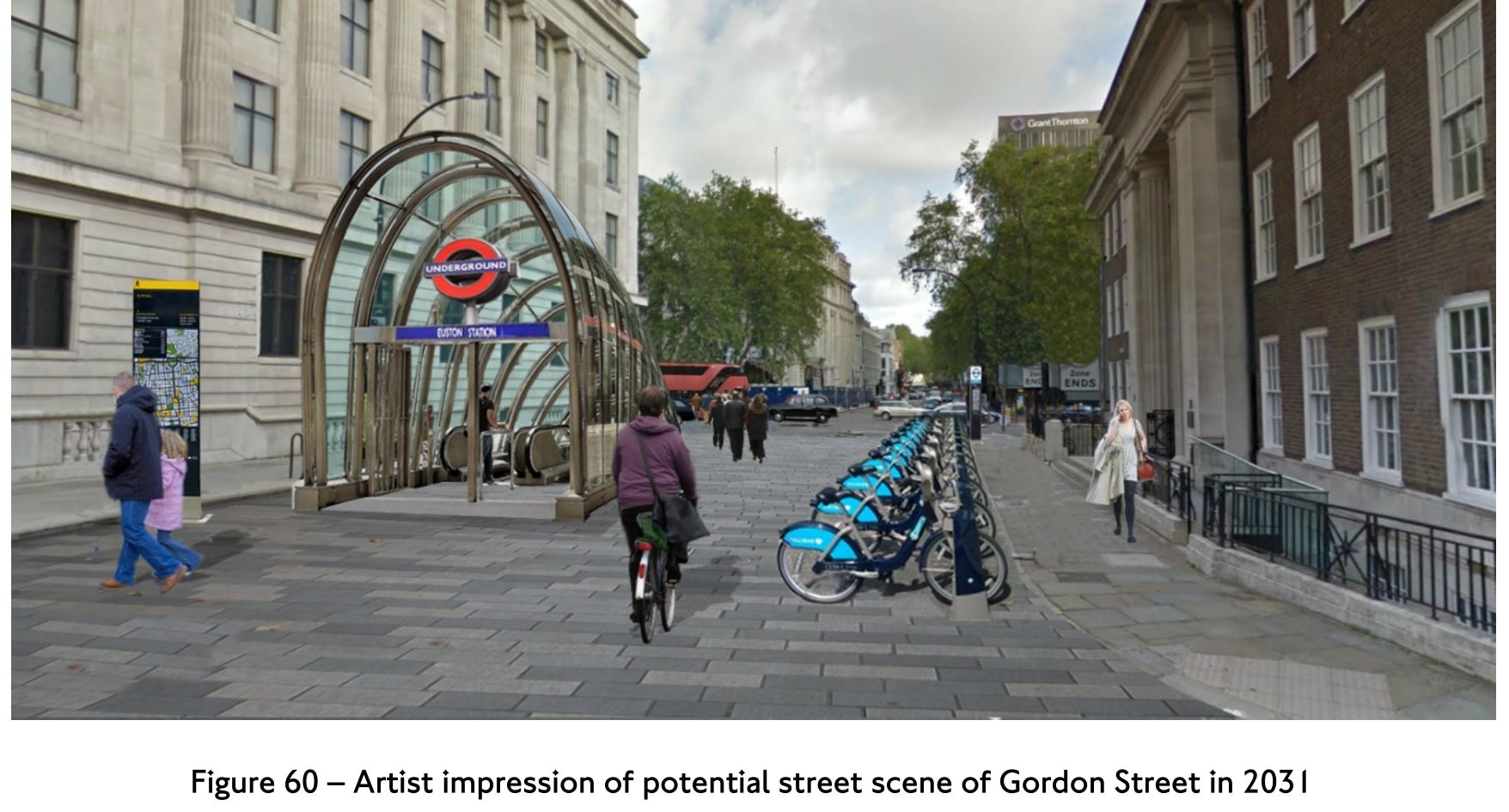
Note.
- The view is looking North.
- A tunnel from this entrance will lead to the Eastern ends of the platforms at Euston Square station, where it appears there will be at least escalator access.
- The tunnel will also lead into Euston station.
- It is a simple improvement, that shouldn’t be too challenging.
This diagram shows the layout of the tunnel.
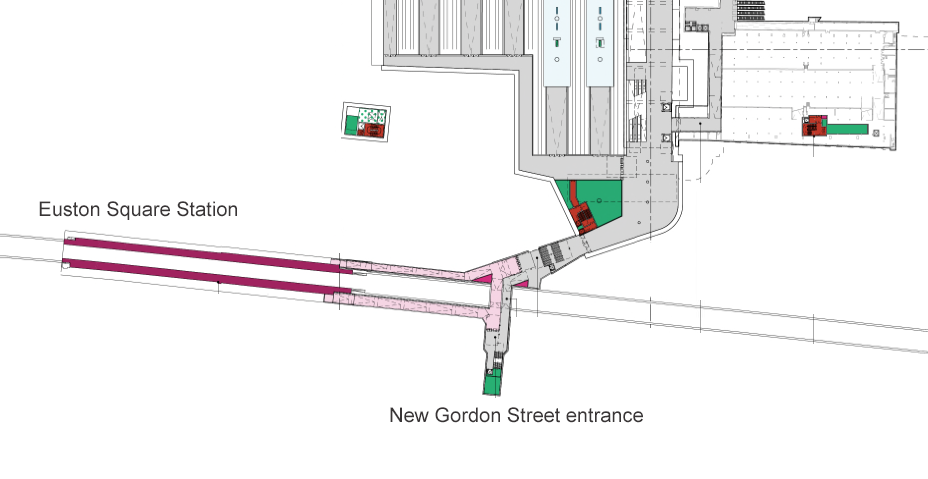
It looks to me to be a neat design, that could be installed between Gordon Street and Euston Square stations without disturbing the traffic on the busy Euston Road.
Once the subway and the Gordon Street entrance were built, there would have these benefits.
- There would be a step-free route between Euston and Euston Square stations.
- It would be a shorter walk in an air-conditioned tunnel, rather than currently along the very polluted Euston Road.
- It would be the fastest way to transfer between Euston and Kings Cross or St. Pancras stations.
- It would give excellent access to the other London terminal stations of Liverpool Street, Moorgate and Paddington.
- It would give step-free access to Crossrail at Farrington, Liverpool Street, Moorgate, Paddington and Whitechapel
- With a change at Farringdon or Liverpool Street to Crossrail, it would offer the fastest route to Canary Wharf.
- The Gordon Street entrance would improve walking routes between Euston station and University College London and other buildings on the South side of Euston Road.
I also suspect that as this project is part of the rebuilding of Euston station for High Speed Two, that it will be completed before Euston station opens for High Speed Two.
If possible, it should be built much sooner to improve access between Euston station and the sub-surface lines.
Once open, even without other improvements at Euston station, this subway would improve access to Euston station by a very substantial amount.
Camden Town Station Upgrade
In 2015, I went to see an exhibition about the proposed expansion of Camden Town station and wrote The Camden Town Station Upgrade Exhibition.
I believe this upgrade should be delivered before High Speed Two opens around the end of this decade.
But due to the financial problems of Transport for London, this project has now been kicked into the long grass.
The Wikipedia entry for Camden Town station, states that upgrading the station will take four years.
Northern Line Split
The completion of the Camden Town Station Upgrade will enable the splitting of the Northern Line into two separate lines, after the completion of the Northern Line Extension to Battersea and the Bank Station Upgrade.
- Northern Line West – Edgware to Battersea Power Station via Camden Town, Euston, Charing Cross and Waterloo.
- Northern Line East – High Barnet to Morden via Camden Town, Euston, Kings Cross, Moorgate, Bank and London Bridge.
Each branch will be running at least 24 trains per hour (tph) and will significantly increase capacity between High Speed Two and other terminal stations and the City of London.
The Northern Line should be split into two lines by the time High Speed Two opens, but with no start date in sight for the Camden Town Station Upgrade, this might not be possible.
Victoria Line Improvements
The Victoria Line or Dear Old Vicky probably won’t be able to help much, but I do think it would be feasible to improve the three most inadequate stations on the line.
- Oxford Circus station needs more capacity and step-free access.
- Highbury & Islington station needs step-free access to the deep lines to complete the station, which was only half-built in the 1960s.
- Walthamstow Central station needs to be double-ended and have step-free access.
I doubt the money can be found to carry out these improvement projects, that are essential, but very much smaller than the Camden Town Station Upgrade.
Sub-Surface Lines Improvements
The big project on the Circle, District, Hammersmith & City and Metropolitan Lines is the Four Lines Modernisation (4LM) project.
- It is an upgrade of the trains, track, electrical supply, and signalling systems.
- This will add 27 % more capacity in the Peak.
- As anybody will know, who has been to a major event at Wembley Stadium, the new S8 Stock trains, that have been running for a few years now, have an almost infinite capacity.
- Incidentally, the S8 Stock trains hold 1350 passengers, which is not far short of the 1500 that each Crossrail Class 345 train can hold.
- Euston Square station will have a step-free connection from the rebuilt Euston station complex.
Most of the Modernisation will be completed by 2023.
I believe that the sub-surface lines will become the main method to get to and from the upgraded Euston station, until Crossrail 2 is built.
- There will be direct trains to around seventy stations from Euston Square station.
- With a change at Paddington to Crossrail, there is a route to Heathrow Airport and Reading.
- With a change at Farringdon or Liverpool Street to Crossrail, there is a route to East London, Canary Wharf and South East London.
- With a change at Farringdon to Thameslink, there are routes to over a hundred stations.
- With a change at Whitechapel to the East London Line, there are routes to North, East and South London.
When you consider that the Metropolitan Line opened in 1863 and was the first passenger-carrying underground railway in the world, hasn’t it done well?
When the Euston Square station upgrade is complete, I will probably use that route to get home from Euston, changing on to a bus at Moorgate, which stops close to my house.
Old Oak Common Station
High Speed Two’s Old Oak Common station is introduced like this on this page on the High Speed Two web site.
Old Oak Common is a new super hub set to be the best connected rail station in the UK.
This map from Transport for London shows the various lines at the station.
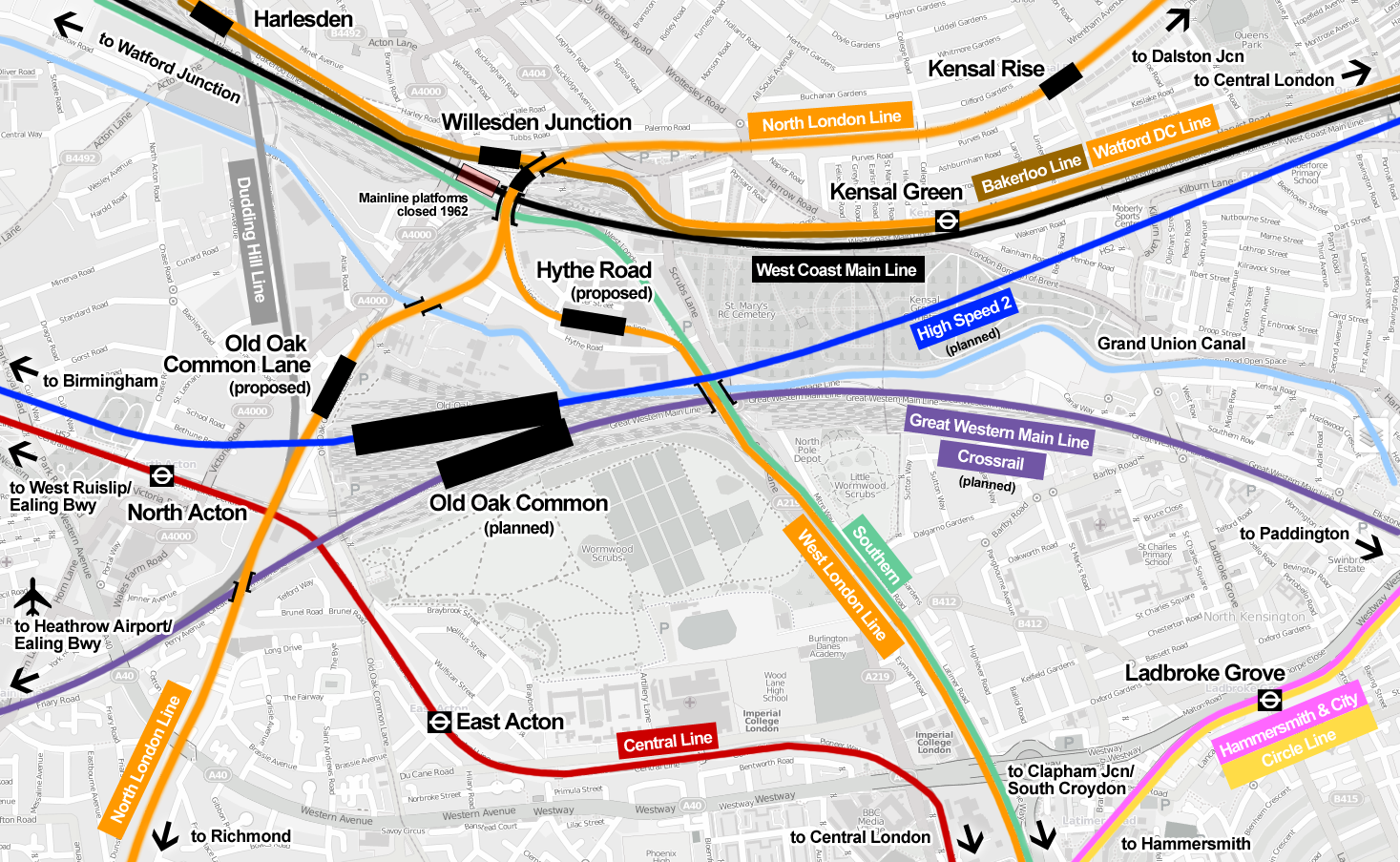
Note.
- The bright blue line is High Speed Two.
- The purple line is the Great Western Main Line and Crossrail.
- I suspect that the interchange between these three lines will be a good one.
- Will all Great Western services stop at Old Oak Common station?
- The orange lines are London Overground services, with two new stations; Old Oak Common Lane and Hythe Road close to the main Old Oak Common station.
- The green line is the Southern service between Milton Keynes and South Croydon.
- The red line is the Central Line and it could be joined to the main station.
- There are plans for a West London Orbital Railway, from Brent Cross and West Hampstead in the North to Hounslow and Kew Bridge in the West, that would call at the main Old Oak Common station.
Old Oak Common station could be well connected to most of London, through its Crossrail. London Overground and West London Orbital connections.
It is my view that these three smaller projects must be completed before the opening of High Speed Two.
- Hythe Road station
- Old Oak Common Lane station
- West London Orbital Railway.
None of these three projects would be very challenging.
Chiltern Railways And High Speed Two
Chiltern Railways already have a London Marylebone and Birmingham Moor Street service
Birmingham Moor Street station will be close to High Speed Two’s Birmingham Curzon Street station.
Plans exist for a second London terminus for Chiltern Railways close to the main Old Oak Common station.
- Could Chiltern Railways become a partner for High Speed Two on routes like between Leeds and Banbury?
- They could certainly bring passengers to Old Oak Common from Buckinghamshire, Oxfordshire and Warwickshire.
- One of my principles on High Speed Two, is that it should be a One-Nation railway.
Old Oak Common would be a very different station to Marylebone with its very useful Crossrail. London Overground and West London Orbital connections.
The terminal for Chiltern Railways at Old Oak Common is another project that should be completed before the opening of High Speed Two.
The Duality Of Euston and Old Oak Common Stations
Euston and Old Oak Common stations could almost be considered to be one station.
- All High Speed Two trains terminating or starting at Euston also call at Old Oak Common station.
- They will be just five minutes apart.
- Both stations have comprehensive networks of connections.
- Taken together the connections from both stations cover most of London and the South East.
There could be advantages for both operators and passengers.
- Would a ticket to and from London Terminals be usable at both stations?
- For some London destinations, passengers might prefer to use one terminal or the other.
- By changing at Old Oak Common to Crossrail will probably be the fastest way to Heathrow, the West End, the City, Canary Wharf and other places.
- Passengers could make the decision about the London terminal to use en route.
- Operators sometimes put the cleaning crew on the train at the last station before the terminal to save time in the turnround. The closeness of the two stations would enable this.
I think the London end of High Speed Two has been designed to make it easy for the operator and passengers.
The Losers If Crossrail 2 Isn’t Built
Crossrail 2 will provide better access to High Speed Two and the London terminals of Euston, Kings Cross, St. Pancras and Victoria for parts of London and the South East.
Victoria Line Passengers
The Victoria Line will have interchanges with Crossrail 2 at the following stations.
- Tottenham Hale
- Euston and Kings Cross St. Pancras on the Victoria Line and Euston St. Pancras on Crossrail 2
- Victoria
Note.
- Crossrail 2 will relieve capacity on the Victoria Line between Tottenham Hale and Victoria
- There will be a very comprehensive interchange at Euston St. Pancras to serve High Speed Two, Eurostar and classic lines out of Euston, Kings Cross and St. Pancras.
From what has been disclosed about the connrection between Euston and Euston Square stations transfer between Euston and Kings Cross and St. Pancras will be a lot easier than it is now.
This reworking of the poor connection to Euston Square station might take some pressure off the Victoria Line.
It might also might be possible to squeeze more trains down Dear Old Vicky.
Passengers On The Suburban Lines Into Waterloo
The suburban lines into Waterloo will go into tunnel at Wimbledon and connect directly to Victoria, Euston, St. Pancras and Kings Cross.
This will be superb access for South West London to four major London terminals.
Without Crossrail 2, passengers will have to use one of these routes to get to and from Euston.
- Change at Waterloo to the Northern Line.
- Change at Waterloo to the Bakerloo Line and then at Oxford Circus to the Victoria Line.
- Change at Vauxhall to the Victoria Line.
Could it be, that the Northern Line Extension should be extended to Clapham Junction station, as it is an aspiration over a safeguarded route under Battersea Park?
In An Analysis Of Waterloo Suburban Services Proposed To Move To Crossrail 2, I showed it was possible to run a Crossrail 2 schedule of four tph into Waterloo station, if the following were done.
- More platform capacity in Waterloo.
- Modern high-performance 100 mph trains like Class 707 trains or Aventras.
- Some improvements to track and signals between Waterloo and Wimbledon stations.
- Wimbledon station would only need minor modifications.
- A measure of ATC between Waterloo and Wimbledon stations.
This would not be a large project
Passengers In Balham And/Or Tooting
Crossrail 2 is planned to run between Wimbledon and Victoria via the following stations.
Note.
- Crossrail 2 should take pressure off the Northern Line.
- Public Opinion is against King’s Road Chelsea station. How will their cleaners, cooks and nannies get to work? Especially, as the roads in the area are already jammed by Chelsea tractors.
- The original route favoured Balham to give an interchange with National Rail. Tooting Broadway also has geological problems for the tunneling.
- On the other hand, Sadiq Khan supports the route through Tooting Broadway, which better serves his former constituency.
This Map from cartometro.com shows the rail lines in the area.
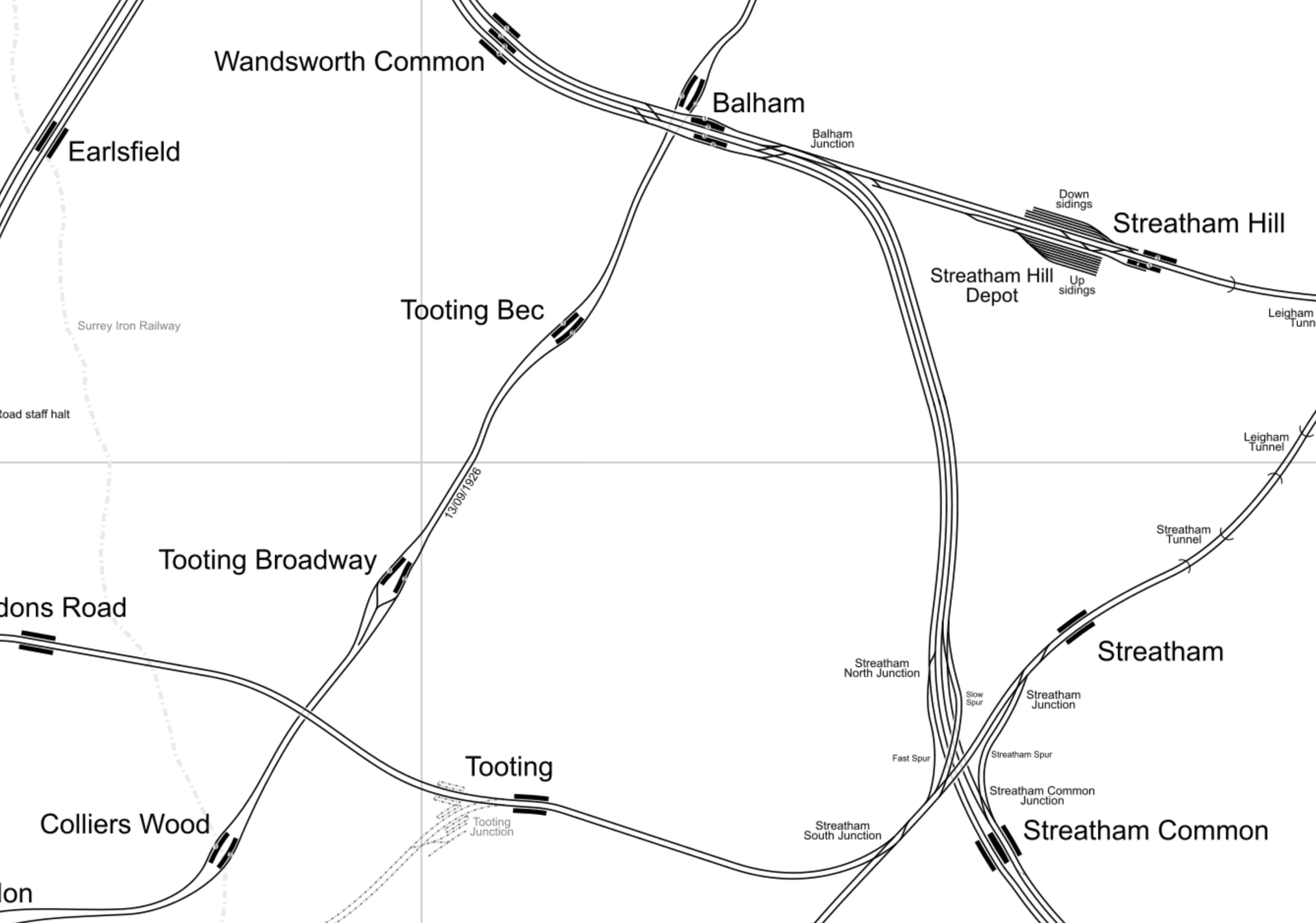
Note.
- Balham station in the North is an interchange station between the Northern Line and National Rail, with a possible four National Rail platforms.
- Tooting Broadway is a simple through station on the Northern Line.
- The next station after Wandsworth Common towards London is Clapham Junction.
- Transport for London have been advocating a new Streatham Common station, that would be an interchange between the lines through Streatham Common and those through Streatham.
- Streatham and Tooting stations are on the Wimbledon Loop Line, which only carries two tph in both directions.
Since I have been writing this blog, there have been several ideas to make better use of the National Rail lines in this area.
There was even a plan that I wrote about in 2016 called The Streatham Virtual Tube.
- Trains would run through Streatham Common, Streatham, Streatham, Hill, Balham, Wandsworth Common, Clapham Junction and into Victoria.
- Trains could also go North from Clapham Junction to Old Oak Common for High Speed Two.
- The Streatham Common Interchange would be built. This would give a useful interchange to the Wimbledon Loop Line.
- There would be four tracks through Streatham.
- A tunnel would be build to allow trains to go through both Streatham and Streatham Hill stations.
- It would have an interchange at Balham with the Northern Line.
- It could have an interchange at Clapham Junction with an extended Battersea Branch of the Northern Line.
- Suppose it had a frequency of perhaps six or even ten tph.
I think it might work, but it shows what can be done, with a bit of out-of-the-box thinking.
Passengers In Dalston And Hackney
One of the entrances to the proposed massive double-ended Crossrail 2 station at Dalston will be at the end of my road and very close to where my mother used to work and where her mother was actually born.
East London had not had major rail improvements since the 1950s and 1960s, when most of the lines into Liverpool Street were electrified and the Southbury Loop was reopened.
But since the creation of the Overground in 2007 from the remains of the ill-performing Silverlink, with the addition of new trains and ticketing and a good clean, there has been a series of smaller projects that have been completed, in and around East and North London.
- 2009 – North London Line starts running to new platforms at Stratford.
- 2009 – Stratford International station opens on High Speed One.
- 2010 – East London Line opens with services to Crystal Palace, New Cross, New Cross Gate and West Croydon stations.
- 2011 – A substantially rebuilt Stratford station opens for the Olympics
- 2012 – South London Line opens with services between Dalston Junction and Clapham Junction stations.
- 2012 – The Docklands Light Railway is extended to Stratford and Stratford International stations.
- 2014 – Hampstead Heath station gets an upgrade.
- 2015 – The Lea Valley Lines between Liverpool Street and Cheshunt, Chingford and Enfield Town stations were moved to the Overground.
- 2015 – TfL Rail begins operation between Liverpool Street and Shenfield, using new Class 345 trains.
- 2016 – Lea Bridge station reopened.
- 2016 – Second entrance to Ilford station in York Road reopened.
- 2018 – Northumberland Park station was rebuilt.
- 2019 – The Gospel Oak to Barking Line was electrified and equipped with new Class 710 trains.
- 2019 – West Hampstead station was rebuilt.
- 2019 – The new Meridian Water station opened.
- 2019 – The rebuilt White Hart Lane station opened.
- 2020 – Tottenham Hale station was rebuilt.
- 2020 – The new Class 710 trains were rolled out on the Lea Valley Lines.
Note.
- There have also numerous smaller upgrades like the addition of lifts to several stations.
- Stations between Stratford and Shenfield have been upgraded for Crossrail.
- There has also been considerable upgrades to the electrification, which in some places was not in the best of condition.
- Most lines have a frequency of four tph or more.
Some may feel that East London has done well with rail improvements in the last few years.
I would agree in some ways, but would counter by saying that before the Overground was created, East London’s were in a terrible state and their state today is a excellent example of what can be achieved by good design, planning and execution, without spending vast sums.
East London and the boroughs of Enfield, Hackney, Haringey, Newham and Waltham Forest in particular, now have a good rail network, that is going to get a lot better with the addition of Crossrail.
- The North London Line is about half a mile to the North of where I live and can walk to two stations or get a bus to another three.
- Crossrail will be a couple of miles to the South with station entrances at Moorgate, Liverpool Street, Whitechapel and Stratford.
- There are four electrified railway lines with new trains, which run North-South with connections to the two East-West lines.
- Although my quickest way to Crossrail will be a bus from close to my house to outside Moorgate station.
- I suspect that everybody in the Borough of Hackney and the Eastern part of Islington will be able to get to a Crossrail station in well under thirty minutes.
- In addition, from where I live the Gospel Oak to Barking Line runs a couple of miles North of the North London Line.
I believe that Dalston’s success over the last decade has been a collateral benefit of its comprehensive rail system, supported by lots of shiny new buses.
Does Dalston want Crossrail 2? Probably, Yes!
Does Dalston need Crossrail 2? Possibly, No!
Do other areas of large cities need Dalstonisation of their railway and bus systems? Absolutely!
I certainly don’t regret moving to Dalston!
Note that one of the reasons I’m so keen on the West London Orbital Railway is that it could do the same for North West London, as the Overground and the Lea Valley Lines have done for North East London.
Passengers Along The Lea Valley
Crossrail 2 will connect the Lea Valley Lines to Dalston and on to Central London.
It will involve the following changes to the West Anglia Main Line.
- Four-tracking of the route at least as far as Broxbourne.
- A junction South of Tottenham Hale station will connect the route to a tunnel to Dalston.
- Level crossings at Brimsdown, Enfield Lock and Cheshunt will be removed.
- Like Crossrail, stations would be substantially step-free.
- The signalling will be upgraded to full in-cab digital ERTMS signalling, that is used by Crossrail and Thameslink under London.
This would enable 10-15 tph running between Tottenham Hale and Broxbourne stations.
With all the development going on around Cambridge and possible expansion of Stansted Airport, I believe that even if Crossrail 2 is not build, then there will be pressure to four-track the West Anglia Main Line, remove the level crossings and improve the stations and signalling.
If this were to be done, then there is an interim plan that could be implemented that I wrote about, four years ago in Could A Lea Valley Metro Be Created?
I envisaged the following.
- Updating the West Anglia Main Line to four-tracks and a standard suitable for Crossrail 2.
- Using the double-track loop at Stratford as the Southern terminal, for some of the trains.
- Updating the Victoria Line stations. The major interchange at Tottenham Hale station has already been improved substantially.
- Providing an appropriate service between Stratford and Broxbourne stations.
- Terminating some Stansted and Cambridge services in the Stratford Loop, as Stratford has better connections to South London and Kent than Liverpool Street.
- Integrating Lea Valley Metro, London Overground and Greater Anglia services to Bishops Stortford, Cambridge and Hertford North stations.
Note.
- All services connect to Crossrail and the Central Line at the Southern end.
- Services to Liverpool Street connect to National Rail services, the Lea Valley Lines of the London Overground and the Circle, District and Metropolitan Lines.
- Services to Stratford connect to National Rail services, the North London Line of the London Overground and the Jubilee Line.
- Could alternate trains serve Liverpool Street and Stratford?
- Could splitting services between Liverpool Street and Stratford mean that the largest proportion of routes have just a single change?
As Transport for London and the train operating companies know where passengers want to go and actually go, I’m sure that a service pattern, that is acceptable to all could be created.
Conclusion
Crossrail 2 is quoted as being a £33 billion project.
I believe that with a good review lots of money could be saved and other smaller projects could be planned and executed to handle the expected increase in the number of passengers.
I would do the following.
- Camden Town station – Upgrade
- Chiltern Railways – Build their connection to Old Oak Common station
- Euston Station – Improve connections to Euston and Euston Square Underground stations.
- Northern Line – Extend the Battersea branch to Clapham Junction
- Northern Line – Split Into Two Lines
- Overground – Build Old Oak Common Lane and Hythe Road stations
- Southern – Build the new Streatham Common station and implement The Streatham Virtual Tube.
- South Western Railway – Run four tph on all proposed Crossrail 2 routes into Waterloo station
- Victoria Line – Upgrade Highbury & Islington, Oxford Circus and Walthamstow Central stations and increase the frequency if possible
- West Anglia Main Line – Upgrade ready for Crossrail 2 and develop the Lea Valley Metro
All of these projects would have their own benefits, whether Crossrail 2 is built or not!
Only when the needs of all passengers have been assessed in a few years, should we make a decision about Crossrail 2.
Will Hitachi Announce A High Speed Metro Train?
As the UK high speed rail network increases, we are seeing more services and proposed services, where local services are sharing tracks, where trains will be running at 125 mph or even more.
London Kings Cross And Cambridge/Kings Lynn
This Great Northern service is run by Class 387 trains.
- Services run between London Kings Cross and King’s Lynn or Cambridge
- The Class 387 trains have a maximum operating speed of 110 mph.
- The route is fully electrified.
- The trains generally use the fast lines on the East Coast Main Line, South of Hitchin.
- Most trains on the fast lines on the East Coast Main Line are travelling at 125 mph.
When in the future full digital in-cab ERTMS signalling is implemented on the East Coast Main Line, speeds of up to 140 mph should be possible in some sections between London Kings Cross and Hitchin.
The Digswell Viaduct Problem
I also believe that digital signalling may be able to provide a solution to the twin-track bottleneck over the Digswell Viaduct.
Consider.
- Airliners have been flown automatically and safely from airport to airport for perhaps four decades.
- The Victoria Line in London, has been running automatically and safely at over twenty trains per hour (tph) for five decades. It is now running at over 30 tph.
- I worked with engineers developing a high-frequency sequence control system for a complicated chemical plant in 1970.
We also can’t deny that computers are getting better and more capable.
For these reasons, I believe there could be an ERTMS-based solution to the problem of the Digswell Viaduct, which could be something like this.
- All trains running on the two track section over the Digswell Viaduct and through Welwyn North station would be under computer control between Welwyn Garden City and Knebworth stations.
- Fast trains would be slowed as appropriate to create spaces to allow the slow trains to pass through the section.
- The train drivers would be monitoring the computer control, just as they do on the Victoria Line.
Much more complicated automated systems have been created in various applications.
The nearest rail application in the UK, is probably the application of digital signalling to London Underground’s Circle, District, Hammersmith & City and Metropolitan Lines.
This is known at the Four Lines Modernisation and it will be completed by 2023 and increase capacity by up to twenty-seven percent.
I don’t think it unreasonable to see the following maximum numbers of services running over the Digswell Viaduct by 2030 in both directions in every hour.
- Sixteen fast trains
- Four slow trains
That is one train every three minutes.
Currently, it appears to be about ten fast and two slow.
As someone, who doesn’t like to be on a platform, when a fast train goes through, I believe that some form of advanced safety measures should be installed at Welwyn North station.
It would appear that trains between London Kings Cross and King’s Lynn need to have this specification.
- Ability to run at 125 mph on the East Coast Main Line
- Ability to run at 140 mph on the East Coast Main Line, under control of full digital in-cab ERTMS signalling.
This speed increase could reduce the journey time between London Kings Cross and Cambridge to just over half-an-hour with London Kings Cross and King’s Lynn under ninety minutes.
The only new infrastructure needed would be improvements to the Fen Line to King’s Lynn to allow two tph, which I think is needed.
Speed improvements between Hitchin and Cambridge could also benefit timings.
London Kings Cross And Cambridge/Norwich
I believe there is a need for a high speed service between London Kings Cross and Norwich via Cambridge.
- The Class 755 trains, that are capable of 100 mph take 82 minutes, between Cambridge and Norwich.
- The electrification gap between Ely and Norwich is 54 miles.
- Norwich station and South of Ely is fully electrified.
- Greater Anglia’s Norwich and Cambridge service has been very successful.
With the growth of Cambridge and its incessant need for more space, housing and workers, a high speed train between London Kings Cross and Norwich via Cambridge could tick a lot of boxes.
- If hourly, it would double the frequency between Cambridge and Norwich until East-West Rail is completed.
- All stations between Ely and Norwich get a direct London service.
- Cambridge would have better links for commuting to the city.
- Norwich would provide the quality premises, that Cambridge is finding hard to develop.
- London Kings Cross and Cambridge would be just over half an hour apart.
- If the current London Kings Cross and Ely service were to be extended to Norwich, no extra paths on the East Coast Main Line would be needed.
- Trains could even split and join at Cambridge or Ely to give all stations a two tph service to London Kings Cross.
- No new infrastructure would be required.
The Cambridge Cruiser would become the Cambridge High Speed Cruiser.
London Paddington And Bedwyn
This Great Western Railway service is run by Class 802 trains.
- Services run between London Paddington and Bedwyn.
- Services use the Great Western Main Line at speeds of up to 125 mph.
- In the future if full digital in-cab ERTMS signalling is implemented, speeds of up to 140 mph could be possible on some sections between London Paddington and Reading.
- The 13.3 miles between Newbury and Bedwyn is not electrified.
As the service would need to be able to run both ways between Newbury and Bedwyn, a capability to run upwards of perhaps thirty miles without electrification is needed. Currently, diesel power is used, but battery power would be better.
London Paddington And Oxford
This Great Western Railway service is run by Class 802 trains.
- Services run between London Paddington and Oxford.
- Services use the Great Western Main Line at speeds of up to 125 mph.
- In the future if full digital in-cab ERTMS signalling is implemented, speeds of up to 140 mph could be possible on some sections between London Paddington and Didcot Parkway.
- The 10.3 miles between Didcot Parkway and Oxford is not electrified.
As the service would need to be able to run both ways between Didcot Parkway and Oxford, a capability to run upwards of perhaps thirty miles without electrification is needed. Currently, diesel power is used, but battery power would be better.
Local And Regional Trains On Existing 125 mph Lines
In The UK, in addition to High Speed One and High Speed Two, we have the following lines, where speeds of 125 mph are possible.
- East Coast Main Line
- Great Western Main Line
- Midland Main Line
- West Coast Main Line
Note.
- Long stretches of these routes allow speeds of up to 125 mph.
- Full digital in-cab ERTMS signalling is being installed on the East Coast Main Line to allow running up to 140 mph.
- Some of these routes have four tracks, with pairs of slow and fast lines, but there are sections with only two tracks.
It is likely, that by the end of the decade large sections of these four 125 mph lines will have been upgraded, to allow faster running.
If you have Hitachi and other trains thundering along at 140 mph, you don’t want dawdlers, at 100 mph or less, on the same tracks.
These are a few examples of slow trains, that use two-track sections of 125 nph lines.
- East Midlands Railway – 1 tph – Leicester and Lincoln – Uses Midland Main Line
- East Midlands Railway – 1 tph – Liverpool and Norwich – Uses Midland Main Line
- East Midlands Railway – 2 tph – St. Pancras and Corby – Uses Midland Main Line
- Great Western Railway – 1 tph – Cardiff and Portsmouth Harbour – Uses Great Western Main Line
- Great Western Railway – 1 tph – Cardiff and Taunton – Uses Great Western Main Line
- Northern – 1 tph – Manchester Airport and Cumbria – Uses West Coast Main Line
- Northern – 1 tph – Newcastle and Morpeth – Uses East Coast Main Line
- West Midlands Trains – Some services use West Coast Main Line.
Conflicts can probably be avoided by judicious train planning in some cases, but in some cases trains capable of 125 mph will be needed.
Southeastern Highspeed Services
Class 395 trains have been running Southeastern Highspeed local services since 2009.
- Services run between London St. Pancras and Kent.
- Services use Speed One at speeds of up to 140 mph.
- These services are planned to be extended to Hastings and possibly Eastbourne.
The extension would need the ability to run on the Marshlink Line, which is an electrification gap of 25.4 miles, between Ashford and Ore.
Thameslink
Thameslink is a tricky problem.
These services run on the double-track section of the East Coast Main Line over the Digswell Viaduct.
- 2 tph – Cambridge and Brighton – Fast train stopping at Hitchin, Stevenage and Finsbury Park.
- 2 tph – Cambridge and Kings Cross – Slow train stopping at Hitchin, Stevenage, Knebworth, Welwyn North, Welwyn Garden City, Hatfield, Potters Bar and Finsbury Park
- 2 tph – Peterborough and Horsham – Fast train stopping at Hitchin, Stevenage and Finsbury Park.
Note.
- These services are run by Class 700 trains, that are only capable of 100 mph.
- The fast services take the fast lines South of the Digswell Viaduct.
- South of Finsbury Park, both fast services cross over to access the Canal Tunnel for St, Pancras station.
- I am fairly certain, that I have been on InterCity 125 trains running in excess of 100 mph in places between Finsbury Park and Stevenage.
It would appear that the slow Thameslink trains are slowing express services South of Stevenage.
As I indicated earlier, I think it is likely that the Kings Cross and King’s Lynn services will use 125 mph trains for various reasons, like London and Cambridge in under half an hour.
But if 125 mph trains are better for King’s Lynn services, then they would surely improve Thameslink and increase capacity between London and Stevenage.
Looking at average speeds and timings on the 25 miles between Stevenage and Finsbury Park gives the following.
- 100 mph – 15 minutes
- 110 mph – 14 minutes
- 125 mph – 12 minutes
- 140 mph – 11 minutes
The figures don’t appear to indicate large savings, but when you take into account that the four tph running the Thameslink services to Peterborough and Cambridge stop at Finsbury Park and Stevenage and have to get up to speed, I feel that the 100 mph Class 700 trains are a hindrance to more and faster trains on the Southern section of the East Coast Main Line.
It should be noted, that faster trains on these Thameslink services would probably have better acceleration and and would be able to execute faster stops at stations.
There is a similar less serious problem on the Midland Main Line branch of Thameslink, in that some Thameslink services use the fast lines.
A couple of years ago, I had a very interesting chat with a group of East Midlands Railway drivers. They felt that the 100 mph Thameslink and the 125 mph Class 222 trains were not a good mix.
The Midland Main Line services are also becoming more complicated, with the new EMR Electric services between St. Pancras and Corby, which will be run by 110 mph Class 360 trains.
Hitachi’s Three Trains With Batteries
Hitachi have so far announced three battery-electric trains. Two are based on battery packs being developed and built by Hyperdrive Innovation.
Hyperdrive Innovation
Looking at the Hyperdrive Innovation web site, I like what I see.
Hyperdrive Innovation provided the battery packs for JCB’s first electric excavator.
Note that JCB give a five-year warranty on the Hyperdrive batteries.
Hyperdrive have also been involved in the design of battery packs for aircraft push-back tractors.
The battery capacity for one of these is given as 172 kWh and it is able to supply 34 kW.
I was very surprised that Hitachi didn’t go back to Japan for their batteries, but after reading Hyperdrive’s web site about the JCB and Textron applications, there would appear to be good reasons to use Hyperdrive.
- Hyperdrive have experience of large lithium ion batteries.
- Hyperdrive have a design, develop and manufacture model.
- They seem to able to develop solutions quickly and successfully.
- Battery packs for the UK and Europe are made in Sunderland.
- Hyperdrive are co-operating with Nissan, Warwick Manufacturing Group and Newcastle University.
- They appear from the web site to be experts in the field of battery management, which is important in prolonging battery life.
- Hyperdrive have a Taiwanese partner, who manufactures their battery packs for Taiwan and China.
- I have done calculations based on the datasheet for their batteries and Hyperdrive’s energy density is up with the best
I suspect, that Hitachi also like the idea of a local supplier, as it could be helpful in the negotiation of innovative applications. Face-to-face discussions are easier, when you’re only thirty miles apart.
Hitachi Regional Battery Train
The first train to be announced was the Hitachi Regional Battery Train, which is described in this Hitachi infographic.

Note.
- It is only a 100 mph train.
- The batteries are to be designed and manufactured by Hyperdrive Innovation.
- It has a range of 56 miles on battery power.
- Any of Hitachi’s A Train family like Class 800, 802 or 385 train can be converted to a Regional Battery Train.
No orders have been announced yet.
But it would surely be very suitable for routes like.
- London Paddington And Bedwyn
- London Paddington And Oxford
It would also be very suitable for extensions to electrified suburban routes like.
- London Bridge and Uckfield
- London Waterloo and Salisbury
- Manchester Airport and Windermere.
- Newcastle and Carlisle
It would also be a very sound choice to extend electrified routes in Scotland, which are currently run by Class 385 trains.
Hitachi InterCity Tri-Mode Battery Train
The second train to be announced was the Hitachi InterCity Tri-Mode Battery Train, which is described in this Hitachi infographic.
Note.
- Only one engine is replaced by a battery.
- The batteries are to be designed and manufactured by Hyperdrive Innovation.
- Typically a five-car Class 800 or 802 train has three diesel engines and a nine-car train has five.
- These trains would obviously be capable of 125 mph on electrified main lines and 140 mph on lines fully equipped with digital in-cab ERTMS signalling.
Nothing is said about battery range away from electrification.
Routes currently run from London with a section without electrification at the other end include.
- London Kings Cross And Harrogate – 18.3 miles
- London Kings Cross And Hull – 36 miles
- London Kings Cross And Lincoln – 16.5 miles
- London Paddington And Bedwyn – 13.3 miles
- London Paddington And Oxford – 10.3 miles
In the March 2021 Edition of Modern Railways, LNER are quoted as having aspirations to extend the Lincoln service to Cleethorpes.
- With all energy developments in North Lincolnshire, this is probably a good idea.
- Services could also call at Market Rasen and Grimsby.
- Two trains per day, would probably be a minimum frequency.
But the trains would need to be able to run around 64 miles each way without electrification. Very large batteries and/or charging at Cleethorpes will be needed.
Class 803 Trains For East Coast Trains
East Coast Trains have ordered a fleet of five Class 803 trains.
- These trains appear to be built for speed and fast acceleration.
- They have no diesel engines, which must save weight and servicing costs.
- But they will be fitted with batteries for emergency power to maintain onboard train services in the event of overhead line failure.
- They are planned to enter service in October 2021.
Given that Hyperdrive Innovation are developing traction batteries for the other two Hitachi battery trains, I would not be the least bit surprised if Hyperdrive were designing and building the batteries for the Class 803 trains.
- Hyperdrive batteries are modular, so for a smaller battery you would use less modules.
- If all coaches are wired for a diesel engine, then they can accept any power module like a battery or hydrogen pack, without expensive redesign.
- I suspect too, that the battery packs for the Class 803 trains could be tested on an LNER Class 801 train.
LNER might also decide to replace the diesel engines on their Class 801 trains with an emergency battery pack, if it were more energy efficient and had a lighter weight.
Thoughts On The Design Of The Hyperdrive innovation Battery Packs
Consider.
- Hitachi trains have a sophisticated computer system, which on start-up can determine the configuration of the train or whether it is more than one train running as a longer formation or even being hauled by a locomotive.
- To convert a bi-mode Class 800 train to an all-electric Class 801 the diesel engines are removed. I suspect that the computer is also adjusted, but train formation may well be totally automatic and independent of the driver.
- Hyperdrive Innovation’s battery seem to be based on a modular system, where typical modules have a capacity of 5 kWh, weighs 32 Kg and has a volume of 0.022 cu metres.
- The wet mass of an MTU 16V 1600 R80L diesel engine commonly fitted to AT-300 trains of different types is 6750 Kg or nearly seven tonnes.
- The diesel engine has a physical size of 1.5 x 1.25 x 0.845 metres, which is a volume of 1.6 cubic metres.
- In How Much Power Is Needed To Run A Train At 125 mph?, I calculated that a five-car Class 801 electric train, needed 3.42 kWh per vehicle-mile to maintain 125 mph.
- It is likely, than any design of battery pack, will handle the regenerative braking.
To my mind, the ideal solution would be a plug compatible battery pack, that the train’s computer thought was a diesel engine.
But then I have form in the area of plug-compatible electronics.
At the age of sixteen, for a vacation job, I worked in the Electronics Laboratory at Enfield Rolling Mills.
It was the early sixties and one of their tasks was at the time replacing electronic valve-based automation systems with new transistor-based systems.
The new equipment had to be compatible to that which it replaced, but as some were installed in dozens of places around the works, they had to be able to be plug-compatible, so that they could be quickly changed. Occasionally, the new ones suffered infant-mortality and the old equipment could just be plugged back in, if there wasn’t a spare of the new equipment.
So will Hyperdrive Innovation’s battery-packs have the same characteristics as the diesel engines that they replace?
- Same instantaneous and continuous power output.
- Both would fit the same mountings under the train.
- Same control and electrical power connections.
- Compatibility with the trains control computer.
I think they will as it will give several advantages.
- The changeover between diesel engine and battery pack could be designed as a simple overnight operation.
- Operators can mix-and-match the number of diesel engines and battery-packs to a given route.
- As the lithium-ion cells making up the battery pack improve, battery capacity and performance can be increased.
- If the computer, is well-programmed, it could reduce diesel usage and carbon-emissions.
- Driver conversion from a standard train to one equipped with batteries, would surely be simplified.
As with the diesel engines, all battery packs could be substantially the same across all of Hitachi’s Class 80x trains.
What Size Of Battery Would Be Possible?
If Hyperdrive are producing a battery pack with the same volume as the diesel engine it replaced, I estimate that the battery would have a capacity defined by.
5 * 1.6 / 0.022 = 364 kWh
In an article in the October 2017 Edition of Modern Railways, which is entitled Celling England By The Pound, Ian Walmsley says this in relation to trains running on the Uckfield Branch, which is not very challenging.
A modern EMU needs between 3 and 5 kWh per vehicle mile for this sort of service.
As a figure of 3.42 kWh per vehicle-mile to maintain 125 mph, applies to a Class 801 train, I suspect that a figure of 3 kWh or less could apply to a five-car Class 800 train trundling at around 80-100 mph to Bedwyn, Cleethorpes or Oxford.
- A one-battery five-car train would have a range of 24.3 miles
- A two-battery five-car train would have a range of 48.6 miles
- A three-battery five-car train would have a range of 72.9 miles
Note.
- Reducing the consumption to 2.5 kWh per vehicle-mile would give a range of 87.3 miles.
- Reducing the consumption to 2 kWh per vehicle-mile would give a range of 109.2 miles.
- Hitachi will be working to reduce the electricity consumption of the trains.
- There will also be losses at each station stop, as regenerative braking is not 100 % efficient.
But it does appear to me, that distances of the order of 60-70 miles would be possible on a lot of routes.
Bedwyn, Harrogate, Lincoln and Oxford may be possible without charging before the return trip.
Cleethorpes and Hull would need a battery charge before return.
A Specification For A High Speed Metro Train
I have called the proposed train a High Speed Metro Train, as it would run at up to 140 mph on an existing high speed line and then run a full or limited stopping service to the final destination.
These are a few thoughts.
Electrification
In some cases like London Kings Cross and King’s Lynn, the route is already electrified and batteries would only be needed for the following.
- Handling regenerative braking.
- Emergency power in case of overhead line failure.
- Train movements in depots.
But if the overhead wires on a branch line. are in need of replacement, why not remove them and use battery power? It might be the most affordable and least disruptive option to update the power supply on a route.
The trains would have to be able to run on both types of electrification in the UK.
- 25 KVAC overhead.
- 750 VDC third rail.
This dual-voltage capability would enable the extension of Southeastern Highspeed services.
Operating Speed
The trains must obviously be capable of running at the maximum operating speed on the routes they travel.
- 125 mph on high speed lines, where this speed is possible.
- 140 mph on high speed lines equipped with full digital in-cab ERTMS signalling, where this speed is possible.
The performance on battery power must be matched with the routes.
Hitachi have said, that their Regional Battery trains can run at up to 100 mph, which would probably be sufficient for most secondary routes in the UK and in line with modern diesel and electric multiple units.
Full Digital In-cab ERTMS Signalling
This will be essential and is already fitted to some of Hitachi’s trains.
Regenerative Braking To Batteries
Hitachi’s battery electric trains will probably use regenerative braking to the batteries, as it is much more energy efficient.
It also means that when stopping at a station perhaps as much as 70-80% of the train’s kinetic energy can be captured in the batteries and used to accelerate the train.
In Kinetic Energy Of A Five-Car Class 801 Train, I showed that at 125 mph the energy of a full five-car train is just over 100 kWh, so batteries would not need to be unduly large.
Acceleration
This graph from Eversholt Rail, shows the acceleration and deceleration of a five-car Class 802 electric train.
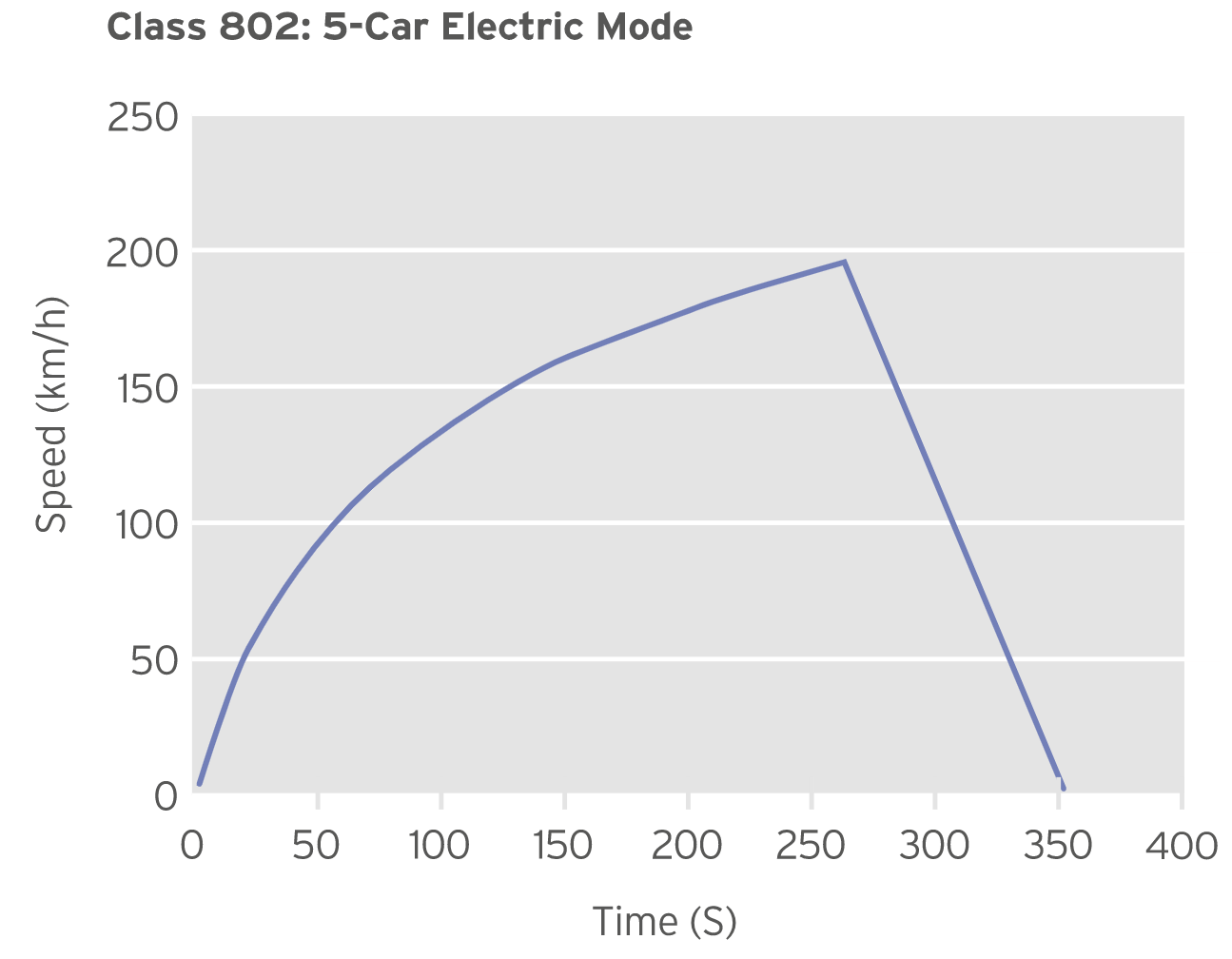
As batteries are just a different source of electric power, I would think, that with respect to acceleration and deceleration, that the performance of a battery-electric version will be similar.
Although, it will only achieve 160 kph instead of the 200 kph of the electric train.
I estimate from this graph, that a battery-electric train would take around 220 seconds from starting to decelerate for a station to being back at 160 kph. If the train was stopped for around eighty seconds, a station stop would add five minutes to the journey time.
London Kings Cross And Cleethorpes
As an example consider a service between London Kings Cross and Cleethorpes.
- The section without electrification between Newark and Cleethorpes is 64 miles.
- There appear to be ambitions to increase the operating speed to 90 mph.
- Local trains seem to travel at around 45 mph including stops.
- A fast service between London Kings Cross and Cleethorpes would probably stop at Lincoln Central, Market Rasen and Grimsby Town.
- In addition, local services stop at Collingham, Hykeham, Barnetby and Habrough.
- London Kings Cross and Newark takes one hour and twenty minutes.
- London Kings Cross and Cleethorpes takes three hours and fifteen minutes with a change at Doncaster.
I can now calculate a time between Kings Cross and Cleethorpes.
- If a battery-electric train can average 70 mph between Newark and Cleethorpes, it would take 55 minutes.
- Add five minutes for each of the three stops at Lincoln Central, Market Rasen and Grimsby Town
- Add in the eighty minutes between London Kings Cross and Newark and that would be two-and-a-half hours.
That would be very marketing friendly and a very good start.
Note.
- An average speed of 80 mph would save seven minutes.
- An average speed of 90 mph would save twelve minutes.
- I suspect that the current bi-modes would be slower by a few minutes as their acceleration is not as potent of that of an electric train.
I have a feeling London Kings Cross and Cleethorpes via Lincoln Central, Market Rasen and Grimsby Town, could be a very important service for LNER.
Interiors
I can see a new lightweight and more energy efficient interior being developed for these trains.
In addition some of the routes, where they could be used are popular with cyclists and the current Hitachi trains are not the best for bicycles.
Battery Charging
Range On Batteries
I have left this to last, as it depends on so many factors, including the route and the quality of the driving or the Automatic Train Control
Earlier, I estimated that a five-car train with all three diesel engines replaced by batteries, when trundling around Lincolnshire, Oxfordshire or Wiltshire could have range of up to 100 miles.
That sort of distance would be very useful and would include.
- Ely and Norwich
- Newark and Cleethorpes
- Salisbury and Exeter
It might even allow a round trip between the East Coast Main Line and Hull.
The Ultimate Battery Train
This press release from Hitachi is entitled Hitachi And Eversholt Rail To Develop GWR Intercity Battery Hybrid Train – Offering Fuel Savings Of More Than 20%.
This is a paragraph.
The projected improvements in battery technology – particularly in power output and charge – create opportunities to replace incrementally more diesel engines on long distance trains. With the ambition to create a fully electric-battery intercity train – that can travel the full journey between London and Penzance – by the late 2040s, in line with the UK’s 2050 net zero emissions target.
Consider.
- Three batteries would on my calculations give a hundred mile range.
- Would a train with no diesel engines mean that fuel tanks, radiators and other gubbins could be removed and more or large batteries could be added.
- Could smaller batteries be added to the two driving cars?
- By 2030, let alone 2040, battery energy density will have increased.
I suspect that one way or another these trains could have a range on battery power of between 130 and 140 miles.
This would certainly be handy in Scotland for the two routes to the North.
- Haymarket and Aberdeen, which is 130 miles without electrification.
- Stirling and Inverness, which is 111 miles without electrification, if the current wires are extended from Stirling to Perth, which is being considered by the Scottish Government.
The various sections of the London Paddington to Penzance route are as follows.
- Paddington and Newbury – 53 miles – electrified
- Newbury and Taunton – 90 miles – not electrified
- Taunton and Exeter – 31 miles – not electrified
- Exeter and Plymouth – 52 miles – not electrified
- Plymouth and Penzance – 79 miles – not electrified
The total length of the section without electrification between Penzance and Newbury is a distance of 252 miles.
This means that the train will need a battery charge en route.
I think there are three possibilities.
- Trains can take up to seven minutes for a stop at Plymouth. As London and Plymouth trains will need to recharge at Plymouth before returning to London, Plymouth station could be fitted with comprehensive recharge facilities for all trains passing through. Perhaps the ideal solution would be to electrify all lines and platforms at Plymouth.
- Between Taunton and Exeter, the rail line runs alongside the M5 motorway. This would surely be an ideal section to electrify, as it would enable battery electric trains to run between Exeter and both Newbury and Bristol.
- As some trains terminate at Exeter, there would probably need to be charging facilities there.
I believe that the date of the late 2040s is being overly pessimistic.
I suspect that by 2040 we’ll be seeing trains between London and Aberdeen, Inverness and Penzance doing the trips without a drop of diesel.
But Hitachi are making a promise of London and Penzance by zero-carbon trains, by the late-2040s, because they know they can keep it.
And Passengers and the Government won’t mind the trains being early!
Conclusion
This could be a very useful train to add to Hitachi’s product line.
Transport Secretary Urged Not To Derail Aylesbury Spur Plans
The title of this post, is the same as that of this article on The Bucks Herald.
This is the sub-heading of the article.
Leader of Buckinghamshire Council, Martin Tett has written to Transport Secretary Grant Shapps urging him to confirm Government support and funding for the much needed Aylesbury link section of East-West rail.
I think this Aylesbury link needs very careful thinking.
There are certainly a lot of issues to consider.
The Aylesbury Link
The Great Central Main Line used to run from London Marylebone station to the East Midlands and North.
Much of the route closed in the 1960s and the only section with a regular passenger service is that that run by Chiltern Railways, between Marylebone and Aylesbury Vale Parkway station.
North of Aylesbury Vale Parkway this rail link connects to the East-West Rail Link.
It was originally proposed to run a service between Aylesbury and Milton Keynes.
High Speed Two
High Speed Two is the herd of elephants in the room and it could have multiple effects all over the country.
Is High Speed Two For London, The Midlands, The North And Scotland Or For The Whole UK?
The answer surely, is that High Speed Two is for the whole UK.
Train Services Between Wales and the West Of England And The North Of England And Scotland
Consider.
- North Wales is well served by a change at Crewe for passengers from the North and Scotland.
- Mid Wales is served by a change at Crewe or in Birmingham.
- South Wales, Bristol and the West and South-West of England are well-served by high speed trains from London Paddington and Reading.
Could South Wales, Bristol and the West and South-West of England, be better connected to the North and Scotland?
One of the ways to improve these services could be with a connection between High Speed Two and East-West Rail Link to allow trains to connect to the Great Western Railway at Didcot Junction.
Train Services Between East Anglia And The North Of England And Scotland
One of the ways to improve these services could be with a connection between High Speed Two and East-West Rail Link to allow trains to connect to and from Cambridge and East Anglia.
A High Speed Two Station At Calvert
Calvert is a village surrounded by landfill and wildlife sites to the South of where High Speed Two and East-West Rail Link cross to the North of Aylesbury.
This Google Map shows the area.
Note.
- Calvert is the village in the middle of the map.
- The light-coloured area to the South-East of the village is one of London’s biggest landfill sites.
- The single-track railway to Aylesbury runs along the North-East side of the landfill.
- To the North of the village, this railway connects to the East-West Rail Link.
This Google Map shows the junction between the two railways in greater detail.
Note.
- The Northern part of Calvert is in the South-East corner of the map.
- The East-West Rail Link crossing across the North of the map
- The railway to Aylesbury running SE-NW across the map, to the East of the village of Calvert.
- The chord connecting the two railways, which allows trains to and from the South to connect to the East.
This map from High Speed Two shows the route of the new railway through the area.
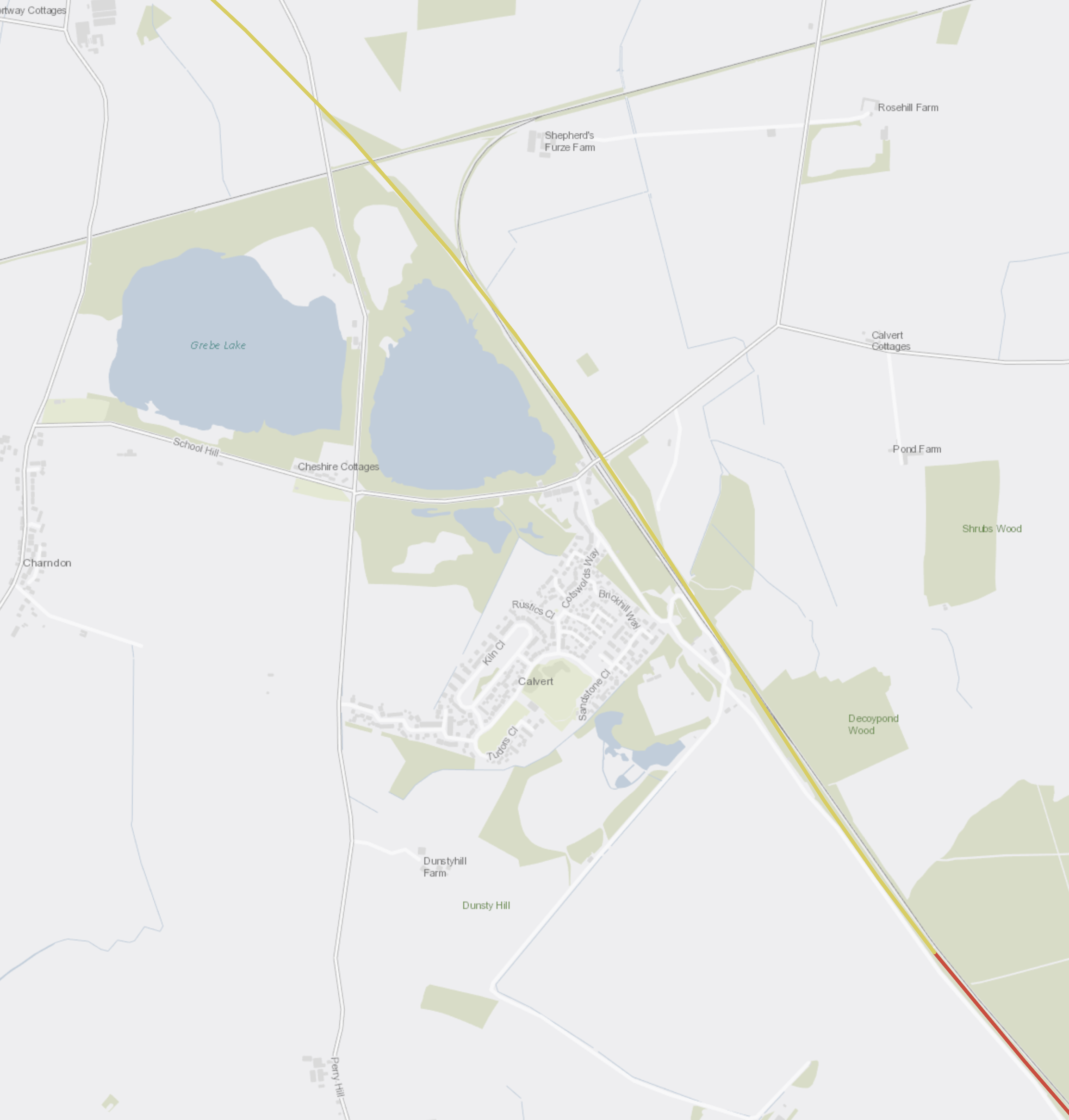
Note.
- High Speed Two is shown in yellow (cutting) and embankment (red).
- High Speed Two appears to run either on the same route or alongside the route to Aylesbury.
The Oakervee Review into High Speed Two, says this on Page 53, about a new station at Calvert in Buckinghamshire.
The Review also heard evidence from a number of informed stakeholders suggesting there should be a new station near Calvert, where HS2 would cross East-West Rail proposals to improve connectivity along the OxfordCambridge corridor. Previously, due to the impact on speed, no interim station had been planned between London and Birmingham Interchange.
The Review concluded that the DfT should consider making passive provision for a future HS2 station near to Calvert. If it is decided that a HS2 station should be built near to Calvert, passive provision will help prevent any disruption to HS2 services. There could be merit in developing an HS2 station in the future here if local plans support a significant residential and commercial development in this region, and if there is passenger demand to justify the cost of developing a station here. Without this coordinated planning, the experience of HS1 stations risks being repeated. The Review notes that the cost of developing a future station near Calvert could be shared with others including potentially the East West Rail Company.
I must admit, that I like the concept of a new station at Calvert.
- The double-track High Speed Two and the single-track Aylesbury Link run alongside each other and a station wouldn’t be a very expensive one.
- High Speed Two Trains will be very powerful and should be able to do a quick stop perhaps losing about two minutes.
- The important Milton Keynes Central station would get a good High Speed Two service, with a change at Calvert.
- Trains between Oxford and Cambridge could serve Calvert station.
It might also be possible for one of High Speed Two’s Classic Compatible trains to join High Speed Two at the station with a reverse.
This could enable a service between say Cardiff and Edinburgh.
- Intermediate stops could be Newport, Bristol Parkway, Swindon, Oxford, Bicester Village, Calvert, Birmingham Interchange, Crewe, Preston and Carlisle.
- It might even join and split at Swindon and Carlisle, with a second Classic Compatible train going between Penzance and Glasgow, which stopped at Plymouth, Exeter, Bristol Temple Meads, Bath, Swindon, Oxford, Bicester Village, Calvert, Birmingham Interchange, Crewe, Preston and Carlisle.
- It would need extra two-hundred metre long platforms at Swindon, Oxford, Bicester Village and Calvert.
If this train ran hourly, there would certainly be a need for an hourly feeder train between Aylesbury and Milton Keynes.
But as yet, it hasn’t been decided to provide provision at Calvert for a possible High Speed Two station.
Rolling Stock For The East-West Rail Link
In July 2019, I wrote Tender Set To Be Issued For East West Rail Rolling Stock.
I analysed if battery electric trains could run services on the East West Rail Link.
I said this.
Consider.
-
- All the major stations except Oxford have electrification.
- Sections of the route are electrified.
- The route is not very challenging.
- The longest section without electrification is around forty miles.
All this leads me to believe that a battery-electric train with a range of forty miles could handle the route, if there was the means to charge the train at Oxford.
Possibly the easiest way to achieve the charging station at Oxford station, would be to electrify between Didcot Junction and Oxford stations.
Since then Hitachi have released the Hitachi Regional Battery Train, whose specification is shown in this infographic.
I believe this train could work the East-West Rail Link and also between Aylesbury and Milton Keynes.
I also believe, that other manufacturers could provide battery electric trains for the route.
These or similar trains would also be suitable for the decarbonisation of Chiltern’s diesel multiple units, that run the suburban services.
Conclusion
High Speed Two could have a station at Calvert.
If it does, there will certainly be a need between Aylesbury and Milton Keynes.
To be continued…
Think Britain To Belfast Is A Bridge Too Far? Try Tunnelling Across Instead
The title of this post, is the same as that of this article in The Sunday Times.
It is a well-written article, with good graphics and maps, which fills out the descriptive title.
This paragraph sums up the overall objective.
For the rail industry, it is part of a long-term ambition to reduce journeys by rail between London and Glasgow and Edinburgh to below three hours, which it is also advocating in the review. Trains to Belfast would turn west near Carlisle, around the Scottish border, and lorries bound for Ireland could be loaded there.
The article also predicts London and Belfast in four hours, with Dublin in six.
In a A Glimpse Of 2035, I looked into the future and left London at eight in the morning on the first train between London and Dublin and arrived at 13:30.
My predictions were thirty minutes less than The Times.
But I also predicted, that eventually, times will be three hours to Belfast and four to Dublin.
A Deep Water Port At Shannon And Its Consequences
One thing not mentioned in the Times article, is that the Irish Government and the EU have a plan to develop a deep water port at Shannon.
It would have a rail link to any rail link to the UK and would speed goods between Germany and North America, avoiding the increasingly congested ports of Rotterdam and Hamburg. Time savings of as much as a day are predicted.
I should say, that I part-grew up in Felixstowe in the 1950s and 1960s and I can remember a sleepy little dock with a giant crane to lift seaplanes out of the water, before the massive container port we know today. There are now something like forty container trains per day, going along the sleepy branch line to Ipswich and then to the rest of the UK mainland. If anybody had predicted that in 1960, they’d have been laughed at.
If the Shannon Port is built, I can see twenty high-speed freight trains per day between Shannon and the Channel Tunnel. There will probably need to be massive improvements to the freight network in the South East of England, to get all those freight trains through or around London.
Standard Or Irish Gauge
If the EU develops the deep water port at Shannon, this would surely be rail connected to the new tunnel.
But the EU only likes to build standard gauge railways, so everybody can use them. I would expect that all new tracks in the Republic of Ireland would be standard gauge.
If you look at Spain, all their high-speed railways are standard gauge and they have both narrow and Spanish gauge railways as well.
Some of the awkward squad in Ireland will object to the standard gauge railways, but he who pays the piper calls the tune.
As the UK will be paying from London to the place where the tunnel emerges and the EU from South of the Irish border, it would be much cheaper to make all the route standard gauge. But some diehards would be against it!
 The Anonymous Widower