Glasgow Queen Street Station To London King’s Cross Station For £52.40
My plan this morning, was to come home via Hartlepool, so that I could take pictures of the nuclear power station there.
I intended to take a train from Glasgow Queen Street station to Newcastle and then take local train to Hartlepool and back to Newcastle, from where I’d buy a ticket and take a train to London King’s Cross.
Things went well until I left Edinburgh on my train for Newcastle.
- I’d bought a ticket from Glasgow Queen Street station to Newcastle for £21.20 with a Senior Railcard, with a change to LNER at Edinburgh.
- I even had a reserved seat after Edinburgh.
- I found a good unreserved seat on the 13:00 Glasgow Queen Street to Edinburgh train, which left on time.
- It arrived in Edinburgh a minute late.
- As Marks & Spencer was by the platform of my Newcastle train, I was able to buy a lunch before I got on the train.
It was then that I noticed that my train took over three hours to travel to Newcastle, when I know they normally take under ninety minutes.
As the train left Edinburgh, it passed through Haymarket station, which confirmed we were going for a Grand Tour of the Southern Uplands of Scotland.


Note.
- The train took the fully-electrified line from Haymarket to Carstairs junction, where it joined the West Coast Main Line.
- I amused myself by taking pictires of the large number of wind turbines along the route and motorways and arterial roads, that share the route.
- It is certainly a route where the hills are alive with spinning wind turbines.
Eventually we arrived in Carlisle, where I took more pictures.
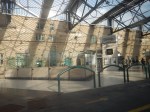
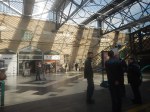

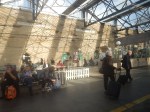
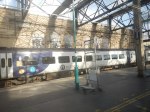
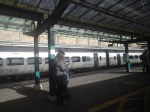
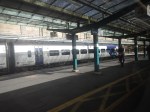
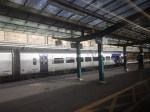
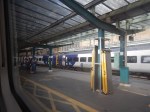
Note.
- The train waited at Carlisle for about 10 minutes.
- It looks like Northern Trains might have been running a pair of Class 158 trains on the Settle and Carlisle Line to add capacity. Real Time Trains confirm that they were.
- The last picture has an LNER train going North in the background.
- Some passengers joined the train at Carlisle.
By the time we left Carlisle, we taken an hour and twenty-eight minutes from Edinburgh.
Our train, then took the Tyne Valley Line to Newcastle, where I took these pictures.




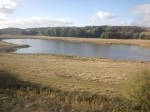
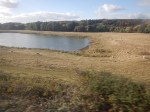
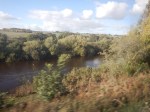
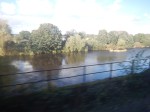
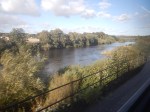
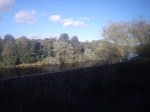

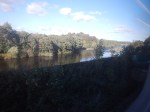




Note.
- It’s not called the Tyne Valley Line for nothing.
- I didn’t see a wind farm between Carlisle and Newcastle.
- The Tyne Valley Line can handle a pair of five-car Class 800 trains.
- The train was powered for 61.4 miles on diesel.
By the time we arrived in Newcastle, we had taken a minute over three hours from Edinburgh.
I decided that I didn’t have enough time to go to Hartlepool.
- I decided to buy a ticket for London King’s Cross.
- I paid £31.20, with my Senior Railcard, for a ticket on the 16:55 Lumo.
- Two hours and 49 minutes we arrived in King’s Cross.
- We were seven minutes late.
But it was an average speed of 95.4 mph.
I have a few thoughts on the journey.
The Ambience Of The Journey Would Have been Improved By Battery-Electric Trains
The only section of the journey between Edinburgh and Newcastle, that was not electrified was the section between Carlisle and Newcastle, which is 61.4 miles.
The journey would have been a lot quieter, if the Class 800 trains had been fitted with enough batteries, to run the route on battery-power.
Did My InterCity225 From Leeds Arrive Like An Airliner In King’s Cross?
Consider.
- I took the 18:40 from Leeds to London King’s Cross today.
- The train was an British Rail-era InterCity 225 in superb condition.
- The train consisted of a Class 91 electric locomotive and seven Mark 4 coaches.
- The train was scheduled to stop at Wakefield Westgate, Doncaster, Grantham and Peterborough.
- The Southern section of the East Coast Main Line is fully digitally-signalled at least as far as Welwyn.
- I assume that means Welwyn North station, which is to the North of the Digswell Viaduct.
- According to Real Time Trains my train was on time, one minute fast, four minutes fast and two minutes fast at the four stops.
- South of Welwyn North station, the train is shown as either one or two minutes ahead of schedule.
- The train arrived in London King’s Cross a minute ahead of schedule at 20:52.
As a Graduate Control Engineer, I believe that from Welwyn North station, the signalling was being used to instruct the driver, what speed he needed to arrive in King’s Cross on time.
This resulted in the slight oscillations in the scheduled time, between Welwyn North station and London King’s Cross.
These are my further thoughts.
Just Like An Airliner
I have well over a thousand hours in command of light aircraft and I held an IMC rating, which is a UK-only qualification, so you can do limited flying on instruments.
As an example, I have done full instrument approaches at major airports like
Belfast Harbour, Dublin, Edinburgh, Hamburg, Leeds, Liverpool, Naples, Prestwick and Stansted, where you guide the plane in so that it is a certain height, at a particular distance from the runway.
Your instruments tell you the height to be at and the direction to fly using a device called an instrument landing system or ILS.
With trains, I suspect, digital signals just give the train or driver, a speed at which to travel.
I believe that if the train is instructed by the digital signals a higher percentage of trains will more likely arrive on time or perhaps up to a couple of minutes early.
The Newark Flat Crossing
I wrote about this notorious piece of track in The Newark Crossing.
My train today crossed the Newark Crossing, exactly on time.
- So was it being digitally-controlled through the crossing?
- Many trains on the East Coast Main Line cross the Newark Crossing within a couple of minutes of their scheduled time.
- For the system to work well trains crossing the East Coast Main Line must also be under control of the digital signalling or the drivers must adhere closely to their schedules.
I believe that full digital signalling will improve safety, where trains cross, join or leave a main line.
Crossing The Digswell Viaduct
This is a two-track section between Welwyn Garden City and Welwyn North stations.
- Various plans to make it four-track have been abandoned over the years, as it would cost billions of pounds.
- My train ran through the section two minutes ahead of schedule.
- Looking at trains on the section between Welwyn Garden City and Welwyn North stations, they seem to maintain the same difference from their scheduled time.
I believe that the digital signalling could be instructing the trains, so that scheduled times are maintained.
Conclusion
I believe as a Graduate Control Engineer, that applying full digital signalling to the UK’s railways, will have the following effects.
- Improved timekeeping.
- Increased safety.
- More capacity.
- It could save on the cost of new infrastructure, by avoiding the building of new track, bridges and flyovers.
- From my experience of installing control systems on industrial plant at Enfield Rolling Mills and ICI, many trains and locomotives can be fitted with add-on control systems. In fact, full digital signalling has already been applied to steam locomotives.
We should complete digital-signalling for the East Coast Main Line and then roll it out for other lines, in order of importance.

