Is This Healey’s Magic Money Tree?
It looks to me that Healey has found a Magic Money Tree, which does the following.
- Saves the welfare budget.
- Allows him to abolish standing charges on gas bills.
- Allows him to take VAT off electricity bills.
- Allows him to give £100 to 20,000,000 householders.
- The Kyiv Independent has a headline of UK Announces ‘Biggest Ever’ Ukraine Support Package Of $13 Billion In 2027.
- He seems committed to increasing defence spending.
- Setting up the National Agentic Security Unit will cost millions.
Is this the Magic Money Tree?
- Jackdaw’s gas goes to St. Fergus as planned!
- One leg of AquaVentus, which is a German system of pipes and wires, that brings green hydrogen and electricity from around the North Sea to Wilhelmshaven could start at the St. Fergus Gas Terminal.
- Other legs of AquaVentus are planned to start in Denmark, Norway and The Netherlands.
- Two H2 molecules can be extracted from each gas molecule, as methane is CH4.
- One way is a process called HiiROC that was developed in Hull, which is backed by big names including Cemex, Centrica, Hyundai, INEOS, Kia and Melrose.
- HiiROC is five times more energy efficient than traditional electrolysis.
- The Aberdeen area is not short of green electricity, given the large number of offshore wind farms.
- Germany gets the hydrogen to decarbonise, through the pipes of AquaVentus.
- The wires of AquaVentus could also take green electricity to Germany.
- Germany has run out of space in their Exclusive Economic Zone (EEZ) for more turbines.
- But as our EEZ is 23 times the size of Germany’s, we have enough to rent out space for German wind turbines.
- The route of AquaVentus will use the UK EEZ and could export energy from existing and planned UK wind farms.
- When the EEZs were drawn up, a corridor was left between the German and UK zones, where pipes and wires could be laid to transfer energy between the two countries.
- Burnham visited Merz a few weeks ago and nothing was said about energy to the media.
- But did they put together an energy deal to give Germany the green energy it needs?
- Chris O’Shea is CEO of Centrica and has several professional connections to Burnham from his Manchester days and the recent Labour Conference.
If Germany should be getting all this green energy, Healey will surely be getting loadsaeuros in return.
These are some further thoughts.
EEZ Of The UK And Neighbouring Coastal States
If you like to know more about EEZs or Exclusive Economic Zones, they have a Wikipedia entry, which includes these two statements.
- The idea of allotting nations’ EEZs to give them more control of maritime affairs outside territorial limits gained acceptance in the late 20th century.
- It was not until 1982 with the UN Convention on the Law of the Sea that the 200 nautical mile exclusive economic zone was formally adopted.
This is possibly, the most significant map concerning the future of the UK.

Note.
- The UK EEZ is shown in bright blue.
- The UK EEZ was setup by David Cameron’s government in 2014.
- Much of the UK EEZ stretches a full 200 nautical miles from the coast.
- Germany’s EEZ is indicated by DE.
- The UK EEZ is 23 times the size of Germany’s.
- There is a narrow corridor between the UK and German EEZs, which goes between the Dutch and Danish EEZs, which was the result of an expensive legal battle and gives Germany access to the North Sea.
- Wilhelmshaven is about in the mid-point of the North-facing part of the German coast.
- But the corridor could most-likely be the route of the Aquaventus pipes and wires system between Aberdeen and Wilhelmshaven via Humberside.
Whichever way you look at it, the UK did incredibly well, when EEZs were allocated.
The Route Of AquaVentus To The UK
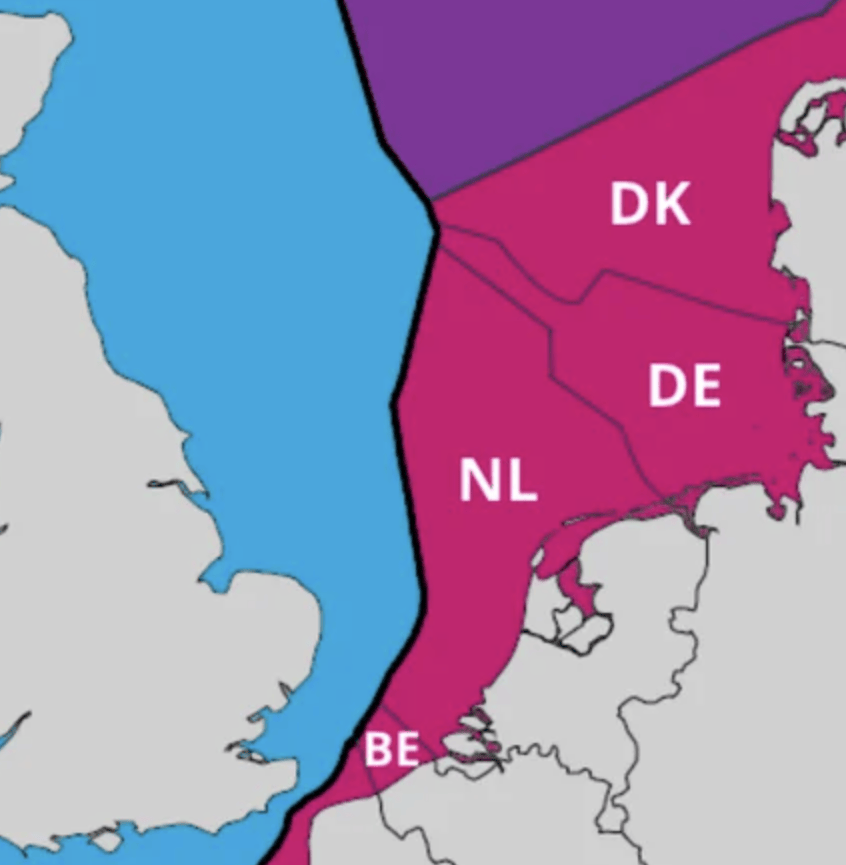
This map shows the border between the UK and German EEZs.
Note.
- The North-East corner of Scotland is clearly visible in the North-West corner of the map.
- The corridor between the UK and German EEZs is clearly visible.
- The corridor points at the North-East corner of Scotland.
- Wilhelmshaven is on the round estuary on the German coast.
- AquaVentus has a preferred route via Humberside, which looks feasible.
If an AquaVentus leg ran between the German EEZ and the North-East corner of Scotland, it would be totally in the UK EEZ, which would probably simplify any negotiations.
Could AquaVentus Make Use Of The UK’s Energy Storage?
Consider.
- Various companies are building three or four large pumped storage hydro systems in the Highlands of Scotland.
- There are two large gas storage facilities; Aldbrough and Rough on Humberside, which could be converted to hydrogen storage.
Energy storage would surely add functionality to AquaVentus.
Does Germany Import Nuclear Energy Through Interconnectors?
Germany doesn’t have any nuclear power stations, but does it import nuclear energy?
I asked Google AI, thquestion in the title of this section, and received this answer.
Yes, Germany imports electricity that originates from nuclear power plants in neighboring countries via cross-border high-voltage interconnectors.
Key Facts on Nuclear Imports via Interconnectors
Zero Domestic Generation: Germany completed the shutdown of its last domestic nuclear power reactors in April 2023 and produces zero nuclear electricity locally.
Integrated European Grid: Electricity in Europe flows through a shared, interconnected network based on market prices, supply, and demand rather than national political borders.
Sources of Nuclear Imports: When Germany imports electricity—such as from France, Switzerland, or Belgium—a portion of that power mix comes from nuclear generation.
Rising Import Volumes: Estimates by DataPulse Research via Visual Capitalist indicate that Germany’s estimated nuclear electricity imports rose to roughly 18,313 GWh in 2024 following the complete nuclear phaseout.
It appears that so long as they don’t build any nuclear power stations, it’s OK!
What Will Be The Route Of AquaVentus From Denmark, Norway And The Netherlands?
The exact routes have not been decided, but if you look at the map of the EEZ Of The UK And Neighbouring Coastal States, it appears, that nearly all of the routes of the pipes and wires, will lie within the UK EEZ.
The hydrogen and electricity may have not been generated by the UK, but it has come through our EEV.
It looks to me, that we have those Europeans screwed, glued and tattooed.
Germany Has Run Out Of Space In Their Exclusive Economic Zone For More Wind Farms
So they have come up with a plan, where they rent space in the EEZs of other countries and then bring the energy as either green hydrogen or electricity, back to Germany using the pipes and wires of AquaVentus.
Could Dogger Bank South Wind Farm Be Connected To AquaVentus?
Consider.
- It will be a pair of two 1,500 MW wind farms
- They are two of the furthest East UK wind farms and are not far from the border between the UK and German EEZs.
- They are being developed by German company ; RWE.
- They are currently to be connected to the UK grid at Birkhill Wood in the East Riding of Yorkshire.
But if it were more convenient or affordable could the two wind farms be connected to AquaVentus and send their green energy to Germany?
Conclusion
AquaVentus will bring Germany the energy it needs from around the North Sea.
And Chancellor Healey will have a long-lasting Magic Money Tree.
New Ferry Link Proposed Between Aberdeen And Iceland
The title of this post is the same as that of this article in The Times.
This is the sub-heading.
Talks are under way for a ferry from Aberdeen to Seydisfjordur in eastern Iceland, reviving a North Atlantic connection that endured for 150 years
These three paragraphs add more detail.
There were wild celebrations when the first ever regular mail steamer from Scotland arrived in Iceland.
Cheering crowds gathered as the Clyde-built Victor Emanuel, her single funnel belching black smoke, slipped into Reykjavik harbour in 1858 after crossing the North Atlantic from Leith. It was an historic day, marking a service that was to bind Britain and Iceland in a way they never had been before.
There was little or no emotion, however, when the last regular sea connection between Scotland and Iceland was lost in 2008 amid the rise of low-cost airlines, ending a century and a half of shipping history.
But now it appears that the ferry might be revived, as The Times article reports.
This Google Map shows the seas between Aberdeen and Iceland.

Note.
- Iceland is in the North-West corner of the map.
- Seydisfjordur, which will be the port, where the service will terminate is indicated by the red arrow.
- The Faroe Islands are in the middle of the map.
- Aberdeen is in the South-West corner of the map.
- The Orkneys and Shetlands are North of Scotland.
I was rather surprised, I could get everything on the single map.
This second map shows all the wind farms being developed around the North of Scotland.

Note.
- These seventeen wind farms have a total capacity of 24 GW.
- Currently, in total, as I write this we’re using 35.7 GW and generating 32.9 GW.
- The difference is made up of transfers.
- There are more details on these wind farms in Ørsted, Simply Blue, Subsea7 Submit Application For 100 MW Scottish Floating Wind Farm.
There would appear to be plenty more space for wind farms.
What Will Happen To This Energy In The North Of Scotland?
The Germans have a shortage of green energy and it is likely that they will build a system of pipes and wires called AquaVentus between Aberdeen and Wilhelmshaven via Humberside to bring green hydrogen and electricity to Germany.
I can see a need for ferries linking Wilhelmshaven, Aberdeen, Orkney, Shetland, the Faroes and Iceland, if construction really takes off in the area, where there is one of the largest undeveloped areas in Europe, that is suitable for wind farms.
And much of the area is in the UK EEZ.
I do wonder, if in his recent visit to Merz, Burnham and the German Chancellor agreed to develop the Northern part of the UK EEZ for the mutual benefit of the two countries.
I will finish with these questions.
What Is The Offshore Wind Potential Of Iceland?
I asked Google AI this question and received this answer.
Iceland possesses massive theoretical offshore wind resources, estimated by the World Bank at approximately 847 gigawatts (GW), which is more than the combined potential of countries like France and Spain.
Key Aspects of Iceland’s Offshore Wind Potential
Resource Scale: The World Bank estimates Iceland’s coastal waters could yield up to 847 GW of power, far exceeding the country’s domestic electricity consumption (which is currently met almost entirely by geothermal and hydroelectric power).
Geographical and Climate Challenges:
Shallows and Coastline: Unlike shallow North Sea basins, Iceland’s rugged coastlines have relatively few shallow areas, which can complicate conventional fixed-bottom turbine installations.
Harsh Conditions: Winter wind speeds and power densities are exceptionally high (with offshore values exceeding 1,000 W/m² in southern, eastern, and western coastal areas), though extreme weather, tectonic activity, and volcanic-glacial sediments require specialized foundation engineering.
Export and Cross-Border Concepts: Because Iceland’s domestic energy needs are already satisfied by low-cost renewables, large-scale offshore wind developments are often proposed for export. For example, developers like Hecate Independent Power (HIP Atlantic) have explored multi-gigawatt offshore wind projects off Iceland’s coast linked directly to the United Kingdom via long-distance subsea HVDC transmission cables.
Emerging Research: Scientific bodies like the British Geological Survey (BGS) and the Icelandic Geological Survey (ÍSOR) have partnered on grants to map Iceland’s seabed and glacial outwash plains to better evaluate site suitability and turbine foundation designs.
Iceland could be Europe’s largest power station.
It’s lucky Trump has no engineering, mathematical or scientific knowledge, otherwise he’d be jealous.
What Is The Offshore Wind Potential Of The Faroe Islands?
I asked Google AI this question and received this answer.
The Faroe Islands possess substantial wind resources, though deep surrounding waters present engineering challenges for standard bottom-fixed offshore wind turbines. To bypass these constraints and overcome local onshore resistance (“NIMBY” opposition), the territory has actively explored and planned offshore installations:
Planned Offshore Wind Projects
Tórshavn Offshore Wind Farm: The Faroese power company SEV planned an initial offshore wind project near the capital, Tórshavn, sized between 96 MW and 120 MW.
Replacement of Onshore Plans: This single offshore initiative was designed to replace at least five delayed or contested onshore wind farms, accelerating the territory’s push toward its goal of 100% sustainable electricity generation by 2030.
Technical & Geographical Challenges
Deep Waters: Standard fixed-bottom offshore wind turbines are difficult or costly to deploy because the waters surrounding the steep volcanic islands become deep very quickly.
Alternative Approaches: Studies and strategies have investigated floating offshore wind options, as well as integrating offshore wind with green hydrogen and ammonia production to power local maritime and industrial sectors.
Tidal Complement: Because standard wind and solar can be variable or affected by harsh salt and wind conditions, the islands are heavily supplementing their wind strategy with predictable underwater tidal kite technology (such as Minesto systems) which hold a separate 2 GW national tidal potential.
It looks like The Faroes goal of 100 % sustainable electricity generation by 2030, will mean they won’t be exporting large amounts of energy.
What Is The Offshore Wind Potential Of The Shetland Islands?
I asked Google AI this question and received this answer.
The Shetland Islands possess some of the most consistent and high-capacity wind resources in Europe, with multi-gigawatt offshore wind potential supported by ScotWind leasing rounds.
Key Offshore Wind Projects & Potential
Arven Offshore Wind Farm: A major floating offshore wind project targeted for the early 2030s located east of Shetland. It features a planned capacity of 2.3 GW (enough to power roughly 2 million homes annually).
Stoura Offshore Wind Farm: An early-stage floating wind project awarded to ESB via Crown Estate Scotland’s ScotWind process. Located about 40 km east of Shetland, it has a targeted capacity of 500 MW.
NE1 Site & Regional Leasing: The broader waters surrounding Shetland have yielded licensing for roughly 2.8 GW to 3 GW or more of offshore floating wind capacity through recent leasing rounds, utilizing deep-water floating technology for depths exceeding 60 meters.
Complementary Energy Infrastructure
Onshore Integration: The massive 443 MW Viking Energy Wind Farm (103 turbines) and related onshore sites operate alongside a 260 km subsea HVDC interconnector cable linking Shetland directly to the UK mainland grid.
Industrial Transition: The historic Sullom Voe Terminal is shifting into a clean energy and carbon storage hub (via projects like Veri Energy and ORION), exploring how excess offshore and onshore renewable power can drive green hydrogen production and offshore platform electrification.
Local Challenges: Developers and authorities must balance this massive marine energy potential with spatial constraints, local fishing industry concerns, and grid-connection capacities.
Shetland seems to have implemented an excellent local solution.
What Is The Offshore Wind Potential Of The Orkney Islands?
I asked Google AI this question and received this answer.
The Orkney Islands possess massive offshore wind potential, with surrounding regional waters estimated to hold anywhere from 5 GW to over 17 GW of immediate local generation capacity, alongside broader island and northern Scottish shelf sharing over 100 GW of combined offshore wind potential.
Key Offshore Wind Scale & Figures
Immediate/Local Potential: Between 5 GW and 10 GW of generation capacity lies within 12 miles of the islands, with broader regional models citing up to 17,000 MW (17 GW) of nearby offshore wind potential.
Broader Northern Potential: Orkney—alongside Shetland and the Outer Hebrides—shares access to a regional pool exceeding 100 GW of offshore wind capacity.
Major Projects: The landmark West of Orkney Windfarm (located 30 km off the west coast) features a capacity of 2 GW (up to 125 fixed-foundation turbines), designed to power over 2 million homes and target initial power generation around 2030. It is the first ScotWind project to secure both offshore and onshore planning consents.
Infrastructure & Grid Challenges
Grid Bottlenecks: Orkney frequently generates more than 130% of its local power needs from renewables, leading to significant wind curtailment because legacy interconnector cables to the Scottish mainland are heavily constrained (limited to roughly 40 MW).
Upcoming Upgrades: A new major transmission interconnector cable project is slated to scale up export capacity and relieve these constraints by the end of 2028.
Ports and Supply Chain: Strategic port developments—such as the Scapa Deep Water Quay project at Scapa Flow—are receiving multi-million-pound investments to transform Orkney into a primary assembly, manufacturing, and maintenance hub for Scottish and European floating and fixed offshore wind farms.
It appears that the priority is better transmission of the generated electricity.
Conclusion
It looks like a substantial amount of green electricity can be harvested and brought South, either as electricity or as green hydrogen.
UK And Germany Will Face Threats Together, Says Burnham In Berlin
The title of this post, is the same as that of this article on the BBC.
This is the sub-heading.
The UK and Germany will face threats together, Prime Minister Andy Burnham has said as he reaffirmed a series of defence and security partnerships
These two paragraphs add some more detail.
On his first official European trip, apart from visits to Ukraine, Burnham met German Chancellor Friedrich Merz, and was greeted with military honours in Berlin.
Speaking to reporters at the German capital’s Federal Chancellery, the prime minister said both countries were facing hybrid attacks “on a regular basis” and “it makes sense” to take them on together.
I am surprised that the article doesn’t mention energy, as it is a problem for both Germany and the UK.
Germany’s problems include.
- They are short of both green electricity and gas.
- They produce about a fifth of their electricity from coal.
- They have weaned themselves off Russian gas and nuclear power.
- They have poor electricity storage.
Their strengths include.
- Siemens is the second-largest European wind turbine manufacturer.
- 29 wind farms in the UK, have been built around Siemens wind turbines.
- RWE is a major German developer of wind farms.
- RWE is the largest generator of electricity in the UK.
- RWE own or part-own thirteen wind farms in the UK.
Germany also has good plans to solve their problems.
- AquaVentus is a series of pipes and wires to bring green electricity and hydrogen from Norway, Denmark, the Netherlands, and Aberdeen and Humberside in the UK. to Wilhelmshaven in North-West Germany.
- H2ercules is a plan to deliver hydrogen around Germany to power industry.
In New Study Shows How North Sea Offshore Wind Can Yield More While Costing Less, I found this “It appears from the text in this must read report, that the Germans might develop as much as 20 GW in neighbouring countries.”
The UK’s problems include.
- High electricity and gas prices.
- Not enough electricity storage.
- Poor connections to the grid.
Our strengths include.
- A large amount of solar and wind power is being developed.
- We will generate more electricity than we need.
- Geographically, we generate more electricity on the East side of the UK, so our electrons are ideally placed in invade Germany.
- We shall be able to send electricity and hydrogen to Germany using the AquaVentus system.
- We are developing at least three 2 GW/30 GWh pumped storage systems in Scotland to store electricity and back up AquaVentus.
- Rough and Aldbrough are gas storage reservoirs on Humberside, that could be converted to store hydrogen, so we could keep Germany supplied.
- HiiROC is affordable hydrogen production technology being developed in Hull, which is five times more efficient, than traditional methods.
Centrica is backing HiiROC and is developing a stable of British ideas.
The UK’s Biggest Advantage
This map shows the The Exclusive Economic Zones (EEZ) around the UK.
Note.
- Undoubtedly, the rules by which EEZs were drawn, favoured the UK, and countries like Belgium and Germany didn’t do as well.
- The area of the UK’s EEZ is twenty-three times that of Germany’s EEZ.
- Belgium doesn’t do well compared to The Netherlands.
- There is a substantial area between the UK and Ireland, which can deliver energy to where it is worth more.
- Great Britain and Ireland are surrounded by a large area, that must be worth developing.
- There is a convenient corridor, that runs North-West from the German EEZ to the UK EEZ, which could be used to deliver energy to Germany.
Didn’t the UK (and the Irish) do well!
I believe that there are joint actions that the UK and Germany can take to both their own advantages.
Find A Way To Keep Rough Operational
If we keep Rough operational, then.
- It can usefully act as hydrogen storage for the Germans, with a connection to AquaVentus.
- We can also use it as a store for hydrogen created from excess energy, when we have too much.
- It can also supply hydrogen to companies like INEOS on Humberside.
- Hydrogen could also be exported from the Port of Hull in small coastal liquid hydrogen tankers.
- Companies that need a lot of zero-carbon energy could move to Humberside.
I suspect John Healey will make an announcement in the 2026 Budget.
AquaVentus And Energy Storage
AquaVentus, the pumped storage hydro in Scotland and the hydrogen storage on Humberside could make a big difference to the cost of UK energy, as instead of paying wind farm operators to turn off their wind farms, the excess electricity be handled in one of these ways.
- It can be sent to Germany using AquaVentus as electricity.
- Electricity can be stored in the pumped storage hydro in the Highlands.
- It can be used to create hydrogen which can be stored in Rough and Aldbrough.
- Hydrogen can be sent to Germany using Aquaventus.
- Electricity waste is minimised, which saves the UK money.
- Germany gets a more reliable supply of green hydrogen.
The UK should get a cash flow from Germany for the energy, that is delivered.
AquaVentus Could Be Combined With National Grid’s Eastern Green Links Project
Consider.
- AquaVentus will bring energy from Aberdeen and Humberside to Wilhelmshaven.
- National Grid are building five Eastern Green Links along the East Coast of the UK to move electricity to where it is needed.
- EGL1 will link Murton, Co Durham and Torness.
- EGL2 will link Drax, Yorkshire and Peterhead.
- EGL3 will link Anderby Creek and Peterhead.
- EGL4 will link Anderby Creek and Westfield, Fife.
- EGL5 will link Anderby Creek and Peterhead.
- All willhave a capacity of 2 GW.
The Eastern Green Links have a Wikipedia entry.
This Google Map shows the location of Wilhelmshaven with respect to the UK.
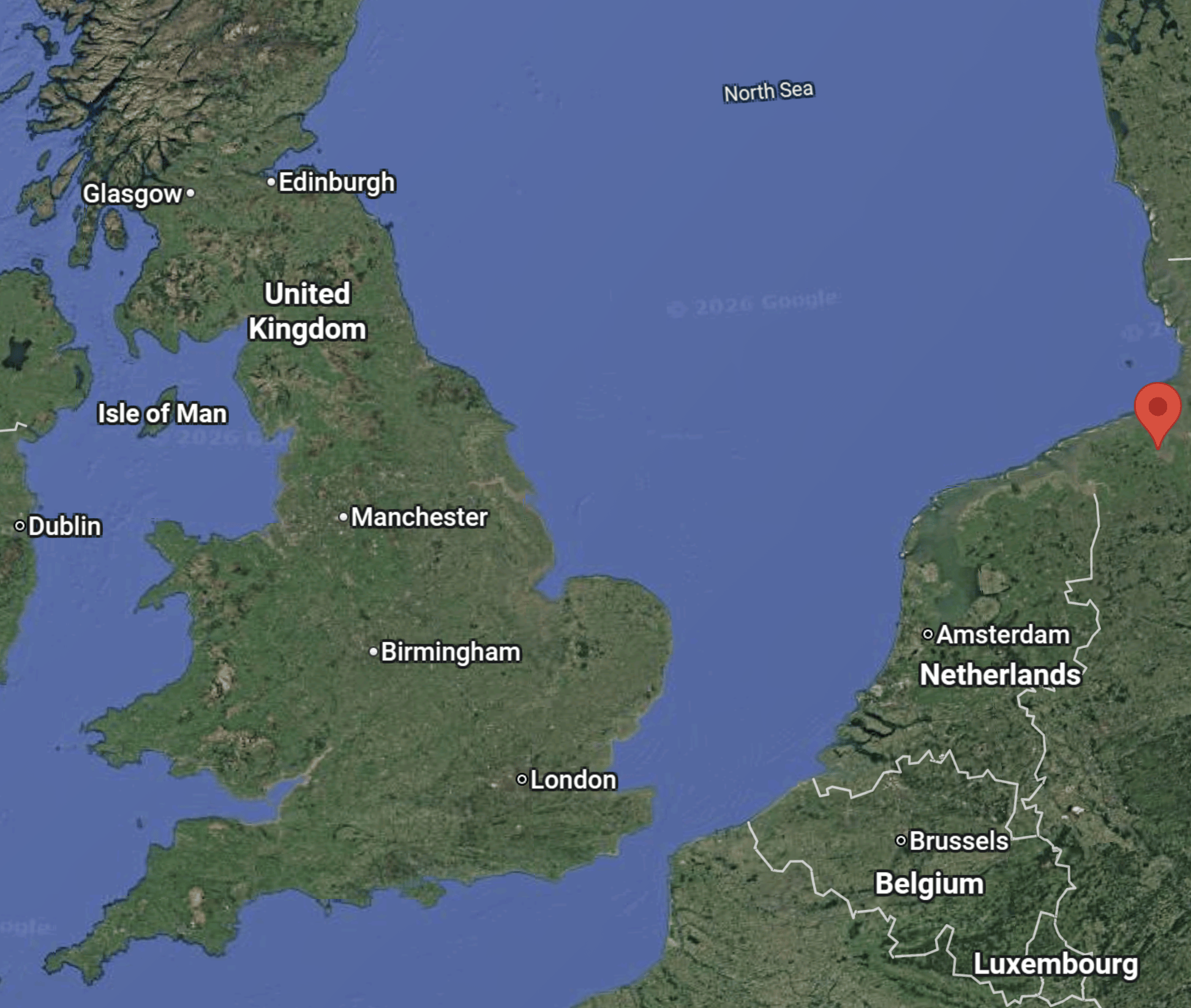
Wilhelmshaven is marked by the red arrow.
- It looks to me, that between Lincolnshire and Scotland AquaVentus and EGL1-5 will be following a similar route up the East Coast of the UK, which would surely make construction easier, faster and less costly.
- Provision could easily be made to provide a link to the Sizewell nuclear site, which has a total capacity of 4.4 GW.
- NeuConnect is a 1.4 GW interconnector between the Isle of Grain and Wilhelmshaven, that is under construction and will be 725 kilometres long.
- On the Isle of Grain is the 1.32 GW gas-fired power station, that is owned by RWE.
- BritNed is a 1 GW interconnector between the Isle of Grain and Rotterdam.
- Nemo Link is a 1 GW interconnector between Kent and Zeebrugge.
- LionLink is a proposed 1.8GW HVDC electrical interconnector to link offshore wind farms in the North Sea to the electrical grids in both Great Britain and the Netherlands.
- In National Grid, TenneT Germany Launch GriffinLink, A First Of A Find Project To Maximise Offshore Wind, I talk about GriffinLink, which will run between the UK and Germany.
I wouldn’t be surprised to see a tidying-up of the electrical connections between England, Belgium, The Netherlands and Germany.
Are the Danish And German Grids Connected Under The North Sea?
I asked Google AI this question and received this answer.
The Danish and German electricity grids are connected through undersea and land infrastructure, though direct grid-to-grid interconnections under the North Sea itself are currently expanding rather than existing as a direct bilateral link between the two countries’ mainland grids.
Current and Planned Connections
Land Boundary: The primary connection between Denmark and Germany is a shared 146-kilometer land border across the Jutland peninsula, which carries high-voltage alternating current (HVAC) power lines linking the two national transmission systems.
North Sea Undersea Cables (Indirect/Transit): The COBRAcable, a high-voltage direct current (HVDC) submarine link operated by TenneT and Energinet, connects the electricity grids of the Netherlands and Denmark, running through the German sector of the North Sea.
North Sea Hybrid Projects: German and Danish transmission system operators (such as Amprion and Energinet) have signed agreements and memoranda—including joint declarations from the North Sea Summit—to examine and develop future hybrid offshore wind interconnectors and energy hub links in the North Sea.
Baltic Sea Connections: In contrast, direct cross-border grid and hybrid wind connections between Denmark and Germany are more established or actively deploying in the Baltic Sea, such as through the Kriegers Flak and Bornholm Energy Island projects.
It looks like what is happening between England and Germany has already been developed between Germany and Denmark.
Does Germany Want To Put Wind Farms In Other Countries EEZs And Bring The Energy To Germany?
Google AI gave this answer to my question.
Yes, Germany is moving toward integrating and allowing cross-border and radial offshore wind projects located in the Exclusive Economic Zones (EEZs) of neighboring countries—such as Denmark—to connect directly to the German grid.
Rather than “renting” areas unilaterally, Germany is accomplishing this through joint cross-border European partnerships and bilateral agreements.
Key Details
Regulatory Changes: Germany has proposed amendments (such as via drafts integrating “international offshore connection lines” into its WindSeeG legislation) to explicitly cover radial lines from an offshore farm outside the German EEZ connected exclusively to the German grid.
Counting Toward Targets: These proposed rules allow cross-border radial offshore wind projects to count directly toward Germany’s national offshore wind targets (such as its 70 GW offshore wind goal).
Cross-Border Cooperation: Strategic frameworks—such as between Denmark and Germany—are being established to link projects in foreign waters (like Danish waters) to German converter platforms (e.g., the OST-2-4 platform in the German EEZ).
Research and Industry Push: Studies (including analysis by Fraunhofer IWES) and industry voices (such as Örsted) have argued that shifting or sharing some offshore build-out into neighboring waters like Denmark and Sweden can optimize output, lower costs, and reduce the risk of regionally weak wind conditions. This is also part of broader European agreements like the North Sea Summit declarations scaling up cross-border infrastructure.
Note.
- The UK and German EEZs join via a corridor, that would surely be bideal for a large capacity cable, which is clearly visible on then EEZ map.
- The UK has more than enough space for wind farms.
- The primary source of the UK’s offshore energy could shift to wind farms to the West and North-West of Great Britain.
- Eastern British would probably play a large part in the construction and service of German wind farms to the East of Great Britain.
There would appear to be winners all round.
- Germany gets the energy it needs.
- The UK gets the affordable energy it needs.
- The UK gets paid for the energy created in and exported from its waters.
- British jobs will be created in the construction and support of the German wind farms.
This could be the start of something very big for Germany and the UK.