Trains Back On Track After Repairs To Unsafe Nuneham Viaduct
The title of this post, is the same as that of this article on the BBC.
This is the sub-heading.
Rail services between Didcot and Oxford have resumed after a two-month line closure caused by an unsafe viaduct.
These are the first two paragraphs.
Services had been expected to resume on Saturday but the first passenger train ran on the line earlier.
Nuneham Viaduct, which crosses the River Thames near Abingdon, was declared unsafe on 3 April.
It looks like it was a job well done.
Government Agrees To Fund £200m Cambridge South Station
The title of this post, is the same as that of this article on the BBC.
This is the sub-heading.
The government has agreed to fully fund a new £200m railway station.
These are a few points.
- Work has already started.
- The station is next to the city’s Biomedical Campus and Addenbrooke’s Hospital.
- Cambridge South station will be on the East West Railway.
It is expected to be open within two years.
I have a few thoughts.
Services At Cambridge South Station
In a typical hour, it seems the following trains go through the proposed site of Cambridge South station.
- 2 tph – Greater Anglia – Liverpool Street and Cambridge North via Tottenham Hale, Cheshunt, Broxbourne, Roydon (1tph), Harlow Town, Harlow Mill (1tph), Sawbridgeworth (1tph), Bishop’s Stortford, Stansted Mountfitchet (1tph), Elsenham (1tph), Newport (1tph), Audley End, Great Chesterford (1tph), Whittlesford Parkway, Shelford (1tph) and Cambridge.
- 1 tph – Greater Anglia -Norwich and Stansted Airport via Wymondham, Spooner Row (1tpd), Attleborough, Eccles Road (1tpd), Harling Road (1tpd), Thetford, Brandon, Shippea Hill (1tpd), Ely, Cambridge North, Cambridge, Whittlesford Parkway and Audley End
- 1 tph – Great Northern – King’s Cross and Ely via Cambridge, Cambridge North and Waterbeach.
- 1 tph – Great Northern – King’s Cross and King’s Lynn via Cambridge, Cambridge North, Waterbeach, Ely, Littleport, Downham Market and Watlington.
- 1 tph – Great Northern – King’s Cross and Cambridge via Finsbury Park, Alexandra Palace, Potters Bar, Hatfield, Welwyn Garden City, Welwyn North, Knebworth, Stevenage, Hitchin, Letchworth Garden City, Baldock, Royston, Meldreth, Shepreth and Foxton.
- 2 tph – Thameslink – Cambridge and Brighton via Royston, Ashwell & Morden, Baldock, Letchworth Garden City, Hitchin, Stevenage, Finsbury Park, St Pancras International, Farringdon, City Thameslink, London Blackfriars, London Bridge, East Croydon, Gatwick Airport, Three Bridges, Haywards Heath and Burgess Hill
- 1 tp2h – CrossCountry – Birmingham New Street and Stansted Airport via Coleshill Parkway, Nuneaton, Leicester, Melton Mowbray, Oakham, Stamford, Peterborough, March, Ely and Cambridge.
Note.
- tph is trains per hour.
- tp2h is trains per two hours.
This gives a base frequency through Cambridge South, Cambridge and Cambridge North of 8.5 tph.
Could some services be extended to Cambridge South or Stansted Airport?
- 1 tph – Greater Anglia – Ipswich and Cambridge via Needham Market, Stowmarket, Elmswell, Thurston, Bury St Edmunds, Kennett (1tp2h), Newmarket and Dullingham (1tp2h).
- 1 tp2h – CrossCountry – Birmingham New Street and Cambridge via Coleshill Parkway, Nuneaton, Leicester, Melton Mowbray, Oakham, Stamford, Peterborough, March and Ely.
These two trains would gives frequencies of.
- Cambridge South – 10 tph
- Cambridge – 10 tph
- Cambridge North – 9 tph
I have assumed these services would terminate at Cambridge South.
There could also be some new services.
1 tph – Greater Anglia – Wisbech and Cambridge via March, Ely and Waterbeach, Cambridge North and Cambridge.
1 tph – East West Railway – Oxford and Great Yarmouth via Oxford Parkway, Bicester Village, Winsford, Bletchley, Bedford, Tempsford, Cambourne, Cambridge, Cambridge North, Ely, Brandon, Thetford, Attleborough, Wymondham and Norwich.
1 tph – East West Railway – Oxford and Manningtree via Oxford Parkway, Bicester Village, Winsford, Bletchley, Bedford, Tempsford, Cambourne, Cambridge, Newmarket, Bury St. Edmunds, Stowmarket, Needham Market and Ipswich.
These three trains would gives frequencies of.
- Cambridge South – 13 tph
- Cambridge – 13 tph
- Cambridge North – 11 tph
I have assumed these services would terminate at Cambridge South.
The A14 Parkway Station
The A14 Parkway station is a proposal from the East West Railway.
- It would be just to the East of Chippenham junction and would be served by both Greater Anglia’s services between Ipswich and Cambridge and Ipswich and Peterborough.
- It would also be close to the major road junction, where the A11 and the A14 meet.
- It would be a Park-and-Ride station.
I believe it could be a major factor in cutting road mileage in East Anglia, as drivers going to Cambridge from Ipswich, Norwich, a large area of North-East East Anglia and North Essex could find that using the A14 Parkway station an easier and faster route. But the A14 Parkway would need a frequent service to the soon-to-be-three main Cambridge stations.
A Soham and Cambridge service could reverse at the A14 Parkway station or by careful timetabling, passengers would be able to change trains in a minute or two.
A Soham and Cambridge service, that terminated at Cambridge South, would give an extra train between Cambridge South and Newmarket and these frequencies at the three Cambridge stations.
- Cambridge South – 13 tph
- Cambridge – 14 tph
- Cambridge North – 12 tph
There would be a minimum interval of no more than five minutes between trains, if you wanted to hop between any of the three Cambridge stations.
Frequencies between Cambridge station and other main stations in the area would be as follows.
- A14 Parkway – 2 tph
- Attleborough – 2 tph
- Bishop’s Stortford – 2 tph
- Bletchley – 2 tph
- Bury St. Edmunds – 2 tph
- Ely – 6 tph
- Great Yarmouth – 1 tph
- Harlow Town – 2 tph
- Hitchin – 3 tph
- Ipswich – 2 tph
- King’s Lynn – 1 tph
- Letchworth Garden City – 3 tph
- Manningtree – 1 tph
- March – 1 tph
- Needham Market – 2 tph
- Newmarket – 2 tph
- Norwich – 2 tph
- Peterborough – 1 tph
- Royston – 3 tph
- Soham – 1 tph
- Stansted Airport – 2 tph
- Stevenage – 3 tph
- Stowmarket – 2 tph
- Thetford – 2 tph
- Wisbech – 1 tph
- Wymondham – 2 tph
Looking at this list, I think that the timetable needs reinforcing, to perhaps Colchester, Haverhill, March, Peterborough, Soham and Sudbury.
But these services will help.
- 1 tph – Greater Anglia – Ipswich and Peterborough via Stowmarket, Bury St Edmunds, Soham, Ely, Manea, March and Whittlesea.
- 1 tph – East Midlands Railway – Liverpool and Norwich via Liverpool South Parkway, Widnes, Warrington Central, Manchester Oxford Road, Manchester Piccadilly, Stockport, Sheffield, Chesterfield, Alfreton, Nottingham, Grantham, Peterborough, Ely and Thetford
But I can’t help feeling that the Stour Valley Railway needs to be reopened.
East-West Rail: Electrification
The first paragraph of the Wikipedia entry for the East West Railway, says this about electrification.
As of March 2020, electrification of the line is not planned, but the 2019 decision (to rule it out) is under review.
But I don’t think it’s a simple decision of electrify or not!
These observations are guiding my thoughts.
Milton Keynes Central Station
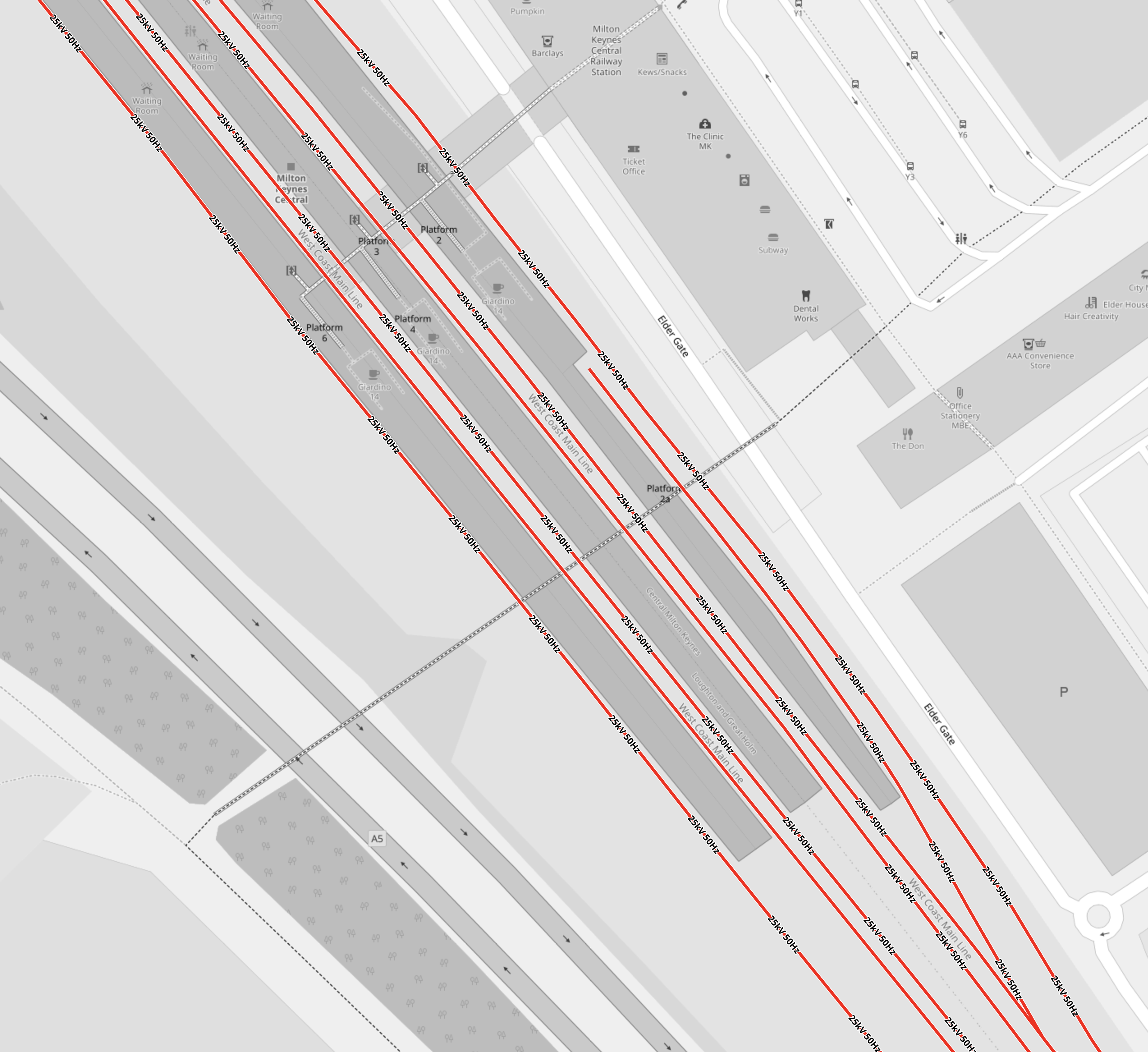
This OpenRailwayMap shows the platforms and whether they are electrified in Milton Keynes Central station.
Note.
- Lines shown in red are electrified with 25 KVAC overhead wires.
- The short platform is Platform 2A, which can take a five-car train and was built recently to terminate the Marston Vale Line service.
- Could Platform 2A be ideal for handling and charging, battery-electric trains, that terminate in Milton Keynes station?
The Wikipedia entry for Milton KeynesCentral station, has a section called Platforms and Layout, which gives full details.
Bletchley Station
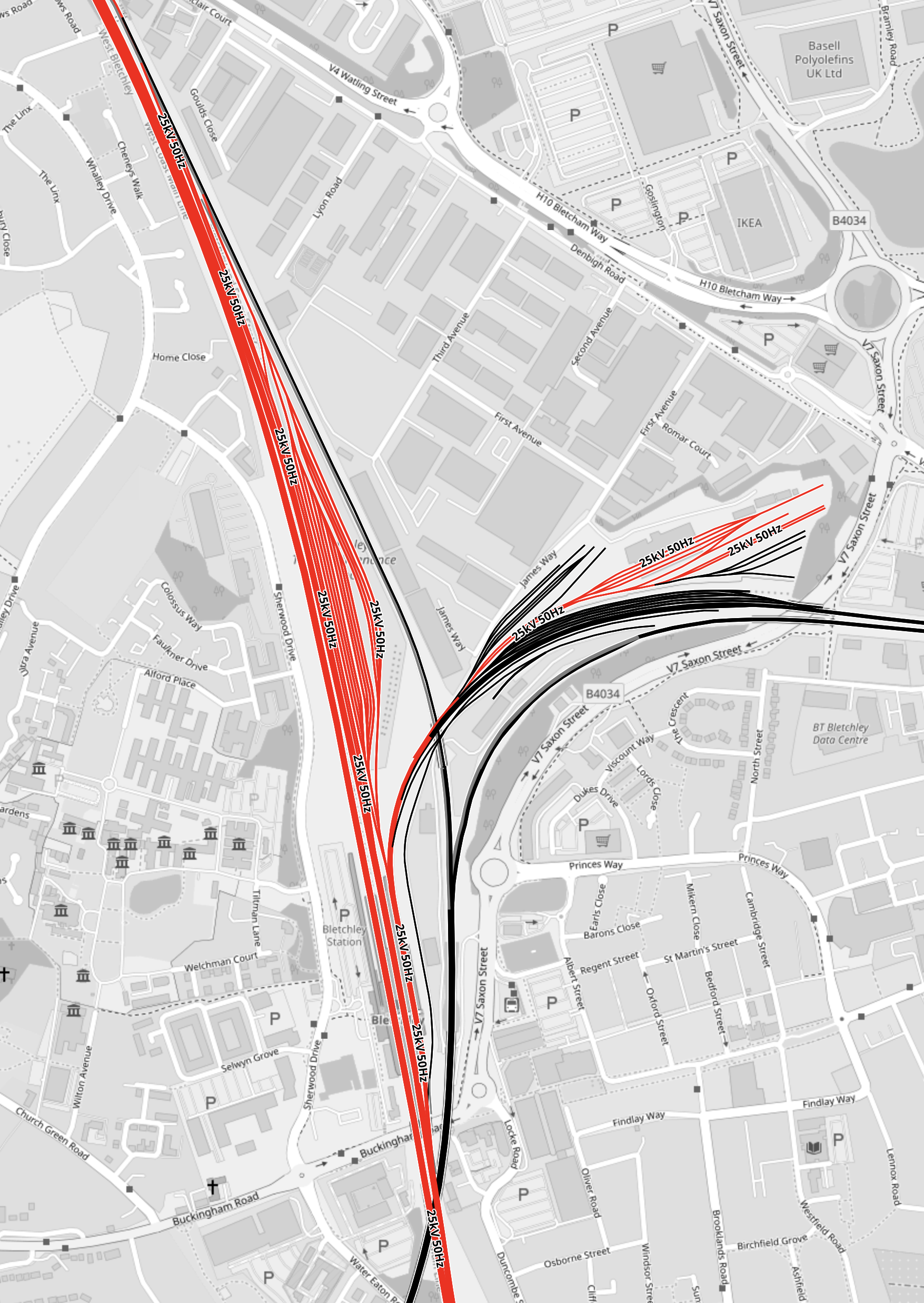
This OpenRailwayMap shows the platforms and whether they are electrified in Bletchley station.
Note.
- Lines shown in red are electrified with 25 KVAC overhead wires.
- The wide swath of red going North is the West Coast Main Line.
- The smaller patch of red to the East of the West Coast Main Line are electrified sidings.
- All low-level platforms at Bletchley station are electrified.
- The viaduct platforms, are shown in black as they are not electrified.
- A non-electrified line leads North-West from the viaduct towards Milton Keynes Central.
- The Milton Keynes end of the line between Milton Keynes Central station and the viaduct is electrified.
- A non-electrified line leads North-East from the viaduct towards Fenny Stratford and Bedford.
The Google Map shows a 3D visualisation of Bletchley station.
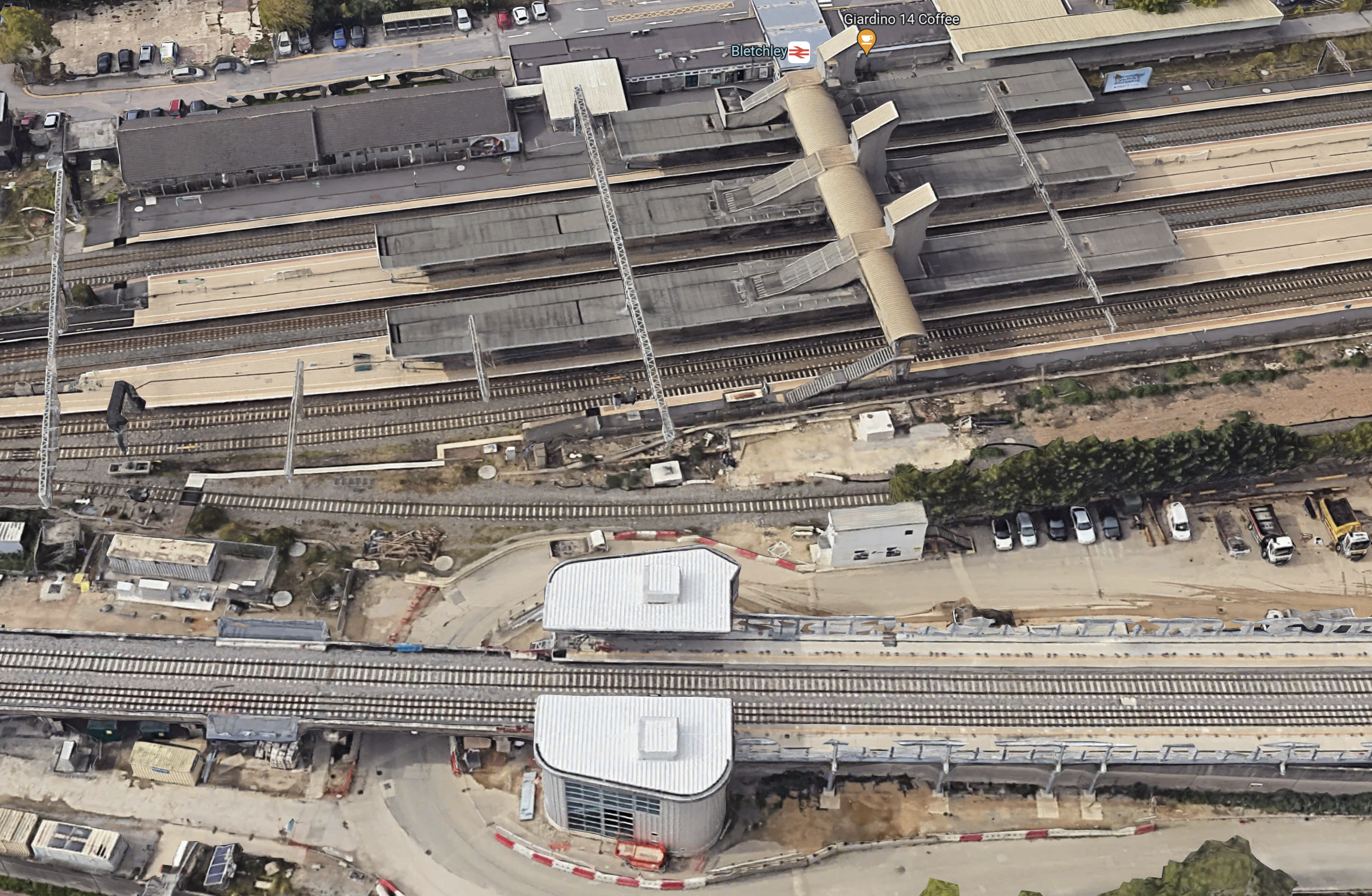
I can’t see much sign of any electrification.
Bedford Station
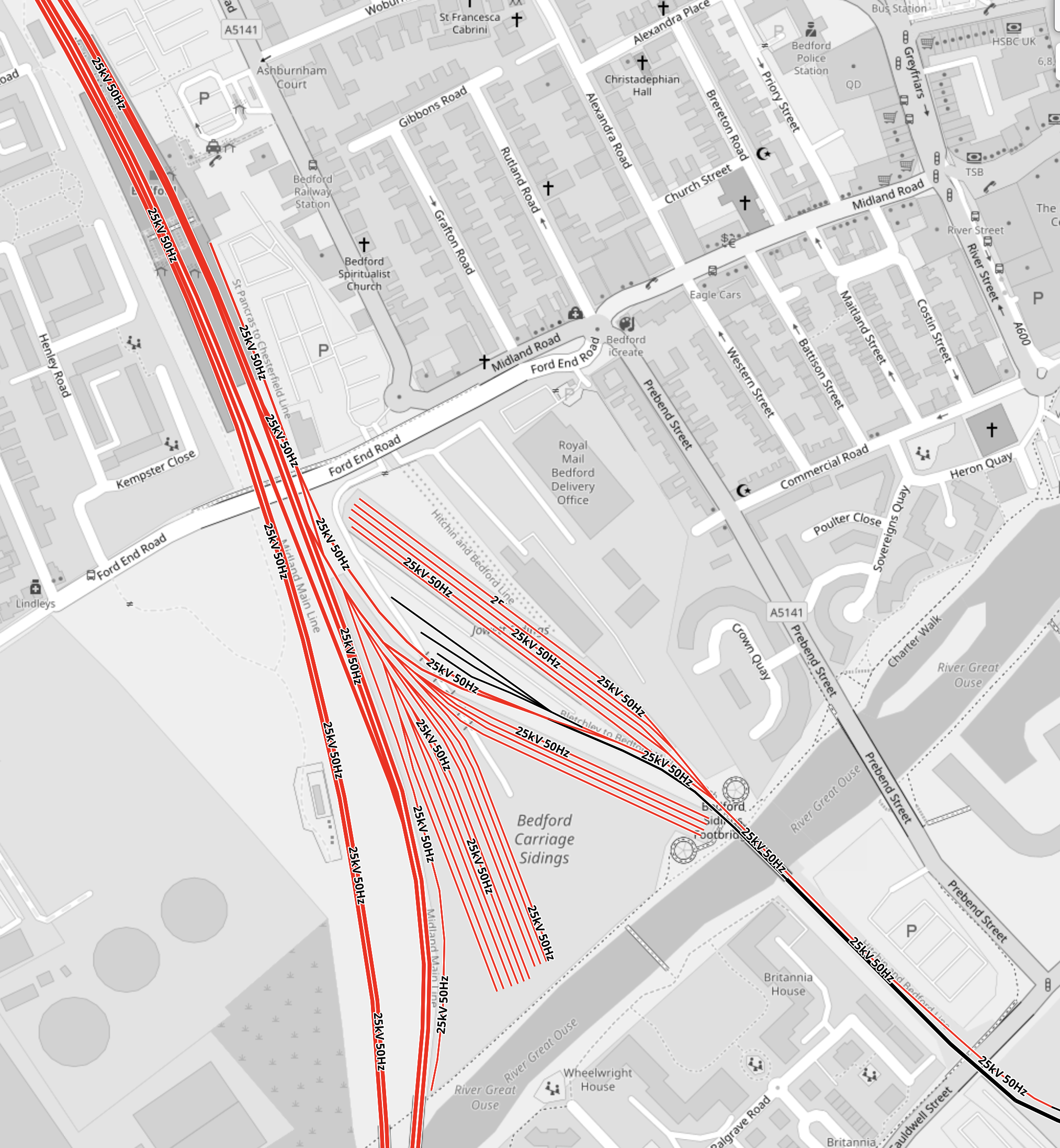
This OpenRailwayMap shows the platforms and the electrification around Bedford station.
Note.
- All platforms at Bedford station are electrified.
- The lines to the West of the station are the electrified Midland Main Line.
- The Marston Vale Line services terminate in the short Platform 1A, which is the South-East corner of the station.
- The track into Platform 1A is electrified for about two hundred metres, through the sidings South of the station.
This picture shows the electrified track as it crosses over the river.
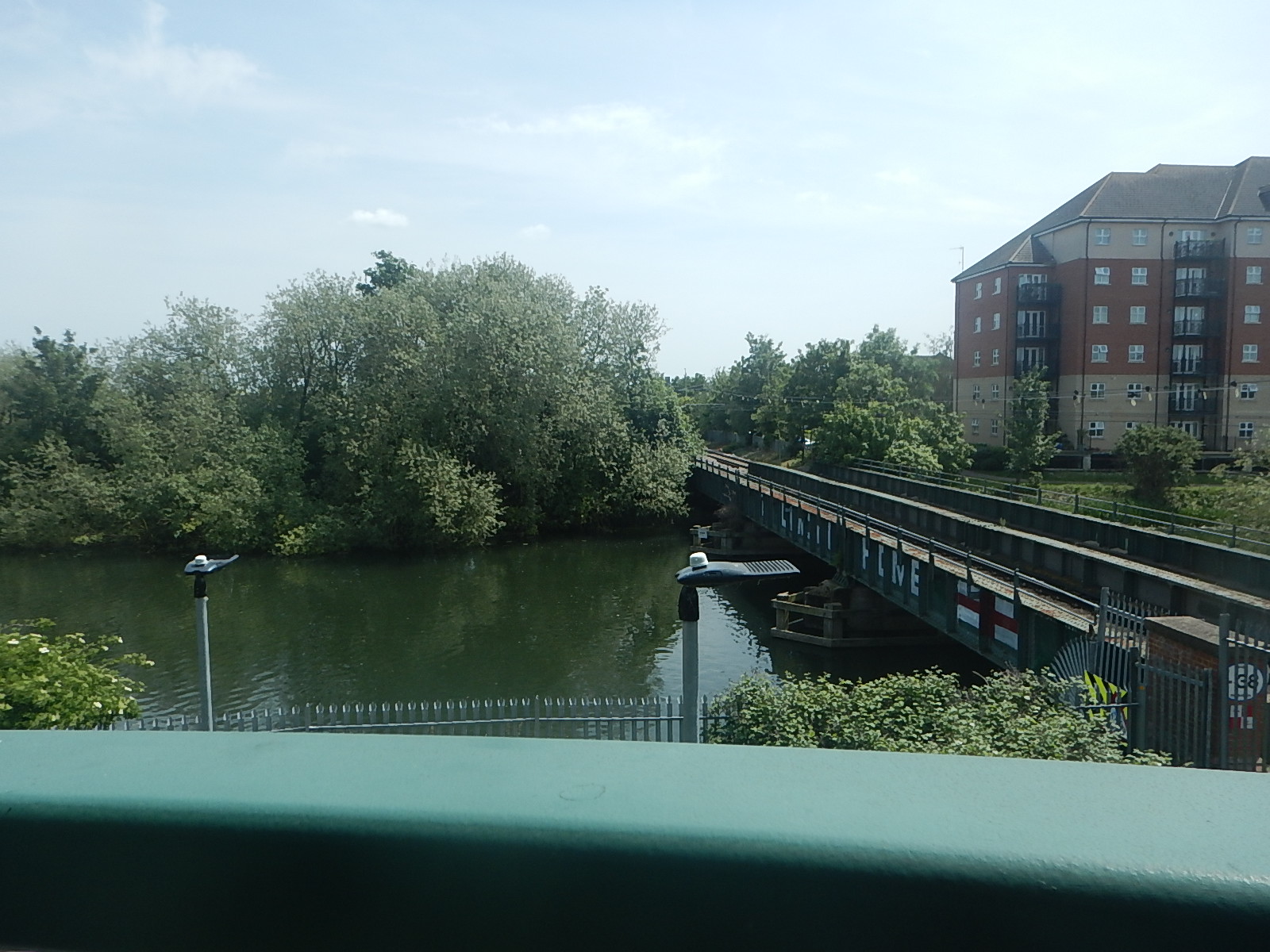
Could Platform 1A be ideal for handling and charging, battery-electric trains, that terminate in Bedford station?
It’s odd that there is the same platform layout at both ends of the Marston Vale Line.
Is it just a coincidence or does Engineer Baldrick have a cunning Plan?
Oxford Station
This OpenRailwayMap shows the platforms and the electrification around Oxford station.
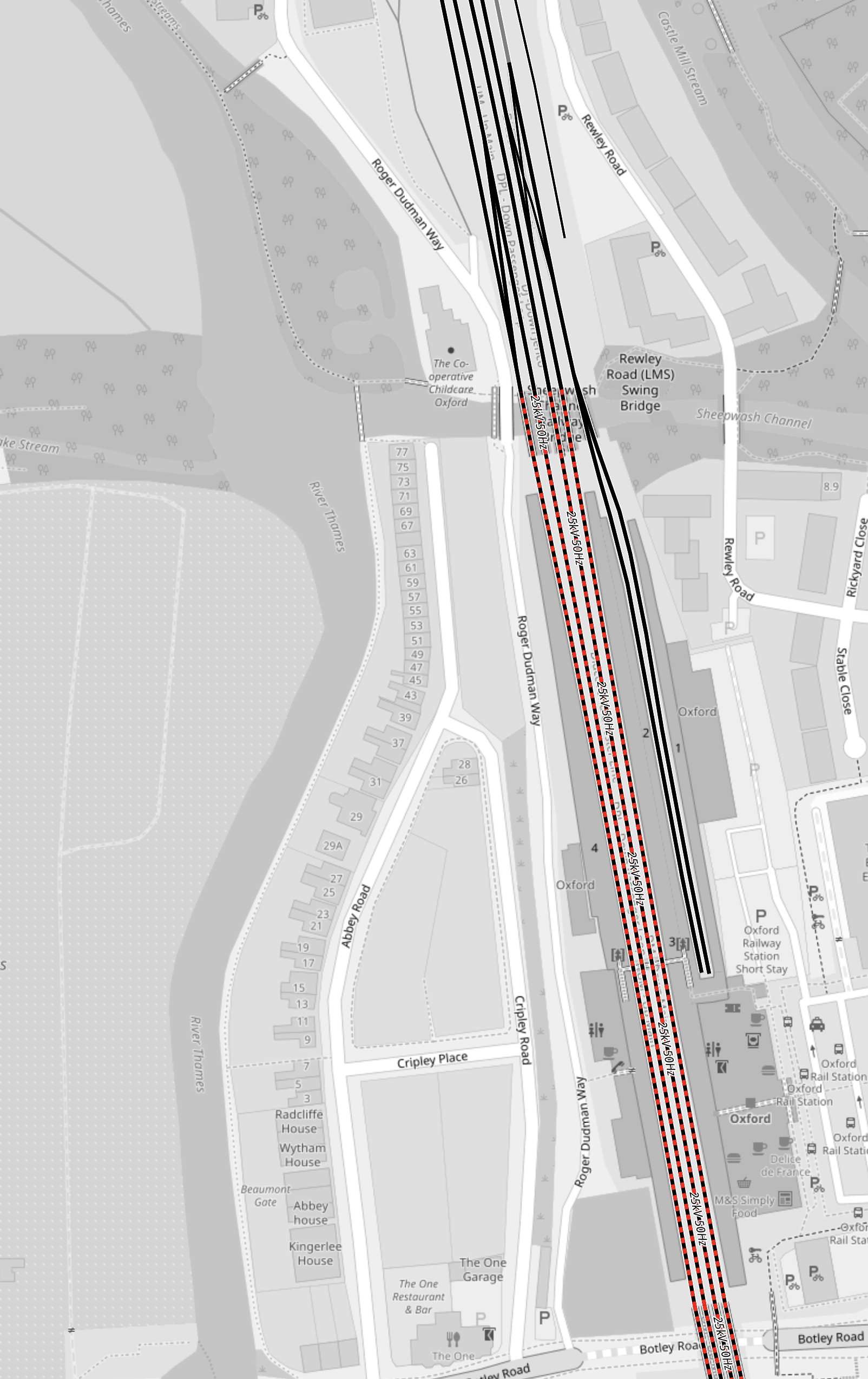
Note.
- The dotted red and black tracks, indicate electrification is planned.
- The planned electrification will connect Oxford station to Didcot Junction station.
- The two bay platforms at the North of the station are not electrified and Platform 2 is now used by Chiltern’s London services.
- Platform 1 could be used by trains on the East West Railway that terminate at Oxford.
When Oxford station is electrified, it wouldn’t be the largest project to add 25 KVAC overhead electrification to the two bay platforms.
Aylesbury Station
This OpenRailwayMap shows the platforms and the lack of electrification around Aylesbury station.
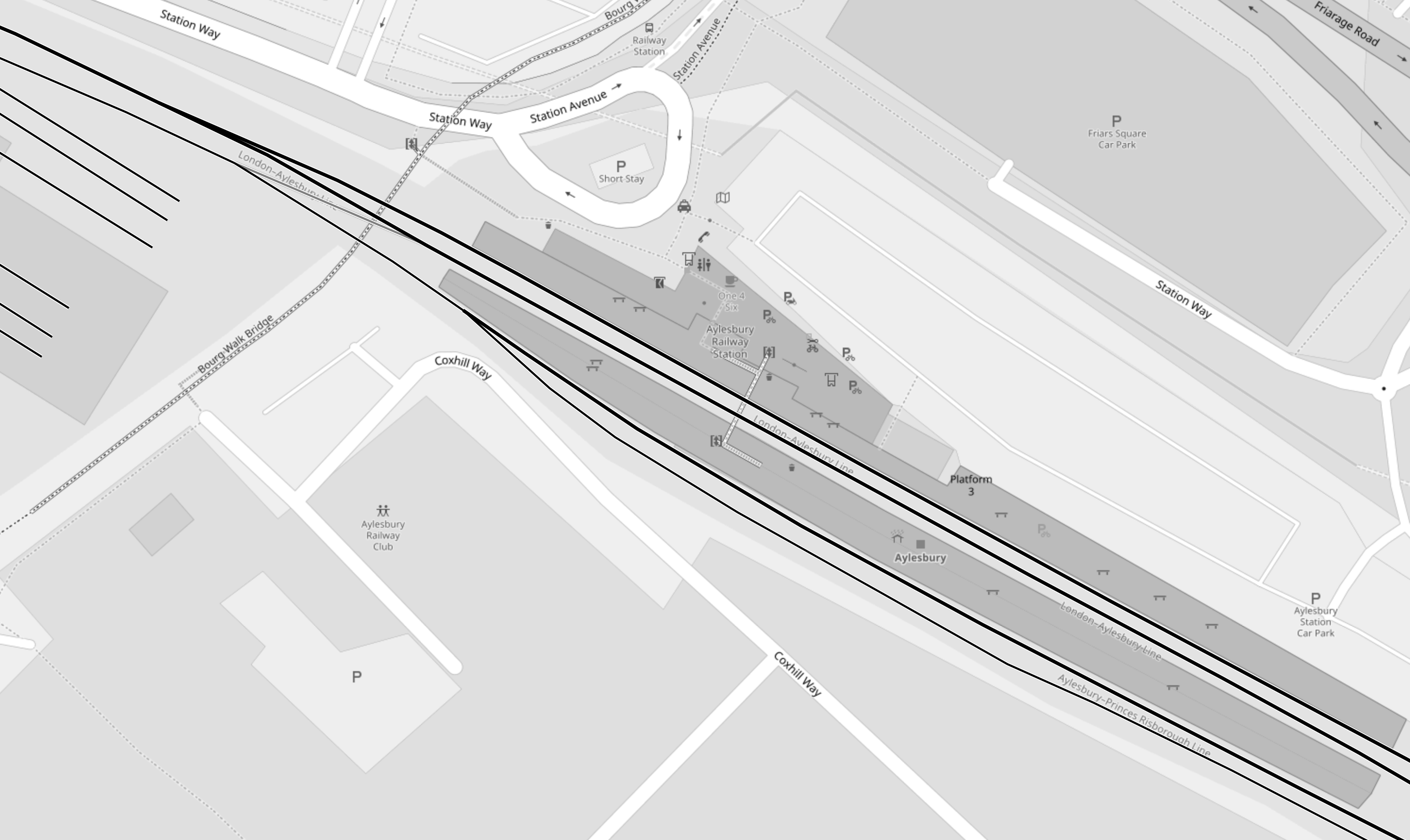
Note.
- No tracks are electrified.
- Platforms are numbered 3, 2, 1 from the top, so 2 and 3 are paired in the middle.
- All freight trains go through Platform 2 and most seem to go via Princes Risborough and High Wycombe.
- Chiltern services use Platforms 1 and 3.
Putting a charging system in Aylesbury station could be tricky.
I wonder if the simplest system for East West Railway would be to electrify between Aylesbury and Aylesbury Vale Parkway stations.
Chiltern Railway’s time between the two stations is as much as seven minutes.
Some trains to Aylesbury take over twenty minutes to do the short journey to Aylesbury Vale Parkway and return, which is more than enough to fully-charge a battery-electric train.
You can even have Chiltern’s hourly Aylesbury Parkway service, sharing the same stretch of electrification with East West Railway’s Aylesbury service, as there is a loop, which creates double-track for some of the way.
It should be noted that between Marylebone and Aylesbury Vale Parkway stations is only 41.1 miles, so some battery-electric trains could do that with a full charge at one end.
East West Railway Distances
In Trains Needed For The East West Railway, I calculated some of these distances.
- Oxford and Bedford – 46.8 miles
- Oxford and Milton Keynes – 33.4 miles
- Aylesbury and Milton Keynes – 25.9 miles
With charging at both ends, all of these routes are possible using modern battery-electric trains, where even a Class 777 IPEMU, designed for extending Merseyrail’s suburban network has done 84 miles on one charge.
On To Cambridge
In this document on the East-West Rail Consortium web site, these services are suggested, for when the East West Railway is complete.
- An hourly train via Norwich terminating at Great Yarmouth.
- An hourly train via Ipswich terminating at Manningtree.
These are distances on these routes that are not electrified, that are to the East of Cambridge.
- Ely and Norwich – 53.7 miles
- Norwich and Great Yarmouth – 18.3 miles
- Cambridge and Haughley Junction – 40.3 miles
Note.
- The Manningtree service would be able to charge its batteries after passing Haughley junction going East and it would be nearly an hour before it needed to use the battery for traction.
- If the Yarmouth service could handle the full route on batteries, then it could return to Cambridge with an efficient charger at Great Yarmouth, which for 25 KVAC overhead electrification trains is an off the shelf item.
- But it does look to me that the trains must leave Cambridge with full batteries, so they can reach electrification at Bedford, Haughley or Norwich.
This map shows the route of the East West Railway between Bedford and Cambridge.
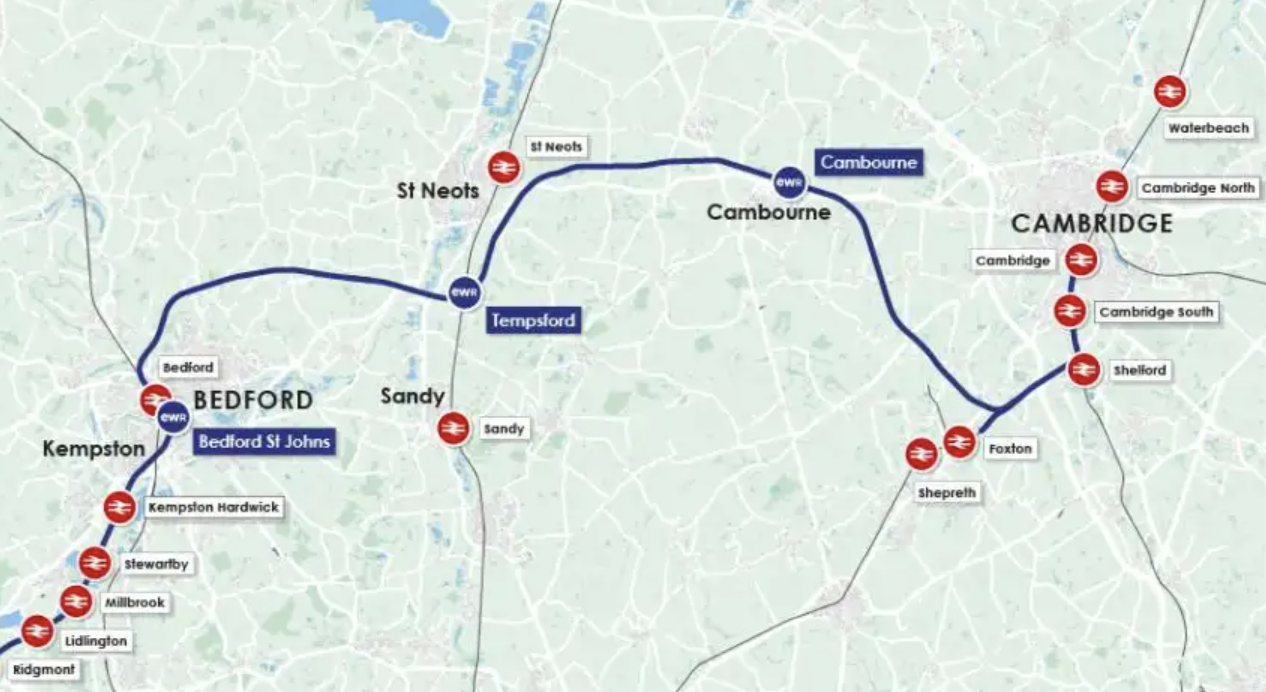
Note.
- Bedford is on the electrified Midland Main Line to London.
- Tempsford is on the electrified East Coast Main Line to London.
- Cambridge has two electrified main lines to London.
- These connections should ensure a good power supply to the East of Bedford for electrification.
I suspect the easiest option will be to add some more electrification at one or more of these places.
- At the Eastern end of the Bedford and Cambridge section.
- To the West of Haughley junction, when it is rebuilt.
- To the North of Ely, when the railways in that area are improved.
Although, as it will be a new route, it might be best to build Bedford and Cambridge as an electrified railway.
East-West Rail: Oxford And Bedford
This map from East West Rail shows the route between Oxford and Bedford.
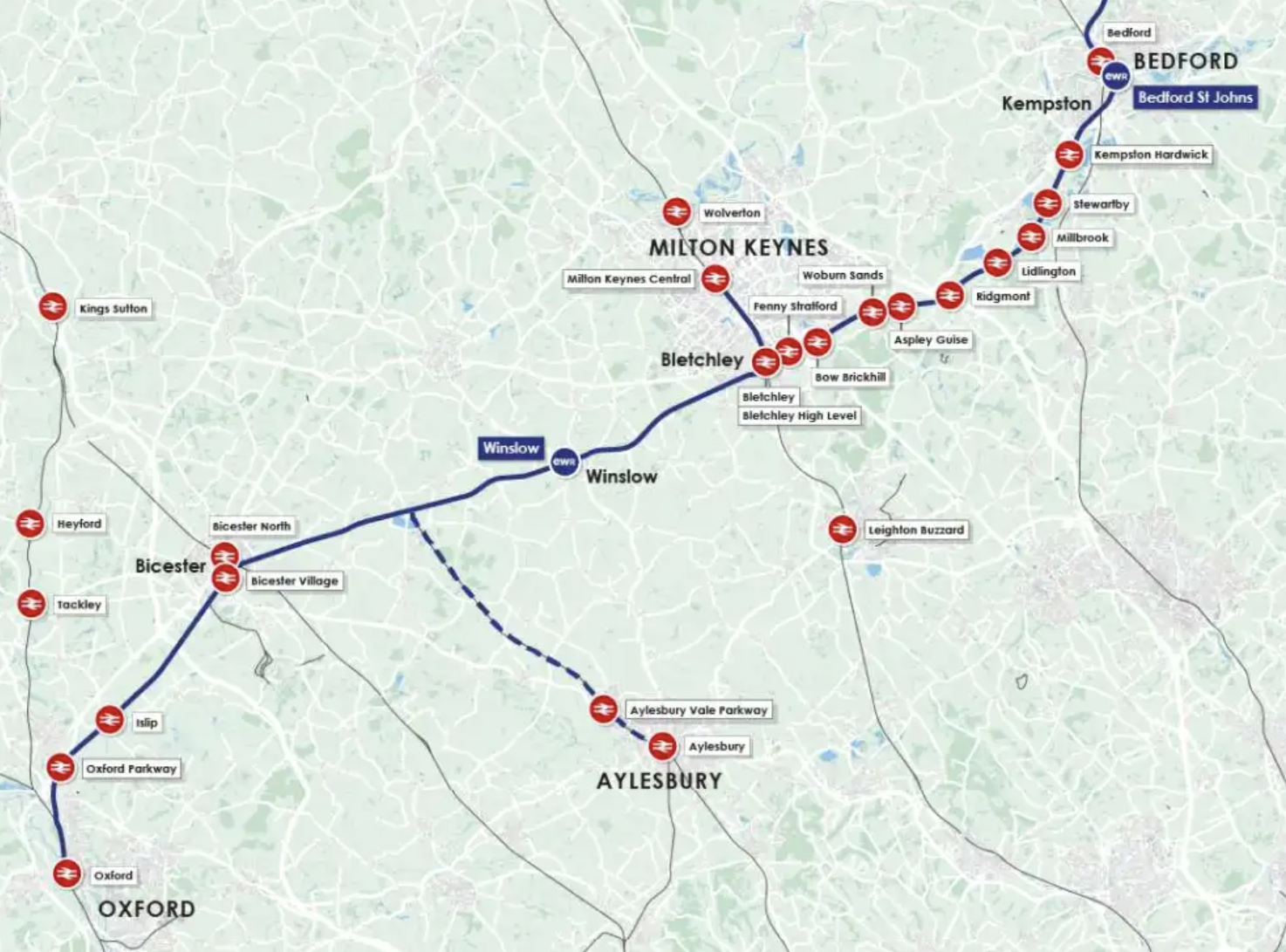
Note.
- The proposed route is shown in blue.
- The possible Southern extension to Aylesbury is shown dotted.
- The route between Bicester and Bletchley is rebuilt track along a former alignment.
- The route between Bletchley and Bedford will surely be rebuilt track along the Marston Vale Line.
- The Bicester and Bedford sections of track will be joined by the Bletchley Flyover, which is well on the way to completion.
This Google Map shows Bletchley station.

Note.
- Bletchley Station has six platforms.
- The double-track Bletchley Flyover runs North-South at the Eastern side of the station.
- There are the beginnings of two platforms on the flyover, which will increase the number of platforms at Bletchley station to eight.
- There is a junction at the Northern end of the flyover, where one pair of tracks go North to Milton Keynes Central and the other takes the Marston Vale Line to Bedford.
The track-layout at Bletchley station allows trains between Oxford and Bedford and Oxford and Milton Keynes Central to call at Bletchley station.
Proposed Passenger Trains Between Oxford and Bedford
According to the Wikipedia entry for the East West Railway, these service will run on the railway between Oxford and Bedford.
- East West Railway – Oxford and Milton Keynes Central via Oxford Parkway, Bicester Village, Winslow and Bletchley – 2 tph
- East West Railway – Oxford and Bedford via Oxford Parkway, Bicester Village, Winslow, Bletchley, Woburn Sands and Ridgmont – 1 tph
- East West Railway – Aylesbury and Milton Keynes Central via Aylesbury Vale Parkway, Winslow and Bletchley – 1 tph
- West Midlands Trains – Bletchley and Bedford via Fenny Stratford, Bow Brickhill, Woburn Sands, Aspley Guise, Ridgmont, Lidlington, Millbrook, Stewartby, Kempston Hardwick and Bedford St Johns – 1 tph
Note.
- tph is trains per hour.
- All larger stations get at least a half-hourly service.
- There are three tph between Oxford and Bletchley via Oxford Parkway, Bicester Village and Winslow.
- There a fast train and a stopping train between Bletchley and Bedford.
- It is still undecided, whether provision will be made for the Aylesbury service.
I think that this service pattern is achievable, with or without the Aylesbury service.
East-West Rail: Route For £5bn Bedford To Cambridge Link Announced
The title of this post, is the same as that of this article on the BBC.
This is the sub-heading.
The preferred route of part of £5bn railway line connecting Oxford and Cambridge has been announced.
The first two paragraphs summarise the route.
The East-West Rail (EWR) project confirmed details of the section between Bedford and Cambridge.
It will include new stations at Tempsford and Cambourne, and enter Cambridge via the south of the city.
This map from East West Rail shows the route.

Note.
- The proposed route is shown in blue.
- The possible Southern extension to Aylesbury is shown dotted.
- The Wikipedia entry for East West Rail has conflicting information, as to when trains can run between Bicester and Bedford.
These related posts describe and discuss various parts and issues of the route.
East-West Rail: Along The Marston Vale Line
East-West Rail: Aylesbury Spur
East-West Rail: Electrification
East-West Rail: Oxford And Bedford
East-West Rail: Through Bedford
We’re Increasing Capacity At Oxford Station To Accommodate Additional Services From 2024
The title of this post, is the same as that of this news item on the Network Rail web site.
This is the sub-heading.
The rail infrastructure in the Oxford Station area is close to full capacity and currently wouldn’t support the start of East West Rail services from the end of 2024. Through Oxfordshire Connect, the station is being expanded and the wider area upgraded, bringing a range of benefits to passengers and residents alike.
I have a few thoughts,
East West Rail Services
East West Rail is aiming to get these services up and running. for Phase 2 of the project.
- Oxford and Milton Keynes Central via Oxford Parkway, Bicester Village, Winslow and Bletchley – two trains per hour (tph)
- Oxford and Bedford via Oxford Parkway, Bicester Village, Winslow, Bletchley, Woburn Sands and Ridgmont – one tph
- Aylesbury and Milton Keynes Central via Aylesbury Vale Parkway, Winslow and Bletchley – one tph.
I suspect not all services will be delivered by the end of 2024. But extra platforms may be needed at Oxford station to accommodate services on East West Rail.
Direct Services Between Oxford And London
There are two direct services in each hour, between Oxford and London Paddington.
- One service terminates at Oxford and the other service terminates at either Great Malvern, Hereford or Worcester.
- Both services stop at Slough and Reading.
- Both services are run by Class 800 electro-diesel trains.
Distances without electrification are as follows.
- Hereford – 96.9 miles
- Great Malvern – 76.1 miles
- Worcester Shrub Hill – 67.6 miles
- Oxford – 10.5 miles
Hitachi are developing a series of battery-electric Intercity trains, which I described in Hitachi Rail And Angel Trains To Create Intercity Battery Hybrid Train On TransPennine Express.
This Hitachi infographic shows the Hitachi Intercity Battery Hybrid Train.
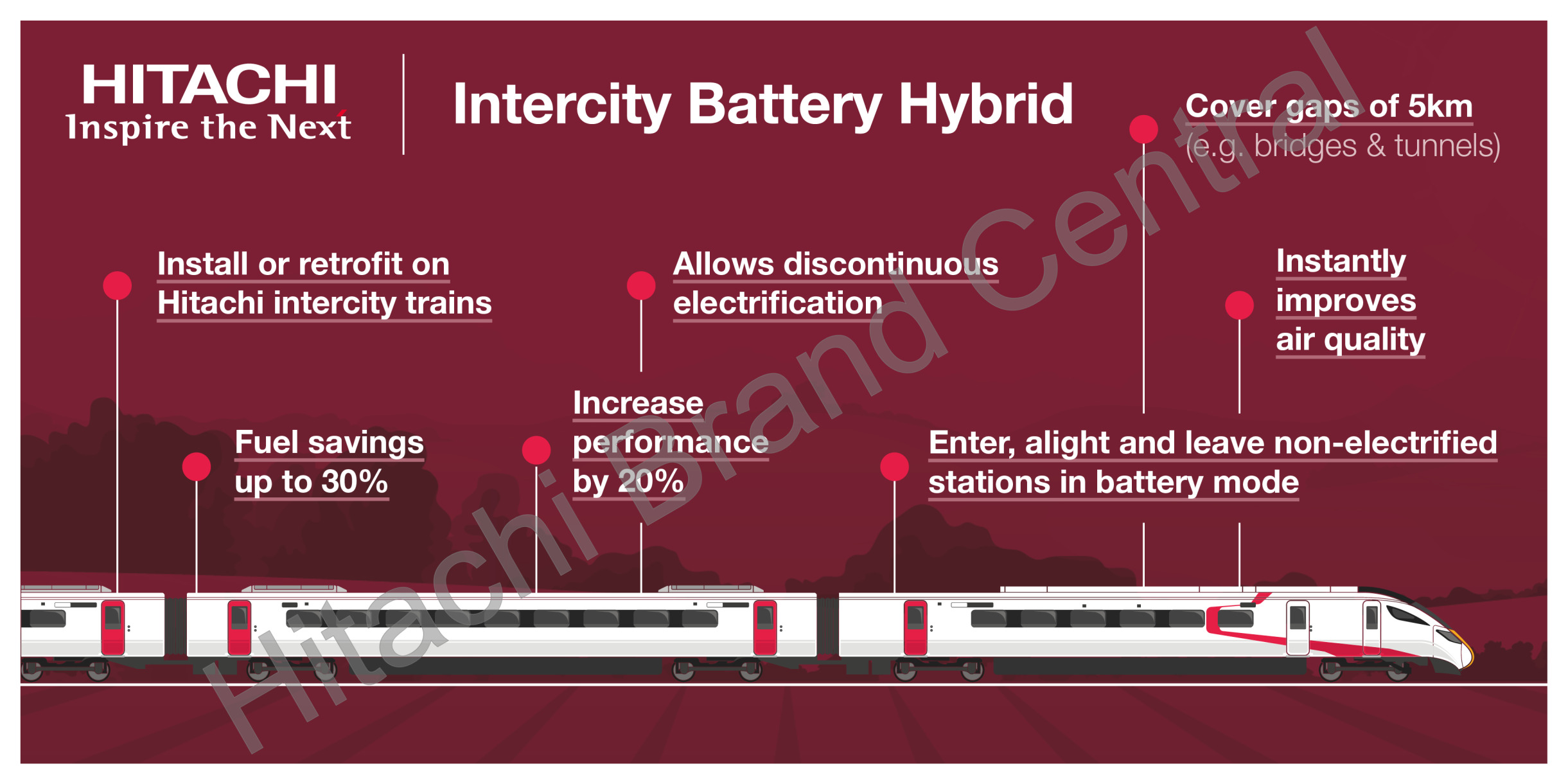
And this Hitachi infographic shows the Hitachi Intercity Battery Hybrid Train.

It looks to me, that one or both of these trains could work some or all of the the four routes to and through Oxford.
A battery train with a range of 21 miles would certainly be able to go between Paddington and Oxford, with battery charging to the East of Didcot.
These trains could be running services by the end of 2024.
The Development of Liverpool Street And Paddington Stations
This article in The Telegraph is entitled Row Over ‘Grotesque’ £1.5bn Liverpool Street Revamp.
There is no doubt that Liverpool Street and Paddington stations will need a higher number of trains per hour and this will probably mean more platforms. But there is no space in either station.
Suppose a long-distance version of the current nine-car Alstom/Bombardier trains were to be built with toilets, a 110 mph top speed, but dimensionally identical to the existing Class 345 trains.
The Central Tunnel of the Elizabeth Line could probably handle more trains, than it currently does, given that Dear Old Vicky handles 36 trains per hour.
So services like Southend and Oxford or Beaulieu and Newbury could be run through the Central Tunnel, replacing the current Greater Anglia and GWR services.
This would relieve platform space in the current terminals and the high-speed Elizabeth Line trains, would just be more trains going through the Central Tunnel at 80 mph.
The important Oxford and Cambridge route would be one change at either Farringdon or Liverpool Street, Or with some track modifications, it might be possible to run direct via the Central Tunnel, Stratford and the West Anglia Main Line.
Sorting out the trains, would ease the development of Liverpool Street and Paddington stations.
Could Chiltern Go Battery-Electric?
In the October 2022 Edition of Modern Railways, there is an article, which is entitled Chiltern Considers Turbo Future, with a sub-title of Battery Replacement Could Be On The Cards.
These are the first two paragraphs.
In early September Chiltern Railways was preparing to launch a market sounding exercise to consider options for the future of the Class 165 Turbo DMU fleet.
The operator has 28×2-car and 11×3-car ‘165s’. which operate alongside its more modern Class 168 DMUs and its loco-hauled sets. The market sounding exercise will consider two options for the future of the fleet – some sort of hybrid conversion, or outright replacement.
The Class 165 Trains
The Class 165 trains were built in 1990-1991.
- Maximum Speed – 75 mph
- Prime Movers – One per car, Perkins 2006-TWH
- 2-car Trains – 28
- 3-car Trains – 11
One is being converted to a diesel/battery hybrid.
The Class 168 Trains
The Class 168 trains were built in 1998-2004.
- Maximum Speed – 100 mph
- Prime Movers – One per car, MTU 6R 183TD13H
- 2-car Trains – 9
- 3-car Trains – 8
- 4-car Trains – 11
One has been converted to a diesel/battery hybrid.
Conversion To Hybrid Operation
If this proves to be feasible, it will surely be the more affordable of the two options.
But it does leave Chiltern with a mixed fleet with two types of train with different maximum speeds and these lengths.
- 2-car Trains – 37
- 3-car Trains – 19
- 4-car Trains – 11
Would a fleet of similar trains, with perhaps a maximum speed of 100 mph, be better operationally?
Battery-Electric Operation
The Modern Railways article introduces the concept of battery-electric operation with this paragraph.
If a replacement fleet is considered the best option for the Turbo units, the replacements could take the form of a straight battery EMU, taking advantage of recent advances in ‘fast charge’ technology.
The article also says this about battery technology and electrification.
There is optimism that advances in battery technology will provide a smooth pathway to decarbonise Chiltern’s operations – the company serves the only non-electrified London terminus.
In the longer-term, it is hoped electrification from Birmingham to Banbury as part of a strategy to decarbonise CrossCountry and freight services would enable Chiltern to run a battery EMU on London to Birmingham duties, running under battery power as far north as Banbury and switching to overhead wires from there, both powering the unit and enabling the batteries to be recharged.
The Modern Railways article looked at each route and I will do this in more detail.
London Marylebone And Aylesbury via High Wycombe
London Marylebone and Oxford would be under battery operation for 40 miles.
Trains would be charged at London Marylebone and Aylesbury stations.
London Marylebone And Aylesbury Vale Parkway
London Marylebone and Oxford would be under battery operation for 41 miles.
Trains would be charged at London Marylebone and Aylesbury Vale Parkway stations.
It might be better to electrify between Aylesbury and Aylesbury Vale Parkway stations.
London Marylebone And Banbury
London Marylebone and Oxford would be under battery operation for 69 miles.
Trains would be charged at London Marylebone and Banbury stations.
Leamington Spa And Birmingham Moor Street
Assuming the Birmingham and Banbury section of the route is electrified, this route will be electrified.
London Marylebone And Birmingham Moor Street Or Birmingham Snow Hill
Assuming the Birmingham and Banbury section of the route is electrified, this route can be considered to be in two sections.
- London Marylebone and Banbury – Battery operation – 69 miles
- Banbury and Birmingham – Electric operation – 42 miles
Trains would be charged at London Marylebone station and on the electrified section.
London Marylebone And Gerrards Cross
London Marylebone and Oxford would be under battery operation for 19 miles or 38 miles both ways.
Trains would be charged at London Marylebone station.
London Marylebone And High Wycombe
London Marylebone and Oxford would be under battery operation for 28 miles or 56 miles both ways.
Trains would be charged at London Marylebone station.
London Marylebone And Oxford
London Marylebone and Oxford would be under battery operation for 66.8 miles.
Trains would be charged at London Marylebone and Oxford stations.
London Marylebone And Stratford-upon-Avon
Assuming the Birmingham and Banbury section of the route is electrified, this route can be considered to be in two sections.
- London Marylebone and Banbury – Battery operation – 69 miles
- Banbury and Hatton Junction – Electric operation – 26 miles
- Hatton Junction and Stratford-upon-Avon – Battery operation – 9 miles
Trains would be charged at London Marylebone station and on the electrified section.
Chiltern’s Mainline Service
Chiltern’s Mainline service between London and Birmingham is run by either a Class 68 locomotive pulling a rake of six Mark 3 coaches and a driving van trailer or two or three Class 168 trains.
As the locomotive-hauled train is about eight coaches, it could surely be replaced by two four-car multiple units working together.
I believe that if Chiltern obtained a fleet of four-car battery electric trains, this would be the most efficient fleets for all their routes.
Charging At London Marylebone Station
I took these pictures at Marylebone station today.
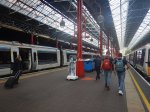
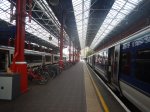
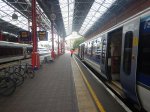
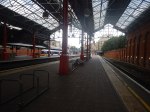

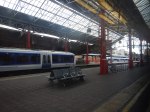
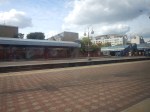


Note.
- It is a surprisingly spacious station and I feel that Furrer+Frey or some other specialist company could add some form of charging to the platforms.
- Charging would probably performed using the train’s pantograph.
It appears that the turnround time in Marylebone is typically twelve minutes or more, which should be adequate to fully charge a train.
Conclusion
Both solutions will work for Chiltern.
But I prefer the new battery-electric train, which has some crucial advantages.
- Battery-electric trains will be quieter than hybrid trains.
- Marylebone station has a noise problem and battery-electric trains are very quiet.
- Chiltern have ambitions to built new platforms at Old Oak Common and to serve Paddington. This could be easier with a battery electric train.
Rhe only disadvantage is that Banbury and Birmingham would need to be electrified.
Extending The Elizabeth Line – Connecting Great Western Main Line Services To The Central Tunnel
If say it was ever needed to run a train between Oxford or Swindon stations and the Central Tunnel of the Elizabeth Line, three things must be possible.
Trains Would Have To Be Compatible With The Central Tunnel Of The Elizabeth Line
As any train would have to be compatible with the platform-edge doors in the central tunnel of the Elizabeth Line, the trains would have to be dimensionally identical to the current Class 345 trains.
- Nine cars
- Possibility of lengthening to ten cars.
- 204.73 metres long.
- 6 sets of doors per carriage
- Ability to run under full digital signalling.
I covered this in detail in Extending The Elizabeth Line – High Speed Trains On The Elizabeth Line.
Trains Would Need A 125 mph Capability To Travel On The Fast Lines Of The Great Western Main Line
They would be designed for a higher speed of at least 110 or 125 mph, to enable running on the fast lines.
The faster running would ease scheduling of the trains.
Effectively, the train would be a Class 345 train with more features and considerably more grunt.
Trains Must Be Able To Connect Between The Fast Lines And The Central Tunnel Of The Elizabeth Line At Royal Oak
This map from cartometro.com shows the track layout at Royal Oak.
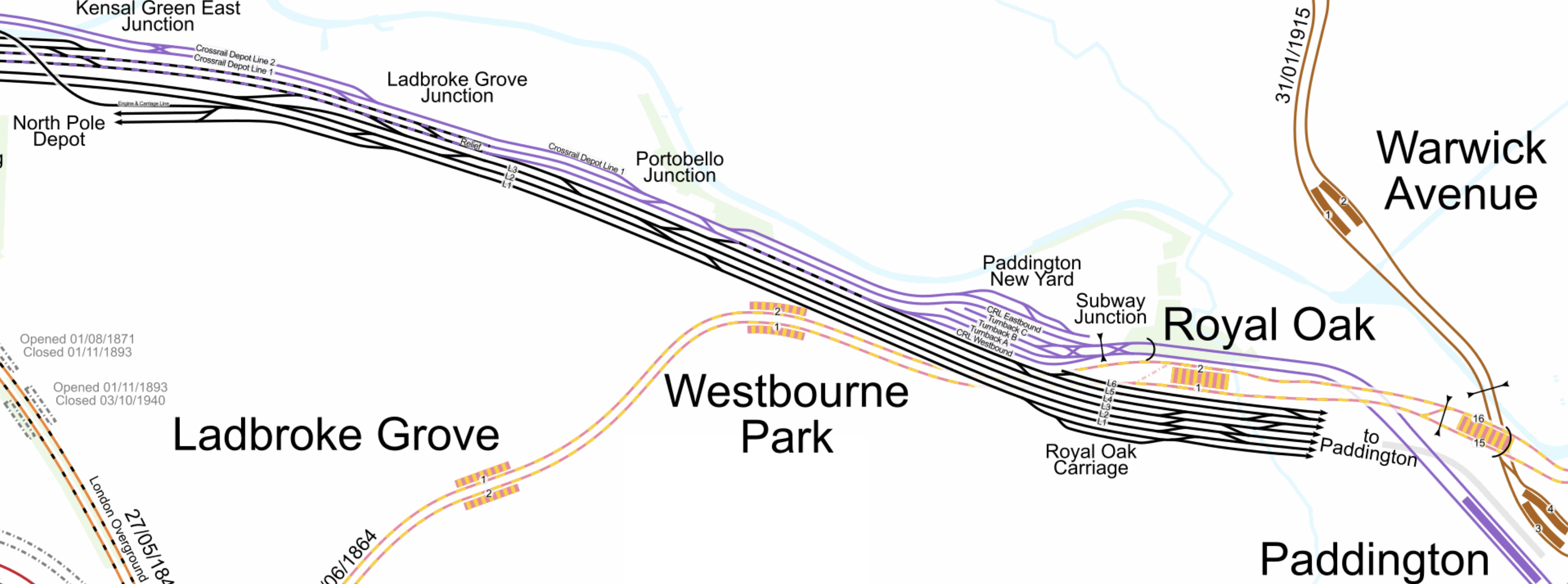
Note.
- The Elizabeth Line is shown in purple.
- Great Western Railway (GWR) tracks are shown in black.
- Where the Elizabeth Line shares the tracks with GWR services the tracks are shown in black and purple.
This map shows an enlargement of Kensal Green East Junction in the North-West corner of the previous map.
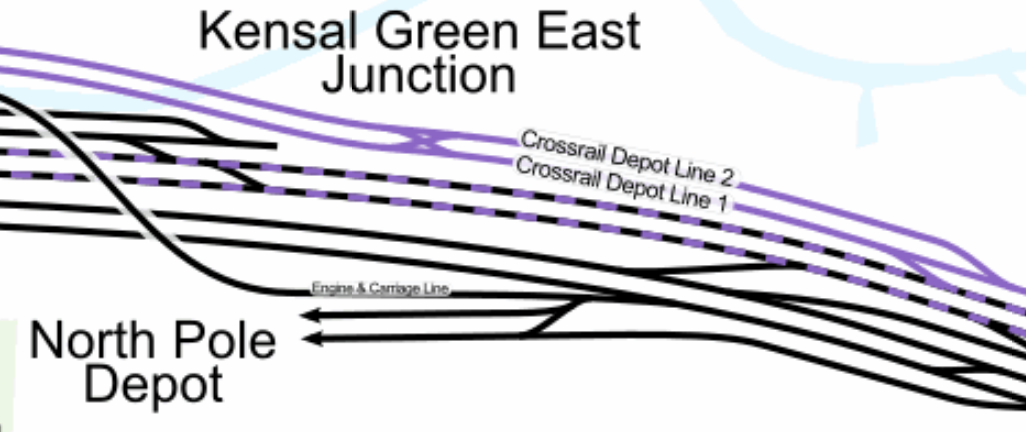
Note.
- The top pair of lines lead to the Elizabeth Line Depot at Old Oak Common.
- the pair of lines that are shown in black and purple handle Elizabeth Line and GWR local services.
- The pair of black lines are the Great Western Main Line.
- North Pole Depot is used by GWR for their Hitachi trains.
This map shows an enlargement between Ladbroke Grove Junction and Royal Oak.
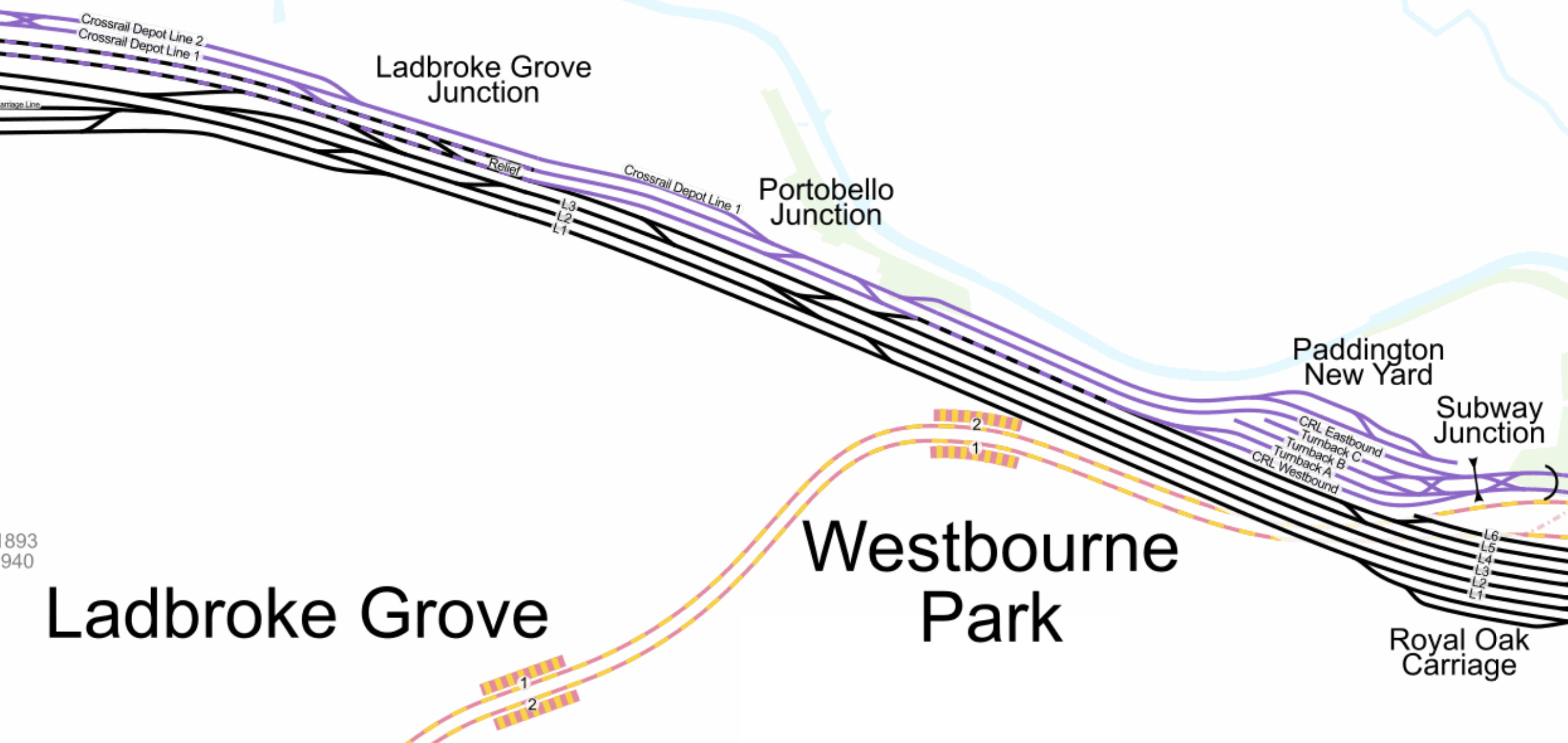
Note.
- In the South-East corner of the map is Subway junction, which appears to have two crossovers for maximum flexibility.
- To the East of Subway junction the curved line indicates the Royal Oak Portal of the Elizabeth Line Central Tunnel.
- To the West of Subway junction, there is Paddington New Yard, where there is five tracks labelled CRL Eastbound, Turnback C, Turnback B, Turnback A and CRL Westbound from North to South.
- Turnback C, Turnback B and Turnback A are the three turnback sidings, where trains are turned back East through the Elizabeth Line Central Tunnel.
- CRL Eastbound and CRL Westbound can be followed across the map to the black and purple lines of the Elizabeth Line to the West of Ladbroke Grove junction.
- At present the Western section of the Elizabeth Line terminates in Paddington station. Crossovers at Portobello junction appear to connect the Western section of the Elizabeth Line into Paddington station.
- More crossovers also appear to connect the Great Western Main Line to the CRL Eastbound and CRL Westbound through Paddington New Yard.
I am fairly sure that the track layout at Royal Oak allows trains to go both ways between Great Western Main Line and the Elizabeth Line Central Tunnel.
Extending The Elizabeth Line – High Speed Trains On The Elizabeth Line
This may seem rather fanciful, but could it be the way to maximise the use of the Elizabeth Line?
- I feel that the Elizabeth Line will eventually serve other destinations like Basingstoke, Beaulieu, Oxford, Southend and Swindon.
- The capacity of the Elizabeth Line will grow to over thirty trains per hour (tph) under control of digital signalling.
These are a few thoughts.
The Design Of The Trains
As any train would have to be compatible with the platform-edge doors in the central tunnel of the Elizabeth Line, the trains would have to be dimensionally identical to the current Class 345 trains.
- Nine cars
- Possibility of lengthening to ten cars.
- 204.73 metres long.
- 6 sets of doors per carriage
- Ability to run under full digital signalling.
They would be designed for a higher speed of at least 110 or 125 mph, to enable running on the fast lines of these routes.
- East Coast Main Line
- Great Western Main Line
- Midland Main Line
- West Coast Main Line
They would also be able to run at 100 mph on the Chiltern Main Line, the Great Eastern Main Line and the North Kent Line.
The faster running would ease scheduling of the trains.
Extra facilities could include.
- Toilets
- Tables
- A third-rail capability for running in Kent.
Effectively, it would be a Class 345 train with more features and considerably more grunt.
Note that in A High Speed Train With An IPEMU-Capability, I started the post with the following.
Bombardier were reported by Ian Walmsley in the April 2016 Edition of Modern Railways, to be developing Aventra, with a 125 mph capability.
Bombardier have also told me, that all Aventras will be wired so they could be fitted with on-board energy storage.
Could it be that the design of a Class 345 train could be modified to run at higher speeds? I wouldn’t be surprised.
Oxford To Southend Victoria
This could be a typical route.
- Between Oxford and Paddington, it would follow a route similar to the GWR’s Oxford service with stops at just Reading and Slough.
- At Paddington the train would take the Central Tunnel of the Elizabeth Line and travel under London, at the same speed as the other trains.
- It would emerge at Stratford and move to the Great Eastern Main Line.
- It would probably stop at Stratford, Romford, Shenfield and all stations to Southend Victoria.
Note.
- Digital signalling would enforce the precise timekeeping needed.
- Much of the Oxford and Paddington section would be up to speeds of at least 125 mph.
- Times in the Central Tunnel of the Elizabeth Line would be identical to the current Class 345 trains.
- Much of the Stratford and Southend section would be up to speeds of at least 100 mph.
I estimate that total time would be a few minutes under two hours.
Connecting To The Central Tunnel Of The Elizabeth Line At Royal Oak
I discuss this in Extending The Elizabeth Line – Connecting Great Western Main Line Services To The Central Tunnel.
Connecting To The Central Tunnel Of The Elizabeth Line At Stratford
I discuss this in Extending The Elizabeth Line – Connecting Great Eastern Main Line Services To The Central Tunnel.
Connecting To The Central Tunnel Of The Elizabeth Line At Abbey Wood
This map from cartometro.com shows the track layout at Abbey Wood.
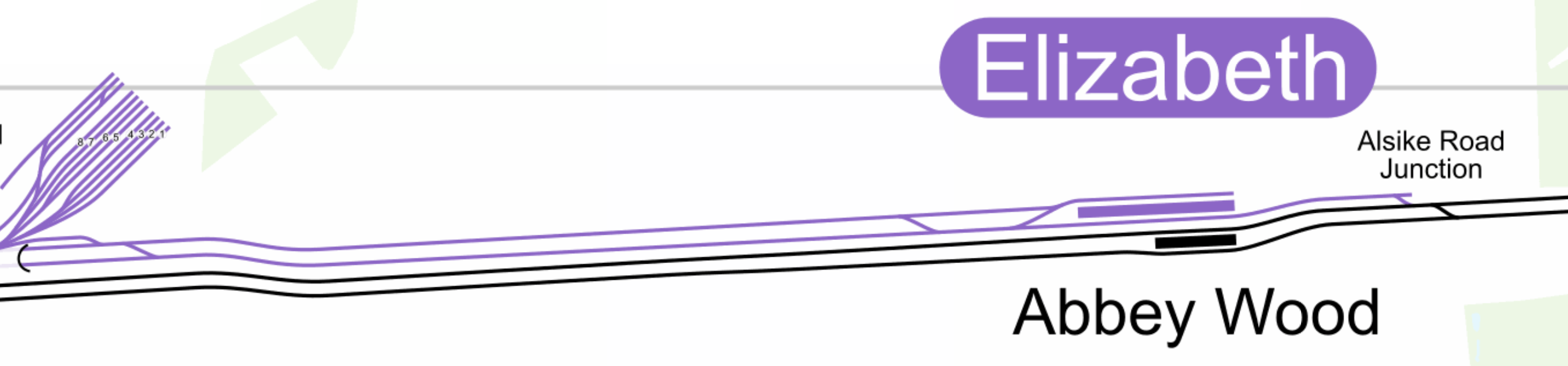
Note.
- The Elizabeth Line is shown in purple.
- The North Kent Line is shown in black.
- The North Kent Line platform to London is the Southernmost platform and is numbered 1.
- The North Kent Line platform from London is the other Southern platform and is numbered 2.
- The Elizabeth Line platforms are numbered 3 and 4.
- Platform 4 is the Northernmost platform.
At present the Elizabeth Line service to Abbey Wood station is twelve tph, with each platform handling six tph.
This picture shows trains in both Platform 3 and 4 looking towards the station buildings.

Note.
- Platform 3 is on the right.
- Platform 4 is on the left.
In Elizabeth Line To Ebbsfleet Extension Could Cost £3.2 Billion, I talk about this proposal as described in this article on Ian Visits.
One of the key features of Crossrail To Ebbsfleet (C2E) project is that instead of all trains terminating at Abbey Wood, trains will terminate as follows.
- Abbey Wood – 4 tph
- Northfleet – 4 tph
- Gravesend – 4 tph
This will mean that 8 tph would pass through Abbey Wood station.
- Platform 4 could certainly handle the four that terminated on the Elizabeth Line.
- Platform 3 would need to handle eight tph in both directions or sixteen tph to fulfil the proposed C2E service.
- This would be one train every 225 seconds.
I believe that digital signalling could handle this easily and safely.
I am fairly sure that the track layout at Abbey Wood allows eight tph to go both ways between the North Kent Line and the Elizabeth Line Central Tunnel.
The Maximum Capacity At Abbey Wood Station
Because of the current track layout at Abbey Wood, I believe that without track modifications, Abbey Wood station will not be able to handle more than 12 tph.
Thameslink
These proposed trains would also be compatible with Thameslink, as this route has no platform edge doors.
No platform extensions would be needed, as the Class 345 trains are shorter than the 12-car Class 700 trains.
If they were 125 mph trains, then this would ease timetabling on the East Coast Main Line, as the trains could mix it with the expresses on the fast lines.
Could These High Speed Trains For The Elizabeth Line Have A Cruising Speed Of 140 mph?
It is likely, when full authority digital ERTMS signalling is installed on main lines out of London, that 140 mph will be possible on some at least these routes.
- East Coast Main Line
- Great Western Main Line
- Midland Main Line
- West Coast Main Line
The extra speed would maximise capacity.

