These strawberries were grown my M Porter in Perthshire and I bought them in the M & S Simply Food store in Waterloo station.
So did they travel between Perthshire and London, by truck or train?
I think the strawberries came from East Seaton Farm, owned by Lochart and Debbie Porter.
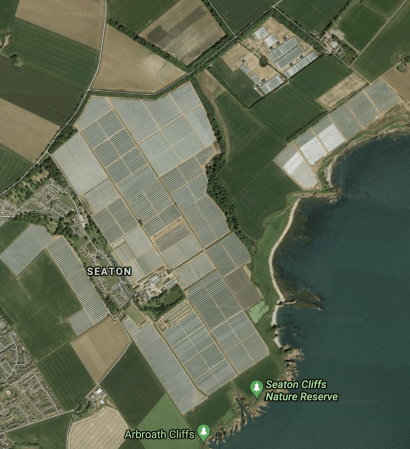
If the strawberries were to be grown any further East, they’d be grown in the middle of the North Sea.
But did they come South, by road or rail?
I suspect it was the former, but there is change in the air! Or do I mean on the rails?
In My First Ride In A Class 769 Train, I talked about Rail Operations Group and their proposed Orion parcels service, that will use Class 769 trains.
This service would surely be ideal to bring strawberries and Arbroath smokies to the South.
June 8, 2021
Posted by AnonW |
Food, Transport/Travel | Class 319 Flex (Class 769) Train, Express Parcels/Light Freight Services, Freight, Rail Operations (UK) Limited, Scotland, Strawberries |
8 Comments
This was my afternoon snack whilst writing on the Internet.
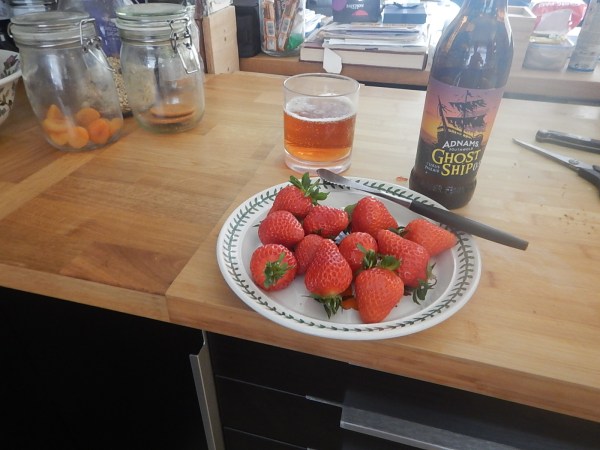
Beer from Suffolk and strawberries from Herefordshire.
May 12, 2021
Posted by AnonW |
Food | Adnams, Beer, Herefordshire, Strawberries, Suffolk |
2 Comments
I have been eating a few more boxes of Dyson’s strawberries.
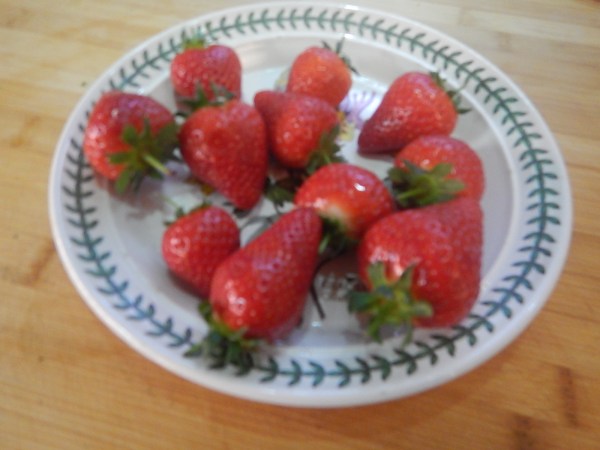
They certainly seem clean and could have had a good vacuum before packing.
Unlike some Moroccan ones, which tasted like they’d been sprinkled with some sand from the Sahara.
Plump And Red
Dyson Farming’s strawberries do seem to be very plump and very red.
Is this because they have been grown, so that they will be easy for picking robots to identify in the future?
April 23, 2021
Posted by AnonW |
Food | Automation, James Dyson, Strawberries |
Leave a comment
With my supper tonight, I had some strawberries from Marks & Spencer.
I regularly eat strawberries and raspberries, when they are available.
But, these were particularly nice.
So I checked the label and found that they had been grown by Dyson Farming in Lincolnshire.
This page on the Dyson Farming web site describes their Strawberry Production.
- The aim is to help the UK to be self-sufficient in food and cut air miles associated with imported soft fruit.
- The strawberries are grown in a 15-acre greenhouse.
- The greenhouse is heated by waste heat from a nearby anaerobic digester.
- The greenhouse contains 700,000 strawberry plants.
- Every year 750 tonnes of strawberries will be produced.
- The website talks of in future using robotic picking and LED lights to prolong the growing season.
Is this the way strawberries will be farmed in the future? You bet, it will!
Dyson Farming seems to be innovating in the growing and marketing of Barley, Oilseed Rape, Peas, Potatoes and Wheat.
Use Of Carbon Dioxide
I wonder if carbon dioxide captured from a gas-fired power station could be added to the greenhouses to aid the production of strawberries. There certainly are a lot of serious research papers on the Internet looking at the effects of carbon dioxide on strawberry production.
Dyson Farm’s location in the South of Lincolnshire, is probably not a good location, as the large power-stations are in the North of the county.
Robotic Picking
I first saw it said in the 1960s, that at some point in the future no fruit will be grown unless it could be harvested by machines
Dyson states they are going that way with strawberries.
Could it also be one of the reasons for large strawberries, which we increasingly see in the shops, is that they ar easier for robots to pick?
LED Lighting To Prolong The Growing Season
This is surely logical, if you have enough electricity.
The Anaerobic Digesters
Their two anaerobic digesters seem to be able to produce a total of around 5 MW of electricity. This is said on the web site.
The anaerobic digesters produce gas which drives turbines producing enough electricity to power the equivalent of 10,000 homes. This green energy also powers the farming operation.
There are two by-products from this process:
Digestate, which is applied to nearby fields as an organic fertiliser to improve soils and crop yields. It is expected that strawberries will be grown in the digestate in future as well.
Heat is captured and used to warm the glasshouse and encourage the strawberries to grow at a time of year when traditionally it has been too cold.
In some ways, the farming operation is run more like an efficient integrated chemical plant, than a large farm.
Conclusion
Anybody with an interest in farming or the environment should read the Dyson Farming web site.
I can envisage a farmer with a sunny but unproductive twenty-acre field contacting Dyson to install their own strawberry greenhouse.
Farming will certainly change.
I shall certainly, be buying Dyson strawberries again.
And I suspect we all will be buying strawberries grown in this way in a few years.
April 16, 2021
Posted by AnonW |
Food | Barley, Farming, James Dyson, Lincolnshire, Marks and Spencer, Oilseed Rape, Peas, Potatoes, Strawberries, Wheat |
3 Comments