A Spelling Mistake From Hydrogen Fuel News
This clipping from Hydrogen Fuel News contains one of the best spelling mistakes I’ve seen in a long time.
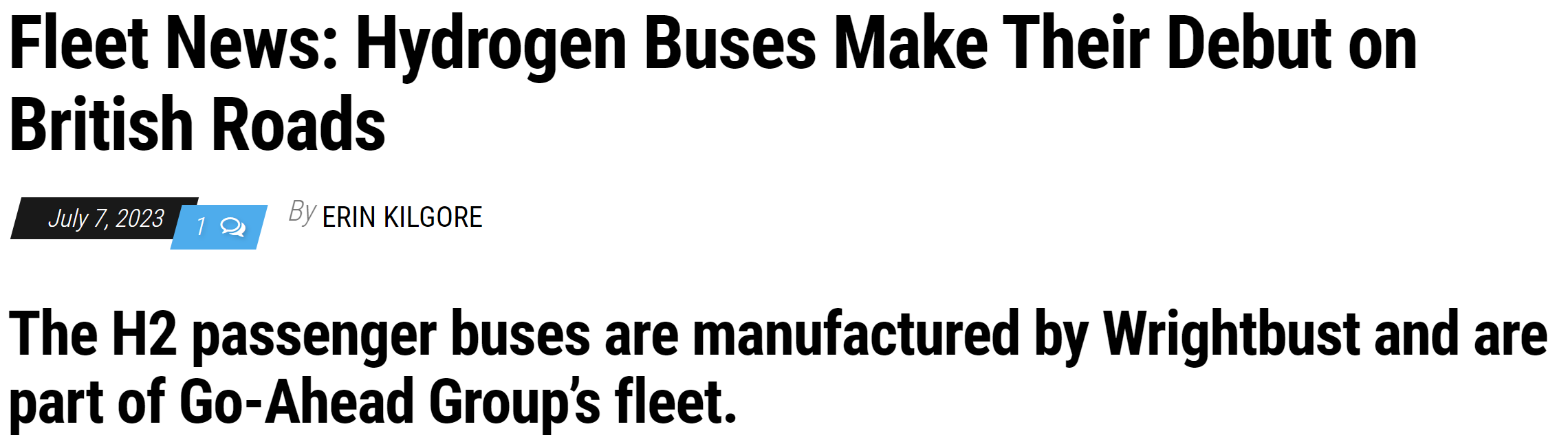
It wasn’t auto-suggestion, as the only lady in the article, is very demurely dressed.
Go-Ahead Adds 20 FC Buses To Gatwick Fleet
The title of this post, is the same as that of this article on electrive.com.
I described my ride on these buses in My Second Ride In A Wrightbus Single-Decker Hydrogen Bus.
I am publishing this post for this key paragraph on the electrive.com article.
When the order was placed in 2021, Martin Harris, Managing Director of Brighton & Hove and Metrobus, already specified why hydrogen buses were now being used for the first time: “We run services 24 hours a day, with hilly terrain, heavy passenger loads and duty cycles well in excess of the national average at up to 370 miles per day. Those provide really challenging conditions for any technology but we concluded that hydrogen provides the most efficient replacement for our diesel buses.”
It is interesting to note, that the hydrogen buses in Birmingham, Dublin and Liverpool are used on longer routes.
Toyota And VDL Groep To Convert Heavy-Duty Vehicles Into Hydrogen Fuel Cell Trucks
The title of this post, is the same as that of this article on Hydrogen Fuel News.
This is the first paragraph.
Toyota Motor Europe (TME) and Dutch VDL Groep have teamed up to covert VDL’s existing heavy-duty trucks into hydrogen fuel cell trucks using Toyota’s fuel cell modules, with a goal to accelerate decarbonizing the road logistics sector while also breaking into Europe’s zero-emission heavy duty H2 trucks market.
Note.
- According to their Wikipedia entry, VDL Groep seem to manufacture buses, coaches, chassis modules and vehicle components.
- In Ricardo Supports Toyota To Develop Its First UK-Based Hydrogen Light Commercial Vehicle, I wrote about conversion of the Toyota Hilux to hydrogen.
- There are a large number of companies all over the world, who will convert vehicles to hydrogen.
- It could be argued that Wrightbus and Alexander Dennis, have designed hydrogen buses, that could be conversions of existing designs.
- Cummins are selling diesel engines, that can be converted to hydrogen.
Could these points indicate, that one of the main routes to the decarbonisation of the heavier end of the commercial vehicle sector will be conversion of existing vehicles to hydrogen fuel?
And will this lead to smaller conversion kits to decarbonise vehicles like Land Rovers, Range Rovers, larger BMWs, Jaguars and Mercedes?
If you consider, that when I was growing up in the 1950s, you rarely saw a small diesel vehicle and how diesel came to grab a large market share, due to good engineering and some misguided tax changes from Gordon Brown, I don’t think it is unreasonable to believe that good engineering and perhaps well-thought out tax changes could create an affordable route to decarbonise a large proportion of vehicles.
If I was still driving and lived away from dreaded ULEZs, then I would be keeping my reliable diesel Jaguar estate.
£77 Million Investment For UK Heavy Duty And Commercial Vehicle Projects
The title of this post is the same as that of this press release from the Advanced Propulsion Centre.
These are the projects.
Ford to design, develop, and build a fleet of 8 hydrogen fuel cell powered Transit vans, with the latest advances in technology
£8 million awarded by government, matched by industry to a total £16.3 million.
This research project will design and develop a hydrogen fuel cell-powered version of the Ford Transit van, with a Ford Dagenham estate facility re-purposed for upfitting of the vehicle. By bringing the manufacturer, vehicle operator and supply chain businesses together, this project aims to establish a business case for the wider rollout of hydrogen Light Commercial Vehicles.
Project partners include: Ocado, BP, Cygnet Texkimp, Cambustion, Viritech.
Note.
- I suspect Ocado will do the road testing.
- BP will probably supply the hydrogen.
- Cygnet Texkimp are a company based in Northwich and is a leading global provider of fibre handling and converting technology. Have they developed a machine for knitting hydrogen fuel tanks?
- Cambustion‘s Engineering Services team provides powertrain development and testing services to a range of global clients from our Cambridge, UK base.
- Viritech’s web site has a mission statement of Rewiring the DNA of Hydrogen Powertrains.
Ford seem to have assembled a team of all the talents.
Wrightbus to develop a new world-leading zero-emission battery and hydrogen fuel-cell electric, multi-axle vehicles
£6.4 million awarded by government, matched by industry to a total £12.7 million.
This project will produce a new, market-leading platform for battery and fuel cell electric driven buses. Whilst demand is growing for zero-emission vehicles, there are currently few options available for heavy, multi-axle vehicles like large buses.
Project partners include: Queens University Belfast, Grayson Thermal Systems, Hutchinson Engineering, Translink.
Note.
- Grayson Thermal Systems are based in Birmingham and specialise in providing HVAC for vehicles and especially zero-carbon ones.
- Hutchinson Engineering are based in Widnes and invest in state-of-the-art machinery and technology to give our customers the most advanced, cost-effective solutions in design, fabrication and manufacturing.
- Translink provides public transport in Northern Ireland.
It looks like Wrightbus have excellent partners.
ULEMCo creating a zero-emission hydrogen fuel cell range extender for prototype ambulance, fire engine and road sweepers
£3.9 million awarded by government, matched by industry to a total £7.9 million.
This project will develop a hydrogen fuel cell range extender for electric vehicles used for special purposes, such as ambulances, fire engines and street sweepers. The zero-emissions range extender will be based on existing, proven technology from the Toyota Mirai, and demonstrate how zero emissions vehicles can be used in a wide range of specialised and challenging settings.
Project partners include: Altair Engineering, Emergency One, Technical Services Ltd, Oxon Fire & Rescue Services
Note.
- ULEMCo are based in the Liverpool City Region and it is very much in Liverpudlian DNA to repurpose something that works. Hence the use of The Toyota technology.
- Altair Engineering is a multinational engineering and technology company.
- Emergency One is a Scottish manufacturer of fire engines and emergency vehicles.
- Technical Services Ltd, who are based in Cleckheaton, supply thermal management systems and solutions.
- Oxon Fire & Rescue Services will obviously be doing the testing.
In Hydrogen-Powered Ambulance Drives Into Glasgow Ahead Of London Trial, I wrote about a prototype hydrogen-powered ambulance, that was built by ULEMCo and industry partners, that was shown at COP26.
Is this project turning the prototype into a system, that can be manufactured in large volumes?
Bramble Energy developing a hydrogen double-deck bus, using innovative, low-cost fuel cell technology
£6.3 million awarded by government, matched by industry to a total £12.7 million.
This project will demonstrate a fuel cell/battery hybrid powertrain on a double-decker bus. This novel product will be cheaper than the equivalents currently available for large vehicles like buses and uses innovative new electronics and energy recovery technologies.
Project partners include: University of Bath, Equipmake, Aeristech
Note.
- Bramble Energy‘s Printed Circuit Board Fuel Cell (PCBFC™) is a patent protected, revolutionary design which leverages existing manufacturing routes from the printed circuit board industry to offer a cost-effective, scalable hydrogen fuel cell solution.
- Equipmake are based at Snetterton in Norfolk.
- In Equipmake Hybrid To Battery Powered LT11, I describe Equipmake’s conversion of a New Routemaster to battery operation.
- Aeristech are based in Crawley and have developed a range of award-winning compressors for Tier-1, OEMs and other customers.
- Is the compressor needed to pump a mixture of hydrogen and air through the fuel cell?
I have a feeling, that this could be a very revolutionary design.
BorgWarner developing hydrogen combustion systems for heavy-duty commercial transport
£4.9 million awarded by government, matched by industry to a total £9.8 million.
This project aims to speed up the rollout of hydrogen-burning internal combustion engines, as an alternative to diesel. Hydrogen is a clean fuel, producing only water when burned. Project Cavendish will develop new fuel and air management systems, so that existing heavy duty diesel technologies can be repurposed to use hydrogen as fuel.
Project partners include: Mahle, Cambustion, Hartridge
Note.
- BorgWarner is a large American automotive supplier.
- Mahle is a large German automotive supplier.
- Cambustion‘s Engineering Services team provides powertrain development and testing services to a range of global clients from our Cambridge, UK base.
- Since the brand formation in 1930 Hartridge, who are based in Buckingham, has become a world leader in diesel fuel injection test equipment.
- Project Cavendish is obviously named after Henry Cavendish, who discovered hydrogen.
In Ricardo Supports Industry Leaders To Develop Innovative Dedicated Hydrogen Engine, I talk about another project involving BorgWarner. Is Project Cavendish a follow-on from the original project or a new one?
Leyland Trucks scaling up the production of electric trucks through innovations in automation and advanced testing
£2.6 million awarded by government, matched by industry to a total £5.1 million.
By better use of automation and advanced testing, Leyland Trucks aim to increase productivity and step up their production of battery electric trucks. A ‘digital twin’ of the Leyland production line will be set up, meaning any changes can be run in simulation before being rolled out physically.
Project partners include: Expert Tooling, HSSMI
Note.
- Leyland Trucks is one of Britain’s leading manufacturing companies. It is PACCAR’s established centre for light and medium duty truck design, development and manufacture. The company is based in Leyland.
- Expert Technologies are specialists in delivering industrial automation solutions. The company is based in Coventry.
- HSSMI is a sustainable manufacturing consultancy.
As I have done a lot of simulation in my time, I’m very much in favour of digital twins.
JLR leading a consortium research project to develop a high-efficiency and highly integrated 800V inverter designed and built in the UK
£6.3 million awarded by government, matched by industry to a total £12.6 million.
This project will explore and develop technology for inverters – a key component in electric vehicles. As well as developing a best-in-class product, this work will support the growth of a UK supply chain in components for electric vehicles.
Project partners include: University of Bristol, Custom Interconnect Ltd, API Capacitors Ltd
Note.
- JLR is Jaguar Land Rover.
- Custom Interconnect is an advanced electronics manufacturing company, which is based in Andover.
- API Capacitors is the UK’s leading designer and manufacturer of high quality power capacitors for power electronic applications. The company is based in Great Yarmouth.
I suspect this invertor will have several applications.
Conclusion
The grants seem to have been widely spread around the UK.
NI Green Hydrogen Projects Win Government Grants
The title of this post, is the same as that of this article on the BBC.
This is the sub-heading.
Two green hydrogen projects in Northern Ireland have won government grants in the first round of the UK Net Zero Hydrogen Fund.
These three paragraphs outline the projects.
Green hydrogen is made by using renewable electricity to separate water into oxygen and hydrogen – a process called electrolysis.
The grants will be used to help fund the construction of electrolysers.
One will be at the Mannok cement plant in Fermanagh, the other at Wrightbus in Ballymena.
I talked about the Wrightbus project in Ballymena: Wrightbus To Develop Hydrogen Production Facility.
Riding The X26 Bus Between West Croydon Bus Station And Heathrow Airport
I did this journey, which will be part of the Superloop, in the pouring rain yesterday, and took these were the awful pictures.











Note.
- The rain didn’t help, but the journey was so slow and it is timetabled for an hour and forty minutes.
- There was a lot of traffic and this meant we were a few minutes late.
- I was sitting up front, with another pensioner, who was going to have lunch with mates in Kingston.
It may be an express bus, but I can’t see the speed of this section attracting a lot of passengers.
When I took my ride across Birmingham in a hydrogen bus, which I wrote about in Riding Birmingham’s New Hydrogen-Powered Buses, where I said this about the Wrightbuses.
I very much feel that the buses are the best hydrogen-powered vehicles, that I’ve travelled in, as they are smooth, comfortable, quiet and seem to have excellent performance.
There were some sections of dual-carriageway in Birmingham, where the buses were able to use their excellent acceleration to get through the traffic and make up many seconds.
It should also be noted, that Dublin uses the same hydrogen buses for a long-distance commuter bus.
Wrightbus: Ballymena Company Gets Order For 117 Buses
The title of this post, is the same as that of this article on the BBC.
This is the sub-heading.
County Antrim firm Wrightbus has secured a £25.3m order to build 117 zero-emission buses for use in England
And this is the first paragraph.
Operated by First Bus, the vehicles will be used in Yorkshire, Norfolk, Portsmouth and Hampshire.
They don’t say, whether the buses are battery or hydrogen powered.
Ballymena: Wrightbus To Develop Hydrogen Production Facility
The title of this post, is the same as that of this article on the BBC.
This is the sub-heading.
Wrightbus is planning to develop a green hydrogen production facility at its factory in Ballymena.
And these first three paragraphs outline the project.
The proposal is being made in partnership with a sister company, Hygen Energy.
Part of the Wrightbus business is the manufacturing of hydrogen-powered buses, some of which are operated by Translink.
The new facility would help create a reliable source of fuel for those buses and other hydrogen-powered vehicles.
It seems a well-designed project and it appears Hygen are building a similar facility in Bradford.
Some months ago, I had a drink in my house, with three senior London bus company executives.
One has had problems with electric buses, as getting the required power to charge a fleet in some Central London garages is not easy.
I showed them these figures, from the Wrightbus web site.
- A Wrightbus electric double-decker takes 2.5 hours to charge for a 200 mile range.
- A hydrogen double-decker takes 8 minutes to refuel with up to a 280 miles range.
They were impressed. Especially, as a typical duty for a bus in London is almost 200 miles. A hydrogen bus seemed to make a lot more sense.
So why isn’t London preparing for scores of hydrogen buses?
Ask the Mayor!
Wrightbus Hydrogen Fleet Cover 1,5 Million Miles
The title of this post, is the same as that of this article on Hydrogen Central.
These are the first two paragraphs.
Leading bus manufacturer Wrightbus’s fleet of hydrogen fuel-cell buses have travelled a staggering 1.5 million miles since first entering service.
This latest milestone from the Ballymena-based firm means the hydrogen fuel-cell fleet has prevented 2,366 tonnes of harmful carbon dioxide (CO2) emissions entering the atmosphere compared to journeys made by an equivalent diesel bus.
It does appear that the company is on the road to a much needed recovery.
Government Boosts Hydrogen Buses With £26m
The title of this post, is the same as that of this article on Energy Live ~News.
These are the first two paragraphs.
A Northern Irish bus company is receiving £26 million in funding to build electric and hydrogen buses.
Wrightbus built the world’s first hydrogen double-decker bus in 2020 and is now looking to export its zero-emission buses worldwide to Australia, Germany, Italy, France and Spain.
Other points from the article include.
- Wrightbus are aiming to build 3,000 zero-emission buses.
- Jobs could increase by 300.
- They would like to increase exports by 40 %.
It looks like there’s a future in zero-emission buses.

