A New Era For Train Travel – FlixTrain Has Ordered 65 New European High-Speed Trains
The title of this post, is the same as that of this press release from Flix.
These four bullet points act as sub-headings.
- FlixTrain has ordered 65 new European high-speed trains, produced by Spanish train manufacturer Talgo, with locomotives supplied by Siemens
- The contract volume amounts up to EUR 2.4 bn, including certain maintenance services
- Flix sees enormous market potential for FlixTrain in Germany and Europe
- CEO André Schwämmlein: “We will start a new era of train travel”
These three paragraphs add more details.
FlixTrain, a subsidiary of the global travel–tech company Flix SE, today announced that it has ordered 65 new European high-speed trains. Talgo will provide the respective trainsets and certain maintenance services, while Siemens will provide the locomotives. The contract volume amounts up to EUR 2.4 bn, of which more than EUR 1 bn is already firmly committed.
With this strategic move, FlixTrain is responding to the growing demand for fast and affordable rail travel. The company intends to use the new high-speed trains to leverage the enormous market potential in Germany and Europe. The high-speed rail market in Germany is expected to grow by 45% by 2030, compared to 2021 volume. Across Europe, the market potential is even greater – around EUR 27 bn in 2023 with an expected annual growth of 4 – 5%.¹ In 2024 alone, FlixTrain expanded its offering by 40%, and recorded significant passenger growth, building on the strong results of 2023.
“We are pursuing a long-term strategy with FlixTrain and we will significantly expand our services in the coming years,” says André Schwämmlein, CEO and co-founder of Flix. “With the tremendous expansion of our train fleet, we will start a new era of train travel in Germany and Europe.” FlixTrain’s overall goal is to bring more people to sustainable travel by train: “We plan not only to increase our market share, but also to significantly grow the market itself”.
It looks like they’re creating a Lumo in Germany.
I have some thoughts.
The Politics
The press release says this about the German government’s view.
On the political side, the newly formed German government has acknowledged the immense potential of long-distance rail by committing to long-term investments in rail infrastructure and a reform of the track access system in Germany. These plans could unlock more private investment in Germany’s rail sector, fostering innovation for a broader range of services. Ultimately, this would lead to more competition and a better offer for customers.
I don’t think, they would be allowed to set up in the UK, as they take revenue from Great British Railways.
I can also see FlixTrain appealing to a future Reform UK government.
Passenger Service
The press release says this.
At the same time, FlixTrain works closely with the European Commission to foster European train travel and to provide a better overall offer for passengers.
I can see FlixTrain providing a better value service in Europe, than that provided in the UK by Great British Railways.
FlixTrain Is A European Product
The press release says this.
Currently, thanks to a comprehensive cooperation with regional transport, around 650 destinations are bookable via FlixTrain; 50 cities are directly connected to the vast FlixTrain network. Together with around 300 FlixBus stops in Germany alone, Flix provides a unique intermodal long-distance travel offer of international bus services and high-speed train connections. The new trains are intended to drive expansion in Germany and other European countries. “We see FlixTrain as a European product. Starting from our home market, we also want to make the service available in other countries” adds Schwämmlein.
I regularly see Flixbuses in London on their way to where?
Conclusion
If FlixTrain is allowed to setup in the UK, Great British Railways is finished for long distance services.
So of course, it won’t be allowed to setup in the UK or even come through the Channel Tunnel.
Government Approval For Large Solar Farm
The title of this post, is the same as that of this article on the BBC.
This is the sub-heading.
A large solar farm in East Yorkshire has been given the go ahead by the government.
These two introductory paragraphs add more detail.
The 3,155 acre (1,277 hectares) site will be built on land around Gribthorpe, Spaldington and Wressle and Howden.
Its developers said it would produce 400 megawatts of electricity – enough to power 100,000 homes.
Note.
- This solar farm is five square miles or a 2.2 mile square.
- Due to the size of the scheme the planning application was handled by the Planning Inspectorate as it was classed as national infrastructure.
- Ed Miliband may have been involved in the final decision.
- The solar farm would connect to the National Grid at the Drax substation in North Yorkshire.
But the solar farm is not without opposition, as these last three paragraphs indicate.
George McManus, spokesman for East Riding Against Solar Expansion (ERASE), said the approval “brings us a step closer to enormous swathes of agricultural land being blanketed in a million, Chinese manufactured, solar panels.”
He added: “Other projects in the pipeline will see another 20,000 acres disappear under glass.
“The East Riding is being industrialised and people need to wake up to that.”
Nothing is said about where Reform UK’s Mayor for Hull and East Yorkshire sits.
Ørsted Pulls Plug On 2.4 GW Hornsea 4 Offshore Wind Project In UK
The title of this post, is the same as that of this article on offshoreWIND.biz.
This is the sub-heading.
Ørsted has discontinued the development of the UK’s Hornsea 4 offshore wind farm in its current form. The developer said the 2.4 GW project has faced rising supply chain costs, higher interest rates, and increased construction and delivery risks since the Contract for Difference (CfD) award in Allocation Round 6 (AR6) in September 2024.
This introductory paragraph adds more detail.
In combination, these developments have increased the execution risk and deteriorated the value creation of the project, which led to Ørsted stopping further spending on the project at this time and terminating the project’s supply chain contracts, according to the Danish company. This means that the firm will not deliver Hornsea 4 under the CfD awarded in AR6.
Consider.
- Hornsea 4 will be connected to the grid at a new Wanless Beck substation, which will also include a battery and solar farm, which will be South West of the current Creyke Beck substation. Are Ørsted frightened of opposition from the Nimbies to their plans?
- I also wonder if political uncertainty in the UK, and the possibility of a Reform UK government, led by Nigel Farage is worrying companies like Ørsted.
So will factors like these prompt companies like Ørsted to move investment to countries, where they welcome wind turbines like Denmark, Germany and The Netherlands.
Could Ørsted Be Looking At An Alternative?
This is a map of wind farms in the North Sea in the Dogger Bank and Hornsea wind farms, that I clipped from Wikipedia..
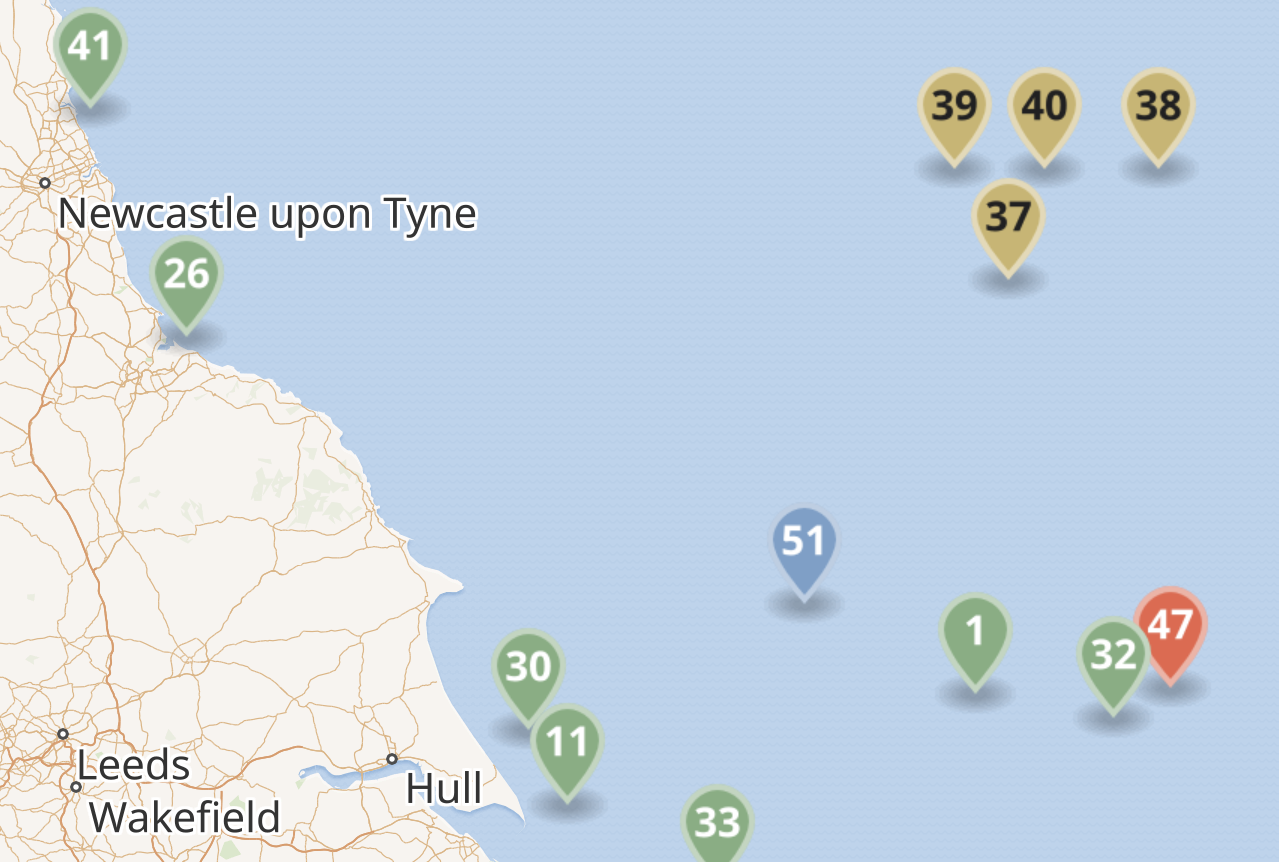
These are the Dogger Bank and Hornsea wind farms and their developers and size
- 37 – Dogger Bank A – SSE Renewables/Equinor – 1,235 MW
- 39 – Dogger Bank B – SSE Renewables/Equinor – 1,235 MW
- 38 – Dogger Bank C – SSE Renewables/Equinor – 1,218 MW
- 40 – Sofia – RWE – 1,400 MW
- 1 – Hornsea 1 – Ørsted/Global Infrstructure Partners – 1,218 MW
- 32 – Hornsea 2 – Ørsted/Global Infrstructure Partners – 1,386 MW
- 47 – Hornsea 3 – Ørsted – 2,852 MW
- 51 – Hornsea 4 – Ørsted – 2,400 MW
Note.
- That is a total of 12, 944 MW, which is probably enough electricity to power all of England and a large part of Wales.
- Wikipedia’s List of offshore wind farms in the United Kingdom, also lists a 3,000 MW wind farm, that is being developed by German company ; RWE called Dogger Bank South,
- The Dogger Bank South wind farm is not shown on the map, but would surely be South of wind farms 37 to 40 and East of 51.
- The Dogger Bank South wind farm will raise the total of electricity in the Dogger Bank and Hornsea wind farms to just short of 16 GW.
Connecting 16 GW of new electricity into the grid, carrying it away to where it is needed and backing it up, so that power is provided, when the wind doesn’t blow, will not be a nightmare, it will be impossible.
An alternative plan is needed!
AquaVentus To The Rescue!
AquaVentus is a German plan to bring 10 GW of green hydrogen to the German mainland from the North Sea, so they can decarbonise German industry and retire their coal-fired power stations.
- I introduce AquaVentus in AquaVentus, which I suggest you read.
- AquaVentus is being developed by RWE.
- AquaVentus connects to a German hydrogen network called H2ercules to actually distribute the hydrogen.
This video shows the structure of AquaVentus.
I clipped this map from the video.

Note.
- The thick white line running North-West/South-East is the spine of AquaVentus, that will deliver hydrogen to Germany.
- There is a link to Esbjerg in Denmark, that is marked DK.
- There appears to be an undeveloped link to Norway, which goes North,
- There appears to be an undeveloped link to Peterhead in Scotland, that is marked UK.
- There appears to be a link to just North of the Humber in England, that is marked UK.
- Just North of the Humber are the two massive gas storage sites of Aldbrough owned by SSE and Brough owned by Centrica.
- Aldbrough and Rough gas storage sites are being converted into two of the largest hydrogen storage sites in the world!
- There appear to be small ships sailing up and down the East Coast of the UK. Are these small coastal tankers, that are distributing the hydrogen to where it is needed?
When it is completed, AquaVentus will be a very comprehensive hydrogen network.
I believe that offshore electrolysers could be built in the area of the Hornsea 4 and Dogger Bank South wind farms and the hydrogen generated would be taken by AquaVentus to either Germany or the UK.
- Both countries get the hydrogen they need.
- Excess hydrogen would be stored in Aldbrough and Rough.
- British Steel gets decarbonised.
- A 1.8 GW hydrogen-fired powerstation at Keadby gets the hydrogen it needs to backup the wind farms.
Germany and the UK get security in the supply of hydrogen.
These may be my best guesses, but they are based on published plans.
Reform UK leader Richard Tice To Stand In Boston And Skegness
The title of this post, is the same as that of this article on the BBC,
This is the sub-heading.
The leader of Reform UK has announced he is to stand as a candidate in Boston and Skegness at the general election.
Anr this is the first paragraph.
Richard Tice announced his intention to stand in the Lincolnshire constituency on social media on Thursday morning.
This article on The Times is entitled What are Reform UK’s Policies — And How Is The Party Polling?
The article has these two paragraphs on energy, decarbonisation and net-zero.
Energy and net zero is another major area of focus. Tice has referred to net zero as “net stupid” and wants to accelerate the granting of oil and gas licences in the North Sea.
Reform has said all existing carbon emissions targets should be abandoned, due to what it says is an unfair burden being placed on taxpayers and consumers.
I shall do some arithmetic to give a few pointers to the constituency he hopes to win.
The Boston and Skegness constituency is a large green energy hub, where in a few years electricity from various source will be collected for distribution to East Anglia and the South of England.
Currently, in operation, under construction or in planning, are the following sources of green electricity.
- Viking Link is a 1.4 GW interconnector between Bicker Fen in Lincolnshire and Denmark.
- EGL3 is a 2 GW interconnector between Lincolnshire and Peterhead in Scotland.
- EGL4 is a 2 GW interconnector between Lincolnshire and Westfield in Scotland.
- Lincs is a 270 MW wind farm.
- Lynn and Inner Dowsing is a 194 MW wind farm.
- Outer Dowsing is a 1500 MW wind farm.
- Triton Knoll is a 857 MW wind farm.
- Race Bank is a 573 MW wind farm.
Note.
- The three interconnectors can send electricity in both directions.
- The wind farms are in North-South order.
- There would appear to be space in the sea for more wind farms.
- The 950 MW Spalding gas-fired power station is available locally, when the wind is on strike.
- The owners of Spalding power station are rumoured to be putting a large battery alongside the power station.
The totals are as follows.
- 1.4 GW – Interconnector to Denmark
- 4 GW – Interconnector to Scotland
- 3.4 GW – Wind farms
- 1 GW – Gas-fired power station.
These total up to 9.8 GW of power.
Conclusion
Consider.
- It would appear that Richard Tice of Reform UK, has decided to stand in a constancy with one of the highest levels of green energy and energy security in the UK.
- It is also likely to be a constituency, which in the future will benefit from investment and employment, as more wind farms are developed in the North Sea.
It looks to me, that he’s a politician with very little mathematical ability.

