Regenerative Braking On A Dual-Voltage Train
Yesterday, I found this document on the Railway People website, which is entitled Regenerative Braking On The Third Rail DC Network.
Although, the document dates from 2008, it is very informative.
Regenerative Braking On 25 KVAC Trains
The document says this.
For AC stock, incoming power from the National Grid at high voltage is stepped down by a transformer. The AC power is transmitted via OHL to the trains. When the train uses regenerative braking, the motor is used as a generator, so braking the axle and producing electrical energy. The generated power is then smoothed and conditioned by the train control system, stepped up by a transformer and returned to the outside world. Just about 100% of regenerated power is put back into the UK power system.
But I have read somewhere, that you need a 25 KVAC overhead electrification system with more expensive transformers to handle the returned electricity.
Regenerative Braking On 750 VDC Trains
The document says this.
After being imported from the National Grid, the power is stepped down and then AC power is rectified to DC before being transmitted via the 3rd rail. Regenerated Power can not be inverted, so a local load is required. The power has to be used within the railway network. It cannot be exported.
So the electricity, is usually turned into heat, if there is no train nearby.
The Solution That Was Applied
The document then explains what happened.
So, until such time as ATOC started to lobby for a change, regenerative DC braking was going nowhere. But when they did start, they soon got the backing of the DfT and Network Rail. It takes a real combined effort of all organisations to challenge the limiting assumptions.
In parallel, there were rolling stock developments. The point at which all the issues started to drop away was when the Infrastructure Engineers and Bombardier, helped out by some translating consultants (Booz & Company), started to understand that new trains are really quite clever beasts. These trains do understand what voltage the 3rd rail is at, and are able, without the need to use any complicated switch gear – just using software, to decide when to regenerate into the 3rd rail or alternatively, use the rheostatic resistors that are on the train.
Effectively, the trains can sense from the voltage if the extensive third-rail network can accept any more electricity and the train behaves accordingly.
As most of the electric units with regenerative braking at the time were Bombardier Electrostars, it probably wasn’t the most difficult of tasks to update most of the trains.
Some of the Class 455 trains have recently been updated. So these are now probably compatible with the power network. Do the new traction motors and associated systems use regenerative braking?
This document on the Vossloh-Kiepe web site is entitled Vossloh Kiepe enters Production Phase for SWTs Class 455 EMU Re-Tractioning at Eastleigh Depot and describes the updating of the trains. This is said.
The new IGBT Traction System provides a regenerative braking facility that uses the traction motors as generators when the train is braking. The electrical energy generated is fed back into the 750 V third rail DC supply and offsets the electrical demands of other trains on the same network. Tests have shown that the energy consumption can be reduced by between 10 per cent and 30 per cent, depending on conditions. With the increasing cost of energy, regenerative braking will have a massive positive cost impact on the long-term viability of these trains. If the supply is non-receptive to the regenerated power, the generated power is dissipated by the rheostatic brake.
So thirty-five year old British Rail trains now have a modern energy-saving traction system.
Has The Solution Worked On The Third-Rail Network?
The Railway People document goes on to outline how they solved various issues and judging by how little there is about regenerative braking on the third-rail network, I think we can assume it works well.
One Train, Two Systems
If you have a train that has to work on both the 25 KVAC and 750 VDC networks, as Thameslink and Southeastern Highspeed trains do, the trains must be able to handle regenerative braking on both networks.
So is there a better way, than having a separate system for each voltage?
In Do Class 800/801/802 Trains Use Batteries For Regenerative Braking?, I investigated how Hitachi’s new Class 800 trains handle regenerative braking.
A document on Hitachi’s web site provides this schematic of the traction system.

Note BC which is described as battery charger.
The regenerative braking energy from the traction motors could be distributed as follows.
- To provide power for the train’s services through the auxiliary power supply.
- To charge a battery.
- It could be returned to the overhead wires.
Hitachi’s system illustrates how using a battery to handle regenerative braking could be a very efficient way of running a train.
Hitachi’s diagram also includes a generator unit or diesel power-pack, so it could obviously fit a 750 VDC supply in addition to the 25 KVAC system on the Class 800 train.
So we have now have one train, with three power sources all handled by one system.
What Has Happened Since?
As the Hitachi document dates from 2014, I suspect Hitachi have moved on.
Siemens have produced the Class 700 train for Thameslink, which is described in this Siemens data sheet.
Regenerative braking is only mentioned in this sentence.
These new trains raise energy efficiency to new levels. But energy efficiency does not stop at regenerative braking.
This is just a bland marketing statement.
Bombardier are building the first batches of their new Aventra train, with some Class 345 trains in service and Class 710 trains about to enter testing.
Nothing has been said about how the trains handle regenerative braking.
But given that Bombardier have been experimenting with battery power for some time, I wouldn’t be surprised to see batteries involved.
They call their battery technology Primove and it has its own web site.
There is also this data sheet on the Bombardier web site.
Class 387 Trains
There is another train built by Bombardier, that is worth investigating.
The Class 387 train was the last and probably most advanced Electrostar.
- The trains have been built as dual-voltage trains.
- The trains have regenerative braking that works on both electrification types.
- They were built at around the time Bombardier were creating the Class 379 BEMU demonstrator.
- The trains use a sophisticated propulsion converter system called MITRAC, which is also used in their battery trams.
On my visit to Abbey Wood station, that I wrote about in Abbey Wood Station Opens, I got talking to a Gatwick Express driver about trains, planes and stations, as one does.
From what he said, I got the impression that the Class 387/2 trains, as used on Gatwick Express, have batteries and use them to keep the train and passengers comfortable, in case of an electrification failure.
So do these trains use a battery to handle the regenerative braking?
How Big Would Batteries Need To Be On A Train For Regenerative Braking?
I asked this question in a post with the same name in November 2016 and came to this conclusion.
I have a feeling that using batteries to handle regenerative braking on a train could be a very affordable proposition.
As time goes on, with the development of energy storage technology, the concept can only get more affordable.
Bombardier make a Primove battery with a capacity of 50 kWh, which is 180 mega-Joules.
So the braking energy of what mass of train could be stored in one of these batteries?
I got these figures.
- 100 mph – 180.14 tonnes.
- 110 mph – 148.88 tonnes.
What is the mass of a Class 387 train?
This is not available on the Internet but the mass of each car of a similar Class 378 train averages out at 32 tonnes.
Consider these points.
- A Class 387/2 train, has 219 seats, so if we assume each passenger and baggage weighs eighty kilograms, that adds up to 17.5 tonnes.
- As the Class 387 trains have a maximum speed of 100 mph on third-rail electrification, it would appear that a Primove 50 kWh battery could handle the braking energy.
- A Primove 50 battery with its controller weighs 827 Kg. according to the data sheet.
It all looks like using one of Bombardier’s Primove 50 batteries on a Class 387 train to handle the regenerative braking should be possible.
But would Bombardier’s MITRAC be able to use that battery power to drive the train in the most efficient manner? I suspect so!
If the traction layout is as I have outlined, it is not very different to the one published by Hitachi in 2014 on their web site for the Class 800 train.
Conclusion
Hitachi have got their traction layout right, as it can handle any number of power sources.
Class 345 Trains And Regenerative Braking
Bombardier don’t seem to talk much about regenerative braking on Class 345 trains.
In the Wikipedia entry for the train, there is a section called Background And Specifications. This is the first paragraph.
In 2008, the UK government’s rolling stock plan stated a requirement for around 600 carriages for Crossrail, expected to be similar in design to the Thameslink rolling stock, to meet the design improvement requirements of the 2007 ‘Rail Technical Strategy’ (RTS), including in-cab signalling/communication including satellite and ERTMS level 3 technologies, regenerative braking, low cost of operation and high reliability, with low weight and high acceleration.
Perhaps Bombardier aren’t letting on how they achieve efficient braking of the trains.
One thing I proved today, was that the trains have no give away electric fires on the roof, where braking energy is traditionally dissipated.
This bad picture was taken through safety netting at Forest Gate station.
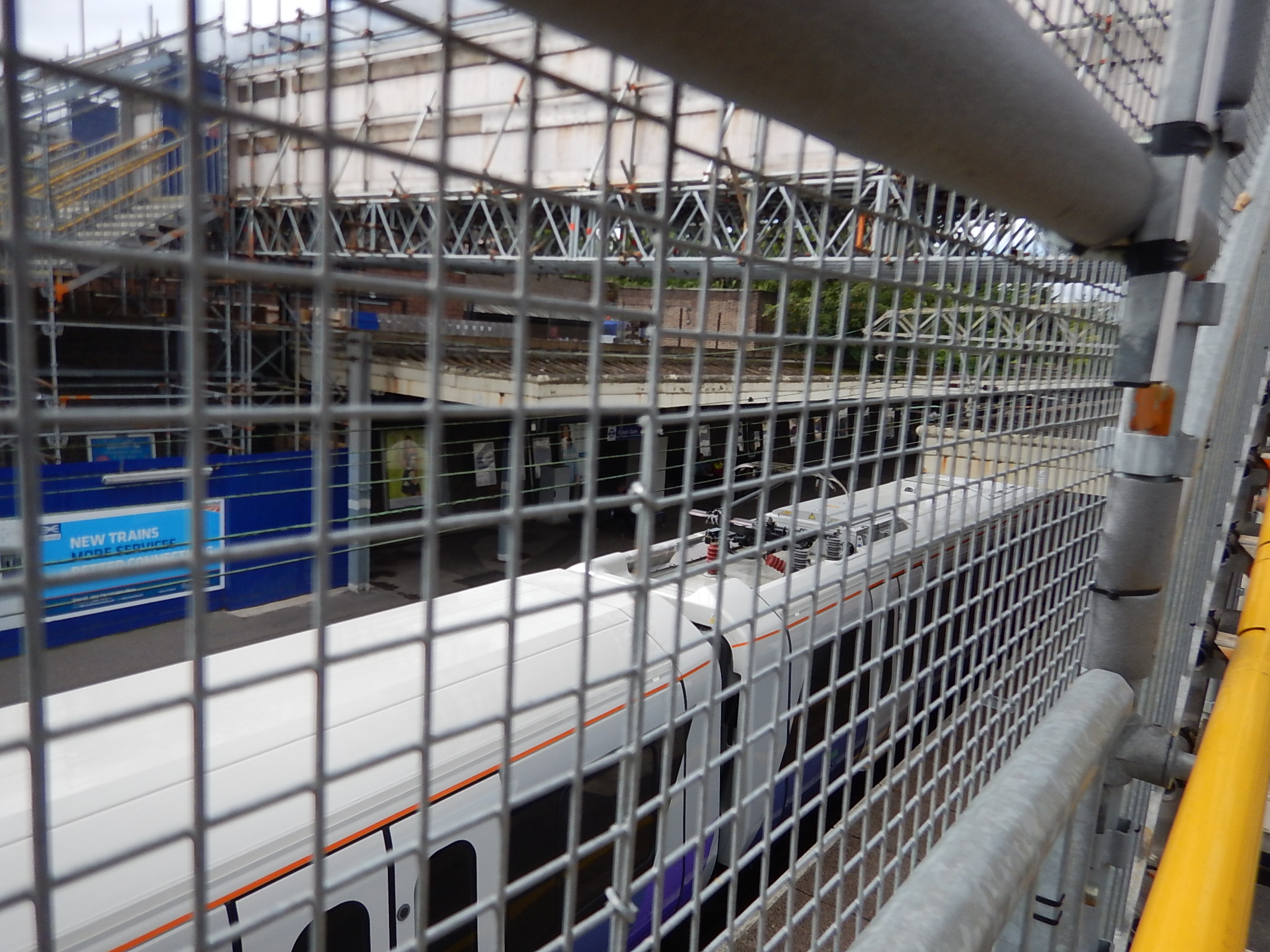
The roof is mainly-smooth with just grills for the air-conditioning and ventilation.
There certainly wasn’t any electric fires on the roof!
So does the braking energy get stored on the train for reuse?
Do Class 800/801/802 Trains Use Batteries For Regenerative Braking?
I ask this question, because I think that it could be key to the announcements about electrification yesterday, as reported in this article in Global Rail News, which is entitled UK Ditches Electrification Plans In Wales, The Midlands And The North.
If you look at all these Wikipedia entries for Hitachi trains being built for the UK.
You will find no reference to regenerative braking.
If you type “Class 800 regenerative braking” into Google, you will find this document on the Hitachi Rail web site, which is entitled Development of Class 800/801 High-speed Rolling Stock for UK Intercity Express Programme.
The only mention of the R-word is in this paragraph.
An RGS-compliant integrated on-train data recorder (OTDR) and juridical recording unit (JRU), and an EN-compliant energy
meter to record energy consumption and regeneration are fitted to the train.
If you search for brake in the document, you find this paragraph.
In addition to the GU, other components installed under the floor of drive cars include the traction converter, fuel tank, fire protection system, and brake system.
Note that GU stands for generator unit.
Traction System
I will start by having a detailed look at the traction system as described in the document.
The document provides this schematic of the traction system.
Note BC which is described as battery charger.
This is said in the text.
The system can select the appropriate power source from either the main transformer or the GUs. Also, the size and weight of the system were minimized by designing the power supply converter to be able to work with both power sources. To ensure that the Class 800 and 801 are able to adapt to future changes in operating practices, they both have the same traction system and the rolling stock can be operated as either class by simply adding or removing GUs. On the Class 800, which is intended to run on both electrified and non-electrified track, each traction system has its own GU. On the other hand, the Class 801 is designed only for electrified lines and has one or two GUs depending on the length of the trainset (one GU for trainsets of five to nine cars, two GUs for trainsets of 10 to 12 cars). These GUs supply emergency traction power and auxiliary power in the event of a power outage on the catenary, and as an auxiliary power supply on non-electrified lines where the Class 801 is in service and pulled by a locomotive. This allows the Class 801 to operate on lines it would otherwise not be able to use and provides a backup in the event of a catenary power outage or other problem on the ground systems as well as non-electrified routes in loco-hauled mode.
This is all very comprehensive.
But nothing is said about how regenerative brake currents from the traction motors are handled.
Any trained Control Engineer, of which I’m a life-expired example, can see all sorts of questions to ask.
- Could it be that all regenerative brake currents are fed into the Auxiliary Power Supply and then used for hotel power and to charge the battery?
- Is the generator unit switched on and off by a sophisticated control system, that uses GPS, train velocity, train weight, battery level etc.?
- Can battery power be used to move the train?
- How big is that mysterious battery?
In 2010, I wrote Edinburgh to Inverness in the Cab of an HST, after taking a memorable trip.
One memory of that trip is of the skill of the driver as he adjusted the twin throttles of the power cars and used the brakes, as the train travelled up hill and down dale.
This line will be Class 800 territory and I suspect that it will be worked by two five car units working as a ten-car train.
As I think that each five-car unit will have three generator units, does this mean that the driver will have six throttles?
Control Engineering has moved on in the forty years since the InterCity 125 entered service and I suspect that like an Airline Pilot, the driver of a Class 800 train, will have little control about how power is delivered. Except probably in a supervisory role.
So on routes like the Highland Main Line, the Class 800 will come into its own, using the generator units and stored energy as appropriate.
Obviously, the less the generator unit is used the better, as this minimises noise and vibration, and cuts carbon emissions.
Other features in the train design have been disclosed.
All Class 801 Trains Have At Least One Generator Unit
All Class 801 trains have at least one GU (generator unit), so it can obviously provide hotel power and probably enough power to limp to the next station, in case of overhead line failure.
Third Rail Class 800/801 Trains Are Possible
The layout of the traction system surely makes a third rail or even a dual-voltage version of the trains possible.
After all, their first cousin; the Class 395 train is a dual voltage train.
Locomotive Haulage Is Possible
As I said, the specification is comprehensive.
The document is also forthcoming in other areas.
Train Configuration
This is said.
Trains have a unit configuration of up to 12 cars, including the ability to add or remove standardised intermediate cars and the generator units (GUs)
(generators with diesel engines) needed to operate commercial services on non-electrified lines.
So if say GWR wanted an eleven-car train, it would be possible.
Automatic Coupling And Uncoupling
This is said.
Because the coupling or uncoupling of cars in a trainset occurs during commercial service at an intermediate station, the automatic coupling device is able to perform this operation in less than 2 minutes.
This is definitely in line with Class 395 train performance.
Automatic Train Identification Function
This is said.
To simplify the rearrangement and management of train configurations, functions are provided for identifying the train (Class 800/801), for automatically determining the cars in the trainset and its total length, and for coupling and uncoupling up to 12 cars in
normal and 24 cars in rescue or emergency mode.
I suspect most modern trains can do this.
One Twelve-Car Train Can Rescue Another
See the previous extract.
Flexible Interior Layout
This is said.
The rolling stock is designed to facilitate changes to the interior layout to accommodate changes to services or to the number of cars in the train.
I suspect that was expected.
An Interim Conclusion
In answer to the question, I posed with this post, I suspect that the answer is in the affirmative.
Extra Evidence
I also found this article on the Hitachi Rail web site, which is entitled Hybrid Propulsion with a sub-title of Energy-saving hybrid propulsion system using storage–battery technology.
This is the introductory paragraph.
As a step toward producing environmentally friendly propulsion systems, Hitachi has supplied a hybrid propulsion system that combines an engine generator, motor, and storage batteries. This system provides regenerative braking which has not been previously possible on conventional diesel-powered trains, and enables increased energy savings via regenerated energy.
They list the advantages as.
- 10% improvement of fuel consumption
- 60% reduction of the hazardous substances in engine exhaust
- 30db reduction of noise in stopping at the station
They also give various links that are worth reading.
All of these pages seem to have been published in 2013.
Conclusion
I will be very surprised if Class 800/801/802 trains don’t have batteries.
Looking at the schematic of the electrical system, the energy captured will at least be used for hotel power on the train.
Will the Class 385 trains for ScotRail have similar traction system?
Class 710 Trains And Regenerative Braking
The new Class 710 trains for the London Overground, will be a next generation train, which could set new standards of energy efficiency. This is from a Bombardier Press release, that the company released when they received the order from London Overground.
The new trains will have similar features to the existing London Overground fleet (also manufactured by Bombardier), including walk-through carriages, air-conditioning and improved accessibility. These next-generation AVENTRA trains will feature an innovative design with optimised performance, including reduced weight, energy consumption, maintenance costs and high reliability, providing substantial benefits to both TfL and its passengers traveling on key London Overground routes, including the newly acquired West Anglia Inner Metro Service.
Note that there is no mention of regenerative braking, but this is mentioned in relation to the other Aventra trains on order; the Class 345 trains for Crossrail.
The Aventra has a slightly unusual and innovative electrical layout.
This article in Global Rail News from 2011, which is entitled Bombardier’s AVENTRA – A new era in train performance, gives some details of the Aventra’s electrical systems. This is said.
AVENTRA can run on both 25kV AC and 750V DC power – the high-efficiency transformers being another area where a heavier component was chosen because, in the long term, it’s cheaper to run. Pairs of cars will run off a common power bus with a converter on one car powering both. The other car can be fitted with power storage devices such as super-capacitors or Lithium-Iron batteries if required.
This was published six years ago, so I suspect Bombardier have improved the concept.
Could it be that the Class 710 trains consists of a two-car power unit sandwiched between two indentical driving cars.
The train could have a formation defined by something like.
DMSO+PMSO+TSO+DMSO or DTSO+PMSO+MSO+DTSO
The cars are as follows.
- DMSO – Driving Motor Standard Open
- PMSO – Pantograph Motor Standard Open
- DTSO – Driving Trailer Standard Open
- TSO – Trailer Standard Open
I’ve assumed there are a lot of powered axles as there are with the Class 345 train, but an appropriate number of trailer instead of motor cars can be used according to the demands of the route.
Search the Internet for “Class 710 train regenerative braking” and you find nothing official of with provenance.
I don’t believe that the Class 710 trains are not fitted with regenerative braking, as if you want to save energy on an electric train, it is one of the must-have features in the design.
But you need to be able to handle the electrical energy generated under braking.
Normally, the electricity is fed back into the overhead wires or third rail, so that it can be used by another train nearby. This technique is used extensively on the London Underground and third-rail electrification systems. Although, it is used on some 25 KVAC overhead systems like c2c, it means that the braking energy has to be converted to a high voltage to feed the electricity back.
So on the Aventra are Bombardier taking an alternative approach of using onboard energy storage to handle the energy generated by the braking?
Consider.
- Braking energy generated at a station stop, is immediately available to accelerate the train back to line speed.
- The onboard energy storage is designed to work with the traction motors.
- It is irrelevant to the drive system, if power comes from 25 KVAC overhead or 750 VDC third-rail.
- The overhead or third-rail power supply doesn’t need to be able to handle return currents.
- The train probably has enough onboard power to get to the next station at all times, should the power supply fail.
But the biggest factor is the amount of energy needed to be handled.
In How Big Would Batteries Need To Be On A Train For Regenerative Braking?, I calculated that the energy of a fully-loaded Class 710 train travelling at 100 kph is around 15 KwH.
So when a train stops, this energy will be released.
To get a better handle on how much energy is involved let’s look at these specifications for a Nissan Leaf car.
Nissan talks about 24 and 30 kWH versions of the car, So if this is the battery size, then one of Nissan’s batteries could store all the braking energy of a four-car Class 710 train.
This sounds absolutely unbelievable, but you can’t argue with the Laws of Physics. or the performance of modern automotive battery technology.
There are five lines, where the new Class 710 trains will run.
- Gospel Oak to Barking
- Chingford Branch
- Liverpool Street to Cheshunt
- Romford to Upminster
- Watford DC Line
How many of these lines are setup with the capability of accepting the return currents of regenerative braking?
The question is irrelevant if the Class 710 trains handle their own braking energy.
Conclusion
As the energy of a laden Class 710 train going at line speed is around 15 kWh, which is well within the capability of an automotive battery from a quality electric vehicle, I feel very strongly, that the Class 710 trains will handle regenerative braking using onboard energy storage.
How Big Would Batteries Need To Be On A Train For Regenerative Braking?
Let’s assume that we have a Class 710 train, trundling around North East London at up to 120 kph.
To calculate the kinetic energy in the train, which will have to be transferred to the battery, we need the mass of the train and its velocity.
I’ll start with the velocity of the train.
As it approached a station, it will be at whatever is the appropriate line speed, which to make things easy I’ll assume is 100 kph or just under 28 metres per second.
In most cases after stopping and discharging and loading a few passengers, it will probably return to a similar line-speed to go to the following station.
The mass of each car of an Aventra, is found at several places on the Internet, including this entry in Wikipedia which gives it as 30-35 tonnes. So the four-car Class 710 train could have a mass of 130 tonnes. Add 100 passengers at an average of 80 kg. each and this would make the mass 138 tonnes
Applying the standard formula gives a kinetic energy of 53240741 joules or in common-or-garden units 14.8 kilowatt hours. So the energy of an Aventra going at 100 kph could power a one bar electric fire for fifteen hours.
To get a better handle on how much energy is involved let’s look at these specifications for a Nissan Leaf car.
Nissan talks about 24 and 30 kWh versions of the car, So if this is the battery size, then one of Nissan’s batteries could store all the braking energy of a four-car Class 710 train.
Even a fully-loaded Class 345 train would only need a 50kWh battery.
Assuming of course, I’ve got the maths correct.
I have a feeling that using batteries to handle regenerative braking on a train could be a very affordable proposition.
As time goes on, with the development of energy storage technology, the concept can only get more affordable.

