RTRI Tests Fuel Cell Multiple Unit
The title of this post is the same as that of this article on Railway Gazette.
This is the first two paragraphs.
JAPAN: Railway Technical Research Institute has started test running with a prototype multiple-unit which can work as a conventional or battery EMU or using a fuel cell powerpack.
Converted from an older 1·5 kV DC EMU, the test train comprises a 34 tonne motor car and 29 tonne trailer vehicle. Each car is 19 760 mm long and 2 950 mm wide. It is able to operate as a conventional EMU when running under overhead catenary, or as a battery unit off-wire, with or without the fuel cell in use to trickle-charge the batteries.
These are my thoughts.
The Hydrogen Fuel Cells.
The article says this about the hydrogen fuel cells.
Two polymer electrolyte fuel cells are contained in an underfloor module 2 600 mm long, 2 655 mm wide and 720 mm high, which weighs 1·9 tonnes.
The fuel cells are stated to have a rating of 90 kW at 200 to 350 V.
To get a handle on how powerful the hydrogen fuel cells are, these are some characteristics of a British Rail Class 456 train.
- It is a two-car electric multiple unit.
- It weighs 72.5 tonnes.
- It has an operating speed of 75 mph.
- It is a 750 VDC train.
- It has a power output of 373 kW
I wouldn’t think that the two trains are that far apart in performance and capacity.
The Japanese train has a total power output from the fuel cells of 180 kW, but it can also use power from the battery.
I wouldn’t be surprised to find out that the Japanese fuel cell and battery combination was powerful enough to power the British train.
I also think, they would fit underneath a typical British train like the Class 456 train, which has a width of 2800 mm.
The Hydrogen Tanks
The article says this about the hydrogen tanks and the range.
Hydrogen is stored in four high pressure cylinders at 35 MPa, with a capacity of 180 litres, giving a range of 72 km.
The mass of the hydrogen in the tank according to this calculator on the Internet is around 4.3 Kg.
In How Much Energy Can Extracted From a Kilogram Of Hydrogen?, I showed that a typical fuel cell can produce 16 kWh from a kilogram of hydrogen.
So the hydrogen tank can be considered a battery holding 4.3 * 16 = 68.8 kWh.
That doesn’t sound much, so perhaps the capacity figure is for a single tank. In that case the total for the train would be 275.2 kWh, which seems more in line with the battery size of Vivarail’s two-car battery prototype, which has 424 kWh.
Each tank would be something like 2500 mm long and 300 mm in diameter, if they were cylindrical. Double the diameter to 600 mm and the capacity would be over 700 litres.
The Battery
The article says the train has a 540 kW battery, which I think could be a misprint, as it would more likely be 540 kWh.
Performance
The article says this about the performance.
The four 95 kW traction motors provide a maximum acceleration of 0·7 m/s2, and an electric braking rate of 0·86 m/s2
It also says that the range is 72 km.
My observations on the performance and traction system are.
- The traction power of the two-car Japanese train at 380 kW is very similar to the 373 kW of the similar-sized British Class 456 train
- The acceleration rate is very typical of an electric multiple unit.
- Braking is regenerative and used to charge the batteries. As it should!
This leads me to conclude, that this is a train, that could run a short public service, just as the Class 379 BEMU demonstrator did in 2015.
Thoughts About Range
The range is quoted at 72 kilometres (forty five miles.) This figure is unusual in that it is very precise, so perhaps it’s the Japanese way to give an exact figure, whereas we might say around or over seventy kilometres.
Applying my trusty formula of three kWh per vehicle-mile for cruising gives a energy requirement of 270 kWh for the full range, which is close to the four-tank energy capacity of 275.2 kWh.
Comparison With Alstom’s Breeze
Alstom are building a hydsrogen-powered version of a Class 321 train, which they have named Breeze.
Like the Japanese train, this is a effectively two-car train with respect to capacity as large hydrogen tanks to give a thousand kilometre range are installed.
So do the developers of both trains feel that a hydrogen-powered train to replace two- and three-car diesel multiple units is the highest priority?
Conclusion
If nothing else, it seems the Japanese have designed a two-car electric multiple unit, that has the following characteristics.
- Practical size of two-cars.
- Most equipment underneath the train.
- Useful range.
- Acceleration and braking in line with modern units.
- Regenerative braking.
- Ability to work on overhead, battery and hydrogen power.
I am led to the conclusion, that once their research is finished, the Japanese could design a very practical hydrogen-powered train for production in the required numbers.
My First Rides In A Class 755 Train
Today, I had my first rides in a Class 755 train. I use rides, as it was three separate timetabled journeys.
- 12:36 – Norwich to Great Yarmouth
- 13:17 – Great Yarmouth to Norwich
- 14:05 – Norwich to Lowestoft
But it was only one train!
Although, I did see at least one other train in service.
These are my observations.
The Overall Style
These are a few pictures of the outside of the train.
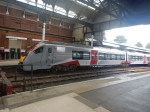
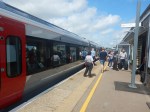
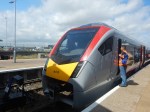
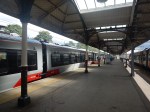
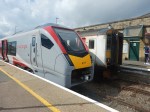
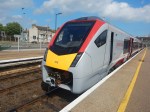
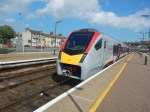
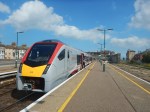
The train certainly looks impressive from the front, but then it has a similar profile to a Bombardier Aventra or a member of Hitachi’s Class 800 family of trains.
The open nose is reminiscent of front-engined Formula One racing cars of the 1950s, with an added sloping front to apply downforce.
I would suspect that the similarity of the trains is driven by good aerodynamic design.
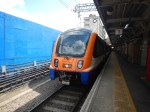
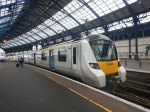
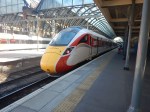

If all the current Formula One cars were painted the same colour, could you tell the apart?
Trains seem to be going the same way. Only Siemens Class 700/707/717 design doesn’t seem to be rounded and smooth.
The PowerPack
The unique feature of these bi-mode trains is the diesel PowerPack in the middle of the train.
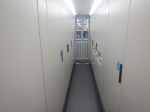
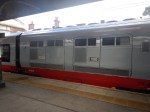
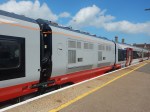
Stadler first used a PowerPack in the GTW, which I described in The Train Station At The Northern End Of The Netherlands.
- GTWs date from 1998.
- Over five hundred GTWs have been built.
- You see GTWs in several countries in Europe.
- GTWs have a maximum speed of between 115 and 140 kph.
The concept of the train with a PowerPack is certainly well-proven.
I have deliberately ridden for perhaps twenty seconds in the corridor through the PowerPack on both trains! Although I didn’t measure it with a sound meter, I’m fairly certain, that the more modern Class 755 train is better insulated against the noise of the engines.
But you would expect that with progress!
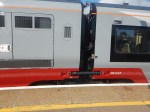
There could be another significant difference between the bi-mode Flirt and the GTW. This picture shows the connection between the PowerPack and the next car.
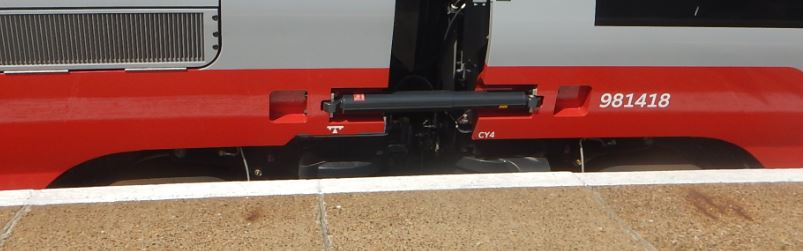
It looks like it could be a damper to improve the performance of the train on curves. It is not visible on this picture of a GTW PowerPack.
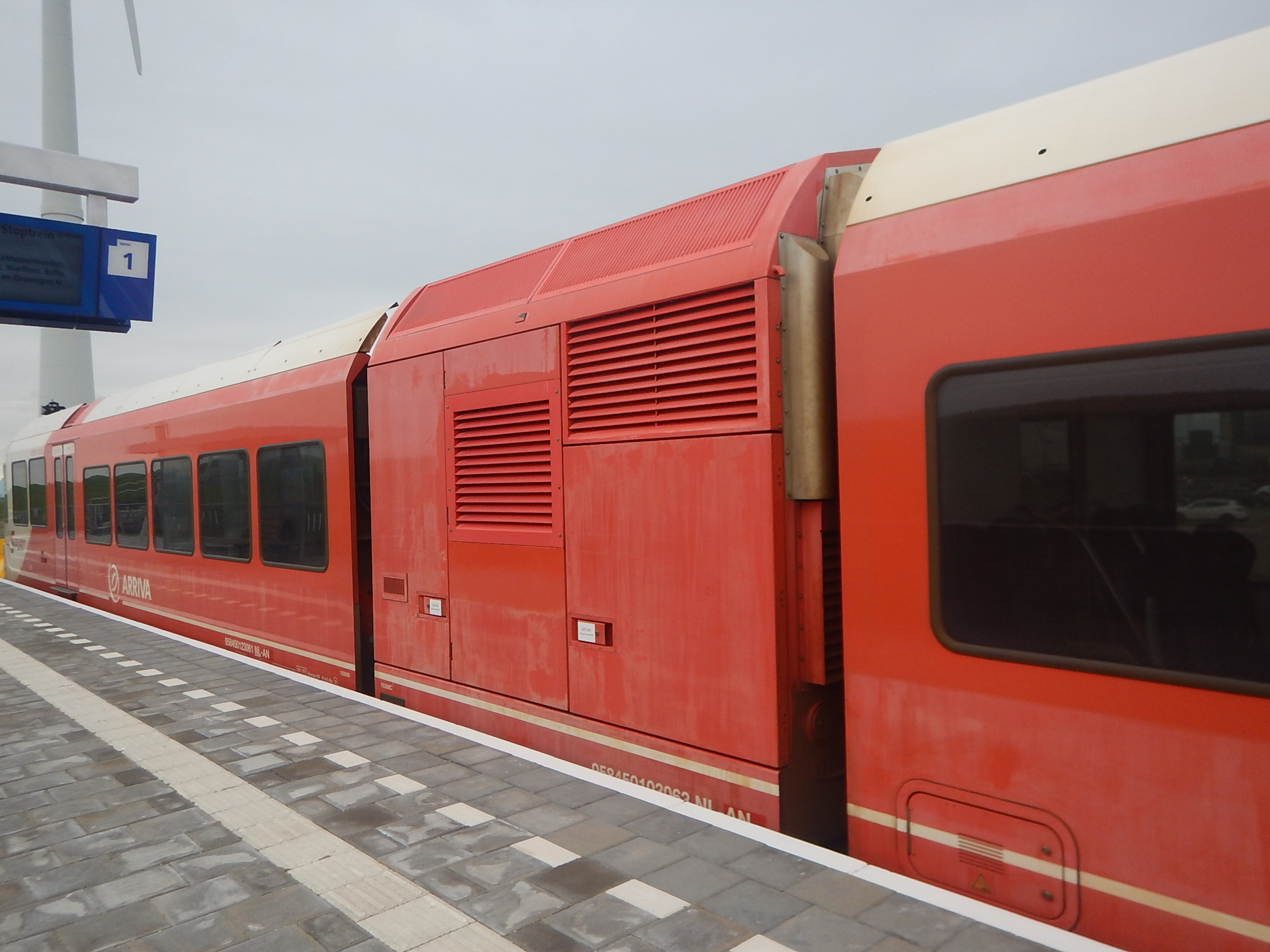
As an engineer, this says to me, that Stadler have taken tremendous care to make the unusual concept of the PowerPack work perfectly.
Train Power On Diesel
Consider.
- This four-car Class 755 train has installed diesel power of 1920 kW.
- At 100 mph, the train will travel a mile in thirty-six seconds.
- In that time, 19.2 kWh would be generated by the engines at full-power.
This means that a maximum power of 4.6 kWh per vehicle mile is available, when running on diesel power.
In How Much Power Is Needed To Run A Train At 125 mph?, I answered the question in the title of the post.
This was my conclusion in that post.
I know this was a rather rough and ready calculation, but I can draw two conclusions.
- Trains running at 125 mph seem to need between three and five kWh per vehicle mile.
- The forty year old InterCity 125 has an efficient energy use, even if the engines are working flat out to maintain full speed.
The only explanation for the latter is that Terry Miller and his team, got the aerodynamics, dynamics and structures of the InterCity 125 almost perfect. And this was all before computer-aided-design became commonplace.
In future for the energy use of a train running at 125 mph, I shall use a figure of three kWh per vehicle mile.
These figures leave me convinced that the design of the Class 755 train can deliver enough power to sustain the train at 125 mph, when running on diesel power
Obviously, as the maximum speed in East Anglia, is only the 100 mph of the Great Eastern Main Line, they won’t be doing these speeds in the service of Greater Anglia.
I also had a quick word with a driver and one of my questions, was could the train design be good for 125 mph? He didn’t say no!
This 125 mph capability could be useful for Greater Anglia’s sister company; Abellio East Midlands Trains, where 125 mph running is possible, on some routes with and without electrification.
With respect to the Greater Anglia application, I wonder how many engines will be used on various routes? Many of the routes without electrification are almost without gradients, so I can see for large sections of the routes, some engines will just be heavy passengers.
I’ve read somewhere, that the train’s computer evens out use between engines, so I suspect, it gives the driver the power he requires, in the most efficient way possible.
Remember that these Greater Anglia Class 755 trains, are the first bi-mode Stadler Flirts to go into service, so the most efficient operating philosophy has probably not been fully developed.
Train Weight
These pictures show the plates on the train giving the details of each car.
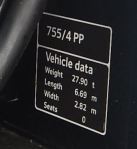
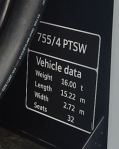
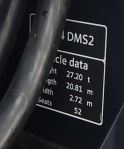
I only photographed one side of the train and I will assume that the other two cars are similar. They won’t be exactly the same, as this intermediate car has a fully-accessible toilet.
The weight of each car is as follows.
- PowerPack – PP – 27.9 tonnes
- Intermediate Car – PTSW – 16.0 tonnes
- Driving Car – DMS2 – 27.2 tonnes
Adding these up gives a train weight of 114.3 tonnes.
Note that the formation of the train is DMS+PTS+PP+PYSW+DMS2, which means that heavier and lighter cars alternate along the train.
Train Length
The previous pictures give the length of each car is as follows.
- PowerPack – PP – 6.69 metres
- Intermediate Car – PTSW – 15.22 metres
- Driving Car – DMS2 – 20.81 metres
Adding these up gives a train length of 78.75 metres.
This is very convenient as it fits within British Rail’s traditional limit for a four-car multiple unit like a Class 319 train.
Train Width
The previous pictures give the width of each car is as follows.
- PowerPack – PP – 2.82 metres
- Intermediate Car – PTSW – 2.72 metres
- Driving Car – DMS2 – 2.72 metres
The PowerPack is wider than the other cars and it is actually wider than the 2.69 metres of the Class 170 train, that the Class 755 train will replace. However, Greater Anglia’s electric Class 321 trains also have a width of 2.82 metres.
It looks to me, that Stadler have designed the PowerPack to the largest size that the UK rail network can accept.
The other cars are narrower by ten centimetres, which is probably a compromise between fitting platforms, aerodynamics and the needs of articulation.
Seats
The previous pictures give the number of seats in each car as follows.
- PowerPack – PP – 0
- Intermediate Car – PTSW – 32
- Driving Car – DMS2 – 52
This gives a total of 168 seats. Wikipedia gives 229.
Perhaps the car without the toilet has more or Wikipedia’s figure includes standees.
Kinetic Energy Of The Train
I will use my standard calculation.
The basic train weight is 114.3 tonnes.
If each of the 229 passengers weighs 90 kg with Baggage, bikes and buggies, this gives a passenger weight of 20.34 tonnes.
This gives a total weight of 134.64 tonnes.
Using Omni’s Kinetic Energy Calculator gives these figures for the Kinetic energy.
- 60 mph – 13.5 kWh
- 100 mph – 37.4 kWh
- 125 mph – 58.4 kWh
If we are talking about the Greater Anglia C;lass 755 train, which will be limited to 100 mph, this leads me to believe, that by replacing one diesel engine with a plug compatible battery of sufficient size, the following is possible.
- On all routes, regenerative braking will be available under both diesel and electric power.
- Some shorter routes could be run on battery power, with charging using existing electrification.
- Depot and other short movements could be performed under battery power.
The South Wales Metro has already ordered tri-mode Flirts, that look like Class 755 trains.
InterCity Quality For Rural Routes
The title of this section is a quote from the Managing Director of Greater Anglia; Jamie Burles about the Class 755 trains in this article on Rail Magazine.
This is the complete paragraph.
Burles said of the Class 755s: “These will be the most reliable regional train in the UK by a country mile – they had better be. They will be InterCity quality for rural routes, and will exceed expectations.”
I shall bear that quote in mind in the next few sections.
Seats And Tables
The seats are better than some I could name.
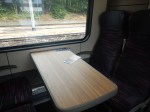
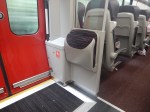
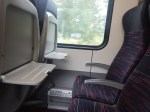
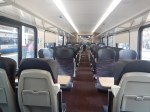
The seats are actually on two levels, as some are over the bogies. However |Stadler seem to managed to keep the floor flat and you step-up into the seats, as you do in some seats on a London New Routemaster bus.
Seat-Back Tables
I particular liked the seat-back tables, which weren’t the usual flimsy plastic, but something a lot more solid.
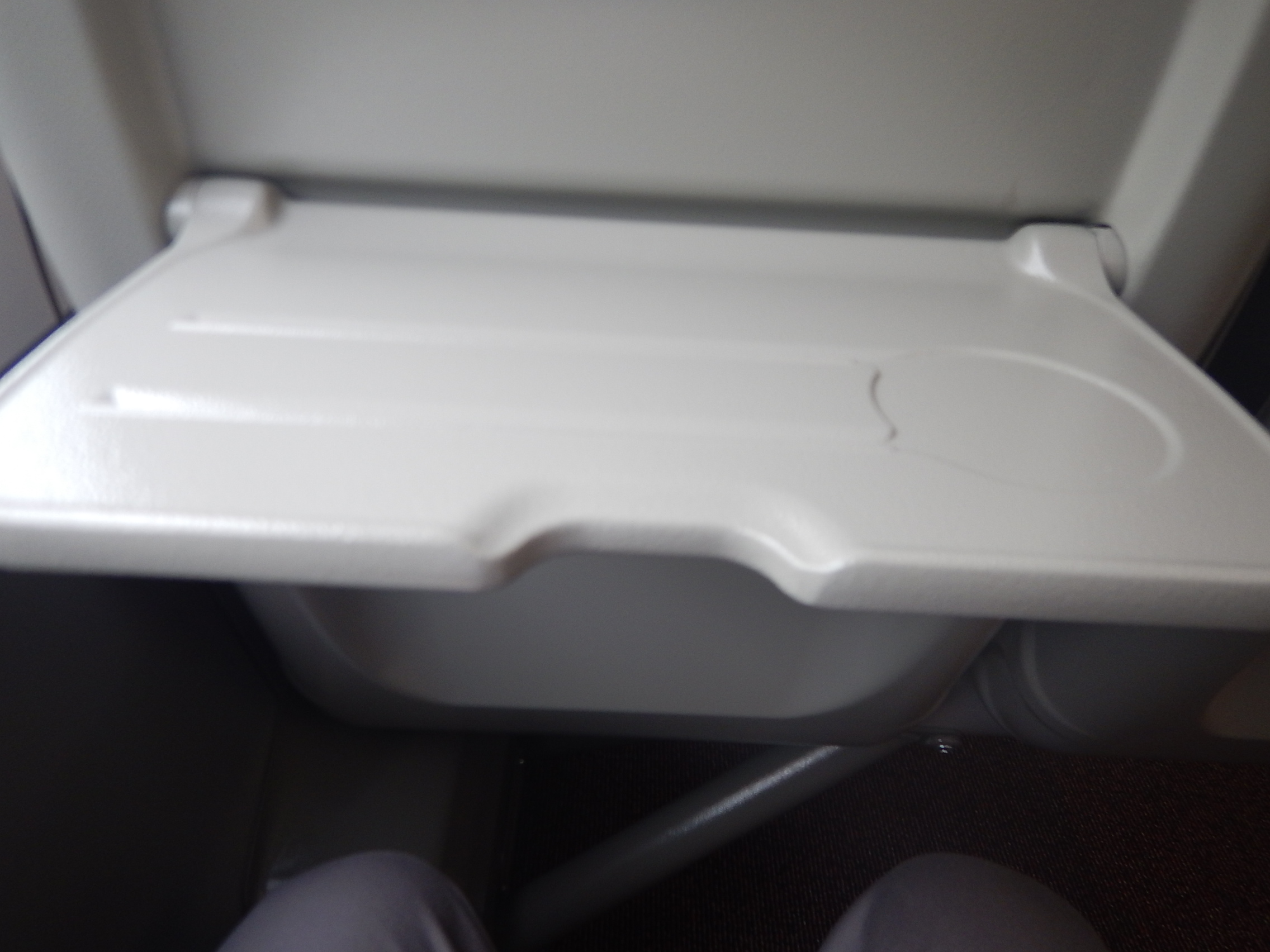
They are possibly made out of aluminium or a high class engineering plastic. You’d certainly be able to put a coffee on them, without getting it dumped in your lap.
It is the sort of quality you might get on an airliner, flown by an airline with a reputation for good customer service.
Step-Free Access
Stadler are the experts, when it comes to getting between the train and the platform, without a step. As I travel around Europe, you see little gap fillers emerge from trains built by Stadler, which have now arrived in East Anglia.
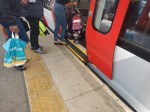
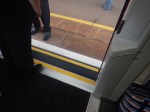
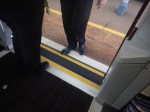

There was a slight problem at Great Yarmouth with a wheelchair, but it was probably something that can be easily sorted.
Some platforms may need to be adjusted.
Big Windows
The train has been designed with large windows, that are generally aligned with the seats.
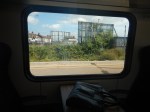
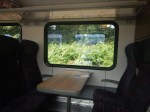
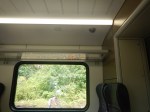
There is no excuse for windows not aligning with most of the seats, as you find on some fleets of trains.
Low Flat Floor
The train has been designed around a low, flat floor.
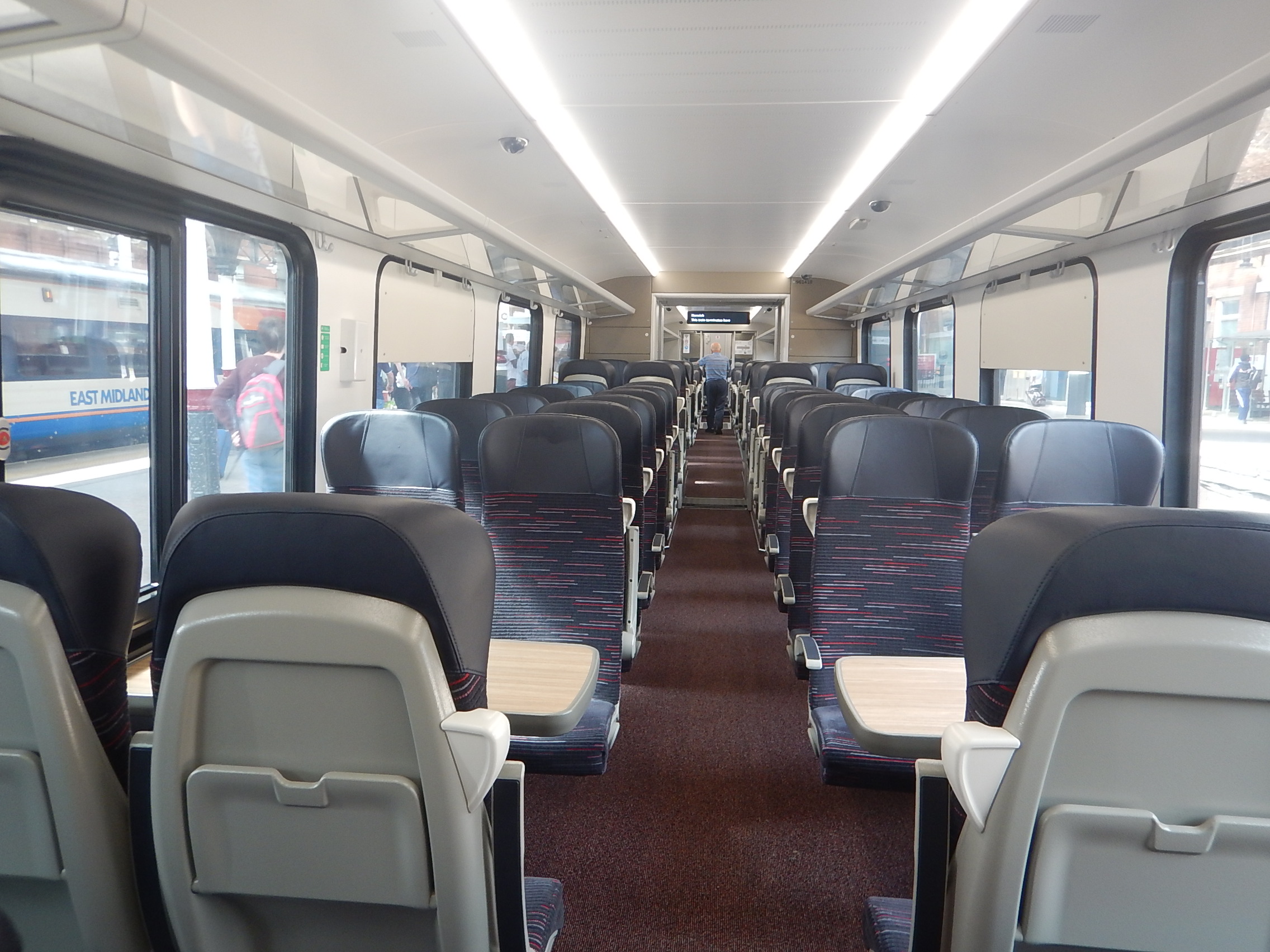
The floor also improves the step-free access and gives more usable height inside the train.
Litter Bins
The train has well-engineered litter bins in between the seats and in the lobbies.
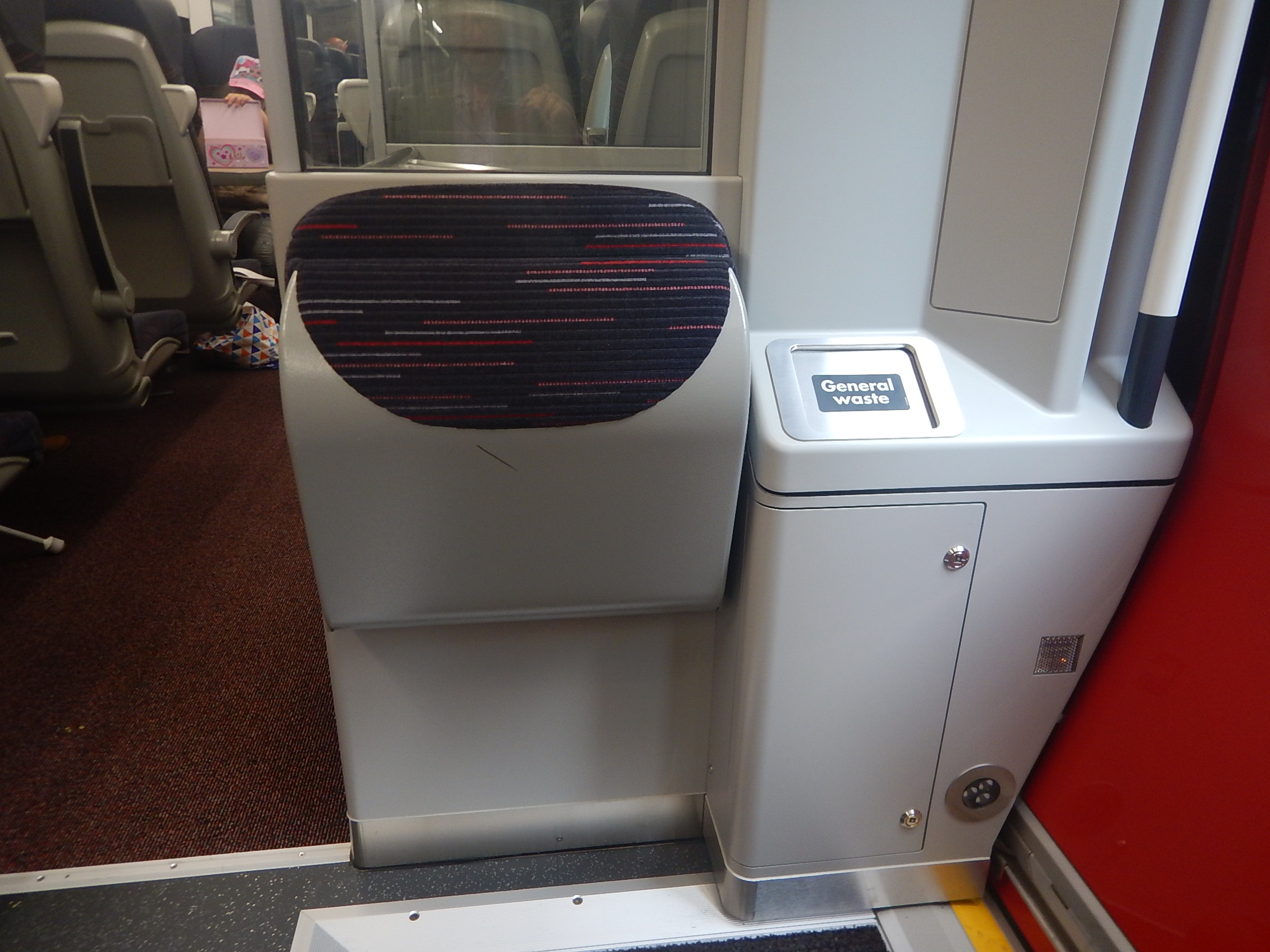
This bin is in the lobby, next to a comfortable tip-up seat.
Too many trains seem to be built without bins these days and the litter just gets thrown on the floor.
Conclusion
It is certainly a better class of rural train and I think it fulfils Jamie Burles’ ambition of InterCity Quality For Rural Routes.
But then services between Cambridge, Ipswich and Norwich are as important to East Anglia, as services between Hull, Leeds and Sheffield are to Yorkshire.
They are all services that can take a substantial part of an hour, so treating passengers well, might lure them out of their cars and off crowded roads.
In My First Ride In A Class 331 Train, I wrote about Northern’s new Class 331 trains.
If I was going to give the Greater Anglia train a score of eight out of ten, I’d give the Class 331 train, no more than two out of ten.
Rock Rail Wins Again!
This article on the Railway Gazette, is entitled Abellio Orders East Midlands Inter-City Fleet.
The order can be summarised as follows.
- The trains will be Hitachi AT-300 trains
- There will be thirty-three bi-mode trains of five cars.
- The trains will be 125 mph capable.
- Unlike the similar Class 802 trains, the trains will have 24 metre long cars, instead of 26 metres.
- They will have a slightly modified nose profile.
- The new trains will have an extra diesel engine.
- The new trains will cost a total of £400 million.
A few of my thoughts.
I shall constantly refer to an earlier post called Vere Promises East Midlands Bi-Modes In 2022.
Cost Of The Trains
In the earlier post, I calculated that the five five-car AT-300 all-electric trains, ordered by First Group for London and Edinburgh services cost four million pounds per car.
Thirty-three trains at this four million pounds per car, works out at £660 million, which is sixty-five percent higher than the price Abellio is quoted as paying.
Abellio are actually paying just £2.42 million per car or forty percent less than First Group.
So are Abellio buying a cut price special?
As Abellio East Midlands Railway will be competing up against LNER’s Azumas on some journeys, I can’t see that running a second class train would be a sound commercial decision.
I am left to the conclusion, that Abellio have got a very good deal from Hitachi.
What Diesel Power Is Used?
In a five-car Class 802 train, there are three MTU 12V 1600 R80L diesel engines, each of 700 kW , which gives a total power of 2,100 kW.
If the Abellio train needs this power, with four diesel engines, each must have 525 kW.
Not sure yet, but this could save a couple of tonnes in weight.
I doubt that Hitachi are dissatisfied with the performance of the MTU diesel engines in the current Class 800, 801 and 802 trains, as there are no media reports of any ongoing problems. So I feel that they could go with the same supplier for the trains for Abellio East Midlands Railway.
If you type “Class 800 regenerative braking” into Google, you will find this document on the Hitachi Rail web site, which is entitled Development of Class 800/801 High-speed Rolling Stock for UK Intercity Express Programme.
The only mention of the R-word is in this paragraph.
An RGS-compliant integrated on-train data recorder (OTDR) and juridical recording unit (JRU), and an EN-compliant energy
meter to record energy consumption and regeneration are fitted to the train.
If you search for brake in the document, you find this paragraph.
In addition to the GU, other components installed under the floor of drive cars include the traction converter, fuel tank, fire protection system, and brake system.
Note that GU stands for generator unit.
The document provides this schematic of the traction system.

Note BC which is described as battery charger.
Braking energy doesn’t appear to be re-used to power the train, but to provide hotel power for the train.
I talk about this in more detail in Do Class 800/801/802 Trains Use Batteries For Regenerative Braking?.
In my view, it is an outdated design compared to some of those seen in the latest road vehicles and trains from other manufacturers.
This is a sentence from the Railway Gazette article.
According to Hitachi, the EMR units will be an ‘evolution’ of the AT300 design supplied to other UK operators, with 24 m long vehicles rather than 26 m, and a slightly modified nose profile.
So does that evolution include regenerative braking to batteries on the train?
This could have advantages.
- improved acceleration and smoother braking
- Less electricity and diesel consumption.
- No running of diesel engines in stations.
I’m only speculating, but could the batteries or supercapacitors be under the car without a diesel engine? A balanced design might make this the middle car of the train
There must also be the possibility, that instead of using MTU diesel engines, the trains use MTU Hybrid PowerPacks.
Why shouldn’t Hitachi get their respected supplier to do as much of the hard work as possible?
Train Length
A five-car Class 222 train, which work the Midland Main Line now, consists of two 23.85 metre and three 22.82 metre cars. So it is 116.16 metres long.
The article says the cars in the new trains will be 24 metres long,, so a new train will be 120.0 metres long or 3.84 metres longer.
This will probably mean that there will be no need for costly and disruptive platform lengthening at a couple of stations.
Capacity
Abellio have stated that passengers like having a table and that they will be offering a catering service
So will we see most seats having a table?
Chiltern have proved it’s a philosophy that works for all stakeholders!
This means that capacity comparisons with the current trains will be difficult, as you’re comparing apples with oranges.
Hopefully, we’ll get more details soon!
Splitting And Joining
I would assume the new trains will have the ability to split and join an route like the other Hitachi trains.
This could be very useful in organising trains in the limited number of paths South of Kettering.
A ten-car train might leave St. Pancras as two five-car units running as a pair. It could split at East Midlands Parkway station and one train could go to Nottingham and the other to Derby. Coming South the two trains would join at East Midlands Parkway.
A Nose Job
I’m intrigued by the phrase “slightly different nose profile” in the extract I quoted earlier.
Have Hitachi’s champion origamists found a way of designing a train which can split and join with both an aerodynamic nose and a corridor connection?
After their experience with the Class 385 train and its curved windows, I suspect Hitachi have learned a lot. Could for instance one end of the five-car train have a Class 800-style nose and the other an improved Class 385-style front end?
Trains would mate blunt-to-blunt, so the Southern train would always point towards London and the Northern train would always point towards Sheffield.
I used to have a friend, who learned origami skills at Hiroshima in the 1950s, whilst doing National Service in the Army.
I don’t think my proposal is impossible, but I’ll admit it’s unusual!
- The blunt end might have a pair of doors, each with a flat window, thus giving the driver an uninterrupted view, when driving from that end.
- When the trains connected the doors would open and swing forward. The gang way would unfold probably from under the cab The driver’s desk would probably fold away, as the two cabs wouldn’t be needed in a ten-car train.
- Connect and disconnect would be totally automatic.
Effectively, two five-car trains would convert into a ten-car train.
The Number Of Trains
In my earlier post, I estimated that Abellio East Midlands Railway would buy 140 bi-mode carriages.
This works out as 35 trains, as against the thirty-three actually ordered.
This is close enough to say, that these new trains are only for main line services and will not be used on the electric services to Corby, which I estimate will be another seven 240 metre-long electric trains
A Complete Fleet Renewal
This is a paragraph from the Railway Gazette article.
Abellio UK Managing Director Dominic Booth said the new trains would ‘form the centrepiece of our ambitious plans for a complete replacement of all the trains on the East Midlands Railway’, representing ‘a more than £600m investment to really improve the region’s railway’.
When Abellio say renewal, they mean renewal.
So will Bombardier or another manufacturer receive a consolation prize of the seven high-capacity 240 metre long electric trains for the St. Pancras and Corby service?
A version of the Abellio part-owned, West Midlands Trains‘s, Class 730 train, would surely do just fine.
The Role Of Rock Rail
The trains will be leased from Rock Rail.
The Rock Rail web site gives this insight.
Rock Rail’s game changing approach to rolling stock funding has:
- Enabled long term institutional investors to invest directly into a new sector.
- Driven better value for government, operators and passengers.
- Extended the market for infrastructure finance.
Rock Rail works closely with the franchise train operators and manufactures to ensure a collaborative approach to design, manufacture and acceptance of the new state of the art trains on time and to budget as well as to manage the long-term residual value and releasing risks.
It’s obviously an approach that has worked, as they have been behind three rolling stock deals at they have funded trains for Moorgate services, Greater Anglia and South Western Railway in recent months.
The Abellio East Midlands Railway makes that a fourth major fleet.
Take a few minutes to explore their web site.
Rock Rail say their backers are institutional investors. So who are these faceless institutions with deep pockets.
I have seen Standard Life Aberdeen mentioned in connection with Rock Rail. This Scottish company has £670 billion of funds under management and it is the second largest such company in Europe.
Companies like these need secure long term investments, that last thirty to forty years, so that pension and insurance funds can be invested safely to perhaps see us through retirement. I know that some of my pension is invested in a product from Standard Life Aberdeen, so perhaps I might ultimately own a couple of threads in a seat cover on a train!
As the Government now insists everybody has a pension, there is more money looking for a safe mattress!
Rock Rail allows this money to be used to purchase new trains.
Rock Rail seem to be bringing together train operators, train manufacturers and money to give train operators, their staff and passengers what they want. I seem to remember that Abellio did a lot of research in East Anglia about the train service that is needed.
Conclusion
Abellio have made a very conservative decision to buy trains from Hitachi, but after my experiences of riding in Class 800, 801 and 802 trains in the last few months, it is a decision, that will satisfy everyone’s needs.
Unless of course, Hitachi make a horrendous mess of the new trains!
But the four fleets, they have introduced into the UK, have only suffered initial teething troubles and don’t seem to have any long term problems.
There are some small design faults, which hopefully will be sorted in the new trains.
- Step-free access between train and platform.
- The carriage of bicycles and other large luggage.
The second will be more difficult to solve as passengers seem to bring more and more with them every year.
Class 710 Train Roofs At Blackhorse Road Station
I took these pictures at Blackhorse Road station.





I couldn’t spot any resistor banks on the roofs, that could be used to burn off excess energy, that is generated by regenerative braking.
Consider.
- The roofs do have a rather clean aerodynamic look.
- I’ve never seen resistor banks placed anywhere other than on the roof of a train.
- Regenerative braking must either return the energy through the electrification or store in in some form of onboard energy storage.
It looks to me, that Bombardier have designed a very efficient train.
Breeze Hydrogen Multiple-Unit Order Expected Soon
The title of this post is the same as that of this article on Railway Gazette.
This is the first paragraph.
Alstom Transport is hopeful of confirming an order before the end of this year for its Breeze hydrogen multiple-unit trains being developed in partnership with leasing company Eversholt Rail, suggesting that the first trains could enter service ‘as early as 2022’.
It then goes out to fill out some of the thinking behind the Alstom Breeze hydrogen-powered train.
The Breeze Is A Stop-Gap
Alstom are quoted as indicating the Breeze is an interim solution, until the next generation of train is available.
But after a ride to Southend recently in a Class 321 Renatus, I’m sure that the ride and passenger acceptance will be of a high standard.
And that’s what counts. Hydrogen is only the train’s personal power supply.
Alstom Are Not Building A Suburban Trundler
The Alstom Coradia iLint is not an exciting train.
- It has a cruising speed of 87 mph.
- It has a range of 370-500 miles.
- It has a noisy mechanical transmission.
- It always runs on hydrogen-power.
- The prototypes have covered 100,000 km.
In my view, it is very much a first generation compromise design.
The article says more about the Alstom Breeze.
- It has a slightly faster cruising speed of 90 mph
- The Breeze will have 50% more power than the iLint. Does this mean better acceleration and/or a longer and heavier train?
- It will have a 1,000 km range.
- It will have regenerative braking to the train’s batteries.
- It will have a new AC traction package, as does a Class 321 Renatus. So will the two systems be the same? Or at least similar?
I am also fairly sure, the train will be able to use electrification of both 25 KVAC overhead and 750 VDC third-rail, as Class 321 trains can now!
Train Capacity
This is said about train capacity.
Despite the loss of some seating space, each set of three 20 m vehicles would provide slightly more capacity than a two-car DMU with 23 m cars which it would typically replace.
The Class 172/0 trains, that are two-car 23 metre diesel multiple units, have 124 seats.
In Hydrogen Trains Ready To Steam Ahead, I estimated that a three-car Alstom Breeze would have a seating capacity of around 140 seats, with the ability to perhaps take an additional 160 standees.
So was my seat estimate fairly good? I also think, that as the Breeze has been designed with bags of grunt, I suspect that the basic train could be increased in size by adding extra trailer cars.
After all, the legendary Class 442 train is a five-car train, with a power-car in the middle. South Western Railway, think they are worth pulling out of the scrapyard and refurbishing to run expresses between Waterloo and Portsmouth.
I am fairly certain, that Alstom can create a five-car Class 321 Breeze with the following characteristics.
- A capacity of about three hundred seats
- A smaller three-car train would have 140 seats.
- A near-100 mph top speed on hydrogen-power.
- A 100 mph top speed on electrification.
- A 1000 km range on hydrogen.
- Regenerative braking to an on-board battery.
- The ability to use 25 KVAC overhead and/or 750 VDC third rail electrification.
The trains could have the ability to run as pairs to increase capacity.
The train would be ideal for the following routes.
- Liverpool and North Wales via Chester
- Norwich and Derby
- Newcastle and Carlisle
- Preston and Carlisle via Barrow
- Cardiff and the South Coast of England
- Borders Railway
- Southampton and Ashford
- Waterloo and Exeter
All of these routes have partial electrification, which would reduce the amount of hydrogen needed to be carried around.
Now that is an interesting multi-variable calculation!
Hydrogen Infrastructure
Alstom seem to be developing infrastructure solutions to supply hydrogen for fleets of ten or more trains, which could be shared with other applications. The obvious one could be where a train depot and a fleet of buses share a facility in say a large city like Exeter, which has an extensive diesel train network.
The article also says this about the source of hydrogen.
Ideally, the trains would use ‘green’ hydrogen manufactured by electrolysis using surplus renewable energy rather than ‘brown’ hydrogen from steam methane reforming.
I agree wholeheartedly with that!
Delivery In 2022?
Consider what has already been achieved in other projects.
- Alstom have proved they can generate enough electricity to power a practical train.
- Eversholt have proved that you can turn Class 321 trains into comfortable and efficient 100 mph Class 321 Renatus trains for routes up to a hundred miles.
- Several classes of Mark 3-based electrical multiple units have been re-engined with AC traction, including the Class 321 Renatus.
- Engineers all over the UK have modified Mark 3-based coaches and multiple units to create better and more-efficient trains.
Helping delivery of the project, is a legacy of drawings and philosophy from British Rail Engineering.
If Alstom say 2022, I believe that that could be a feasible date.
Conclusion
The ghost of British Rail Engineering is certainly a benign one allowing all sorts of worthwhile development paths.
London To Have World-First Hydrogen-Powered Double-Decker Buses
The title of this post, is the same as that of this article in the Guardian.
This is the first three paragraphs.
London will have the world’s first hydrogen-powered doubledecker buses on its streets next year, as the capital steps up attempts to tackle its polluted air.
Transport for London (TfL) has ordered 20 of the buses, which cost around £500,000 each and only emit water as exhaust.
As well as cutting polluting exhaust emissions, the buses will run on green hydrogen produced via North Kent offshore wind farms, according to TfL.
After the announcement of the Alexander Dennis hydrogen buses for Liverpool, that I wrote about in New Facility To Power Liverpool’s Buses With Hydrogen, I wondered how long it would take Wrightbus to respond?
It appears to be less than a month.
This is also said about the buses.
The buses will also feature amenities such as USB charging points, and promise a smoother, quieter ride. They will operate first on three routes in west London and to Wembley, which served over 10 million passenger journeys last year.
I will add these comments.
USB Charging Points
I’ve only ever used USB charging points three times on the move.
- On a Vivarail Class 230 train.
- On a newly-refurbished Scotrail Class 158 train.
- In a LEVC TX electric black cab.
All installations were under a few years old and it is definitely the way passenger transport is going.
London Overground’s new Class 710 trains will be fitted with USB charging points and wi-fi.
Smoother, Quieter Ride
I have ridden in the following electric or hydrogen-powered vehicles
- A battery-electric Vivarail Class 230 train
- A battery-electric Class 379 train
- Several battery-electric and hydrogen-powered buses in London.
- A hydrogen-powered Alstom Coeadia iLint train.
- An LEVCC TX electric black cab.
With the exception of the iLint train, which has a mechanical transmission, all are smooth and quiet.
So I have no reason to disbelieve this claim in The Guardian article.
Three Routes In West London
This article in Air Quality News gives more details on the routes.
The vehicles will be introduced on routes 245, 7 and N7, with people travelling to Wembley Stadium, or from west London to the West End.
- Route 7 runs between East Acton and Oxford Circus.
- Route 245 runs between Alperton Sainsburys and Golders Green station.
Both are operated by Metroline from Perivale East garage, where they appear to be the only routes served from the garage, which has a capacity of forty buses.
This Google Map shows a 3D picture of Perivale East garage.
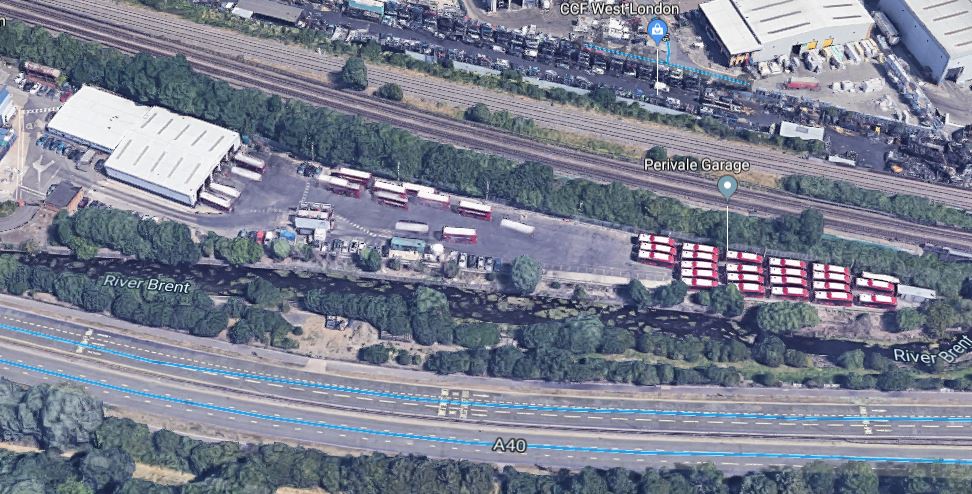
The garage is squeezed into a triangle of land between the Acton-Northolt Line, the Central Line and the six-lane A40 road.
- It’s not near any houses.
- It’s surrounded by trees and industrual units.
- Is the site large enough to generate hydrogen on site?
- Could hydrogen be brought in by rail?
- It could easily hold the twenty hydrogen buses and a few others.
I can certainly see why Transport for London have chosen to use hydrogen buses on routes 7, 245, N7, based at Periavale East garage.
Design
This is a paragraph from the Air Quality News article.
TfL says they are investing £12m in the new buses and the fuelling infrastructure with Northern Ireland firm Wrightbus as the manufacturer, which uses a fuel cell from Ballard to power a Siemens drivetrain.
Wikipedia says this about the transmission of a New Routemaster bus, that was built by Wright.
Hybrid diesel-electric in series; 18 kW] Microvast Lithium Titanate battery,Microvast LpTO, Siemens ELFA2 electric traction motor.
I should point out that it appears that originally, the New Routemaster had a larger 75 kWh battery. Has the technology improved?
Is the transmission and the chassis based on the Wright-designed New Routemaster chassis and transmission, substituting a Ballard fuel cell for the Cummins diesel engine?
The Cummins diesel engine in the New Routemaster is rated at 185 hp or 138 kW.
This page on the Ballard web site is the data sheet of Ballard’s FCveloCity family of fuel cells.
- The fuel cells come in three sizes 60, 85 and 100 kW
- The largest fuel cell would appear to be around 1.2 m x 1 m x 0.5 m and weigh around 400 Kg.
- The fuel cell has an associated cooling subsystem, that can provide heat for the bus.
It strikes me that this fuel cell is smaller and weighs less than a typical diesel engine fitted to a double-decker bus.
With a larger battery, regenerative braking and a clever transmission would a 100 kW fuel-cell provide enough power for the bus?
Wright have obviously solved the problem and found space for the hydrogen tank, otherwise they wouldn’t have received the order.
Drawing on their experience with the New Routemaster and adding the proven fuel cell technology of Ballard looks at first glance to be a low-risk route to a hydrogen-powered bus.
Conclusion
Wright Group and Transport for London appear to have designed a well-thought out solution to the problem of providing zero-emission buses for London and delivering the first buses next year!
We now have two hydrogen double-decker bus projects under way.
- London and Wright Group
- Liverpool and Alexander Dennis
Both appear to be fully-integrated projects, which include the supply of hydrogen to the buses.
When both are proven, there could be very keen competition between the two companies to sell systems all over the UK and the wider world.
It should be noted, that double-decker buses are not that common outside of the UK, Ireland, Hong Kong and Singapore.
But could these two zero-emission projects open up the rest of the world, to these most British of products?
Greater Anglia’s Class 720 Trains
Greater Anglia have ordered a new fleet of Class 720 trains for their suburban routes.
- 22 x 10-car trains.
- 89 x 5-car trains.
What do we know about the formation of Aventra trains?
The Formation Of Class 345 Trains
In A Detailed Layout Drawing For A Class 345 Train, I detailed the formation of a Class 345 train as follows.
DMS+PMS+MS1+MS3+TS(W)+MS3+MS2+PMS+DMS
Several things can be said about the formation.
Lots Of Cars With Motors
The Class 345 train has a high-proportion of cars with motors.
This may seem to be the wrong way to go, as motors cost money and lots of them, may make a more complicated and unreliable train.
But think of a tug-of-war team, which applies the force over a large patch of ground!
Having lots of motors may have advantages.
- Force to move and accelerate the train is applied along the train.
- It may make regenerative braking smoother and more controlled.
- There is a greater contact area with the rail, so it may make train performance better with leaves on the line and other poor rail conditions.
- The redundancy may mean greater reliability.
A clever control system on the train, may be able to distribute power to extract the best performance from a train, for various rail conditions, passenger loading and perhaps with one motor out of action.
Two-Half Trains
The Class 345 train formation clearly shows two half-trains with this formation.
DMS+PMS
Are these like mini-locomotives with seats for passengers at each end of the train?
With respect to a Class 345 train, I have observed the following.
- The trains have two pantographs.
- In a seven-car train, there is just a TS(|W) car in the middle. This is a trailer car with four wheelchair spaces.
- A nine-car train has two extra motor cars inserted.
So are all seven-car and more trains, built as two half-trains with an appropriate number of cars in the middle to get the required length?
The concept surely means that in many scenarios of partial train failure, the remaining half-train can take passengers to a safe evacuation point, dragging the other half-train with it. This is obviously important in Crossrail’s long tunnel.
A Pair Of Power-Cars
In this article in Global Rail News from 2011, which is entitled Bombardier’s AVENTRA – A new era in train performance, gives some details of the Aventra’s electrical systems. This is said.
AVENTRA can run on both 25kV AC and 750V DC power – the high-efficiency transformers being another area where a heavier component was chosen because, in the long term, it’s cheaper to run. Pairs of cars will run off a common power bus with a converter on one car powering both. The other car can be fitted with power storage devices such as super-capacitors or Lithium-ion batteries if required. The intention is that every car will be powered although trailer cars will be available.
Unlike today’s commuter trains, AVENTRA will also shut down fully at night. It will be ‘woken up’ by remote control before the driver arrives for the first shift
This was published over eight years ago, so I suspect Bombardier have refined the concept.
But the concept of splitting the power components between two cars must be a good one, as there is twice the space underneath the cars, compared to a traditional single car with all the power components.
In the Class 345 train, it looks like the pair of cars are the DMS and PMS cars.
- So a nine-car Class 345 train has five cars between the two pairs of power-cars.
- Motored or trailer cars can be added to lengthen the train.
Shorter trains would only have one pair of power-cars and could be as short as three cars.
Greater Anglia’s Train Needs
Ten- and five-car trains may be OK for many of Greater Anglia’s routes, but there could be a few problems.
Hertford East Branch
These pictures show an eight-car Class 317 train at Hertford East station.
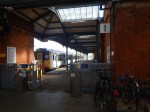
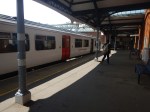
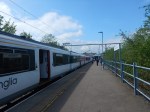
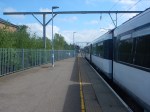
Note how both platforms are not much longer than the 160 metres of a pair of four-car Class 317 trains. Would the capacity of a five-car train be enough for the route?
Braintree Freeport Station
The pictures show Braintree Feeport station, which also seems to be sized to fit an pair of four-car Class 317 or Class 321 trains..
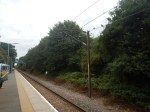
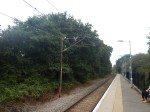
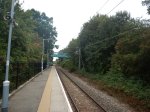
The same questions as with Hertford East station arise!
Wickford Station Bay Platform
This picture shows a Class 321 train parked in the bay platform at Wickford station, that is used for the Crouch Valley Line.
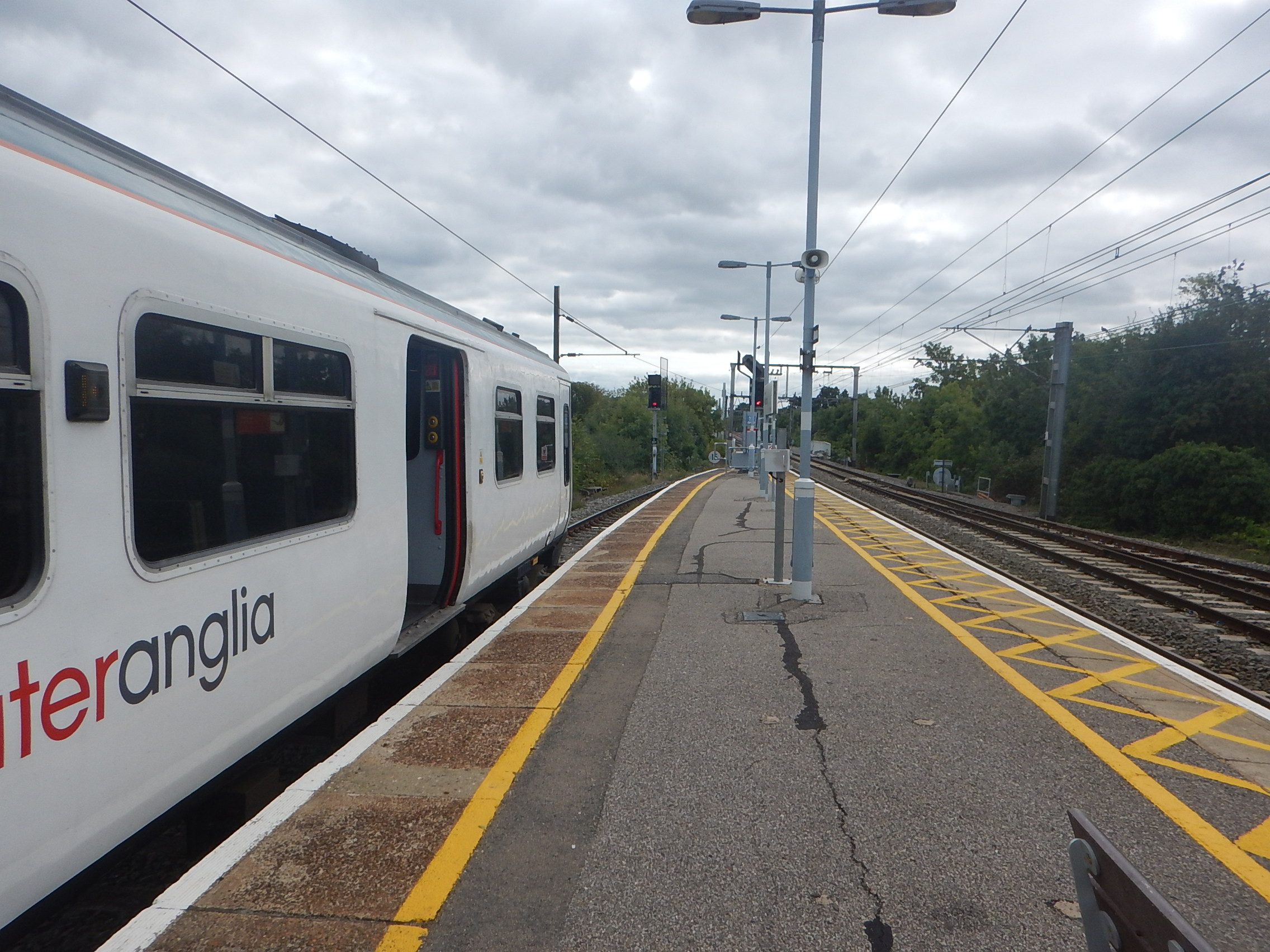
I would estimate that there is perhaps another twenty metres of space in the platform.
As a five-car Class 720 train is 122 metres long, as opposed to the eighty metres of the four-car Class 321 train in the picture, it will be a tight squeeze to get the new train in the platform.
But a four-car Class 720 train would probably fit.
Manningtree Station Bay Platform
Are there similar problems at Manningtree station, that a four-car Class 720 train would solve?
The Length And Capacity Of Different Trains
This table shows the length and capacity of different trains.
- Four-car Class 317 train – 80 metres – Standard – 267/234 – First – 22/24 – Total 289/258
- Eight-car Class 317 train – 160 metres – Standard 534/468 – First -44/48 – Total 578/516
- Four-car Class 321 train – 80 metres – Total 309
- Eight-car Class 321 train -160 metres – Total 618
- Twelve-car Class 321 train -240 metres – Total 927
- Four-car Class 360 train – 80 metres – Total 280
- Eight-car Class 360 train – 160 metres – Total 560
- Twelve-car Class 360 train – 240 metres – Total 840
- Five-car Class 720 train – 122 metres – Total 540 – Standing – 145
- Ten-car Class 720 train – 243 metres – Total 1100 – Standing – 290
Note that two five-car Class 720 trains, working as a ten-car formation have virtually identical length and capacity to a ten-car Class 720 train.
Ten-Car Services
We already know, that the ten-car Class 720 trains have been designed to replace twelve-car formations of Class 321 and Class 360 trains to places like Clacton, Ipswich and Southend.
- They are similar lengths within a few metres.
- The ten-car Class 720 trains give an 19% increase in seats over twelve-car Class 321 trains.
- The ten-car Class 720 trains give an 31% increase in seats over twelve-car Class 360 trains.
An advantage must surely be that with two fewer cars, the trains will need less maintenance.
Five-Car Services
But how does a five-car Class 720 train compare with an eight-car formation of Class 317 or Class 321 trains?
- Seat numbers are similar depending on the layout of the older train.
- Standees will probably have more handholds.
- The walk-through trains allow passengers to circulate around the train to find spare seats.
- The new trains will fit any platform that can be served by an existing eight-car service.
- With their better performance will the Class 720 trains be running faster services?
- There are three cars less to maintain.
I feel that Greater Anglia have done their sums and feel that more train capacity and extra services might be a better way to increase total capacity than run longer trains, which will need expensive platform lengthening.
I’ll take the Braintree Branch services as an example, where extra services could be better than longer trains.
Currently, service is hourly, but a combination of some of the following might allow a doubling of frequency.
- A passing loop.
- Faster modern trains with shorter dwell times.
- An improved timetable.
Two five-car Class 720 trains per hour as opposed to an hourly eight-car Class 321 train, would be around a doubling of capacity.
Four-Car Services
A four-car class 720 train would be ninety-six metres long and probably around 450 seats.
Bombardier and London Overground have shown recently, shortening a Class 378 train is a simple operation.
I think it is reasonable to expect that creating a four-car Class 720 train will be just as easy.
So if Greater Anglia need to run four-car Class 720 trains on certain routes, they can just take a car out of the required number of trains.
First Class
It should be noted that none of the services operated using Class 720 trains will have First Class after this year.
This article on the BBC, which is entitled Greater Anglia: First Class seats scrapped on most trains, gives details and an explanation of Greater Anglia’s thinking.
I have searched the Internet and can’t find any complaints.
But Greater Anglia are only putting themselves in line with c2c, who offer no First Class seats on any service.
Conclusion
I can’t wait to ride these trains, later in the year.
My First Ride In An Alstom Coradia iLint
I’m finally, riding in a hydrogen-powered Alstom Coradia iLint train through the German countryside.

Not as quiet as the two battery trains, I’ve ridden, but that’s because It feels to me that the traction motors are crudely under the passengers and cardan shafts are used to drive the wheels!
Battery electric trains with regenerative braking should be virtually free of any mechanical noise. Both the Class 379 and Class 230 battery demonstrators were almost silent. As electricity generated from hydrogen doesn’t appear to generate much noise, then a hydrogen-powered train can also be almost silent.
From talking to fellow passengers, it would appear that the train has been very reliable in service.
Alstom are proving hydrogen would work well in a train designed for that purpose, but updating a DMU with a mechanical transmission, possibly isn’t the way to go.
Class 321 Breeze Train
I think that the Class 321 Breeze train will be quieter and faster.
It appears too, that if Alstom’s conversion follows the design of the Class 321 Renatus, the train will have a totally flat floor.
Come to think of it, I can’t think of a train running in the UK, that doesn’t have a totally flat floor!
The iLint, like the Lint has several sets of steps.
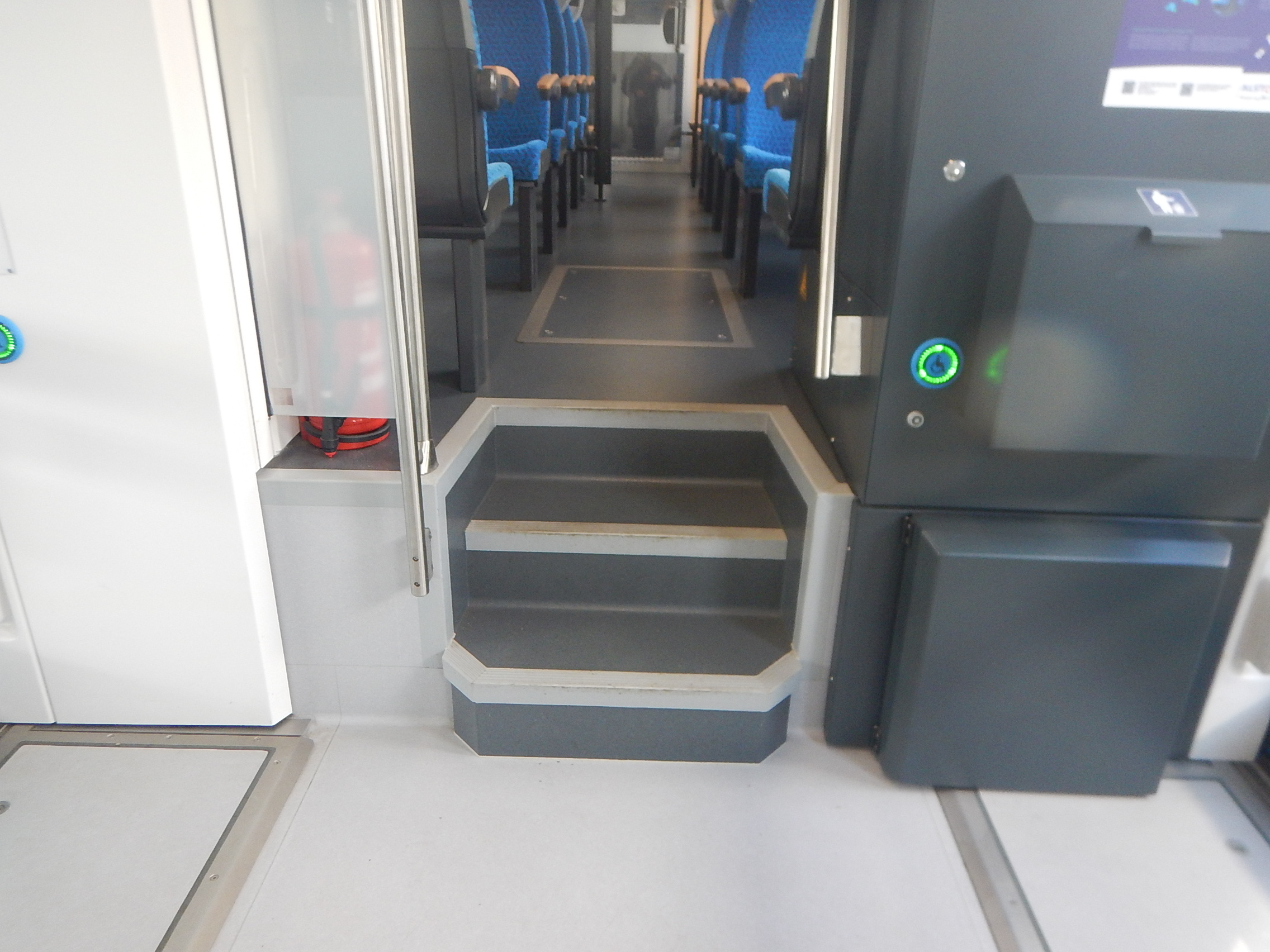
These are not acceptable in a modern train, bus or tram.
Lint 41 And iLint Compared
It is interesting to compare the iLint with the current diesel Lint 41s on the route.
- The iLint is faster and may accelerate better.
- The iLint is based on the bigger Lint 54, so it has more seats and two doors instead of one on each side of the cars.
- The newer iLint appears to have a higher quality interior.
I feel that the iLint will be quicker on a real.route.
The Future Of Buxtehude And Cuxhaven
Currently, to go between Buxtehude and Cuxhaven and back to Buxtehude takes around five hours. So that means the current hourly service needs five trains.
But if the iLint could do a round trip in four hours, the number of trains would be teduced to four.
If to increase capacity, all trains were pairs of iLints, the number of trains required would be eight.
Supposing it was required to double frequency, this would mean sixteen trains would be needed!
And how many trains have been ordered? Sixteen!
Coincidence or good planning?
Publicising The Achievement
When Bombardier created the Class 379 IPEMU, they made certain that there was a lot of local publicity including a report on BBC Look East.
I made a point of asking local residents about the train and no-one had heard of it. Although, I must say that students who regularly used the train, were very much in favour.
This was the only information, I found about the train.
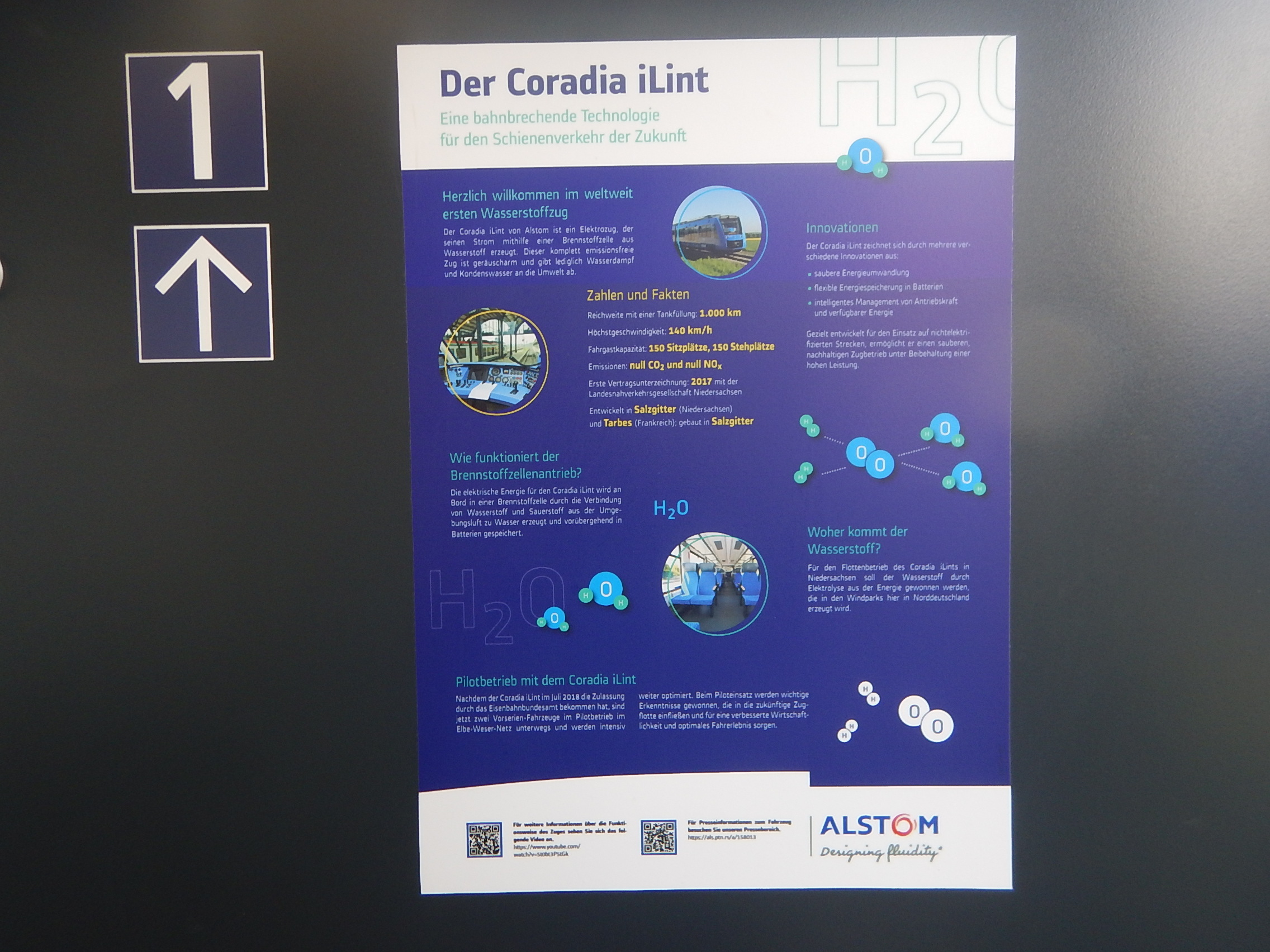
It was only in German, which I can read,. But surely, such an important achievement deserves better publicity and explanation in perhaps German, English and French.
Conclusion
Alstom have proved that hydrogen-power is possible in a smaller train, suitable for regional routes.
My reservations are totally about the Lint, which is an inferior train compared to many others that I’ve ridden in the UK and Europe.
I wouldn’t like to use the train in a wheel-chair!
The next generation of purpose-built trains with hydrogen power will be much better!
Would Electrically-Driven Trains Benefit From Batteries To Handle Regenerative Braking?
There are two basic types of electrically-driven trains.
Electric trains, which include electrical multiple units and trains hauled by electric locomotives like the InterCity 225.
Diesel-electric trains, which include multiple units like Voyagers and the InterCity 125.
Regenerative Braking
In an electrically-driven train, the traction motors can be turned into generators to slow the train, by turning the train’s kinetic energy into electricity.
Many electric trains can do this and the generated electricity is returned through the electrification system, so that it can power other trains nearby.
This all sounds fine and dandy, but there is the disadvantage that all the electrification system must be able to handle the reverse currents, which increases the capital cost of the electrification.
Batteries For Regenerative Braking
Fitting batteries to a train, to handle the electricity that is generated by regenerative braking is an alternative.
A Station Stop
Suppose a four-car train that weighs 200 tonnes is travelling at 125 mph and needs to stop at a station.
My example train would according to Omni’s Kinetic Energy Calculator would have a kinetic energy of 86.7 kWh.
To put that amount of energy into context, the traction battery in a New Routemaster bus is 55 kWh.
So if a battery of this size was put into each car, there is more than enough capacity to store the energy of the train, when it stops at a station.
When the train leaves the station, a proportion of this energy can be used to accelerate the train back to 125 mph.
As regenerative braking is perhaps only eighty percent efficient at present, additional energy will need to be provided.
But even with today’s primitive batteries and less-than-efficient traction motors, there are still substantial energy savings to be achieved.
Hitachi Class 800/801/802 Trains
In Do Class 800/801/802 Trains Use Batteries For Regenerative Braking?, I looked at the question in the title.
I found this document on the Hitachi Rail web site, which is entitled Development of Class 800/801 High-speed Rolling Stock for UK Intercity Express Programme.
It was written in 2013 and I suspect every train designer has read it, as it gives a deep insight into the design of Hitachi’s trains.
The document provides this schematic of the traction system.
Note
- BC which is described as battery charger.
- The battery size is not disclosed.
- The APS supplies the hotel power for the train in two different voltages.
- Can the APS with the battery supply power to the Drive Converter?
After a lot of reasoning, I came to this conclusion.
I will be very surprised if Class 800/801/802 trains don’t have batteries.
Looking at the schematic of the electrical system, the energy captured will at least be used for hotel power on the train.
Hitachi have not said, if the batteries on the Class 800/801/802 trains can be used for traction purposes.
Storing the regenerative energy in a battery can be used for one of two purposes.
Hotel Power
Hitachi’s Class 800 trains certainly use the electricity in the battery to power the hotel functions of the train like air-conditioning, doors, lights, power-sockets, toilets and wi-fi.
In a diesel-electric train, this could give benefits.
- The engines generally won’t need to run in a station to provide hotel power.
- Less fuel will need to be expended to provide hotel power.
- If say the train has to halt perhaps because of a signalling or track fault, hotel power can be provided without running the engines.
- If batteries are supplying the hotel power, the train may have more power for traction.
Overall, the diesel-electric train would be more efficient and would emit less carbon dioxide and pollutants.
Traction Power
There is no engineering reason, why the energy in the battery can’t be used to actually move the train.
But to implement it, could be complicated and expensive on an existing train.
Some Worked Examples
I’ll look at a few examples.
InterCity 125
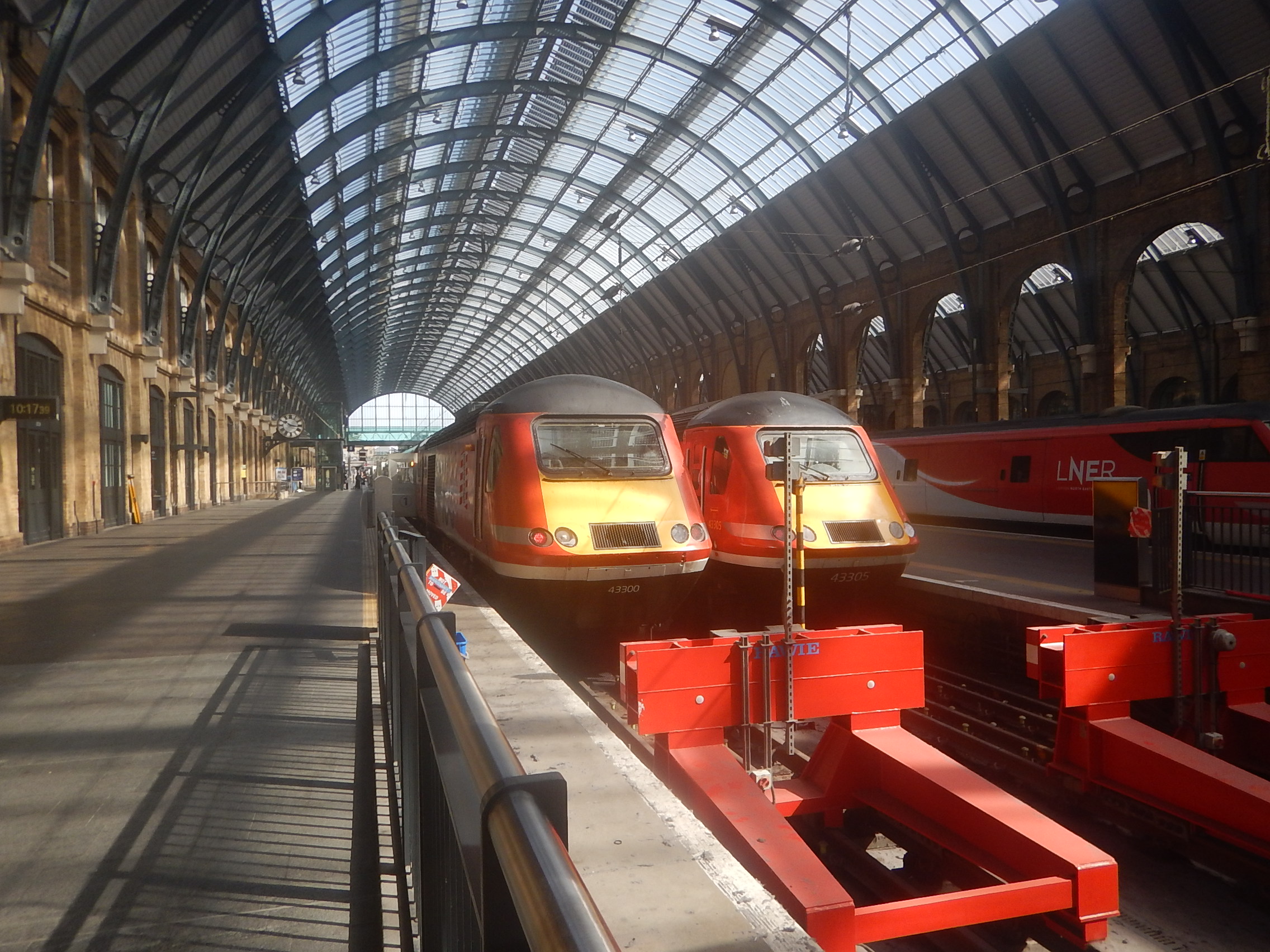
The iconic InterCity 125s are unique, in that they are impossible to scrap. Just as they seem to be approaching the end of their life, a devious engineer or marketing man comes up with a plan to keep them running.
As I write this, Great Western Railway and Abellio ScotRail are testing short-formation InterCity 125s and training drivers for services in the South West of England and Scotland. Both train operating companies appreciate the marketing advantages of Terry Miller‘s world-famous train, that was built as a stop-gap, after the failure of the Advanced Passenger Train.
So what size of battery would need to be fitted to each locomotive to handle the braking energy of a short-formation InterCity 125 with four passenger cars?
Consider.
- Each Class 43 locomotive weighs 70.25 tonnes.
- Each Mark 3 coach weighs 33.60 tonnes.
- An eight car InterCity 125 can carry about 500 passengers.
- I will assume that a four-car InterCity 125 can carry 250 passengers.
- If each passenger weighs 90 Kg with all their bikes, buggies and baggage, that adds up to 22.50 tonnes.
This gives a total train weight of 297.40 tonnes.
Calculating the kinetic energy using Omni’s Kinetic Energy Calculator for various speeds gives.
- 50 mph – 20.6 kWh
- 75 mph – 46.4 kWh
- 90 mph – 66.9 kWh
- 100 mph – 82.5 kWh
A fifty kWh battery in each locomotive would be able to handle the braking energy of the train.
The only problem, is that Class 43 locomotives have DC traction motors, no regenerative braking and air brakes.
But if any operator or rolling stock owner were bonkers enough to fit a new traction system, a diesel/electric/battery Class 43 locomotive is possible for a four-car InterCity 125.
This page on the Hitachi web site is entitled V-TRAIN 2.
Hitachi used a Class 43 power car to prove that diesel/electric/battery trains were feasible, before getting the order for the Class 800 trains.
So fitting batteries to Class 43 locomotives has been done before!
The simplest thing to do would be to use the batteries to provide hotel power for the train.
Class 375 Train
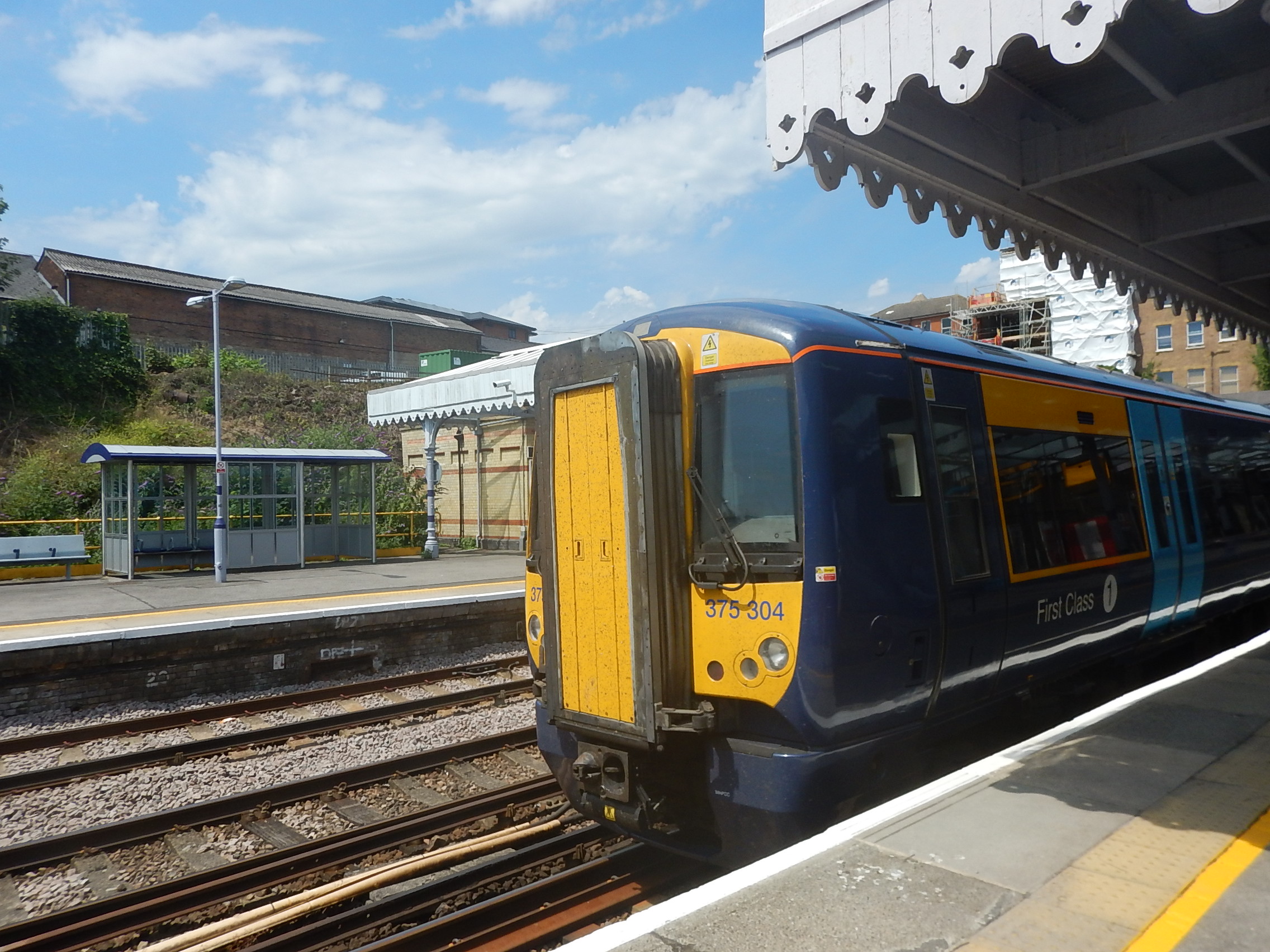
In this exercise, I shall consider a Class 375/6 train, with the following characteristics.
- Four cars
- Three cars are motored.
- Regenerative braking
- A weight of 173.6 tonnes.
- A capacity of 236 seated passengers
- An operating speed of 100 mph.
I will now go through my standard train kinetic energy calculation.
- I will assume three hundred passengers including standees.
- If each passenger weighs 90 Kg with all their bikes, buggies and baggage, that adds up to 27 tonnes.
This gives a total train weight of 200.60 tonnes.
Calculating the kinetic energy using Omni’s Kinetic Energy Calculator for various speeds gives.
- 50 mph – 13.9 kWh
- 80 mph – 35.6 kWh
- 100 mph – 55.7 kWh
It would appear that adding batteries to a Class 375 train would not involve large capacity batteries, especially if one was added to each of the three cars with motors.
As a Control Engineer by training, blending battery and electrification power could run the train more efficiently.
Probably naively on my part, I suspect that using batteries on Class 375 trains to handle regenerative braking, would be one of the easier installations.
Other Electrostars
All Electrostars are fairly similar, so if Class 375 trains could be updated, then I wouldn’t be surprised if all could.
InterCity 225
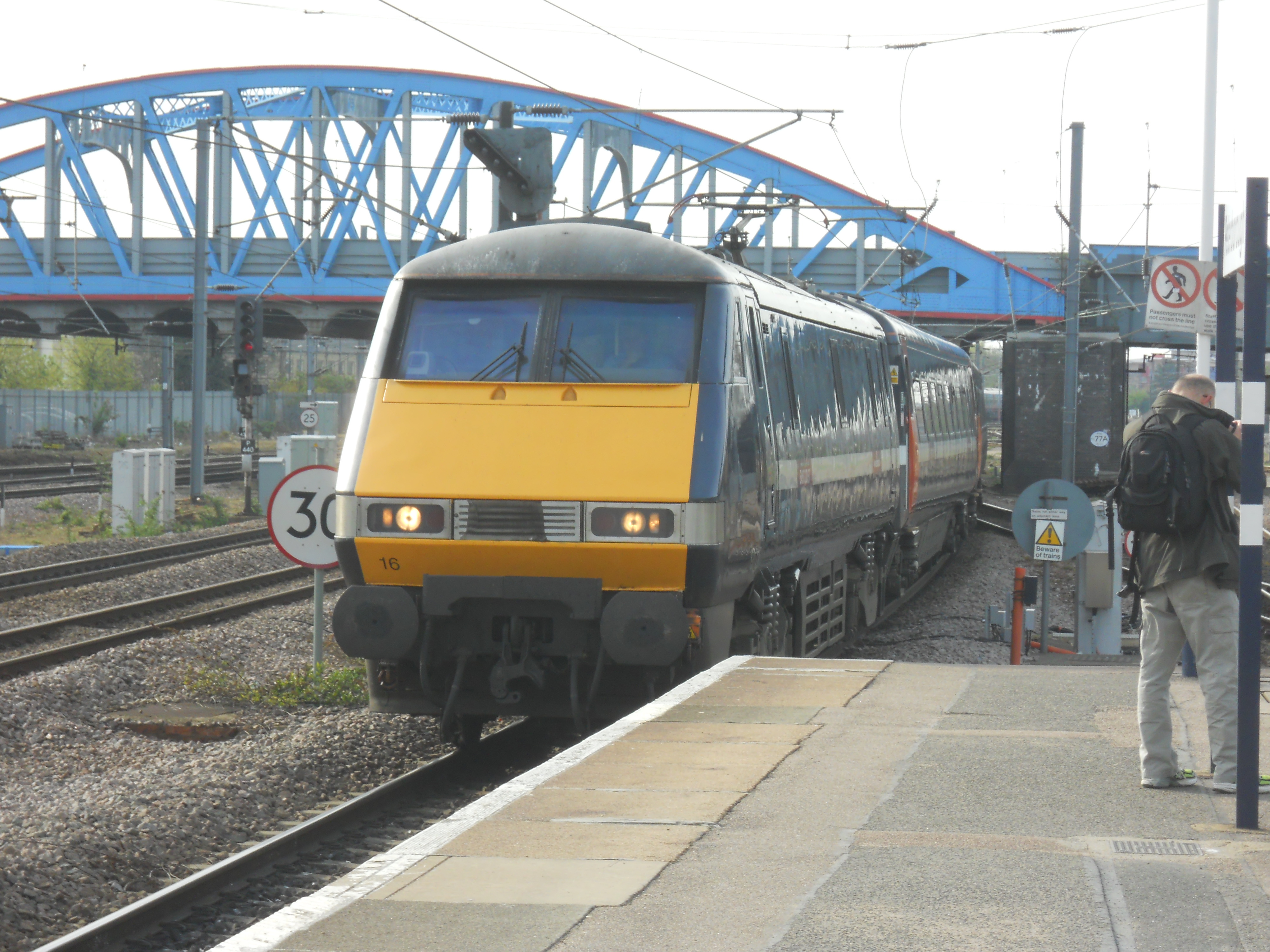
It looks like InterCity 225 trains will be used between London and Blackpool by Alliance Rail Holdings.
Other commentators have suggested that shortened sets run on the Midland Main Line between a diesel locomotive and a Driving Van Trailer (DVT) or two Class 43 locomotives.
I shall do the energy calculation for a five-car InterCity 225.
- A Class 91 locomotive weighs 81.5 tonnes.
- A Mark 4 coach weighs between 40 and 43.5 tonnes.
- A nine-car InterCity 225 seats 535 passengers.
- I will assume that a five-car InterCity 225 will seat around 300 passengers.
- I will assume each passenger weighs 90 Kg. with all their baggage, bikes and buggies.
- A DVT weighs 42.7 tonnes.
For a current nine-car train this gives the following.
- The empty train weight is almost exactly 500 tonnes.
- The passengers weigh 48 tonnes.
- This gives a total weight of 548 tonnes.
At 125 mph, the nine-car InterCity 225 has a kinetic energy of 238 kWh.
For a proposed five-car train this gives the following.
- The empty train weight is almost exactly 333 tonnes.
- The passengers weigh 27 tonnes.
- This gives a total weight of 360 tonnes.
At 125 mph, the five-car InterCity 225 has a kinetic energy of 156 kWh.
Reduce the speed to 110 mph and the kinetic energy drops to 121 kWh.
I suspect that using current technologies, there is not enough space in a Class 91 locomotive for the batteries.
Perhaps a short section of the coach next to the engine could be converted to hold a large enough battery.
Five Mark 4 Coaches And Two Class 43 Locomotives
This has been suggested in Modern Railways by Ian Walmsley and I wrote about it in Midland Mark 4.
Consider.
- A Class 43 locomotive weighs 70.25 tonnes.
- A Mark 4 coach weighs between 40 and 43.5 tonnes.
- A nine-car InterCity 225 seats 535 passengers.
- I will assume that a five-car InterCity 225 will seat around 300 passengers.
This gives the following.
- The empty train weight is 349 tonnes
- The passengers weigh 27 tonnes
- The train weight is 376 tonnes.
At 125 mph this train would have a kinetic energy of 163 kWh.
I’m sure that it would be possible to put a 100 kWh battery in the space behind the engine of a Class 43 locomotive, so I suspect that all the engineering solutions exist to create a train with the following characteristics.
- Two Class 43 locomotives with new traction motors to enable regenerative braking and a 100 kWh battery.
- Five Mark 4 coaches meeting all the regulations.
- The batteries would provide hotel power for the train.
- 125 mph operating speed.
It may be a fantasy, as the economics might not stack up.
Five Mark 4 Coaches, A Driving Van Trailer And A Stadler UKLight Locomotive
I wrote about this combination in Five Mark 4 Coaches, A Driving Van Trailer And A Stadler UKLight Locomotive.
I came to this conclusion.
Using the Mark 4 coaches or new Mark 5A coaches with a new 125 mph diesel/electric/battery hybrid Stadler UKLight locomotive could create an efficient tri-mode train for the UK rail network.
The concept would have lots of worldwide applications in countries that like the UK, are only partially electrified.
The concept or something like it, has possibilities.
Voyagers
In the July 2018 Edition of Modern Railways, there is an article entitled Bi-Mode Aventra Details Revealed.
A lot of the article takes the form of reporting an interview with Des McKeon, who is Bombardier’s Commercial |Director and Global Head of Regional and Intercity.
This is a paragraph.
He also confirmed Bombardier is examining the option of fitting batteries to Voyager DEMUs for use in stations.
The Voyager family of trains has three members.
- Class 220 trains – Voyagers – 34 trains of four cars – operated by CrossCountry.
- Class 221 trains – Super Voyagers – 44 trains of four or five cars – operated by CrossCountry
- Class 222 trains – Meridians – 27 trains of four, five or seven cars – operated by East Midlands Trains.
The trains are diesel-electric and I explore the possibility of using batteries in these trains in Have Bombardier Got A Cunning Plan For Voyagers?.
I felt is was a good plan.
Conclusion
In answer to the question, that I posed in the title of this post, I feel that handling regenerative braking in batteries on the train could be of benefit.
Will The Trains On High Speed Two Have Batteries For Regenerative Braking?
Regenerative braking is being fitted to most modern trains with an electric transmission.
So the proposed trains on High Speed Two will definitely use the technique.
But what will be done with the energy generated, when a train brakes?
It won’t be turned into heat, by passing the electricity through resistors on the train roof. It’s just not efficient!
Could it be returned through the electrification system to power nearby trains?
- I think this is unlikely as you can’t always be sure there is a nearby train.
- It also makes electrification more expensive.
So I’m pretty certain, that if possible, the energy created by braking will be stored on the train in batteries.
Modern high speed trains like Siemens Velaro have lots of powered axles, as this distributes the traction and braking forces along the train.
The AVE Class 103 is a member of the Velaro family and has these characteristics, which are given by Wikipedia.
- Eight cars, of which six are powered.
- Cab car length – 25.7 metres
- Intermediate car length – 24.2 metres
- Service speed – 310 kph
- Capacity – 404 passengers
- Train weight – 425 tonnes
Can this data be used to estimate the energy of a train on High Speed Two?
I will calculate the energy for an individual car.
- I know the cab cars will be heavier, but dividing the train weight by eight should give an estimate.
- So the car weight is 53.125 tonnes.
- Each car will have fifty passengers.
- So assuming each passenger weighs 90 Kg with bags etc, this gives a passenger weight of 4.5 tonnes.
- The line speed is 400 kph.
This gives a kinetic energy for a single car of 98.8 kWh.
A Bombardier Primove 50 kWh battery, which is built to power trams and trains, has the following characteristics.
- A weight of under a tonne.
- Dimensions of under two x one x half metres.
- The height is the smallest dimension, which must help installation under the train floor or on the roof.
I conclude that the train designer won’t have any problems sourcing batteries with sufficient capacity to handle the regenerative braking, that can be fitted into the train.
I would distribute the batteries along the train.

