New Train Service Connects Finland And Sweden For First Time In Decades
The title of this post, is the same as that of this article on the BBC.
This is the sub-heading.
A new passenger train linking Finland and Sweden has begun running, creating the first rail connection between northern Finland and southern Europe in nearly 40 years.
These three paragraphs add more detail.
Shortly after 05:00 local time (03:00 BST) on Monday, a double-decker train set off from the coastal Finnish city of Oulu, rumbling its way across the border to Sweden.
As the inaugural service crossed the Torne river from Finland and pulled into Sweden’s Haparanda station, it was met by crowds of people waving Finnish and Swedish flags.
The route was initially suspended in the late 1980s to the early 1990s, due to low passenger numbers and technical differences in the tracks between Finland and Europe.
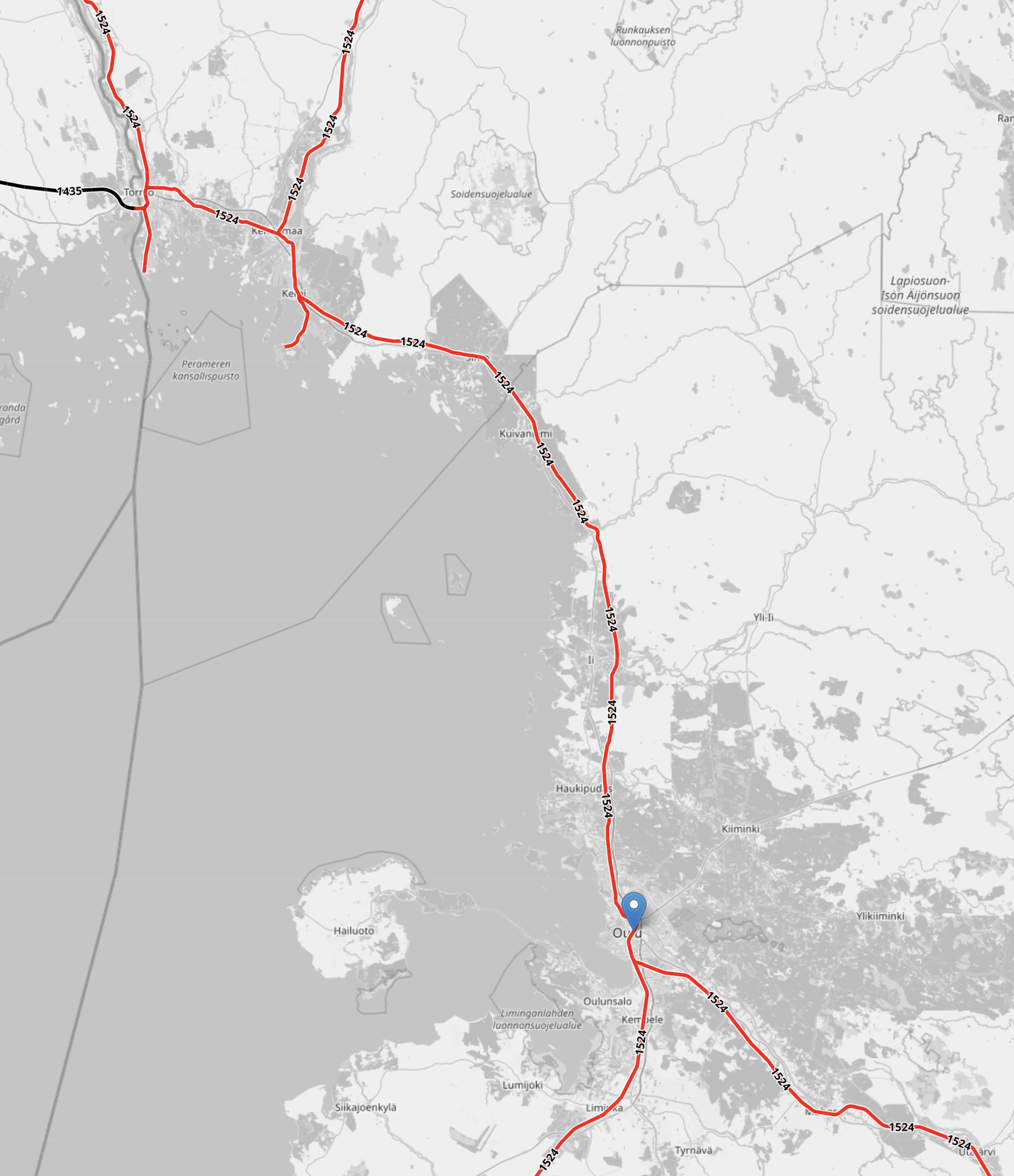
This OpenRailwayMap shows the route between Oulu and Haparanda stations.
Note.
- The map is drawn by track gauge.
- Finnish gauge tracks are shown in red.
- Swedish gauge tracks are shown in black.
- The location of Oulu in Finland is shown by the blue arrow.
- The location of Haparanda in Sweden is at the Eastern end of the black track in the North-Western corner of the map.
- The route seems very much along the coast.
- I wouldn’t be surprised that the sea views are excellent.
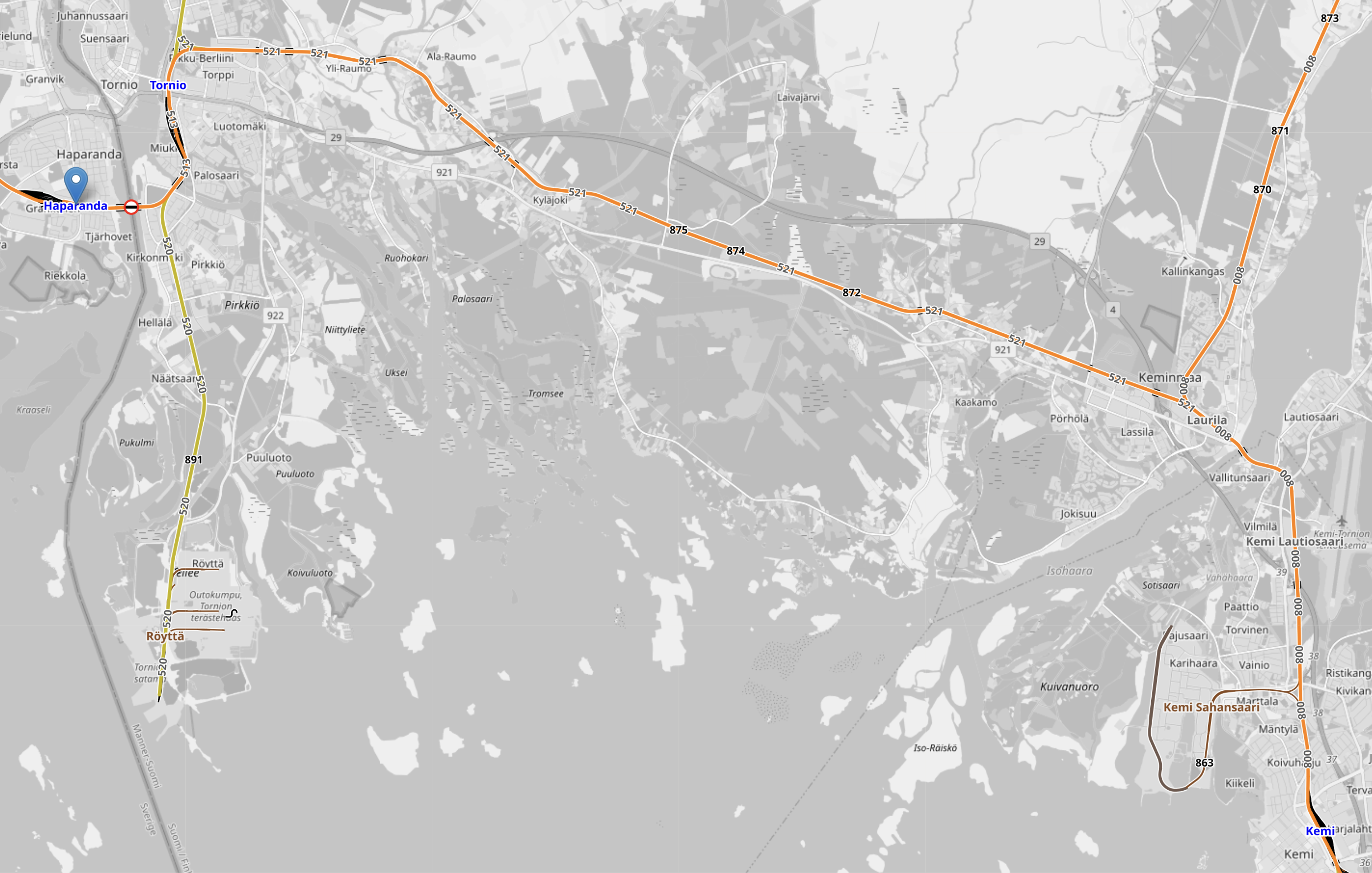
This second OpenRailwayMap shows the route between Kemi and Haparanda stations.
Note
- The location of Haparanda in Sweden is shown by the blue arrow.
- The location of Tornio in Finland is indicated by the blue lettering to the North-East of Haparanda.
- The location of Kemi in Finland is indicated by the blue lettering to the South-East corner of the map.
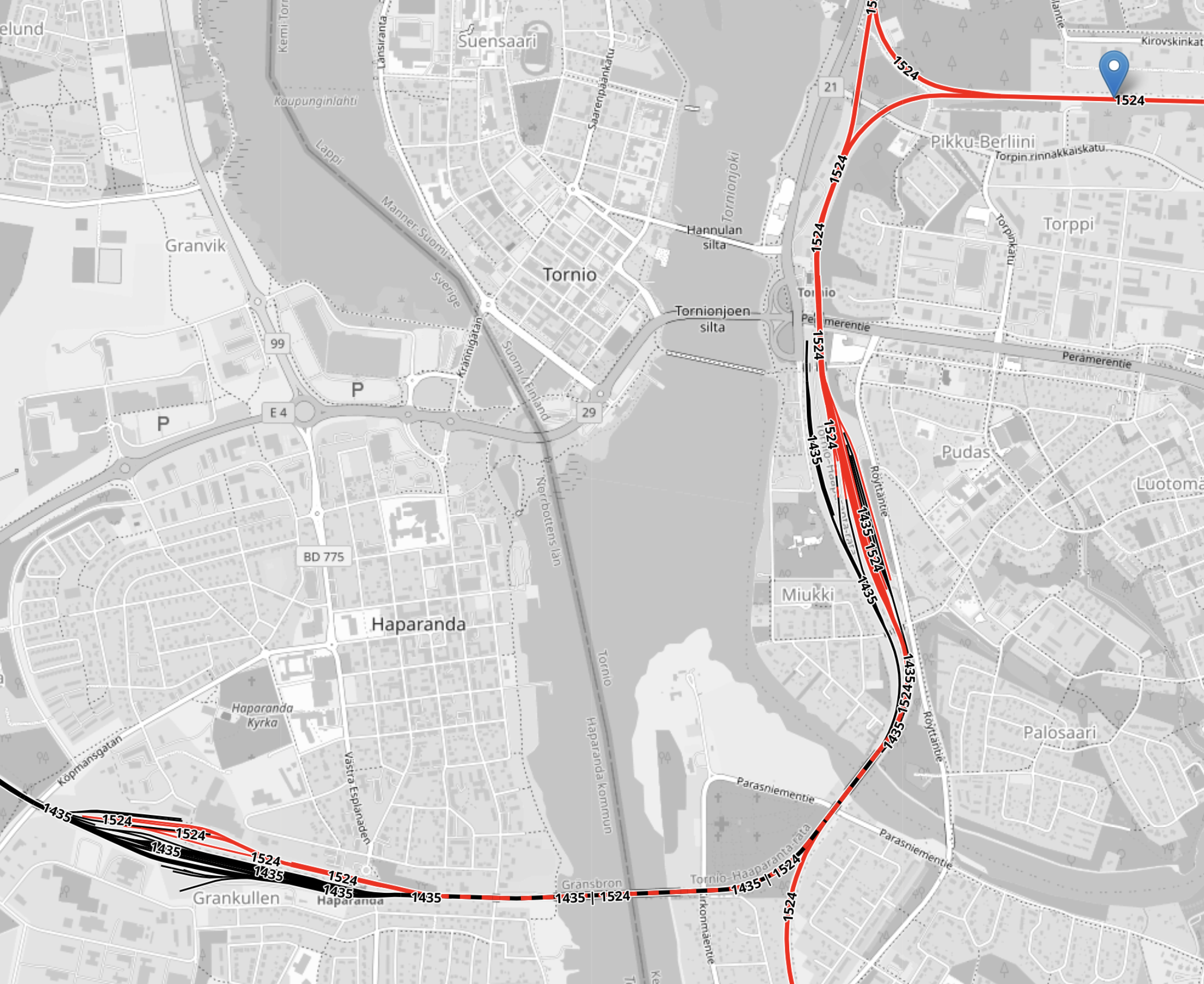
This third OpenRailwayMap shows the route between Tournio and Haparanda stations.
Note.
- The map is drawn by track gauge.
- Finnish gauge tracks are shown in red.
- Swedish gauge tracks are shown in black.
- The track to Oulu in Finland is shown by the blue arrow.
- Tornio station is by the marshalling yard on the Finnish side.
- Haparanda station is by the marshalling yard on the Swedish side.
- The track between Haparanda and Tornio is shown dashed red and black, as it accepts trains of both Finnish and Swedish gauges.
I have some thoughts.
Torne River Railway Bridge
This is is the first paragraph of the Wikipedia entry for the Torne River Railway Bridge.
The Torne River Railway Bridge is a dual gauge railway bridge on the Tornio–Haparanda railway between Haparanda, Sweden and Tornio, Finland; the bridge can be used by the 1524mm gauge trains of Finland, as well the 1435mm gauge trains used in Sweden. A temporary ice river track was built over the Torne River in 1917.
Note
How Do Trains Cross The Torne River Railway Bridge?
I asked Google AI the title of this section and received this answer.
Trains cross the Torne River Railway Bridge on dual-gauge tracks featuring four rails.
This setup accommodates both Finland’s wider 1,524 mm track gauge and Sweden’s standard 1,435 mm track gauge, allowing freight and specialized rail equipment to pass directly between Tornio, Finland, and Haparanda, Sweden, without stopping.
Bridge and Track Design
Dual-Gauge System: Four physical rails are laid on the bridge deck. They interlace the wide-gauge and standard-gauge tracks so different wheel sets fit.
Electrification: The 410-meter truss bridge and connecting line feature overhead catenary wires aligned with Finnish electric standards.
Control and Operations: Train movements across the bridge and its shared dual-gauge sections are managed by Finnish rail traffic control.
Cross-Border Travel
Freight Transport: Freight trains and containerized goods (such as shipments from Outokumpu) use the dual-gauge tracks to move directly between the marshalling yards of both countries.
Passenger Services: While regional passenger train connections operate across the border via the Tornio–Haparanda railway, regular passenger operations involve seamless station transfers at Haparanda rather than continuous through-running for all service types.
It is a simple but ingenious system.
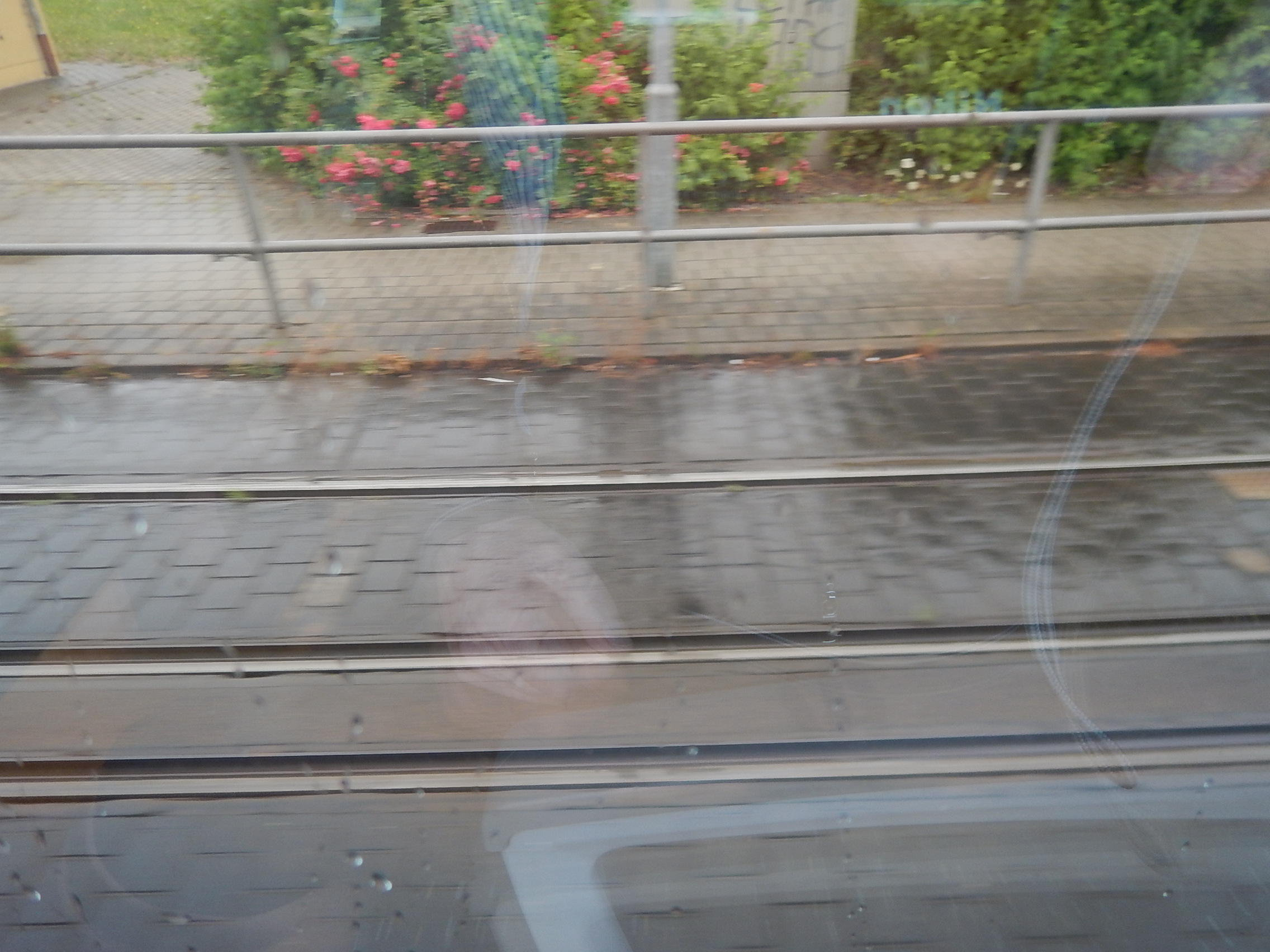
I’ve never seen one anywhere else, although I have ridden on the three rail track at Zwickau.
Note.
- Standard gauge trains use the two outer rails.
- Metre gauge trams use the two far rails, which are a metre apart.
- In the UK, all modern trams are standard gauge, so we don’t have the problem.
But say a narrow-gauge heritage railway wanted to connect into a standard gauge station, I’m sure that the Zwickau system could be used.
Do Other Bridges Use The Same Interleaved Dual Gauge Track As The Torne River Railway Bridge
I asked Google AI the title of this section and received this answer.
Yes, other rail locations use an interleaved dual-gauge track setup (technically known as a gauntletted or four-rail configuration) when two track gauges are too close together to share a common rail.
Why Interleaved Tracks are Used
Gauge Proximity: When the difference between two track widths is small (such as Finland’s 1,524 mm and European standard 1,435 mm, a difference of only 89 mm), a standard three-rail shared setup cannot fit the necessary rail-fastening hardware.
Space Constraints: Interleaving four separate rails inside the same restricted width allows different trains to cross narrow infrastructure like bridges or tunnels without building entirely separate parallel spans.
Examples of Similar Infrastructure
Russia-North Korea Border: The crossing over the Tumen River utilizes multi-gauge configurations to accommodate Russian broad gauge and standard gauge connecting to the port of Rajin.
Historical and Industrial Lines: Short interlaced stretches have been historically deployed on restricted-width civil engineering structures like the Boyne Viaduct in Ireland during structural renewals, or on specific quarry tramways (such as the Ravenglass and Eskdale Railway in the UK) to temporarily interchange standard and narrow gauge wagons.
No comments yet.


Leave a comment