Councillors Urged To Raise No Objection To Hydro Scheme Near Loch Ness
The title of this post, is the same as that of this article on the BBC.
This is the sub-heading.
Highland Council planning officials have recommended councillors raise no objection to a hydro-electric project that would use water from Loch Ness
These initial four paragraphs give more details.
Under the proposals, Glen Earrach Pumped Storage Hydro scheme would use Loch nam Breac Dearga in hills above Drumnadrochit as an upper reservoir and Loch Ness as a lower one.
Glen Earrach Energy said its 2GW project would be one of the UK’s largest and most water efficient energy storage schemes.
Highland Council’s south planning applications committee is due to debate the proposals next week.
The Scottish government has consulted the local authority on the plans.
But has Nessy been consulted?
Seriously though, if you want to learn more the project has a web site.
This paragraph introduces the project.
Glen Earrach Energy is a 2GW, 34GWh pumped storage hydro project located on the Balmacaan Estate above Loch Ness. Using the site’s unique topography and a 480m head height, it will be one of the UK’s largest and most water efficient energy storage schemes.
It then gives these facts.
2GW of installed pumped capacity, 1.8GW of installed electrical generation capacity
34 GWh of clean energy output
10% reduction in the electricity grid’s post-2030 carbon footprint.
Over £2.9 billion in savings to electricity grid running costs
This really is a monster of a project!
Train Staff To Strike Over East West Rail Door Row
The title of this post, is the same as that of this article on the BBC.
This is the sub-heading.
The first trains on a £7bn new railway which will eventually connect Oxford and Cambridge could be further delayed due to industrial action
These three paragraphs add more detail.
The National Union of Rail, Maritime and Transport Workers (RMT), which represents train guards, said on Tuesday that its Chiltern Railways members had agreed to take 24-hour strike action.
It comes following a lengthy dispute over plans for drivers to control the opening and closing of carriage doors on services along the first section of the new East West Rail (EWR) route.
Tony Baxter, the interim managing director of Chiltern Railways, said the firm was “disappointed” by the vote in favour of industrial action.
Surely, it’s about time for Andy Burnham to invite the unions round to No. 10 for beer and sandwiches.
Have Chris O’Shea And Andy Burnham Met?
I feel that this is a sensible question to ask Google AI.
I received this answer.
Yes, Centrica CEO Chris O’Shea and Prime Minister Andy Burnham have met.
They most recently crossed paths at the September 2026 Labour Party Conference in Liverpool.
During the event, Chris O’Shea was part of a slimmed-down delegation of top British business executives who attended a private meeting where Andy Burnham took questions and delivered a frank address regarding the “cost of business” and his future economic strategy.
They have also met previously during Burnham’s tenure as Mayor of Greater Manchester.
For instance, in April 2022, the banking group NatWest arranged a high-level meeting involving both Andy Burnham and Chris O’Shea to discuss green energy initiatives and policy incentives for sustainable housing.
It should also be noted, that Centrica, where Chris O’Shea is Chief Executive, have backed Highview Power’s 50 MW/300 MWh battery at Carrington in Greater Manchester. I wouldn’t be surprised that given the NatWest meetings, that Burnham and O’Shea met at Carrington at some point. In Andy Burnham and Highview Power, I investigated Burnham’s attitude to the Carrington battery and it appears to be positive.
I have just read this interview with Chris O’Shea in the Guardian.
Burnham and O’Shea have a lot of similarities in their lives.
- There is only a four years difference in their ages.
- Both are from Catholic families.
- Both may have had financial troubles in their families as children.
- Both went to good universities.
- Both are keen football supporters.
I can expect that on a lot of important issues, they are in agreement.
Power Lines Disappear From Cornish Beauty Spot
The title of this post, is the same as this news item from National Grid.
This is the sub-heading.
Visitors to a North Cornwall beauty spot will be able to enjoy improved views after overhead power lines were removed by our engineers.
These three paragraphs add more detail.
They took down more than a mile of poles and lines at Hawkers Cove, near Padstow, which have been replaced by underground cables.
The cove is a popular destination known for its coastal scenery and views across the Camel Estuary, and we worked with Cornwall National Landscape, Cornwall Council, local landowners and a tenant farmer to identify which overhead equipment could be removed.
This resulted in more than a dozen poles and 15 spans of high and low voltage conductors covering 1,600 metres being taken down.
It appears that National Grid work in partnership with National Parks and National Landscapes, to identify and prioritise schemes.
I posted this story, as in Burnham’s speech, he said he would be setting up Great British Grid.
Will this mean, if you vote Labour, you’ll get ugly cables removed from around your house, so that it goes up in value?
First Engine Start For First Hydrogen-Powered Locomotive
The title of this post, is the same as that of this article in the Windhoek Observer.
These three paragraphs add more details.
CMB.TECH Namibia’s has said the engine start for Namibia’s first hydrogen-powered locomotive represents an important step in the project’s development.
It is the first hydrogen dual fuel engine to be started in Africa and the first hydrogen dual fuel engine to be started in a locomotive worldwide.
The company revealed that a combined team of eight electrical, mechanical and software engineers, together with the engine commissioning engineer, worked into the night to prepare the locomotive for its first engine start.
These are a few points from the rest of the article.
- During the initial run, the BeHydro engine idled for approximately 30 minutes while the team carried out a series of checks.
- This 2,250-horsepower BeHydro dual fuel engine can operate on both diesel and green hydrogen, with the hydrogen to be produced locally at CMB.TECH Namibia’s facility in Walvis Bay.
- Namibia has a large fleet of idled locomotives that can be repowered with this cost-effective and future proof technology.
I first wrote about the Belgian BeHydro dual fuel engine in Green Tugboats? ‘Revolutionary’ Hydrogen Ship Engine Unveiled In Belgium.
Is History Repeating Itself?
Thirty or forty years ago, I was friendly with a steam locomotive enthusiast called Dick.
- Dick and his mates were helping various African countries, get their steam locomotives running again.
- The Chinese had sold Africa lots of diesel locomotives to replace European steam locomotives, that often dated from before the Second World War.
- But now these Chinese diesels were falling apart.
My friend and his mates were dragging the old steam locomotives out of the sidings and getting them going again.
So with a little help from the Belgians, are the Namibians bringing the ancient Chinese diesel locomotives into the net-zero world of the twenty-first century?
More About The Project
These paragraphs in the Windhoek Observerer describe the project.
- The project is the result of a strategic partnership between three companies firmly rooted in Namibia including TransNamib Holdings Limited, Africa Global Logistics and CMB.TECH Namibia.
- TransNamib is responsible for managing and operating the national rail network and freight services.
- Africa Global Logistics (AGL) is an established logistics operator active in Namibia, playing a key role in freight, transport and logistics operations across the country, with a strong focus on strengthening strategic transport corridors.
- AGL also manages operations at the Walvis Bay Multipurpose Bulk Terminal and operates one of Africa’s largest integrated logistics networks, with a presence in over 50 countries connecting ports, corridors and multimodal supply chains.
- These partners will operate Namibia’s first heavy‑duty freight service running on locally produced green hydrogen.
- Initially, 50 round trips will be covered between the Port of Walvis Bay and the Container Depot near Windhoek during the trial period, with the option to extend operations.
- Green hydrogen for the project will be produced off‑grid at CMB.TECH Namibia’s hydrogen plant in Walvis Bay.
Note.
- It seems very much a Namibian project.
- Namibia has plenty of wind and sun to make the green hydrogen.
- Would they be using an efficient process like HiiROC?
This OpenRailwayMap shows the location of Walvis Bay and Windhoek.

Note.
- Walvis Bay is indicated by the blue arrow.
- Windhoek is East of Walvis Bay, where there is a major railway junction.
- Windhoek and Walvis Bay are about 224 miles apart and a train journey takes between 9 and 11 hours.
It will probably be one of the longest hydrogen-powered rail journeys in the world.
Subsea Micropiles To Invest GBP 5 Million In Expanding Manufacturing, Offshore Ops At Scottish Port
The title of this post, is the same as that of this article on offshoreWIND.biz.
This is the sub-heading.
Subsea Micropiles is investing GBP 5 million (approximately EUR 6 million) over the next three years to expand its manufacturing and offshore operations at Montrose Port in Scotland, supported by GBP 1.45 million (approx. EUR 1.7 million) from Scottish Enterprise.
These three paragraphs add more details.
The company plans to expand its infrastructure and manufacturing capabilities at the port to support the production and maintenance of subsea technology for offshore survey and construction. The investment is expected to create around 80 jobs over the next three to five years.
Subsea Micropiles announced the investment on 28 September, during a visit to its Montrose facility by Scotland’s First Minister John Swinney and Scottish Enterprise’s Managing Director of Investment and International, Reuben Aitken.
As reported today, SSE also announced that it has selected Montrose Port as the O&M base for its 1.4 GW Berwick Bank B offshore wind farm.
This Google Map shows the town of Montrose and its port at the South.
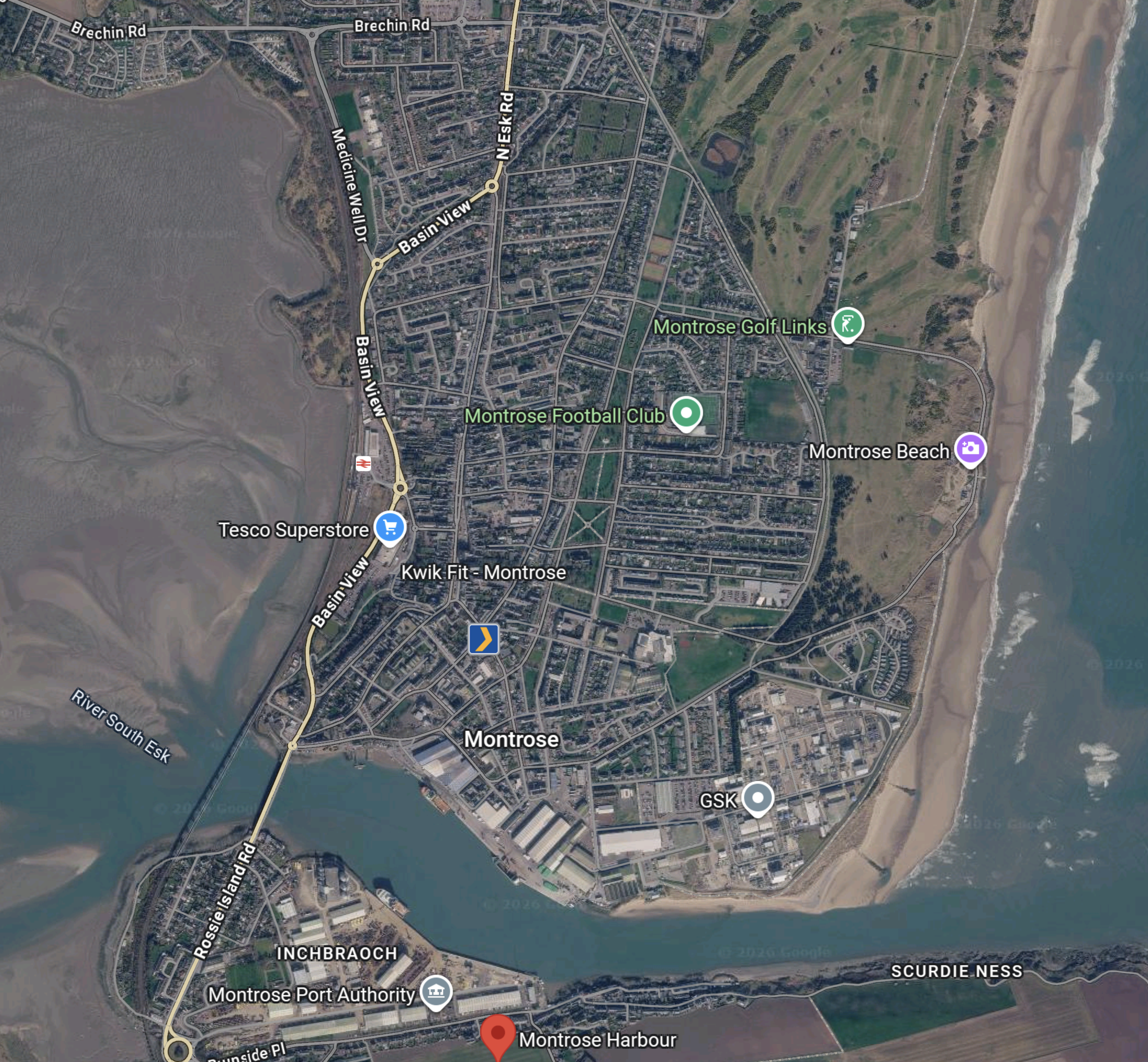
Note.
- Montrose station is on the West side of the town, on the main Edinburgh and Aberdeen railway.
- Montrose looks to have a major beach.
- Montrose Port is on both sides of the River South Esk.
- There looks to be plenty of space for Subsea Micropiles to build their micropiles.
Subsea Micropiles have a comprehensive web site.
They appear to have offices in Dublin and Aberdeen and say this about micropiles.
We are leading the adaption land-based micro piling technology to create superior marine foundation and anchor solutions.
Micropile has a Wikipedia entry.
A New Entrance/Exit For King’s Cross Station – 27th September 2026
A new fully step-free entrance to King’s Cross Station has opened on the South side of Euston Road.
As I was passing this morning I took these pictures.
















Note.
- The tunnel under Euston Road is level.
- It connects on the North side to tunnels and lifts to King’s Cross station, St. Pancras station and all the Underground lines.
- On the South side it connects to a new office block.
- There are lots of signs.
- The tunnel has stairs and lifts to the surface on both sides.
- The South entrance has a single lift.
- A kiosk appears to have been built in the South entrance.
- There are bus and tube maps in the new entrance.
These are some of my thoughts.
Westbound Buses From King’s Cross and St. Pancras Stations
I believe this could be a big benefit of the new entrance.
Within fifty metres to the West of the new entrance is Bus Stop A.
This has a good selection of buses including according to Google AI, these buses.
- 30: Towards Euston Bus Station
- 73 / N73: Towards Oxford Circus / West End
- 91 / N91: Towards Trafalgar Square / Central London (Note: Route 91/N91 may have temporary local diversions nearby)
- 205 / N205: Towards Paddington / Marble Arch
- 390: Towards Victoria Bus Station
Note.
- The 30, 73 and 205 buses provide a link to Euston.
- The 205 bus provides a link to Paddington and Marylebone.
- The stations have gained a step-free Westbound bus terminal.
I would expect this list of Westbound buses to be improved.
Later, I arrived at the Bus Stop A and took these pictures from the bus, as I arrived and as I walked back to the entrance.




























Note.
- I arrived at King’s Cross after taking a 73 bus from Angel.
- Buses twist their way onto Euston Road in front of the two stations.
- Bus Stop R is beside a crossing to in front of the King’s Cross station.
- The area in front of King’s Cross, isn’t one of London’s most salubrious.
- There are a number of trees along Euston Road.
- Bus Stop A is in front of St. Pancras station.
- Some of the side roads could have cheaper hotels.
- The walk between Bus Stop A and the new station entrance is slightly downhill.
Once inside the station complex it was an easy walk to the trains.
There May Be Some More Affordable Hotels On The South Side Of Euston Road
If they are the new entrance will help travellers find them.
If You Have Heavy Cases You May Find The Buses Easier Between Stations
Euston to King’s Cross has been easy for many years. Now the reverse is true.
As I walked Through The New Entrance About Four Illegal Migrants May Have Taken Up Residence!
Two guys about sixteen had their sleeping bags down in the new entrance.
Irizar Hydrogen Coach With Bosch 190 kW Fuel-Cell System Faces Test Operation In Madrid
The title of this post, is the same as that of an article on Hydrogen Central.
Irizar have a page on their web site, which describes their hydrogen-powered coaches.
This paragraph describes their range.
The way our clients operate will not be changed, because the Irizar i6S Efficient Hydrogen has a range of up to 1000 km and minimal charging times, of around 20 minutes. In addition, it can run in 100% electric mode for short times, if required.
All hydrogen-powered coaches seem to claim a 1,000 km. range.
TRISO-X Completes Vertical Construction Of TX-1 Fuel Fabrication Facility
The title of this post, is the same as that of this news item from X-energy.
These two bullet-points act as sub-headings.
Completion of vertical construction marks major milestone for first-in-the-nation commercial scale advanced nuclear fuel fabrication facility
Project advances into interior buildout, fuel fabrication equipment installation and construction of supporting facilities
These two paragraphs add more detail.
TRISO-X, LLC (“TRISO-X” or the “Company”), a wholly-owned subsidiary of X-Energy, Inc. (Nasdaq: XE) (“X-energy”), today announced the completion of vertical construction at TX-1, its first-in-the-nation advanced nuclear fuel fabrication facility in Oak Ridge, Tennessee. The milestone completes the primary building structure of the 214,000-square-foot facility and enables the project to advance fully into its next phase of construction, including interior buildout, installation of fuel fabrication equipment and continued construction of supporting facilities.
“Completing vertical construction is a major milestone for TX-1 and another tangible demonstration of the progress our team is making in Oak Ridge,” said Joel Duling, President of TRISO-X. “We are moving from constructing the core and shell of the facility to building out the interior utilities, installing manufacturing equipment, and constructing key support capabilities. Every milestone brings us closer to establishing a new domestic source of advanced nuclear fuel and supporting the deployment of the next generation of American nuclear reactors.”
Note.
- Oak Ridge is one of the United States premier nuclear facilities.
- It would be like building a similar facility for specialist nuclear reactor fuel at Harwell in the UK.
This is without doubt a very professional start to the X-energy programme.
I also feel that the fourth paragraph has important information.
Once operational, TX-1 is expected to produce approximately 700,000 TRISO-X fuel pebbles annually, equivalent to 5 metric tons of uranium (“MTU”), with capacity to provide fuel for up to 11 Xe-100 reactors. The U.S. Nuclear Regulatory Commission (“NRC”) granted TRISO-X a 40-year Special Nuclear Material License for the facility earlier this year, the first-ever NRC Category 2 fuel fabrication license issued for the processing of high-assay low-enriched uranium. TX-1 is expected to be the first new commercial-scale advanced U.S. nuclear fuel fabrication facility built in more than 50 years.
Note.
- TX-1 will be able to support eleven Xe-100 reactors.
- Four Xe-100 reactors will be built initially at Dow’s Seadrift site.
- In Hartlepool Nuclear Reactor Moves To UK Regulatory Assessment, I said that Hartlepool will eventually be a 12-pack site.
I can envisage a fuel strategy based on TX-1, which is something like this.
TX-1 will provide the TRISO fuel for the four reactors at Dow’s Seadrift site.
TX-1 will provide the TRISO fuel for the initial reactor or reactors at a new site like Hartlepool, or for other licensees like Amazon or North Western.
TX-1 will be cloned as necessary to create TX-2, TX-3, TX-4 etc. as more Xe-100 reactors are built.
I am sure, that there is relevant expertise to make TRISO-X fuel pebbles safely in Japan, Korea and the UK of the known partners of X-energy.
The Wikipedia entry for the Dragon reactor finishes with these three paragraphs.
The choice of helium coolant was made after a long debate within the UKAEA between proponents of helium and carbon dioxide, with helium ultimately selected. Groundbreaking occurred in 1960. It operated from 1965 to 1976, and is generally considered extremely successful.
Dragon’s construction was followed by similar work in the US, leading ultimately to the much larger Fort Saint Vrain Nuclear Power Plant. This suffered from a number of problems due to corrosion and the customer soured on the design. Contracts for similar models in the US that were being signed were cancelled, and although Dragon suffered none of these issues, no orders were forthcoming in Europe either. By this time the market had largely standardized on the pressurized water reactor (PWR) for the large buildout that occurred during the 1970s and 80s, and the decision was made to shut down Dragon.
As of 2023, Dragon is being decommissioned.
Note.
- It appears only two reactors using TRISO fuel have been constructed.
- The 20 MW Dragon reactor was extremely successful.
- The 330 MW Fort Saint Vrain reactor had corrosion problems.
- Both reactors used helium gas as a coolant.
- The Wikipedia entry for the Fort Saint Vrain reactor details the corrosion problems.
- According to Google AI fuel for Fort Saint Vrain was fabricated at the General Atomic Fuel Fabrication Facility in San Diego, California.
- According to Google AI fuel for the Dragon reactor was fabricated on-site at Winfrith.
After writing these seven points, I have concluded that TRISO-fueled helium-cooled nuclear reactor designs better suited to small reactors?
What does Google AI think?
I asked Google AI “Are TRISO-fueled helium-cooled nuclear reactor designs better suited to small reactors?” and received this reply.
TRISO-fueled, helium-cooled reactor designs are exceptionally well-suited for small and micro-modular reactor applications because their physical properties scale down efficiently to provide inherent safety and high-temperature operation.
Why They Suit Small Reactors
Inherent Safety (Walk-Away Safe): Each TRISO fuel particle acts as its own tiny containment system, capable of withstanding extreme temperatures (well over 1,600°C) without melting or releasing radioactive fission products. In a small reactor design, the high surface-area-to-volume ratio allows residual decay heat to dissipate passively through the reactor vessel walls, meaning the reactor cannot suffer a catastrophic meltdown even if active cooling completely fails.
Simplified Helium Cooling: Helium is chemically inert and does not absorb neutrons or become radioactive. In smaller reactor configurations, helium’s single-phase gas state eliminates the high-pressure water loops and massive containment structures required by traditional large light-water reactors.
High-Temperature Process Heat: Because helium can operate at very high temperatures without boiling off, small TRISO-gas systems can deliver high-grade industrial heat (useful for chemical plants or hydrogen production) alongside electricity.
Compact Footprint: Small modular reactor (SMR) and microreactor developers (such as X-energy and Ultra Safe Nuclear Corporation) leverage these traits to design factory-fabricated units that can be transported and sited near urban or off-grid industrial locations.
Key Challenges
Power Density and Size: Helium has a lower volumetric heat capacity than water, meaning gas-cooled cores can be physically bulkier per megawatt than water-cooled equivalents, placing a premium on optimizing core geometry for micro-scales.
Supply Chain and Cost: High-Assay Low-Enriched Uranium (HALEU) and specialized TRISO manufacturing face immature supply chains and higher first-of-a-kind costs.
The more I read about X-energy’s technology, the more I like it.
Under The Railway At Oxford Station – 24th September 2026
I took these pictures as I walked under the railway using the new Botley Road underpass.



















Note.
- I walked to the far side and then back again.
- Where I walked, there was also a cycle track.
- It looks like, when the station upgrade is completed, it will be possible to access both sides of the station from the underpass.
I can see this underpass winning some awards.

