UK Energy Grid Needs £60bn Upgrade To Hit Green Target, Plan Says
The title of this post, is the same as that of this article on the BBC.
This is the sub-heading.
The UK’s electricity network needs almost a further £60bn of upgrades to hit government decarbonisation targets by 2035, according to a new plan.
These five paragraphs explain the plan.
About 4,000 miles of undersea cables and 1,000 miles of onshore power lines are needed, said the National Grid’s Electricity Systems Operator (ESO).
The investment would add between £20 to £30 a year to customer bills, it said.
The government said the ESO’s plans were preliminary and yet to pass a “robust planning process”.
The plans were written up by the ESO, the organisation which runs the electricity network and would run the updated system it is calling for too. It is currently owned by National Grid but will transfer into government ownership later this year.
Its latest £58bn estimate is for work needed between 2030 and 2035 and comes on top of a previous £54bn estimate for work taking place between now and 2030.
These are my thoughts.
The Amount Of Undersea Cable
Edinburgh and London are roughly 400 miles apart as the train runs, so it looks like there could be the equivalent of ten underwater cables between the North of Scotland and England.
In Contracts Signed For Eastern Green Link 2 Cable And Converter Stations, I talked about the proposed 2 GW link between Peterhead in Scotland and Drax in England, which will be a double cable. So there’s the first two of these long cables.
It looks to me, that National Grid are proposing to use underwater cables wherever they can, so they avoid large expensive planning rows stirred up by Nimbies.
Monitoring The Undersea Cables
Last week Ofgem gave National Grid a £400,000 grant to develop new innovative technologies, which I wrote about in £400k For National Grid Innovation Projects As Part Of Ofgem Fund To Help Shape Britain’s Net Zero Transition.
One of the project is called HIRE – Hybrid-Network Improvement & Reliability Enhancement and will be used to check all these cables are performing as they should.
My electrical engineering experience tells me, that there must be some cunning way, that will detect that something is happening to the cable. The involvement of a technology company called Monitra in the project is a bit of a giveaway.
How Much Will It Cost Me?
Currently, UK consumers pay about £30 per year to have electricity delivered, so this will rise to between £50 and £60 per year.
That is just over a pound a week. I would pay about the same for a resident’s parking permit outside my house for an electric car and probably three times more for a petrol or diesel car.
Do We Have Enough Cable?
Two undersea cable factories are under development in Scotland and I suspect the 4,000 miles of undersea cables will be delivered on schedule and covered in saltires.
What About T-Pylons?
The latest onshore electricity transmission line between Hinckley Point C and Bristol, doesn’t use traditional pylons.
It uses T-pylons like these to connect the 3.26 GW nuclear power station.
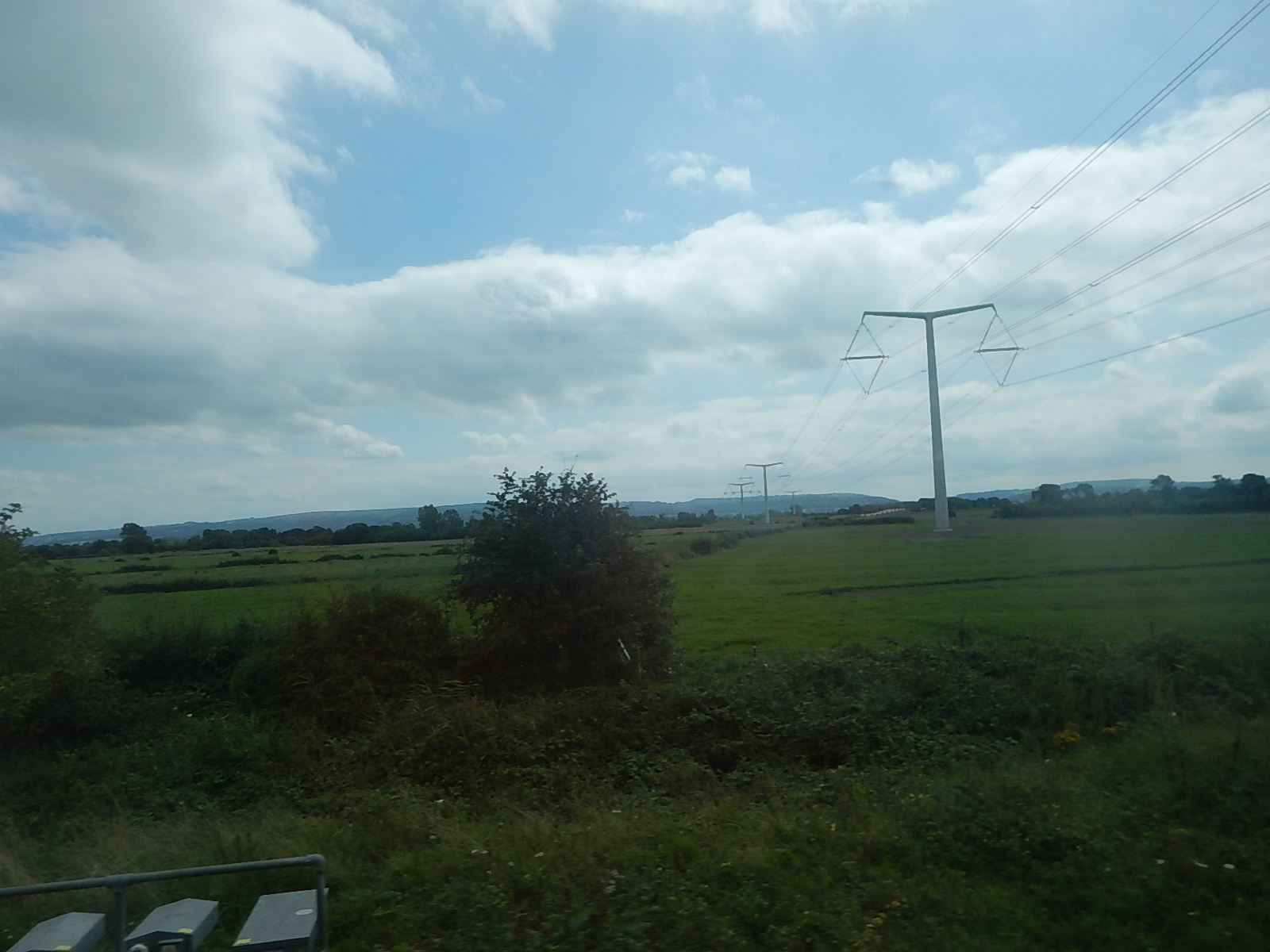
Note that they are shorter, designed to be less intrusive, have a smaller footprint and are made from only ten parts.
I suspect they will cost less to install and maintain.
There is more on T-pylons in National Grid Energise World’s First T-Pylons.
I wouldn’t be surprised that some of the oldest traditional pylons will be replaced by T-pylons.
I am surprised that T-pylons are not mentioned in the BBC article.
I like T-pylons. How do you feel about them?
Eastern Green Link 2
This press release from National Grid, describes Eastern Green Link 2 like this.
Eastern Green Link 2 (EGL2) is a 525kV, 2GW high voltage direct current (HVDC) subsea transmission cable from Peterhead in Scotland to Drax in England delivered as a joint venture by National Grid and SSEN Transmission.
This map from National Grid, shows the route of the Eastern Green Link 2.

The Northern landfall is at Sandford Bay and the Southern landfall is at Wilsthorpe Beach.
This Google Map shows Sandford Bay and Peterhead power station.
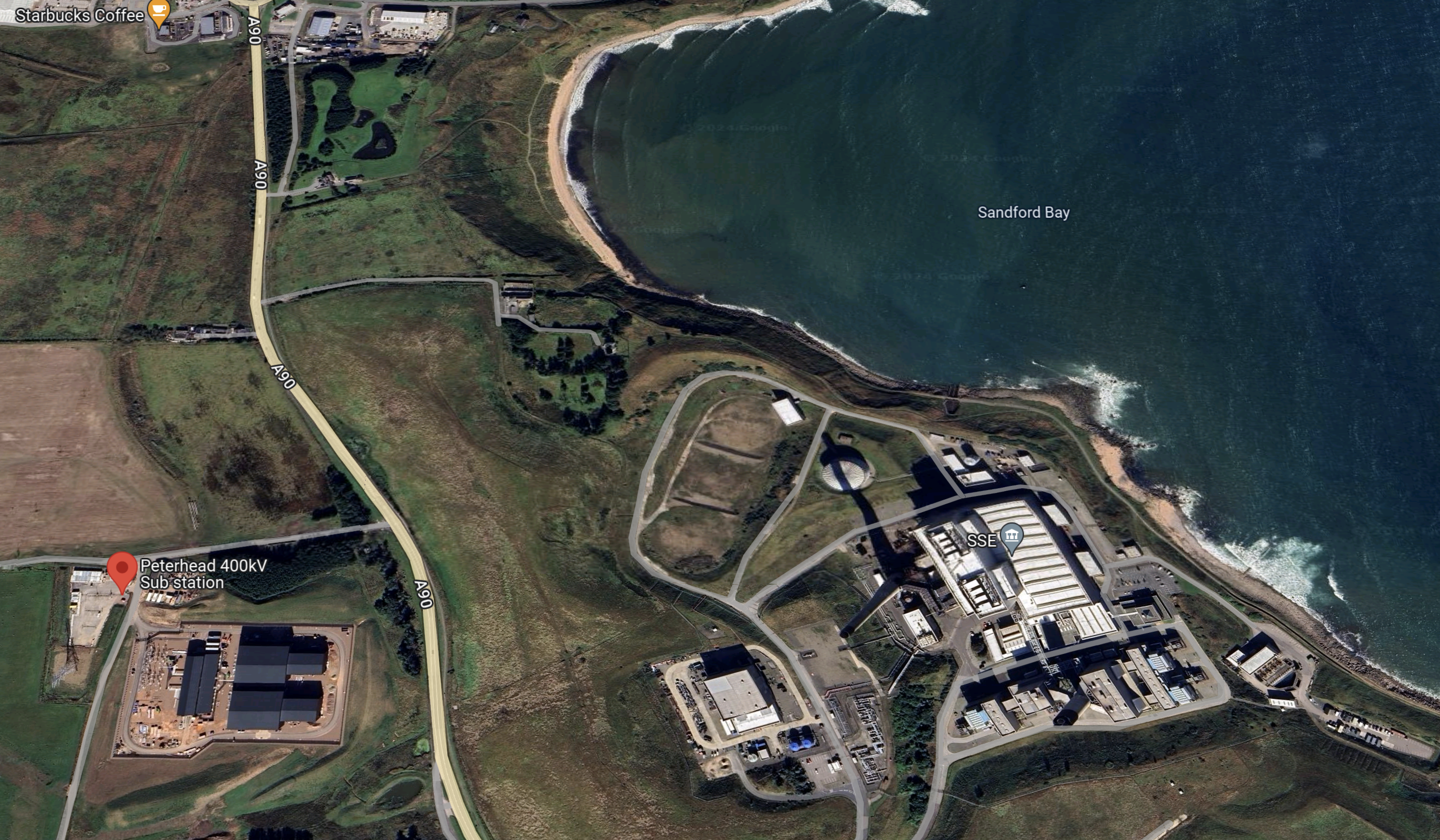
Note.
- Sandford Bay occupies the North-East corner of the map.
- The red arrow indicates the main 400kV sub-station at Peterhead.
- The 2177 MW gas-fired Peterhead power station is to the East of the sub-station marked as SSE.
This second Google Map shows the onshore route of the cable from Wilsthorpe to Drax.

Note.
- Flamborough Head is in the North-East corner of the map.
- Wilsthorpe Beach is at Bridlington a couple of miles South of Flamborough Head.
- The red arrow indicates Drax Power station.
- An onshore underground cable will be installed from landfall in Wilsthorpe to a new onshore converter station built in Drax.
The EGL2 HVDC cable connection from Scotland to England consists of 436km of submarine cable and 69km of onshore cable.
Both converter stations will be on existing power station sites and the major onshore works will be the underground cable between Wilsthorpe and Drax.
Where Does Drax Go From Here?
Currently, Drax power station is a 2595 MW biomass-fired power station.
There are now other large power sources that could replace some or all of the output of Drax power station.
- 2GW of Scottish wind power coming to Drax on Eastern Green Link 2.
- 6 GW of offshore wind is being developed at the Hornsea wind farms.
- 8 GW of offshore wind is being developed at the Dogger Bank wind farms.
- 2.5 GW from the three gas-fired power stations at Keadby, two of which are likely to be fitted with carbon capture.
- 1.8 GW from the proposed hydrogen-fired Keadby Hydrogen power station.
Given the bad feelings many have about Drax burning biomass, with 20.3 GW of electricity, you might think that shutting down Drax would be a simple solution.
But, according to Drax’s Wikipedia entry, it has a unique property.
Despite this intent for baseload operation, it was designed with a reasonable ability for load-following, being able to ramp up or down by 5% of full power per minute within the range of 50–100% of full power.
So Drax could be very useful in balancing the grid, by ramping up and down to fill the gap between production and need.
In addition, there is good biomass. This is from the Wikipedia entry.
A 100,000 tonne pa capacity straw pelletization facility was constructed at Capitol Park, Goole in 2008.
Drax are also promoting BECCS or Bioenergy carbon-capture and storage.
There is a Wikipedia entry for Bioenergy With Carbon Capture And Storage, of which this is the first couple of sentences.
Bioenergy with carbon capture and storage (BECCS) is the process of extracting bioenergy from biomass and capturing and storing the carbon, thereby removing it from the atmosphere. BECCS can theoretically be a “negative emissions technology” (NET).
I do feel that carbon capture and storage is a bit like sweeping the dust under the carpet, when you sweep the floor around it.
But carbon capture and use could be another matter.
This Google Map shows the Drax site.

Note how it is surrounded by agricultural land.
Could the power station be the source of pure carbon dioxide to be fed in greenhouses to flowers, herbs, salad vegetables, tomatoes and other plants?
I suspect there’s productive life left in Drax power station yet!
LionLink
LionLink, that is being developed by National Grid is a new type of interconnector, called a multi-purpose interconnector, that will connect Suffolk and The Netherlands via any convenient wind farms on the way. This means that the electricity generated can go where it is needed most.
I wrote about LionLink in World’s Largest-Of-Its-Kind Power Line To Deliver Clean Power To 1.8m UK Homes And Boost Energy Security.
Other Multi-Purpose Interconnectors
I can see other multi-purpose interconnectors like LionLink being built around the UK.
- There could be one across the Dogger Bank to link out 8 GW of Dogger Bank wind farms with those of the Dutch, Danes and Germans on their section of the bank.
- NorthConnect could be built between Scotland and Norway via some of the wind farms being developed to the North-East of Scotland.
- Could wind farms to the North of Ireland use a multi-purpose interconnector between Scotland and Northern Ireland.
- I can also see one or possibly two, being built across the Celtic Sea to link Devon, South Wales and Southern Ireland via the wind farms being developed in the area.
- Will we also see a Channel multi-purpose interconnector to transfer electricity along the South Coast of England?
Some of these multi-purpose interconnectors could be key to creating a revenue stream, by exporting electricity, to countries in Europe, that have a pressing need for it.
Conclusion
National Grid’s excellent plan will lead to the end of the practice of shutting down wind turbines. The spare electricity will be exported to Europe, which will surely create a good cash-flow for the UK. This in turn will encourage developers to create more wind farms in the seas around the UK’s coasts.
Ørsted Greenlights 2.9 GW Hornsea 3 Offshore Wind Farm
The title of this post, is the same as that of this article on offshoreWIND.biz.
This is the sub-heading.
Ørsted has taken the final investment decision (FID) on what the company says is the world’s single largest offshore wind farm, the 2.9 GW Hornsea 3, which is expected to be completed around the end of 2027.
These are the two introductory paragraphs.
In July 2022, Ørsted was awarded a contract for difference (CfD) for Hornsea 3 at an inflation-indexed strike price of GBP 37.35 per MWh in 2012 prices.
The CfD framework permits a reduction of the awarded CfD capacity. The company said it will use this flexibility to submit a share of Hornsea 3’s capacity into the UK’s upcoming allocation round 6.
With all the work, that Ørsted have done to protect kittiwakes, which I wrote about in Kittiwake Compensation, the company seems to have been taking the development of this wind farm carefully and this statement from the wonderfully-named Mads Nipper, Group President and CEO of Ørsted indicates that the UK Government has been persuasive in times, that are not totally favourable to wind farm developers.
Offshore wind is an extremely competitive global market, so we also welcome the attractive policy regime in the UK which has helped secure this investment. We look forward to constructing this landmark project, which will deliver massive amounts of green energy to UK households and businesses and will be a significant addition to the world’s largest offshore wind cluster.
But the article also has this paragraph.
According to Ørsted, most of Hornsea 3’s capital expenditure was contracted before recent inflationary pressures, securing competitive prices from the supply chain, adding that the larger wind turbines and the synergies with Hornsea 1 and 2 lead to lower operating costs.
It looks like Ørsted, may have taken advantage of Siemens well-publicised financial woes and got a good price for the over two hundred turbines.
This page on the Hitachi web site, describes their part in Hornsea 3, where this is said.
Hitachi Energy has supported Ørsted with the grid connection of Hornsea One and Hornsea Two, but Hornsea 3 will be the first phase to use HVDC application in the Hornsea cluster.
The overall HVDC system, including the offshore platform, is delivered in partnership with Aibel. Hitachi Energy will supply two HVDC Light® converter systems, while Aibel will deliver two HVDC offshore converter platforms. The platform is based on Hitachi Energy’s modular HVDC system including its advanced control and protection system, MACH™. As the HVDC offshore market grows and becomes more complex, Hitachi Energy will continue to develop solutions with its customers and partners to enable a more flexible offshore grid of the future.
Hitachi Energy is supplying four HVDC converter stations, which convert AC power to DC for transmission in the subsea cables, then reconvert it to AC for integration into the onshore grid. Two of the converter stations will be installed on offshore platforms and two at mainland grid connections.
Note.
- Hitachi are pushing their electrical innovation hard.
- Hitachi and Ørsted have worked together on Hornsea 1 and 2.
- What better place is there for Hitachi to test their new modular HVDC system, than on one of the world’s largest wind farms?
- Hitachi appear to say, they like to develop with customers and partners.
It looks to me, that Ørsted may well have got new improved technology at an advantageous price.
This is the last paragraph of the article.
The Hornsea zone will also include the Hornsea 4 project, which could have a capacity of up to 2.6 GW. The wind farm received its development consent order from the UK government earlier in 2023 and is now eligible for forthcoming CfD allocation rounds.
So will Hornsea 4 be a slightly smaller version of Hornsea 3 using the same suppliers?
- There could be savings in the design and manufacturing of the electrical systems, foundations, sub-stations and turbines.
- Could for instance, Hitachi’s modular HVDC result in savings in converters and sub-stations, if the two wind farms shared infrastructure?
- I’m sure that Siemens, Hitachi and the other suppliers will be happy to just keep rolling.
- It would be an ideal follow-on.
It looks to me, that by using good design and management, and established suppliers, Ørsted have managed to get the costs of Hornsea 3 and Hornsea 4 to a level, where the venture is profitable.
Masdar To Invest In Iberdrola’s 1.4 GW East Anglia Offshore Wind Project
The title of this post, is the same as that of this article on offshoreWIND.biz.
This is the sub-heading.
Iberdrola and Masdar have signed a strategic partnership agreement to evaluate the joint development of offshore wind and green hydrogen projects in Germany, the UK, and the US, which also includes an investment in Iberdrola’s 1.4 GW East Anglia 3 offshore wind project in the UK.
These first two paragraphs outline the del.
After the parties’ successful co-investment in the Baltic Eagle offshore wind farm in Germany, the new milestone of this alliance will be to achieve a further co-investment concerning the 1.4 GW East Anglia 3 offshore wind project in the UK, said the companies.
According to the partners, the deal has been under negotiation for the last few months and could be signed by the end of the first quarter of 2024. Masdar’s stake in the wind farm could be 49 per cent.
This deal appears to be very similar to Masdar’s deal with RWE, that I wrote about in RWE Partners With Masdar For 3 GW Dogger Bank South Offshore Wind Projects.
- The Iberdrola deal involves the 1.4 GW East Anglia 3 wind farm, which has a Contract for Difference at £37.35 £/MWh and is scheduled to be completed by 2026.
- The RWE deal involves the 3 GW Dogger Bank South wind farm, which doesn’t have a Contract for Difference and is scheduled to be completed by 2031.
- Both deals are done with wind farm developers, who have a long track record.
- Both wind farms are the latest to be built in mature clusters of wind farms, so there is a lot of production and maintenance data available.
I suspect, that many capable engineers and accountants can give an accurate prediction of the cash flow from these wind farms.
I will expect that we’ll see more deals like this, where high quality wind farms are sold to foreign energy companies with lots of money.
Just over five years ago, I wrote World’s Largest Wind Farm Attracts Huge Backing From Insurance Giant, which described how and why Aviva were investing in the Hornsea 1 wind farm.
Conclusion
It appears that Masdar are doing the same as Aviva and usind wind farms as a safe investment for lots of money.
Highview Power, Ørsted Find Value In Integrating Offshore Wind With Liquid Air Energy Storage
The title of this post, is the same as that of this article on offshoreWIND.biz.
This is the sub-heading.
Highview Power and Ørsted have completed their joint investigation into how combining the technologies of Liquid Air Energy Storage (LAES) and offshore wind could unlock greater value for investors and consumers.
These three paragraphs outline the findings.
The results show that there is value in combining offshore wind with LAES to support reducing wind curtailment, increasing productivity, and helping the move to a more flexible, resilient zero-carbon grid, according to Higher Power.
The two companies have carried out analysis of technical performance, route to planning approval, and route to market with a regulatory and economic assessment.
As a result of this study, the companies believe a project can be developed and built aligned with the timeline of an offshore wind farm.
I feel very strongly, that putting the two technologies together is a good idea.
In the simplest cases, the storage could be built into the offshore sub-station.
Could LAES Be Used With Hornsea 4 Wind Farm?
The Wikipedia entry for the Hornsea Wind Farm says this about Hornsea 4.
In July 2023, British government officials gave the final approval for Hornsea Four, the fourth phase of the wind project. Hornsea Four is expected to generate 2.6GW, have 180 giant wind turbines, and has the capability to generate enough renewable energy to power 1 million homes in Britain.
The Wikipedia entry also says this about Hornsea 3.
Project 3 will be to the east of Projects 1 and 2, with an estimated maximum capacity of 2.4 GW over 696 square kilometres (269 sq mi). DONG Energy (which in November 2017 changed its name to Ørsted) began consultation on the project’s development in May 2016. Ørsted submitted a Development consent application in 2018 and consent was granted on 31 December 2020.[69] In early 2023, consent was also given to a battery storage power station at Swardeston. The project is expected to begin construction in 2022, and be completed by 2025.
If Ørsted are adding a battery to the 2.4 GW Hornsea 3 wind farm, I would feel, that Ørsted would think about a battery on the 2.6 GW Hornsea 4 wind farm.
The Energy Storage The UK Needs
This is the last paragraph of the article.
The UK will need up to 100 GWh of energy storage by 2050 according to the estimates from National Grid ESO’s Future Energy Systems Scenario.
SSE Renewables are planning two large pumped-storage hydroelectric power stations in Scotland.
- Coire Glas – 1.5 GW/30 GWh – Possible completion in 2031.
- Loch Sloy – 152.5 MW/25 GWh – See SSE Unveils Redevelopment Plans For Sloy Hydro-Electric Power Station.
A quick calculation, says we’d need seven pumped-storage hydroelectric power stations, which need a lot of space and a handy mountain.
I don’t think pumped-storage hydroelectric would be feasible.
Highview Power say this about their next projects on this page of their web site.
Highview Power’s next projects will be located in Scotland and the North East and each will be 200MW/2.5GWh capacity. These will be located on the national transmission network where the wind is being generated and therefore will enable these regions to unleash their untapped renewable energy potential and store excess wind power at scale.
Note.
- This is more like the size.
- Work is now underway at Carrington – a 50MW / 300MWh plant at Trafford Energy Park near Manchester.
- Highview’s technology uses liquid air to store energy and well-proven turbo-machinery.
They are a definite possibility, as only eighteen 200MW/2.5GWh systems would be needed.
Ørsted ‘First’ To Use Giant Autonomous Drones to Transport Cargo To Wind Turbines
The title of this post, is the same as that of this article on offshoreWIND.biz.
This is the sub-heading.
Ørsted says it is the first offshore wind company in the world to use giant autonomous drones to transport cargo to wind turbines
These three paragraphs outline the use of drones.
The Danish offshore wind giant is testing the drones to transport cargo from vessels to its 1.2 GW Hornsea One project in the UK.
Building on its previous experience using smaller drones in other countries, the company is now trialling the 58-kilogram drones with a wingspan of 2.6 metres to transport cargo of up to 68 kilograms.
The drones are operated from existing crew transfer vessels (CVTs) and service operating vessels (SOVs) which are already on site, said Ørsted.
Using drones appears to save cost and time, reduce risk and even allows the deliveries with the turbine working.
With a payload of 68 kilograms, someone my size could even take a lift.
UK Investor Takes Stake In Hornsea Two Transmission Assets
The title of this post, is the same as that of this article on offshoreWIND.biz.
This is the sub-heading.
London-based international investor and manager, John Laing Group, has acquired a stake in the transmission assets for the 1.3 GW Hornsea Two offshore wind farm in the UK, as part of a portfolio acquisition from HICL Infrastructure.
These two paragraphs outline the deal.
John Laing Group has agreed to acquire HICL Infrastructure’s entire equity interest in four UK public-private partnership projects, including a 37.5 per cent stake in the Hornsea Two offshore transmission assets for a total consideration of GBP 204 million (EUR 236 million).
All five acquisitions are expected to be completed before the end of March 2024.
I wrote World’s Largest Wind Farm Attracts Huge Backing From Insurance Giant in November 2018.
Funds and investors with money don’t seem to be losing their appetite for assets, that can provide a regular income.
Ørsted Receives Development Consent For 2.6 GW Hornsea Four Offshore Wind Farm
The title of this post, is the same as that of this article on offshoreWIND.biz.
This is the sub-heading.
The UK Secretary of State for Energy Security and Net Zero has granted development consent to Hornsea Project Four, a 2.6 GW offshore wind farm Ørsted plans to build some 69 kilometres off the Yorkshire Coast.
This is the first paragraph.
The UK government, in a press release issued on 12 July, stated that Hornsea Four was the 126th Nationally Significant Infrastructure Project and 73rd energy application to have been examined by The Planning Inspectorate within the timescales laid down in the Planning Act 2008.
It certainly looks like The Planning Inspectorate has been working overtime.
Note that the four Hornsea wind farms are planned to have at least the following sizes.
- Hornsea 1 – 1218 MW
- Hornsea 2 – 1386 MW
- Hornsea 3 – 2852 MW
- Hornsea 4 – 2600 MW
These four wind farms give the Hornsea complex, a total capacity of at least 8056 MW.
When I worked at ICI in Runcorn in the late 1960s, I used to cross the Runcorn Bridge twice every day and would see Fiddlers Ferry power station, with its eight cooling towers, on the North Bank of the River Mersey to the East. It was generally thought of as a large coal-fired power station.






These pictures of Fiddlers Ferry power station were taken in 2021, from a Liverpool-bound train on the railway bridge.
This Google Map shows the power station.

Note.
- Fiddlers Ferry may have been large for its time at 1989 MW, but it is still less than a quarter of the size of the Hornsea wind farm!
- Drax power station in 1986 at 3960 MW, was larger than Fiddlers Ferry, but was still less than half of the size of Hornsea!
Hornsea wind farm is a true green giant!
This paragraph is from the Hornsea Project 4 section of the Wikipedia entry for the Hornsea wind farms.
Construction of the wind farm was provisionally expected to start in 2023, and be operational by 2027, at the earliest. The project’s capacity is unknown by Ørsted due to the ever increasing size of available wind turbines for the project.
When completed, it could be even bigger.
Take A 360° Tour Of World’s Largest Offshore Wind Farm In Operation
The title of this post, is the same as that of this article on offshoreWIND.biz.
This is the sub-heading.
Located some 89 kilometres off the Yorkshire Coast, the UK, the 1.3 GW Hornsea Two comprises 165 Siemens Gamesa 8 MW wind turbines and is currently the world’s largest fully commissioned offshore wind farm.
The article has a link to an excellent Ørsted video, about they access and service the wind farm.
Ørsted Posts All-Time High Offshore Wind Earnings
The title of this post, is the same as that of this article on offshoreWIND.biz.
This is the sub-heading.
World’s leading offshore wind developer, Ørsted, has reported DKK 6.9 billion (EUR 926 million) operating profit (EBITDA) for the first quarter of 2023, DKK 2.5 billion less compared to the same period a year earlier.
For those, who are sceptical about offshore wind, these results must surely pour cold water on your views.
The profits also appear to have in part been driven by the commissioning of the Hornsea Two wind farm.
Kittiwake Compensation
The title of this post, is the same as that of this page of Ørsted’s Hornsea Three web site.
The first section of the page gives the background.
Hornsea 3 Offshore Wind Farm received planning permission in December 2020. As part of our Development Consent Order, a requirement was included for ecological compensation measures for a vulnerable seabird species whose populations could be affected by wind farms – the Black-legged kittiwake (Rissa tridactyla).
Our compensation plan focusses on providing artificial nesting structures for kittiwake along the east coast of England. This project is the first of its kind and we are working on new and innovative designs for the artificial nesting structures. Each structure will be purpose-built, bespoke and specific to the landscape characteristics of each location. The structures also present an educational opportunity, allowing researchers to better understand kittiwake.
Developing effective environmental compensation measures is essential to ensure the UK Government’s targets for offshore wind can be realised, to deliver a net zero-carbon future.
So kittiwakes are not being paid compensation, as I don’t suspect many have bank accounts.
But they are being built a few new nesting structures.
Wikipedia has an entry on kittiwakes.
It notes that all European kittiwakes are of the black-legged variety and this is a picture, I took of some on the Baltic in Newcastle.

I’ve seen several pictures of kittiwakes lined up like these.
The document goes on to describe the work being done for the kittiwakes and this is said about work in East Suffolk.
Lowestoft and Sizewell are the only locations between Kent and Humberside with thriving kittiwake colonies. Kittiwake normally nest on steep cliffs with narrow ledges. East Anglia doesn’t have these natural nesting spaces, so kittiwake have reverted to colonising urban areas, for example on windowsills and ledges of buildings. Kittiwake breeding for the first time are most likely to find artificial structures that are situated close to these urban areas. They are less likely to find structures in places where there are not already kittiwake. Lowestoft and Sizewell are therefore two of the few places in East Anglia where artificial structures could be colonised quickly. These purpose-built nesting sites would improve breeding conditions for kittiwake, whilst successfully achieving our compensation requirements to unlock the world’s biggest offshore wind farm.
I took this picture of kittiwakes at Sizewell.
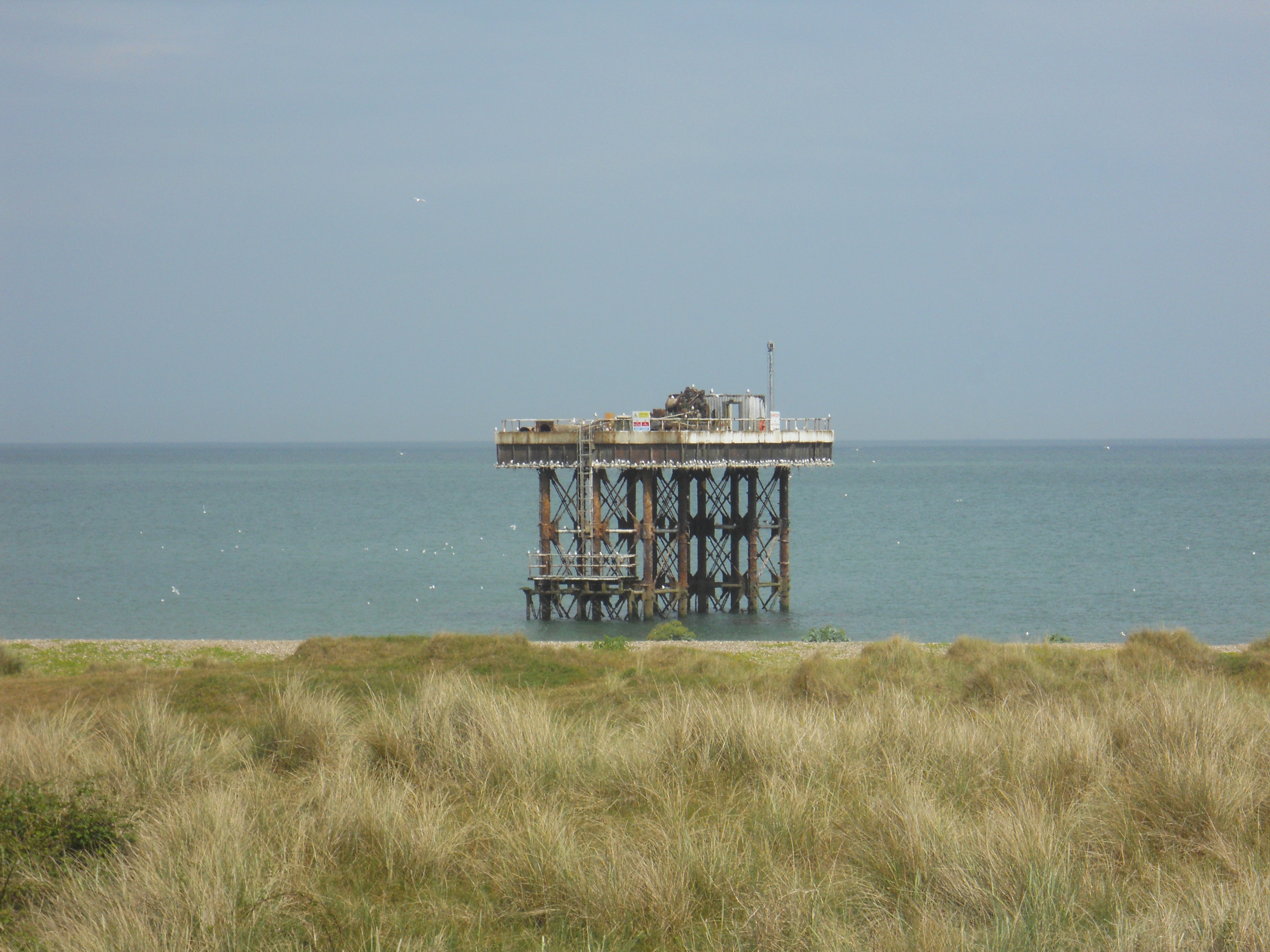
It doesn’t seem too unlike the structure on the Hornsea 3 web site.
 The Anonymous Widower