How Can We Deal With Air Pollution In The UK?
This article on the BBC is entitled Green group wins air pollution court battle.
This is the start of the article.
Campaigners have won the latest battle in legal action against the UK Government over levels of air pollution.
A judge at the High Court in London ruled in favour of environmental lawyers ClientEarth.
The group called air pollution a “public health crisis” and said the government has failed to tackle it.
The ruling in the judicial review called the government’s plan “woefully inadequate”.
As my mate Brian would have said, the \government has been screwed, glued and tattooed, by the Judge.
Does Pollution Affect Me?
I feel very strongly about this, as in the 1940s and 1950s, I suffered badly from the pollution of the time.
Now pollution levels are cutting out the vitamin D producing UVB rays of the sun. Could this be the rason for my low vitamin D levels?
No Magic Bullet
So what can the Government do to meet the European Emission Standards?
There is no magic bullet, but I believe that a raft of measures can gradually bring the levels of pollution down.
Reduction Of All Road Transport
One of London’s problems is that the amount of traffic in the city, means that a lot of the vehicles are stationery and just causing pollution.
I suspect this is a problem in many other cities.
So measures must be taken to reduce the level of all traffic.
- London needs more Park-and-Ride sites. Do other cities?
- Differential congestion charging and residents parking, so the polluter pays.
- More cycling superhighways to encourage cycling.
- City centre parking must be taxed, with the money funding public transport.
- Aggressive illegal parking control.
- Automatic box junction enforcement.
- 20 mph speed limit to make walking easier.
- Area average speed control.
- Reduction of the number of taxis and mini-cabs.
I particularly like the concept of having a grid of linked speed cameras in a city and then issuing a ticket automatically, if the limit is exceeded between two cameras.
Reduction Of Diesel-Powered Transport
As nitrogen dioxide from diesels is the main source of the pollution, we should aim to eliminate as many diesel-powered vehicles, as is practical.
- Reduction of diesel vehicles will need legislation, probably backed up with government money.
- Buses, taxis and local delivery vehicles will need to be hybrid or electric.
- There must be progressive bans for diesel vehicles not meeting the latest standards.
- Diesel scrapping schemes have been introduced in certain places.
I particularly like the idea, where in an experiment involving Sainsburys, supplies for the supermarkets were delivered by train into Euston at three in the morning and then delivered around Central London by low-emission vehicles.
Increase In Electrically-Powered Transport
This is the key to reducing a lot of pollution in cities.
- Electric and hybrid vehicles.
- Trams to replace buses.
- Development of electric rail lines.
- More cross-city rail lines like Crossrail 2 and the Camp Hill Line.
I also think we’ll see some innovative solutions, like the PRT system, I wrote about in A Visit To Heathrow Terminal 5.
The problem of improving transport systems is well-illustrated in Chelsea, where some selfish locals don’t want Crossrail 2, as it might hinder them driving their tractors.
More Details
I shall now expand a few of those topics and add a few more ideas.
They are in alphabetical order.
Battery Trains
Battery trains are an alternative to full electrification, where one or both ends of the line to be electrified, already have electrification.
The Greenford Branch is an obvious possibility.
- The line is only 4.3 km. long.
- The bay platform at West Ealing station could be easily electrified to charge the trains.
- Either a new train or a refurbished one with batteries could work the line.
- Two trains would be needed to run the promised four trains per hour service.
- Little new infrastructure would be needed.
I believe that battery trains are an affordable alternative to full electrification.
Battery Trams
Battery trams are being introduced into Birmingham to extend the Midland Metro. This article in the Railway Gazette, which is entitled Midland Metro trams to be converted for catenary-free operation, gives full details.
- The only construction required is to lay the rails, build the stops and install the signalling.
- Putting up overhead wires in a historic or sensitive city centre can be a legal and logistical nightmare and very expensive.
- Battery trams work in Seville and Nanjing.
- Trams charge the battery at either a charging station or when running under wires outside of the centre.
I can see a time, when in city centres, most trams will be battery-powered.
It will be interesting to see how Brummies take to their battery trams.
Connectivity Improvements
Compare arriving in Birmingham New Street and Euston stations, needing to go a few miles to say Centenary or Trafalgar Squares respectively.
At Euston, you go to the nearest bus stop, look up the spider map with all the destinations from Euston and it tells you how to get to about a hundred locations. Job done!
But in Birmingham, the brand new station doesn’t have that information on display in an easy-to-understand form.
Birmingham isn’t too bad and is certainly better than Manchester, but why can’t cities copy the London system.
You may get to these places easily, but the connecting and ticketing arrangements, tell you to bring your car next time.
Contactless Bank Card Ticketing
London now allows anybody to use their contactless bank card, as a ticket on all modes of public transport.
I don’t have the figures, but I believe that every time a new feature is added, like the new Bus Hopper, there is an increase in public transport usage.
After London’s experiences, I have no doubt, that contactless bank card ticketing increases the use of public transport and removes traffic from the roads.
Introducing contactless bank card ticketing, should be a condition of Central Government finance for public transport projects.
But every city in the world will introduce this form of ticketing!
Not doing it, will make sure visitors don’t come back and tell their friends what a crap place they’ve visited.
Cross-City Railways And Trams
A lot of cities and conurbations have a lot more traffic and the resulting pollution, as getting from one side of the city to the other is not easy, without driving through the city centre.
As an example, Crossrail will improve access to Heathrow from East and South-East London, where the alternative is a drive round the M25 or through the city centre, on congested roads. But Crossrail is only one of many successful cross-city routes in the UK.
- The Central, District, Jubilee, Metropolitan, Northern, Piccadilly and Victoria Lines of the London Underground.
- The East, North and West London Lines and the Gospel Oak to Barking Line of the London Overground.
- Thameslink in London
- The Northern Line in Liverpool.
- The Cross-City Line and Snow Hill Lines in Birmingham
- The East and West Coastway Lines in Brighton.
- The Metro in Newcastle.
- The Nottingham Express Transit in Nottingham.
- The Valley Lines in Cardiff
All of these lines are well-used and there are plans to upgrade those, not to the standard of the London Overground.
Efficient Deliveries
If I have my window open, I can sometimes hear several delivery trucks call at my various neighbours in a short period of time.
This is not efficient and surely something better can be done.
I was once offered delivery of a small parcel to my Local Sainsburys, which is about a hundred metres away.
Organised properly with enough drop points, that must be more efficient and convenient.
This is one we don’t need to worry about, as the big shopping groups will make it happen as they go for greater sales and more profits.
Park-And-Ride
Park-and-Ride is a good way of keeping, passenger cars away from City Centres.
Nottingham may be a lot smaller than London, but it is a city that has designed the Nottingham Express Transit with several Park-and-Ride sites, at the edges of the city.
Compare that with the non-existent Park-and-Ride provision on Crossrail, which I wrote about in Crossrail’s Park-And-Ride Facilities.
Railway Electrification
Electrification of rail routes across cities and replacing diesel trains with electric ones, is always an option to cut pollution.
Consider.
- London is currently electrifying the Gospel Oak to Barking Line and this will also allow noisy and polluting Class 66 diesel locomotives to replaced with electric ones on freight trains on this route.
- Lines in Liverpool and Birmingham are also being electrified.
- Electric trains also seem to be passenger magnets as the Class 378 trains of the London Overground have shown.
But remember, that every passenger on an electric train, can’t be using their car and is rteducing their pollution footprint.
Rewards For Going Car-Free
I have met several people recently, who have given up owning a car in Central London.
So could those, who don’t bring their car into the congested area, receive some form of reward.
Is A Secondary Effect Of London’s Air Pollution Making Me Ill?
There is no doubt, that i am suffering from a vitamin D deficiency, as it has been measured and I have several of the classic symptoms. Several of my friends seem to be suffering too!
As a coeliac, I get no or little vitamin D from my food, as vitamin D is not added to gluten-free food, so I rely on the sun for my vitamin D.
And there has been very little of that over the last few years in London and the South East of England.
I take vitamin D supplements and these help, but if say I get half an hour in strong sunlight, I feel a lift and a lot better.
I got to wondering, if London’s pollution is cutting out the UVB radiation that I need to generate vitamin D in my skin.
I can’t find any scientific paper, which shows the effect of airpollution on UVB radiation.
Now my health has got worse over the l;ast decade or so, which is a time that corresponds to more diesel cars polluting the atmosphere.
I may be talking sabsolute claptrap, but if I could find a scientific paper, I might be able to be proven wrong.
But I can’t get iot out of my head, that all these diesels are producing pollution, that is cutting the UVB radiation. As my health was appalling in the 1950s, during the legendary London smogs, I wonder if there is a connection.
Unfortunately, to many UVB radiation is an evil as it causes skin cancer. So anything that cuts UVB radiation levels is to be welcomed.
How To Catch Polluting Vehicles
I’ve just read about the EDAR pollution sensor in the Sunday Times.
Read more above the device on this page of the Hager Environmental and Atmospheric Technoogies web site.
I think they’ll sell a lot of these and in some ways it’s the best way to cut pollution caused by vehicles in cities.
Most drivers will make sure they;re legal!
How Long Before I Get A Message About The Jokeswagen Scandal?
Now that the PPI calls seem to have run their course, Jokeswagen have presented the cold calling merchants with manna from heaven.
How long before they start targeting the owners of Jokeswagen diesels to offer to sue the company at no expense to you for compensation?
They might also decide to phone and contact everybody, as Jokeswagen could surely be considered responsible for all the pollution in our cities and the increaee in asthma.
The Great Car Con
Tomorrow night on Despatches on Channel Four are showing a program called The Great Car Con. They say this in summary about the program.
Motorists were promised diesel would be the cheap, green fuel of the future, but it turns out that’s not the case. Why did politicians encourage the ‘dash for diesel’?
All of today’s generation of politicians, won’t know much about air pollution, like my generation suffered from before the Clean Air Act of 1956, cleaned up our major cities. Unless of course they have been on a freebie to Beijing.
In my view we need to agree an objective function, where the amount of everything we emit into the air is balanced in a scientifically-correctly weighted way.
I would want a strict limit for CO2 and all the other pollutants. And there should be a firm cut-off date when after which vehicles that do not meet the limits are banned. I should also be Europe-wide.
In London we should start with buses, taxis and trucks, which would be controversial. But lots of legislation is opposed, but if it is sensible and well thought out, after a brief time, no-one would want to give up the improvements to their lives.
Does anybody want to allow smoking on buses, trains and in public houses?
I used to love my cars, but I haven’t driven for nearly five years now. Do I miss it?
Of course not!
I do wonder if people choose to give up driving voluntarily or not bother to learn, then they should be entitled to a discount on public transport.
London’s Proposed Ultra Low Emission Zone
London is proposing to have an Ultra Low Emission Zone. Here’s the summary of the proposal.
Air pollution affects the quality of life of a large number of Londoners, especially those with respiratory and cardiovascular conditions. It is estimated in 2008 more than 4,000 deaths in London were brought forward due to long term exposure to air pollution.
I’m all for this, as not only will improved air quality help my breathing, but also it will hopefully get some of the older and larger vehicles off the roads.
As a pedestrian, I’ve nearly been hit a couple of times, when something like an older 5-series BMW has been driven far too fast across lights turning red. Strangely, these near misses have never occurred with a vehicle less than a couple of years old. I think people tend to look after new vehicles better, or is it that as they are fully-taxed and insured, they are traceable. Usually, the drivers have the look of someone, I wouldn’t want as a friend.
But not everybody wants it, as this article on ITV shows.
The Pollution Didn’t Seem To Be Too Bad!
To check on the forecast pollution, I took some pictures this morning and early afternoon.
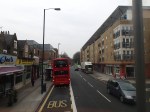
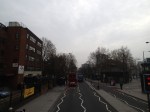

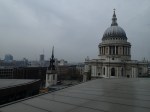
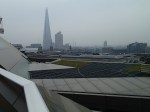


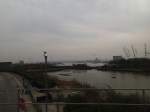
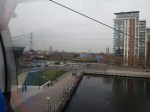

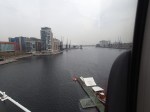

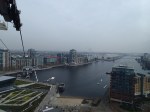

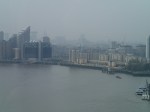
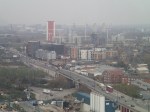

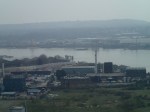

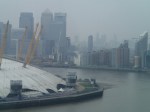
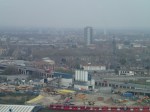
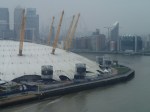
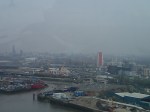

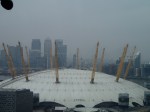
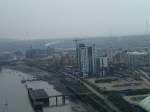

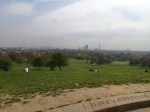

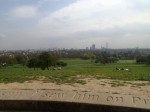
I started by taking a 56 bus, which is one of the Dalston omnibuses, to St. Paul’s, where I mounted on One New Change.
I then took the DLR from Bank to Royal Victoria, from where I took the cable car to North Greenwich.
I finished the journey by taking the Underground to Chalk Farm from where I walked to the top of Primrose Hill.
I also found this page on the DEFRA web site, which gives a pollution forecast.
British Coal In A British Grate
This phrase was quoted in an article in The Times today by David Aaronovitch, where he likens the arguments of those who don’t believe in climate change, global warming and renewable energy, with those who were against the Clean Air Act of 1956. The MP for Bromsgrove, Michael Higgs was the opponent of the Act, who Aaronovitch quoted.
I can remember the smogs of that time and they weren’t pleasant. The only good thing was that we got sent home early from my primary school; de Bohun in Southgate. Teachers would organise us into groups and put a responsible ten or eleven year old in charge. Our parents didn’t know we were coming home, but then most mothers didn’t work in the 1950s.
I don’t think they’d do that now!

