125 mph Upgrade For MML OLE South Of Bedford
The title of this post, is the same as that of an article in the June 2023 Edition of Modern Railways.
This is the sub-heading.
Targeted Investment Benefits From Project SPEED Approach
The main objective was to upgrade the 1980s electrification between Bedford and St. Pancras, so that it could support 125 mph running by East Midlands Railway’s new Class 810 trains.
Originally, a total replacement was envisaged, but in the end a more selective approach will be carried out.
This paragraph indicates the benefits of the approach.
The proposal for wholesale replacement of the OLE South of Bedford would have cost several hundreds of millions of pounds, whereas the approved scheme comes in at just £84 million, around one-third of the previous cost – testament to the application of SPEED principles.
I have a couple of thoughts.
Network Rail’s Project Management
If I go back to the 1970s and 1980s, when we were developing and selling the project management system; Artemis to the world, we sold very few systems to the UK Government and none to British Rail or the NHS. Later Artemis was used on the Channel Tunnel and the Rail Link to London, the Jubilee Line Extension, sections of the Docklands Light Railway and railways in Australia and Hong Kong.
So it is good to see, Network Rail getting to grips with managing the electrification upgrade of the Midland Main Line with some good project management.
An Encounter With A Group Of Drivers
It might have been five years ago, when I travelled with a group of drivers from East Midlands Trains positioning to St. Pancras.
- One of the observations they had was that the Class 700 trains coming into service were not fast enough as they were only 100 mph trains, whereas their Class 222 trains were capable of 125 mph.
- Since then the Class 360 trains have been introduced on Corby services. These trains have been uprated from 100 to 110 mph.
- We now have the situation, where Class 810 trains capable of running at 125 mph will replace the Class 222 train.
If you look at the traffic at West Hampstead Thameslink station, you can see that Both Thameslink and East Midlands Railway are using the fast lines, through platforms 3 and 4.
The fast lines have a maximum speed of 125 mph North of Luton and generally 100-110 mph between Luton and West Hampstead Thameslink station.
Would it help the timetabling of services on the Midland Main Line, if the Thameslink services were capable of running faster, when they were using the fast lines?
I feel the drivers may have a point.
Devizes Station Would Need To Be Part Of Wider Rail Plan
The title of this post, is the same as that of this article on Railway Gazette.
These two paragraphs outline the current status.
The construction of a Devizes Gateway station at Lydeway is unlikely to represent value for money as a standalone project, but it could be viable as part of a wider rail improvement programme, a study has concluded.
The feasibility study undertaken by Wiltshire Council, Devizes Development Partnership, GWR and Network Rail built on a strategic outline business case submitted to the Department for Transport under the Restoring Your Railway Fund programme in November 2021.
The Department for Transport will now decide what to do next.
I think there are other issues on the route between Reading and Taunton.
The Current Train Service
The only passenger services using the Reading and Taunton route are these three trains, which all have a frequency of one train per two hours (tp2h).
- London Paddington and Exeter St. Davids – Calling at Reading, Newbury, Hungerford, Pewsey, Westbury, Castle Cary, Taunton and Tiverton Parkway
- London Paddington and Plymouth – Calling at Reading, Taunton, Tiverton Parkway and Exeter St Davids
- London Paddington and Penzance – Calling at Reading, Taunton, Tiverton Parkway and Exeter St Davids
Note.
- London Paddington and Exeter St. Davids takes a few minutes over two hours.
- London Paddington and Plymouth takes a few minutes over three hours.
- London Paddington and Penzance takes a few minutes over five hours.
- The Reading and Taunton route is a double-track railway with a 110 mph operating speed.
- London Paddington and Newbury is electrified.
- The last two trains alternate to give Plymouth an hourly service.
- After Exeter St. Davids, trains have a sophisticated stopping pattern to give all stations served a good service.
From several trips along the line, I have the impression, that it’s a route, where drivers can get the best out of the trains.
Electrification
The line would benefit from electrification, in terms of journey times and decarbonisation.
But could this route be run by battery-electric trains?
- It is 89.7 miles between Newbury and Taunton.
- It is 120.4 miles between Newbury and Exeter St. Davids.
- It is 52.1 miles between Exeter St. Davids and Plymouth.
- It is 79.4 miles between Plymouth and Penzance.
- London Paddington and Newbury is electrified.
- Taunton, Exeter St. Davids, Plymouth and Penzance stations could have a charging system of some sort.
This Hitachi infographic shows the specification of the Hitachi Intercity Tri-Mode Battery Train.

Consider.
- Two trains go between Newbury and Taunton without stopping.
- The Exeter St. Davids service stops three times.
- Newbury and Taunton non-stop took 75 minutes at an average speed of 72 mph
- Newbury and Taunton with three stops took 78 minutes.
- All trains currently appear to be nine cars.
I suspect that Hitachi’s Intercity Tri-Mode Battery Train could go between Newbury and Taunton with a great deal of ease.
How many diesel engines and batteries would the train have?
Normally, nine-car Class 800/802 trains have five diesel engines.
So how many will be replaced by batteries?
The infographic says one engine will be replaced, so if that is a five-car train, it looks likely that a nine-car train could have two batteries.
But Hitachi could be playing a long game!
In Stadler FLIRT Akku Battery Train Demonstrates 185km Range, I wrote about how the FLIRT Akku has a range of 115 miles.
If Hitachi can squeeze 125 miles out of a nine-car Class 800 with two or three battery packs, they will outrange the FLIRT Akku and be able to run between London Paddington and Penzance on batteries, with some topping up on the way.
We mustn’t forget the engineers at Hyperdrive Innovation, who are designing and building Hitachi’s battery packs.
They will be ultracompetitive and know the range required to get battery-electric trains to Penzance.
I suspect that when the range of the nine-car battery-electric Class 800/802 is revealed, it will astonish everybody!
Bedwyn Station
Bedwyn station is served by an hourly shuttle train to and from Newbury, run by a diesel train.
The station used to have a direct service from London, but now passengers change at Newbury.
A Station For Marlborough
I investigated this in A Station For Marlborough, where this was my conclusion.
With the next generation of electric train with onboard energy storage or IPEMUs, a Marlborough station on a new Marlborough Branch Line can be used to create a two tph service to and from Paddington to replace the current one tph service from Bedwyn.
So a new Marlborough station would be a win for all those using stations on the Reading to Taunton Line to the East of Pewsey.
I also wonder how many other similar services can be developed by extending a service past a main line terminal to a new or reopened branch line, which is built without electrification and run using trains with onboard energy storage.
In answer to my posed question in the last paragraph, I suspect it is quite a few!
Devizes Gateway Station At Lydeway
I wrote about this proposed Devizes Gateway station in Reinstatement Of Rail Access To Devizes Via A New Station At Lydeway.
After writing Was Baldrick An Essex Man? about the building of an avoiding line at the new Beaulieu Park station North of Chelmsford, I do wonder, if it would be an idea to incorporate one in this proposed station, if there is a need to increase capacity.
This Google Map shows the station site, where the A342 crosses the railway.

I suspect a third track can be squeezed in.
Westbury Station
Westbury station is a busy station, where the Reading and Taunton Line crosses the Wessex Main Line.
This map from OpenRailwayMap shows the lines in the station.

Note.
- The blue lettering indicates Westbury station.
- The two major rail routes are shown in orange.
- The Reading and Taunton Line goes East-West across the map.
- Note the avoiding line South of Westbury station.
- Reading is in the East and Taunton is in the West.
- The Wessex Main Line goes North-South across the map.
- Bristol is in the North.
- Salisbury and Southampton is in the South.
In Westbury Station – 30th July 2020, there are some pictures I took of Westbury station.
This section in Wikipedia says this about the Future of Westbury station.
The line to Westbury is not due to be electrified as part of the 21st-century modernisation of the Great Western Main Line. Although local councillors support it, the extension of electrification beyond Newbury to Westbury was assessed as having a benefit–cost ratio of only 0.31.
On the other hand this document on the Network Rail web site, which is entitled the Devizes Gateway Interim
Feasibility Study, suggests that another platform might be added at Westbury station.
Castle Cary Station
Castle Cary station doesn’t seem to have any well-publicised problems, so please tell me if you know of any.
Frome Station
Frome station is described in its Wikipedia entry as an unusual station and one that is Grade II Listed.
I suspect, it could do with some more services.
Somerton Station
I wrote about a new Somerton station in Somerset: Plans For New Railway Station On Levels.
Track Improvements
I suspect if Network Rail were improving the route between Reading and Taunton, they know of some places, where they could do some work.
Service Improvements
Consider.
- There is probably a need for a stopping train between Newbury and Taunton, which calls at all stations.
- It might terminate at the London end, at either London Paddington or Reading.
- It might be a battery-electric train.
- An hourly frequency would be ideal, if the track and signalling could handle it.
- Charging systems would be positioned as needed.
The train would interface with other Great Western services to Bristol, London Paddington, Gloucester, Salisbury, Southampton and Weymouth.
Oy could also interface with the Transwilts services.
Conclusion
This could be developed into a very useful network for Wessex.
Work Underway At Motspur Park Station In South London
The title of this post, is the same as that of this article on Rail Business Daily.
These two paragraphs outline the project.
Network Rail has announced that £8.9 million is being invested in new lifts and walkways installed among other upgrades at Motspur Park station in south London.
Network Rail is working with South Western Railway and the London Borough of Merton Council to install a step free footbridge as part of the Government’s Access for All programme, funded by the Department for Transport (DfT).
I visited the station this morning and took these pictures.


Note.
- When Motspur Park station was built in 1925, I must assume that there were no persons of restricted mobility.
- According to some commentators, it sounds like Network Rail and its partners are going for a complete rebuild.
- Did the Woodworm Preservation Society protest at the new design?
- Some new trains to serve the station would surely help too!
It should open in early 2024.
I shall be interested to see how the new station alters passenger numbers.
Was Baldrick An Essex Man?
I have been looking at Network Rail’s page for Beaulieu Park station.
This is the heading.
Network Rail and Essex County Council are working together to develop proposals for the first railway station to be built on the Great Eastern main line for over 100 years.
These two paragraphs outline the project and where the finance is being obtained.
The new station is part of a wider regeneration of the Beaulieu Park estate in Chelmsford with new road infrastructure and up to 14,000 homes.
Essex County Council, in partnership with Chelmsford City Council, successfully secured £218m of funding from the Government’s Housing and Infrastructure (HIF) fund together with £34m contributions from the South East Local Enterprise Partnership and the developers of Beaulieu, Countryside and L&Q.
These features of Beaulieu Park station are listed on the page.
- Three platforms with a central loop line and new tracks to enable stopping services to call at the station while allowing fast trains to pass through unimpeded
- Step free access to all platforms via 2 lifts
- Accessible toilets, baby change facilities, waiting area and space for retail/catering
- Ticketing facilities, with ticket vending machines and a gate line
- Pedestrian and cycle access routes to the station
- 500 spaces for cycle parking and storage
- A bus interchange including bus stands for local services
- Pick up and drop off area with dedicated taxi bays
- Parking for over 700 cars, 5% of which to be designated Blue Badge bays, and motorcycle spaces, as well as dedicated parking for station staff, emergency services, and a dedicated space for service access.
Note.
- How many other parkway stations, other than Ebbsfleet International station have 700 parking spaces?
- The parking at Whittlesford Parkway can only hold 377 vehicles.
- How many other parkway stations have an overtaking loop for faster trains?
Beaulieu Park is not your average parkway station!
I have a few thoughts.
Which Of The Current Services Will Call?
The Network Rail page says this about services.
It will provide additional access to the railway with regular connections to the capital (only 40 minutes from London Liverpool Street station) and other destinations in the east of England. New tracks will enable stopping services to call at the station while allowing fast trains to pass through unimpeded.
Note.
- Trains between London and Hatfield Peverel station typically take under forty minutes.
- Two fast trains per hour (tph) between Liverpool Street and Norwich via Colchester, Ipswich and Stowmarket pass through.
- Only one of the fast trains stops at Chelmsford.
- Four stopping tph, one to each of Braintree, Clacton-on-Sea, Colchester Town and Ipswich pass through.
If all the stopping trains stopped, Beaulieu Park would have the following services.
- Braintree – 1 tph
- Chelmsford – 4 tph
- Clacton-on-Sea – 1 tph
- Colchester – 3 tph
- Colchester Town – 1 tph
- Hatfield Peverel – 1 tph
- Ingatestone – 2 tph
- Ipswich – 1 tph
- Kelvedon – 2 tph
- London Liverpool Street – 4 tph
- Marks Tey – 2 tph
- Romford – 1 tph
- Shenfield – 3 tph
- Stratford – 4 tph
- Witham – 4 tph
All trains are new Class 720 electric trains.
I also feel, that Network Rail could be being cunning.
Suppose, the Liverpool Street and Norwich express, that doesn’t stop at Chelmsford, stopped instead at Beaulieu Park.
- This would give an hourly express service between Beaulieu Park and Norwich, which stopped at Colchester, Manningtree, Ipswich, Stowmarket and Diss.
- It would also enable two tph between Beaulieu Park and Ipswich.
The 700 parking spaces at Beaulieu Park now start to make sense.
- Both Ipswich and Norwich stations are within walking distance of the town centres and the football grounds.
- Ipswich station has a shuttle bus service to the town centre and the hospital.
- Both stations have several local train services.
Beaulieu Park station appears to have been designed as a Park-and-Ride station for the Great Eastern Main Line and all its branches.
Services To And From Lowestoft
In Making Sense Of The New East Anglia Franchise, I looked in detail at Greater Anglia’s promises.
In a section, which is entitled London – Lowestoft – Yarmouth Services, I said this.
There are going to be four direct services between London and Lowestoft each day. This probably initially means two trains to London in the morning peak and two trains back in the evening one.
When, I first moved back to Suffolk in the 1970s, I regularly caught a diesel-hauled train from Wickham Market to London for the day.
This is all motherhood and apple pie for those in Lowestoft wanting to go to London, but I suspect it isn’t the easiest service for a train operator to schedule efficiently and make money.
Would a train operator really want to start a full train at Lowestoft at say six in the morning and then have it wait around all day in London before returning in the evening?
The service hasn’t started.
Services To And From Cambridge Or Peterborough
At some time in the last decade, one of the predecessors of Greater Anglia, used to run a service to Peterborough via Colchester and Ipswich, so that travellers in Essex could catch trains to the North.
Given too that Cambridge has an employment problem, if a service was run, it might attract passengers.
The Class 755 trains Could Serve Bury St. Edmunds, Cambridge, Lowestoft, Newmarket, Peterborough And Yarmouth
Consider.
- A pair of Class 755 trains would leave Liverpool Street.
- They would use electric power to run to Ipswich.
- The trains would run in one of the paths of the current hourly Ipswich service.
- Like their all electric siblings; the Class 745 trains, they would probably run most of the journey at near 100 mph.
- At Ipswich the trains would split.
- One train would go to on to Lowestoft and Yarmouth and the other would go to Cambridge and Peterborough.
If passenger numbers felt it was a good idea, I’m certain, it could be timetabled.
The Chelmsford Avoiding Line
In Will The Chelmsford Avoiding Line Be Rebuilt?, I described the avoiding line, that used to be between the two tracks at Chelmsford station.
It probably saved a few minutes, by allowing fast expresses to pass stopping trains.
Effectively, a new avoiding line is being built at Beaulieu Park, a few miles from the original position at Chelmsford.
So will the fast expresses save a few minutes?
Could The Elizabeth Line Run To Beaulieu Park?
Consider
- The end sections of the Elizabeth Line seem to be busy, as I wrote in Very Busy Lizzie.
- The City of Chelmsford is between Shenfield and Beaulieu Park.
- Paddington and Reading is 35.9 miles.
- Liverpool Street and Hatfield Peverel is 35.9 miles.
So Beaulieu Park is actually closer to London than Reading.
Perhaps, at some time in a few years, passenger traffic between Beaulieu Park and Shenfield will be such, that the Elizabeth Line will be extended to Beaulieu Park.
The ideal service from Beaulieu Park would surely be two tph to Heathrow, as getting to Heathrow from East Anglia by train needs a change at Liverpool Street.
The only drawback is that to work effectively on the Great Eastern Main Line, a sub-variant of the Class 345 trains will be needed with a 100 mph operating speed. I wrote about these trains in Extending The Elizabeth Line – High Speed Trains On The Elizabeth Line.
But they may have the advantage of being able to take the fast lines between Shenfield and Stratford.
Conclusion
Beaulieu Park may just look like any other station to serve a housing development.
But it’s a lot more than that!
- It’s a Park-and-Ride for the whole Great Eastern Main Line and London.
- It should speed up expresses between London and Colchester, Ipswich or Norwich.
- It should improve local connectivity.
- It could take a lot of traffic off the nearby A12.
- It could give the City of Chelmsford its own local metro.
- It could give Heathrow a direct link to much of Essex.
- How much carbon will be saved by passengers?
We need many more well thought out Park-and-Ride stations.
Platform Canopies To Be Renovated For Passengers At Lancaster Station
The title of this post is the same as that of this press release from Network Rail.
These are the first two paragraphs.
Station platform canopies are being renovated at Lancaster to improve passenger journeys on the West Coast Main Line.
Network Rail is investing £9.5m to restore and upgrade the station building for the future.
This picture from Network Rail shows an aerial view of the station.

Note that the camera is looking South.
This picture shows the current canopies.

Network Rail can surely do better on a Grade II Listed Building.
The press release lists that this work will be done.
- Replacing all glazing in the platform canopies
- Repairing and strengthening the structure of the canopy structures
- Repainting across the station
The press release says the work won’t affect train services, but will be done when trains aren’t running.
These are my thoughts.
Lancaster Station and High Speed Two
Lancaster station will be a terminus on the High Speed Two Network.
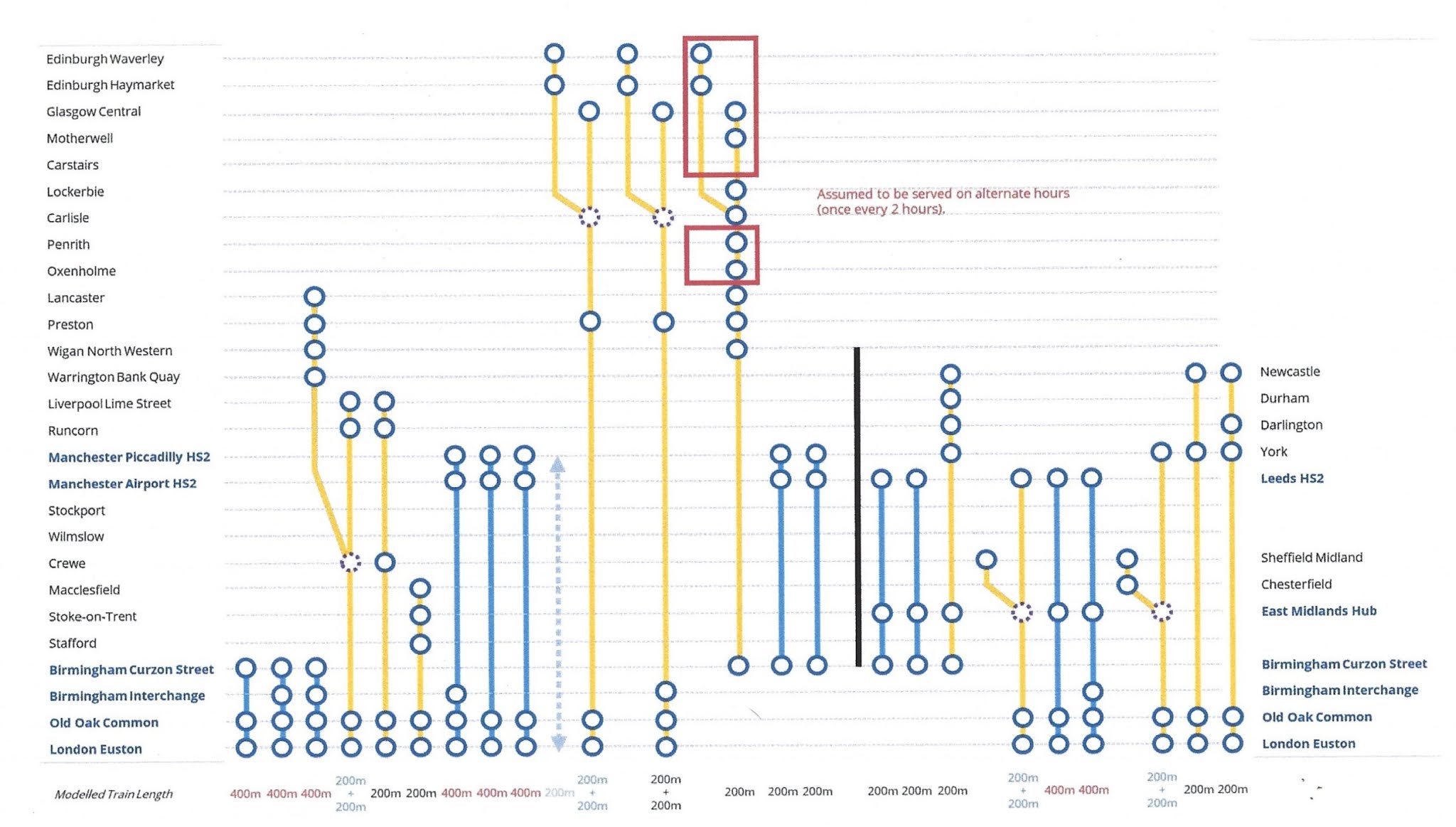
Note.
- Train 4 , which is a pair of 200 metre High Speed Classic Compatible trains, leaves London Euston and splits at Crewe, with one train going to Liverpool Lime Street and the other to Lancaster.
- Train 12, which runs between Birmingham Curzon Street and Scotland, also calls at Lancaster.
Both trains will be single 200 metre High Speed Classic Compatible trains at Lancaster station and platforms 3, 4 and 5 can handle them.
But how will the Lancaster train terminate?
This map from OpenRailwayMap shows the lines through Lancaster station.
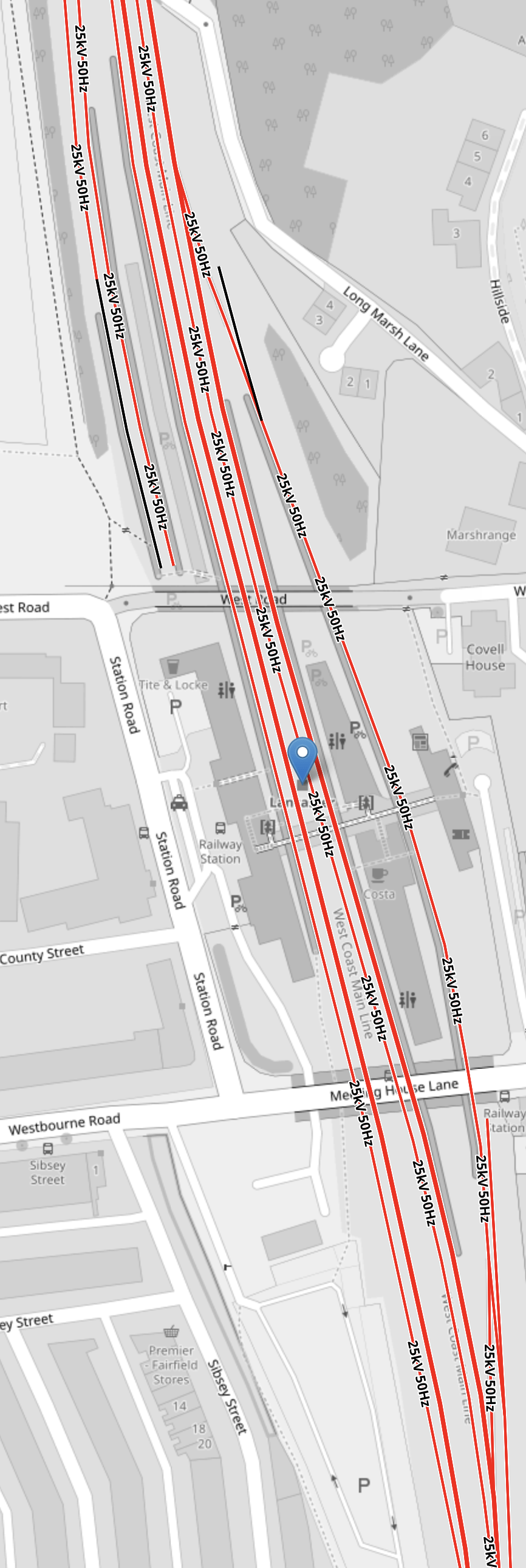
Note.
- The red lines are electrified with 25 KVAC overhead wires.
- In the North-West corner of the station are the bay platforms 1 and 2, which handle Morecambe services.
- West Coast Main Line services between London Euston and Scotland, go through platforms 3 and 4 in the middle of the station.
- On the East side of the station is platform 5 which is on a loop off the West Coast Main Line.
I would expect that the London Euston and Lancaster service will generally terminate in platform 5.
Wikipedia says this about platform 5 and the signalling.
Platform 5, which can be used by both northbound and southbound trains or by terminating services.
All platforms are signalled for arrivals and departures in either direction.
That all sounds very convenient.
There may be some minor changes for the longer High Speed Two trains, but I doubt it would be too challenging.
Onward To Morecambe
The Eden Project North at Morecambe could attract a lot of traffic.
- Lancaster will be just two hours and three minutes from London by High Speed Two.
- There are numerous rail connections from Lancaster to all over the North of England and Scotland.
- Would you drive for two hours to the Eden Project North, if there was a convenient and quicker train?
- Train companies may offer combined tickets for the attraction with rail tickets.
Wikipedia says this about the development and opening of the attraction.
Having been granted planning permission in January 2022 and with £50 million of levelling-up funding granted in January 2023, it is due to open in 2024 and predicted to benefit the North West economy by £200 million per year.
I’ve always wanted to go to the Eden Project in Cornwall, but it’s difficult if you don’t drive.
However, I might manage to get to Eden Project North.
Trains between Morecambe and Lancaster are at least hourly.
- I think they can use any platform at Lancaster.
- Morecambe station has two platforms.
- Morecambe and Lancaster stations are four miles apart, with probably half electrified.
- A battery-electric train could work between Morecambe and Lancaster.
I can envisage two main ways to arrange the connection between Morecambe and Lancaster.
- Trains arrive in Lancaster and passengers for Morecambe catch the next Morecambe train for two stops, that take ten minutes.
- When High Speed Two serves Lancaster from Euston, the shuttle train can wait in the Northern end of Platform 5 and when the High Speed Two train arrives passengers can just walk up the platform to the shuttle.
But if the Eden Project North is as successful as the Cornish original, there is going to be a need for more trains between Morecambe and Lancaster.
This Google Map shows Morecambe station.

Note that the island platform is probably about 160 metres long.
This would accommodate.
- A five-car Class 802 or Class 805 train.
- A pair of four-car Class 319, Class 321 trains.
- A pair of three-car Class 331 trains.
But why not be bold and lengthen at least one platform to the full two hundred metres, so that it can accommodate a High Speed Classic Compatible train?
This would also accommodate.
- A seven-car Class 807 train.
- A pair of four-car Class 331 trains.
All of these electric trains would need the Morecambe branch line to be electrified to Morecambe station.
But the Eden Project North would get the public transport access it needs.
Electrifying To Morecambe
This map from OpenRailwayMap, shows the Morecambe Branch Line between the West Coast Main Line and Morecambe station.
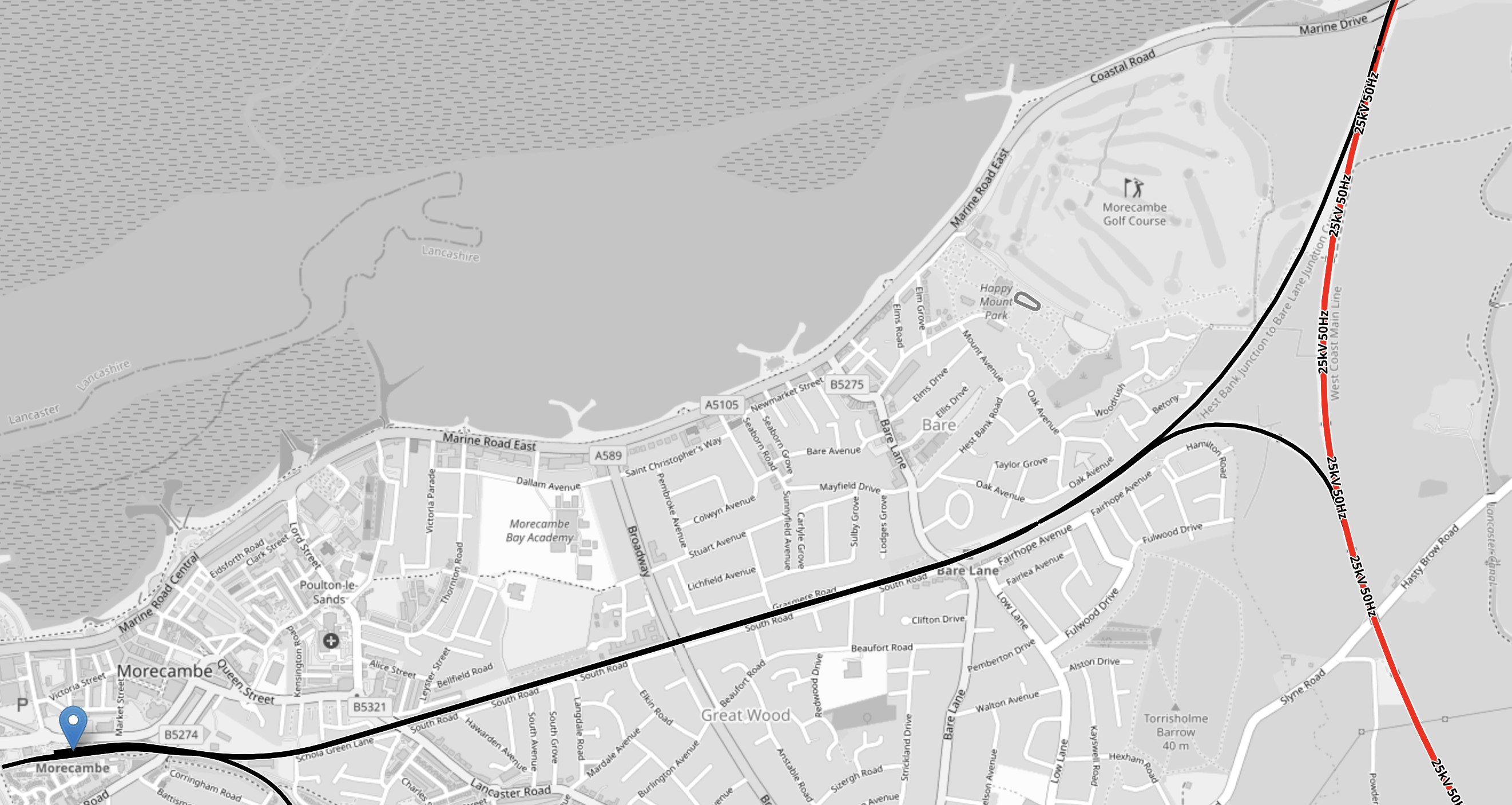
Note.
- The tracks shown in red on the Eastern side of the map are the West Coast Main Line.
- The black lines are the unelectrified tracks of the Morecambe branch line.
- Morecambe station is marked by the blue arrow.
- Much of the Morecambe branch line is single track, with some sections of double track.
- The distance between the West Coast Main Line and Morecambe station is around 2.1 miles.
I don’t think it would be the most challenging of electrifications.
A Green Route To The Isle Of Man And Ireland
This map from OpenRailwayMap, shows the terminal of the Morecambe Branch Line at Heysham Port.

Note.
- There is a rail connection to the West Coast Main Line via Morecambe, which is shown in yellow.
- The port appears to have three berths for ferries.
- There are only a couple of train services per day.
- South of the port is the Heysham nuclear power station, which has a capacity of 2.5 GW.
At a first glance, it would appear, that a rail-served passenger terminal could be built close to the port.
I suspect most passengers using Heysham are travelling with a vehicle.
The problem is also that the ferry crossing to Belfast takes around eight hours and there are faster and more convenient routes.
The ferries could be decarbonised by using ammonia or hydrogen fuel, but I doubt that they would be any faster.
I suspect that getting more passengers to use Heysham for the Isle of Man or Ireland will be a difficult proposition to sell to passengers.
And it is made even more difficult with such an infrequent train service.
Before High Speed Two
Avanti West Coast might like to run a train between Euston and Morecambe for the Eden Project North.
Are National Rail Promoting Theme Parks?
I found this page on the National Rail web site, which is entitled Theme Parks.
It gives a list of most theme parks and their nearest stations.
Does such a page exist for hospitals, cathedrals and other similar groups.
‘Lift-off’ – Project To Provide Step-Free Access At Bexley Station In Kent Kicked Off In February
The title of this post is the same as that of this press release from Network Rail.
This is the sub-heading.
Network Rail has kicked off construction of a new footbridge and lifts at Bexley station which will provide passengers with a fully accessible station.
These four paragraphs outline the scheme.
This project, which is funded through the Department of Transport’s (DfT) ‘Access for All’ scheme, is expected to be completed in late spring 2024 and will ensure there is step-free access to all of the station’s platforms.
Network Rail will be working with contractors BAM Nuttall to install two 16-person capacity lifts which will be located behind the existing subway and help passengers with impaired mobility or those travelling with luggage, children, or cycles to access the platforms.
Platform one will be widened to create space for the lifts and allow passengers to navigate through the station a lot easier.
Alongside this, a new footbridge will be built to allow passengers easily get from one side of the platform to the other.
I’m surprised that lifts are being added to the existing subway, rather than being added to the new footbridge.
Looking at the statistics for Bexley and nearby stations, I suspect that Bexley station has more traffic.
This Google Map shows Bexley station.

As there appears to be a lot more housing and the car park to the North of the railway, I suspect there’s a lot of crossing of the railway by passengers.
So it does seem that Network Rail have designed scheme for the number of passengers, which is something Transport for London haven’t done with the buses, where I live.
On a visit to the station on the 14th of March, I took these pictures.


This is a Network Rail visualisation of how it will look.

The visualisation is looking towards the East.
TfL Considers Replacing Over Half Of London Overground Trains Within The Next 4 Years
The title of this post, is the same as that of this article on MyLondon.
This is the sub-heading.
The trains were specially built for the dimensions of the Overground network
This paragraph outlines, why the trains may be replaced.
The 57 Class 378 ‘Capitalstar’ trains which provide the majority of services on London Overground could disappear as soon as June 2027, as Transport for London (TfL) officials decide what to do with them as their leases expire. The five carriage walkthrough trains have helped revolutionise the Overground network, being built to special dimensions to fit the unique profile of the suburban routes they run on – notably the East London line, where trains use the narrow single-bore Thames Tunnels.
Note.
- The Class 378 trains, which I use regularly, still seem to be performing well!
- They could do with a lick of paint and a tidying up in places.
- Would it be too much to ask for power sockets and wi-fi?
- The other London Overground trains, the Class 710 trains can’t run through the Thames Tunnel on the East London Line, as they have no means to evacuate passengers in the tunnel in an emergency.
- More Class 378 trains are needed for the East London Line to increase services, but these can be obtained by transferring trains from the North London Line and replacing those with new Class 710 trains.
I live near the two Dalston stations on the London Overground and the thing we need most is more capacity.
I have some thoughts on London Overground’s future trains.
Increased Services On The Current Network
Plans exist to increase the frequency on various London Overground services and this graphic sums up what was planned a few years ago.
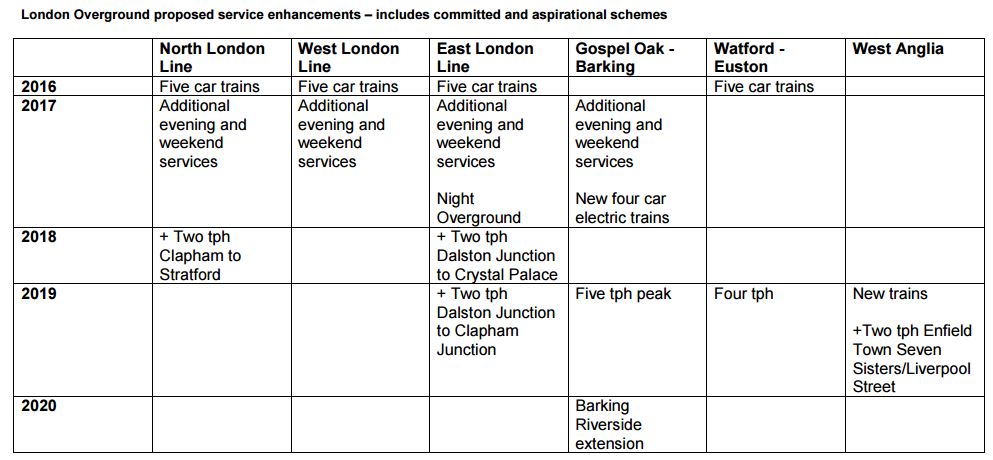
Note the extra two trains per hour (tph) between the following stations.
- Clapham Junction and Stratford
- Dalston Junction and Crystal Palace
- Dalston Junction and Clapham Junction
- Enfield Town and Liverpool St. via Seven Sisters
I think only Route 1 services have been increased.
I know signalling updates are holding up the extra trains on the East London Line, but are more trains needed to fully implement the extra services?
- Routes 2 and 3 services will need Class 378 trains because of the tunnel and these would be transferred from the North London Line.
- Route 4 would need Class 710 trains, as the service already uses them.
So there may be a need for more Class 710 trains.
West London Orbital Railway
The graphic doesn’t mention the West London Orbital Railway.
- There would be two routes between West Hampstead and Hounslow and Hendon and Kew Bridge using the Dudding Hill Line.
- The tracks already exist.
- Some new platforms and stations would be needed.
- The route would probably need improved signalling.
- Four tph on both routes would probably be possible.
- The West London Orbital Railway would connect to the Great Western Railway, the North London and Elizabeth Lines and High Speed Two at Old Oak Common station.
I believe it could be run by battery-electric versions of either the Class 378 or Class 710 trains. This would avoid electrification.
As some commentators have suggested that the West London Orbital Railway and the Gospel Oak and Barking Line would be connected, I would expect that new battery-electric Class 710 trains would be used.
Adding On-board Energy Storage To The Class 378 Trains
In Will London Overground Fit On-board Energy Storage To Class 378 Trains?, I asked whether it would be worthwhile.
I finished with these two sentences.
I have no idea how much electricity would be saved by regenerative braking on the London Overground, but various applications of regenerative braking technology talk of electricity savings of between ten and twenty percent.
I think it is only a matter of time before the technology is proven to be sufficiently reliable and the numbers add up correctly for the Class 378 trains to be fitted with on-board energy storage.
What would be the advantages from fitting on-board energy storage?
- There would be the savings of electricity by the use of regenerative braking to the batteries.
- Trains could be rescued from the Thames Tunnel, if there was a power failure.
- Hotel power would be maintained, if there was a power failure.
- Trains can be moved in depots and sidings without power.
- Trains would be able to move in the event of cable theft.
- Short route extensions might be possible.
- Could battery power be used to serve Euston during the rebuilding process for High Speed Two?
- Do Network Rail want to remove third-rail electrification from Euston station for safety or cost reasons?
There could be a saving in train operating costs.
We know the trains are coming up for a new lease.
Suppose the leasing company fitted them with new batteries and some other customer-friendly improvements like new seat covers, better displays, litter bins, power sockets and wi-fi.
- The leasing company would be able to charge more, as they have added value to the trains.
- TfL would be saving money due to less of an electricity bill.
- The passenger numbers might increase due to the extra customer-friendly features.
- Electrification might be removed from places where theft is a problem.
- Third-rail electrification could be removed from Euston station. It’s only 2.8 miles to South Hampstead station, where third-rail electrification already exists.
Get it right and passengers, TfL, Network Rail and the leasing company would all be winners.
The Hook Landslip
This page on the South Western Railway web site is called Landslip Near Hook.
This is the operator’s explanation about what happened and their solution.
Over the weekend of Saturday 14 and Sunday 15 January, heavy rain caused part of a railway embankment to collapse between Hook and Winchfield stations on the South West Main Line, which connects London Waterloo with Basingstoke.
The landslip took place on a very busy part of our route. On a normal weekday morning, around 13 trains per hour run through this section, with services between London Waterloo and Basingstoke, Exeter St Davids, Portsmouth Harbour (via Eastleigh), Salisbury, Southampton Central, Winchester and Weymouth.
The landslip left a 44-metre stretch of track suspended in mid-air and only one of the four tracks available for trains to run on. This severely restricted the number of services we could run between Basingstoke and Woking.
Initial repairs by Network Rail on Saturday 21 and Sunday 22 increased the number of trains that we could run to six per hour, however they were still unable to call at Hook from the direction of London.
Network Rail intend to fully complete their repairs by Friday 24 February, and restore services to Hook in the direction of Basingstoke from Monday 13 February.
To do this, engineers will require more access to the railway between Farnborough and Basingstoke overnight. Normally the last service to run between these stations is at around 0100, but to give engineers the time they need, services will now have to end by 2220.
I passes the site today and took these pictures.


Note.
- Network Rail had to build quite a long roadway to access the site.
- Judging by the site full of portacabins, there were a lot of people working on the site.
- There was even someone working on a Sunday.
- The information board was in the subway at Basingstoke station.
- The pictures would have better, if the sun had been in a different direction.
Network Rail have to manage a lot of embankments like this.
Disused Railway Land In Lowestoft Gets A New Lease Of Life
The title of this post, is the same as that of this article on Rail Advent.
This is the sub-heading.
The land has been cleared and 30 willow trees planted by a Network Rail team in a bid to increase biodiversity.
I can see many small pieces of land getting a similar treatment.
Construction Of New Cameron Bridge Station Begins
The title of this post, is the same as that of this press release from Network Rail.
These four paragraphs outline the work.
Network Rail has started work to build the new Cameron Bridge station
Cameron Bridge, one of two new stations which will be built on the £116m Scottish Government Levenmouth Rail Link project, will boast two platforms with a connecting footbridge and lifts.
It will serve the western end of the line connecting the communities of Cameron Bridge and Methilhill to the rail network for the first time in more than five decades as well as serving as a ‘park and ride’ facility for communities across the East Neuk of Fife.
Located southeast of Windygates just off the A915, the new station will have 125 car parking spaces with provision for EV charging, accessible spaces and cycle storage.
The Levenmouth Rail Link is planned to open in Spring 2024