Polanski And Farage Don’t Agree. But They Have More In Common Than You Might Think
The title of this post, is the same as that of this article on the BBC, by Laura Kuenssberg.
It is very much a must read article comparing two of the most controversial party leaders in the UK.
This is the sub-heading.
One is a former stockbroker from the south who, by his own proud admission, loves smoking, drinking and women. The other’s a proud vegan, gay, northern former actor, who told me he’d never drunk a drop.
These first three paragraphs add detail to the story.
But the jubilant Zack Polanski and Nigel Farage have rather a lot in common.
Before you scream, burst out laughing, or think I have lost my marbles, of course, there are very big differences between them.
The Greens talk about a climate emergency. Reform UK calls the government green plans, “net stupid zero”.
This is Laura’s summing up of the Terrible Twins.
Their views on the cause of Britain’s pain vary wildly.
The Greens might point the finger at the super-rich, the “donor billionaires” they often cite. Reform often blames immigration, which they controversially characterise as an “invasion” of people arriving in the UK without permission.
But both parties feed off and stir up sentiment that’s felt by lots of the public: that Britain doesn’t work any more.
Whether it’s the new Green MP saying “working hard used to get you something” in her victory speech, or Nigel Farage repeatedly telling us “Britain is broken”, the same argument flows from both: that the country is in such a dreadful state that only new political saviours can fix it.
And both Reform and the Greens are willing to push the conventions of what traditional UK politicians would find acceptable – or what they believe would make them electable.
That’s not just about their image or the unstuffy ways they court publicity – Nigel Farage willingly going into the I’m A Celebrity jungle, or Zack Polanski being seen on a dance floor in campaign videos – but how they choose to focus on sensitive issues, where others might not choose to tread.
I would disagree that Britain is broken, but that it needs someone with sensible policies that everybody can get behind.
The Greens policies on the super-rich would drive anybody with ambition and money from this country and already countries like Canada are advertising for migrants.
With two immigrant lines, Farage is everything my father thought was bad about Oswald Mosley and his fascists in the 1930s. If a Reform UK Government started rounding up illegal immigrants on the streets, the violence would probable be enormous.
How Much Renewable Energy Will The UK Be Generating By 2030?
I have to admit, that whether you like the Tories or not, they have developed an energy generation policy and an energy relationship with Germany, that appears to be working and is allowing the current Government to do a bit of spending on defence and other needs.
I asked Google AI, the question in the title of this section and received this reply.
The UK government has set an ambitious target to reach 95% low-carbon electricity generation by 2030, aiming for a system driven by 43-50 GW of offshore wind, 27-29 GW of onshore wind, and 45-47 GW of solar power. This plan aims to dramatically reduce fossil fuel reliance, supported by 23-27 GW of battery capacity.
Key 2030 Renewable Energy Projections & Targets:
Total Clean Power Goal: The goal is 95% of electricity from low-carbon sources (renewables and nuclear) by 2030, up from roughly 74% in 2024.
Offshore Wind: Target of 43-50 GW, deemed crucial to powering the grid.
Onshore Wind: Target of 27-29 GW, with recent policy changes lifting bans to accelerate development.
Solar Power: Target of 45-47 GW, aiming to triple current capacity.
Flexibility: 23-27 GW of battery capacity and 4-6 GW of long-duration storage are needed to manage intermittency.
Challenges and Forecasts:
Shortfall Risks: While the government target is high, some projections suggest wind and solar may only account for 44% of generation by 2030, requiring significant acceleration to reach the 95% clean goal.
Investment Needs: Achieving these goals requires an estimated £48 billion in additional investment, on top of planned projects.
Progress: In 2024, renewable sources already hit a record of over 50% in certain quarters, with low-carbon sources overall (including nuclear) providing nearly 70% of generation.
My Thoughts
I will add some of my thoughts.
Electricity Demand: As I write, according to National Grid: Live it is 33.3 GW, which is met by with Production of 27.1 GW and Transfers of 6.2 GW.
Electricity Production: In 2030, I believe that if the UK has long-term battery capacity of something like 4 GW/40 GWh, that total UK electricity production could be upwards of 125 GW.
Hinckley Point C Power Station: This should add 1.6 GW in 2030 and 2031 to further boost UK electricity production.
Pumped Storage Hydro: In How Much Pumped Storage Hydro Will Be Operational In The UK By 2030?, I estimate that the Bank of England standard of energy storage, will add 5 GW of electricity production.
Highview Power: Highview Power are developing long duration liquid-air energy storage and have identified locations for sixteen 300 MW/3.2 GWh monsters.
Excess Electricity Production: This will be exported, either as electricity or after conversion to hydrogen. It will be a Magic Money Forest for the victor of the General Election in 2029.
If Hinckley Point C, the pumped storage hydro and Highview Power’s batteries work as their engineers hope, then the result of the next General Election will be predictable.
It is certainly, Kier Starmer’s to win, by getting the energy right!
Highview Power And The 2029 General Election
Every extra GWh added to energy storage has the following affect.
It will mean that more wind farms will not have to be switched in times of high wind and over production, as the electricity can be stored.
At the present time, there are four ways of storing energy.
- Turn it into hydrogen. But the Hindenberg did a good PR job for not using hydrogen.
- Store it in a pumped storage hydro system, but these have problems with their large land use.
- Store it in a large lithium battery, but these have problems with fire risks and need a large amount of expensive lithium.
- Store it in one of Highview Power’s liquid air batteries.
I believe that Highview Power’s liquid-air long duration batteries, have several advantages.
- They are built from readily available components.
- They can be scaled to the need at the location, where they are installed.
- A small one is 50 MW/300 MWh and a large one is 300 MW/3.2 GWh.
- The batteries come with grid stabilisation and other features.
- The batteries have a lifespan of greater than 50 years
- The energy storage fluid, is captured from the air.
- They are a product, that would be easy to finance in quantity.
- Goldman Sachs is an investor.
- A village with a power problem could fund a Highview Power battery and have a nice little earner, with perhaps a wind turbine on a nearby hill.
- Centrica is an investor.
If a politician were to understand it, it could wind them the next General Election.
New Baltic Sea Interconnector On Horizon As Lithuania, Latvia, and Germany Plan Cross-Border Link
The title of this post, is the same as that of this article on offshoreWIND.biz.
This is the sub-heading.
Lithuania, Latvia, and Germany are planning a joint offshore interconnector that would enable electricity trading between the Baltic countries and Germany and allow for the integration of up to 2 GW of offshore wind capacity in Lithuania and Latvia
These first two paragraphs add more detail to the article.
The energy ministers of the three countries signed a joint declaration of intent on 18 February, paving the way for the development of the Baltic-German PowerLink interconnector, which would, in addition to electricity trading and offshore wind capacity integration, also enable the expansion of onshore renewable energy capacity.
The Lithuanian, Latvian, and German transmission system operators (TSOs) – Litgrid, Augstsprieguma tīkls and 50Hertz – agreed to assess the feasibility of the hybrid electricity interconnection.
As Germany, has the following connections under development in the West.
- AquaVentus to Aberdeen, Humberside, Denmark, Norway and The Netherlands.
- NeuConnect to the Isle of Grain In England.
- GriffinLink, which is an offshore link to England.
The Germans seem to be putting themselves at the centre of an energy distribution system, that has the capability to stabilise European and UK electricity for thousands of years. Especially, if the network grows to include more countries.
This paragraph says this about the Baltic-German PowerLink project.
The Baltic-German PowerLink project concept developed by Litgrid, Augstsprieguma tīkls, and 50Hertz includes a 2 GW, approximately 600 kilometres long hybrid offshore connection, with the connection point in the Baltic States planned to be on the border between Lithuania and Latvia. The exact location is to be determined after technical studies.
Note.
- The interconnectors may be long, but they are not longer than anything built successfully before in European waters.
- The UK and the Island of Ireland are well-linked.
- There would appear to be no need for challenging projects like the Morocco-UK Power Project
I suspect that Germany will get the energy it needs and the British Isles will get a nice little earner.
If Europe is generating large amounts of wind and solar energy with its variable output it will need lots of energy storage.
What Countries Have The Terrain For Pumped Storage Hydro In Europe?
I asked Google AI and received this answer.
Key countries with ideal, high-elevation terrain and significant existing or planned capacity include:
Alpine Region (The Heart of European Pumped Storage):
Switzerland: Extremely high capacity due to steep, mountainous landscapes and significant water sources, hosting the world’s oldest working pumped storage plant.
Austria: Heavily mountainous, it is a major player in PSH expansion and modernization.
France: Home to one of Europe’s largest, the Grand Maison hydroelectric power station.
Italy: Holds high capacity with numerous planned projects.
Germany: Strong existing infrastructure.
Southern Europe:
Spain: Features some of Europe’s largest plants (e.g., La Muela/Cortes-La Muela).
Portugal: Significant recent investment in large-scale projects like the Tâmega complex.
Other Potential Areas:
Norway: High potential due to its mountainous, water-rich terrain.
United Kingdom: High project volume currently under construction.
Balkans & Central Europe:
Countries like Bulgaria, Romania, and the Czech Republic have suitable terrain for further development.
These countries benefit from significant hydraulic head (steep drop) and natural or artificial reservoir potential, making them ideal for storing energy for peak consumption hours.
Note.
- As expected, the Alpine region is Top of the League.
- The UK is holding its own despite its small mountains.
- There is a lot of potential to be developed.
But then Electric Mountain in Snowdonia is certainly at the top table of pumped storage systems despite being built in the 1980s.
What Countries Have The Terrain For Hydrogen Storage In Europe?
I asked Google AI and received this answer.
Key European countries with suitable geological terrain—specifically salt caverns and depleted gas fields—for large-scale, underground hydrogen storage include Germany, the Netherlands, Denmark, the United Kingdom, and France. Other significant regions for storage potential include Spain, Hungary, and Austria, which are developing porous storage facilities.
Key Regions & Terrain Types:
Salt Caverns (North-Western Europe): Germany, the Netherlands, Denmark, France, and the UK have substantial salt deposits suitable for creating caverns, identified as cost-efficient for large-scale storage.
Depleted Gas Fields (Porous Rock): The Netherlands, Germany, and parts of Central/Southern Europe (Spain, Hungary) have significant capacity in existing porous storage, particularly in the North Sea region.
Specific Projects: Germany (Uniper’s Krummhörn project), Netherlands (HyStock), and France (HYPSTER at Etrez) are active, with Spain and Denmark emerging as major hydrogen hubs.
Capacity Potential: The Netherlands, for instance, holds massive potential (35-60 TWh) due to its offshore and onshore depleted fields.
Salt cavern projects, which offer high-deliverability storage, are heavily concentrated in the North-Western European industrial corridor.
I was lucky enough have a tour of ICI’s salt mine in Cheshire, when I worked there in the 1960s and I remember these facts from those days.
- There was enough salt in the ground under Cheshire to last several thousand years.
- Most salt was extracted from boreholes, for making chlorine using electrolysis and the Castner-Kellner process.
- Hydrogen was a by-product and much of it was mixed with coal gas to raise steam for the works.
The same technique used to make boreholes to extract the salt, is used to hollow caverns in the salt to store gases like hydrogen.
Once, when they were digging salt out of the salt mine at Winsford, a worker broke into an unmarked borehole and ICI nearly lost the mine because of the water rushing in.
Two stories stand out from the rescue of the mine.
- There was a need for dry clothes for all the workers, so ICI took a truck to Marks & Spencer in Northwich and emptied it of anything they might need. I was told the story enriched with plagues of locusts.
- A Ford Transit was found to have travelled a few thousand miles underground in axle deep salt slurry. Rather, than scrap it and buy another, it was offered back to Ford, who were delighted to swap it for a new one. I heard that Ford said, that the accelerated corrosion research would have taken many years, if done on the roads.
Always think out of the box.
Renewable Power By 2030 In The UK
I am doing this to see what the total output will be by the net election.
Offshore Wind Power
I shall start with offshore wind power.
- Operational in July 2025 – 16,035 MW
- 2025 – Dogger Bank A – 1,235 MW
- 2026 – Sofia – 1,400 MW
- 2026 – Dogger Bank B – 1,235 MW
- 2026 – East Anglia 1 North – 800 MW
- 2026 – East Anglia 3 – 1,372 MW
- 2027 – Dogger Bank C – 1,218 MW
- 2027 – Hornsea 3 – 2,852 MW
- 2027 – Inch Cape – 1,080 MW
- 2027 – Llŷr 1 – 100 MW
- 2027 – Llŷr 2 – 100 MW
- 2027 – Norfolk Boreas – 1,380 M
- 2027 – Whitecross – 100 MW
- 2028 – Aspen – 1008 MW
- 2028 – Morecambe – 480 MW
- 2028 – Ossian – 2,610 MW
- 2028 – Stromar – 900 MW
- 2029 – Beech – 1008 MW
- 2029 – East Anglia 2 – 967 MW
- 2029 – Green Volt – 400 MW
- 2029 – Mona – 1,500 MW
- 2029 – Morgan – 1,500 MW
- 2029 – Norfolk Vanguard East – 1,380 MW
- 2029 – Norfolk Vanguard West – 1,380 MW
- 2029 – North Falls – 504 MW
- 2029 – West of Orkney – 2,000 MW
- 2030 – Awel y Môr – 500 MW
- 2030 – Bellrock – 1,200 MW
- 2030 – Berwick Bank – 4,100 MW
- 2030 – Caledonia – 2,000 MW
- 2030 – Cedar – 1008 MW
- 2030 – Five Estuaries – 353 MW
- 2030 – Morven – 2,907 MW
- 2030 – N3 Project – 495 MW
- 2030 – Outer Dowsing – 1,500 MW
- 2030 – Rampion 2 Extension – 1,200 MW
This gives these yearly totals, if I use pessimistic dates.
- 2025 – 1,235 MW
- 2026 – 4,807 MW
- 2027 – 5,350 MW
- 2028 – 4,998 MW
- 2029 – 9,631 MW
- 2030 – 15,263 MW
This adds up to a total of 58,897 MW.
Solar Power
For solar power, I just asked Google AI and received this answer.
The UK government aims to have between 45 and 47 gigawatts (GW) of solar power capacity by 2030. This goal is set out in the Solar Roadmap and aims to reduce energy bills and support the UK’s clean power objectives. The roadmap includes measures like installing solar on new homes and buildings, exploring solar carports, and improving access to rooftop solar for renters.
Let’s assume that we only achieve the lowest value of 45 GW.
But that will still give us at least 100 GW of renewable zero-carbon power.
Energy Storage
For pumped storage hydro, I asked Google AI and received this answer.
The UK’s pumped storage hydro (PSH) capacity is projected to more than double by 2030, with six projects in Scotland, including Coire Glas and Cruachan 2, potentially increasing capacity to around 7.7 GW from the current approximately 3 GW. This would be a significant step towards meeting the National Grid’s required 13 GW of new energy storage by 2030, though achieving this depends on policy support and investment.
It looks like there is about another 5 GW of capacity to find.
Glen Earrach Energy (GEE) To Give £20m Per Year To Highland Communities
The title of this post, is the same as that of this article on the Inverness Courier.
These two paragraphs introduce the article.
The announcement is underpinned by the publication of a new developer-led research report, the first of its kind in the UK energy sector, which brings together national polling, public consultation, and direct input from communities.
The report marks a major step in the development of the fund, setting out emerging priorities, design principles and governance themes that reflect what GEE has heard to date and will help guide the next phase of engagement.
Other points from the article include.
Size And Delivery
This is said about the size and delivery of the project.
Subject to planning, the project will provide up to 34GWh of long-duration energy storage in 2030.
All these projects seem to be on course for delivery by 2030. Mr. Ed. Milliband will be pleased.
The Community Wealth Fund
This is said about the Community Wealth Fund.
The fund will be rooted in the communities that share the key water resource underpinning the scheme, with scope to contribute to wider regional projects, including contributions to a Strategic Fund for the Highlands as a whole.
“The GEE Community Wealth Fund is about more than sharing the benefits of clean energy, it is about creating long-term value for the communities who make this project possible.
As the grandmother of all pumped storage hydro in the UK; Electric Mountain, started storing energy and producing power in 1984, the Community Wealth Fund should last a few years.
Mountain Marvel: How One Of Biggest Batteries In Europe Uses Thousands Of Gallons Of Water To Stop Blackouts
The title of this post, is the same as that of this article on The Guardian.
This is the sub-heading.
Much-loved’ Dinorwig hydroelectric energy storage site in Wales has a vital role to play in keeping the lights on
These are the first three paragraphs of the article.
Seconds after a catastrophic series of power outages struck across the UK in the summer of 2019, a phone rang in the control room of the Dinorwig hydropower plant in north Wales. It was Britain’s energy system operator requesting an immediate deluge of electricity to help prevent a wide-scale blackout crippling Britain’s power grids.
The response was swift, and in the end just under one million people were left without power for less than 45 minutes. While trains were stuck on lines for hours and hospitals had to revert to backup generators, that phone call prevented Britain’s worst blackout in a decade from being far more severe.
Almost six years later, the owners of Dinorwig, and its sister plant at Ffestiniog on the boundary of Eryri national park, formerly Snowdonia, are preparing to pump up to £1bn into a 10-year refurbishment of the hydropower plants that have quietly helped to keep the lights on for decades.
This is one of the best articles, I have read about pumped storage hydroelectricity.
It is very much a must read.
ENGIE And CDPQ To Invest Up To £1bn In UK Pumped Storage Hydro Assets
The title of this post, is the same as a news item from ENGIE.
These four bullet points act as sub-headings.
- Refurbishment programme to extend life of plants at Dinorwig and Ffestiniog will ensure the UK’s security of supply and support the transition to a low carbon energy future
- ENGIE owns 75% of the plants via First Hydro Company, a 75:25 joint venture with Canadian investment group CDPQ
- The two pumped storage hydro plants are the UK’s leading provider of power storage and flexibility, with 2.1GW of installed capacity
- They represent 5% of the UK’s total installed power generation capacity and 74% of the UK’s pumped storage hydro capacity
These three paragraphs give more details.
The preparation of a 10-year project of refurbishment at *ENGIE’s Dinorwig pumped storage station has begun, following an 8-year refurbishment at Ffestiniog, enabling the delivery of clean energy whenever needed.
These flexible generation assets, based in North Wales, are essential to the UK Government’s accelerated target of achieving a net zero carbon power grid by 2030. Together they help keep the national electricity system balanced, offering instant system flexibility at short notice. The plants are reaching end of life and replanting will ensure clean energy can continue to flow into the next few decades.
Re-planting could see the complete refurbishment of up to all six generating units at Dinorwig – a final investment decision is still to be made on the number of units to replace – while the re-planting at Ffestiniog will be completed at the end of 2025. The program also involves the replacement of main inlet valves – with full drain down of the stations – and detailed inspections of the water shafts.
It also looks like the complete refurbishment at Dinorwig will take ten years, as it seems they want to keep as much of the capacity available as possible.
When the replanting is complete, the two power plants will be good for twenty-five years.
Hopefully, by the time Dinorwig has been replanted, some of the next generation of pumped storage hydroelectric power stations are nearing completion.
The news item says this about Dinorwig.
Dinorwig, the largest and fastest-acting pumped storage station in Europe, followed in 1984 and was regarded as one of the world’s most imaginative engineering and environmental projects.
Dinorwig must be good, if a French company uses those words about British engineering of the 1980s.
Ambitious £3bn Pumped Hydro Project At Loch Ness Moves Forward
The title of this post is the same as that of this article on Sustainable Times.
These are the two introductory paragraphs.
A £3 billion pumped storage hydro (PSH) project near Scotland’s iconic Loch Ness is one step closer to becoming a reality. Glen Earrach Energy (GEE) confirmed on April 25th that it has officially submitted the planning application for its ambitious 2gw scheme.
If greenlit, this project would represent nearly three-quarters of the total PSH capacity planned for Loch Ness, contributing 34 GWh of the region’s 46 GWh storage goal. But it’s not just the storage that stands out. This development would also account for two-thirds of the generating capacity, all while using just half of the water previously considered. To put it into perspective, the project’s capacity would be on par with the combined output of around 800 onshore wind turbines scattered throughout the Highland Council area.
Note.
- The generating and pumping capacity for this ambitious scheme is given as 2 GW. Only three in China and one in the United States are larger.
- The storage capacity of 34 GWh will make it the largest in the UK, possibly the second largest in Europe to Ulla-Førre in Norway and one of the ten largest in the world.
- A projected 10% reduction in the UK grid’s carbon footprint is claimed.
- The cost of three billion is high, but compare that with the tens of billions quoted for the 3.26 GW Hinckley Point C.
The Glen Earrach scheme is not short on superlatives and the article in Sustainable Times is worth a thorough read.
Fifth Hydro Project Proposed At Loch Ness, is based on a BBC article of the same name.
These were my thoughts in the related post.
The Existing Hydro Schemes On Loch Ness
According to the BBC article, there are two existing hydro schemes on Loch Ness.
- Foyers is described on this web site and is a reasonably modern 305 MW/6.3 GWh pumped storage hydroelectric power station, that was built by SSE Renewables in the last fifty years.
- Glendoe is described on this web site and is a modern 106.5 MW conventional hydroelectric power station, that was built by SSE Renewables in the last twenty years.
Foyers and Glendoe may not be the biggest hydroelectric power stations, but they’re up there in size with most solar and onshore wind farms. Perhaps we should look for sites to develop 100 MW hydroelectric power stations?
The Proposed Hydro Schemes On Loch Ness
According to the BBC article, there are four proposed hydro schemes on Loch Ness.
- Coire Glas is described on this web site and will be a 1.5GW/30 GWh pumped storage hydroelectric power station, that is being developed by SSE Renewables.
- Fearna is described on this web site and will be a 1.8GW/37 GWh pumped storage hydroelectric power station, that is being developed by Gilkes Energy.
- Loch Kemp is described on this web site and will be a 600MW/9 GWh pumped storage hydroelectric power station, that is being developed by Statera.
- Loch Na Cathrach is described on this web site and will be a 450MW/2.8 GWh pumped storage hydroelectric power station, that is being developed by Statktaft.
In addition there is, there is the recently announced Glen Earrach.
- Glen Earrach is described on this web site and will be a 2GW/34 GWh pumped storage hydroelectric power station, that is being developed by Glen Earrach Energy.
Note.
- The total power of the seven pumped storage hydroelectric power stations is 4.76 GW.
- The total storage capacity is 89.1 GWh.
- The storage capacity is enough to run all turbines flat out for nearly nineteen hours.
I estimate that if 2 GW/34 GWh of pumped storage will cost £3 billion, then 4.76 GW/89.1 GWh of pumped storage will cost around £7-8 billion.
Earba 1.8GW Pumped Storage Hydro Project Secures Approval
The title of this post, is the same as that of this article on the Solar Power Portal.
These three paragraphs introduce the article.
Gilkes Energy has been awarded planning consent for its Earba Pumped Storage Hydro (PSH) scheme.
The Earba PSH scheme is set to be the largest project of its kind in the UK, with an installed capacity of 1.8GW and a storage capacity of 40GWh, meaning that it can provide 22 hours of storage at full power. The planning application for the project was submitted to the Scottish government in early March 2024.
The project will be located at Loch Earba in the Scottish central Highlands. Gilkes Energy states that this location was chosen because the area has an ideal combination of geology and topography, which the firm states will make it one of the most economically viable PSH projects under development in the UK.
In Gilkes Reveals 900MW Scottish Pumped Storage Plan, I said that Loch Earba was a 900 MW/33 MWh PSH scheme, but now it appears a it is 1.8 GW/40 GWh scheme, which will probably put it in the largest twenty PSH schemes in the world.
It will be one of four PSH schemes under development in Scotland.
- Coire Glas – 1.3 GW/30 GWh
- Loch Earba – 1.8 GW/40 GWh
- Loch na Cathrach (formerly known as Red John) – 450 MW/2.8 GWh
- Loch Sloy – 160 MW/16 GWh
In addition.
- Cruachan is being extended to 1 GW/7 GWh.
- Highview Power are planning to build two 200 MW/2.5 GWh of their liquid air batteries in Scotland.
Everything totals up to 5.1 GW/100.8 GWh, which compares with a UK electricity production as I write this article of just under 29.5 GW.
I wouldn’t be surprised to see some high-energy industries moving to Scotland because of all this renewable and hopefully reliable power.
SSE Files Plans For 100 MW Pumped Hydro Scheme
The title of this post is the same as that of this article on reNews.biz.
This is the sub-heading.
Proposal aims to convert iconic Sloy Power Station into storage facility by end of 2030
These three paragraphs outline the proposals.
SSE has submitted plans to the Scottish Government for the 100MW Sloy pumped storage hydro scheme.
The plans would see the existing Sloy Power Station – a conventional hydro power station – on the banks of Loch Lomond converted into a pumped storage hydro scheme with a pumping capacity of up to 100MW.
If given the green light, the converted Sloy scheme would be capable of delivering up to 16GWh of long-duration electricity storage capacity.
SSE intend to make an investment decision by late 2027 and this is said about increasing capacity.
As part of the planning application, SSE Renewables is also proposing to upgrade the existing 32.5MW G4 turbine to match its sister units, which would increase the station’s generating output by 7.5MW to 160MW.
This appears to be a world-class example of canny Scottish engineering.
The project would turn the current 152.5 MW hydroelectric power station into a 160 MW/16 GWh pumped storage hydroelectric power station.
Not a bad transformation, that was opened three years after I was born.
SSE And Gilkes Energy Submit Plans For Pumped Hydro Storage Project
The title of this post, is the same of this article in Solar Power Portal.
This is the sub-heading.
SSE Renewables and Gilkes energy have submitted a planning consent application to Scottish Ministers for a proposed Pumped Storage Hydro (PSH) project.
These two paragraphs add more detail.
The Fearna PSH project is proposed as a 50:50 joint venture project between SSE and Gilkes Energy, with Gilkes Energy leading the development under a developer services agreement with SSE Renewables. The scheme will have an installed capacity of 1.8GW and a stored capacity of up to 36GWh, providing 20 hours of storage. If approved, the project would be the largest pumped hydro scheme in the UK.
The proposed site is located around 25km from Invergarry in the Scottish Highlands and adjoins SSE Renewables’ existing Loch Quoich reservoir, which forms part of the Great Glen hydro scheme. The development will include the construction of tunnels and a new power station that will connect the existing Loch Quoich reservoir to an upper reservoir at Loch Fearna.
This Google Map shows the location of Invergarry and Loch Quoich.

Note.
Loch Quoich is the dolphin-shaped loch at the West of the image.
Invergarry is indicated by the red dot at the East of the image.
This second Google Map shows the location of Loch Fearna to the North-East of Loch Quoich.
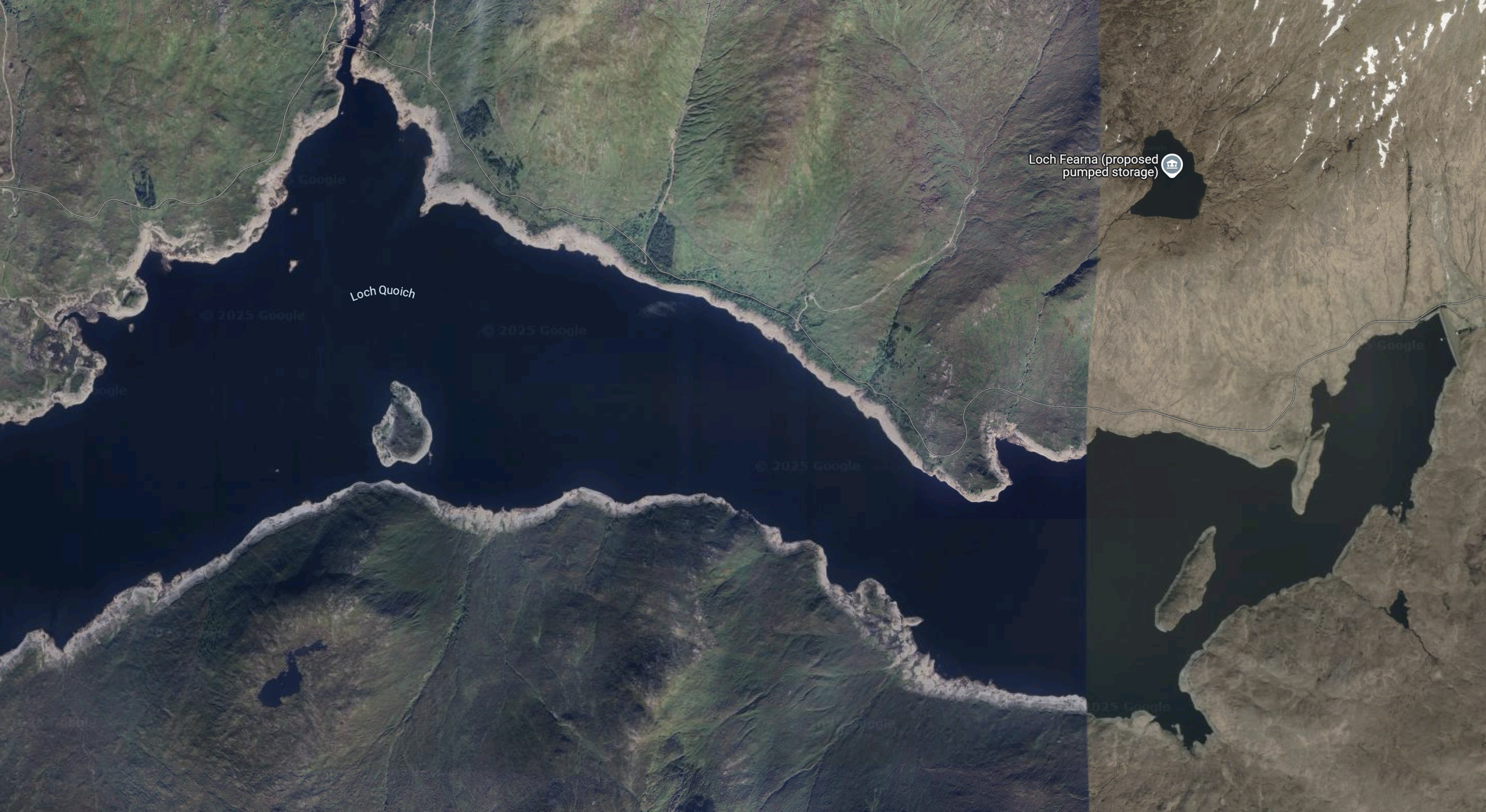
These are my thoughts.
It Will Be A Large Scheme
With an installed capacity of 1.8GW and a stored capacity of up to 36GWh, providing 20 hours of storage, this is not a small scheme.
Wikipedia’s Description Of Loch Quoich
This is the first two paragraphs of the Wikipedia entry for Loch Quoich.
Loch Quoich (Scottish Gaelic: Loch Chuaich) is a loch and reservoir situated west of Loch Garry approximately 40 km northwest of Fort William, Lochaber, Scotland. The name means “loch of the quaich”. In 1896, it was listed as six miles long and three-quarters of a mile in width, belonging to Mrs. Ellice of Glenquoich, within the parish of Kilmonivaig.
Both lochs form part of the Glen Garry hydroelectricity project commissioned by the North of Scotland Hydro-Electric Board in the 1950s.
So is the Loch Fearna scheme, a massive repurposing of the existing Glen Garry hydroelectricity project?
I wrote about this before in Repurposing The Great Glen Hydro-Electric Scheme?
This map from the SSE Renewables web site shows the layout of the dams and power stations between Loch Quoich and Invergarry..
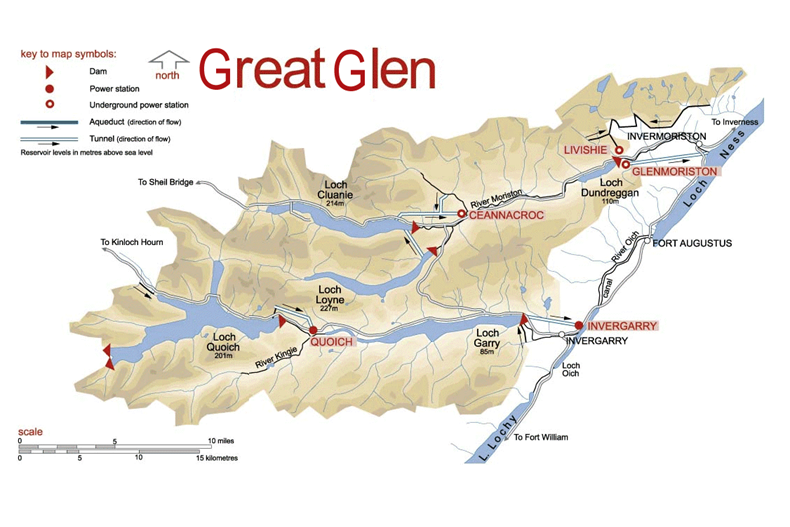
The sizes of the power stations in the scheme are as follows.
- Ceannacroc – 20 MW
- Livishie – 15 MW
- Glenmoriston- 37 MW
- Quoich – 18 MW
- Invergarry – 20 MW
- Mucomir – 1.7 MW
This gives a total power of 112.7 MW.
112.7 MW to 1.8 GW (1800 MW) is a colossal increase in power.
It should be noted that 1.8 GW is half the power of Hinckley Point C nuclear power station.

