London Overground Lines To Be Given Unique Names
The title of this post, is the same as that of this article on the BBC.
This is the sub-heading.
Six London Overground lines are to be given unique names.
These three paragraphs explain it all.
Routes to be named include Euston to Watford Junction, Romford to Upminster and Gospel Oak to Barking, City Hall confirmed.
Seb Dance, deputy mayor for transport, said posters had been put up in stations informing people of the plans and encouraging them to get involved.
London Overground will remain as the umbrella brand, according to transport bosses.
It will cost £6.3 million.
What a waste of money!
I suppose they will all be given nice politically correct names, that no-one will use and those on thee far-right will cover with graffiti.
Yesterday, I needed to use The Drain, so I asked if it was open at Waterloo. Perhaps the first thing, that they ought to do, is teach staff all the colloquial names that my parents’ generation used.
The sooner the good voters of London give SadIQ his marching orders the better.
Orkney Council To Look At Proposals To Become Territory Of Norway
The title of this post, is the same as that of this article on the BBC.
This is the sub-heading.
The Orkney Islands could change their status in the UK or even become a self-governing territory of Norway under new proposals.
These paragraphs outline their possible strategy.
A motion will go before the council next week to investigate “alternative forms of governance”.
Council leader James Stockan said Orkney does not get fair funding with its current relationship within the UK.
He wants to look at Crown Dependencies like the Channel Islands and overseas territories like the Falkland Islands.
He suggested another possible future could be like the Faroe Islands – which is a self-governing territory of Denmark.
Councillor Stockan told BBC Radio Scotland there were many areas where Orkney was being “failed dreadfully” by both the UK and Scottish governments.
These are my thoughts.
Has Orkney Been Failed Dreadfully By The UK And Scottish Governments?
I wouldn’t be surprised, if the legal and economic framework between the Orkney, Scotland and the UK, dates back hundreds of years and didn’t really expect to see a more independent Scotland.
This is a quote from Council leader James Stockan.
And the funding we get from the Scottish government is significantly less per head than Shetland and the Western Isles to run the same services – we can’t go on as we are.
I could argue, they should be similar.
Orkney’s Income From Oil, Gas And Wind
Orkney doesn’t have Shetland’s oil, gas and wind infrastructure, so perhaps Scotland and the UK, think Orkney is the other’s problem.
Wind Development In Orkney, Shetland And The Western Isles
This map from Cross Estate Scotland shows all the wind contracts for Orkney, Shetland and The Western Isles.

These wind farms could send wind power to Orkney.
- 7 – Ayre – 1008 MW
- 13 – West of Orkney – 2000 MW
That is a total of 3008 MW.
These wind farms could send wind power to Shetland.
- 18 – Ocean Winds – 500 MW
- 19 – Arven – 1800 MW
- 20 – ESB Asset Development – 500 MW
That is a total of 2800 MW.
These wind farms could send wind power to the Western Isles.
- 14 – Havbredey – 1400 MW
- 15 – N3 Project – 495 MW
- 16 – Spiorad na Mara – 840 MW
That is a total of 2735 MW.
On this quick look, it does appear that there is a fair balance of investment in wind power between Orkney, Shetland and The Western Isles.
The Flotta Hydrogen Hub
The Flotta Hydrogen Hub is being planned and it has its own web site.
It looks like it will be linked to the West of Orkney wind farm.
The Ferries
CouncilStockan says this about the ferries.
We are really struggling at the moment, we have to replace the whole ferry fleet which is older than the CalMac fleet.
And it is well-known, that the Scottish Nationalist Party got into a muddle with ferries.
Conclusion
If you read the Wikipedia entry for Orkney, the islands would appear to have a sound future, based on hydrogen, tourism and wind.
I would hope that a discussion around some good local food and the local whisky could sort out Otkney’s worries.
Effects Of The ULEZ In West London
This page on the Transport for London web site is entitled ULEZ Expansion 2023.
This is the first paragraph.
To help clear London’s air and improve health, the Ultra Low Emission Zone (ULEZ) is expanding across all London boroughs from 29 August 2023.
These are some points from the rest of the page.
- Poor air quality is impacting the health of Londoners, and it’s mainly caused by polluting vehicles.
- Air pollution even contributes to the premature death of thousands of Londoners every year.
- 9 out of 10 cars seen driving in outer London already meet the ULEZ emissions standards.
- If you drive anywhere within the ULEZ and your vehicle does not meet the emissions standards, you could face a daily charge of £12.50.
- Residents of the ULEZ are not exempt from the charge.
- Any money received from the scheme is reinvested into running and improving London’s transport network, such as expanding bus routes in outer London.
There is no reference to trucks or HGVs.
These are my thoughts.
Objections To The ULEZ
If you type ULEZ into Google and look at the News page, you get a lot of stories that don’t show the ULEZ in a good light.
Here are a few headlines.
- BBC – ULEZ: Labour MPs Seek Support For Non-Londoners
- BBC – Firms In Essex Could Close Due To ULEZ, Warns Business Leader
- Big Issue – London’s Ulez Plans Could Hit Disabled People, Charities And Small Businesses The Hardest
- Daily Mail – Sadiq Khan Claims That Nazis Have Infiltrated Anti-Ulez Protests
- Guardian – EU Motorist Fined Almost £11,000 After Falling Foul Of London Ulez Rule
- Guardian – London’s Mayor Faces High Court Challenge Over Ulez Expansion
- Kent Live – Anti-ULEZ Campaign Group Support Soars As Kent Drivers ‘Unfairly Targeted’
- LBC – No More Ulez? Sadiq Khan Considers Scrapping Controversial Scheme And Replacing It With ‘Pay-As-You-Drive’ System
- Slough Observer – Ulez Faces High Court Challenge
- Which? – Why It Could Cost £17.50 To Drop A Loved One At Heathrow This Summer
It looks like Sadiq Khan has fallen into a hole.
And he hasn’t stopped digging!
To make it worse, he has suggested a Pay-As-You-Drive System. I seem to remember, that a Dutch Prime Minister, who tried it, lost the next election.
But then Sadiq Khan likes tolls as the new Silvertown Tunnel and the Blackwall Tunnel will be tolled in a few years.
Heathrow Airport
Heathrow Airport is one of the world’s busiest airports and 76,000 people work at the airport, with many more employed nearby.
The airport handled 61.6 million passengers in 2022, which is a few short of 170,000 per day.
If you consider that those that work at the airport do two trips per day and passengers generally do one, that means there are 322,000 trips per day to or from the airport.
But as it now so easy to get to the Airport using the Elizabeth Line will more people use the new line to meet and greet and say goodbye to loved ones or business associates. Since the Elizabeth Line opened, I’ve met a couple of friends at Heathrow, who were passing through.
I wonder, if that daily journey total of 322,000 could be nearer to 350,000 or even 400,000.
If the ULEZ charge makes some passengers and staff switch from their car to using a bus or train, this probably means that public transport to and from the airport, will need to be boosted by a substantial amount.
But improving public transport to Heathrow wouldn’t be easy.
- The Elizabeth Line seems to have put a big hole in the finances of Heathrow Express.
- How many more trains can be squeezed into the Heathrow Tunnel?
- The Western Rail Link to Heathrow would probably need to be built. But that seems to be in limbo.
- New trains for the Piccadilly Line are a few years away.
It might have been better to build a different scheme for Western access to Heathrow like the Heathrow Southern Railway.
I suspect that there will be a lot more passengers on the Elizabeth Line to and from Heathrow.
A ULEZ For Heathrow
This article on fleetworld, from four years ago, is entitled Heathrow To Introduce Charging ULEZ In 2022.
It hasn’t happened, but that doesn’t mean it won’t be implemented in the future.
If it did happen, there would be more passengers for the Elizabeth Line.
The Elizabeth Line
I have written three posts about how busy the Western section of the Elizabeth Line can get.
- Very Busy Lizzie
- Elizabeth Line: Commuters Say Service ‘Not What Was Promised’
- So Many Cases On A Train!
Is there sufficient capacity to accommodate all the ULEZ-dodgers on the trains to and from Heathrow?
To make matters worse, there is a large Asian population from the Indian sub-continent living along the Elizabeth Line between Ealing Broadway and Reading.
- They seem to be enthusiastic users of the line.
- Having ridden several times on crowded Indian trains, perhaps using trains is very much part of South Asian culture.
- I also suspect that a lot of Indian families have spread themselves along the line, just like my mother’s close family spread themselves along the 107 bus route.
In Very Busy Lizzie, I said this.
Reading needs four tph to Central London.
The ULEZ will make this even more essential.
The Piccadilly Line
The Piccadilly Line may be getting new trains, but it is not a line that is blessed with lots of step-free stations.
The West London Orbital Railway
It does appear that the West London Orbital Railway may be more likely to be built, than a few months ago.
In Is There Progress On The West London Orbital Railway?, I wrote about a report, that consultants were being chosen.
This railway could ease pressure on the railways in West London.
Cutting Pollution In London From Trucks
London like all big cities has a lot of trucks.
As the average truck has a much larger engine than the average car, I would suspect it gives out more pollution.
One way to cut pollution from large vehicles would be to run them on hydrogen.
But unlike some cities in the UK, London has no hydrogen policy and filling stations to fill them up.
The Mayor could at least get a workable hydrogen policy.
Conclusion
I suspect the next Mayor of London will have to have a rethink on the ULEZ and implement a hydrogen policy.
East-West Rail: Bedford’s Mayoral Candidates Split On Rail Project
The title of this post, is the same as that of this article on the BBC.
This is the first sentence.
Part of the route of the controversial East-West Rail project will not be decided before we know the winner of Bedford’s mayoral elections.
Unfortunately, the four candidates for Mayor all seem to have different ideas for East-West Railway through the town.
I have a few thoughts and observations.
Thameslink
Thameslink has the following connections to the East West Railway.
- Four tph at Bedford.
- Three tph at Cambridge.
Note.
- tph is trains per hour.
- All Bedford trains terminate at Bedford.
- The half-hourly Luton Airport Express between London St. Pancras and Corby stops at Luton Airport Parkway, Luton, Bedford, Wellingborough and Kettering.
- Cambridge trains may extend to Cambridge North station.
- Cambridge has additional through services between London King’s Cross and Ely and/or King’s Lynn.
Both Bedford and Cambridge will be busy stations.
Extra Tracks At Bedford
Bedford station has four tracks; two which are generally used by Thameslink services and two main lines used by through trains.
- The fast lines must accommodate the following trains.
- East Midlands Railway – 6 tph in both directions. Two tph stop in Bedford station.
- Freight Trains – 2 tph in both directions.
- East West Railway – 2 tph in both directions. All trains will stop in Bedford station.
It strikes me, that the station may need at least one and possibly two extra tracks.
If there are extra tracks, there will need to be some demolition of houses.
Freight Trains
In Roaming Around East Anglia – Newmarket Station, I wrote this about the plans of the East West Rail Consortium in the area.
In this document on the East-West Rail Consortium web site, this is said.
Note that doubling of Warren Hill Tunnel at Newmarket and
redoubling between Coldham Lane Junction and Chippenham Junction is included
in the infrastructure requirements. It is assumed that most freight would operate
via Newmarket, with a new north chord at Coldham Lane Junction, rather than
pursuing further doubling of the route via Soham.
So would it be possible to create a double-track railway through Newmarket station?
In the related post, I came to this conclusion.
Newmarket can benefit from East West Rail, but the two parties must agree objectives that don’t cause problems for the other.
But I do think, that Newmarket will not welcome the building of a double-track railway through the town.
I do wonder, if the East West Rail Consortium plan to run freight trains between Felixstowe and South Wales and the West of England through Bedford and Oxford.
Four freight tph, through Bedford would certainly need extra tracks and the demolition of houses in the centre of Bedford.
Electrification
Two of the candidates for Bedford’s mayor, think that the line needs to be electrified.
As the route is full or partially-electrified at Didcot, Bletchley, Bedford and Cambridge, I believe that battery-electric trains could handle the route.
But then there are no plans to purchase any passenger trains of this type.
Freight trains would still need to be diesel hauled, unless more progress is made fairly quickly in the development of hydrogen-powered freight locomotives.
The Cambridge Effect
Cambridge is one of the most important cities in the world, because of its strength in innovation in high technology industries.
But Cambridge is bursting at the seams and needs more space for laboratories, advanced manufacturing and housing.
A fully-developed double-track and electrified East West Railway would open up Bletchley, Milton Keynes, Bedford, Newmarket, Bury St. Edmunds and Ipswich to act as satellites to help Cambridge build a shared and successful future.
The Felixstowe Effect
If Cambridge will stimulate the growth of passenger traffic, then Felixstowe will promote the growth of East-West freight traffic.
Conclusion
It may not be initially built that way, but probably by 2040, the East West Railway will be a fully-electrified double-track railway between Didcot and Felixstowe.
Extra tracks will also be needed through Bedford. This will mean demolition of houses.
Rahul Gandhi Disqualified As MP After Conviction In Defamation Case
The title of this post, is the same as that of this article on the BBC.
This is the sub-heading.
India’s parliament has disqualified senior opposition leader Rahul Gandhi, a day after he was sentenced to two years in prison in a defamation case.
The next two paragraphs outline the case.
A parliament notice said that Mr Gandhi “stands disqualified from the membership of Lok Sabha”, alluding to the lower house of parliament.
He was convicted by the court for 2019 comments about PM Narendra Modi’s surname at a election rally.
Recently, I made a comment to a doctor with part Indian genes about Modi and I got a very unflattering reply.
13 Offshore Wind Projects Selected In World’s First Innovation And Targeted Oil & Gas Leasing Round
The title of this post, is the same as that of this article on offshoreWIND.biz.
This is the sub-heading.
Crown Estate Scotland has selected 13 out of a total of 19 applications with a combined capacity of around 5.5 GW in the world’s first leasing round designed to enable offshore wind energy to directly supply offshore oil and gas platforms.
This paragraph outlines INTOG (Innovation and Targeted Oil & Gas) and its objectives.
INTOG, which has been designed in response to demand from government and industry to help achieve the targets of the North Sea Transition Sector Deal through decarbonising North Sea oil and gas operations, is also expected to further stimulate innovation in Scotland’s offshore wind sector, create additional supply chain opportunity, assist companies to enter the renewable energy market, and support net-zero ambitions.
This is undoubtedly the most important news of the day.
- When complete it will generate 5416 MW of electricity.
- 4068 MW will be used primarily to decarbonise oil and gas platforms with surplus electricity going to the grid.
- The amount of carbon dioxide released by oil and gas platforms in the North Sea will be reduced.
- The gas saved by decarbonising oil and gas platforms, will be transported to the shore and used in the UK gas grid.
- 449 MW will be generated in innovative ways in small wind farms, with a capacity of less than 100 MW.
One of the benefits of INTOG is that the UK will be able to reduce gas imports, which must increase energy security.
This map from this document from the Crown Estate Scotland, shows the INTOG wind farms.
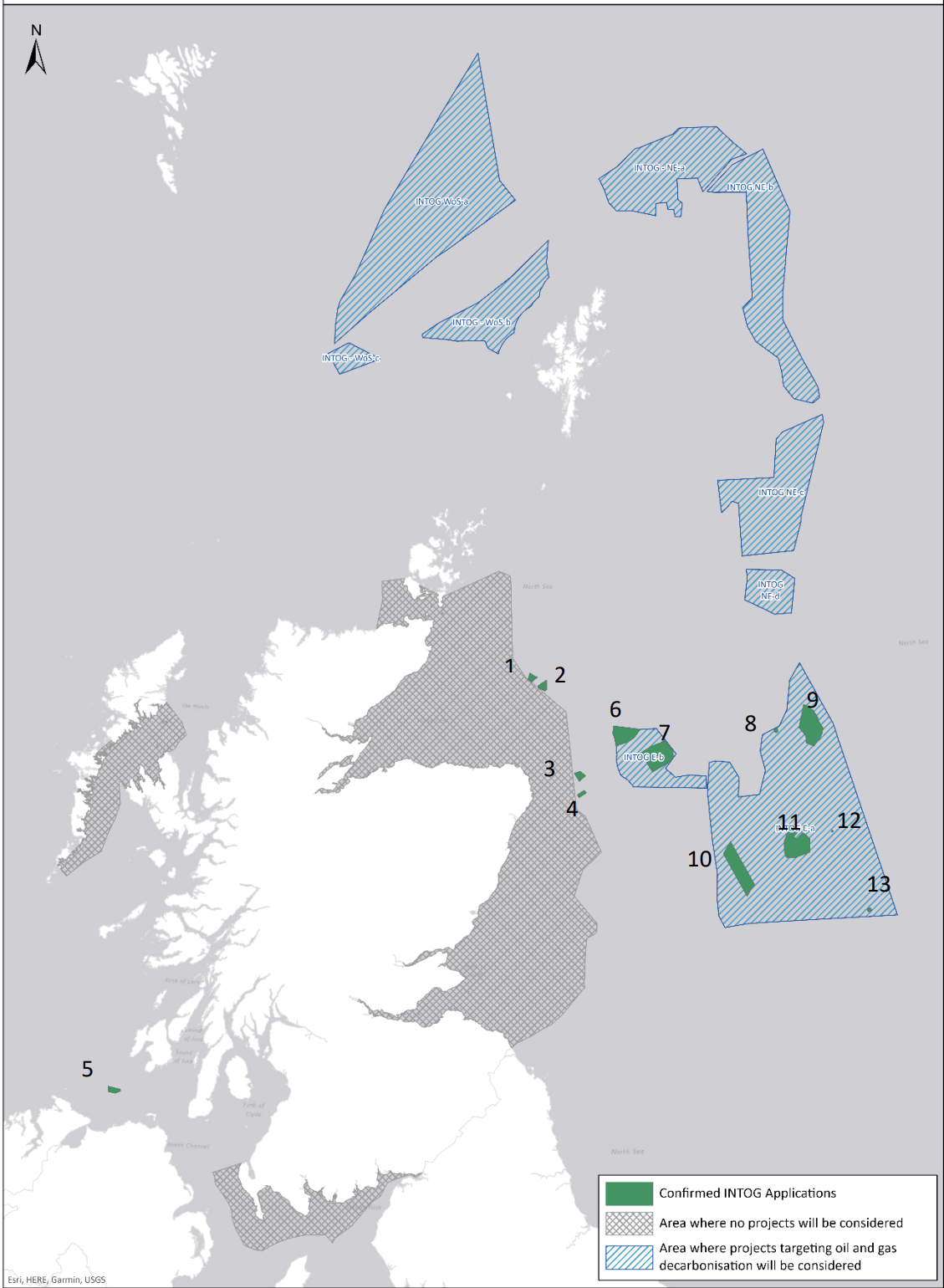
This is a list of the farms.
- 1 – Bluefloat Energy/Renantis Partnership – Innovation – Commercial – 99.45 MW
- 2 – Bluefloat Energy/Renantis Partnership – Innovation – Supply Chain – 99.45 MW
- 3 – Simply Blue Energy (Scotland) – Innovation – Supply Chain – 100 MW
- 4 – BP Alternative Energy Investments – Innovation – New Markets – 50 MW
- 5 – ESB Asset Development – Innovation – Cost Reduction – 100 MW
- 6 – Floatation Energy – Targeted Oil & Gas – 560 MW
- 7 – Cerulean Winds – Targeted Oil & Gas – 1008 MW
- 8 – Harbour Energy – Targeted Oil & Gas – 15 MW
- 9 – Cerulean Winds – Targeted Oil & Gas – 1008 MW
- 10 – Cerulean Winds – Targeted Oil & Gas – 1008 MW
- 11 – Floatation Energy – Targeted Oil & Gas – 1350 MW
- 12 – TotalEnergies – Targeted Oil & Gas – 3 MW
- 13 – Harbour Energy – Targeted Oil & Gas – 15 MW
Note.
- These total up to 5.42 GW.
- The five Innovation sites seem to be as close to the coast as is possible.
- I thought some Innovation sites would be closer, so supply difficult to reach communities, but they aren’t.
- Floatation Energy and Cerulean Winds seemed to have bagged the lion’s share of the Targeted Oil & Gas.
- Sites 6 and 7 sit either side of a square area, where Targeted Oil & Gas will be considered. Is that area, the cluster of oil and gas facilities around Forties Unity, shown on the map in this page on the BP web site?
- Harbour Energy have secured two 15 MW sites for Targeted Oil & Gas.
These are my thoughts on the various companies.
Bluefloat Energy
Bluefloat Energy has posted this press release on their web site, which is entitled Bluefloat Energy | Renantis Partnership Bid Success For Two 99mw Innovation Projects In Crown Estate Scotland’s INTOG Process.
The press release starts with these three bullet points.
- BlueFloat Energy | Renantis Partnership offered exclusivity rights to develop its Sinclair and Scaraben floating wind projects north of Fraserburgh – leveraging synergies via its 900MW Broadshore project.
- The projects seek to trial innovative floating wind technology solutions, kick-starting supply chain growth and job creation in Scotland and providing a ‘stepping-stone’ to the partnership’s ScotWind projects.
- Bid proposals include the intention to develop a scalable community benefit model – creating a potential blueprint for floating offshore wind in Scotland.
The first three paragraphs expand the bullet points.
The BlueFloat Energy and Renantis Partnership has been offered seabed exclusivity rights to develop two 99MW projects under the innovation arm of Crown Estate Scotland’s INTOG (Innovation and Targeted Oil & Gas) auction process. The auction saw ten projects bid to bring forward the development of small-scale innovation projects.
The Sinclair and Scaraben projects, located north of Fraserburgh and adjacent to the Partnership’s 900MW Broadshore project, seek to trial innovative foundation technologies, associated fabrication works and mooring systems with a view to maximising opportunities for the Scottish supply chain, driving local investment and job creation.
A key element of the bid proposals is the opportunity to test and adapt a community benefit model, governed independently, and directed by the communities in which the schemes will operate, through collaboration with our supply chain and project partners. The model could create a blueprint, shaping the future of community benefit from floating offshore wind throughout the whole of Scotland. This builds on Renantis’ successful track record of deploying similar schemes via its onshore wind farms in Scotland.
Note.
- Companies called Sinclair Offshore Wind Farm and Scaraben Offshore Wind Farm were registered a few months ago in Inverness.
- I couldn’t find the websites, so I suspect they’re still being created.
- These two projects appear to be pathfinders for the 900 MW Broadshore project, with regards to the supply chain and community involvement.
It certainly looks like the partnership are going about the development of these two projects in a professional manner.
BP Alternative Energy Investments
There has been no press release from BP as I write this, so I will have to deduce what BP are planning.
This map from this document from the Crown Estate Scotland, shows the Southern INTOG wind farms.
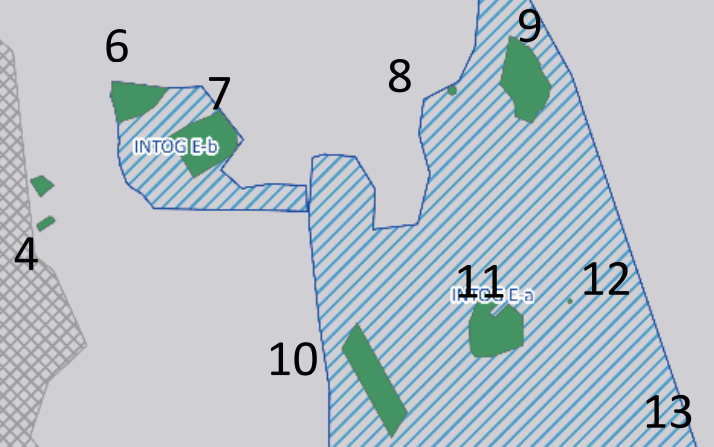
Note.
- Site 4 is the site of BP Alternative Energy Investments’s proposed wind farm.
- Sites 6 and 7 could be either side of the cluster of platforms around Forties Unity.
Consider.
- In the wider picture of wind in the North Sea, BP’s proposed 50 MW wind farm is a miniscule one. SSE Renewables’s Dogger Bank wind farm is over a hundred times as large.
- A cable to the shore and substation for just one 50 MW wind farm would surely be expensive.
- BP Alternative Energy Investments are also developing a 2.9 GW wind farm some sixty miles to the South.
- It would probably be bad financial planning to put large and small wind farms so close together.
For these are other reasons, I believe that there is no reason to believe that the proposed 50 MW wind farm is a traditional wind farm.
But if I’m right about sites 6 and 7 indicating the location the position of Forties Unity, it might open up other possibilities.
This document from INEOS, who own the Forties Pipeline System, explains how the pipeline works.
The Forties Pipeline System (FPS) is an integrated oil and gas transportation and processing system. It is owned and operated by INEOS and utilises more than 500 miles of pipeline to smoothly transport crude oil and gas from more than 80 offshore fields for processing at the Kinneil Terminal. At Kinneil the oil and gas are separated, with the oil returned as Forties Blend to customers at Hound Point or pumped to the Petroineos refinery at Grangemouth.
At the same time the gas goes to our LPG export facilities or is supplied to the INEOS petrochemical plant. FPS transports around 40% of the UK’s oil production supply and brings over 400,000 barrels ashore every day.
In Can The UK Have A Capacity To Create Five GW Of Green Hydrogen?, I said the following.
Ryze Hydrogen are building the Herne Bay electrolyser.
- It will consume 23 MW of solar and wind power.
- It will produce ten tonnes of hydrogen per day.
The electrolyser will consume 552 MWh to produce ten tonnes of hydrogen, so creating one tonne of hydrogen needs 55.2 MWh of electricity.
If BP were to pair the wind farm with a 50 MW electrolyser it will produce 21.7 tonnes of hydrogen per day.
Could it be brought to the shore, by linking it by a pipeline to Forties Unity and then using the Forties Pipeline System?
As the category on site 4, is New Markets, are BP and INEOS investigating new markets for hydrogen and hydrogen blends?
- Some of the latest electrolysers don’t need pure water and can use sea water. This makes them more affordable.
- Do BP and/or INEOS have the capability to extract the hydrogen as it passes through the Cruden Bay terminal, to provide the hydrogen for Aberdeen’s buses and other users?
- INEOS and BP probably have some of the best oil and gas engineers in the world.
- How many other places in the world have an offshore oil or gas field set in a windy sea, where floating wind- turbine/electrolysers could generate hydrogen and send it ashore in an existing pipeline?
- Several of these offshore oil and gas fields and the pipelines could even be owned by BP or its associates.
- Remember that hydrogen is the lightest element, so I suspect it could be separated out by using this property.
This BP site, is to me, one of the most interesting of the successful bids.
- BP probably have a large collection of bonkers ideas, that have been suggested during their long involvement with offshore oil and gas.
- Some ideas could be even suggested by employees, whose fathers worked for BP fifty years ago. I’ve met a few BP employees, whose father also did.
- Will the wind farm, be a floating electrolyser at the centre of a cluster of a few large floating turbines?
- Will each turbine have its own electrolyser and the substation only handle hydrogen?
- Will the floating electrolyser have hydrogen storage?
- Have BP got a floating or semi-submersible platform, that could either go to the breakers or be repurposed as the floating electrolyser?
- Repurposing a previous platform, would make all the right noises.
So many possibilities and so far, no clues as to what will be built have been given.
See also.
Further Thoughts On BP’s Successful INTOG Bid
Cerulean Winds
In What Is INTOG?, I said this about Cerulean Winds.
Cerulean sounds like it could be a sea monster, but it is a shade of blue.
This article on offshoreWind.biz is entitled Cerulean Reveals 6 GW Floating Offshore Wind Bid Under INTOG Leasing Round.
These are the two introductory paragraphs.
Green energy infrastructure developer Cerulean Winds has revealed it will bid for four seabed lease sites with a combined capacity of 6 GW of floating wind to decarbonise the UK’s oil and gas sector under Crown Estate Scotland’s Innovation and Targeted Oil and Gas (INTOG) leasing round.
This scale will remove more emissions quickly, keep costs lower for platform operators and provide the anchor for large-scale North-South offshore transmission, Cerulean Winds said.
Note.
-
- It is privately-funded project, that needs no government subsidy and will cost £30 billion.
- It looks like each site will be a hundred turbines.
- If they’re the same, they could be 1.5 GW each.
- Each site will need £7.5 billion of investment. So it looks like Cerulean have access to a similar magic money tree as Kwasi Kwarteng.
Effectively, they’re building four 1.5 GW power stations in the seas around us to power a large proportion of the oil and gas rigs.
For more on Cerulean Winds’s massive project see Cerulean Winds Is A Different Type Of Wind Energy Company.
So does it mean, that instead of 6 GW, they were only successful at three sites and the other or others were in the six unsuccessful applications?
There is a press release on the Cerulean Winds web site, which is entitled Cerulean Winds Wins Bid For Three INTOG Floating Wind Sites, where this is said.
Cerulean Winds and Frontier Power International have been awarded three lease options for the Central North Sea in the highly competitive INTOG leasing round, the results of which were announced by Crown Estate Scotland today.
The sites, in the Central North Sea, will enable the green infrastructure developer and its partners to develop large floating offshore windfarms to decarbonise oil and gas assets. The scale of the development will enable a UK wide offshore transmission system, that can offer green energy to offshore assets in any location and create a beneficial export opportunity.
Nothing about unsuccessful applications was said.
This map from this document from the Crown Estate Scotland, shows the Southern INTOG wind farms.
Note.
- Sites 7, 9 and 10 are Cerulean’s sites.
- Sites 6 and 11 are Floatation Energy’s sites.
- Site 4 is BP Alternative Energy Investments’s Innovation site.
- Sites 8, 12 and 13 are much smaller sites.
It looks like Cerulean and Floatation Energy are well-placed to power a sizeable proportion of the platforms in the area.
ESB Asset Development
ESB Asset Development appear to be a subsidiary of ESB Group.
The ESB Group is described like this in the first paragraph of their Wikipedia entry.
The Electricity Supply Board is a state owned (95%; the rest are owned by employees) electricity company operating in the Republic of Ireland. While historically a monopoly, the ESB now operates as a commercial semi-state concern in a “liberalised” and competitive market. It is a statutory corporation whose members are appointed by the Government of Ireland.
This press release, is entitled ESB Offered Exclusive Rights To Develop Innovative 100MW Floating Offshore Wind Project In The Malin Sea.
These two paragraphs outline the project.
ESB today welcomes the outcome of Crown Estate Scotland’s latest seabed leasing process which has resulted in the offer of exclusive development rights to ESB for a 100MW floating wind project in Scottish waters off the north coast of Northern Ireland. The successful project, Malin Sea Wind, is a collaborative bid between ESB and leading technology developers Dublin Offshore Technology and Belfast-based CATAGEN. The outcome underscores ESB’s growing capabilities and expanding presence in the offshore wind industry.
The Innovation and Targeted Oil and Gas (INTOG) seabed leasing process, run by Crown Estate Scotland, aims to drive cost reduction in the offshore wind sector by enabling the deployment of new and innovative technologies, and to harness wind energy to decarbonize the oil and gas sector. Malin Sea Wind aims to support the reduction of floating offshore wind costs by demonstrating Dublin Offshore’s patented load-reduction technology. Furthermore, the project will support decarbonisation of the aviation sector by powering sustainable aviation fuel (SAF) production technology currently under development by net-zero technology specialists, CATAGEN.
Note.
- I’ve just looked at the Technology page of the Dublin Offshore Technology web site.
- In the 1970s, I built large numbers of mathematical models of steel, concrete and water cylinders in my work with a Cambridge University spin-out called Balaena Structures.
- I believe, that an experienced mathematically modeller could simulate this clever system.
That would prove if it works or not!
This Google Map shows the Malin Sea.
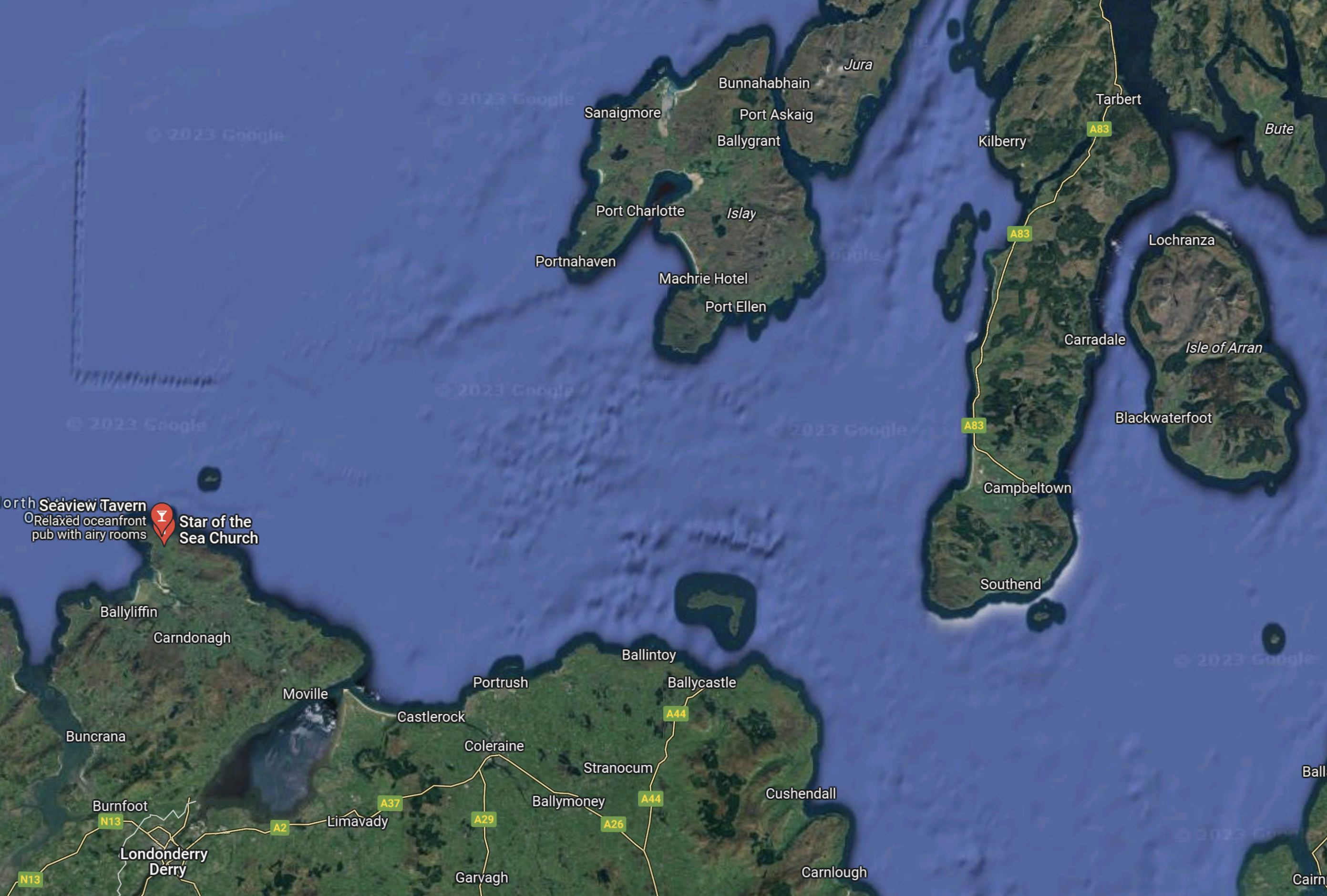
Note.
- Malin Head is marked by the red arrows on the Northern Irish coast.
- The most Westerly Scottish island is Islay and the most Easterly is the Isle of Arran.
- Between the two islands is the Kintyre peninsula.
- Portrush can be picked out on the Northern Irish coast.
By overlaying the two maps, I suspect the centroid of the wind farm will be North of Portrush about a few miles North of the Southern end of Arran.
I suspect that if all goes well, there could be a lot of floating wind turbines in the area.
This Google Map shows the River Foyle estuary and Foyle Port to the North-East of Londonderry/Derry.
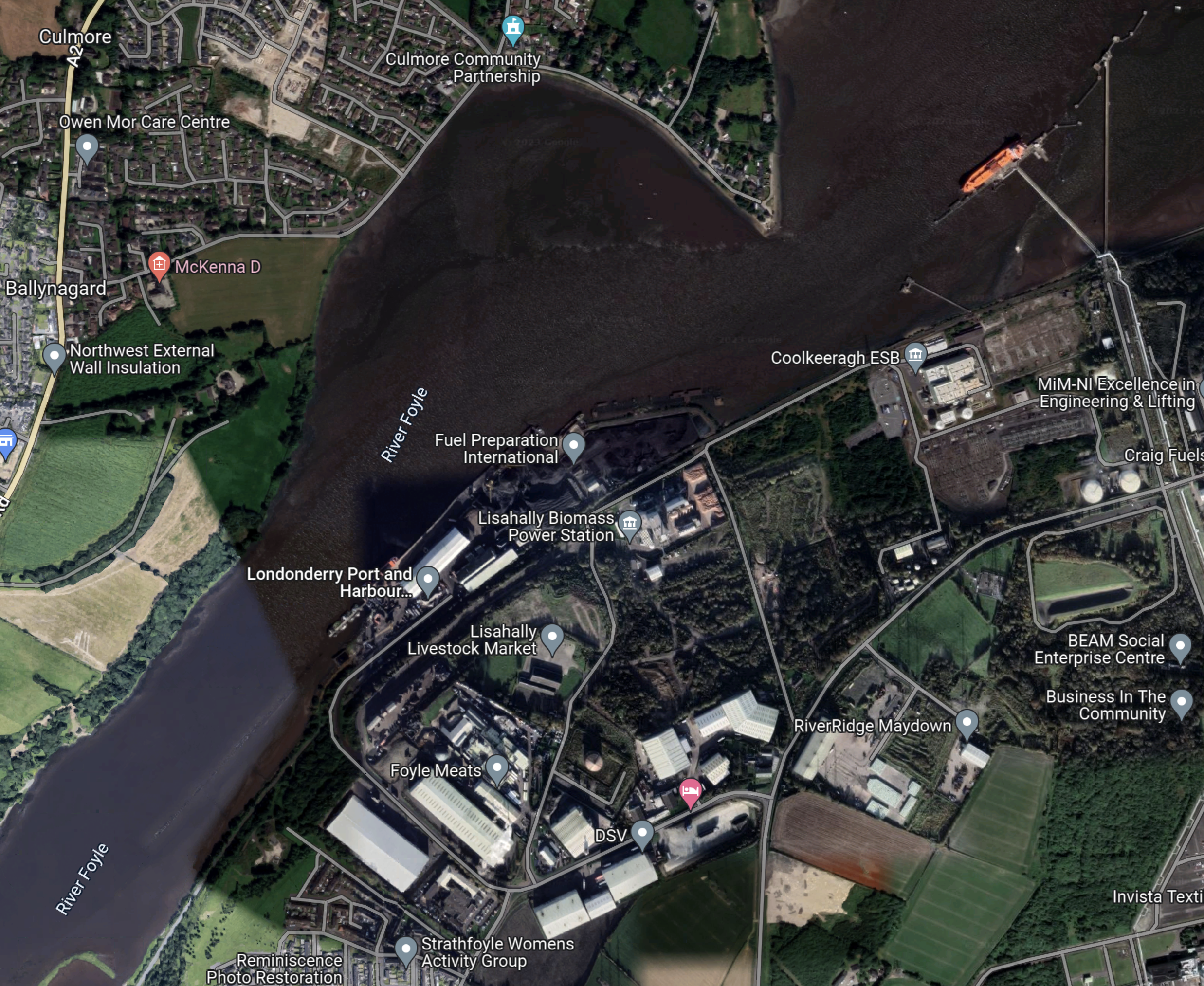
Note.
- Coolkeeragh ESB and Lisahally biomas power station on the South bank of the River Foyle.
- Lisahally biomas power station has a capacity of 16 MW.
- There appears to be a large substation at Coolkeeragh ESB.
- A tanker of some sort seems to be discharging.
Until told, I’ve guessed wrong, it looks to me like Coolkeeragh ESB could be the destination for the electricity generated by Malin Sea Wind. Given that this project’s aim is cost reduction, a 100 MW wind farm could make a difference.
In addition could Foyle Port be used to assemble and maintain the floating turbines?
Floatation Energy
Floatation Energy have posted this press release on their web site, which is entitled Flotation Energy and Vårgrønn Awarded Exclusivity To Develop Up To 1.9 GW Of Floating Offshore Wind In Scotland.
The first part of the press release, has a graphic.
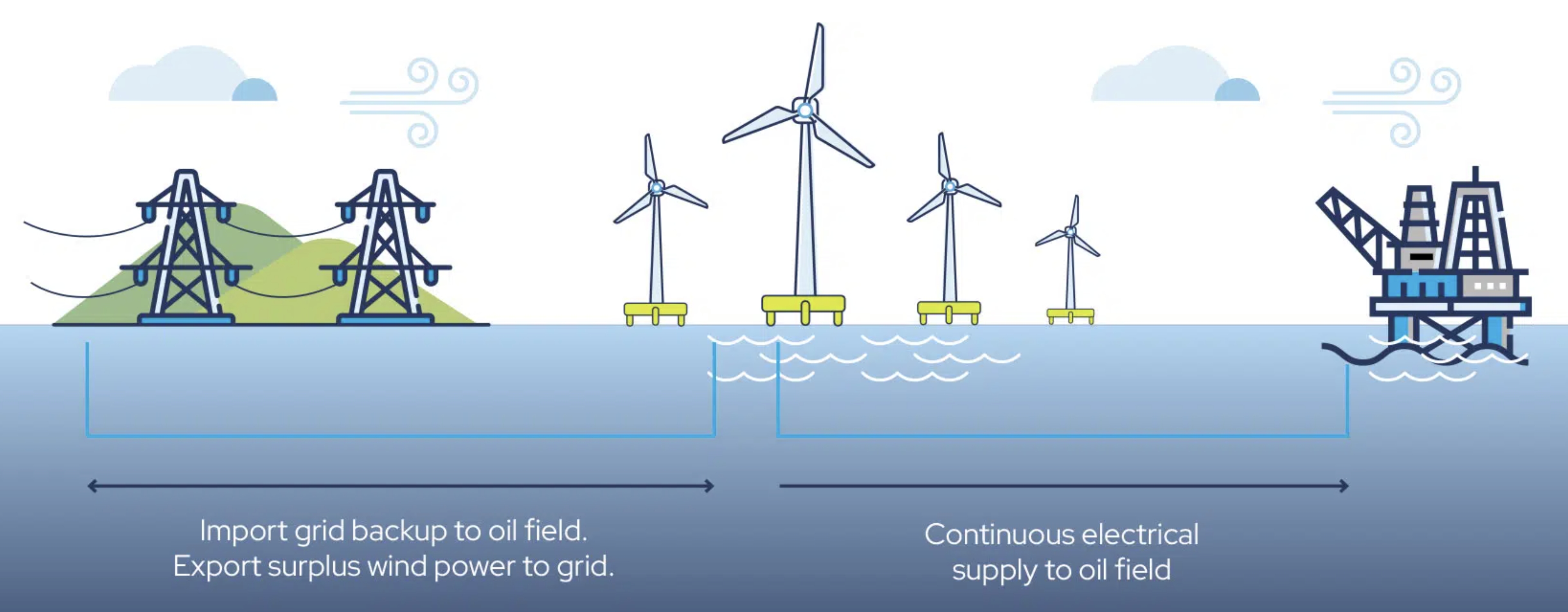
It shows how their proposed system will work.
- A floating wind farm will be placed between the shore and oil and gas platforms to be decarbonised.
- The wind farm will be connected to the shore by means of a bi-directional cable, so that the wind farm can export electricity to the grid and when the wind isn’t blowing the grid can power the platforms.
- A cable between the wind farm and the platforms completes the system.
It is a simple system, where all elements have been built many times.
Floatation Energy must have been fairly confident that their bids would be successful as they have already named the farms and set up web sites.
- Site 6 – Green Volt – 560 MW
- Site 11 – Cenos – 1350 MW
The websites are very informative.
The Timeline for 2019-2021 on the Green Volt web site describes the describes the progress so far on the project.
2019 – As construction of the Kindardine offshore floating wind farm kicks off, Flotation Energy identifies the Buzzard oil facility (a relatively new oil and gas platform with a long field life and high electrical load) as the optimal starting point for a significant contribution to the North Sea Transition Deal – the process of replacing large scale, inefficient gas-fired power generation with renewable electricity from offshore wind.
2020 – Flotation Energy begins environmental surveys on the Ettrick/Blackbird oil field, a redundant site nearby Buzzard, which is in the process of decommissioning. The “brownfield” site is confirmed as an exceptional opportunity to create an offshore floating wind farm, with water depths of 90-100m and high quality wind resource.
2021 – Flotation Energy works with regulators to understand the potential for project “Green Volt” to decarbonise offshore power generation for Buzzard. Flotation Energy completes and submits an Environmental Scoping report to Marine Scotland, reaching the first major milestone in the Marine Consent process. Crown Estate Scotland announces a new leasing round for Innovation and Targeted Oil and Gas Decarbonisation (INTOG).
On a section on the Cenos web site, there is a section called Efficient Grid Connection, where this is said.
The power generated by the wind turbines will be Alternating Current (AC) and routed to a substation platform. AC power will be exported to the oil and gas platforms.
For efficient export to the UK grid, the substation platform will include a converter station to change the AC power to Direct Current (DC) before the power is transported to shore. This is due to transporting AC power over long distances leading to much of the power being lost.
Cenos is working in partnership with the consented NorthConnect interconnector project, to utilise their DC cable routing where possible. Cenos will also use the NorthConnect onshore converter station planned for Fourfields near Boddam, which then has an agreed link into the Peterhead Substation. This collaboration minimises the need to construct additional infrastructure for the Cenos project.
That all sounds very practical.
Note.
- Floatation Energy delivered the Kincardine offshore floating wind farm.
- Both wind farms appear to use the same shore substation.
- Buzzard oil field is being expanded, so it could be an even more excellent oil field to decarbonise.
- NorthConnect is a bit of an on-off project.
Floatation Energy seem to have made a very professional start to the delivery of their two wind farms.
Harbour Energy
The Wikipedia entry for Harbour Energy describes the company like this.
Harbour Energy plc is an independent oil and gas company based in Edinburgh, Scotland. It is the United Kingdom’s largest independent oil and gas business. It is listed on the London Stock Exchange and is a constituent of the FTSE 250 Index.
But if you look at news items and the share price of the company, things could look better for Harbour Energy.
On their map of UK operations, I can count nearly twenty oil and gas fields.
As they have other oil and gas fields around the world, decarbonisation of their offshore operations could increase production by a few percent and substantially cut their carbon emissions.
That is a philosophy that could be good for profits and ultimately the share price.
So has the company gone for a very simple approach of two identical floating wind turbines?
They have been successful in obtaining leases for sites 8 and 13.
- Both have a capacity of 15 MW, so are the farms a single 15 MW wind turbine?
- I think this is likely, unless it is decided to opt for say a 16 MW turbine.
- Or even a smaller one, if the platform is in a bad place for wind.
- The wind turbine would be parked by the platform to be decarbonised and connected up, to a simple substation on the platform.
- I would recommend a battery on the platform, so that if the wind wasn’t blowing, power was still supplied to the platform.
- There would be no need for any cable between shore and wind farm and the only substation, would be a relatively simple one with a battery on the platform.
It could be a very efficient way of decarbonising a large number of platforms.
Once Harbour Energy have proved the concept, I could build a simple mathematical model in Excel, to work out any change in profitability and carbon emissions for a particular oil or gas platform.
Who Is Britannia Ltd?
In this document from the Crown Estate Scotland, there is a section that gives the partners in each project.
Listed for site 8 are Chrysaor (U.K.) and Britannia Limited and for site 13 is Chryasaor Petroleum Company UK Limited.
This page on the Harbour Energy web site gives the history of Chrysaor and Harbour Energy.
This is the heading.
Chrysaor was founded in 2007 with the purpose of applying development and commercial skills to oil and gas assets and to realise their value safely.
This is the history.
The Group grew rapidly over the years through a series of acquisitions. With backing from Harbour Energy – an investment vehicle formed by EIG Global Energy Partners – Chrysaor acquired significant asset packages in the UK North Sea from Shell (2017) and ConocoPhillips (2019) to become the UK’s largest producer of hydrocarbons.
In 2021, Chrysaor merged with Premier Oil to become Harbour Energy plc.
So that explains the use of the Chrysaor name or Chryasaor as someone misspelt it on the Crown Estate Scotland document.
I asked myself, if Britannia Ltd. could be a technology company, so I checked them out. The only company, I could find was a former investment trust, that was dissolved over ten years ago.
But Britannia is an oil and gas field in the North Sea, which is partially owned by Harbour Energy. It has a page on Harbour Enerrgy’s web site, which is entitled Greater Britannia Area.
This is said about the Britannia field.
Britannia in Block 16/26 of the UK central North Sea sits approximately 210-kilometres north east of Aberdeen. The complex consists of a drilling, production and accommodation platform, a long-term compression module of mono-column design and a 90-metre bridge connected to a production and utilities platform. Britannia is one of the largest natural gas and condensate fields in the North Sea. Commercial production began in 1998. Condensate is delivered through the Forties Pipeline to the oil stabilisation and processing plant at Kerse of Kinneil near Grangemouth and natural gas is transported through a dedicated Britannia pipeline to the Scottish Area Gas Evacuation (SAGE) facility at St Fergus.
Looking at the maps on the Crown Estate Scotland, Harbour Energy and others, it looks like site 8 could be close to the
Greater Britannia Area or even the Britannia field itself.
Simply Blue Energy
Simply Blue Energy are developing the 100 MW Salamander wind farm.
I wrote about this project in The Salamander Project.
Did it get chosen, as it was a project, where the design was at an advanced stage?
TotalEnergies
I wouldn’t be surprised to find out that TotalEnergies have gone a very similar route to Harbour Energy, but they are trying it out with a 3 MW turbine.
Conclusion
They are an excellent group of good ideas and let’s hope that they make others think in better and move innovative ways.
Politics will never save the world, but engineering and science just might!
A Road Scheme That Appears To Going Nowhere
This article on the BBC is entitled A57 Link Roads Mottram Bypass: Charity Seeks Judicial Review.
This is the sub-heading.
Environmental campaigners are seeking a judicial review of proposals designed to ease road congestion between Manchester and Sheffield.
And these are the first two paragraphs.
Plans for the A57 Link Roads Mottram Bypass scheme were boosted in November when Transport Minister Huw Merriman granted a development consent order.
But countryside charity the CPRE said there was no evidence building a new road “moves away a traffic problem”.
I remember this area well from the 1960s, when I was studying at Liverpool University and my parents lived in Felixstowe.
- There was no motorway across the Midlands between Coventry and Stafford and the alternative of the A5 was a nose-to-tail crawl.
- The M62 was still in the design phase.
So I took to using this cross-country route.
- A45 between Felixstowe and Huntingdon.
- A1 to Worksop, which was mainly dual-carriageway.
- A57 to Manchester, through Sheffield and Glossop, which was and still is single-track.
- A580 to Liverpool.
I think my best time was about five hours in a 1954 Morris Minor.
I feel, I must have gone through Mottram in Longdendale, judging by the map on the BBC article.
It is interesting to read the Wikipedia entry for the Longdendale Bypass, which starts like this.
The Longdendale Bypass (also known as the A57/A628 Mottram-in-Longdendale, Hollingworth & Tintwistle Bypass) is a long-planned road scheme in England by the Highways Agency. The aim is to alleviate traffic congestion on the A57 road/A628 road/A616 road routes that presently pass through the villages. There is both support and opposition for this long-planned scheme which will pass through the valley of Longdendale and part of the Peak District National Park.
The scheme was approved by the Highways Agency in 2014, so politicians have not exactly been quick off the mark.
These are some choice phrases from the Wikipedia entry.
- It is used by a relatively large number of heavy goods vehicles.
- Supporters of the scheme say that the A628 is one of the most congested A-road routes in the country.
- There is no viable alternative to a bypass.
- A survey in 2010 found that the junction of the A57 and M67 was the most congested in Manchester.
It is a disaster and the intervention by the CPRE will further delay a solution.
Conclusion
It is problems like this, that lead me to one solution.
On the one hand, you improve the railways and on the other you bring in universal road charging.
Hopefully passengers and freight will find a happy equilibrium.
But voters wouldn’t like it and any Government, that brought it in would lose the next election to a yet-to-be-formed Motorists Party.
Former US President Donald Trump Launches $99 NFT Trading Cards
The title of this post is the same as that of this article on the BBC.
Under images of two of the cards, one showing him as a roughneck with a shotgun and the other as a superhero, this is the first paragraph.
Former US President Donald Trump has launched a collection of digital trading cards depicting him in various guises including a superhero, astronaut and Nascar driver.
In the superhero picture he has a T on his chest.
I would think a W with an anchor would have been more appropriate.
Electrolyser System To Linde For Green Hydrogen Production In Niagara Falls, New York
The title of this post, is the same as that of this press release from Cummins.
This is the first paragraph.
Cummins Inc. will supply a 35-megawatt (MW) proton exchange membrane (PEM) electrolyzer system for Linde’s new hydrogen production plant in Niagara Falls, New York. Once commissioned, Cummins’ electrolyzer system will power Linde’s largest green hydrogen plant in the U.S., marking significant progress in moving the green hydrogen economy forward.
Note.
- The electrolyser will be powered by hydroelectricity.
- Linde have a strategic investment in iTM Power, who are a British manufacturer of electrolysers.
- ITM Linde Electrolysis is a joint venture between iTM Power and Linde.
Why did Linde choose Cummins over iTM Power?
Is it down to cost, delivery, politics or quality?
€1m Qatar Corruption Scandal Rocks European Parliament
The title of this post, is the same as that of this article in The Times.
This is the sub-heading.
A senior MEP and three officials have been charged with corruption, money laundering and participating in a criminal organisation.
As Cilla would have said “Surprise Surprise!”

