An Update To Will We Run Out Of Power This Winter?
My Methods
Project Timescales For Wind Farms
In How Long Does It Take To Build An Offshore Wind Farm?, I came to these conclusions.
- It will take six years or less from planning consent to commissioning.
- It will take two years or less from the start of construction to commissioning.
I shall use these timescales, as any accelerations by the government, will only reduce them.
Dates
If a date is something like 2024/25, I will use the latest date. i.e. 2025 in this example.
The Update
In Will We Run Out Of Power This Winter?, which I wrote in July this year, I did a calculation of how much renewable energy would come on stream in the next few years.
I summarised the amount of new renewable energy coming on stream like this.
- 2022 – 3200 MW
- 2023 – 1500 MW
- 3024 – 2400 MW
- 2025 – 6576 MW
- 2026 – 1705 MW
- 2027 – 7061 GW
This totals to 22442 MW.
But I had made two omissions.
- Hornsea 3 wind farm will add 2582 MW in 2026/27.
- Hinckley Point C nuclear power station will add 3260 MW in 2027.
Ørsted have also brought forward the completion date of the Sofia wind farm to 2023, which moves 1400 GW from 2024 to 2023.
The new renewables summary figures have now changed to.
- 2022 – 3200 MW
- 2023 – 2925 MW
- 3024 – 1326 MW
- 2025 – 6576 MW
- 2026 – 1705 MW
- 2027 – 13173 MW
This totals to 28554 MW.
Note.
- The early delivery of the Sofia wind farm has increased the amount of wind farms coming onstream next year, which will help the Winter of 2023/2024.
- It will also help the Liz Truss/Kwasi Kwarteng government at the next election, that should take place in early 2025.
- Hornsea 3 and Hinckley Point C make 2027 a big year for new renewable energy commissioning.
By 2027, we have more than doubled our renewable energy generation.
The Growth Plan 2022
In this document from the Treasury, the following groups of wind farms are listed for acceleration.
- Remaining Round 3 Projects
- Round 4 Projects
- Extension Projects
- Scotwind Projects
- INTOG Projects
- Floating Wind Commercialisation Projects
- Celtic Sea Projects
I will look at each in turn.
Remaining Round 3 Projects
In this group are the the 1200 MW Dogger Bank B and Dogger Bank C wind farms, which are due for commissioning in 2024/25.
Suppose that as with the Sofia wind farm in the same area, they were to be able to be brought forward by a year.
The new renewables summary figures would change to.
- 2022 – 3200 MW
- 2023 – 2925 MW
- 3024 – 3726 MW
- 2025 – 5076 MW
- 2026 – 1705 MW
- 2027 – 13173 MW
This totals to 28554 MW.
It looks like if Dogger Bank B and Dogger Bank C can be accelerated by a year, it has four effects.
- The renewables come onstream at a more constant rate.
- SSE and Equinor, who are developing the Dogger Bank wind farms start to get paid earlier.
- The UK gets more electricity earlier, which helps bridge the gap until Hornsea 3 and Hinckley Point C come onstream in 2027.
- The UK Government gets taxes and lease fees from the Dogger Bank wind farms at an earlier date.
Accelerating the remaining Round 3 projects would appear to be a good idea.
Round 4 Projects
According to Wikipedia’s list of proposed wind farms, there are six Round 4 wind farms, which total up to 7026 MW.
Accelerating these projects, is probably a matter of improved government regulations and pressure, and good project management.
But all time savings in delivering the wind farms benefits everybody all round.
This document from the Department of Business, Industry and Industrial Strategy lists all the Contracts for Difference Allocation Round 4 results for the supply of zero-carbon electricity.
Many of these projects are smaller projects and I suspect quite a few are shovel ready.
But as with the big wind farms, there are some projects that can be brought forward to everybody’s benefit.
Norfolk Boreas
Norfolk Boreas wind farm is one of the Round 4 projects.
The wind farm is shown as 1400 MW on Wikipedia.
On the web site, it now says construction will start in 2023, which could mean a completion by 2025, as these projects seem to take about two years from first construction to commissioning, as I showed in How Long Does It Take To Build An Offshore Wind Farm?.
The new renewables summary figures would change to.
- 2022 – 3200 MW
- 2023 – 2925 MW
- 3024 – 3726 MW
- 2025 – 6476 MW
- 2026 – 1705 MW
- 2027 – 11773 MW
This still totals to 28554 MW.
This acceleration of a large field would be beneficial, as the 2025 figure has increased substantially.
I would suspect that Vattenfall are looking hard to accelerate their Norfolk projects.
Extension Projects
I first talked about extension projects in Offshore Wind Extension Projects 2017.
The target was to add 2.85 GW of offshore wind and in the end seven projects were authorised.
- Sheringham Shoal offshore wind farm – 719 MW with Dudgeon
- Dudgeon offshore wind farm – 719 MW with Sheringham Shoal
- Greater Gabbard offshore wind farm
- Galloper offshore wind farm
- Rampion offshore wind farm – 1200 MW
- Gwynt y Môr offshore wind farm – 1100 MW
- Thanet offshore wind farm – 340 MW
These are the best figures I have and they add up to an interim total of 3359 MW.
I suspect that these projects could be easy to accelerate, as the developers have probably been designing these extensions since 2017.
I think it is reasonable to assume that these seven wind farms will add at least 3000 MW, that can be commissioned by 2027.
The new renewables summary figures would change to.
- 2022 – 3200 MW
- 2023 – 2925 MW
- 3024 – 3726 MW
- 2025 – 6476 MW
- 2026 – 1705 MW
- 2027 – 14773 MW
This now totals to 31554 MW.
Accelerating the extension projects would be a good idea, especially, as they were awarded some years ago, so are probably well into the design phase.
ScotWind Projects
I first talked about ScotWind in ScotWind Offshore Wind Leasing Delivers Major Boost To Scotland’s Net Zero Aspirations.
It was planned to do the following.
- Generate 9.7 GW from six wind farms with fixed foundations.
- Generate 14.6 GW from ten floating wind farms.
But since then three more floating wind farms with a total capacity of 2800 MW have been added, as I wrote about in Three Shetland ScotWind Projects Announced.
I suspect that some of these projects are ripe for acceleration and some may well be generating useful electricity by 2030 or even earlier.
INTOG Projects
I wrote about INTOG in What Is INTOG?.
I can see the INTOG Projects contributing significantly to our fleet of offshore wind turbines.
I have already found a 6 GW/£30 billion project to decarbonise oil and gas rigs around our shores, which is proposed by Cerulean Winds and described on this web page.
If the other large INTOG projects are as good as this one, then we’ll be seeing some sensational engineering.
Floating Wind Commercialisation Projects
This page on the Carbon Trust website is entitled Floating Wind Joint Industry Programme (JIP).
They appear to be very much involved in projects like these.
The page has this description.
The Floating Wind Joint Industry Programme is a world leading collaborative research and development (R&D) initiative dedicated to overcoming technological challenges and advancing commercialisation of floating offshore wind.
This graphic shows the partners and advisors.
Most of the big wind farm builders and turbine and electrical gubbins manufacturers are represented.
Celtic Sea Projects
The Celtic Sea lies between South-East Ireland, Pembrokeshire and the Devon and Cornwall peninsular.
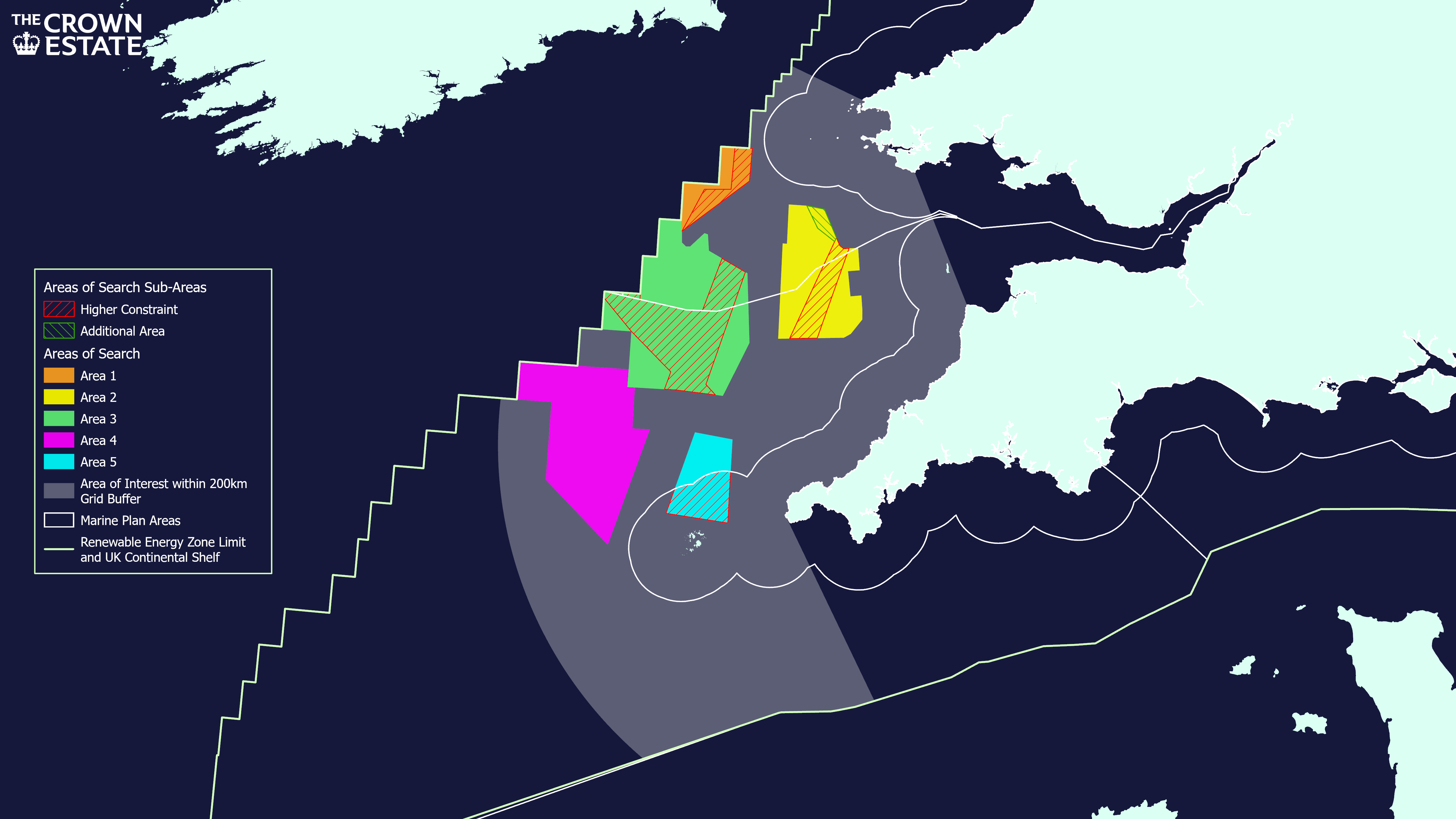
The Crown Estate kicked this off with press release in July 2022, that I wrote about in The Crown Estate Announces Areas Of Search To Support Growth Of Floating Wind In The Celtic Sea.
This map shows the five areas of search.
One Celtic Sea project has already been awarded a Contract for Difference in the Round 4 allocation, which I wrote about in Hexicon Wins UK’s First Ever CfD Auction For Floating Offshore Wind.
Other wind farms have already been proposed for the Celtic Sea.
In DP Energy And Offshore Wind Farms In Ireland, I said this.
They are also developing the Gwynt Glas offshore wind farm in the UK sector of the Celtic Sea.
- In January 2022, EDF Renewables and DP Energy announced a Joint Venture partnership to combine their knowledge and
expertise, in order to participate in the leasing round to secure seabed rights to develop up to 1GW of FLOW in the Celtic Sea. - The wind farm is located between Pembroke and Cornwall.
The addition of Gwynt Glas will increase the total of floating offshore wind in the UK section of the Celtic Sea.
- Blue Gem Wind – Erebus – 100 MW Demonstration project – 27 miles offshore
- Blue Gem Wind – Valorus – 300 MW Early-Commercial project – 31 miles offshore
- Falck Renewables and BlueFloat Energy – Petroc – 300 MW project – 37 miles offshore
- Falck Renewables and BlueFloat Energy – Llywelyn – 300 MW project – 40 miles offshore
- Llŷr Wind – 100 MW Project – 25 miles offshore
- Llŷr Wind – 100 MW Project – 25 miles offshore
- Gwynt Glas – 1000 MW Project – 50 miles offshore
This makes a total of 2.2 GW, with investors from several countries.
It does seem that the Celtic Sea is becoming the next area of offshore wind around the British Isles to be developed.
How do these wind farms fit in with the Crown Estate’s plans for the Celtic Sea?
I certainly, don’t think that the Crown Estate will be short of worthwhile proposals.
Conclusion
More and more wind farms keep rolling in.
Are The Tories Bluffing About Fracking?
I’ve just listened to a Treasury Minister (Chris Philp (?)) on the BBC and he didn’t mention fracking.
But he did mention more oil and gas in the North Sea, where there is a project agreed between the British and Scottish governments called INTOG, which aims to innovatively cut carbon emissions in the North Sea and possibly extract smaller amounts of gas and oil from existing wells.
As you know, I think fracking is irrelevant. It will take a few years to deliver substantial amounts of gas and we can extract more from the North Sea and by repurposing existing wells.
We might even find one or two existing wells, that could be converted to much-needed gas storage.
I also believe that the cash flow in taxes and leases from offshore wind will be astronomic and it can be used to finance borrowing. We did the same with Artemis to finance the company against future sales. But we were only borrowing millions. We used to parcel up all our leases from companies like Shell, NASA and BP and effectively sell them to Lloyds Bank at a discount.
I’m sure that a clever banker could find a mechanism, that converts future income from offshore wind into a magic money tree for today. Is that what Kwasi Kwarteng has done, in order to cut taxes?
The one problem with offshore wind with the public, is that putting in the cables arouses the NIMBYs. It should also be born in mind, that a lot of the grid connections, go through Tory seats, where NIMBYs are very much against more cables.
So I do wonder, if Moggy has announced the start of fracking to give the NIMBYs a target, so they allow the efficiency of offshore oil and gas to be improved and offshore wind farms to be built without hindrance.
Perhaps Moggy should concentrate on the most important thing that our offshore wind industry needs. This is an innovative pricing mechanism for energy storage, that does the following.
- Allows investors to get a similar return on energy storage to that that they get for offshore wind farms, onshore solar farms and interconnectors.
- Encourages the building of more energy storage.
- Assists in the development of novel energy storage ideas.
As one estimate says we need 600 GWh of energy storage in the UK, sorting this pricing mechanism, can’t come soon enough.
The previous government was talking about this, as I wrote in Ministerial Roundtable Seeks To Unlock Investment In UK Energy Storage.
So continue the conversation, Moggy!
Where Are The Magnificent Eighteen?
In the two classic Japanese and American films of the fifties, there were seven saviours, who worked together.
This page on the Highview Power web site talks about their proposed CRYOBattery in Yorkshire, where this is said.
Highview Power’s second commercial renewable energy power station in the UK is a 200MW/2.5GWh facility in Yorkshire. This is the first of 18 sites for UK wide deployment strategically located to benefit from the existing transmission infrastructure.
As the UK’s energy problem is much worse than the problems in the films, perhaps we need more saviours.
In this article on the Telegraph, which is entitled Britain Will Soon Have A Glut Of Cheap Power, And World-Leading Batteries To Store It, Rupert Pearce, who is Highview’s chief executive, is quoted as saying the following.
Highview is well beyond the pilot phase and is developing its first large UK plant in Humberside, today Britain’s top hub for North Sea wind. It will offer 2.5GW for over 12 hours, or 0.5GW for over 60 hours, and so forth, and should be up and running by late 2024.
Further projects will be built at a breakneck speed of two to three a year during the 2020s, with a target of 20 sites able to provide almost 6GW of back-up electricity for four days at a time, or whatever time/power mix is optimal.
Is this Humberside CRYOBattery, the one on the web site described as in Yorkshire? It’s certainly in the old East Riding.
In Highview Power’s Plan To Add Energy Storage To The UK Power Network, I came to the conclusion, that the Humberside CRYOBattery will most likely be built near Creyke Beck substation, which is close to Cottingham.
- Dogger Bank A, Dogger Bank B and Hornsea 4 offshore wind farms will all be connected to the Creyke Beck substation.
- These wind farms have a total capacity of 3.4 GW.
- The Humberside CRYOBattery, now looks to have a maximum output of 2.5 GW.
- It looks like the Humberside CRYOBattery would be a well-matched backup to the three planned wind farms and perhaps even a few more turbines.
Building the Humberside CRYOBattery at Creyke Beck substation would appear to be a sensible decision.
We Only Have Half A Story
It looks like we’ve only got half a story, with a lot of detail missing.
- Will there be eighteen or twenty of Highview Power’s CRYOBatteries?
- Will they have a power output of 400 MW or nearly 6 GW for four hours?
- Will they have a storage capacity of 2.5 GWh or 30 GWh?
- Is the web site or the CEO correct?
- Have Highview Power and National Grid signed a deal for the next few CRYOBatteries?
I am expecting to see a big press statement at some time, perhaps even in the next few days, that will clear everything up.
If it was me, I would invite the new Prime Minister to the opening of the Carrington CRYOBattery and make the statement there.
The joint publicity could be equally valuable to both the Prime Minister and Highview Power.
Renewable Power’s Effect On The Tory Leadership Election
I wouldn’t normally comment on the Tory Leadership Election, as I don’t have a vote and my preference has already been eliminated.
But after reading this article on the Telegraph, which is entitled Britain Will Soon Have A Glut Of Cheap Power, And World-Leading Batteries To Store It, I feel I have to comment both about this election and the General Election, that will follow in a few years.
These two paragraphs from the article illustrate the future growth of offshore wind power.
It is a point about the mathematical implications of the UK’s gargantuan push for renewables. Offshore wind capacity is going to increase from 11 to 50 gigawatts (GW) by 2030 under the Government’s latest fast-track plans.
RenewableUK says this country currently has a total of 86GW in the project pipeline. This the most ambitious rollout of offshore wind in the world, ahead of China at 78GW, and the US at 48GW.
If we assume that there is eight years left of this decade, that means that we should install about 4.9 GW of offshore wind every year until 2030. If we add in planned solar and onshore wind developments, we must be looking at at least 5 GW of renewable energy being added every year.
We have also got the 3.26 GW Hinckley Point C coming on stream.
I think we can say, that when it comes to electricity generation, we will not be worried, so Liz and Rishi can leave that one to the engineers.
If we have an electricity problem, it is about distribution and storage.
- We need more interconnectors between where the wind farms are being built and where the electricity will be used.
- National Grid and the Government have published plans for two interconnectors between Scotland and England, which I wrote about in New Electricity ‘Superhighways’ Needed To Cope With Surge In Wind Power.
- We need energy storage to back up the wind and solar power, when the wind isn’t blowing and the sun isn’t shining.
I think it is reasonable to assume, that we will get the interconnectors we need and the Telegraph article puts forward a very feasible and affordable solution to the energy storage problem, which is described in these two paragraphs from the article.
That is now in sight, and one of the world leaders is a British start-up. Highview Power has refined a beautifully simple technology using liquid air stored in insulated steel towers at low pressure.
This cryogenic process cools air to minus 196 degrees using the standard kit for LNG. It compresses the volume 700-fold. The liquid re-expands with a blast of force when heated and drives a turbine, providing dispatchable power with the help of a flywheel.
The article also talks of twenty energy storage systems, spread around the UK.
- They will have a total output of 6 GW.
- In total they will be able to store 600 GWh of electricity.
The first one for Humberside is currently being planned.
Surely, building these wind and solar farms, interconnectors and energy storage systems will cost billions of pounds.
Consider.
- Wind and solar farms get paid for the electricity they generate.
- , Interconnectors get paid for the electricity they transfer.
- Energy storage systems make a profit by buying energy when it’s cheap and selling it, when the price is better.
- In World’s Largest Wind Farm Attracts Huge Backing From Insurance Giant, I talked about how Aviva were funding the world’s largest wind farm at Hornsea.
- National Grid has a history of funding interconnectors like the North Sea Link from large financial institutions.
I believe that the islands of Great Britain and Ireland and the waters around our combined shores will become the largest zero-carbon power station in the world.
This will attract engineering companies and financial institutions from all over the world and we will see a repeat of the rush for energy that we saw for oil and gas in the last century.
If we get the financial regime right, I can see a lot of tax money flowing towards the Exchequer.
The big question will be what do we do with all this energy.
- Some will be converted into hydrogen for transport, the making of zero-carbon steel and cement and for use as a chemical feedstock.
- Industries that use a lot of electricity may move to the UK.
- A large supply of electricity and hydrogen will make it easy to decarbonise housing, offices and factories.
The Telegraph article also says this.
Much can be exported to the Continent through interconnectors for a fat revenue stream, helping to plug the UK’s trade deficit, and helping to rescue Germany from the double folly of nuclear closures and the Putin pact. But there are limits since weather patterns in Britain and Northwest Europe overlap – partially.
I suspect that more energy will be exported to Germany than most economists think, as it will be needed and it will be a nice little earner for the UK.
Given the substantial amount of German investment in our wind industry, I do wonder, if Boris and Olaf did a deal to encourage more German investment, when they met in April this year.
- BP have been backed with their wind farms by a German utility company.
- RWE are developing the Sofia wind farm.
- Only last week, the deal for the NeuConnect interconnector between the Isle of Grain and Wilhelmshaven was signed.
- Siemens have a lot of investments in the UK.
I wouldn’t be surprised to see more German investments in the next few months.
The Golden Hello
Has there ever been a Prime Minister, who will receive such a golden hello, as the one Liz or Rishi will receive in September?
The Tory Leadership Election
Some of the candidates said they would reduce taxes , if they won and Liz Truss is still saying that.
I wonder why Rishi isn’t saying that he would reduce taxes, as he must know the cash flow that is coming. It may be he’s just a more cautious soul.
Vote Hydrogen For London
London has an air pollution problem, as do many cities around the UK and the world.
This web page from Imperial College is entitled Air Pollution Research in London.
It starts like this.
Why Do Research In London?
- Air pollution is a very large public health issue in London. It shortens the lives of Londoner’s leading to up to 9,400 extra deaths per year.
- We still do not fully understand the health effects of air pollution.
- London is a good place to do air pollution research, and acts as a giant laboratory.
- Air pollution is well recorded in London, starting in 1993 and now covering about 200 sites.
- London has a large population and good data on health, movement and population.
Surely, 9,400 extra deaths per year are 9,400 extra deaths too many!
These pictures were taken close to where I live in Hackney, mainly on the Bals Pond Road and Moorgate.












All show heavy diesel trucks, spewing out large amounts of carbon dioxide and other emissions.
So how can we reduce the pollution from these heavy trucks?
Consider.
- I doubt that despite what Elon Musk says, these six- and eight-wheeled trucks can’t be powered by batteries.
- Nearly all of these trucks, never go far from London.
- Many of these trucks could be converted to hydrogen and thus become zero-carbon.
- When they are replaced, these trucks should be replaced by zero-carbon hydrogen trucks.
But there is one big problem. Unlike Aberdeen, Birmingham, Glasgow and a few other areas, London has no hydrogen infrastructure and the Mayor has no plans to develop one.
I will not vote for any politician, who doesn’t support developing a hydrogen infrastructure and a hydrogen policy for London.
‘New Era’ As German Coalition Prioritises Rail Spending Over Road
The title of this post, is the same as that of this article on Railway Gazette.
This is the first paragraph.
The so-called ‘traffic light coalition’ formed by the Social Democratic, Green and Free Democratic parties as the next federal government has committed to launching a ‘Rapid Capacity Expansion’ to enhance railway infrastructure as part of its wider transport strategy.
Other policies would include.
- A national regular interval timetable as a matter of priority.
- Increasing rail’s share of the freight transport market from the current 19% to 25% by 2030.
- Doubling passenger traffic by the end of the decade.
- Electrify 75 % of the network by 2030.
- Road tolls for trucks would be increased to reflect CO2 emissions.
- New commercial and industrial developments would be mandated to examine the potential for incorporating a rail connection.
- A pressure group, whose name translates as Alliance Pro Rail is in favour.
But will the average German voter in their Audi, BMW, Mercedes or Volkswagen cruising down the autobahn be in favour?
It certainly looks like it will be all change on German railways and roads.
The article is also linked to three in depth articles on the future of German railways published by Railway Gazette in the last few months.
- Comment: Climate Goals To Trump Profits
- German Associations Seek More Competition In Second Rail Reform
- Rail Reopenings To Support Climate-Friendly Transport
It certainly is all change.
Covid in Wales: Groups Of Six Allowed To Meet In Pubs
The title of this post, is the same as that of this article on the BBC.
This is the first paragraph.
Groups of no more than six people will be allowed to meet in pubs, cinemas and restaurants in Wales from 26 December, the first minister has said.
I’m glad I don’t live in a nanny socialist state like Wales.
We should be treated like adults and allowed to develop our own rules.
- I am doubly-vaccinated with AstraZeneca
- I have recently had a booster Pfizer vaccine.
- I generally wear a mask, when I’m outside my house.
- I avoid crowded places when I’m outside my house.
- I only invite a selected group of people into my house.
- I obey social distancing rules.
But my biggest protection comes from being coeliac on a long-term gluten free diet, which gives me an immune system, which is immensely strong.
I’ve yet to meet or hear of any coeliac on a long-term gluten-free diet, who has had a serious dose of the Covids.
Tube Strikes: Passengers Warned Of Widespread Disruption
The title of this post, is the same as that of this article on the BBC.
I can see a scenario, where the Tories put something in their next General Election manifesto to bring a little bit of sense to the RMT and there is a total National rail strike during the election.
It would be Starmer’s worst nightmare!
As it is this morning, I’ll probably have difficulty getting to Moorgate for my gluten-free full English breakfast and do my food shopping for the weekend in Marks and Spencer.
Thoughts On Splitting The Northern Line
In Battersea Power Station Station Opens, I talked about the scale of the new Battersea Power Station station.
- It looks like it could have three entrances.
- It’s got four escalators and two lifts to go to down to platform level.
- It has two terminal platforms.
I feel it has been designed to handle as many passengers and trains as Morden station.
- Morden station has five platforms.
- The station is step-free.
- The station handles ten million passengers per year.
The signalling can handle up to thirty trains per hour (tph) to Morden.
It looks to me that Battersea Power Station station has been designed to be big enough to take half the trains from North London with ease.
The Bank Station Upgrade
In the Bank Station Upgrade, nearly a mile of new train tunnel and several shorter pedestrian tunnels were built.
They were dug not with a tunnel boring machine, but by traditional methods, that would have been understood by Brunel and the ancient Egyptians; pick and shovel, but probably assisted by the best modern electrical diggers and trucks.
I would expect that any tunnelling needed to split the Northern Line will not use an expensive tunnel boring machine.
The Northern Line will be going back to the future.
The Proposed Split
There has been talk of splitting the Northern Line into two separate lines for some years.
- The Western Line (Charing Cross Line) would run between Edgware and Battersea Power Station via Camden Town, Euston, Charing Cross and Kennington.
- The Eastern Line (Bank Line) would run between High Barnet and Morden via Camden Town, Euston, Bank and Kennington.
Note.
- I will call the two lines the Bank and Charing Cross Lines.
- Both lines could have Victoria Line frequencies of at least thirty tph.
- It is generally felt that the split would need a rebuild at Camden Town station to handle the extra passengers.
- Camden Town station also needs better access between the trains and the street.
- There would need to be better connections at Kennington and Euston stations.
Surely, the main advantages of the split would be as follows.
- Trains on both lines would go end-to-end without crossing a junction, where signals and points were constantly switching trains. This is why the Victoria Line can handle more than thirty-three tph.
- Trains will run at Victoria Line frequencies on both lines.
- All trains at Camden Town and Kennington stations would use a route without points to go as fast as possible through the station.
- Eliminating the points, would make both lines more reliable.
- Euston station will have upwards at least sixty tph connecting it to Crossrail.
Effectively, the new Bank and Charing Cross Lines would be able to perform just like Dear Old Vicky.
I will now look at where work needs to or could be done to successfully split the two lines.
Kennington Station
In Could Access Between Platform And Train Be Improved At Kennington Station?, I outlined how passengers might use Kennington station to change between the Bank and Charing Cross Lines.
I developed this rule.
The rule would appear to be if you’re on one line and are going to a station on the other, you change at Kennington station.
Staff would need to be on the platform to help those, who were changing direction.
But I do think changing can be made to work well with step-free access between train and platform on all four platforms at Kennington station.
It will be interesting to see, what proportion of train changes at Kennington are simple cross-platform changes, where there is no use of the steep stairs. I think it could be quite high.
I believe Kennington station will grow into a very smooth interchange between the Bank and Charing Cross Lines.
Although, there’ll be a problem for some time, if you’re in a wheelchair and want to go between Morden and Battersea Power station.
This could be solved by lifts between each pair of platforms and the intermediate level passage, which connects to the lifts to the surface.
The Camden Town Problem
This map from cartometro.com shows the lines around and through Camden Town station.

Note.
- Camden Town station has four platforms.
- The Eastern pair are under Kentish Town Road and connect to High Barnet in the North.
- The Western pair are under Camden High Street and connect to Edgware in the North.
- In each pair of tracks the Northbound track is above the Southbound track.
- There is a level passage between the two Northbound tracks, so it is an easy interchange, if you’re on the wrong train going North.
- The passage between the two Southbound tracks has stairs at either end, if you want to change Southbound trains at the station.
But the real problem lies South of the station; the horrendously complicated Camden Town Junction.
The junction must be able to handle trains going between the following stations.
- Bank and Edgware
- Bank and High Barnet
- Charing Cross and Edgware
- Charing Cross and High Barnet
Note in the map, that the High Barnet tracks dive under the Edgware tracks so they can form two separate pairs of tracks to Euston, only one of which goes via Mornington Crescent.
If there was a similar junction on the motorways of the UK or the Interstate Highways of the US, it would have years ago been simplified.
The split will mean the following.
- The Eastern pair of platforms will still be connected to High Barnet as now, but will also be directly connected to the tracks that go directly to Euston and on to Bank.
- The Western pair of platforms will still be connected to Edgware as now, but will also be directly connected to the tracks that go to Euston via Mornington Crescent and on to Charing Cross.
- Camden Town Junction could be seriously simplified, with perhaps the ability to swap between routes only available for depot and engineering movements.
I do suspect, it would also mean all trains from High Barnet will go via Bank and all trains via Edgware will go via Charing Cross.
- A proportion of passengers would have to change at Camden Town.
- Both routes would connect to High Speed Two at Euston.
- Both routes connect to the Central, Jubilee, Piccadilly and Victoria Lines.
- Improvements promised for Euston will give better access to the Sub-Surface Lines.
I think it will be a case of winning some good routes and losing others. Disgusted from Finchley might complain.
But then there will be Crossrail, which as it connects to both lines at Tottenham Court Road and Moorgate could give serious advantages.
The split isn’t without passengers who will object to losing their preferred route.
Camden Town Station
This document on TfL’s web site gives more details of the proposed capacity upgrade at Camden Town station. This schematic of the tunnels, platforms and walkways shows how the station could look in a few years time.
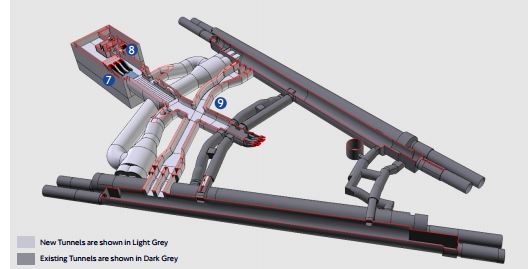
Note.
- New tunnels are shown in light grey.
- Existing tunnels are shown in dark grey.
- The Northbound platforms are above the Southbound ones.
- The tunnels in the foreground are those of the Charing Cross Line.
- The far tunnels are those of the Bank Line.
- The new Buck Street entrance is labelled 8.
- There is a new pedestrian tunnel between the two Northbound Lines.
- Below it is a new tunnel between the two Southbound Lines.
- There is an existing passage linking the four lines.
The full upgrade is very much on the back burner, but could Camden Town station be upgraded with the proposed extra cross passages.
- These would enable passengers to change lines easily on the level.
- Passengers changing between the Bank and Charing Cross Lines could be kept away from the existing escalators and the space at their bottom.
- The tunnels would increase the circulation area.
- The tunnels would be part of the new Buck Street entrance if it were to be built.
I feel with improved cross-platform interchange, Camden Town could function as an interchange station between the Bank and Charing Cross Lines.
A similar rule as I used for Kennington station would apply for passengers.
The rule would appear to be if you’re on one line and are going to a station on the other, you change at Camden Town station.
Staff would need to be on the platform to help those, who were changing direction.
But it would be a more comprehensive and easier interchange than Kennington, as all changes would be without steep stairs.
Once Camden Town station is working well with the new cross passages, I would then get a developer to put a large development on the proposed site of the Buck Street entrance, with a new entrance with lifts and escalators underneath, that reached down to the new cross tunnels.
After what the contractors did at Whitechapel, I suspect this could be achieved, whilst keeping the trains running and leaving the existing Camden Town station intact.
This Google Map shows the area between Camden Road and Camden Town stations.
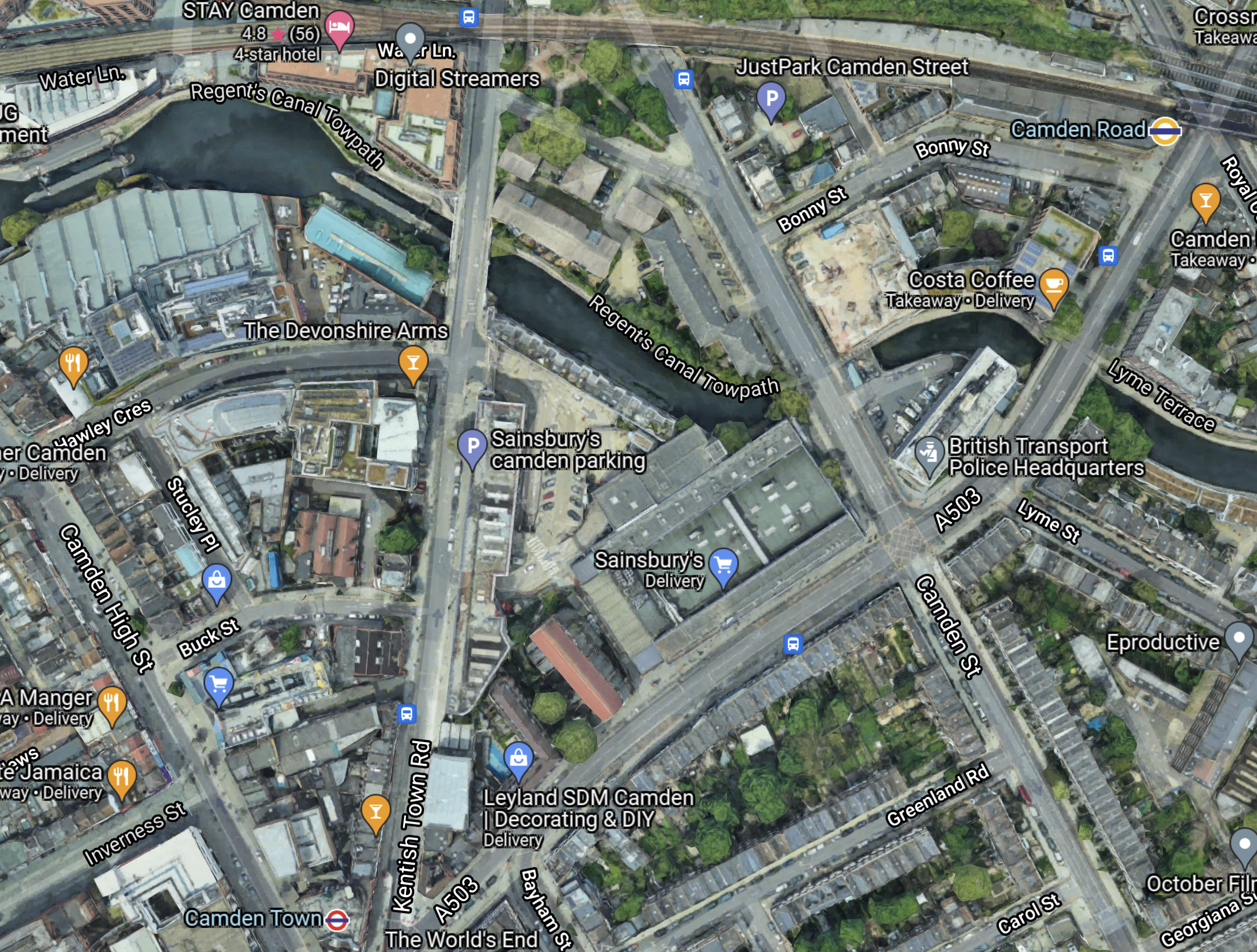
Note.
- Camden Road station on the North London Line is in the North-East corner of the map.
- Camden Town station is at the bottom of the map towards the West.
- The Charing Cross Line to Edgware is under Camden High Street.
- The Bank Line to High Barnet is under Kentish Town Road.
- Buck Street is to the North of Camden Town station connecting Camden High Street and Kentish Town Road.
- The red-roofed building in Buck Street is the former Hawley School, which is now owned by Transport for London and is earmarked for the new station entrance.
- The Regent’s Canal, which has a convenient towpath, runs East-West across the map.
- A lot of development is happening on the North bank of the canal.
The map doesn’t show how difficult it is to walk between the two stations along the busy Camden Road.
In Between Camden Road And Camden Town Stations Along The Canal, I walked between the two stations along the canal and then up Kentish Town Road. It took me fourteen minutes in total with seven minutes between the canal and Camden Town station.
I believe the following will happen.
- People living and working in the new developments will need access to Camden Town station.
- The Regent’s Canal towpath will be updated into a safer walking route between Camden Lock and Camden Road station, that serves a lot of the developments.
- More tourists will need to get to Camden Lock and the markets.
These will increase the need for extra capacity at Camden Town station.
The only way it will get built is by a private developer, who puts a lot of housing on the Buck Street site and sells it as quality housing in an iconic location.
A lot of politicians won’t like it, but solving the problems at Camden Town station, which is an overcrowding accident waiting to happen, is more important than their egos.
These pictures show some of the features of Camden Town station.












I believe Camden Town station could grow quickly into a very smooth interchange between the Bank and Charing Cross Lines.
In a few years time, when the Buck Street entrance is built, the capacity problems will be on their way to solution.
Finally, once the Buck Street entrance is complete, the original station can be refurbished.
Euston Station, Crossrail, Crossrail 2 and the Northern Line
Consider.
- Euston station is a very busy station and it will be even busier, when High Speed Two opens.
- Crossrail 2 will not be built before High Speed 2 opens.
- The Victoria Line doesn’t connect to Crossrail.
- The only connection between Euston station and Crossrail are the two branches of the Northern Line.
Splitting the Northern Line into the Bank and Charing Cross Lines will increase the number of Northern Line trains through Euston to at least sixty tph, if both lines can handle Victoria Line frequencies.
It looks to me, that making the Northern Line step-free at Euston is the best short-term alternative to building Crossrail 2.
Euston Station
Euston station is the third station, where the Bank and Charing Cross Lines connect.
This map from cartmetro.com shows the Northern Line through Euston station.
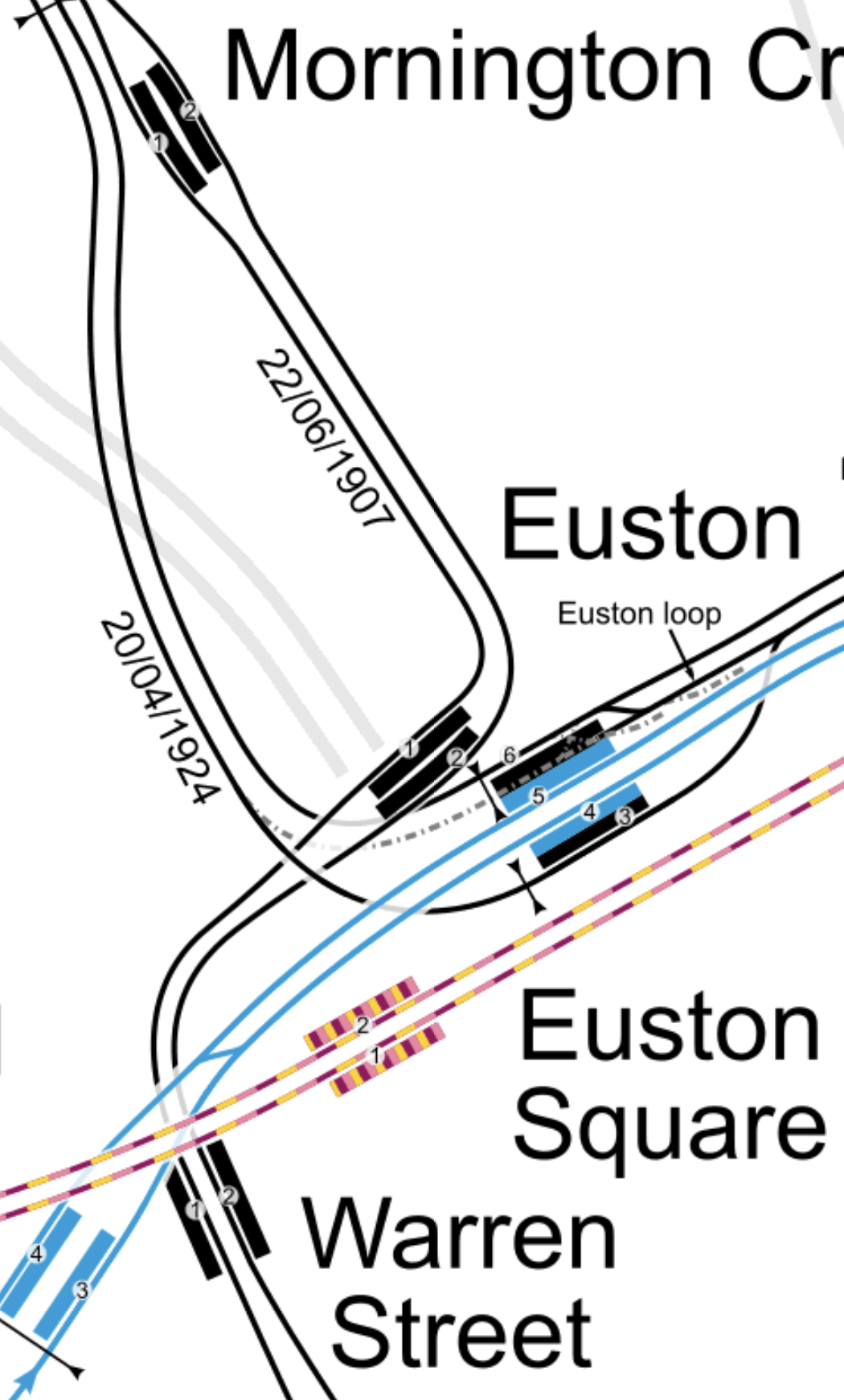
Note.
- The Northern Line is shown in black.
- The Victoria Line is shown in blue
- The Sub-Surface Lines are shown in purple and yellow.
In the map, the platforms are as follows going from top to bottom.
- Platform 1 – Northbound – Northern – Charing Cross to Camden Town
- Platform 2 – Southbound – Northern – Camden Town to Charing Cross
- Platform 6 – Southbound – Northern – Camden Town to Bank
- Platform 5 – Northbound – Victoria – Victoria to Walthamstow
- Platform 4 – Southbound – Victoria -Walthamstow to Victoria
- Platform 3 – Northbound – Northern – Bank to Camden Town
It is a bit unusual as the cross-platform interchange between Bank and Victoria Lines involves a change of direction.
With the development of Euston station for High Speed Two, I am sure interchange between the two branches of the Northern Line and the other lines at Euston will be made step-free.
Plans have already been published that will connect Euston Square station and Euston station. I wrote about it in The New Step-Free Entrance At Euston Square Station.
These pictures are of Euston station.







I feel the wide Platform 6 could give scope for innovation.
Level Access Between Train And Platform
I believe that many platforms on the Northern Line can be modified to give level access between train and platform.
In Could Access Between Platform And Train Be Improved At Kennington Station?. I outlined how it could be achieved at Kennington station.
At Kennington station, all platforms are straight and this is a prerequisite to making the access level.
I also feel that any straight platform with a Harrington Hump could effectively be given a full length hump.
I suspect that a lot of stations could be converted to level access between train and platform
Conclusion
I believe that splitting the Northern Line would be very worthwhile.
How Nicki Minaj And Swollen Testicles Became Part Of a UK Coronavirus Briefing
The title of this post, is the same as that of this article on the BBC.
I do like this comment from Sajid Javid on Sky News, from the BBC report.
People that are in the public eye whether they are a celebrity or a politician or whoever they are should be very careful with their language and certainly shouldn’t be spreading untruths.
I had never heard of Nicki Minaj before and I don’t think I want to hear any of her future pronouncements.
 The Anonymous Widower