Site Investigations Underway At RWE’s Three Norfolk Offshore Wind Project Sites
The title of this post, is the same as that of this article on offshoreWIND.biz.
This is the sub-heading.
RWE has kicked off geophysical and geotechnical site investigations at the Norfolk Boreas, Norfolk Vanguard East, and Norfolk Vanguard West offshore wind project sites in the UK, rights to which the German company acquired from Vattenfall earlier this year.
All three projects in RWE’s 4.14 GW wind farm off the Norfolk coast, at last seem to be making progress.
According to the Wikipedia entry for the List Of Offshore Wind Farms In The United Kingdom, this is the last status.
Norfolk Boreas
Owner: RWE
Turbines: Vestas
Status: Contract for Difference – Round 4
Commissioning Date: 2027
Norfolk Vanguard East
Owner: RWE
Turbines: Vestas
Status: Early Planning
Commissioning Date: Before 2030
Norfolk Vanguard West
Owner: RWE
Turbines: Vestas V236-15.0 MW
Status: Early Planning
Commissioning Date: Before 2030
Note.
- All three Norfolk wind arms, will be using Vestas turbines.
- The data for Norfolk Vanguard West shows that Vestas V236-15.0 MW turbines will be used.
- In SeAH To Deliver Monopiles For Vattenfall’s 2.8 GW Norfolk Vanguard Offshore Wind Project, I discussed the monopiles for the Norfolk wind farms. Will these be standardised across the Norfolk wind farms?
- In RWE Orders 15 MW Nordseecluster Offshore Wind Turbines At Vestas, I speculated that RWE had standardised on these large turbines for their North Sea wind farms, which would surely be a sensible action to take.
Using the same large turbines and monopiles for a number of wind farms, will surely give advantages in manufacture, installation, operation and and servicing for RWE, SeAH Wind and Vestas.
The finances should also be more beneficial.
These are my thoughts.
Will The Norfolk Wind Farms Produce Hydrogen For Germany?
Consider.
- As Hornsea 4 wind farm makes landfall in Norfolk, Norfolk should have enough renewable electricity.
- The Norfolk Nimbies will object to more electricity transmission lines across Norfolk.
- H2ercules, which is the large German hydrogen network will need lots of green hydrogen.
- Wilhelmshaven, which will be the main hydrogen feed point for H2ercules, is just across the North Sea at Wilhelmshaven.
- There are no Houthis roaming the North Sea.
- Hydrogen could be transported from the Norfolk wind farms to Wilhelmshaven by pipeline or coastal tanker.
- German companies are building the Norfolk wind farms.
I believe that there is a good chance, that the Norfolk wind farms will produce hydrogen for Germany.
This will have the following benefits.
- Germany will get the hydrogen it needs.
- The hydrogen link will improve energy security in Europe.
- The UK government will receive a nice cash flow.
The only losers will be the dictators, who supply Europe with energy.
Wood To Optimise Hydrogen Storage For Centrica’s Rough Field
The title of this post, is the same as that of this press release from Wood plc.
These are the first three paragraphs.
Wood, a global leader in consulting and engineering, has been awarded a contract by Centrica Energy Storage (CES) for the redevelopment of the UK’s Rough field in readiness for future hydrogen storage.
The Rough reservoir, located in the Southern North Sea, has been used to store natural gas safely for over thirty years and has the potential to provide over half of the UK’s hydrogen storage requirements.
The front-end engineering design (FEED) contract, awarded to Wood, entails new pipelines, a new unmanned installation, as well as onshore injection facilities at the Easington Gas Terminal, is the first step in making the field hydrogen ready.
Offshore Magazine has this article about the deal, which is entitled Wood Assessing Hydrogen Storage Needs For North Sea Rough Reservoir.
This is a paragraph from the Offshore Magazine article.
Centrica aims to position the Rough Field as the world’s largest long-duration hydrogen storage facility, although FID on the redevelopment project would depend on government support.
It would be a very important project.
Why would Centrica be planning for this massive increase in hydrogen storage?
There could only be one reason.
There is going to be a massive increase in hydrogen production and use.
In Where’s The Plan, Rishi?, I laid out what I believe will happen in the next few years.
- In RWE Goes For An Additional 10 GW Of Offshore Wind In UK Waters In 2030, I detailed how RWE intended to add an extra 10 GW of offshore wind to the seas around the UK.
- As our current offshore wind capacity is around 15 GW, so another 10 GW would surely be very welcome.
- The Germans will develop H2ercules, which is their massive project to create a hydrogen network to bring hydrogen to Southern Germany.
- A hydrogen hub at Wilhelmshaven is being built by Uniper to feed H2ercules with green hydrogen from around the world.
But would it not be better, if instead of feeding H2ercules with hydrogen from around the world, some came from the UK, a few hundred miles across the North Sea?
- RWE are developing the 3 GW Dogger Bank South wind farm, which is not in the best place for a cable to the UK. So could this wind farm have an offshore electrolyser and send the hydrogen to Wilhelmshaven, by pipeline or coastal tanker?
- RWE are also developing the 4.2 GW Norfolk cluster of wind farms to the North-East of Great Yarmouth. It might be better, if the output of these wind farms took a hydrogen route to Wilhelmshaven.
- I also believe that a third offshore electrolyser might be situated North of the Wash to bring more hydrogen to Germany.
- Hydrogen could also be sent from the Rough facility to Wilhelmshaven.
The coastal tanker route gives flexibility, so green hydrogen could be sent as required to the UK mainland.
Rishi Sunak’s Manifesto Speech – June 11
I also reported on Rishi Sunak’s Manifesto Speech, which he made on June 11th. This is an extract
This document on the Policy Mogul web site is entitled Rishi Sunak – Conservative Party Manifesto Speech – Jun 11.
These are three paragraphs from the speech.
We don’t just need military and border security. As Putin’s invasion of Ukraine has shown, we need energy security too. It is only by having reliable, home-grown sources of energy that we can deny dictators the ability to send our bills soaring. So, in our approach to energy policy we will put security and your family finances ahead of unaffordable eco zealotry.
Unlike Labour we don’t believe that we will achieve that energy security via a state-controlled energy company that doesn’t in fact produce any energy. That will only increase costs, and as Penny said on Friday there’s only one thing that GB in Starmer and Miliband’s GB Energy stands for, and that’s giant bills.
Our clear plan is to achieve energy security through new gas-powered stations, trebling our offshore wind capacity and by having new fleets of small modular reactors. These will make the UK a net exporter of electricity, giving us greater energy independence and security from the aggressive actions of dictators . Now let me just reiterate that, with our plan, we will produce enough electricity to both meet our domestic needs and export to our neighbours. Look at that. A clear, Conservative plan not only generating security, but also prosperity for our country.
It is now nineteen days since Rishi made that speech and I can’t remember any reports about an energy security policy, which he outlined in the last paragraph of my extract from his speech.
He particularly mentioned.
- New gas-powered stations
- Trebling our offshore wind capacity
- Having new fleets of small modular reactors.
He also said we would have sufficient electricity to export to our neighbours. As I said earlier some of this energy will be in the form of hydrogen, which has been created by offshore electrolysers.
If we are exporting electricity and hydrogen to Europe, this is likely to have three effects.
- An improvement in Europe’s energy security.
- H2ercules will improve and decarbonise German industry, using UK hydrogen.
- The finances of UK plc will improve.
It looks like there will be winners all round.
Conclusion
Centrica’s plan for a massive hydrogen store at Rough, close to SSE’s existing gas storage in the salt caverns at Aldbrough, would appear to make sense, if the UK’s excess of offshore wind is converted into green hydrogen, which is then stored and distributed as needed.
Where’s The Plan, Rishi?
In RWE Goes For An Additional 10 GW Of Offshore Wind In UK Waters In 2030, I detailed how RWE intended to add an extra 10 GW of offshore wind to the seas around the UK.
As our current offshore wind capacity is around 15 GW, another 10 GW would surely be very welcome.
My post also outlined H2ercules, which is Germany’s massive project to create a hydrogen network to bring hydrogen to Southern Germany.
I also gave details of the hydrogen hub at Wilhelmshaven, which is being built by Uniper to feed H2ercules with green hydrogen from around the world.
I believe that some of this hydrogen for H2ercules will take a short trip across the North Sea from UK waters, after being created by offshore electrolysers.
Rishi Sunak’s Manifesto Speech – June 11
I also reported on Rishi Sunak’s Manifesto Speech, which he made on June 11th. This is an extract
This document on the Policy Mogul web site is entitled Rishi Sunak – Conservative Party Manifesto Speech – Jun 11.
These are three paragraphs from the speech.
We don’t just need military and border security. As Putin’s invasion of Ukraine has shown, we need energy security too. It is only by having reliable, home-grown sources of energy that we can deny dictators the ability to send our bills soaring. So, in our approach to energy policy we will put security and your family finances ahead of unaffordable eco zealotry.
Unlike Labour we don’t believe that we will achieve that energy security via a state-controlled energy company that doesn’t in fact produce any energy. That will only increase costs, and as Penny said on Friday there’s only one thing that GB in Starmer and Miliband’s GB Energy stands for, and that’s giant bills.
Our clear plan is to achieve energy security through new gas-powered stations, trebling our offshore wind capacity and by having new fleets of small modular reactors. These will make the UK a net exporter of electricity, giving us greater energy independence and security from the aggressive actions of dictators . Now let me just reiterate that, with our plan, we will produce enough electricity to both meet our domestic needs and export to our neighbours. Look at that. A clear, Conservative plan not only generating security, but also prosperity for our country.
It is now nine days since Rishi made that speech and I can’t remember any reports about an energy security policy, which he outlined in the last paragraph of my extract from his speech.
He particularly mentioned.
- New gas-powered stations
- Trebling our offshore wind capacity
- Having new fleets of small modular reactors.
He also said we would have sufficient electricity to export to our neighbours. As I said earlier some of this energy will be in the form of hydrogen, which has been created by offshore electrolysers.
If we are exporting electricity and hydrogen to Europe, this is likely to have three effects.
- An improvement in Europe’s energy security.
- H2ercules will improve and decarbonise German industry, using UK hydrogen.
- The finances of UK plc will improve.
It looks like there will be winners all round.
Rishi also said this, in his speech.
As Putin’s invasion of Ukraine has shown, we need energy security too.
The gas-powered stations, offshore wind farms and the fleets of small modular reactors, will be part of the equation.
But I believe, we need three other components to complete our energy security.
- The upgrading of the National Grid.
- The building of four x 2 GW interconnectors between Scotland and Eastern England.
- Large amounts of energy storage.
Note.
- The Great Grid Upgrade and the four x 2 GW interconnectors are being planned.
- In Huge Boost To UK Supply Chain As National Grid Launches The Great Grid Partnership With Seven New Industry Partners, All United In The Drive To Deliver The Great Grid Upgrade, I describe how National Grid has setup the Great Grid Partnership to deliver the Great Grid Upgrade.
- In UK Infrastructure Bank, Centrica & Partners Invest £300M in Highview Power Clean Energy Storage Programme To Boost UK’s Energy Security, I describe how the big boys do a deal with Highview Power to create affordable batteries for the UK and the world.
- In Grid Powers Up With One Of Europe’s Biggest Battery Storage Sites, I describe how the very large Swardeston BESS is to be built near Norwich.
- In Mercia Power Response & RheEnergise Working Together To Build Long Duration Energy Storage Projects In The UK, I describe another UK-developed long duration energy storage system, which is now being planned.
- In National Grid Shares Proposals For Green Electricity Projects In Lincolnshire And West Norfolk, Needed To Boost Home-Grown Energy Supplies And Progress Towards Net Zero, I describe National Grid’s projects in the East of England.
- In UK ESO Unveils GBP 58 Billion Grid Investment Plan To Reach 86 GW of Offshore Wind By 2035, I show how we’re not that far away from 86 GW by 2035.
- In 400k For National Grid Innovation Projects As Part Of Ofgem Fund To Help Shape Britain’s Net Zero Transition, I describe how National Grid is using innovation to help target net-zero by 2035.
- In Iberdrola Preparing Two East Anglia Offshore Wind Projects For UK’s Sixth CfD Round, I describe how Iberdrola is getting 1.7 GW ready for commissioning in 2026.
- In National Grid To Accelerate Up To 20GW Of Grid Connections Across Its Transmission And Distribution Networks, I describe how National Grid are accelerating the development of the electricity networks. 10 GW of battery storage is a collateral benefit.
These ten projects, most of which are financed and/or underway, would appear to be good foundations, on which to build the Great Grid Upgrade.
It looks to me, that National Grid, RWE, Centrica, Iberdrola and others, by just doing what comes naturally have offered the next government a road to a future.
It will be interesting, what gets said before the election.
The Core Of Sunak’s Manifesto
I have a feeling, that the core of Sunak’s manifesto is a massive German project called H2ercules, which is intended to bring low-carbon hydrogen to industry in South Germany.
There will be a massive hydrogen hub at Wilhelmshaven on the North-Western coast, which is being built by Uniper, from which hydrogen will be imported and distributed.
I suspect that the Germans aim to source the hydrogen worldwide from places like Australia, the Middle East and Namibia. It would be brought from and round the Cape by tanker. The Suez route would be too risky.
But RWE, who are one of the UK’s largest electricity suppliers, are planning to deliver 7.2 GW of electricity in British waters on the Dogger Bank and North-East of Great Yarmouth.
Both wind farms would be difficult to deliver profitably to the UK, because Eastern England already has enough electricity and the Nimbies are objecting to more pylons.
I believe that RWE will build offshore electrolysers and coastal hydrogen tankers will take the hydrogen to Wilhelmshaven.
H2ercules will be fed with the hydrogen needed.
By the end of the next parliament, the Germans could be paying us substantial sums for green hydrogen, to decarbonise their industry.
Rishi Sunak hinted in his speech, that we will be exporting large amounts of energy.
Much of it will be in the form of green hydrogen to Germany.
If we need hydrogen for our industry, we would create it from some of our own wind farms.
H2ercules
H2ercules is a project that will create the German hydrogen network.
The H2ercules web site, introduces the project with these two paragraphs.
A faster ramp-up of the hydrogen economy in Germany is more important than ever in order to drive forward the decarbonisation programme, put the German energy system on a more robust footing, and thus contribute towards a green security of supply. What this needs is a geographical realignment of the infrastructure for energy in gas form: Instead of flowing from the east of Germany to the west and south of the country, the gas – natural gas now, hydrogen in the future – will have to make its way in future from generation locations in the north-west to centres of consumption located mainly in the west and south. That also means that new sources will have to be connected, and gaps in existing pipeline networks will have to be closed. To speed up this vital process, OGE and RWE have developed the national infrastructure project “H2ercules”, which is intended to supply consumers in Germany’s south and west with domestically produced green hydrogen from the north of the country, in addition to imported sources. This will involve connecting up the electrolyser capacities that are currently being planned and developing more besides. RWE wants to create up to 1 GW of additional electrolyser capacity as part of the H2ercules project. For the connection component, OGE is planning to put 1,500 km of pipelines in place. For the most part, this will mean converting pipelines from the existing natural gas network to hydrogen, supplemented by newly constructed facilities. Converting natural gas pipelines is not only the more cost-efficient solution, but it also allows for a faster schedule. The system is expected to be supplemented by the planned hydrogen storages of RWE.
The current plan is to complete the project in three stages between 2026 and 2030, in order to connect industries to the hydrogen supply as soon as possible. The aim of this collaboration across multiple value levels is to resolve the chicken-and-egg problem on a super-sized scale and also smooth the way forward for other projects.
Note.
There will be a lot of conversion of the existing natural gas network to hydrogen.
RWE wants to create up to 1 GW of additional electrolyser capacity as part of the H2ercules project.
The second paragraph indicates to me, that they want to move fast.
This map from the H2ercules web site, indicate the proposed size of the network in 2030.

These three paragraphs describe how H2ercules will be developed.
OGE and RWE are both strong companies that aim to combine forces as part of the H2ercules project in order to overcome this Herculean task. While the task for OGE will be to convert the required gas pipelines to hydrogen and construct new pipelines, RWE will expand its electrolyser capacity and import green hydrogen in addition. Gas-fired power stations with a capacity of at least 2 GW will be converted to hydrogen, and new H2 -storages as well as H2-storages repurposed from gas storages on the Dutch border will be connected to the hydrogen supply system.
H2ercules also opens up new opportunities to connect Germany’s future centres of hydrogen consumption to key import routes, first via pipelines from Belgium and the Netherlands, and later via Norway and also from southern and eastern Europe, with the added prospects of import terminals for green molecules in Germany’s north. The project is thus contributing significantly to the creation of a European hydrogen market.
The first additional companies and organisations have already indicated their interest in this project, and it is expected that in the future smaller businesses will benefit in addition to large-scale customers, as the entire industry is guided towards a decarbonised future.
These are my thoughts.
Why Is It Called H2ercules?
I suspect, it’s nothing more, than the Germans wanted a recognisable and catchy name.
- Name selection is not helped by the German for hydrogen, which is wasserstoff.
- Hercules is Herkules in German, which doesn’t really help.
- Projekt Wasserstoff isn’t as memorable as H2ercules, which at least isn’t English.
It looks to me, that the Germans have come up with a good acceptable compromise.
The Wilhemshaven Hydrogen Import Terminal
German energy company; Uniper is building a hydrogen import terminal at Wilhemshaven to feed H2ercules and German industry with hydrogen from places like Australia, Namibia and the Middle East. I wrote about this hydrogen import terminal in Uniper To Make Wilhelmshaven German Hub For Green Hydrogen; Green Ammonia Import Terminal.
Wilhelmshaven and Great Yarmouth are 272 miles or 438 kilometres apart, so a pipeline or a tanker link would be feasible to export hydrogen from Notfolk to Germany.
I suspect RWE will build a giant offshore electrolyser close to the Norfolk wind farms and the hydrogen will be exported by tanker or pipeline to Germany or to anybody else who pays the right price.
RWE’s Norfolk Wind Farms
What is interesting me, is what Germany company; RWE is up to. Note they are one of the largest UK electricity producers.
In December 2023, they probably paid a low price, for the rights for 3 x 1.4 GW wind farms about 50 km off North-East Norfolk from in-trouble Swedish company; Vattenfall and have signed contracts to build them fairly fast.
In March 2024, I wrote about the purchase in RWE And Vattenfall Complete Multi-Gigawatt Offshore Wind Transaction In UK.
This map from RWE shows the three wind farms, with respect to the Norfolk coast.

Could it be, that RWE intend to build a giant offshore electrolyser to the East of Great Yarmouth?
- The planning permission for an electrolyser, which is eighty kilometres offshore, would be far easier, than for one onshore.
- The hydrogen pipeline between Norfolk and Germany would be less than 400 kilometres.
- Hydrogen could also be brought ashore in Norfolk, if the price was right.
- The Bacton gas terminal is only a few miles North of Great Yarmouth.
But the big advantage, is that the only onshore construction could be restricted to the Bacton gas terminal.
Adding More Wind Farms To The Electrolyser
Looking at the RWE map, the following should be noted.
South of Norfolk Vanguard East, there is the East Anglian Array wind farm, which by the end of 2026, will consist of these wind farms.
- East Anglia One – 714 MW – 2020
- East Anglia One North – 800 MW – 2026
- East Anglia Two – 900 MW – 2026
- East Anglia Three – 1372 MW – 2026
Note.
- The date is the commissioning date.
- There is a total capacity of 3786 MW
- All wind farms are owned by Iberdrola.
- There may be space to add other sections to the East Anglian Array.
I doubt, it would be difficult for some of Iberdrola’s megawatts to be used to generate hydrogen for Germany.
To the East of Norfolk Boreas and Norfolk Vanguard East, it’s Dutch waters, so I doubt the Norfolk cluster can expand to the East.
But looking at this map of wind farms, I suspect that around 4-5 GW of new wind farms could be squeezed in to the North-West of the the Norfolk Cluster and South of the Hornsea wind farms.
The 1.5 GW Outer Dowsing wind farm, which is being planned, will be in this area.
I can certainly see 8-10 GW of green electricity capacity being available to electrolysers to the North-East of Great Yarmouth.
Conclusion
UK offshore electricity could be the power behind H2ercules.
- The hydrogen could be sent to Germany by pipeline or tanker ship, as the distance is under 400 kilometers to the Wilhelmshaven hydrogen hub.
- Extra electrolysers and wind farms could be added as needed.
- The hydrogen won’t need to be shipped halfway round the world.
The cash flow won’t hurt the UK.
.
Do RWE Have A Comprehensive Hydrogen Plan For Germany?
What is interesting me, is what Germany company; RWE is up to. They are one of the largest UK electricity producers.
In December 2023, they probably paid a low price, for the rights for 3 x 1.4 GW wind farms about 50 km off North-East Norfolk from in-trouble Swedish company; Vattenfall and have signed contracts to build them fairly fast.
In March 2024, wrote about the purchase in RWE And Vattenfall Complete Multi-Gigawatt Offshore Wind Transaction In UK.
Over the last couple of years, I have written several posts about these three wind farms.
March 2023 – Vattenfall Selects Norfolk Offshore Wind Zone O&M Base
November 2023 – Aker Solutions Gets Vattenfall Nod To Start Norfolk Vanguard West Offshore Platform
December 2023 – SeAH To Deliver Monopiles For Vattenfall’s 2.8 GW Norfolk Vanguard Offshore Wind Project
Then in July 2023, I wrote Vattenfall Stops Developing Major Wind Farm Offshore UK, Will Review Entire 4.2 GW Zone
Note.
- There does appear to be a bit of a mix-up at Vattenfall, judging by the dates of the reports.Only, one wind farm has a Contract for Difference.
- It is expected that the other two will be awarded contracts in Round 6, which should be by Summer 2024.
In December 2023, I then wrote RWE Acquires 4.2-Gigawatt UK Offshore Wind Development Portfolio From Vattenfall.
It appears that RWE paid £963 million for the three wind farms.
I suspect too, they paid for all the work Vattenfall had done.
This transaction will give RWE 4.2 GW of electricity in an area with very bad connections to the National Grid and the Norfolk Nimbies will fight the building of more pylons.
So have the Germans bought a pup?
I don’t think so!
Where Is Wilhemshaven?
This Google Map shows the location of Wilhemshaven.

Note.
- Heligoland is the island at the top of the map.
- The Germans call this area the Wdden Sea.
- The estuaries lead to Wilhelmshaven and Bremerhaven.
- Cuxhaven is the port for Heligoland, which is connected to Hamburg by hydrogen trains.
This second map shows between Bremerhaven and Wilhelmshaven.
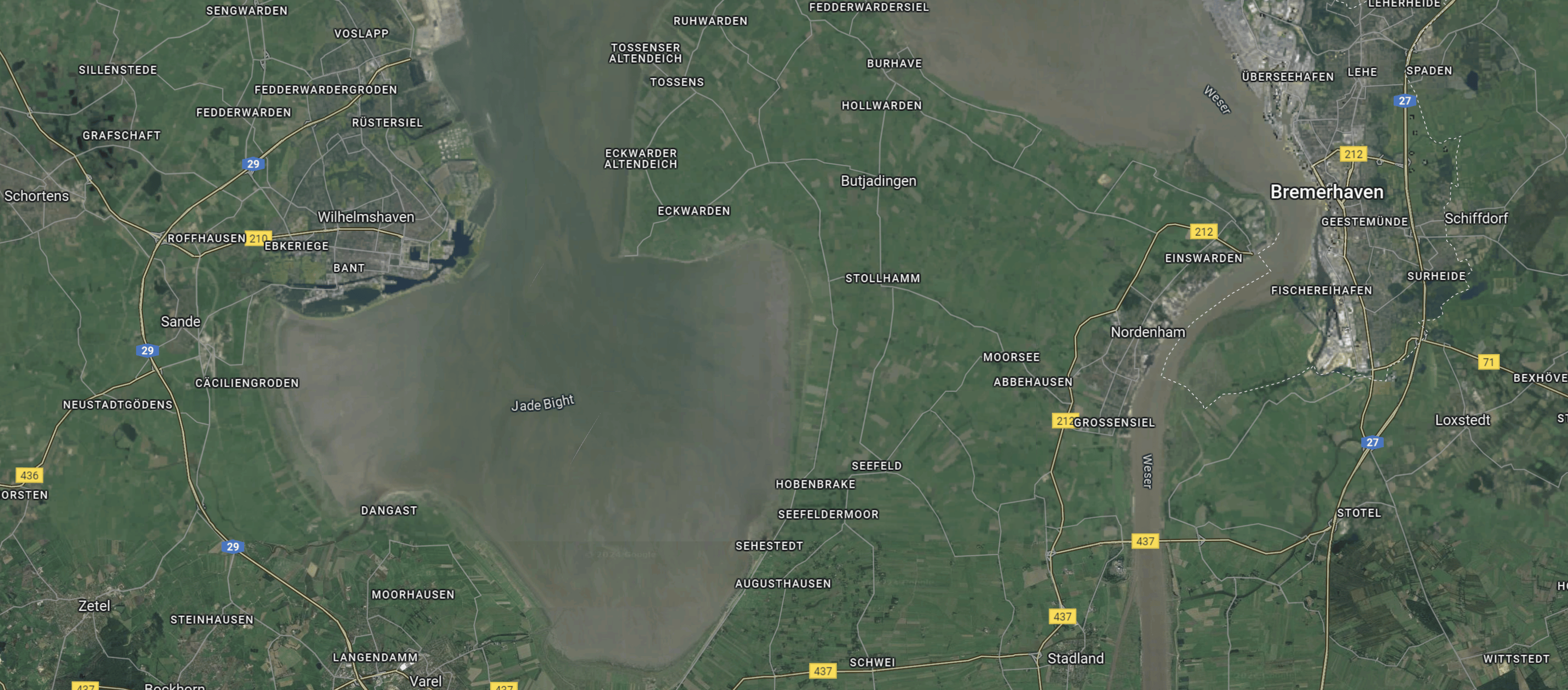
Note.
- Wilhelmshaven is to the West.
- Bremerhaven is in the East.
- The River Weser runs North-South past Bremerhaven.
I’ve explored the area by both car and train and it is certainly worth a visit.
The Wilhemshaven Hydrogen Import Terminal
German energy company; Uniper is building a hydrogen import terminal at Wilhemshaven to feed German industry with hydrogen from places like Australia, Namibia and the Middle East. I wrote about this hydrogen import terminal in Uniper To Make Wilhelmshaven German Hub For Green Hydrogen; Green Ammonia Import Terminal.
I suspect RWE could build a giant offshore electrolyser close to the Norfolk wind farms and the hydrogen will be exported by tanker or pipeline to Germany or to anybody else who pays the right price.
All this infrastructure will be installed and serviced from Great Yarmouth, so we’re not out of the deal.
Dogger Bank South Wind Farm
To make matters better, RWE have also signed to develop the 3 GW Dogger Bank South wind farm.
This could have another giant electrolyser to feed German companies. The wind farm will not need an electricity connection to the shore.
The Germans appear to be taking the hydrogen route to bringing electricity ashore.
Energy Security
Surely, a short trip across the North Sea, rather than a long trip from Australia will be much more secure and on my many trips between the Haven Ports and The Netherlands, I haven’t yet seen any armed Houthi pirates.
RWE And Hydrogen
On this page on their web site, RWE has a lot on hydrogen.
Very Interesting!
H2ercules
This web site describes H2ercules.
The goal of the H2ercules initiative is to create the heart of a super-sized hydrogen infrastructure for Germany by 2030. To make this happen, RWE, OGE and, prospectively, other partners are working across various steps of the value chain to enable a swift supply of hydrogen from the north of Germany to consumers in the southern and western areas of the country. In addition to producing hydrogen at a gigawatt scale, the plan is also to open up import routes for green hydrogen. The transport process will involve a pipeline network of about 1,500 km, most of which will consist of converted gas pipelines.
Where’s the UK’s H2ercules?
Conclusion
The Germans have got there first and will be buying up all of our hydrogen to feed H2ercules.
UK-German Energy Link Reaches Financial Close
The title of this post, is the same as that of this article on renews.biz.
These are the three introductory paragraphs.
A multibillion-euro 725 km interconnector between the UK and Germany has reached financial close, paving the way for construction works to begin in the coming months.
The £2.4bn (€2.8bn) NeuConnect interconnector will form an “invisible energy highway” with subsea cables allowing up to 1.4GW of electricity to flow in either direction between the UK and Germany and will help deliver a more secure and resilient energy supply, particularly as more renewable generation is added.
Independent analysis shows the project will create over £1.7bn in UK consumer benefits over 25 years.
Other points about NeuConnect include.
- It has been privately funded by a consortium of over twenty national and international banks.
- It will run between the Isle of Grain and a the new Fedderwarden substation in Wilhelmshaven.
- It should be operational in 2028.
Although, it is bi-directional, it appears that one of its major uses will be to provide Germany with UK wind energy to compensate for the loss of Putin’s bloodstained gas.
Boris Baldrick’s Cunning Plan
This written statement to Parliament on the UK Government web site, is entitled Transport Update: Transpennine Route Upgrade.
It has been published by Grant Shapps and this is the sub-title.
Additional funding has been made available for the Transpennine route upgrade.
This is the complete statement.
Today 19 July 2022, the government has made available £959 million of additional funding to continue to progress the delivery of the ambitious Transpennine route upgrade.
This funding is a significant milestone and another step towards upgrading the key east-west rail artery across the north of England, to further this government’s levelling up and decarbonisation objectives.
In addition to progressing the design of aspects of the upgrade, this funding will enable further on-the-ground delivery of electrification and journey time improvement works, mostly west of Leeds.
One of the first tangible benefits will be enabling electric trains to run between Manchester and Stalybridge by the middle of the decade. We are also developing scope that will enable the Transpennine route upgrade to become the first phase of Northern Powerhouse Rail, including plans to unlock freight flows and take thousands of lorries off our roads.
We are also more than trebling the investment in the Transpennine route upgrade from £2.9 billion to between £9.0 billion and £11.5 billion.
This additional investment will enable the roll out of digital signalling technology, electrification of the full route and the provision of additional tracks for commercial and freight services, giving rail users more reliable, more punctual, more comfortable and greener rail journeys.
I have some thoughts.
It’s Not A Wish List, But A Reality
The last paragraph reads like a wish list.
This additional investment will enable the roll out of digital signalling technology, electrification of the full route and the provision of additional tracks for commercial and freight services, giving rail users more reliable, more punctual, more comfortable and greener rail journeys.
But it’s not a wish list, it’s what is to be done.
Where Will The Government Get Between Nine and Eleven-And-A-Half Billion Pounds?
It’s not the sort of small change that you have in a sock draw.
This document on the UK government web site, is entitled PM Opening Remarks At Press Conference With German Chancellor Olaf Scholz: 8 April 2022, where this is these three paragraphs.
We will also agree on the importance of weaning ourselves off dependence on Russian gas and oil, and ensuring that our energy security cannot be threatened by a rogue state.
This is not easy for any of us, and I applaud the seismic decisions taken by Olaf’s government to move Germany away from Russian hydrocarbons.
Today we have agreed to maximise the potential of the North Sea and collaborate on energy security and on renewables, where Germany and the UK lead the way in new technology.
So did Boris and Olaf sign the world’s first Green Alliance based on zero-carbon energy?
- They may not have signed an Alliance, but they have agreed on common actions.
- Over the last year or so, German money and technology has started to be more visible in our offshore wind farms.
- BP have been backed by German utility; enBW in some of their huge wind farms.
- Siemens Gamesa are providing a lot of wind turbines.
- Will German shipyards build the floats for floating wind farms?
- An interconnector between the Isle of Grain and Wilhelmshaven is planned.
- Rolls-Royce and its German subsidiary MTU are charging into battle against climate change.
- The Germans have taken a liking to ITM Power’s electrolysers to produce hydrogen.
I can see the North Sea or the German Ocean becoming Europe’s power station, with by 2030, a large amount of the energy not needed by the UK, being exported to the Continent, either as electricity or hydrogen.
The Germans could become our magische Geldbäume.
But unlike gas and oil, wind power in the North Sea won’t run out, as it’s renewable.
In How Britannia With Help From Her Friends Can Rule The Waves And The Wind, this was my conclusion.
Boris’s vision of the UK becoming a Saudi Arabia of wind is no fantasy of a man with massive dreams.
Standard floating wind turbines, with the possibility of also harvesting wave power could be assembled in ports along the coasts, towed into position and then connected up.
Several GW of wind-power capacity could probably be added each year to what would become the largest zero-carbon power station in the world.
By harvesting the power of the winds and waves in the seas around the British Isles it is an engineering and mathematical possibility, that could have been developed by any of those great visionary Victorian engineers like Armstrong, Bazalgette, Brunel and Reynolds, if they had had access to our modern technology.
Up Yours! Putin!
This energy and the money it provides will finance our infrastructure and our tax cuts.
UK Energy Exports To Europe At Record High
The title of this post, is the same as that of this article on The Times.
This is the first two paragraphs.
Britain has exported record amounts of gas to Europe so far this year as its liquefied natural gas terminals receive shipments destined for the Continent.
Electricity exports also have surged to unprecedented highs in recent weeks after an unexpected glut of gas pushed down short-term gas prices and resulted in gas-fired power plants generating more for export.
Who’d have thought it, that all those gas pipelines and electricity interconnectors between the UK and the Continent of Europe would be part of the replacementliqui for Russian gas.
According to Wikipedia, we have three liquified natural gas terminals; two at Milford Haven; South Hook and Dragon, and Grain on the Isle of Grain.
Note.
- South Hook is Europe’s largest liquified natural gas terminal and is owned by a partnership of the Qataris, ExxonMobil and Elf.
- South Hook and Dragon together can provide 25 % of the UK’s natural gas needs.
- Grain is owned by National Grid and according to Wikipedia, is in terms of storage capacity it is the largest LNG facility in Europe and the eighth largest in the world.
- Grain can supply 20 % of the UK’s natural gas needs.
- Grain has a reloading facility, so that gas can be exported.
- Grain seems to be continually expanding.
- Both Milford Haven and the Isle of Grain have large gas-fired power-stations.
Politicians say we don’t have enough gas storage, but we do seem to have world-class LNG terminals.
I have a couple of extra thoughts.
Blending Natural Gas With Hydrogen
HyDeploy is a project investigated blending hydrogen natural gas to cut carbon emissions. The project is described in this post called HyDeploy.
Surely, these terminals could be places, where hydrogen is blended with our natural gas supply.
- The terminals are connected to the UK gas network.
- Both Milford Haven and the Isle of Grain should have access to large amounts of offshore wind energy in the next few years, which could be used to generate green hydrogen.
- The terminals would need electrolysers to generate the hydrogen.
The Isle of Grain already has a blending capability.
NeuConnect
NeuConnect is an under-development interconnector between the Isle of Grain in Kent and Wilhelmshaven in Germany.
- It will have a capacity 1.4 GW.
- All the planning permissions seem to be in place.
- Prysmian have won a € 1.2 million contract to deliver the interconnector.
- Arup and German engineering firm Fichtner have formed a joint venture to provide project services for the interconnector.
- Construction could start this year.
It looks like the Germans will be replacing some of Putin’s bloodstained gas with clean zero-carbon energy from the UK.
Should We Develop More Gas Fields?
There are some gas fields in the seas around the UK, like Jackdaw, that could be developed.
Suppose, we extracted the gas and sent it to the reloading terminal on the Isle of Grain through the gas transmission network, where it could be exported by ship, to the Continent.
The UK would not be increasing its carbon emissions, as that would surely be the responsibility of the end-user.
Should We Develop More Gas Fired Power-Stations?
I believe it is possible to develop carbon-capture technology for gas-fired power stations.
The carbon dioxide would be either used in a beneficial way or stored in perhaps a worked-out gas field under the North Sea.
So long as no carbon dioxide is released into the atmosphere, I don’t see why more gas-fired power stations shouldn’t be developed.
What is happening at Keadby near Scunthorpe would appear to be one model for zero-carbon power generation.
Keadby Power Station
This is an existing
Conclusion
We will be exporting more energy to the Continent.
NeuConnect Awards Two Major Contracts
This page on the NeuConnect web site is entitled NeuConnect Awards Over £1.5 billion Of Major Contracts As First Ever UK-German Energy Link Moves An Important Step Closer.
NeuConnect is a proposed interconnector between England and Germany.
- It will have a capacity of 1.4 GW.
- The interconnector will be around 450 miles long.
- It will be HVDC, like many similar undersea power cables.
- As the title says, it will be the first-ever UK-German energy link.
Wikipedia describes the route like this.
The cable will run between the Greystones substation on the Isle of Grain, in Kent in England to the new Fedderwarden substation in Wilhelmshaven in the Lower Saxony region of Germany. Landfall will be next to Grain Coastal Park, in Kent, and at Hooksiel, near Wilhemshaven in Germany.
Two contracts have been awarded.
- The contract to design, manufacture, install, test and commission the 725km interconnector has been awarded to Prysmian Group.
- The contract to design and build two converter stations in the UK and Germany has been awarded to Siemens Energy.
This sounds like a very simple plan to add an important interconnector between the UK and Germany.
I have some observations and thoughts.
The Isle Of Grain
The Isle of Grain is described in Wikipedia like this.
Isle of Grain (Old English Greon, meaning gravel) is a village and the easternmost point of the Hoo Peninsula within the district of Medway in Kent, south-east England. No longer an island and now forming part of the peninsula, the area is almost all marshland and is a major habitat for diverse wetland birds. The village constitutes a civil parish, which at the 2011 census had a population of 1,648, a net decrease of 83 people in 10 years.
Apart for the birds, over the last few decades it has been home to the following.
- Until 1982, it was the location of a BP oil refinery.
- In the 1990s, the isle was used to make the segments for the lining of the Channel Tunnel.
- Following completion of the Channel Tunnel, the site is now part-occupied by Thamesport, the UK’s third largest container port.
- Next to the former BP site is Grain Power Station, built in the 1970s, which previously burnt oil.
- This power station was demolished in the 2015 and replaced with a 1.275 GW gas-fired power station.
- Another major installation is a new Grain Liquefied Natural Gas (LNG) import facility, which takes heat from the gas-fired power station.
- The Isle of Grain is the landing point for the BritNed undersea power cable between The Netherlands and the UK.
The Google Map shows the Isle of Grain.

Note.
- Thamesport is in the South-West corner
- To its North is the LNG import facility.
- To the North-East of Thamesport is the 735 MW Medway power station.
- There is a rail connection to Hoo Junction on the North Kent Line.
This second Google Map shows the Eastern side of the Isle.

Note.
- Grain Coastal Park, where NeuConnect will make landfall, is marked by the green arrow at the top of the map.
- Towards the South-Eastern corner of the map is the 1.275 GW Grain gas-fired power station.
- To the East of the power station, there is more switchgear than you see in a bad Frankenstein film.
- The smaller square at the bottom with the two white squares could be the converter station for the BritNed interconnector.
I am sure there is space on the island for a connection for NeuConnect.
There is also a total of 2.01 GW of gas-fired power stations on the Isle of Grain.
Wind Power In The Thames Estuary
This Google Map shows the Thames Estuary.

Note that the red arrow indicates the Isle of Grain.
This map from Wikipedia shows the wind farms in the area.

These are the ones that are operational.
- 2 – East Anglia Array – 714 MW
- 8 – Greater Gabbard – 504 MW
- 9 – Gunfleet Sands – 184 MW
- 13 – Kentish Flats – 140 MW
- 15 – London Array – 630 MW
- 27 – Thanet – 300 MW
Note.
- The Isle of Grain is just above the second o in London.
- I have ignored the Ramplion wind farm (21!), as it is too far from the Isle of Grain.
- This is a total of nearly 2.5 GW.
Planned extensions in the area include.
- East Anglia Array – 3.1 GW – Completion date of 2026
But the Wikipedia entry for the East Anglia Array says this about the wind farm.
The target capacity for the entire East Anglia Zone is 7200 MW which could require up to 1200 turbines.
Could we see one of the following?
- A connector from the East Anglia Array to the Isle of Grain.
- One or more new wind farms in the Thames Estuary connected to the Isle of Grain.
- German investment in a wind farm or farms connected to the Isle of Grain.
The Isle of Grain could become an island of energy providing power for London, the South-East of England, Germany and The Netherlands.
An Electrolyser On The Isle Of Grain
Consider.
- There will be plenty of renewable electricity.
- As there is a liquified natural gas terminal, there is plenty of gas storage.
- One or both of the gas-fired power stations can be converted to run on hydrogen.
- As more and more trucks are converted to hydrogen, there will be a large demand for hydrogen for heavy transport.
This must surely make a large electrolyser on the Isle of Grain a possibility.
The BritNed Interconnector
The BritNed interconnector is described like this in Wikipedia.
BritNed is a 1,000 MW high-voltage direct-current (HVDC) submarine power cable between the Isle of Grain in Kent, the United Kingdom; and Maasvlakte in Rotterdam, the Netherlands.
The BritNed interconnector would serve as a link for the foreseeable European super grid project.
Up to now, most of the electricity flow has been to the UK.
But surely, as more wind farms are developed power will flow the other way.
Wilhelmshaven Will Be A German Hub For Green Hydrogen
In Uniper To Make Wilhelmshaven German Hub For Green Hydrogen; Green Ammonia Import Terminal, I described plans by the Germans for a hydrogen hub at Wilhelmshaven.
The original story came from an article with the same name on Green Car Congress.
This is the first two paragraphs.
Under the name “Green Wilhelmshaven,” Germany-based international energy company Uniper plans to establish a German national hub for hydrogen in Wilhelmshaven and is working on a corresponding feasibility study.
Plans include an import terminal for green ammonia. The terminal will be equipped with an ammonia cracker for producing green hydrogen and will also be connected to the planned hydrogen network. A 410-megawatt electrolysis plant is also planned, which—in combination with the import terminal—would be capable of supplying around 295,000 metric tons or 10% of the demand expected for the whole of Germany in 2030.
As I said in the original post, I’m not happy about green ammonia, but the 1.4 GW NeuConnect interconnector has more than enough power to run a 410 MW electrolyser plant at full capacity.
It could even run three electrolysers of this size.
Hooksiel And Wilhelmshaven
NeuConnect will make landfall at Hooksiel.
This Google Map shows Hooksiel and Wilhelmshaven.

Note.
- Hooksiel is the village outlined in red.
- The water to the right of the map is the Jade Bight.
- The square block sticking out into the bight appears to be a container port.
- There appears to be chemical works or oil refineries North of the port.
- Wilhelmshaven is the town to the South of the port.
There would appear to be plenty of space for Uniper to construct Green Wilhelmshaven.
German And UK Wind Power Production
According to this page on Wikipedia, which is entitled Wind Power By Country, in 2020, these were installed wind power in various countries.
- Germany – 62,184 MW
- Spain – 27,089 MW
- UK – 24,665 MW
- France – 17,382 MW
- Italy – 10,389 MW
- Netherlands – 6,600 MW
In 2020 we were 37.5 GW behind Germany.
It looks like we’ll commission 3.3 GW this year and 6.1 in 2023, with Wikipedia saying that 12.9 GW is under development, which should close the gap to a certain extent.
In ScotWind Offshore Wind Leasing Delivers Major Boost To Scotland’s Net Zero Aspirations, I described how Scotland will add 15.1 GW of floating and 9.7 GW of fixed foundation offshore wind.
It looks like initially, we’ll be buying German wind-generated electricity, but in the future the direction could easily change around.
Boris And Olaf
There were mumblings from Boris, that energy was talked about in their meeting in Downing Street last week.
It does appear there is a lot of ways that the UK and Germany can co-operate in the future with respect to energy.
- German finance can be used to build wind farms in UK waters.
- German companies can build the turbines and the interconnectors we need to develop vast offshore wind farms.
- We can supply surplus energy to Germany through the NeuConnect interconnector.
I wouldn’t be surprised if Boris and Olaf had signed a very comprehensive energy co-operation agreement.