Centrica Tackles Difficult Terrain To Deliver Sustainable Solar Solution For Derbyshire Manufacturer
The title of this post is the same as that of this press release from Centrica.
This is the sub-heading.
Centrica Business Solutions has successfully completed a bespoke solar farm for Carpenter Ltd, a Glossop based manufacturer, overcoming significant terrain challenges to help the business take a major step towards a sustainable future.
These two paragraphs add some more detail.
- Built on a 14.62% sloped bank – a location once considered unsuitable for development – the project required careful planning, specialist machinery, and adaptive engineering techniques to ensure safe, efficient installation in mud-heavy winter months. Most solar farms are installed on flat ground; this project demanded a fully customised approach.
- The new solar array comprises 1,666 panels generating 1,025 MWh of renewable energy per year. This will help Carpenter Ltd cut carbon emissions by 116,150 kg CO₂ in the first year alone, reduce energy costs, and strengthen local economic resilience by supporting sustainable manufacturing jobs in the region.
This is a picture of the site from Centrica.
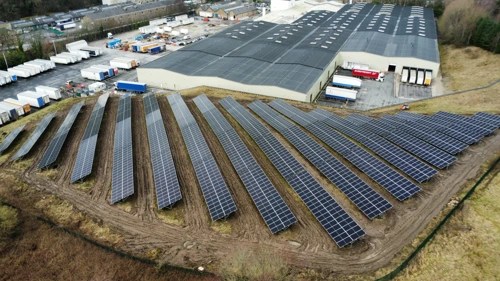
Google AI says the array is around a MW.
How many other difficult solar installations can be developed using good old-fashioned construction and engineering techniques?
Alstom And Cummins Make A Deal On Hydrogen Rail Technology
I asked Google AI about this deal and receive this reply.
On April 2, 2026, Alstom announced the acquisition of Cummins’ hydrogen fuel cell activities specifically dedicated to the rail sector. This strategic move brings the technology and manufacturing capabilities for Alstom’s Coradia iLint hydrogen trains in-house, following a period where Cummins looked to wind down its wider hydrogen business amid losses in its Accelera energy transition segment.
Here are the key details of the deal:
Scope of the Acquisition
Fuel Cell Technology In-House: Alstom acquired the engineering, product, and support capabilities for the fuel cells used in its existing hydrogen train fleets, specifically the Coradia iLint.
Manufacturing Facilities: The deal includes the transfer of Cummins’ fuel cell manufacturing and assembly site in Herten, Germany, which has been producing for Alstom since 2021.
Targeted Support: The acquisition allows Alstom to strengthen its ability to maintain, improve, and provide support for existing hydrogen fleets in Germany, Italy, and France.
Context and Strategy
Securing Supply Chain: After facing maintenance issues with the fuel cells, which previously required sourcing parts from North America, this move gives Alstom direct control over its key technology.
Strategic Pivot: While Cummins moves to pivot away from the wider hydrogen market following losses in its Accelera unit, Alstom continues to focus on hydrogen as a critical solution for replacing diesel trains on non-electrified, long-haul lines.
Commitment to Hydrogen: Despite a 2025 announcement by Alstom that it would pause “further development” of new hydrogen technology due to funding cuts, this acquisition proves that the company remains committed to supporting and enhancing its current, contracted hydrogen train programs.
Future Impact
Reliability Improvements: Alstom plans to leverage this acquisition to accelerate development work, improve the energy management, durability, and reliability of the Coradia iLint fleet, and ensure the success of projects in Germany, Italy, and France.
Market Position: This acquisition solidifies Alstom’s position as a leader in sustainable rail alternatives, even as battery technology has advanced.
I would agree strongly with the future impact.
My First Ride In An Alstom Coradia iLint
In March 2019 in My First Ride In An Alstom Coradia iLint, I said this.
I’m finally, riding in a hydrogen-powered Alstom Coradia iLint train through the German countryside.

Not as quiet as the two battery trains, I’ve ridden, but that’s because It feels to me that the traction motors are crudely under the passengers and cardan shafts are used to drive the wheels!
Battery electric trains with regenerative braking should be virtually free of any mechanical noise. Both the Class 379 and Class 230 battery demonstrators were almost silent. As electricity generated from hydrogen doesn’t appear to generate much noise, then a hydrogen-powered train can also be almost silent.
From talking to fellow passengers on my German trip, it would appear that the train has been very reliable in service.
Conclusion
Alstom are proving hydrogen would work well in a train designed for that purpose, but updating a DMU with a noisy mechanical transmission, possibly isn’t the best to go.
I now believe that Alstom have everything they need to create a 125 mph tri-mode multiple unit.
Adding in today’s article about hydrogen, I have written enough about Bombardier, which is now Alstom, and their future plans, so that they can build an Alstom 125 mph tri-mode Aventra, with with electric, battery or hydrogen power.
It could be the ultimate train.
The Bombardier Aventra And Brexit
The Batteries for Bombardier Electrostar
Parallel Thinking From Bombardier
Bombardier’s Battery Technology
Have Bombardier Got A Cunning Plan For Voyagers?
Bombardier Bi-Mode Aventra To Feature Battery Power
Stadler Flirt And Bombardier Aventra Tri-Modes Compared
Bombardier’s Plug-and-Play Train
Bombardier’s 125 Mph Electric Train With Batteries
Do Bombardier Aventras Have Remote Wake-Up?
What Offshore Wind Turbine Components Can Be Transported By RORO Ferries?
I asked Google AI, the title of this post and received this answer.
Roll-on/Roll-off (RORO) ferries, specifically specialized vessels like the Rotra class (Rotra Vente, Rotra Mare, Rotra Futura), are used to transport major, oversized offshore wind turbine components. These vessels allow large parts to be rolled directly on and off the deck using hydraulic ramps, mitigating the need for heavy-lift cranes in some cases.
Wind Turbine Blades: Modern RORO vessels can transport massive rotor blades—sometimes over 100 meters long—stowed in tiers (up to 12 or more blades per trip).
Nacelles: RORO vessels can carry multiple complete nacelles for large-scale direct-drive wind turbines.
Tower Sections: These vessels can accommodate large tower sections, often transporting multiple sections at once.
Hubs: Hub components can be transported via RORO, especially when loaded onto specialized trucks.
Drivetrains and Transformers: Internal components and large drivetrain assemblies are transported in the holds.
Floating Substructures/Substructures: In addition to the turbine itself, specialized RORO systems can transport components of floating substructures, such as secondary steel, inverters, and mooring equipment.
Advantages of RORO for Wind Components
Reduced Handling: Eliminates the need for cranes to lift heavy items, reducing the risk of damage during transport.
High Efficiency: Allows rapid loading and unloading of numerous large items simultaneously.
Protection: Specialized RORO vessels often feature telescopic roofs to protect sensitive nacelles from saltwater spray.
Efficiency for Large Projects: Specifically designed for handling large-scale offshore wind projects, such as the North Sea developments.
Specialized vessels, such as the Rotra Futura and Rotra Horizon, are designed to handle even larger, heavier components for next-generation offshore wind farms, and they often include cranes to complement their RORO loading method.
This article on offshoreWIND.biz is entitled RoRo Offshore Vessel Rotra Futura Hits the Water, and gives a full description of the vessel and her sister; Rotra Horizon.
This is the sub-heading.
The first of two offshore wind Roll-on/Roll-off (RoRo) vessels, the Rotra Future, designed to transport wind turbine components, has been launched at Jiangsu Zhenjiang Shipyard in China.
These four paragraphs give details of the design, financing, construction and ownership of the two vessels.
Concordia Damen has collaborated with Amasus, deugro Denmark, Siemens Gamesa, and DEKC Maritime in the development and construction of two RoRo vessels, namely Rotra Futura and Rotra Horizon.
The vessels, of which the first one was launched recently at the shipyard in China, are designed for the transport of large, and ever growing, wind turbine components.
The design of the two RoRo vessels builds on the previous ships in the Rotra concept, the Rotra Mare and Rotra Vente, which were also developed by Concordia Damen and have been operating since 2016.
These vessels are designed with a RO/RO (Roll-On/Roll-Off) system and an innovative ramp, allowing for the safe and efficient transport of larger loads.
Toyota Won’t Give Up On Hydrogen, Teams Up With Truck Giants
The title of this post, is the same as that of this article on TorqueCafe.
This is the sub heading.
Japanese car giant Toyota has signed a non-binding MoU to collaborate with Daimler Truck and Volvo Group on hydrogen fuel cells.
These three paragraphs add more details.
Toyota just won’t let its hydrogen-fuelled dreams die, this week announcing it wants to further develop fuel cell technology with two big players in the heavy vehicle market.
Daimler Truck (makers of Mercedes-Benz, Freightliner, Western Star and Fuso trucks) and the Volvo Group (responsible for Volvo, Mack and Renault trucks), already have a joint venture, cellcentric, which Toyota has signed a non-binding Memorandum of Understanding to join.
Split between equal shareholding, a joint press release said “the combination of the parties’ complementary experience and know-how will support and advance their joint objective to develop, produce and commercialise fuel cell systems for heavy-duty vehicles and other heavy-duty applications with comparable requirements”.
The rest of the article gives a summary of where Toyota are with hydrogen.
It is worth a thorough read.
Backing hydrogen you have Centrica, Ceres, Cummins, Daimler, Hyundai, JCB, INEOS, Kia, Ryse, Volvo, Wrightbus and a few others.
Will they prevail against a cynical world?
I think it will be one iconic vehicle, that excites the world. I will nominate.
- A 1000 km. range hydrogen-powered coach from Mercedes, Solaris, Volvo or Wrightbus.
- A large American-style pickup from Dodge with a Cummins engine or from Toyota.
- A large American-style truck.
- A remodelling of the iconic London new Routemaster bus with a hydrogen Cummins engine by Wrightbus.
- A small affordable hydrogen hatchback from the French, Toyota or the Koreans, based on a fuel cell and an electric transmission.
When I was a child the icon was a dragline called Big Geordie, who is shown in this video.
I suspect for some of the mining projects in the world today, a hydrogen-powered Big Geordie would make a good fist of it.
EU, France Grant EUR 126 Million For BW Ideol’s Floating Foundation Factory
The title of this post, is the same as that of this article on offshoreWIND.biz.
This is the sub-heading.
BW Ideol has signed the final grant agreement for up to EUR 74 million from the EU Innovation Fund for a factory in Fos-sur-Mer, France, that will produce concrete floating wind foundations. The factory, dubbed Fos3F, has also secured up to EUR 52 million from the French State.
These three paragraphs add more detail.
The final agreement for the EU Innovation Fund grant was signed on 19 March, after BW Ideol revealed in November 2025 that the Fos3F was selected for up to EUR 74 million in funding by the European Commission.
The French government awarded support for the project at the end of 2025 through the C3IV tax credit scheme, dedicated to supporting leading French companies in the Green Industry. The funding from the French State will cover up to EUR 52 million to partially fund development and capital expenditures.
According to BW Ideol, if built, the Fos3F will be a first-of-its-kind factory dedicated to the serial production of concrete floating wind foundations based on the company’s patented Damping Pool.
The factory is stated to have a capacity of thirty foundations per year.
This Google Map shows the location of Fos-sur-Mer.
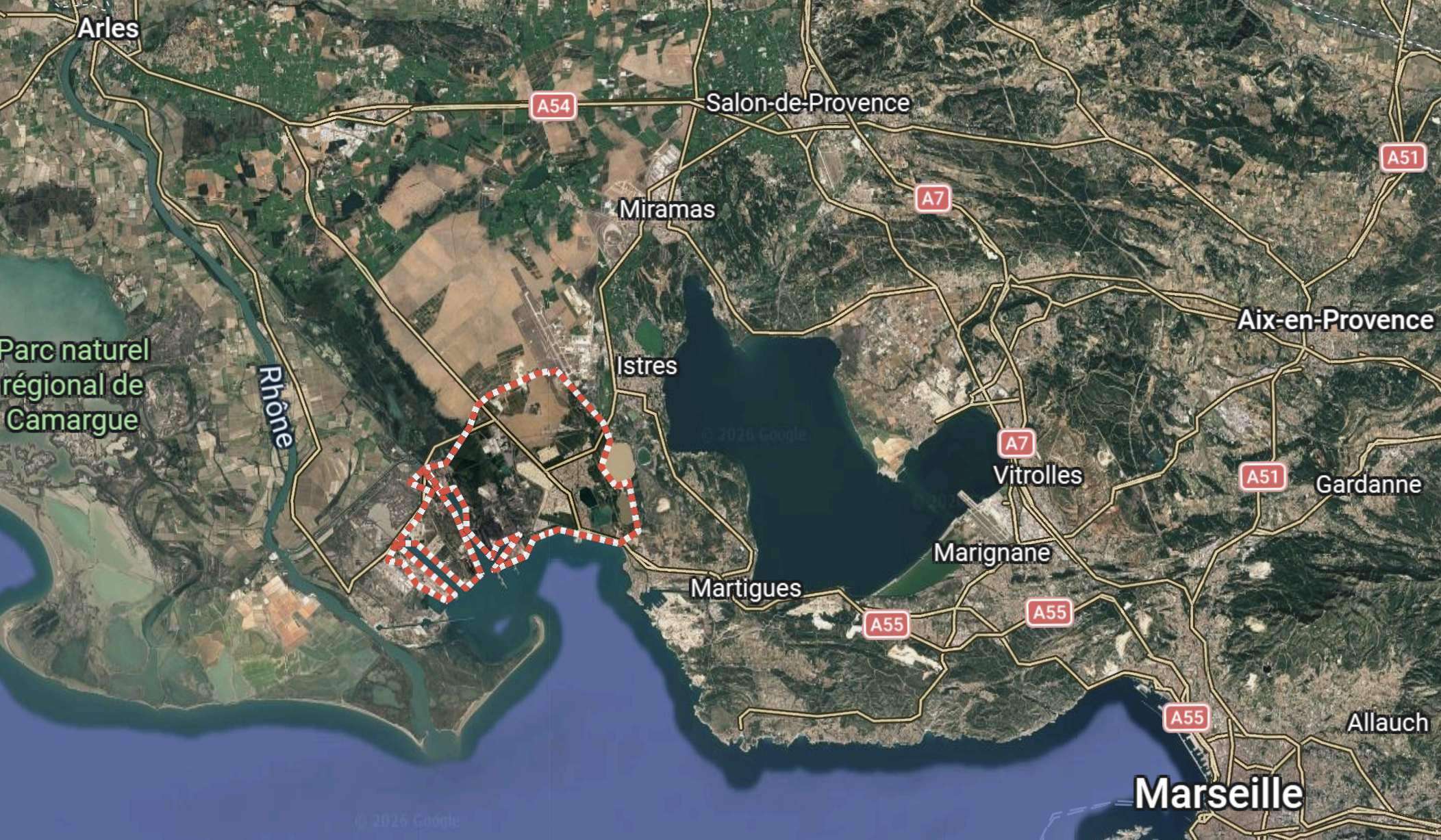
Note.
- Arles is in the North-West corner.
- Marseille is in the South-East corner.
- The mouth of the Rhône River is in between.
- Fos-sur-Mer is outlined by the red-and-white border.
Google AI says there is significant steel making at the mouth of the Rhône River.
I also asked Google AI, “What turbines will BW Ideol floating foundations support? and received this reply.
BW Ideol’s floating foundations are designed to be universal, supporting all major 15 MW+ offshore wind turbines currently on the market, with scalability to future 20 MW+ platforms. Their concrete barge-type technology—using the Damping Pool® design—is compatible with both existing and next-generation turbine manufacturers.
Key Compatibility Details:
15 MW+ and 20 MW+ Turbines: The foundations are engineered for current large-scale turbines (15 MW+) and are ready to accommodate upcoming 20 MW+ turbines, with designs already certified by DNV.
Proven Technology: The technology has been in operation since 2018 at the Floatgen site in France (using a Vestas V80 2 MW turbine) and in Japan, covering both shallow and deep-water applications.
Universal Application: The design is tailored for diverse metocean conditions and is designed to support the commercial deployment of large turbines in projects like the Buchan Offshore Wind project in Scotland.
Production Scalability: The concrete floating platforms are designed for mass production, capable of being manufactured quickly in a factory setting, such as the proposed Fos-sur-Mer site, to meet the schedules of major developers.
These foundations have received Design Certification from DNV, confirming their suitability for large-scale, commercial floating wind farms.
My Thoughts:
Concrete v. Steel: I used to work with someone, who was a big advocate of concrete yachts. Also check out the Wikipedia entry for the Troll A platform, which is a concrete Norwegian gas platform.
Zero-Carbon: I wouldn’t be surprised if concrete manufacture emits less carbon, than steel.
Port Talbot: Will BW Ideol build a similar factory at Port Talbot? I wrote about the Port Talbot factory in Port Talbot To Become Offshore Wind Hub For Celtic Sea. Both sites are next to a large bay, which would be ideal for parking completed floats and a world-class steelworks.
Buchan: Buchan’s web site says it will use seventy BW Ideol floats and generate I GW, 75 km. to the North-East of Fraserburgh. Google AI said the floats will be built at the Port of Ardersier.
Will A Mini-Steel Mill Be Built At The Port Of Ardersier?
I asked Google AI, the question in the title of this section and received this reply.
Yes, a £300 million green steel mill is planned for the Ardersier Port redevelopment as part of its transformation into a circular Energy Transition Facility. This facility aims to process scrap steel from decommissioned oil rigs into new materials to support offshore wind developments, alongside creating a concrete production plant.
Key details regarding the development:
Purpose: The mill is intended to process scrap from offshore decommissioning.
Technology: It is planned as a green steel plant.
Integration: It is aimed to be integrated into a new, fully circular “Energy Transition Facility”.
Context: While the facility aims for circular steel production, the port is primarily focused on becoming a hub for offshore wind and manufacturing.
Recent developments as of March 2026 suggest a focus on a “scaled back,” more achievable vision by new owners/managers, focusing on floating concrete wind turbine bases. Additionally, recent UK government intervention restricted a large Chinese-backed manufacturing plan at the site due to security concerns.
Vestas Unveils Plans For V236-15.0 MW Nacelle Factory In Scotland
The title of this post, is the same as that of this article on offshoreWIND.biz.
This is the sub-heading.
Vestas plans to build a nacelle and hub assembly facility in Scotland to support offshore wind projects in the UK and across Europe.
These four paragraphs give what looks to be a full outline of a more or less comprehensive plan.
The proposed factory would require a capital investment of more than EUR 250 million and is planned to manufacture nacelles and hubs for the company’s V236-15.0 MW offshore wind turbine. The new facility is expected to create up to 500 direct jobs, with additional employment across the supply chain.
According to Vestas, the plan to set up the factory follows the results of the Contracts for Difference Allocation Round 7 (AR7) in January 2026, the company’s growing offshore wind order book in the UK, and strategic discussions with the UK and Scottish governments on the next steps to develop and co-invest in the facility.
The plan also includes the potential co-location of suppliers producing other major turbine components, as part of a broader manufacturing setup.
The final investment decision (FID) on the new factory will depend on Vestas securing sufficient UK-based orders for the AR7 projects and those from the upcoming AR8. Subject to the timing of those results and the planning process, the facility could begin production by 2029 or 2030, Vestas said on 25 March.
- V236-15.0 turbines are 15 MW turbines, for which Vestas have 256 orders in the UK for Inchcape, Norfolk Vanguard East and Norfolk Vanguard West.
- In addition to new wind farms, will these large turbines be used for refitting to older wind farms?
- If other manufacturers or components could be involved, this would surely be sensible.
The picture in the original article shows the large size of these nacelles, which would suggest a site with good access to water might be good to ease transport.
Did The Help For Steel, Six Days Ago Help?
On the 19th March, I wrote UK Steel Industry Backed By Major New Trade Measure And Strategy. Did this help for steel to formulate Vestas’s plans? I wouldn’t be surprised, if the steel can be taken to the site Vesta chooses by rail or water.
Port Talbot To Become Offshore Wind Hub For Celtic Sea
The title of this post, is the same as that of this article on the BBC.
This is the sub-heading.
Port Talbot will become the first dedicated hub for floating offshore wind in the Celtic Sea.
These four introductory paragraphs add some detail.
Associated British Ports (ABP) will begin detailed design and engineering work on new port infrastructure after securing grant funding of up to £64m from the UK government.
The project will support the assembly and deployment of floating turbines that will operate in deeper waters off the Welsh coast. ABP said the development could support thousands of jobs and attract hundreds of millions of pounds in further investment.
The UK government said the new port would help deliver clean, homegrown electricity, protect households from volatile fossil fuel markets and create up to 5,000 new jobs.
Redeveloping the port to handle the assembly of wind turbines could position Port Talbot at the centre of a fast-growing clean energy sector.
I have some thoughts.
How Much Wind Power Is Planned For The Western Approaches?
In Ocean Winds Enters Lease Agreement With Crown Estate For 1.5 GW Celtic Sea Floating Wind Project, I published this Google AI estimate of the wind power, that could be developed in the Western Approaches.
How Much Wind Power Is Planned For The Western Approaches?
I asked Google AI, the title of this section and received this answer.
The UK has a target of 50 GW of offshore wind by 2030, with significant projects planned for the Celtic Sea (part of the Western Approaches), which is a key area for 5 GW of floating wind. Total UK offshore wind pipeline capacity exceeds 93 GW, with major developments in this region focusing on floating technology.
Key details regarding wind power in the Western Approaches (specifically the Celtic Sea) include:
Celtic Sea Developments: The area is a primary focus for floating wind projects, designed to capitalize on deep-water potential, with 5 GW of floating wind expected to be deployed across the UK by 2030.
Pipeline and Capacity: The total UK pipeline for offshore wind, which includes the Western Approaches, is 93 GW, and the government is aiming for 43-50 GW of installed offshore capacity by 2030.
Project Status: The region is expected to benefit from the Crown Estate’s leasing rounds aimed at accelerating floating wind, with 15.4 GW of new projects submitted across the UK in 2024.
Wales/South West England Context: Wales has 1.4 GW of projects in the pre-application stage, with some potential for developments off the South West coast.
For more detailed information on specific projects and their development status, you can visit the RenewableUK website and RenewableUK website.
It looks like about 20 GW of offshore wind could be installed in the Western Approaches.
I would expect, a lot of work will be generated in the Port Talbot area.
A Lot Of Steel Will Be Needed
Earlier in the weeek, the UK Government backed the steel industry in Port Talbot, with a press release entitled UK Steel Industry Backed By Major New Trade Measure And Strategy.
Port Talbot Is A Comprehensive, Well-Connected Site
This Google Map shows the site.
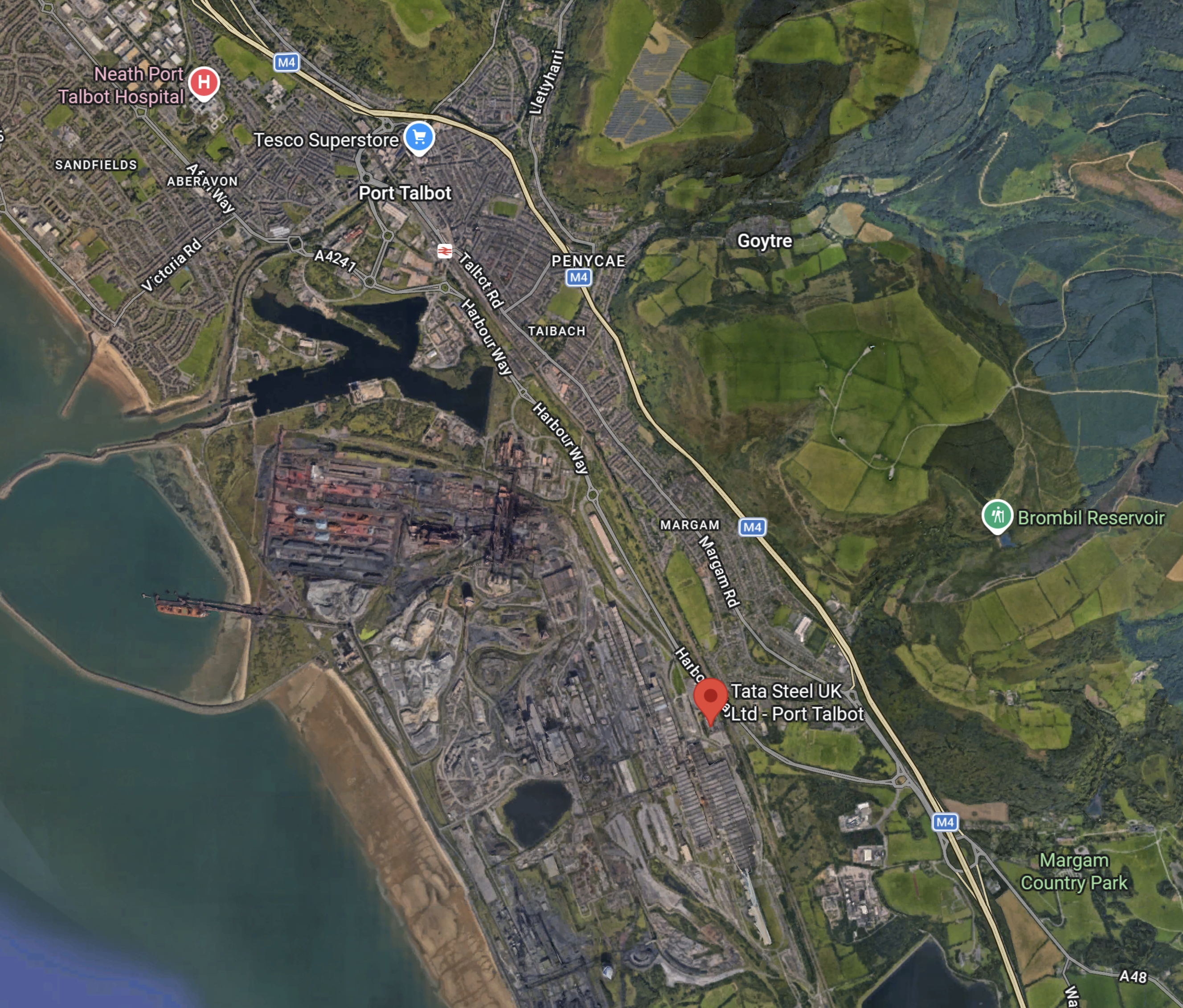
Note.
- The M4 running along the site.
- The South Wales Main Line running along the site, with Port Talbot Parkway serving the site.
- The harbour by the station.
- The Tata steelworks marked by the red arrow.
I hope the up to £64 million grant from the government is sufficient for Associated British Ports (ABP) to turn the harbour into a world-class floating wind facility and that the Treasury haven’t been too mean.
BW Ideol, ABP To Explore Serial Production Of Floating Wind Foundations At Port Talbot
I wrote a post with this name in December 2023, before the leases for the Celtic Sea windfarms had been awarded. As one has been awarded to EDf Renewables, BW Ideol seem to have made a good move.
BW Ideol have a web page, which describes their concrete floating wind foundations manufacturing line.
I hope South Wales has got enough concrete?
UK Continues Offshore Wind Expansion With 6 GW Leasing Round Planned For Early 2027
The title of this post, is the same as that of this article on offshoreWIND.biz.
This is the sub-heading.
The Crown Estate has unveiled plans for the UK’s Offshore Wind Leasing Round 6 to be held in the first half of 2027, targeting the development of at least 6 GW of new capacity.
These three paragraphs add some details.
The upcoming leasing process will focus on areas primarily located in the northeast of England. The sites are expected to be suitable for fixed-bottom offshore wind projects and will be brought forward following market and stakeholder engagement, including the National Energy System Operator’s (NESO) strategic plans for energy and for electricity networks, which will inform the exact capacity of the upcoming leasing round and refine specific site details and locations.
The Crown Estate said on 26 March that it had begun a programme of market engagement ahead of the official launch of a new leasing round, and is seeking market views on commercial approaches to the leasing round “to understand the potential viability and market appetite.”
The UK seabed manager said that it had also identified other areas of seabed opportunity across the South West, Wales and other regions which may form the basis of subsequent leasing rounds through the Crown Estate’s new seabed management tool, the Marine Delivery Routemap, which is being used for the first time in Round 6.
In Renewable Power By 2030 In The UK, I calculated how much offshore wind could be commissioned up to 2030.
These were my results.
This gives these yearly totals, if I use pessimistic dates.
- 2025 – 1,235 MW
- 2026 – 4,807 MW
- 2027 – 5,350 MW
- 2028 – 4,998 MW
- 2029 – 9,631 MW
- 2030 – 15,263 MW
This adds up to a total of 58,897 MW.
But This Doesn’t Include Round 5 Or Round 6!
But the article on offshoreWIND.biz does, say this about Round 5.
The Crown Estate’s previous leasing round, Round 5, focused on floating offshore wind in the Celtic Sea, covering areas off South Wales and South West England and targeting up to 4.5 GW of capacity. The round awarded seabed rights to Equinor, Gwynt Glas, and Ocean Winds, with individual project development areas of up to 1.5 GW. Agreements for lease were recently signed for all three Round 5 sites.
The article also indicates that 6 GW can be expected from Round 6.
Which gives a total of 69,397 MW or 69.4 GW.
No wonder the UK Government can back the steel industry, with press releases like this UK Steel Industry Backed By Major New Trade Measure And Strategy.
Lots of renewable energy, is the new rich!
Centrica Partners With Ceres Power On Solid Oxide Fuel Cells
The title of this post, is the same as this article on gasworld.
This is the sub-heading.
UK multinational energy and services company Centrica is partnering with clean tech firm Ceres Power to accelerate solid oxide fuel cells [SOFCs] production to meet forecasted ‘multi-gigawatt’ demand from industrial customers across Europe.
These three paragraphs indicate the market opportunity, that Centrica feel, that the partnership will fill.
With electricity grid connection delays impacting new industrial, commercial and digital projects, the UK and Europe are experiencing a widening gap between demand and available capacity.
Centrica aims to offer customers high‑efficiency, low‑carbon, grid independent on‑site power that can be deployed much faster than gas turbines or nuclear.
Group Chief Executive Chris O’Shea said by collaborating with Ceres’ technology it sees an opportunity to support data centres, AI and industry with cleaner power at scale. Ceres claims SOFCs can be manufactured and delivered on site to get power online “in months not years”.
It certainly sounds feasible to drop in an appropriate-sized stack of fuel cells and connect them up to the gas main.
These two paragraphs, indicate how Ceres will support Centrica.
Initially, Ceres will support Centrica in expanding a new differentiated service-led model for clean power, providing access to British technology through its expanding network of global manufacturing partners.
Ceres will assist Centrica with opportunities across project origination, installation and commissioning, remote monitoring, predictive maintenance and end of life recycling.
I have a few questions for Google AI.
Do Ceres Fuel Cells Emit Carbon Dioxide?
Google AI replied this.
Yes, Ceres Power has developed Solid Oxide Fuel Cell (SOFC) technology, known as the SteelCell®, that works on natural gas. This technology is specifically designed to be fuel-flexible, capable of converting grid natural gas into electricity at high efficiency.
Key Details About Ceres Fuel Cells and Natural Gas:
Technology Capability: The Ceres SteelCell runs on natural gas, as well as future-focused fuels like hydrogen and biogas.
Application: These fuel cells are used for distributed power generation in homes, businesses, and industrial settings (such as AI data centres).
Efficiency: When running on natural gas, the SOFC systems can achieve an electrical efficiency of around 62%, with total efficiency exceeding 90% when combined with heat recovery.
Emission Reductions: Compared to conventional combustion engines, the technology offers a 30% reduction in carbon emissions.
Current Strategy: As of early 2026, Ceres is focusing on natural gas-fueled SOFCs for stationary power markets, particularly in collaboration with partners like Centrica to address power shortages in the UK and Europe.
While the systems can be used for hydrogen in the long term, they are currently fully functional with natural gas, making them a “bridge” technology for decarbonisation.
A 30% reduction is surely worthwhile!
In What Size Are Ceres Power Holdings Fuel Cells Manufactured?
Google AI replied this.
Ceres Power Holdings’ solid oxide fuel cell (SOFC) technology is manufactured in modular, scalable sizes, with individual stacks ranging from 10-50 kW and commonly deployed in 1-5 MW power modules. These stacks are produced at manufacturing facilities with capacities like 50MW (e.g., with partner Doosan), with plans for up to 100MW annual capacity.
Key manufacturing and size details include:
Cell Component: 30–150W.
Stack: 10–50 kW.
Stack Array/Module: 100–500 kW, up to 1-5 MW modules.
Manufacturing Capacity: 50MW production facility in South Korea (Doosan), with plans for 100MW+ annual capacity in future plants.
Applications: Primarily stationary, distributed power systems for AI data centres, industrial decarbonisation, and commercial buildings.
Ceres licenses its technology to partners like Bosch and Doosan, with cell technology based on low-cost printed steel substrate
How Much Power Does A Top Of The Range MRi Scanner Use?
I am asking this question, as it is surely something you might power with a Ceres fuel cell powered by natural gas.
Google AI replied this.
A top-of-the-range MRI scanner (such as a 3-Tesla or 7-Tesla system) is highly energy-intensive, consuming substantial power 24/7 to maintain its superconducting magnet. During active scanning, power usage often ranges from 25 kW up to 80 kW or more.
Here is a breakdown of the power consumption for high-end MRI scanners:
Power Consumption Breakdown
Idle/Stand-by Mode (24/7): The machine constantly consumes roughly 6 to 7 kW for background cooling (liquid helium refrigeration).
Standard Scanning: Productive scanning sessions typically demand around 25 kW.
High-Demand Scanning: Demanding examinations (e.g., head examinations with EPI sequences or special angles) can cause power usage to surge to 70 kW to 80 kW.
System Total: A 3T MRI, including cooling systems (chillers) and peripheral electronics, might require a 3-phase, 480V, 200A supply—roughly equivalent to the capacity of six modern houses.
Conclusion
This seems to be a deal with a large number of possibilities.
Speaking from my past experience of banks and financing, where the bill is ultimately paid by a reputable individual or company like Shell or BP, I believe that Centrica will have no difficulty in financing lots of these systemsusing instiutions like Lloyds or Deutsche Bank.
EasyJet’s New Slimline Seats Will Offer 2 Inches More Legroom
The title of this post, is the same as that of this article in The Times.
This is the sub-heading.
The Kestrel seat’s thinner design promises improved knee and shin clearance. Could the ‘fixed recline’ feature also lead to fewer spats over space?
These three paragraphs add more detail to the story.
As budget airlines try to squeeze more and more passengers onto flights, it can feel as though the seat in front gets slightly closer every time you step on a plane.
But a “next generation” economy seat is coming, which its makers say will give travellers extra legroom with no loss of space for airlines.
The Kestrel seat from Mirus Aircraft Seating, a British manufacturer, will be installed from 2028 on hundreds of easyJet’s new aircraft, providing an extra two inches of “improved knee and shin clearance” for passengers.
Hopefully easyJet’s passengers will be sitting more comfortably.

